The 10 Consumer AI Trends That Will Define 2026, Live From CES
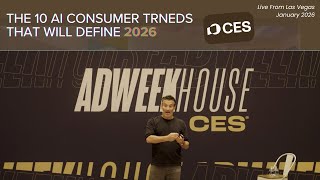
Matt Britton outlines ten AI trends for 2026, from creative democratization to agentic workflows that let AI operate autonomously. Only 1% of users have reached true AI agents; most stay at simple queries. He predicts the $84 trillion boomer-to-Gen Z wealth transfer will offset job displacement, while AI chat becomes the internet's new front door, replacing search.
Chapters
I recently gave via a webinar on what I believe will be the top 10 consumer AI trends of 2026. Just a little bit about me. I have spent the last two years spending most of my working hours in AI building an AI. I wrote a bestselling book called Generation AI. It's available on Amazon. You guys should pick it out. And I speak all over the world on this topic and I spend a lot of time thinking not so much about the technology itself, but on the impact that it's going to have on the consumer landscape, which I know being here as part of Ad Week most people are interested in. I also run a podcast with AD we called the Speed of Culture which interviews leading CMOs. So I'm going to go through what I believe and it's going to be pretty rapid fire because I think I only have like 25 minutes what I think the top consumer AI trends are going to be and we'll dive in. So I'm going to start with the video.
Columbus comes alive Nationwide set, heart beating, ready to thrive.
Before I spoke in front of 5,000 people at Nationwide Shorts
AI Transformation. The future's already here. From data to decisions, automation in the air, tomorrow's claims and coverage handled with care. He's painted what's next with the confidence dry because Nationwide is on your side.
So I made this video at midnight the night before I went on stage in front of 5,000 people. Three years ago, if I were to make this music video, I would have had to have hired a songwriter, a band, a video producer, a graphic designer which would have designed the Nationwide logo to fly across the streets and I would have had to have the confidence it would all be put together on time. But instead I was able to create it in my hotel room with a team of one. And it's something that I've done many times and I think this really illustrates how far we've come. So when you hear people say AI can't build creative AI isn't going to change the agency landscape. You only need to look at something like this. And sure you can look at some of the graphics and detect things that are wrong. But the fact is AI is doubling in its power and potency every seven months. And if it can do something just okay today, it's going to be able to do that same task in a mind blowing way just a year from now. And one piece of advice I'd have for everyone in this room is act accordingly. If you see it can create something that isn't quite there yet. Just know it's going to be there and build your time and your strategy accordingly. I'm going to again, dive around pretty quickly. I do a lot of work on generations and consumer generations. And each generation that I've lived through in the business world has ushered in a new technology, Gen Y, which is a millennial generation, which a lot of people still talk about like their kids. But the reality is this year, for the first time ever, the average age of a first time mother in the US is no longer a millennial, but they're Gen Z. So millennials, not kids anymore. They're age 29 to 44. And of course they ushered in the Internet as a defining technology. I grew up before the Internet. When I tell my kids, one of which is my son Cameron, who's in the room right there, that I grew up before the Internet existed, he looks at me like I'm a dinosaur. The same way I probably looked at my grandfather when he said he used to walk to school with no shoes on in the rain. But it's true. When I was born, there was no Internet. Gen Z brought in the iPhone and social media. So now the power of the Internet was in everyone's hands. And now we have Gen Alpha, currently age 0 to 15 years old. And they are going to be the fine by AI for the most part. They are never going to know a world without AI, never going to know world without technology that you can talk to like a human. For many parents of Gen Alpha kids, it's going to seem creepy and strange to them that they're developing intimate relationships with an AI chatbot. But you have to remember that is going to be their complete worldview. They're never going to know world war that doesn't exist. And the powerful grip that this improving technology is going to have on relationships is something that's going to be quite profound and something I think most parents and educators are not really equipped to deal with at present. So one thing I'm fascinated with is why AI still skews younger. So if you look at usage data on AI, Gen Z has nearly double the penetration as baby boomers. But the reality is you don't. There should be no adoption curve in using AI. In order to effectively use AI, you just need to be able to talk or text, just like you do friend and family member. I think a huge opportunity moving forward is getting baby boomers to adopt AI. Many of them think it's just for the whiz kids. Many think it's a far flung technology. But the reality is if you know how to communicate, you really could learn how to use AI effectively. So how are consumers using AI today since we are talking about consumer AI trends? Well, it's mostly for writing. Some are using it for coding projects, some students are using it for help on assignments or creating presentations, et cetera. And it's really emblematic of, I think, the spectrum of AI use that we see right now. I speak to many CMOs and I read many articles where people are saying they're adopting AI, but the reality is they are talking about AI in the most basic use, which is using it as a tool. If you think about the spectrum of AI usage about 90% of people are using as a tool. Meaning where should I travel in the Caribbean? What's the best recipe for lasagna? Call and response. Much like how people are using it For Google, about 9% of people are using it in terms of automations or workflows. Meaning at the end of this presentation, I'm going to have a QR code, you're going to snap it to get a copy of my presentation. It'll take the QR code, it'll find out who you are, it'll write a customized email and it'll send out the presentation. That's automation. Knowing how to build those tools are really effective and can drive a lot of efficiency. But only about 1% of people are actually using it in the term of agentic workflow or agents. That word is misused so much, probably in rooms like this over and over again. And the difference between workflow and agentic automation is instead of going from step A to B to C in that same workflow example, it might know that I know Jesse and it might know that he lives in la. And instead of just saying him the deck, it's going to say, Matt's going to be in LA on February 14th. You want to have lunch with him. And that's giving the agent access to tools, including the ability to write and send an email. And that's why people are so excited about this sort of agent tech revolution, because once you start to give AI autonomy and access to the right tools, it's going to do things that you didn't even plan. So workflow again is deterministic. I know what I want to do. But once you deploy AI agents the right way, things will be done for you that you might not even think could be done. And I think that's the biggest distinction. So I've spent this is 25,000 hours is probably 50 to 100,000 hours building an AI. And the reason why I did so was I run a software company called Suzy, and at the time, we had about 85 engineers. And when ChatGPT first took off, my inclination was to give AI to my engineering team. And I waited and nothing happened. And I made a decision to take the power of AI back to into my own realms for myself. And I made the decision that before I was going to use AI to solve a problem for business, I was going to use AI to solve a problem personally. Because my experience in my life is the closer a problem is to something you really care about, the more likely it'll be for you to see it through. So I just turned 50 years old. Not only do I have older children, but I have two younger children. That's a whole different keynote that we're not going to get into. But one of the problems I want to solve is I want to stay alive as long as possible. So I made a decision that I was going to use AI to solve that problem first. So everything I read also told me that it's all about data in the use of AI. Well, what's the data to help me stay alive? The data of my body. So I went through 25 years of personal health data. MRIs, X rays, blood test information, notes from doctors. I went through external hard drives, I went through file cabinets to basically pull together everything I could and organize it. And I created my own personal health bot. And it took me about seven days to build. And I was ready to ask him my first question. I got my cup of coffee and the question I asked was, if I'm going to die in five years, what is the most likely cause? Now, if you think about it, most people who ask that on WebMD, it's going to tell us we're all going to die in five years, right? Because that's sort of how, you know, the Internet works. But this was something that was trained just on my data. It was trained just on the information about me. And the answer kind of freaked me out, right? And the answer that I got is going to be answers differently than you guys all get. And of course I was like, well, what can I do about it? Why is this the case? I'm like, well, what about 10 years? It was something different. And once I asked it why, it's like, well, you had this health marker and this family history and this and that. And it was that process of identifying the problem I want to solve, which is staying alive as long as possible, gathering the data that can help deliver that solution and understanding what a tool would look like that can ultimately pay off. My goal of staying alive is the same test we all need to be doing in the workplace. The thing I see, especially at large enterprises, I work with a large enterprise and I went to this vendor fair where they had 50 different companies that they hired doing AI, but nothing had changed in their company. And I spoke to the CMO and she's like, why? And I told her, nobody is all working on the same problem. You don't need 50 vendors, you just need a couple people that know what they're doing, but most importantly, need to identify the problem. If my job to figure out AI was to figure out how to use 50 different tools, I never would have built a health pot, right? So we have to all zoom out and figure out what is the growth limiting factor in our business, what is the growth limiting factor in our lives? Identify that secondarily. What is the data that can help us build a solution, envision what a tool should look like, and go to work. Now your next question is, well, how do I do that? You go to ChatGPT and say, I want you to give me step by step directions and building a health bot that can help me stay alive. And this part's important. Do not give me step two until I tell you step one is done. Because you don't want a thousand different things in front of you. You want one. So I went to step one, step two, step three, and by the time I got to step 43, I looked back and I was like, holy, I can't believe how much I've learned. Because this step can be used for this and this step can be used for that, and it really is that simple. But most people don't want to go to distance to do that. They get overwhelmed with the tools and overwhelmed on how they're going to use it. It's like if you go to a Vegas buffet here, you're not going to know what to eat first because there's everything, right? So you end up eating nothing and circling around. The reality is it's all about focus and understanding what that problem is. And I applied that same framework to my business in a variety of different ways. And over time you start, the world starts to look a little bit differently to you because you understand that there's really nothing you can't build. And the tools that you start to use for one project or the approaches you can start to use for others, and then you start to develop a superpower over time. This superpower right now for me is a plus up, but over time I believe it's going to become a mandate. And the other thing I see often with large enterprises is these big companies are telling people to become AI savvy, but the reality is they're hamstrung. You can't download any tool you want, you can't upload customer data, you have it data security, privacy issues. So you really can't do it. So I actually think the only way you're going to be able to get to going down the path where I am right now is to build stuff for yourself. So whether it's a, you know, math tutor for your 8 year old or whether it's something that can help you organize your family schedule, it might seem superfluous, but it's not really about what you're building. It's about understanding the process of building something in a way that you're unencumbered. And then once you have the opportunity to build in the professional setting, your mind is going to be trained differently. And again, that is not just about knowing how to put in a prompt into AI, which is so many people believe what it is. And those who say AI is a bubble and this net haven't done it until you've tried to build something and you have successfully, you're going to have all these charlatans on stage telling you this or that. It doesn't matter until you've built, until you put in the 25 or 50,000 hours, understand what's really possible. And once you understand what's possible, you then start to see how things are going to unfold. And it's these skill sets of creativity and problem solving and critical thinking that are going to become the defining skill sets of our era. And the issue is that's largely incongruent with the way our education system works. If you look at K through 12 and how kids are taught, it's around the premise of memorization and regurgitation. Cram in information, spit it back out. Whether it's you're a six year old and you're in first grade and you're completing a test, or whether you're trying to Prepare for the SATs, right? And that memorization and regurgitation workflow is sort of the hallmark of the knowledge economy. Because if you memorize how to do someone's taxes and you regurgitate their client, or how to write someone's contract and did it as a lawyer, or how to read someone's X ray and did it as a radiologist, Those are all skill sets that are quite deterministic and far less important. Those jobs, as well as the job of coding were born in the golden age of the knowledge economy where knowledge really mattered the most. But I actually think we're entering the end of the knowledge economy and I think ultimately it's not about memorization, regurgitation, but it's about going through the process that I just showed you we could. But that requires a different skill set because I don't need to have all that deep domain expertise. I just need to have those soft skills that enable me to actually solve those problems. As an employer of over 200 people in a software company, that is a challenge because we hired during the peak of the knowledge economy. We hired people with those specialized skill sets that don't really apply to the world because the light switch turned on and the world changed more rapidly than really any time we've seen in history. And that's why employers are struggling, that's why companies are struggling. That's why incumbents are having such a hard time competing against these young AI native startups that don't have that legacy baggage within their organization. This was a, a study that came out by the World Economic Forum that talked about what are the new workplace skills. And they talk about analytical thinking and resilience and flexibility. Because if I didn't have resilience, I would have quit on step four of my healthbot. Right? So resilience is so important because it's so easy to give up creative thinking, having some type of technological literacy if you systems based thinking, that's what companies are looking for now. It doesn't matter if you got straight A's in college in a certain topic. The hard thing and the thing I worry about is a lot of these skills are very hard to teach, especially later in life. I don't know if you've ever tried to teach somebody to be creative. It's not exactly an easy thing to do. And I think ultimately people are going to need to reskill. And that leads me to my first consumer trend, which is one I'm not really happy about. But I think in 2026, AI powered job displacement is going to go mainstream. I think that companies are going to figure out what Big tech has found out. You know, the future's already here. It's just not evenly distributed. But Big tech understands that the power of automation can drive efficiency and cut costs. And I think you're going to see the Main Street, American businesses and also globally make these cuts because they're going to find out it can happen. And one thing I'm really focused on this point in my career is making sure that everyone I talk to is on the other side of it, that they can future proof. And the way to future proof is by going through the process that I just spoke about. Job openings and hires in the US is dropping. Younger people are feeling disenfranchising, can no longer afford homes. We saw what the impact of that has been for from political standpoint. We saw a new mayor that just got appointed in New York City. All these things are kind of happening. The one saving grace is the great wealth transfer that we have coming up where over the next two decades, $84 trillion with a T is going to be passed on from baby boomers to Gen Z and Gen Alpha. And the relationship that they have with capital could not be more starkly different. Right. Baby boomers who grew up in the shadows of World War II and a great Depression have a relationship with capital, one of scarcity. They do not want to spend it. Tell me when Gen Z was the beneficiary of the fiscal stimulus that they have a relationship of capital scarcity. No, we had GameStop, GameStonks, NFTs. They couldn't spend money quickly enough. And I think once $80 trillion gets transferred to people holding on the money like this, the people who are, you know, spending money like they're in Vegas all the time, I think you're going to see an undercurrent and maybe some tailwinds that will counteract some of this job loss that we might see. Number two, the Internet is getting a new front door. In 2025, over 80% of my inbound increase for public speaking came from ChatGPT. The year before is 87% on Google. Right. So in a one year period, you're finding that this is how people are finding things. It's a new front door. What's interesting about people finding you through ChatGPT is the level of specificity is different because the consumer is much further down the funnel. Meaning in Google it's best pickleball racket. But in ChatGPT or Gemini or pick your, you know, AI chatbot, you're going a little bit further down the conversation funnel before the agent will give you a recommendation. It's getting more context who you're buying the pickleball racket for. Are they advanced, Are they beginner? Is it for a kid or is it for adult? What, what that means for brands that want to win in this new front door of the Internet. Is the level of your content needs to be more specific. Meaning if you sell pickleball rackets, you want to make content out there. Best pickleball racket for an 8 year old girl. Best pickleball racket for a 10 year old boy. I just go up the chain. Because if the models can sense that content that's specific and pays it off, they're much more likely to grab it. So it is about content, just like it was with SEO, but it's a little bit different in that regard. Chat based shopping is emerging. The data we saw coming out of Black Friday Cyber Monday was mind blowing. Nearly 80% of consumers used it as part of the buying journey. Not many used it to buy, but it's going to happen because these AI models know so much about you that they become true shopping assistants. What does that mean for a company like Amazon? Well, they're investing in Rufus AI, which is a chatbot. But over time, and I say over time, over time in the AI world isn't six years, it's six months. You're going to start to see more and more consumers purchase in AI. Has anyone made a purchase over AI yet? Okay, so two people. I'm glad we're on camera. Next year, 50% of the people will say yes, that's a big deal. That's a big deal for any E commerce provider. Anybody who sells anything 3 AI powered or just 5 AI power creative takes center stage as I showed you with the video I just showed you earlier. It's kind of here. I'm going to show you another example in a second. This is a fascinating slide. So you're going to hear people say AI can't produce imagery. Well, V1, that guy had six fingers on one hand and seven on the other. Right. But V1 was 18 months ago and right now Mid Journey is working on V8. Look at the fidelity in V5.1. So tell me, where are we going to be in version 8 and if this is an 18 month window, where are we going to be a year from now? So, and this is just text to image, obviously, but now text to video has nearly the same fidelity. This is a video that I created for the real estate industry. I spoke in front of 5,000 real estate brokers and I want to show them how they can use AI powered creative. And I said, instead of you just posting a listing for a real estate listing, why don't you turn a real estate listing into a music video? And again, the night before in my hotel at this point it was in Dallas I actually grabbed a real estate listing from Dallas and decided to turn into a music video and this is what I came up with. On Gold Cup Way in Houston. The palm tree sway, steeple chase living where the backyard steals the day Waterfall flowing swim up bar glowing no rear neighbors inside now all this information keeps on showing. So I had 1600 brokers emailed me. It's how everything is going to turn to entertainment. It's how accessible it all becomes. How did I build this same process? How do I come from something creative? Got a listing Lyrics use a variety of tools and there you go and that's how it gets created My next trend is about hyper personalization. It's going to become a baseline expectation for many years hyper personalization has been thrown around, but the reality is it hasn't been here until now. I created this email newsletter called Future Proof where basically it can take consumer information hyper personalize emails based upon who you are, your interest, what you post about on LinkedIn saying I was able to build There should be no more one to many email newsletters. Everything should be one to one based upon who you are. Every experience should be one to one. Hyper personalization is going to move to a baseline level of expectations Spoke about consumers Consumers learning AI in the home. I think this is critical. I think brands are getting pressured to adopt AI, but their employees don't know how to do it. The reason they don't know how to do it is they can't do it in an unencumbered fashion because of the stringent regulations and privacy and risk control that's around it. Because of it, they can't. We all need to take this into our own hands and push this ahead. And I think this is a mandate moving forward in terms of how to learn. Creators turning their sights towards AI tech deals is another huge trend. Ryan Sirhan, a huge real estate influencer, launched a tool called Sell it, which is a tool that helps real estate brokers learn how to sell. This tool is a parody with hundreds if not thousands of other tools, yet his tool is very successful. Why he has distribution and the same way we saw Kim Kardashian launch Skims, the same way we saw George Clooney behind Casamigos, the same way we saw Dr. Dre behind Beats and with CPG we saw a huge differentiation factor. Once manufacturing became commoditized, the differentiation became distribution. And I think you're going to start to see the same thing with tech where you're going to see big creators attach their names to white label technology and they're going to create massive valuations because they have the distribution. So if I got the most famous doctor that you can think of, right, and I connected them with my HealthBot, it would get a multi billion dollar valuation tomorrow because they have the distribution, they have the name, they have the brand behind it. And I think you're going to start to see more and more of that. AI is going to become a pillar of longevity and preventative health. So I told you about the healthbot example. We are entering this era of quantified self. Whether it's the eight sleep mattress or the Oura ring or the Apple watch, we're getting all this data on our body. The difference is now we can actually do something about it. And people are going to become increasingly obsessed with collecting data on their body and help drive decisions. I spoke recently in front of the retirement industry and I told them this should be a big part of their overall strategy because how long you live is largely connected with your health information and that can help plan your retirement. So I think ultimately people are going to have this personal dashboard of their health data, of their personal data, of their financial data, all this individual stuff that's going to help them drive decisions and it's going to quantify their life. And we're already starting to see it with the Oura ring and you know, your recovery score, I think it's going to level up on a personalized basis. AI hitting American classrooms is the last trend. There is a school in Miami that's called the Alpha School and there's also one in New York. And it's basically an AI school. It's a private school, it's very expensive, it's hard to get into. Bill Ackman, the famous private equity execration, pulled his kid out of a fancy New York private school and he's sending them there. This. It's going to be really interesting to see how this works. And they probably won't get it right the first time, but in China they are implementing it. Kids is age six and in some cases younger. And in China, three quarters of consumers trust AI and in the United States less than a third trust AI. And it's because it's not being embraced, it's not being implemented. And we do not want to lose the battle with any other nation because it's broader than business, it goes to the fence and so many other areas. So I know we're in a scary time right now. I know people are worried about job loss. I know that people don't really know the future of the advertising industry, let alone any industry. But I think by nature of you being here and by nature of you having the motivation, you can control the future. But you're not going to do it unless you embrace these tenants. You start to build, you get your hands on keyboard, and once you do so I think you're going to be looking at things a lot differently. I have a QR code here. I'll send you guys a bunch of stuff from the presentation if you're interested. And thanks, adweek, for having me and all the support and thanks, everyone.
More from Matt




MikMak’s Rachel Tipograph on Consumer Spending, Retail Media & Holiday Shopping Trends



Jaguar Land Rover’s Charlotte Blank on Luxury, Purpose & Experiential Storytelling



