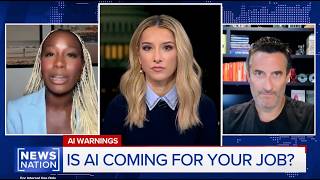
In this interview, host Speaker B moderates a discussion with AI expert Matt Britton, former White House Press Office chief of staff and instructor Yemini Egboale, and references remarks from Senator Bernie Sanders and former President Donald Trump. The conversation opens with Sanders warning that recent college graduate unemployment, currently at 9%, could surge to 30‑35% by 2025‑2028 as AI displaces entry‑level white‑collar roles. Yemini confirms that students are anxious about losing junior analyst and administrative positions, feeling a breach of the social contract that promised stable jobs after college. The host notes Democratic calls for a moratorium on new data centers, which Trump rebuffs, emphasizing U.S. AI leadership. Matt Britton argues that AI regulation is futile because large language models can fit on a thumb drive, and that the labor market will evolve into a “barbell economy”: high‑end creative, strategic, and engineering jobs on one end, low‑end physical service jobs on the other, with middle‑skill roles disappearing rapidly. He urges individuals to future‑proof themselves by learning to build AI. Yemini critiques the data‑center moratorium as short‑sighted, advocating AI literacy and suggesting trade‑school pathways (HVAC, electricians) to support the physical infrastructure AI will require. The discussion concludes with Matt giving concrete steps: pick a problem, use a LLM (ChatGPT, Claude, Gemini) for step‑by‑step guidance, and build a solution to truly understand AI’s capabilities. Overall, the interview frames AI as an imminent, disruptive force reshaping the job market, calls for policy nuance, and offers practical personal strategies for the Class of 2026.
Chapters
Recent college grad unemployment's 9%. I'll bet anybody in the room it goes to 30 or 35% before 2025, 2028. I think, you know, hitting particularly kids who've done everything right coming out of college has a double economic whammy. Scares the hell out of everybody.
It's a scary time to be a new graduate, especially when a senator is outright warning about sky-high unemployment rates in the next 2 years due to potential employers turned to artificial intelligence instead. Right now, the class of 2026 is just about to put on their caps and gowns and grab their well-deserved diplomas. But AI is threatening to snatch their jobs before they've even secured them. Full transparency, I teach at Princeton, so I know exactly how AI is affecting my students. Some are already worrying about what their futures could look like once they cross that stage in May. With us now, former Biden White House Press Office Chief of Staff Yemisi Egboale. She's also teaching students who might be worried about this at USC this semester. Congratulations, Yemisi. And AI expert and author of Generation AI, Matt Britton. As I said off cam, he's the perfect guest as well. Yemisi, let's start with you. Are you hearing those same concerns from your students?
Well, first, I just want to say, having worked on tech policy for Senator Mark Warner, it's really great to follow him. And I usually do follow in his footsteps on a lot of his thinking in this area. Students are super hyper concerned about AI, and they're not concerned from a kind of doomer sense that a lot of, I think, the older generation is in this belief that robots will take over anything. It really is niche in the way that they're concerned about that entry-level ladder, the junior analyst, the administrative worker. They're worried about those jobs in particular that they would usually have access to being taken from them. Look, they followed the system. We told them to go to college, get the degree, accumulate the debt, and when they got out, we would take care of them. We would have something for them. And so I think they feel uneasy because there's a contract with civil society and they don't know if the job market is going to honor that.
Yeah. And to follow your passion, right? I mean, it's very hard when you see stats like this to do that. I totally feel for them. Matt, Democratic lawmakers called for a pause on building new data centers in hopes of putting some guardrails on AI. But today, I thought this was really interesting. President Trump pushed back on that. Take a listen.
We're also committed to ensuring the United States remains number one in artificial intelligence. We're doing great. We're leading China by a lot, and I'll not allow radical left maniacs to sacrifice American leadership to red tape or political correctness. It's going good.
So the White House is clearly embracing AI, but recent polls, as you know, show American workers are really worried about their future job availability. We have it here on the screen. 66% think it will decrease jobs. 19% think it will increase jobs. So who's right? Who is right, Matt? Shed some light on this for us.
Yeah, well, I don't think it matters who's right because AI is here and we're not going backwards. You can fit a large language model on a thumbnail, a thumb drive rather. So this cannot be regulated. It's something that is already out there and anyone who wants to can access it. And I think each of us need to think about what's in the best interest of our career and our families and do everything we can to future-proof ourselves and our career around this. For the first time ever, it's white-collar jobs that this new technological revolution is coming after, not really blue-collar jobs. And I think what you're going to see coming out on the other side of this is more of a barbell economy. You're going to have high-end creative thinkers, strategists, and engineers, and low-end physical service-based roles. I think it's everything in the middle that you're going to see start to get eliminated very quickly.
Yeah. Yamiche, and I want to get both of you on this, but Senator Bernie Sanders gave a very dire warning about AI this week. Let's listen to part of that and then talk about it.
Artificial intelligence and robotics will impact our economy, our democracy, our privacy rights, our emotional well-being, our environment, and even our very survival as human beings on this planet. The scale, scope, and speed of this transformation will be on precedented.
Okay, so it is pretty scary stuff to think about. But Bernie Sanders, historically sort of an alarmist, right? Yeah. I mean, yes.
Can you contextualize that for us?
Yeah.
Yes. And I have to say that the bill that he and AOC introduced this week, putting a moratorium on data centers, is just shortsighted. Look, AI is here and in fact, it's beyond here. It's outpacing us. So the better thing to tell people is to become AI literate. Putting your head in the sand and ignoring the problem or trying to pull a full stop to it domestically will actually decrease our chances of having robust national security internationally. Why don't we talk to students about other things they can do, like trade schools? I mean, I saw that Axios AI Summit. A lot of people talked about the need for HVAC, for electricians. We're going to have to build out this physical infrastructure for AI. I think the smarter thing to do is to direct future generations into a more advantageous career field.
Matt, I have very little time, but just quickly, what should people do about this? What are they supposed to do?
They need to learn how to build an AI. Pick a problem that you're most passionate about solving. Go to ChatGPT and say, or Claude or Gemini, and say, this is the problem I want to solve. Here's the data I have. Give me step-by-step instructions. Do not give me step number 2 until I tell you step number 1 is done. And just don't quit until you've actually built something. You really can't understand what AI is capable of until you've built on your own. And when you do, you will feel empowered because it's going to create a lot of prosperity at the same time. And I think it's important just to lean into that.
Thank you so much, both Yama Si and Matt Britton. Perfect guests. Thank you again. Coming