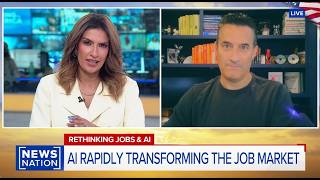
In this interview, Matt Britton, author of Generation AI, argues that society is moving from a "knowledge economy"—where information itself held value—to an "execution economy," where the ability to apply information matters most. He explains that AI’s rapid advancement (doubling in power roughly every seven months) is reshaping the workforce: routine knowledge‑based jobs (e.g., tax accountants) are being automated, while new roles will emerge that require deep technical expertise, creativity, problem‑solving, and critical thinking. Britton highlights the growing burden of college debt—over $1.2 trillion—and questions the ROI of a traditional four‑year degree in this changing landscape. He advises individuals to prioritize learning AI fundamentals, building personal AI tools (such as health or finance bots), and cultivating uniquely human skills. The conversation ends with a call to embrace AI rather than resist it.
Chapters
Here with us now, author of "Generation AI," an expert on how technology is reshaping the next generation, Matt Britton. Matt, welcome to the show. Good morning. I've been looking forward to talking to you because I know so many, not only young adults, but many adults are having the same conversation.
Yeah, I mean, we are entering the end of the knowledge economy. You know, we're exiting the era where information had value and really entering the execution economy. Where it matters what you do with that information. And that is such a societal shift that I think students and professionals alike are really going to have to grapple with.
So let's start with the big picture. We're seeing artificial intelligence rapidly expand across industries. A study on the future of work estimates that almost— that most jobs that will exist in 2030 have not even been invented yet. Explain to me what that means for our workforce.
I mean, this technology is doubling in its power and potency every 7 months. So it's really hard even for me, a technology executive, to understand how to focus my roadmap for my business given all the unknowns that that creates. And when that transcends down to the job market, there are so many knowledge economy jobs. For example, an accountant who for years has had a prolific career on knowing how to do someone's taxes, this year for the first time, I use an AI model to do my taxes and I will never use an accountant to do my taxes again. And that dynamic is repeating itself over and over again. But I think what that study also shows is there will be new jobs that are going to be created by this incredible revolution that we're witnessing.
You know what, that is the headline I took from that. New jobs will be created. And hopefully that puts some optimism on the minds of many. With the nature of work changing so quickly, what types of roles or skills are most at risk right now on the flip side, which have more staying power?
Yeah, I think if you go deep into an art or deep into a science, those are areas where you likely are most protected, meaning either understanding how to operate, build, develop this incredible technology or do things that the machines truly can't do, which exists in the core of humanity. Those are in areas like creativity and problem solving and critical thinking. But it's everything in the middle. Where you're essentially just leveraging knowledge and deploying it in a work setting, often mundane, rote tasks that you're doing every single day. Those are exactly the tasks that AI is adapting, getting better every single day at doing.
We're seeing stress on families over the rising cost of college. People starting to question whether they need a 4-year degree. What's your take on that debate? Does the skepticism make sense for so many parents and their seniors who are having these conversations right now?
You know, there's over $1.2 trillion in college debt right now, and it's a huge burden on so many families. And it's really a burden on someone who graduates college and does what they need to do to pay back the debt versus follow their dreams. So the reason that you go to college is so you can pursue your dreams. But if you're saddled with debt, you really don't have that choice. How I feel about it is if you are in the position, you're in the fortune position where your parents pay for your college degree for you, and I understand that's a very— an increasingly few amount of Americans pursue college. But if you have to take on debt to go to a 4-year college, my take is, is every single day it becomes less and less worth it given all the changes that we just discussed.
Okay, that's very— that's an interesting take. What should they actually be prioritizing today to put themselves in the strongest position when it comes to their future career?
Well, again, it goes back to where do you focus. If you're somewhat technical, if you're curious, I would learn AI. I would learn how to understand how these models work. I would understand the different applications, I would understand how to build an AI. I speak a lot at conferences, and I tell people, start at home. Create your own health bot where you can take decades of personal health information and create a version of ChatGPT that's trained just to keep you alive. You can create a version of ChatGPT or Claude to help you manage your finances. But going through that process of going step by step and building a tool that helps make your life easier will allow you to see the world differently. And if you do decide to go on the more technical side, the side of science, if you will, then I think that you're gonna really be able to carve a lucrative path for yourself. If you're not technical, focus on, you know, the creative areas, focus on problem solving, focus on critical thinking, creativity, areas that I think companies are gonna increasingly need because ultimately companies right now are lost and they need help in figuring out what direction should they go in? What are the problems that are most important to solve?
This is such a fascinating conversation and I know it's not going anywhere anytime soon. No.
For better or for worse, AI's here. We're not going backwards.
And we need to get on board. And I think that really is, is what it comes down to. Matt Britton, thank you so much for coming on.