The Female Quotient’s Shelley Zalis on Entrepreneurship, Passion & Equality
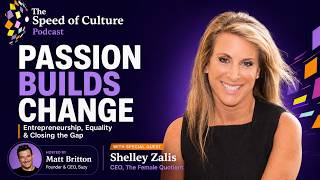
In this Speed of Culture podcast recorded at CES, host Matt Britton interviews Shelley Zalis, founder and CEO of The Female Quotient. Zalis recounts her early career as a pioneer of online market research, creating OTX (Online Testing Exchange) in 2000 to move surveys from offline mall intercepts to the internet, building a "sample blender" ecosystem despite lacking a tech background. She describes selling OTX three times, including to Nielsen and Ipsos, and how those experiences shaped her entrepreneurial mindset of disrupting herself. Zalis explains how she leveraged her CES presence to launch the Girls Lounge—a women‑focused networking space that grew from a 50‑woman walk on the show floor to a global series of lounges at CES, Cannes, SXSW, and the World Economic Forum, funded initially by her own money and later by corporate sponsors. She details the creation of The Female Quotient, a community and media brand that connects women across industries, curates experiences, and advises Fortune‑500 companies on closing the gender gap. Zalis offers concrete advice for leaders: focus on intentional action, use data to address pay, care, leadership, and procurement gaps, and recognize that gender equity is the only Sustainable Development Goal that can be directly controlled by organizations. She highlights systemic biases in venture capital, AI, and check‑writer demographics, and introduces the "Algorithm for Equality" initiative to rewrite AI rules with women in 100 countries. Throughout, she emphasizes confidence, the importance of designing workplaces for caregivers (the "lowest common denominator"), and the need to replace pledges with measurable actions. The interview ends with a call to stop imposter syndrome, to believe in oneself, and to push for transformative, intentional change.
Chapters
Today we're excited to be joined by Shelly Zalis, the CEO of The Female Quotient, working with companies to curate experiences, thought leadership, and solutions designed to achieve gender equality at work. In 2018, Shelly was the Matrix Award honoree issued by New York Women in Communications and has had so much more great accolades and success. And Shelly, it's so great to see you here at CES.
And I'm just like I'm already on fire with you. Like, we could just talk forever.
So before we even started filming the podcast, Shelley and I just kind of jumped into it. So this could be a really exciting one. And I mean, tell me about CES. You've been here for how long?
Gosh, we— it feels like one day has been 4 weeks already because we've had so many amazing conversations.
I mean, how many years have you been coming here?
Oh gosh, I think this is our 10th year here. We are the official quality partners of CES.
So what does that mean?
Well, we help them with their programming. We ensure that there's diversity on every stage for them. We also brought the sex toys back, which is amazing. I mean, I don't know why they got rid of them. So we brought those back because that's important too. But, you know, most importantly, we do a walking tour, a Girls Gone Walking tour. Yesterday— no, Tuesday, we did the first morning. We had over 300 women walking the floor, the showroom floor together. And it was absolutely remarkable. And we started, I mean, that's how the female quotient really started, was at CES.
So, and that's interesting because electronics, tech, predominantly a male, uh, dominated industry. And CES used to be completely different. 'Cause CES, when I used to come, was actually really electronic devices. Now you have media and tech companies here. But was that why you came to CES specifically, just based upon the makeup of the industry?
Well, I mean, I'm a woman in tech, so I pioneered online research. So if you've ever taken one of those shitty surveys on the internet, sorry, not sorry, but I'm the mother of that invention. And that was probably in 2000. I started a company called OTX, Online Testing Exchange, and migrated research from offline to online. And that was in a day and age where only wealthy old men had broadband connections. Right. You know, 14/4 modems or something like that.
It was before the iPad, it was before the iPhone, any of these, right?
I was, you know, way ahead of its time. It was before SurveyMonkey and, you know, all that. And had to create the blender is what I called it with online sample and mixing and matching samples.
Why did you decide to start OTX?
Well, I was in market research and, you know, mall intercept and telephone surveys.
Yeah, clipboards, all that stuff.
Yeah, you know, when, you know, we would check, check, check, you know, if you were the right demographic and paper pencil surveys and all of that kind of stuff. And I was then doing, website testing and efficiencies and, you know, all of that kind of stuff. So, and then I had this idea to, well, why not just move research online? But there was no one online. So I had to build the whole ecosystem. And I remember one day closing my eyes and thinking about how we did RDD, random digit dialing, and you needed the phone books and we'd go into the, you know, phone book and find the people that you would call. And how do I simulate that same scenario to do—
Phone intercepts, doing it online.
Yeah, how do you, How do we migrate that concept to do online? And I thought, well, we have to pull the sample from all of the different websites, right?
That would— yeah. You need a statistically significant sample set that your clients go after.
And so I thought I had to build this blender that would take sample from everyone's—
Did you have a tech background when you started it?
No.
So how did you learn about it?
Well, that's, that was the way to do it. You have to go to the lowest common denominator, right? To do, representative sample for research.
But even to build the technology, you needed technology jobs.
I actually hired this guy, he was 21 years old, that was helping me do website testing and said, I just need sort of a website for research, market research.
Yeah.
It was sort of a website at the beginning. And it was, it was really quite an amazing evolution.
So, amazing question. Being in the market research industry even today, I can tell you that online research, there's just a lot of hesitation with in terms of the audience quality. And, you know, a lot of clients still wanna work with the legacy services because they trust them more. It's an industry that doesn't move fast. It must have been really challenging to get clients to adopt and buy into this new format.
Oh, you have no idea.
I have some idea, but probably not as much as you, 'cause you were the pioneer in this space.
You know, I always say when you're building something new, you have to be the first, the second, and the third. Yeah. The first is always the innovator that makes all the mistakes. You gotta fail to succeed. The second is the copycat. They copy everything that you do, but they don't really understand what's under the hood. Yeah. The third is the sweeper. They ride in on the shiny white horse 'cause you've already built the ecosystem and they, they win the game.
That happened with MP3 players. It happens with, happened with social media.
Oh, you know, but Yeah. When you are someone that has worked their ass off and, you know, really believes in what you're doing. I always said to myself, I need to be the first, I'm gonna be the second. I love that. And I am gonna be the third. 'Cause there is no one that will beat me at my own game.
So you basically disrupted yourself.
I disrupted myself every single time. And I actually sold my same company 3 times. And it is, and that's a whole other story in and of itself. And if I tell you the tricks of the trade of things I did and how I brought an online business where everyone told me it wasn't the right time, I have to wait, there's no ecosystem. And I remember I do a lot of teaching in business school 'cause I love listening to young people and giving back and learning and, I don't like grading papers and all that, so I'll never be a full-time professor, but I love learning. And so I go in and out and do guest lecturing. And I was at Wharton and teaching a course and I was talking about the whole blender and everyone told me, "Oh, that's so unsophisticated." I'm like, "No, but it's true. You need all sample from different places to create representative population." The first 18-year-old that needs to go to this survey will come Boom, boom, boom. And you wrote, I rotated like this, da, da, da, da, da. And I said, gosh, it's like Dr. Seuss's One Fish, Two Fish, Red Fish, Blue Fish. And I remember saying, okay class, get up, we're gonna go down to the library. And we went down to the library and I had everyone sit around, they had a little kids area and I read everyone the book, One Fish, Two Fish, Red Fish, Blue Fish. And I said, it's like you need to have the big ocean where you have all kinds of fish. That's an ecosystem.
Yeah.
And that was the inspiration behind my blender. I needed to collect all sample from all different places, but put it into this big blender because you can't just have sample from Greenfield at the time and sample from AOL and just use the AOL sample because you need it to blend. It could be skewed. Right. It could be skewed.
Yeah.
Oh, you get it.
Of course I get it.
And that was the inspiration for my blender. And then from then everyone started getting in the business and I, but then I said, oh, and I wanted sample from even mobile companies because there was, this young guy that, Matt Dusick, that had this mobile thing, but he didn't know how to use it for. And so I put his sample in and this and this and this. And then that next thing you knew, I had 100 sample providers. Boom, boom, boom, boom, boom.
What about the customer side? What about storytelling the customers, getting people to buy into your product?
That was so easy because I built a whole model around incentivizing.
But in a way— But the clients trust the data and they trusted the research?
Of course they didn't. No. But I parallel tested against the mall data that we had tons of data. And so I, I did not, I said to clients, don't trust me.
Right. It's like Coke-Pepsi challenge type thing, right?
I have no, I have no norms.
Right.
And so I parallel tested and I gave free data. Smart. Free data. And you know what I did? And this was before we even had online data. And they all were, they wanted paper. And so I would give them back Stacks and stacks of paper 'cause that's what they were used to.
They wanted a paper trail of the research actually being, the real work behind the data.
But what they trusted still was offline. And I started in the movie business even though my background was CPG, consumer packaged good data. And so I started in the movie business. In CPG, it's womb to tomb. TV commercials. Yep. In the movie business, which I had zero experience, you needed information within 48 hours. Movie trailers, which are 2.5 minutes long. Yep. Not 30 seconds. Hardest thing to do online 'cause you have to DRM, you have to, you know, make sure you secure it 'cause a movie could open and close in 2 seconds flat. Yep. But to secure online where it was still very slow.
Yeah.
I mean, you understand that, right? And how do you secure yourself? This is in 2000. This is a really long time ago, way ahead of its time.
So I was— Yeah, video barely worked on the internet in 2000. It would, it would pixelated. It wasn't right.
I mean, it's like if you're on a freeway with lots of traffic with 14.4 modem, imagine the download. Right. And tons of people on it. I mean, now we have, you know, very high speed internet, but at the time it was really slow.
What gave you the ambition and conviction to do something that's so disruptive? It was that the first time you were an entrepreneur and then started something? Yes. So what was the moment where you're like, you know what, I'm going out on my own, I'm gonna launch this?
I, I saw it. And by the way, everyone, and I was at a traditional— That's not enough, it's seeing it.
A lot of people see stuff, but they don't start a company.
I was at a traditional research company, ASI.
Mm-hmm.
And I went to my bosses, I said, I have this ridiculous idea, but it's time to migrate research from offline to online. And they all told me it's not the right time. No one's online. And I happened to be on a panel with Larry Mock, who was the Chief Research Officer of Procter Gamble. And my bosses are all in the front row and I'm whispering to Larry and I come off the panel and my bosses all said to me, "What did you talk to him about? What were you whispering to him about?" I says, "So I just asked him when's the right time to come into Procter and talk to you about migrating research from offline to online?" And he said, "Next week." And I said, oh my God, okay. And my bosses said, great, Paul will go, Ringo will go, and Star will go. And I'm like, what about Shelley? And they said, it's a boys club. That's the right audience. That's, we're the right team to go. And I said, well, if I'm not going, I'm gonna cancel the meeting and you can all wait for the right time.
I love that.
And that was, and I call these heartbeat moments. It was my heartbeat moment where I'm like, well, why, when and why am I not right. When can I be the boss?
Right.
And I said—
So you made yourself the boss.
The only way I'll ever be right is if I'm the boss. And I had already been doing, you know, website testing and I did infomercial testing and I built new solutions. And I just said, you know what, I'm gonna go. And I needed $1 million because I promised this young kid that if I ever, I'm gonna do this, I will give him $1 million. I didn't have it. And I said, but if someone ever buys into it, I will give you $1 million. And I went to Nielsen.
To do what?
To give— Build me an online portal.
Right.
I saw it in my head.
All the development.
Yep. No one believed me except my father and my husband. And they each said they'd give me half a million, but I didn't wanna take their money because I knew that A, I didn't have it. My husband is a butt doctor, colorectal surgeon, but he was a, fellow. We didn't have the money. Right. And I knew if I took their money, I would not take risk. I'd be safe.
That's the problem with taking friends and family money. It's too personally connected.
And I didn't even know that at the time, but I just, and so I went to Nielsen and I said, I'm gonna pioneer online research. And they said, we love that idea. What do you need? I said, I need $1 million for this kid. I didn't think about me. And they said, okay. And I gave away 80% of the business, whatever the business was gonna be or not gonna be. And I handed this young kid a check and I said, let's build it. And that was that. And that's how I started.
Are you still in touch with him today?
And I called it, yeah. Yeah, he's Patrick Hoff.
Oh wow. Alan Patrick Hoff's son.
He's Trevor Hoffman that went into business with Patrick Hoff's son. Right. Yeah. And that is how I started. And I called it Real Real Estate. Research, R-E-E-L, at the time and pioneered it at Nielsen, built a whole movie business around it, first of its kind. And the way I got my first client, which is hysterical, was I went to Warner Brothers and there was a company that was— it was Joe Farrell, NRG, was legend. And they had a monopoly in movie research. It was mall intercept testing. They every studio, and they were unbreakable. There was no competitor. And I said to Warner Brothers, are you completely satisfied with how you do movie research today? And I used the word completely. And they said, well, who's ever completely satisfied?
Right.
And no one's ever broken the monopoly ever because Joe Farrell was the godfather to every single movie studio CEO, producer, director.
He was institutionalized there.
Because he was the studio whisperer. Told everyone how their movie was gonna open and close and whatever. And he had the keys to the castle.
Were you based in LA at this point?
Yeah. I knew no one in the movie business, but I was a brilliant researcher. But I knew no one in the movie business. And the head of research, looked at me and he said, and I said, I have this crazy idea to migrate research to the internet. The internet, what is that? And I said, and I won't charge you a nickel. All I want is when you test in the mall, I wanna parallel test the same spot online for 1 year. Give me all your data.
That's the way to do it.
And that's all I want. And they said, it's a deal. They said, but we have exclusivity with Joe Farrell. You can't tell anyone because we will be in trouble. Right. I said, mom's the word. That was the deal. And they said, but we have a contract and it has exclusivity. I said, let me see your contract. In the contract, it said they have exclusivity with NRG for mall intercept testing. Right. That was the loophole. I said, but I'm online. And that is how I got into every single studio.
And you took that year and you proved that your data was just as good and more efficient.
It was even better than that. I said, when you go to meetings, what I found from what I was doing, while I didn't want to replace the recall testing and all of that because that was normative-based, what online had at the time that was genius was the open-ended responses. I had the best open-ended—
The qualitative why behind the what.
Was genius. And at the time, it had people were putting in bold and exclamation and, I said to the studios, I want you to go into the producer meetings and give them still the mall testing quant.
Quant, right.
And you bring in the qual. And don't tell 'em where it came from, 'cause then they'll doubt it. Just show 'em that. And so they would go in with their quant, and I say, you can even call it NRG if you want. Let 'em think that's what it is. And just come in with the qual. The new enhanced. And the producers and directors like, holy shit, what the hell happened? This is the best stuff I've ever seen. Where'd you get it? And like, oh, it's this new thing. It's online. Ba ba ba ba ba. And then I said slowly, and I'm gonna actually now not give you all these pages. I'm gonna start sending you stuff Online, so you, we can start eliminating some paper trail. And when I would send the online, I would also send homemade chocolate chip cookies and milk. I said, when you read it online, here's a little something. Enjoy your reading. Next thing you knew, word traveled. And then I started parallel testing and calibrating norms. And showing them that actually my data was more reliable than MOLLE. And within 2 years, I started replacing MOLLE. And poor Joe Farrell started calling me "her." If you are going to use her, I'm not going to give you my data anymore. But by then, I was already able to replace his scores. I was the only company in the world that was able to break an unbreakable company that was the only company in the world providing scores to the movie industry. And that was my little company that became OTX. First company in the world that was now an alternative to NRG.
It's amazing. And I think like when I hear the story, it's like the things that dawn on me is you had conviction, you had perseverance, you know, you believed in yourself. Those things are really the, the hallmarks of what a great— makes a great entrepreneur, right? Because without those things, you could have a great product, but you're not gonna have that internal willpower to push through.
You know, I just had, you know, I, I hire for passion, train for skill. I was passionate about what I was doing, resilient. I knew I was onto something and I wasn't gonna stop. And, you know, I'm, and I built an uncorporate model, you know, and I, you know, I always say when you love what you do, it's called passion. When you don't, it's called stress. And I loved what I did. And there were tons of hurdles, you know, I, I built something for the first time and, and, you know, today what makes me so, proud of online research is there's so many spinoffs. I mean, online research is a thing. I mean, it's not— it wasn't a trend. It stuck. And a lot of people take a lot of credit for, you know, online research. I know where it came from. You know, we didn't have social media at the time, and there's not a lot of reports written. I mean, you'll see a lot of stories, but this is a long time ago. And, you know, a young guy that worked for me has taken the sample blender technology and has now, you know, built a huge sample company. Just sold it for, I sold my company for $80 million. He sold my sample technology. A lot of sample companies have, you know, come from that.
Of course.
He sold it for $1 billion, you know? And so watching the evolution and the evolution and the evolution and the impact.
You paved the path for companies like Suzy. We should rename our company Shelley.
Yeah. But I love that, you know, and I think that makes me proud. It should make you proud. You know, to see what has come from all that and how technology— I mean, when I was doing online surveys, I was using avatars. My kids have little talking avatars for surveys. Or we were using, you know, the concept of QR codes before QR codes. It wasn't sticky then because, as you said, consumer adoption has to be ready for it. It was too ahead of itself. Avatars. Now everyone's like, oh, right, the Web3 and virtual world. I was doing that. No one wanted it. It was like, ugh. Or, you know, QR codes. You need the adoption. Consumers weren't there yet. It was a good idea. Yeah. Too ahead of itself, you know?
So you ran that for 10 years?
Oh gosh, who knows? I was, I was in research. I only, you know, I was the only female CEO, top 25. My entire career. I've been in the boys' club my whole career. Didn't hold me back at all. I'm sure I'm owed a shitload of money and I'm sure I was paid less than, you know, everyone in, you know, in my field. And if I went back and checked my paycheck, I could probably get paid a lot, you know, they probably owe me a lot of money. Right. Didn't affect me at all. I was always, I was passionate. Well, you were passionate too.
And you love what you were doing. Yeah.
Through your focus. No regrets. You know, I, I really have a philosophy of, you know, I never wanna look back and say shoulda, woulda, coulda. So I, I have zero regrets. And I've had the most amazing journey and it led me to where I am today. Yeah.
So let's talk about Female Quotient. For those in the audience who don't know what Female Quotient is, what is it?
So I sold my company, um, uh, OTX to, well, I, when I left Nielsen, I went to iFilm. iFilm was the YouTube then, which, you know, was an amazing company. And I built the next iteration of, Online. So it was real research at Nielsen. I then went to iFilm and created OTX, then sold it from iFilm to Bob Pittman and Strauss Zelnick, which was, you know, really an entrepreneurial undertaking going to the VC. And then from there I sold it to Ipsos, the third largest research company in the world, and was running innovation in 83 countries. I stayed there for 5 years and realized after that it was time to give back with generosity what I wish I had my entire career.
Which was?
A network of women supporting women. I'm 61 years old. I did not have that. You know, I lived in a Mad Men era truly. And you know, I rose the ranks very successfully, but I really did feel that what I really could do now was give back what I wish I had. And so I, decided I wanted to go to CES. And this is the question that you asked me, a tech trade show. I was a techie, you know, but I built for the lowest common denominator 'cause that's how you get consumers, which is, you know, what, what you need for market research. And I heard there was 150,000 people going, less than 3% were women. And so I called 5 girlfriends of mine and I said, let's walk the floor together. I don't wanna go by myself. And if you know other women, please invite them. 24 hours later, 50 women showed up to walk the floor. That was 10 years ago. And the most remarkable things happened. Two things. One, 50 women walking the floor, I called it power of the pack. A woman alone has power, collectively we have impact. When I would walk the floor alone, you're invisible. When 50 women walk the floor, the invisible become visible. It was this whoosh moment. That's all I can explain because that's what I felt like. Every single guy's head turned like, where the hell did all you women come from? Boom. And it just lit me up. I was like, this is incredible feeling. And the second thing that happened was I was surrounded by women just like me.
How'd you find them? Or how did they find you?
I knew women in the industry.
Just your network?
Yeah, but we were never together. You know, we've always been individuals.
Yeah.
And we were talking about work-life balance and imposter syndrome, and we were all doing deals with one another, and we all were power of the pack. You know, we all had tons of money spending it with each other. Wow. What a concept. You know, there's such a scarcity of women at the top. We were trained to compete with one another, but why? And we were in my little hotel room that the next day, you know, 50 turned to 100, 100 to 300, and we were in my suite. And that is how the Girls Lounge started. And it was called the Girls Lounge. The opposite of boy is girl. The opposite of club is lounge. If there's a boys' club, now there's a girls' lounge. And then I thought, gosh, if I could connect women in tech, what about women in marketing? What about women in media? What about women in finance? What about women in cybersecurity? What about women in space? What about? So I thought, gosh, I'll do these girls' lounges, these pop-up spaces that women could connect and collaborate and have safe spaces and, and meet other women and not feel alone at these big conferences dominated by men at every conference. So I did a girls' lounge at Cannes and a girls' lounge at South by Southwest and a girl, you know, did that.
Did you think about a business model at that point or you just wanted to solve the problem of getting women together?
Well, I needed a business model because I don't charge membership. Right. And so I needed brands to sponsor it, but I didn't really have that concept yet. So I sponsored it myself. Right. And thought simple, I'll just pay for that. And the idea started when I was at Ipsos. So the Girls Lounge started at Ipsos and I had Ipsos pay for it 'cause I was running global innovation. So I'll have Ipsos, it was the Ipsos Girls Lounge. So that's how the model started. Ipsos was the brand. Sponsoring it. After my 5 years at Ipsos, I decided time to go and do it myself. Then I get invited to the World Economic Forum. My invitation was, we want you to come, but you might not feel welcome.
Once again, they literally said that to you?
Yeah, that was the invitation. There was one little spot left. And so I said, you know, my head said, who wants to go? That's not a very nice invitation. My heart said, I must. And I've always wanted to be invited to the World Economic Forum. Yeah. That's a dream come true. And I went to a big brand that goes to the World Economic Forum and they said, we love the idea, but we don't like the name. You gotta change the name. I said, I'm not changing the name.
The name of Girls Lounge, right?
Yeah. And so, and it was called the Girls Lounge, the place for the 17%. 'Cause at the World Economic Forum, only 17% of White badges, which is official Congress, are women. And so I didn't get the sponsorship money that I needed, which was $250,000. And so I called a girlfriend of mine that was the COO of Bloomberg, Jackie Kelly. I said, Jackie, you gotta go with me. I don't wanna go by myself. It's too scary, but we're going. And she said, I'll go with you. So I took my own money, paid for it, knew I had to go. And we showed up, put my little shingle up, the Girls Lounge. Place for the 17%. And we had the best content. We— I did not do hair and makeup in the last—
Best content meaning you brought people together and you would just bring speakers.
We had a little tiny shack with big windows so everyone could see in. I hung chandelier, which I always hang to bring the feminine. I'd— it looked beautiful. Great food, great content. People poked their head in, but women, with the badge that knew of us from Cannes or from, you know, 'cause we already had a reputation. Yeah. Came. And then Jamie Dimon came and Jamie's like, oh my God, this is the best thing I've seen at the World Economic Forum. I'd like to be a speaker here. And he shows up and became a speaker. And he said, I wanna sponsor this. This is the best thing I've ever seen. And then Anne Finucane.
Jamie Dimon, the CEO of JP Morgan Chase.
Just saying.
Yeah.
That's the one. Yep. Yep. And next thing you knew, Ann Finucane from Bank of America, she's retired since then, says, why am I not speaking here? And then everyone's like, well, why am I not speaking here? Why? And then the original person, company I went to was like, oh, their CEO came and said, this is the hottest spot here. And this is 10 years ago, 9 years ago, little shack. And they want to be a sponsor now with the Girl's Lounge name. I said, you can't. And they said, why? I said, because someone has exclusivity in that category now, JP Morgan. Jamie is the first one every year now, his team calls and says he wants to write into the schedule to make sure he can be there. He is our greatest champion. That's awesome. Every year. Heart, real, true, champion of change.
Can you get in the run for president?
God bless. And I have to tell you, today we are the destination for closing the, for changing the equation and closing the gap at the World Economic Forum, standing room only with the most incredible champions for change across Fortune 500 companies. We trend top 5 there. We have a 2-story class house right in the middle of the street, diagonal from Congress. And we have moved and shifted the power source. And we've changed the gender at Davos where it's not, it is not, it's, I think the place for 17% are men now. I mean, it really is remarkable. And our big sign when you walk in now says equality is possible. If you want it. And we attract conscious leaders that all show up and they bring their A-game. And it is just quite incredible. And so today, you know, the female quotient is all around changing the equation, closing the gap. We have the largest global community of women across every industry supporting one another. And we also have the most incredible partners, which is Fortune 500 companies with CEOs that are intentionally, purposely, consciously all in on closing the gender gap in the workplace. And that is their legacy.
And it's gonna be your legacy.
It's ours collectively. Yeah. And you know, the World Economic Forum says it'll take 131 years to close the gender gap. And we say, not on our watch. It is a mindset gap. And if we want it, we can do it.
And that's, and that's your mission. And besides World Economic Forum, you're, you're here at CES and you're in, I've seen you in Cannes before.
You go to, yeah, no, we're all over.
We're all the big places where influential industry people come. You set up these forums where you bring speakers sponsored by, you know, your corporate partners and it gives women a voice and it gives awareness to the things that women are doing in business to bridge that gender gap.
But we also, because we have the largest global community of women in the workplace, across every category. We also are a media brand now. Yeah. So, you know, we're in experiences, media, and advisory on how to close the gender gap in the workplace.
So as a CEO of a company, what advice could you give me to make sure I'm proactively trying to push gender equality in the workplace? Like, what are some things that you've seen well-intentioned male leaders miss on?
Well, first of all, I don't think it's about whether you're male or you're female. It's just about intentional action.
Right.
Priority, choice, and realizing that of all the sustainable, the SDGs, Sustainable Development Goals, it is the only one of the 17 that you can actually control and do because it's a mindset gap in your workplace or in the world. Yeah. The other ones, hunger, poverty, sustainability, climate, you have to rely on the rest of the world.
Yeah, externalities, right?
To do. This is the only one you can control. The pay gap, you have the data, you can fix that one. The care gap, you can actually fix that one as well. Not rely on government, but rely on yourself to put the policies in place. Yeah. Leadership gap, you can control that one as well. They're all fixable and they're actually not hard. Procurement, which is supply chain, less than 5% of supply chain goes to women. And it's not because it's a lack of women. It's not because the women aren't as talented. It's legacy issues. If you actually look under the hood.
Legacy relationship, the old boys network. It's just in place since.
Ba-doom, ba-doom, ba-doom, ba-doom, bam. Right. Boom. Not complicated. Workforce, women in underserved parts of the world, they, it, the solutions are not complicated.
Also investment too. You look at the VC investments, I read very small percentage goes to women-run companies.
And actually, if you actually look at why, if you actually understand why, most check writers are men. So the data that we're seeing is very misleading. If you look at when there's diverse check writers, the percentage is much higher.
Right.
We're just looking at the wrong numbers. So it sends you down the wrong path. AI, look at the bias in AI. So we're working on a whole new solution called the Algorithm for Equality. And we have women in 100 countries helping rewrite the rules.
You're already seeing bias in AI.
Of course. Junk in, junk out. If you have—
It's regurgitating what's on the internet. And since that exists, it's gonna—
I mean, and we're not even profiling. I mean, look at the latest New York Times, only profiled the men in AI. You don't think there's women in AI? Of course there are. I mean, facial recognition. We didn't even have Black people in coding. So we've missed so many crucial variables. I mean, I can go on and on and on about the bias, the biases. So, I wrote Algorithm for Equality, just even that tagline, 10 years ago. Who knew AI was gonna be hot?
So you, you're, a lot of what you're talking about is sort of like the leadership's driving the change and that, but when I hear about your story and what you did at OTX, a lot of it was based, you, you became the change you wanted to see. So I think to me there's two pieces of it. It's making sure the leaders facilitate this, but also make sure that the women, the young women who enter the workforce, have the wherewithal and the confidence that don't feel they need to ask for permission to go, to go for it. What— how, how did you have that confidence? You talk about your, you know, your, your parents, your father supporting you. Like, what are some things that we can do to make sure the young woman can also drive it themselves?
Yeah, listen, Sorry, not sorry. Permission granted. When I started my company, I didn't have a choice because I am a, a mom, a grandmother. I wasn't a grandmother at the time, but primary caregiver.
Yeah.
And I just created the uncorporate rules because if I didn't, I wouldn't be in the workplace. Right. And so I decided that, um, it's the only way I will thrive in the workplace is being my own boss. Writing my own rules, which is how I became Chief Troublemaker. I broke every rule that made no sense and created the new ones. And so either you follow status quo, which is the rules that were written by men over 100 years ago for men. And I'm not saying that was wrong, it just was what worked then.
Right.
But nothing has been redesigned. So I just designed a workplace for me that would work for everyone. Because if you design it based on what a caregiver needs, it's gonna work for everyone. I designed it for the lowest common denominator, which is gonna work for the majority. Yeah. And so that's just what I did. So sorry, not sorry. Right. And I just, you know, yesterday in the lounge we stamped out the imposter syndrome concept and we, we wrote in the new alternative that we're kind of coming up with a new name cuz that's just so dumb. We just think, that you have to follow status quo because that's what it's been. But what about the possibilities of what can be? Let's stop holding on to the past and let's open up the new door of opportunity and write it forward. It's not very complicated. Just because it hasn't been done doesn't mean it can't be done. And sometimes we think—
Well, you did it. That's what I'm saying.
You did it yourself. But I didn't know.
I didn't know. You didn't know, but you did it. So the fact that— The empowering part for me of what you're saying is you're somebody who actually went through the battle and won, and now you want other people to win their own battles. But you've done it yourself, and I think that's why you're successful and that's why people believe in you because you did it yourself.
But I gotta tell you, they didn't believe in me from the beginning. Yeah. And even today, and this is, you know, Laura, you talked about her.
Laura Desmond.
Even, yeah. When I did, Girls Lounge. A lot of people didn't like the name Girls Lounge, even women. They're like, we're not girls. And I'm like, have you ever heard of men object to being a boy in the boys club? Like, they didn't like the name, which I, you know, because women were, we dressed like men and we didn't wear makeup and we didn't do hair publicly. And I very consciously did it publicly. It was scary, trust me. And, and I don't blame senior level women that didn't wanna come because it wasn't where the power was.
Right. We weren't powerful. It was counterculture in some ways.
It was so counterculture and I stuck with it, but I had to pay for it myself because getting women that were the only one, men weren't gonna pay for it. Right. Brands weren't into the, and I very consciously was in a women's space. Even though I was called a women's space, but I wasn't a feminist organization. I called it Business of Equality intentionally, but I didn't have CEO support. I didn't have CMO support. I didn't have women's support. I had no one's support.
Right.
But I've always been alone. Remember that. And so it took me a really long time to break in. You have to hold ground. Yeah. And I didn't have the money until I had the money. To support myself to do it. So it's complicated. So it's not like I can just say to everyone, go spend your own money to believe in yourself. But you know what I can say is it doesn't cost money to believe in yourself. It does cost money to start your own business, but it doesn't cost money to believe in yourself. Because if you don't believe in yourself, no one else will. It costs $0 to shut that bitch up in your head, which is imposter syndrome. $0 for men and for women.
Yeah.
Men tend to ignore the voice. Women let that voice get louder. But the loud voice needs to be the confidence voice of you got this, you are awesome, you have amazing ideas and you don't need to have 'em all. But the idea you do have to have is follow your heart, not your head. Your heart doesn't have imposter syndrome, right?
That's amazing. Well, it looks like we're running up on time. I mean, I feel like we could do this podcast for another hour, and I wanna— because I wanna, I wanna dig deeper into things that are more tactical that can actually push us forward. Um, and I'm sure you get this a lot as people hear you and they want to take action. That's how I feel.
So all about action. And you know, the one thing I also say is stop putting pledges on the table because pledges— no one follows up on a pledge. But what you do follow up on is intentional action. So, you know, if you want to move forward, commit to transformative intentional action, action for change that pushes you forward.
We're going to leave it with that. This has been amazing. Thank you so much for sharing your story. I cannot wait for our audience to hear it, and I'm incredibly inspired. I want to figure out ways we can collaborate more in the future.
Amazing, because we're going to talk about why you also called it Susie. Yeah, we'll do that too, because I can't wait to hear that too.
Absolutely. On behalf of Susie and the Adweek team, thanks again to the great original Shelley Zalis, founder and CEO of The Female Quotient, for joining us today. Be sure to subscribe, rate, and review the Speed of Culture podcast on your favorite podcast platform. We're here live in Vegas at CES, and we'll see you real soon. Take care.
More from Matt




MikMak’s Rachel Tipograph on Consumer Spending, Retail Media & Holiday Shopping Trends



Jaguar Land Rover’s Charlotte Blank on Luxury, Purpose & Experiential Storytelling



