The Future of Eating? Gen Z and AI Are Deciding Right Now
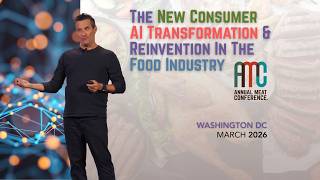
In this closing keynote at a meat‑protein industry conference, Matt Britton (founder & CEO of Suzy) outlines how generational shifts and the rapid rise of AI are reshaping consumer demand, brand strategy, and the economics of the protein market. He begins by noting that Gen Z and Millennials drove two‑thirds of unit growth in 2025, and that Gen Alpha – the first generation to grow up with AI – will further accelerate demand for protein‑rich, health‑focused foods. Britton then explains why AI is the defining technology of this era: low learning curve, exponential capability growth (large language models doubling every 7 months), and ubiquitous adoption (ChatGPT approaching 1 billion monthly users). He contrasts AI’s disruptive speed with past tech cycles, warns of fear‑based resistance, and argues that AI will replace many knowledge‑economy jobs while creating new “new‑how” skill sets (problem‑identification, data fluency, resilience, creativity, systems thinking). He shares concrete examples of personal AI use – building a health‑bot trained on his own medical records, an AI‑driven financial planner, and step‑by‑step AI‑generated software – to illustrate a repeatable workflow: define a problem, gather relevant data, prompt a large language model with incremental instructions, and iterate. Britton then translates these insights to the protein industry: GLP‑1 drugs are driving a surge in protein‑focused diets; The “great wealth transfer” ($84 trillion) will shift capital from scarcity‑mindset boomers to spend‑hungry Gen Z/Alpha, amplifying demand; The market is polarizing into a barbell/K‑shaped economy – luxury/high‑end brands thrive, value brands survive, mid‑tier struggles; AI‑powered “answer‑engine optimization” (ensuring brand content surfaces in AI agents) will replace traditional SEO; Creator‑driven storytelling, experiential food, and AI‑enabled smart appliances (e.g., AI‑vision refrigerators) will dictate purchase pathways; Brands must shift from media‑centric advertising to creator‑centric, AI‑mediated engagement. He concludes with a call to action: identify the single biggest growth‑limiting problem, use AI (ChatGPT, Gemini, Claude) to prototype a solution step‑by‑step, and develop the soft skills (perseverance, self‑awareness) that differentiate early adopters. He offers a QR code for a 100‑tool list and an AI agent for follow‑up questions.
Chapters
As we think about the future of protein and the meat case, the data is clear. Power of Meat shows that Gen Z is not stepping away from protein. They're leaning into it. In fact, Gen Z and millennials were responsible for roughly two-thirds of all unit growth in 2025. Younger shoppers are actively seeking high protein and fresh options. Reinforcing long-term demand strength for our category. Our closing keynote speaker is one of the world's leading experts on the impact of tomorrow's consumer on the brands of today. For more than two decades, Matt Britton has guided over half of the Fortune 500 through the fast-evolving dynamics of millennials and Gen Z. Helping companies understand not just where consumers are, but where they're headed. As the founder and CEO of Suzy, the groundbreaking real-time consumer intelligence platform, Matt has transformed how brands gather insights, make decisions, and stay connected to the people they serve. He brings unmatched perspective at the intersection of emerging technology, cultural shifts, and consumer expectations. Please join me in welcoming Matt Britton.
Every label shouting protein from the shelf and from the screen, but BS has been here all along, hiding in between. From kitchens to the cutting board, from history to what's in store. The story's old but still brand new, and now it's time to tell it true. At the annual meat conference, hear the message loud and clear. Matt Britton on a stage saying the future How about that, huh?
So let's just think about that for a second. 5 years ago, if I wanted to make a music video with a song that I came up with in my head and produce it, I would have needed a songwriter, a band that could play instruments, a video producer, probably somebody to shoot B-roll. But instead, Upstairs in my hotel room, past midnight, in the span of about 30 minutes, I was able to create that. That is how far we've come as a society and how much technology has enabled all of us to do things that in the past were never possible. What I want to impart on everybody today is that we are in a completely new world. And I'm sure if you've come to conferences like these over the last couple of decades, You've probably heard the same thing, but I can tell you right now, this time it's real. As someone who's spending every day on the edge of these frontier AI models and doing everything from running a business, managing employees, driving marketing and sales activities, those who are able to embrace this new technology are going to be able to future-proof themselves in an increasingly uncertain world. I have spent my entire career helping big brands understand the new consumer. When I first came into the workforce, the new consumer was the millennial generation, the first generation to grow up with the internet in the household. When I tell my kids that when I grew up, I did not have the internet, they look at me the way I looked at my father when he used to tell me he used to walk to school during the snow with no shoes on. But it's true. I did not have the internet growing up. I, like many of you in this audience, had to go to the library to learn, actually pick up the phone and talk to people. And now all of a sudden we had a generation whose brains were hardwired differently, who knew no other world but one with the internet. And then came Gen Z about 10 to 15 years later. Gen Z is the first generation to grow up with the iPhone and social media in the household. Now, the incredible power of the internet was in their pockets. For those of you who have a Gen Z kid at home, as you'll probably know, as an appendage to their body. And it forever changed the way that we communicate. The way that we share content and express ourselves. Where would we be without the iPhone? We would probably actually be looking at our kids playing soccer versus holding the phone up. But that is the generation that ushered in this mobile world that we're all in. And now we have a new generation coming to society, Gen Alpha, currently aged 0 to 15 years old. Gen Alpha will forever be known as the AI generation.. They will never know a world without artificial intelligence. They will never know a world without a technology that you can communicate to the same way that you can communicate with other humans. Their brains are going to be hardwired completely differently. For Gen Alpha consumers, it's not going to seem crazy for them to have an intimate relationship with an AI chatbot, for them to think about going to AI for things that you and I would never consider going to AI for. And sharing things that you and I would never consider sharing. But their worldview is going to be immersed in a world of AI, and Gen Alpha is going to usher in a new chapter in business and culture and society. And we are very early, not even in the first inning yet, of the changes that we're about to see. Why is AI the defining technology of this new generation, and why do I believe it's different this time? Well, first and foremost, unlike other technologies, there is no learning curve for you to understand how to use AI. Even the iPhone, you had to get used to typing on a glass screen. The internet, we had to learn this whole new protocol with www. But AI, you just need to talk to in any language, in any modality, just like you would a friend or family member. And because there's no learning curve, we're seeing tremendous adoption. ChatGPT nearing 1 billion active monthly users. It's also increasing at an unprecedented rate, a rate of improvement that we've never seen before with any other technology. If you think about the iPhone, it took 18 months from the first iPhone to the second to come out with minimal feature builds. But today, my friends, AI is doubling in its power and potency every 7 months. I hear all the time people tell me, I tried to have AI do writing for me, or I had to have it. I tried to have it make a video or an image and it was terrible. But that's like me saying I tried to stream the internet in the year 2000. Today I refuse to watch Netflix. It doesn't matter where AI was 6 months ago. It doesn't even matter where it is today, because if AI can power something just okay today, you can be sure that it's going to do that in an unbelievable form factor in just a couple of years from now. Too many people are resting on their laurels, being romantic about the past and saying, I don't like AI. I don't like how it's taking away our creative functions, taking away the artistry. And that may be true, but keep in mind the people who ran the 70,000 horse and carriage businesses before the Model T came out said the same thing. Socrates, in fact, once famously said that writing would be bad for humanity because it wouldn't force us to remember things. With every new technology, there is fear, and we tend to demonize what we don't understand. But the reality is whether AI is a good thing or a bad thing, and it's going to bring both to society. It's here to stay, and we are not going backwards.
Back now at 56 Pass. I wasn't prepared to translate that as I was doing that little tease.
Oh, that's right.
That little mark with the A and then the ring around it.
At.
See, that's what I said. Katie said she thought it was about.
Yeah.
Oh, but I'd never heard it around. I'd never heard it said. I'd always seen the mark but never heard it said. And then it sounded stupid when I said it. Violence at NBC.
He had heard it around in the lunchroom the other week.
There it is. Violence at NBC GE com.
I mean, Allison should know. What is the internet anyway? Internet is, uh, that— what is internet anyway? Was the question that was on the Today Show in 1998. And it seems laughable now, but the reality is that was only 25 years ago. We are in the what is AI period of society right now. A lot of correlations could be made to the growth of the internet in the early 2000s and the explosion of AI today. Back then, there was a tool called America Online, which actually started not too far from here. And they were the crowbar technology that got America and the world at large, the consumer, to use the internet. The internet was available for government and military purposes prior, but it was America Online that commercialized it. And the same is the case with artificial intelligence, which also has been around for a long time, but not really something that was accessible to the mainstream consumer until ChatGPT. And given its ease of use, given its lack of learning curve, it became the fastest growing technology we have seen in history in terms of total adoption. ChatGPT is what's called a large language model. It is a technology that allows you to input a prompt and it will go through a knowledge base. The knowledge base could be anything from the entire internet to a specified knowledge base on your business and output or generate an image, a video, or text, which is why it's called generative AI. There are many large language models, ChatGPT just being probably the most notorious. Google has a tremendous large language model called Gemini, and perhaps the best model is from a company called Anthropic that has a model called Claude. The thing you need to know about these large language models is they keep leapfrogging each other. People ask me all the time, what is the best large language model? Well, it changes every week. Given the exponential rate of change and improvement that we are seeing in these models. In fact, in just one year, the smartest large language model improved its IQ score from 96 to 136. Let's think about that for a second. It would be like your weird Uncle Larry who could barely put two sentences together at Thanksgiving, the next year coming back as a Rhodes Scholar. That is how quickly this has all evolved. How much further can it go past 136? Well, since I made this slide, it's already at 144. So this data doesn't lie, and it really illustrates how fast we are moving, which leads me to think about what this means for our future consumers and our future leaders. I know many of you in the audience have children. I get asked all the time when I am presenting and after I present, what should my kids focus on? What does this mean for our future? Well, if you think about it, for the last 20 to 25 years, We have become part of a booming knowledge economy, and it all starts in school. In school, we are taught how to memorize and regurgitate. I was a terrible student, but I knew how to cram Red Bull and information in my head and regurgitate both the next morning. And that worked. And it worked in high school. It helped me perform well on standardized tests, helped me get into a good college, and set me on the right path. And that has been the case in the American education system for the last 25 years. We have pushed the ability to memorize and regurgitate as a marker of aptitude, as a signal of future success. But I would argue that we are now entering the end of the knowledge economy, because what AI can do perhaps better than anything else is harness the world's information and contextualize it in any form factor that you see fit. So whether you're a lawyer and spent your career having to write contracts, or whether you are a radiologist and spent your career how to read X-rays, or a software engineer spending your career how to write code, AI, if not today, in very short order, will be able to do all of those things better than humans. This year, for the first time, for this upcoming tax season next month, I will be using AI to do all my taxes. Why? Last year I did a parallel path, had a high overpaid accountant and AI do it, and AI found a $5,000 deduction that my accountant did not. That's all I needed to know. So what does this mean? What does this mean for accountants, lawyers, software engineers today? What does it mean for our children in a world where the knowledge economy may quickly go away? Well, this has been something that I've been obsessed with over the last couple of years. As mentioned during my intro, I do run a software company called Suzy, and we have about 250 employees, a third of which are engineers. And when ChatGPT first came out, my inclination was to give AI to my engineering team. And what I quickly found out was this was not like other technologies. Engineers are trained to take a brief and the right code to deliver on it. But AI isn't about that. AI operates at a different plane. It takes a different strategic type mindset versus a knowledge economy-based mindset, arguably one that's better fit for leaders or creative people. So I made the decision to take AI back for myself to figure it out. And before I was going to figure it out for my software company, I made the decision that I was going to figure it out for myself because my experience in my career is the closer something is to something that really matters to you, the harder you will work on it. So I just turned 50. I have 2 young children. I also have 2 older children, but that's a whole separate keynote. And I made the decision that I was going to use AI to help me stay alive as long as possible so I can hopefully help see my children grow up. Everything I read also taught me that data is the most important thing in powering AI. And I start to think, well, what is the data that I can correlate with help me stay alive? What's the data of my body? So I went through 25 years of personal health information, MRIs, X-rays, blood test information, notes from local doctors. I went through old filing cabinets and external hard drives and created very structured information, blood test PDF, X-ray PDF, MRI PDF. And I loaded it into my own version of ChatGPT that was trained just on my information. And I called it my own health bot, and I trained it to tell it that you're going to act like a leading doctor from Johns Hopkins University with one role: to keep Matt Britton alive. It took me about a week to build. I learned new things along the way, and I sat down one morning. I was ready to ask it my first question, and the question I asked it was, If I'm going to die in 5 years, what's the most likely cause? Now, AI has no bedside manner. It doesn't care about hurting your feelings. It also isn't a doctor that has 4 other patients in the waiting room that maybe is confusing your personal health situation with somebody else's. It also has the benefit of all the health research that we've done in human history. And I've used this health bot now probably weekly. I use it to create dossiers if I'm going to see an allergist, and I ask it to create a dossier that I can give to my allergist of all the relevant health history. I then went on to build one to help me with my finances, trusts, estates, mortgages, and now I no longer have to dig that information up, and I use it to help me make recommendations on investment decisions and budgeting and things of that nature.. And it's that process of zoning in on a problem that needs to be solved, understanding the data that can help you solve the problem, having an understanding of what that application might look like, and going to ChatGPT or Gemini or Claude and saying, this is what I wanna build. Give me step-by-step instructions. Do not give me step 2 until I tell you step 1 is done. And if you just focus and you go step by step, you'll be at step 17 and look back and say, wow, I can use that step for this. This step for that. And all of a sudden, you'll be down the path to future-proofing yourself for the changes that are about to hit our society in a way like we've never seen before. A lot of people try to write themselves off like this isn't for them because they are not technologists, but neither was I. I just had the motivation and desire and the perseverance to push through. And that's how I was able to succeed. And it was very much correlated with this really, I think, insightful study. It was actually produced a couple of years ago by the World Economic Forum, who surveyed 500 CEOs across various industries around the world, asking the question, what are the most important workplace skills in the age of AI? And you can see a lot of the skills that are written here are skills that I exhibited in building my health bot. You have to have analytical thinking. Well, it was all around data. You have to be resilient. There were many times I was going through, through it, was testing it. It was giving me the wrong information. I could have quit, but I didn't. You have to be creative. You have to have self-awareness. I had the self-awareness of what was most important to me to give myself a task I knew I was going to be motivated to figure out. You have to be somewhat technologically literate, but you can see how far that is down the list. Systems thinking being another one. These are not knowledge economy skills. These are the skills that I am looking for in building my businesses. And I believe you should be looking for not only to grow yourselves, but perhaps to hire people and build your businesses. Because in a world of AI, what is the new how? Meaning being adept at understanding and identifying the problems that need to be solved is so much more important than knowing how to solve the problem. It used to be to be a photographer. You need the technical skill sets of going to a darkroom and developing the film. You need to know how to operate a DSLR camera. You need to know technical terms like ISO and f-stop and understand all the knobs and the dials. But today in 2026, 99.9% of pictures are taken on the iPhone. And many people who are looked at as the best photographers are those that simply know where to point the camera to. That is the best analogy that I have in the world of AI. You no longer need to know the knobs and dials. Of so many skill sets in so many industries. You just need to know where to point the power of AI to. And that's why what is a new how. And that's why I feel like the knowledge economy is ending and is going to be impacting every industry that we know of. And we're already seeing it play out in the economy. Just last week, a publicly traded technology company called Block cut 4,000 of their 10,000 employees specifically due to AI. Many times in the last couple of months when big tech companies have had layoffs, they've tried to obfuscate the real reason. But Jack Dorsey, the former founder of Twitter, he held— he did not hold back. He said that AI is going to change the way we work. And as a result, 40% of the people or 4,000 people we no longer need. And we're starting to see this play out. And I do believe it's going to continue to play out because they say the future is not evenly distributed. It's already here. Well, It is already here where it is. These people like Jack Dorsey and what he's saying now, larger companies are going to see and it is going to create pressure on the economy. However, there are countervailing factors on the economy, one of which is what's called the great wealth transfer. Over the next 20 years, $84 trillion with a T is being passed on from baby boomers to younger generations like Gen Z and Gen Alpha. Well, why does this matter? Well, my dad passed away a couple of years ago, and when he did, I was left in charge of his estate. And I was actually surprised by how much he had saved. He was the type of person who would circle around over and over to find a parking spot because he didn't want to pay for a garage. Right. He didn't live life in a way that had him spending a lot of money. Yet the amount of money he had saved was incongruent to that. And I started to look into it. I was sorting through everything emotionally and just from a financial standpoint for my family and The more research I did led me to understand that my dad was a child of the Great Depression and World War II, and his relationship with capital was one of scarcity. For him, it wasn't natural to spend money. Now let's juxtapose that with Gen Z. What happened when they were the beneficiaries of fiscal stimulus during the pandemic? Was their relationship of capital one with scarcity? I would beg to differ. In a world of NFTs, cryptocurrency, online gambling, game stock stops, they couldn't spend money quickly enough. So what is going to happen when $84 trillion gets passed on from people who have a scarcity relationship with money to people who can't spend it fast enough? So there are countervailing factors that are happening in our economy. You have this AI job loss overhang, but then again, you have the great wealth transfer that is occurring, which leads me to what this means for your industry. First and foremost, I think we are continuing to enter and going to accelerate what's known as the barbell economy. So I spoke to somebody who's in the meat industry this morning, and he operates a high-end brand, and business could not be better for him because there is an insatiable demand in the luxury sector. Right. And we're seeing this play out in private air travel, and hotels can charge $4,000 a night. On the luxury side, there is growth, and on the value side, Based on this economic pressure, we see brands like Walmart continue to thrive. They want value. But who's not winning? Well, who's not winning are brands like The Gap that used to sell $100 jeans because the wealthy luxury sector would rather spend $250 on jeans at a boutique. And the value sector is fine buying $20 Lee jeans at Walmart. And there is a middle in every industry that is struggling right now.. And one thing to think about in your industry is what side of the barbell will you be on as, or what's otherwise known as a K-shaped economy, continues to occur as a result of all this AI disintermediation and the great wealth transfer. Another huge change we're starting to see, and this is perhaps the biggest change I see here in 2026, is that the internet, after 25 years, finally has a new front door. I was speaking with the producers of this conference backstage right before I came on stage, and I asked them how they found out about me, and they said, we went to ChatGPT and searched, and you came up, and we did our background research, and hopefully I'll make them proud today. In the past, that would have been Google. In fact, by show of hands, how many people have used a tool like ChatGPT to find something in an instance where you would have used Google a year ago? So that's about 75%, 80%. If I asked this a year ago, it would have been 10% to 15%. What does this mean? It means that the internet has a new front door. It means that Google, who has created perhaps the most valuable business model in history through its search engine and its paid ads that support it, now has to reinvent itself in a world where we're going to AI chatbots to find everything. Now, this isn't just about search. Because what AI is powering is not only conversations at the top of the funnel, but actually slowly allowing people to buy. Why does this matter to you? Because whether it's a B2B purchaser or a consumer who's about to fill an ingredient list to go to the supermarket, they are going to be increasingly using AI agents to make every single decision. In the '50s, there were 3 channels on TV, and if you knew how to write a check to be on the Ed Sullivan Show, you were going to be able to build your brand. And that's how some of America's great, great brands like Tide and Hershey's were built. Right now, it's a completely different world. And if you're operating in a world where mass media is all you're thinking about, you're going to quickly become irrelevant no matter who you're selling to. So this is an example. What brand of filet mignon is best for me to use when cooking for a high-end dinner party? And you could see it's listing brands for me. Over time, this is going to be integrated with an Instacart. And ChatGPT already is integrating tools like Shopify, which is an e-commerce suite that powers local merchants, as well as Etsy. And whether you're a business buyer or a consumer buyer, the front end is going to look increasingly like an AI chatbot, which is why one of the biggest things that brands are focused on right now is called answer engine optimization. How can your brand show up in a world where agents, which is what this is called, are increasingly driving purchase decisions. And you can't look at me like I'm crazy now if 2 minutes ago, 80% of you raised your hands and said you're using ChatGPT instead of Google. Both things cannot be true because what you don't understand is it's not traditional algorithms that are driving these decisions. It is AI agents. How are AI agents powered? It's through content they're able to access and through information that they know about you. Another huge change, and I illustrate this when I walked on stage, that we're going to see as a result of AI is the ability for AI to generate imagery and creative. This is a text-to-image tool called Midjourney version 1. This was about 18 months ago, and I can tell you why you can't see it. That guy in version 1 had 6 fingers on one hand and 7 on the other. Look at version 5.1 of Midjourney. And oh, by the way, Midjourney is right now on version 7. Look at the fidelity of that image. And how are we going to be able to distinguish what's real and what's not? One of the downsides of AI in the world of deepfakes, and there is going to be nefarious actors that use AI for scary purposes. But this technology is here to stay. Google has rolled out a variety of tools under their Gemini model, one called Nano Banana. Which can make product imagery for you, packaging designs, merchandising mockups that you can send to retailers nearly instantly on brand, uploading your image, your brand, no longer having to hire a photographer or a graphic designer to do these things. You can create 30 different versions for 30 different retailers and communicate with these people in a way that you have not been able to do in the past. AI and Google specifically also has a model called Vio3, which now allows you to create 4K videos of anything that you dream up.
This AI thing is really taking off.
Excuse me, I can't wait to hear Matt Britton unpack it all for us today. So let's think about this for a second. These people don't exist. They are not real people. That is not really the hotel that we're at. It's an amalgamation of what this model has been able to get from its knowledge base to create this. But just think about what that means for about somebody growing up or anything that they can imagine, any scene, any dream that they have, anything they want to see come to life through a simple prompt, all of a sudden they could watch it. And while Google Veo 3 only allows you to create 8-minute video— I'm sorry, 8-second videos today, you can rest assured it will be 8 minutes a year from now. And in 2 to 3 years from now, we're going to be able to create 2-hour full-feature motion videos with us and our college friends about the ultimate road trip, right? That will be able to happen. High-level actors and actresses will be able to clone themselves. Reese Witherspoon and The Rock will be able to clone themselves and offer their IP. But what's gonna happen to extras in Hollywood? Why would a Hollywood studio ever pay for extras when you could just have scenes like this for nearly free? In the business world, in Hollywood, if you're an extra, you're going to be out of luck. And if you're a star, you're going to be able to 10x your value. And I think there's a really strong correlation. The biggest evolution we've seen in AI this year has been in the world of coding. Right now, the tools that allow you to create any type of software product, from inventory management to analytics suites to new platforms that allow you to manage your customers through CRM programs, can actually be created with a prompt. I've created multiple end-to-end software platforms by prompting. That is a fascinating thing. My company raised $120 million primarily to hire engineers to create software. And now it just takes your ability to understand the software that you want to create. And increasingly, as it turns out, computers are much better at writing, writing computer language than humans are. And you can create software. Not everyone is going to, but this is going to allow companies to move faster, allow you to build interfaces interfaces that work best for your customers, allow them to be able to track inventory, and so many new things custom built for you. So we are obviously entering a new world, and one thing I often get is, well, food is AI-proof. That is the case. AI cannot satiate us. It cannot give us nutrition. It cannot give us protein. But your brand is not necessarily AI-proof. Your business is not necessarily AI-proof. And the businesses that do understand this new world in terms of how people are finding out about information, how are they creating the right levels of content, is going to differentiate brands that are all of a sudden going to take off and brands that all of a sudden see their growth slowing down. One thing that you all know, and I'm speaking at the end of the conference, not the beginning, so I'm going to try to be respectful to not repeat things that you've probably heard over and over again. But this notion that everything old is new again is obviously my main takeaway as being an outsider to your industry and doing research for this presentation. There used to be a time where protein was at the center and we shifted away from that. And now obviously we're coming back to it in a big way, which creates obviously opportunity, but also some risk for your industry in this new AI-powered world. One of the biggest drivers, and I heard this during the last presentation, obviously is GLP-1s.. And we are seeing this take off, especially with younger generations. And we are still in the early stages of what many analysts see as over 25% adoption of GLP-1 drugs as costs come down in America. And obviously protein-based diets are a byproduct of this GLP-1 craze. This is going to provide tailwinds for this industry for years to come. There's obviously also a renewed interest coming out of COVID on health and wellness. One thing I'm seeing a lot of growth of is this notion of the quantified self, where people are now taking advantage the same way I did with my health bot of the data of their body to make smarter decisions on their diet and their lifestyle. The Apple Watch, the Oura Sleep Ring, which can give you your wellness score, the Withings Wi-Fi scale that can track your weight over time. In the past, these were kind of parlor tricks, but now when pulled together in the Apple Health Watch, you can actually get a good profile of your health and how your diet is impacting your health. And this is only going to make consumers much more cognizant of their diets, of the way that they're, you know, spending their time and their money moving forward. Obviously, protein has it— and this is an AI-generated video as well. It's hit obviously a tipping point as a result. GLP-1s were sort of the facilitator, but there was this growing demand over time. And you could see like the words are kind of, you know, not real words on those packaging. That's an example of something that is going to be fixed, right? It looks this way now, but if I come back here next year, those words will be real brands, or if they're not real brands, there's a copyright, it's going to be actual words that you can read. But going back to my point, protein has really taken off. And as we all know, it's not just centered around the meat industry. When you see Starbucks focus on protein coffee, you know that we've kind of flipped the shark here, right? And essentially all consumers are interested in protein-based diets and every food company, and struggling ones like Starbucks, they're going to jump on the craze. And while we might laugh at something like this, Let's go back to my earlier point in terms of younger people finding out about things through AI chatbots. And if their AI chatbot tells them their best source of protein is Starbucks coffee, well, then that's where they're going to seek out their protein. Whether we think it's crazy or not, these consumers are spending all their time in the phone, in AI models, in social feeds. And what they see is what they know and what they believe. So while this industry is in a great place to take advantage of the huge tailwinds of everything we've discussed, it cannot rest on its laurels based upon the changing consumer and the way they're going to be consuming information. Because Gen Alpha, again, raised with AI tutors, AI entertainment, AI assistants, their preferences are going to be shaped by algorithms. They're also going to be shaped by a whole new realm of technologies. I interviewed the chief marketing officer of Samsung at the Consumer Electronics Show. And she told me about this new AI vision-powered refrigerator that can actually sense what is in your refrigerator. If your milk is running low, if you need to order more eggs, if you need to order more meat, and over time will be integrated with Instacart and just order for you. Over time, it might be Samsung that is suggesting the brands that you buy. Maybe Samsung creates its own AI agent. These are new things that we need to contend with in the kitchen, which is where decisions are made by the end consumer on what they're going to put in their refrigerator. Recipes are now going viral in seconds. Social media is driving food experimentation. This social media era continues to boom. Platforms like TikTok and Instagram Stories are taking up the majority of Gen Z's time. And we might think Gen Z's are kids, But this year, for the first time ever in America, the average age of a first-time mother is Gen Z. So that person who's glued to the iPhone is no longer just a kid that you can shrug off, but she's becoming the CFO of the household. And the household buying decision she is making is ultimately what tips the trickle-down decisions that impact your brand and your industry. So your ability to storytell is far more important now than it was 10 years ago when your buyer did not grow up with the iPhone in the household and maybe was still consuming media through more traditional channels. Case in point, Chili's had this huge platform around its new triple cheesy plate, and basically it took off on TikTok. It was a cultural moment on TikTok, and it drove a 70% growth in product sales at Chili's. This may seem crazy to us that people that we haven't heard of creating videos would have that much of an impact on a national brand, but it does. We are also seeing a huge rise in experiential food. Dining is becoming an experience. During COVID when people were stuck at their homes and they weren't able to go anywhere, they bought a TV for every room in the house. They spent a lot of money on their homes. And they were not able to explore the world. And then coming out of it in 2022, up until now, we have seen this notion of revenge travel. We've seen Taylor Swift have a multibillion-dollar tour. We see Disneyland have record numbers. Experiences are what are defining people right now, because in 2026, the status update is a new status symbol.. It used to be that your car, house, watch, and sneaker is what defined you. But now it's the experiences that you capture, which is why you see influencers taking pictures of their plates at restaurants, and which is why we're seeing a huge rise in big festivals that are food-oriented. And it's showing that food is no longer just something that you put on your plate and eat, but becomes something that helps define Experiences helps define culture. And a lot of brands in this room that are thinking about how to reach the consumer need to be thinking about how they storytell in a much different way. And as the status update is a new status symbol, it is being driven by creators. The creator economy is now way more important, way more impactful than traditional media. In a world where the average age of the first-time mom is Gen Z and in a world where she looks at her phone and when she's looking at her phone, she is not seeing messages from traditional broadcast sources, but from individuals who most people haven't heard of before. Working with creators, working with those people that others follow for decisions is more important than ever before. There are decreasing amounts of opportunities where you're even going to be able to reach people somewhere like television. The Super Bowl probably being the last bastion of live entertainment because everything is time shifted. Everybody is streaming. And it is about understanding how creators are driving storytelling. Now, many of you in this audience might say, well, I don't have a consumer brand. What does this matter to me? Well, it doesn't matter because the consumer is the consumer No matter what, whether they're buying from businesses or whether they're a B2C business, they are being influenced by what they see online. If you are selling to retailers, who are the influencers in this industry? What type of content can they create? What type of value can they put out there? I can tell you as a professional public speaker, there's a direct correlation to the amount of business I get and the amount of content I produce that adds value to my audience. That is going to become the name of the game for your brand to be able to separate itself from others, even though it might not be something that's natural because it hasn't been a mandate for you in the past. We are also seeing so many platforms that have already had a big impact on our industry take on an even bigger role. Instacart, the online grocery delivery system, which finally hit scale during COVID when consumers had no choice but to order food online, is really starting to slowly push AI into its models as well. And when I say that AI is going to seep everywhere, platforms like Instagram know that consumers are increasingly becoming predisposed to chatting. And if a consumer goes into Instacart and is asking, what can I throw on the grill for a summer barbecue? They're going to want to deliver it. Well, who is Instacart recommending? Right? How can your brand be what they recommend? That's an example of an agent making a decision. This is going to happen increasingly over the next year. And a year from now, we're not even going to think about the traditional ways for driving how consumers make decisions. We're only going to focus on this new AI-powered way. When consumers, and I mentioned this earlier, are making decisions and they're making bigger decisions about the ingredients they're going to have, they are going to go to these AI chatbot models. Here's an example of somebody coming in and say, your job is to recommend protein ingredients and cooking method, and it's coming back with chicken breast and it's coming back with the ingredients. It's going to come back with the brand. How can you dictate that in the future? Those are going to be the brands that are going to stand apart. So what does this mean for everyone in this room in terms of how you should spend your time? How you should focus so a year from now, as things continue to change, you're taking advantage of this massive evolution in AI. First and foremost, it is about being a problem solver, and there's two L's in that word on purpose because we're talking about large language models. You need to understand what is the most important problems in your business that need to be solved. What are the growth limiting factors? What are the things in your business that are stopping you from accelerating growth? Is it the perception from your customer? Is it lack of reach? Is it you don't have enough content out there that are impacting or influencing the way that they think about you? Is it issues with understanding supply chain and inventory-related issues? No matter what those problems are, there are tools and approaches using AI that can help you solve those things. And if I impart one thing to all of you as we wrap up this conference and you leave this room is to figure out what that one thing is. What is the one most important thing in your business that you want to focus on? And I would go back to ChatGPT or Gemini and I would say something as simple as, I run a business that does X. My growth limiting factor is Y. What is the best solution I could build to help me solve this problem? Give me step-by-step instructions on how to build it. Do not give me step 2 until I tell you step 1 is done. And I promise you, if you follow that and you go through every step, you will email me thanking me because you will have done something that had impact on your business. And the reality is most people won't do this, but those that do, they are going to find that they have been able to take advantage of this incredible tsunami of new capabilities to impact their future. Practice perseverance. It's not gonna work the first time. You might be on step 3 and say, that guy Matt's an idiot. This can't do it. And that's fine. What you need to do is find every angle in. And if it doesn't work, you go back to the model and say, try this, it didn't work. Copy and paste this, do this, do that. And once you get through those little steps, you will find that you're gonna understand what AI can really do for you, because the fact is most people think AI is just about giving you the latest lasagna recipe on ChatGPT. But until you've built something in AI, even something small, you really can't understand the new world we're living in. Understanding the power of data. We all have data on our business. We have data from our customers. We have data from our consumers. We have data on the market. In the past, that data would live in folders on your laptop seldom looked at, but now that data can be unlocked to show you something about your business that you might not have known before. A buying opportunity, a market that's surging, concerning trends that might, might make you rethink your product roadmap. The power of data is greater than ever before because now we have this incredible tool that can sit on top of the data that can help you analyze it. And lastly, be action-oriented. None of this is going to happen on its own. You have to have the motivation and desire to want to build something. And if you do and you follow these steps in whatever problem you think is best, I think you're going to find at the end that you are looking at the world a different way, like I do today. Ultimately, you do not need to be an expert in this world to do something great. It is about the soft skills that are differentiating those who can take advantage of this new world and those who are going to be left behind. And I hope through all of this, you're motivated, inspired, have a little bit more knowledge to be able to deliver upon this. I have a QR code on the screen. If you take a picture of it, I will send you a copy of my presentation from today, a list of 100 top tools. That I have used on an everyday basis, as well as access to an AI agent which you can ask more questions about today's presentation. I'm also available at my website, mattbritton.com, for any questions you guys have. I'm wishing this industry nothing but success in 2026, and I hope you guys all dive into the age of AI. Thanks so much for having me. Enjoy the rest of the show. Bye-bye.
More from Matt




MikMak’s Rachel Tipograph on Consumer Spending, Retail Media & Holiday Shopping Trends



Jaguar Land Rover’s Charlotte Blank on Luxury, Purpose & Experiential Storytelling



