The Future Of Education In An AI-Powered World
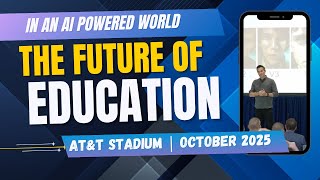
Keynote transcript of Matt Britton (Oct 2025) surveying AI’s rapid rise and its implications for consumers, business, and education. Britton frames the change through generations (Millennials, Gen Z, Gen Alpha), shares personal AI use-cases (custom GPTs for health and finance, business call-transcript analysis), explains the AI value chain and large language models, and urges educators and parents to teach problem-solving, data literacy, and perseverance to prepare students for an AI-driven economy.
Please welcome Matt Britton. Thank you. Hi, everyone. You know, it's funny. I grew up in the shadows of Philadelphia. A huge Eagles fan. Sorry. And I always dreamed I'd come into Dallas and wow the crowd. I don't think I ever thought it would be like this. But hopefully I'll get to deliver today like your Cowboys did yesterday. So congrats on that. I've spent my entire career helping the world's largest brands understand the new consumer. I was fortunate enough to have come out in the business world in the year 2000, when the new consumer was the Millennial generation. The millennial generation is the first generation to grow up with the Internet in the household. I'm a Gen Xer, and when I tell my kids that when I grew up there was no Internet, they look at me the way I looked at my grandfather when he said he walked to school with no shoes on in the pouring rain. But that is the reality. 25 years ago, there was no Internet. And people like myself who had to grow up with long twisty cords making rotary phone calls, hoping that mob wouldn't pick up and start dialing. I was just talking to my high school crush, or going to the library, or actually picking up the phone and talking to people versus texting. My brain was hardwired differently, as is many of yours who grew up in the pre Internet world. And then the millennials came into society and they changed things because they knew no other world but a world with the Internet. It changed their expectations, it changed how they communicated, it changed how they gathered information. Then about 10 to 15 years later, a new generation came in, Generation Z. And like the way the millennials were defined by the Internet and growing up with the Internet, Gen Z was defined by growing up with the iPhone and social media. Or for those of you who have a Gen Z kid has an iPhone as an appendage to their body, right? And now the power of the Internet was in the palm of their hands and obviously it changed the way they shop. Fast forward. Today, over 2/3 of all E commerce is actually mobile commerce. It changes the way they communicate, changes the way they can get information instantly. And we have tools obviously like Uber where you hit a button and a car just shows up, all due to the power of the iPhone. Gen Z is a completely different consumer. And now we have a new generation coming to society. Gen Alpha, currently age 0 to 14 years old. Gen Alpha will never know a world without AI. They will never know a world where you cannot talk to technology the same way that you talk to another human, it's going to seem foreign and even creepy to have your 12 year old in the house developing a very close, if not intimate, relationship with an AI chatbot. But. But for them, they're going to know no other way because they are going to be turning to AI for information, for advice, for emotional support, in some instances more than they will humans. Now, I know, I hear at conferences everywhere all around the world, this is so bad. It's so bad that AI is coming here. Well, we were told that rock and roll was bad. We were told that electricity is bad. In fact, when humans have been handwriting, Socrates famously said that handwriting is bad for humanity because it will not force humans to remember anything. New technology has always been demonized. And some of the negative comments about new technology have come true. The Internet has created wars, it's created terrible things, but it's also created love and arguably peace and great prosperity, as has social media, as is every other technology. But, my friends, we are not going backwards. AI is here. And whether you believe it takes away the artistry of what it means to be a human, whether you think it's terrible for your kids, not one company in five years from now is going to be using AI less than they are today. Not one shareholder of a major organization is pushing the company that they've invested in to use AI less. So when I hear about schools, taking AI out of schools, while I understand that you do not want kids to actually have ChatGPT write your term paper for you, which, by the way, my son did right when ChatGPT first came out. And I was conflicted because here I am getting paid to travel the world to talk about AI and he obviously gets in trouble for using AI to read term paper. My Eagles are actually in the super bowl, right? Leading up to that, I still thought it was okay to take him. His mom, not so much. We didn't go. I totally get it. Don't mess with her. Put the point is, we are in interesting times right now, right? And we want to be able to, especially in the educational curriculum, bring in AI, but not to the extent that it takes away people's ability to think, reason, do work, et cetera. And that's going to be ultimate balancing act for parents and for educators moving forward. But I do not believe shutting it off will do anything for tomorrow's future leaders besides disabling them. And in an increasingly globalized society, where we are right now in an AI arms race, which we'll get into. So it is tough and tricky times, but I can tell you, as somebody who spends 99% of their waking hours thinking about and building an AI, that this thing is far more powerful than probably most of you in this room even realize. And while the future is already here, it's not evenly distributed, but where it is distributed, people are realizing that we are never going to be living in the same world again. So what I hope to impart on all of you today is a couple things. One, an understanding of where AI is today. What is the bleeding edge of what this technology is capable of and what are the implications? Two, what can you do about it as individuals to future proof yourself as parents, as educators, as business people, to make sure that you're not on the wrong side of this? Because I believe a lot of people will be on the wrong side of it in the short term. And three, what it means for education? What does it mean for tomorrow's leaders? How do you implement it into a curriculum? What does it mean for facilities and the technology you want to integrate into what you're doing? So I hope you're able to pull away from that. I will be providing copies of my slides to everyone, as well as a copy of an AI agent which has the entire transcript we're going to talk about today. So if you want to dig deeper or ask about something I said, you could easily do it, just not with me, but with my digital twin. So we're going to dive right in and I want to thank the folks from VLK for having me today in Dallas. It's a beautiful day to be here. Let's dive in. So I talked about Gen Alpha and Gen Alpha being the AI generation, but they're more than just AI generation. Gen Alpha and their predecessors. Gen Z will be the beneficiaries of the greatest wealth transfer in history, where over $30 trillion with a T will be passed on from baby boomers to Gen Z and Gen Alpha youth in the years ahead. So my father passed away a couple years ago. And when he did, I was put in charge of his estate. And when I was in charge of it and I was sorting through everything both emotionally and financially, I was shocked by how much money he'd accumulated versus the way he lived. Like he was somebody who would circle around for an hour to avoid paying $7 for a parking space. We all know those people were parents. And I didn't understand it because he didn't have to do it. After I realized how much wealth he accumulated and why he lived in the house he did, why he drove the car he did. But the more research I did, I uncovered that my dad was a baby boomer and his relationship of money was one of scarcity. He grew up in the shadows of the Great Depression and World War II. And you just don't throw money around when you grow up experiencing that. Now let's juxtapose that against. Against Gen Z, when they were the beneficiary of the stimmies or the financial stimulus during the pandemic, was their relationship with Capital One of scarcity? I would beg to differ. GameStop, GameStonks, NFTs anything they could spend money on, they would. So one thing I often think about is what happens when $30 trillion goes to people who are holding on money like this, to people who are holding on the money like this. And what does that mean for society? Because this younger generation did grow up with Instagram, did grow up with seeing everyone else's highlight reels and believes that they should have it. Now, when you combine that with $30 trillion suddenly ending up in their hands, it is going to change society. And in many ways it already has. It's going to make people far less patient and it's going to change and drive industries. So I just want to give you that context when I go over this technology, because not only is AI so very powerful, but it's going to be ushered into society by a very affluent population that is more digitally savvy and looks at the world completely differently. So why is AI so very big? Why do I believe that it's going to change society the way I do? Well, there's a couple of reasons why. First and foremost, it is incredibly easy to use. There's a misconception out there that you need to be a whiz kid, a young, technologically savvy person that use AI. And that could not be further from the truth. In fact, the only thing you need to use AI is the ability to communicate in any language you want. If you can text your mom, you can use AI. It's more about understanding how to use it than understanding how to use it. In fact, my own mom, who now lives alone, would text me three to four times a week for the Netflix password. And I went to her house down in Florida and scanned every single appliance in her home, and I created a spreadsheet with every single password and I fed it into mom GPT, her own chatbot. And now she's able to just text the thing, which has a shortcut on her iPhone, and ask me information that she would normally ask me and while I still love to hear from her, it's not so much from the tech support side. And she's the least technically savvy person I know, and she uses AI to power her life. That's a perfect example. While the digital divide may have left people out who were not as technically savvy, that is not the case with AI. The other thing that fascinates me about AI is the rate of change that we're seeing. AI is doubling in its power and potency every seven months. So I hear people all the time in business saying to me, oh, I tried that a while ago, it didn't work. I can't do that. And my friends, that would be like me saying to you, I tried to stream a movie on the Internet in the year 2001. So here in 2025, I refuse to watch Netflix. It is really that analogy coming to life. It is happening so fast that in some ways, AI is progressing in its power in a way faster than humans have ever need to digest this rate of change. If you think about the iPhone, arguably the greatest technological innovation of the last 25 to 50 years, it took 18 months from the first iteration of the iPhone to the second to come out. And I would argue there's more innovation and growth and power in AI in the last 18 months than iPhone has seen throughout its entire life cycle of nearly two decades. That's how fast it's moving. So the rate of change and ease of use are ultimately the two things that are opening up exponential use cases and should make everyone in this room really prioritize understanding what AI is capable of and what it means for you. So I think a lot about education, I think a lot about what it means to be an educator. I have four children, I have two kids who are in college, and I have a one and four year old. That's a completely different keynote, but different generations, same problems, trying to figure out what technology means in an ever changing world. And because of that, I'm kind of exposed to a focus group firsthand on what education means, both with two kids in college and two kids that are entering their educational journey. I saw this article back in March that in Beijing they are rolling out AI courses for kids as young as age 6. Now, we may think that's not a great idea, but what is happening as a byproduct of it is there is less trust here in the United States in AI than in China. And when you trust something more, you lean into it more. And in a world where we are in a Global AI arms race. Because you have to remember, AI doesn't just impact business, our education, it impacts defense, it impacts the evolution of our society. Where would our country be right now without innovation? What is holding up America? It's the innovators, it's the apples and Google's and that is, it's certainly not manufacturing anymore. It's in innovation where our country's future and potential rests. And AI is at the heart of innovation. And right now we have a trust issue in America because we are not bringing into people's lives quickly enough. Again, balancing act and play, but that nonetheless. This is a study that came out late last year from the World Economic Forum about what people are looking for. And it should give you a little bit of a clue in terms of where we need to focus, in terms of nurturing and building tomorrow's leaders. And it's in the areas of understanding data, being creative, being agile, and understanding how to put the power of this technology to work. The best example I like to give in terms of how the world changed is one of photography. It used to be in order to be a good photographer, you needed to know how to go into a dark room with that smelly kind of liquid that you would use to develop the film. And then you need to know how to use a fancy DSLR camera with the knobs and the dials and understand ISO and F stop and, and all these nods and thousand technical specifications. But now 99.9% of all photos are taken on the iPhone. And the people who are seen as the best photographers in our society are those that simply know where to point the camera to. In the world of AI, it's far less about how to solve the problem and far more about knowing the problem that needs to be solved. Where to point the proverbial camera to. So much of the knobs and dials are now under the hood in an AI driven world that it allows everybody to uplevel up level in a more critical thinking and creativity and problem solving type framework, which I think really is juxtaposed against how we are used to learning in many ways right now. What is the new how? What are you going to do? What are you going to put AI to use for is far more important than actually knowing how to do something. And I'm going to give you so many examples of that. But that's not what we were all taught growing up. We were all taught growing up memorization and regurgitation. I was a terrible student, but I was taught that if you could memorize information and spit it out the next day that you would be a good student whether you retained it long term, kind of less important. That made sense in a knowledge economy. In an economy where you were rewarded heavily for maintaining and applying knowledge. Knowledge of how to do somebody's taxes and spitting out as accountant, knowledge of how to write a contract and spitting it out as a lawyer, knowledge of how to read someone's X ray and spitting out as a radiologist. But now all three of those careers have to be redefined because if not today, I can promise you tomorrow AI will read X rays better, it will write contracts better, it will do your taxes better than humans. That is a very scary thing to think about and something every radiologist, accountant and you know and, and lawyer will tell you is bullshit. It's not the case. But they are not living in AI like I am. I'm actually using AI to write contracts. I'm using AI to do my taxes and I caught a $5,000 deduction that my expensive accountant did not last year. What these models can do is take all the information on the open web and apply it. And they are getting better and better. So what does it mean for education? It means we need to teach young people to be critical thinkers, to be problem solvers, to understand the power of data. But we don't need to necessarily teach them to memorize and regurgitate information anymore because knowledge is, is increasingly become a commodity. And I think you'll see many examples today with data supporting it, which is why this is the case. What do those people do though? Because I mentioned earlier, you know, the future's already here, it's just not evenly distributed. But where it is distributed is the companies like Google and Microsoft. And what are they doing? They're laying off in upwards of 10,000 people every quarter because they understand a lot of the knowledge based jobs can be automated. Now we can say it's terrible, but what they'll tell you is well, how many people own Microsoft Stock in their 401k? How many college endowments invest in Microsoft? They have a responsibility to drive shareholder return. So they can't just employ everybody because then their stock will go down and then the people who hold those stocks will lose their retirement funds. So you really can't do that. So a lot of people don't understand that these companies are, have a responsibility. And with that responsibility and with their knowledge of where AI is, they are acting the way they are. And I think it's only a matter of time that Main Street America is going to be doing the same thing that The Walmart and FedEx is. And these big companies are going to realize what the tech companies have, and we are going to face a massive dip in employment here in the United States. Now, the hope and the optimist in me sees that as these companies do that they're going to be generating far more cash flow and they're going to want to reinvest that capital. And when they do, it's going to be towards people that are critical thinkers, that are problem solvers. And if you want to mold tomorrow's youth to be leaders, we have to teach them to be just that for people who are later in their careers. I worry and what I try to do is impart on people that you need to take action now. So let me tell you what taking action looks like. So I run a software company called Suzy. We have 300 employees. And when AI first came to bear, my first inclination was, wow, this ChatGPT thing's amazing. I'm going to give it to my 80 engineers who were trained at writing code to figure out how to use AI to better build our product. And I gave it to them. And I waited and I waited and I waited and nothing really happened. And it dawned on me this is a completely different realm than any other technology in the past. So instead I made the decision to figure out AI as CEO in my own right. And my experience throughout my life has been if you want to be good at something, attach it to something that you care about the most. So I made the decision that before I was going to use AI for my business, I was first going to use AI to solve a problem for myself personally. So as I mentioned earlier, I have two small children and I just turned 50 years old. And the problem I want to solve for is I want to stay alive as long as possible. I want to be healthy and see them grow up. So I set out to to use AI to do just that. Everything else I had done research on told me that it's your use of data that will make AI the most powerful. And I started to think, well, what is the data that's connected to my longevity? What's the data of my body? So I went through 25 years and collected as much information I could get my hands on. MRIs, blood tests, X rays, notes from doctors, information that was in file cabinets, information that was on external hard drives. And I organized it together. I was obsessive over a six to seven day period pulling this all together, and then I uploaded it into Something called a custom GPT, which is a version of ChatGPT that instead of it being trained on the whole Internet, is just trained on my information. And I gave it a prompt, and the prompt was, you are a leading doctor from Johns Hopkins University and you have one goal in your job, to keep Matt Britton. Al. And I finally felt like I was good enough to put it to use. And I was ready. And I had a cup of coffee and I was ready to ask it my first question. And the question I asked it was, if I'm gonna die in five years, what's the most likely cause? Now just think about that for a second. Like if you went on WebMD, it's gonna tell all of us we're gonna die, right? But this is something that is trained just on my information. It knows everything there is about my history, my family medical history. I've lived a relatively healthy life, but as I mentioned, my dad passed away pretty suddenly of cancer. And we all worry about our longevity, right? We're all mere mortals. And I wanted to know what AI thought and when it told me why I was most likely to die, it wasn't the reason I thought. I'm like, well, what about in 10 years? Something different. Well, why? Well, your blood markers show this. Your family history is this. What can I do about it? And ever since that day about a year and a half ago, I use it for everything. I use this health bot to write for my allergist a full dossier of anything in my health history, recent blood test, anything that's possible, and I give it to the allergist before I go there and they read it. If I'm feeling something off, I'm going to go to this custom GPT before I go to a doctor. This is not medical advice. I need to say that. But for me, I look at the reality, and the reality is that My doctor has 10 appointments before me and 10 after, and he may have a headache or maybe his football team lost yesterday, he's in a bad mood and maybe he's not going to give me the attention he's here. Maybe he's not even going to remember the information that was sent. But you don't really get that with AI. I often get asked also, like, don't you worry about uploading your health information into AI? And my answer is always the same. I'd rather risk chatgpt knowing my cholesterol store than dropping dead here on stage. Right? It's all about a trade off. Families post pictures on vacation. The risk is Your house could get robbed. You do it because you want people to see your cute family and the fact that you going somewhere nice. The use of technology is always about a trade off. And for me, it's a worthwhile trade off. And after I built this for my health, I built it for my finances and I uploaded my mortgage and my will and trust in the state and all that stuff. And now I use it during tax time or any question I have in terms of when that great interest rate's going to reset. Right? And they'll tell me instantly. What AI can do incredibly powerfully is take information and extract what matters and give it to you in any form factor you want. And it's getting better and better at doing that. Again goes back to the skill sets that are most needed because that's what we used to rely on our brains for, right? But now I would argue AI can do it better, but you still need to know how to have an idea to build a healthbot, how to have an idea to use that about how to use this incredible technology to further our lives. And then I took that same framework to my business and I took 25,000 hours of customer call transcripts that we had had since the pandemic and loaded it in. And what that taught me in terms of what we should do with our product roadmap, and what do customers say before they're about to fire us or before they're about to give us more money? It's all the same thing. It's understanding the problem you want to solve, understanding the data you have that can help you solve the problem, and having an idea of a solution. One thing I found consulting so much of the Fortune 500 and large companies is many people who work at large companies and probably large schools and universities, can't just download any tool they want and start uploading personal information. You're just not allowed to do that. But at home, you could do it at home, you could upload your recipes at home, you could upload your health information or, or your finance information or your kid's soccer schedules. And when I talk to him about future proofing yourself and how some people are gonna be at the wrong side of this, the way to be on the right side of this is having that hands on experience of how to use it. And I found the best way at getting that hands on experience is to build something for yourself personally. And if there's one homework assignment any of you take, and most won't, but hopefully some will try to go back to your home and try to build a custom GPT, which is basically a version of ChatGPT, on any type of data that's important to you. And if you want to know how to build a custom GPT, I'll send you a link where you'll be able to ask my digital twin how to do it. But it's just step by step. The thing about AI also is it's just following instructions. You could ask ChatGPT, I want to build a custom GPT to create a math tutor for my 8 year old. Give me step by step instructions. Do not give me step two until I tell you step one is done. And just follow orders, just ask questions. You'll hit some stumbling blocks, but by step 31, you're gonna look back and be like, oh my God, I can't believe I built this. And people around the dinner table are gonna think that you're the next Bill Gates, right? But the reality is you just have perseverance and curiosity and that's really all it takes. You do not need to have specific tech information in your brain or applications. It's just not like that. So what is a new how? What is a new how? And it's the biggest kind of profound stumble that I ran into in terms of how is the world going to change? So let me tell you why, what is a new how? And break it down for you. This is something called the AI value chain. It's the way I've tried to kind of, in a very easy format, describe and break down what AI is. And there's really four layers to it, the first of which being infrastructure. And I'm not going to spend too much time in infrastructure, but say you all should have invested in this company called Nvidia about five years ago. Nvidia is now one of the world's most valuable companies. And their success, like many companies, it was through happenstance. They created these GPU chips that were originally built to power the graphical demand of video games. And they were at the right place and the right time when this AI boom came. And now their chips are really the only chip that's in demand by the world's greatest companies to power AI. What powers these chips, though, are data centers and actual power. Right now, Deloitte is forecasting 30 times more demand for data centers in just 10 years in the state of Virginia. Right now, 40% of all power consumption is actually from data centers. So you. What we don't realize every day is when we use tools like this is that this incredible technology eats Up a ton of power. In fact, one query on ChatGPT eats up 33 times the energy than a simple search on Google. So with that, we're seeing many of the world's largest companies that are powering this dive into. And the optimist in me sees them diving into alternative energy sources to be able to keep up with this demand because it is rapid. Right now, large language models is ultimately the crowbar that got all most of us into using AI. And when I bring this up, I like playing this video because it's a good reminder of how quickly things change.
Back now at 56 pass, I wasn't prepared to translate that as opposed to in that little tease, that little mark with the a and then the ring around it at. See, that's what I said. Katie said she thought it was about.
Yeah.
Oh, but I'd never heard it. I'd never heard it said. I'd always seen the mark, but never heard it said. And then it sounded stupid when I said it. Violence at NBC. Yeah, it hurts me around picking up.
In the lunchroom the other week.
There it is. Violence@nbcge.com.
I mean, Allison should know.
What is Internet anyway?
What is Internet anyway? Internet is. This is on a Today show in 1998 when nobody knew what the Internet was. And it seems funny today because now it's like running water or electricity into our society. Well, AI is getting there. If you look at the time taken to reach a million users and you can ignore threads because it kind of just got turned on by Facebook. But ChatGPT is by far the fastest growing technology product in history. And if we look back 25 years from now, if I'm lucky enough to be here on stage, what we'll say is, ChatGPT brought America on AI the same way AOL brought America online. And what ChatGPT is, is a large language model. And a large language model basically has three steps to it. Just to oversimplify it, there's a prompt, which is basically like an input. You know, you say, I want the best spaghetti and meatballs recipe and ingredients for, you know, a table of 12. And then what it will do is it will take that prompt and go through a knowledge base of information. In the case of my healthbot, it was just the information I uploaded. But in the case of ChatGPT, it's actually going through the entire open Internet, right? And it's trying to find and piece together through trillions of different data sources, what the best answer is for you. And it'll generate an output and it could generate an output in any modality in any language. And that's why it's called Generative AI. That is what a large language model does. Not too dissimilar to what Google did or still does with algorithm, where you put in a search query and it processes it and it gives you an output. But there are many ways which we'll get into on how ChatGPT is far different than Google. But a large language model is basically the product archetype that brought, you know, AI to the mainstream. And there are endless amounts right now of large language models, the best of which being ChatGPT, which is by a company called OpenAI. There's Gemini from Google. There is a platform, a wonderful platform called Claude by a company called Anthropic. And then the Elon Musk has one called Grok. And they are all different and they keep leapfrogging each other. Right. So it's not like one is spreading ahead. And I believe with these large language models, we're going to look at it one day the same way we look at airlines. None of them are really that different than one another. And none of them have created an incredible business from a shareholder perspective, but they've been a great beneficiary to humanity. And that's how I think the large language model world will evolve over time. The one thing you need to know about large language models is they keep getting better. A year ago, the best large language model had an IQ score of 96. Today it's 136. Imagine your weird Uncle Larry was at Thanksgiving a year ago and you he could barely piece three sentences together and now all of a sudden he's a Rhodes scholar. That's what happened with AI. It is that much better. Where is it going to be a year from now? It's going to be literally off the scales in terms of iq. One company is obviously not turning an eye on AI is Google. By show of hands, how many people have used ChatGPT to find something that you would have used Google for a year ago? Wow. So that's 75%. Google is a verb in our society and Here we have 3/4 of people raising their hand saying now they're using something else to capture information. That shows just how quickly it is changing things for us. It is replacing search as the primary. Well, people are getting information and many companies right now are trying to figure out what does that mean in terms of having chatgpt recommend my brand or my product or service Datasets is the unique part of a large language model that makes my use of it different. Different than yours. My health information is not really valuable to you. Your health information is. And having your health information there is way more valuable than just going into ChatGPT without it having any context and say, what am I likely to die of in five years? If you don't give it your information, it's going to give you the same information it would give anyone else who's your age. Right. And anything else you gave them. That's why data is so important. So yes, ChatGPT is trained on the open web, but there are ways to season the data with specific information that make it better. In many ways, data is the new code that is a new differentiator. There's a platform out there called Reddit which is very popular. And the thing about Reddit is people have conversations about very niche topics, like what is the best place to walk my French bulldog in Duluth, Minnesota? Like that level of niche. And those are the types of questions that people ask in large language models. For that reason, a lot of the LLMs, large language models want to get their hands on Reddit's data. Allegedly Anthropic, which has one of the biggest ones, use Reddit's information without the getting paid and they're suing them. So we're seeing a lot of wars around data right now as these companies try to get their hands around it. But there's all sorts of data. I have a friend in real estate who has 58 brokers throughout Brooklyn and they were getting asked questions all the time, like what the crime rate or air quality or noise on the city block. And they would always have to say, I'll get back to you. But as it turns out, New York City publishes open data as an API, which basically means it's just spreadsheets of millions of lines in it. If you put this and connect it to an LLM like ChatGPT, all of a sudden the brokers have a superpower, right? And they can access the data instantly. And I ended up building this for him over a weekend. And now all of a sudden his brokers are way more effective and they can spend more time with customers and less time grabbing information. And that's really emblematic of the world we are headed to right now. So the fun part is applications. Applications is when these incredible GPUs which power large language models which are seasoned by data, get served up. It's the way that we use AI. And this is where I want all of you to think about how People are going to be using AI moving forward and what it means for what it is that you do every day, because we are in a completely different place now than we even were six months ago. So in the application world of AI, one thing to understand is it's both multimodal and multilingual. Meaning if you look at something like social media, it took about 10 years to go from text like, I just had a burger for lunch, right? That was like Facebook and the origins of Twitter, to images. Look at my Instagram picture of my burger I have for lunch to video. Hey guys, it's Matt. I just had a burger for lunch, right? And that Snapchat and YouTube, etc. About 10 years ago. There we're in AI. It's all there. Right now. AI can output in any modality, but it's also multilingual. It can now translate in any language instantly, which I don't think the world has got its arms wrapped around yet. Is that anything that you do in AI, anybody else can do do in any language, and it instantly translates it. In fact, the new AirPods have a way where in real time, if you go somewhere else around the world, it will translate for you. If we think about what's been the biggest barrier to globalization, it's been language and culture. And language now is ultimately solved through AI. So I mentioned earlier, you know how it makes no sense to say I used AI a couple months ago, it didn't work for something, so I'm never going to do it again. This is mid journey and it's a text to image tool. Version 1 was 17 months ago, version 5.1 was a couple weeks ago. But right now, version 7 is supposed to roll out for this particular tool in December. So tell me, where's version 13 going to be? Are you going to know the difference between AI generated image and a real one? No. Should that scare us? Yes. Deepfakes, nefarious actors, et cetera. Is it going to be deployed from for lots of ways for society? It sure is. And I can tell you, version one, that guy had six fingers on one hand and seven on the other. And a lot of people tried to build images out of AI back then and it didn't work and they wrote it off where now it is lifelike. Your ability to create imagery from anything you dream and put on a screen is instant. There's no gap between imagination and reality. It can just come there. You no longer need people who need to tell you how to do it. Perfect example. This is ChatGPT's image creation. That man right there who looks nothing like anyone in this audience, he was able to be created through a prompt. He does not exist. That is not a real person. He's an amalgamation of a trillion different data points. And in the past, if you want to have that image, you'd have to find that guy, pay him, have a wardrobe person, have a, have a lighting person, have a photographer figure out how to do the background. And now you just have to have the idea. So understanding the problem you want to solve, far more important than having that whole team to do it. If I want that cat to stop drinking a beer because it's driving and have it drinking a Diet Coke instead, just have to tell it to do it. So what does that mean for the future of graphic design? People who have spent decades understanding how to use things like Photoshop and all the knobs and dials where now Adobe itself, the company behind Photoshop, has Firefly, where everything is prompt driven. Knowing how to solve that problem, nowhere near as important now as knowing the problem you want graphic design solve. Google recently rolled out a tool which I think is the tool that has blown me away the most. And it's called VO3. And last week they wrote out VO3.1. Instead of you writing text to get an image, you can write text to have a video in 4.4K instantly. Anything you can imagine can now be seen and lifelike with a real person in a way that's increasingly indistinguishable for real life. Let me give you a couple examples. One day I'm gonna go into Dallas and wow them all. That was me as a kid, right? That person doesn't exist. He's outside of Philadelphia. I describe myself and that was the video that came up. What a great day to be in Dallas. I can't wait to hear Matt Britton talk about AI today, right? Pretty good, right? That's not really the stadium, right? Those people don't really exist. But tell me, if you were a film director in Hollywood, are you going to pay for extras anymore? Are you, are you going to pay for a scene of Main street somewhere and absorb that cost when you could just get it with a prompt? Now, right now these videos are only eight seconds long. But you saw the last slide of V1 to V7. This is going to be 80 minutes a year from now and two years from now, any of us are going to be able to dream up or own two hour motion picture or video game and have you or your kid as a star in it. Somebody like The Rock or Reese Witherspoon will be in movies that he or she actually never filmed for and they're just going to be licensing their ip. Now you can tell me no one's ever going to want to watch Reese Witherspoon when it's not really her, it's an avatar. And I will point you to the Electronic Daisy Carnival in Las Vegas every year where 500,000 people come to watch DJs press buttons with songs that were not made by instruments. People want to be entertained and they want to be entertained the way they want to be entertained. And we're going to be watching TV shows that are going to be different. You're going to be able to educate through schools with customized learning plans based upon what people want. You're going to have video based tutorials and based upon the level the student is at, the avatar will be able to deliver it. You're going to be able to capture transcripts from each student and understand what they're interested in and customize it in a really unique way. That is where it's all headed. But that is juxtaposed against the place where I spoke for Pearson Education last year for 700 professors, many of which told me their textbooks were written before ChatGPT ever came out. So there is a gap. And catching up that gap is going to be a huge challenge for the education system because the world is moving so much faster than any of us would imagine. But we are in a world right now where your imagination can become reality instantly. I made this video back there at that table because I had the idea of doing it and I put it in the presentation. I came up here and I'm showing it. So that is fascinating to think about because it changes the way that we should all look at the world. It used to be if you had an idea, you need to capital, you need to find experts, you need to do these things. Not anymore. You just need to understand. So how do we breed tomorrow's leaders to have ideas to come up with things like that? This chamber is closed until we agree on something real. You keep saying that, but you won't move an inch because your inch costs a mile. So this is ChatGPT's new video tool called Sora 2. I went to explain to my four year old daughter what the government shutdown was and I said, create a video that describes in a way a four year old will understand. And this is the video that they created. The chamber is closed until we agree on something real. You keep saying that, but you won't move an inch because your inch costs a mile. Order. Order. This is a video about rising interest rates. Rates and inflation bring down consumer confidence. Right? So these new tools, this is a different tool, but it allows you to more visually understand things. And here's the last one. So this is a video about how people are using, you know, DIY solutions for Halloween outfits, basically based upon rising costs and what they're doing. That house does not exist. Those people do not exist. That bicycle does not exist. But you can create it that quickly. So voice to video, text to video is really, to me, changes our world as we know it. Because if I would have told any of you five years ago that I could come up with something and have a video, create it five minutes before going on stage and show it to you, you would have said it was crazy, right? And that's where we are, Britain talking. But it's really Matt's digital twin. I've been told to speak confidently in front of all of you beautiful people at Nationwide today. Matt doesn't seem too worried I'm going to take his job though. So I played this for a talk. I gave a Nationwide insurance last. Last week. You can clone your voice. So I've cloned my voice. I start to clone myself for uses of me doing a podcast and me having readouts and all these things, and it's just not hard to do anymore, which is fascinating to think about. So digital twins is real. People are going to be creating Personas of themselves. We're already seeing it happen in social media. So many people realize that in order for them to get attention, they want to be in social media, but they're not comfortable on camera. They're building digital twins themselves and they are posting themselves talking in social media. Companies are rolling out tutorials using digital twins. It's starting to happen in the education space. We're going to see it happen more and more again. I think the best use case is hyper perspective personalization, where you can have thousands of videos that are each different, that are talking to people based upon that individual and what their learning needs are. Coding is one of the biggest places this is impacting. For so many years. If you studied to be an engineer and you went to MIT or Stanford and you learned how to code, it was a tried and true path to having a great career. But now there are tools like cursor and lovable that allow you to, with a simple prompt, actually output a software product. I mentioned I was at Nationlike last week on the plane the night Before I actually prompted something to have a competitive price testing tool where people nationwide who work there can see how their prices compare to their competitors. And I showed up to them with an application they would have paid millions of dollars to have developed a couple years prior and just build it for me now. You need some level of technological knowledge today, but not for long, which is why software development job postings in the United States have plummeted. Another how to solve the problem type job slowly going away. So the sooner we could all realize that the knowledge economy is fading away and our ability to be creative and be critical thinkers and be analytical and be problem solvers is really what matters, the quicker we can be on the right side of this to wrap up here. There's an adoption curve that's going on right now in AI. Most people are using AI as a tool, like a call and response tool. Almost like you'd use Google, right? Give me a recipe, write a blog post, tell me the best places to visit when I'm in Utah and it'll tell it to you. That's using AI as a tool. That's about 90%, about 9% of people are using it as an automation tool. So to give you an example, I'm about to show you a QR code which you can snap on your phone and give me your information and I'll send you my agents. You can get information. You're going to get the email and it's going to be written to you automatically. I'm not going to have to do a thing because I created a tool which takes your email address, figures out who you are, writes the email, pulls the information and sends it out. That's automation. That's the first place AI is going to take jobs is people who go into work every single day and have a deterministic role. They're doing the same thing every day. They wait for their boss to tell them what to do. Building these up automation tools is incredibly easy. And there are so many jobs that just aren't needed because I can do it. And a lot of companies are going to, unfortunately, I think because of pressure, they're going to get it, get, they're going to be turned on. This where we are right now though, and this is really only 1% of the use cases is in the world of AI agents which instead of going from step one to two to three, you could sign up and an agent would say, oh, Matt, Matt, I know Matt knows that person. So instead of me just sending them a generic email back, I'm Going to ask them for lunch the next time Matt's in Dallas in mid November, and it'll do it for me. That's what agents can do. And we're going to start to hear and see a lot more about AI agents, which have autonomy. So instead of being deterministic at being taught to go through these steps, it's going to have access these agents to a variety of different tools, and you're going to have agents for your personal life that are going to be able to book things for you. And obviously, agents are going to write curriculums and agents are going to write emails. I might be sounding like I'm crazy right now on stage here, guys, but I'm telling you, I didn't know anything about code a couple years ago. I've never engineered in my life, and I've spent 99% of my hours. I haven't slept a lot, as you might be able to tell. I'm chugging Mountain Dew before I'm going on stage. It's hard to sleep when you actually see the future, and I'm living in it right now. I'm building for the world's largest companies. You're going to see agents everywhere, and it's not going to hit everywhere right away, but the world's smartest companies are already figuring out how to adopt it. So what does it mean for everybody? What does it mean for students? What does it mean for educators? What should we be doing? Well, to me, there's four main pillars. First and foremost is you have to learn how to be a problem solver. A lot of people don't know how to use AI because there's so many tools. It's so overwhelming. It's almost like turning on Netflix. There's a million things to watch and you feel like you have nothing to watch. Right. It's a paradox of choice. You have to really figure out what is the problem that you want to solve either in your life personally, like I did with my healthbot, or at work. And the way you frame the problem you want to solve is what can save you the most time so you can do things that you like doing more or where you can be more productive. Because that's the. The promise of AI ultimately is it can allow us to uplevel the way that we spend our time by having AI do things that we don't necessarily need to do anymore. Right. Whether it's data entry or doing tons of research, that's what AI is great at. So figure out the problem two is practicing perseverance. If you do want to learn how to really be a master or even somebody who's adept at this, you're going to have to have perseverance. It's going to take time. And, and if it, and if you hear that it takes time, 10 steps or 15 steps to build your Healthbot, you can't quit at step six. You can't say, oh, I don't understand it. Because with AI you can say, well, explain it to me like, I'm six years old. I do that sometimes. I'm like, oh, now I get it. Explain to me like, I'm four years old. Just at a certain point, you will understand what the next step is and how to do it. Data is so important. So understanding the power of data and then being action oriented, like taking action either personally or in your business life to actually understand this, because it is like we all woke up and all of a sudden we have electricity, right? That was. I was actually at Disney with my family and there's this ride called Carousel of Progress, I think it's called. And it shows how there was a point where there's electricity and all of a sudden there's electricity and it's like, wow. Well, that's where we kind of are right now in society, I believe, is we have this technology that is just as. As powerful and will be just as impactful in society as electricity, as the Internet, as industrial revolution was in our society. And it's so very new and so very powerful. And the sooner we understand it, the sooner I believe it can improve our lives, despite the concerns that might come out of it.
More from Matt




MikMak’s Rachel Tipograph on Consumer Spending, Retail Media & Holiday Shopping Trends



Jaguar Land Rover’s Charlotte Blank on Luxury, Purpose & Experiential Storytelling



