The Future Of Travel 'A To Z' A Keynote By Matt Britton | September 2024
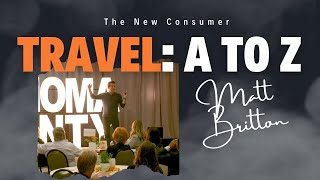
Keynote presentation ("A to Z") by Matt Britton (September 2024) surveying 26 consumer and travel-related trends—one per letter of the alphabet—aimed at helping hospitality and travel businesses prepare for Millennials, Gen Z, and emerging generations. Britton frames generational differences (Millennials: age 30–45; Gen Z: mobile-first; Gen Alpha: age 0–15, AI-native) and argues AI, creator culture, personalization, creator-driven content, mobile-first experiences, chatbots, dynamic pricing, impact travel, and the barbell economy are core forces shaping demand and marketing tactics. The talk mixes high-level trends, tactical recommendations (e.g., deploy AI chatbots, mobile-first sites, leverage creator partnerships, use generative-AI tools like Canva/Suno), and brief demos/ anecdotes.
Impact of Millennials and Gen Z. Currently at the helm of Suzy, a pioneering consumer intelligence platform. And you know how we love our consumer intelligence. Matt has facilitated a radical transformation on how brands garner real time feedback. That radical transformation is what we too are looking for as an organization. Before making his mark with Suzy, Matt established mri, a digital and social media marketing agency. He also is the author of Youth Nation, a best selling book on Amazon. But we bring him here today to help all of us better understand the Millennial generation, what makes them tick, what makes them different, and really how all of us can better embrace this important consumer. So everybody, please help me welcome Matt Britton to the stage.
Thanks everyone. Just going to grab my clicker and dive in. It's great to be here in Sonoma County. You know, being a keynote speaker is glorious. Get to take nice morning walks here. And of course, tonight I have the wonderful red eye to Cleveland. So it's not all roses, but I love what I do and I love getting in front of people and really painting the picture of where the world is headed. I've spent my entire career helping some of the biggest brands in the world understand where the consumer is going. When I first started my career in 2000, the Internet itself was first being adopted as, as a media consumption tool. When I tell my kids that, they look at me like a dinosaur. Sometimes I feel like that. But if you think about all the change that we've seen in the last two and a half decades, it's truly remarkable. Since I've been in the workforce, and probably since many of you have, we've seen the onset of the Internet, we've seen the onset of YouTube and Facebook and so many transformational tools that have changed the way that we communicate with each other and that businesses communicate with us. And we talked about millennials during the onset and why they're so important. And millennials have been a big buzzword because they are the first generation to grow up with the Internet in the household. Right now, millennials are aged 30 to 45. One key note is millennials aren't so young anymore. The youngest being 30, the oldest being 45. You can almost look at the Millennials as the head of the household. Where in the past you'd thought of millennials, maybe for Doritos and Xbox and pizza. Different generation. But again, millennials are the first generation to grow up with the Internet in the household. Then you have Gen Z, which, which is the first generation to grow up with the mobile device in the household. Or as many of you probably know with children, a mobile device as an appendage to your body. So they never knew a world without the iPhone. And the iPhone had such a transformational impact on the way that we communicate. When it first came out, it was stated that the iPhone had the same power as all of NASA did 20 years prior. So obviously being defined by the iPhone as a generation has changed society. You have consumers that are constantly looking down on your phones. And obviously, as younger people adopt these habits, as do their parents, and as does the rest of the culture. And next, we have a new generation coming up, which I'm not going to talk a lot about today, but you're going to start to hear a lot about in the years ahead, which is Generation Alpha. They kind of reset the Alphabet. Generation Alpha, age 0 to 15, is going to be the first generation to grow up with artificial intelligence in a household. So they are never going to know a world without AI. I am going to be talking about AI today because in my 25 years in business, I have never, never seen a tool that has such power to transform every facet of life as AI. And even though this presentation's not an AI, AI is seeping into every corner of the way that we live, work and play. So you're going to hear me talking about that a lot today. The name of my presentation is called A to Z and it's called A to Z for a reason. What I'm going to do today is go through every letter of the Alphabet from A to Z, and every letter is going to correspond with a trend that I think impacts your consumer. Around travel, around leisure, around the way that they live their lives. This presentation is being recorded. So you're all going to get a video of this. So you're welcome to take pictures of the slides, but you're all going to get a copy of the slides and copy of the videos that you can share and re watch again. So thanks again to the good folks from Sonoma for having me today. And I can't wait to deliver this presentation, so let's dive in. So as I mentioned earlier, A stands for AI. And I can tell you that my journey with AI was sort of eye opening for me. I run a software company with about 300 people and I kept trying to get my team to understand what AI is and no one was really able to adopt it. And I took a step back during the holidays of last year and said, you know what, it's up to me as a CEO of my organization to understand really what AI means and what it can do. And instead of diving into AI to try to solve a problem for my business, I first dove into AI to try to solve a problem for myself, right? So I have young children, and I want to stay alive for them, and I want to see their grandkids, and I want to, as we all do, live as long as possible. So that was my core problem. I want to survive. I mean, that's probably everyone's core problem they want to solve, right? And I look to AI to help me do it. And the one thing I learned about AI is the power of AI. And unlocking it is not just logging into ChatGPT and typing whatever you want. It's feeding with data that matters. In the case of staying alive and your health, the data that matters is information that you get, like your blood test, your X rays, your mri, maybe things that your Apple watch tells you. I went through all my email over the last 20 years, and I dug every piece of document and data that I could on myself, and I fed it into something called a custom GPT, which is essentially the ability for me to talk to all that data, but with a layer of analysis on top of it. And I essentially created my own healthbot. And I start to ask it questions like, if I'm gonna make five doctor's appointments this year, what should they be? If I'm gonna die in 10 years from now, what's likely gonna be a cause? Why do I feel this way? What should I eat? What should I not eat, right? And what I learned from it was really fascinating. And it really showed me the future of not just where the medical field's going, but where the world is heading in general, is that we all have data. You have your own business data. We have data for the county, we have. We have data for the country, we have data for the world. Your ability to take that data, put it into a form factor that's driven by AI, and have it tell you things is gonna be the future of how we interact with everything. From that, I took it to my business. What is the blood pressure of my business? What are the X rays of my business? And start to tell me things about my business that I never knew. We were able to uncover about 20,000 hours of transcripts with customers that we were able to basically transcribe, put it in this model, and learn all sorts of things. So this is very much just the beginning. AI is evolving so quickly, it's even hard for somebody like me to keep up. In fact, I refuse to give presentations to conference producers more than three days before I present because the news happens that fast and I want to make sure that I'm on top of where everything is headed for our audiences. So as I mentioned earlier, Gen Alpha is indeed the first generation to grow up with the Internet household and not only with the AI in the household. Not only is Gen Alpha have that standard, but they are also going to be part of the first fully digital household. Because the parents of Gen Alpha are actually going to be millennials who themselves grew up with the Internet. So what we saw with Gen Xers is they had kids who were Gen Z and there was a big digital divide. They didn't truly understand what was going on. But now that digital divide is going to change and what that means for everybody in this room is as time passes, digital is dial tone, digital is oxygen. And there's no world where digital is not the core of what you're looking at. And with AI, there's no world where data and your own business data isn't the core. I'm going to dig deeper into this during this presentation because I looked at a bunch of the websites of a lot of people in this room and there are so much low hanging fruit you can do to better communicate with your prospects and customers. That doesn't cost a lot of money, it just takes a little bit of effort. And my hope is when you leave here, you'll take one or two ideas back to your business to make yourselves much more ready for 2025 in this future. Facing world. B stands for the barbell economy. And we have seen the withering away of the middle class in America for a very long time. What we saw during COVID is basically the rich got richer and the poor got poorer. You had people who owned stocks that exploded, you had people that were on the front lines that really either got laid off or saw inflation outpace the rate of wages. And what that has created in a business capacity is what I call the barbell economy. Which means there is still tremendous opportunity on the value side of the equation. Dollar Store, Dollar Tree, Dollar General Vizio that sells flat screens for $199. And there's tremendous opportunity on the luxury side of the equation. They're selling birkin bags for $30,000. Amman Resorts is getting away charging $5,000 during the holidays in their various locations around the world. There is sort of an immense demand that's grown faster than ever before on the luxury side. But what's really struggling is the middle of the barbell. If you sell $100 jeans, right now, you are struggling. If you're selling $20 jeans at Walmart, you probably are doing okay. If you're selling $250 jeans at a cute little boutique, that's going to do okay as well. So when you think about your business, you want to think, am I selling $100 jeans? And if you are caught in the middle, in this world where you are seeing a withering wet of the middle class, which is only going to continue with this millennial generation, you almost need to rethink your strategy. And I'm seeing that commonality take place across almost every industry that I work with. C stands for the creator movement. As I mentioned, what defined Gen Z is the phone, and the first generation to grow up with the phone. And when people are staring at their phones, what are they looking at? Well, they're normally scrolling through a social media feed, and when they are scrolling through a social media feed, they're looking at content not from a new source, but more often than not from other people. Other people are dictating their habits, dictating where they travel, dictating the restaurants, dictating the clothes that they buy, et cetera. Those people that are posting are called creators. And there's been a lot of talk in the last couple years about what's called the creator economy, which is basically a burgeoning class of professionals that are making a living creating content for brands. First, they'll create content for themselves. So maybe they'll be a foodie, maybe they'll be a luxury traveler. Maybe they'll be a mom that wants to talk about their journey as a mom. And they'll talk about the products that they're buying and what they're doing. With millennials, and especially Gen Z, that is how they're learning about everything. I can tell you firsthand that if you're targeting millennials, they are learning about this location. They're learning about your properties, not through ads, but through seeing somebody else post about it on Instagram. And so many businesses aren't focused on pushing out content and working with creators and making it more likely that you're going to be in that feedback. That's where eyeballs are. Kids that are going to college right now, they're not bringing TVs. When I went to college, everybody had a TV. Why? They're just looking at their phones, or maybe they're going on YouTube on their laptops. That's all you need to know in terms of how consumption is happening, creators is a movement. Creators are where content is coming from and to understand who these creators are that talk to your prospects, talk to your customers, and to put content out there that those creators are likely to gravitate towards and share is a huge opportunity that you need to prioritize moving forward to focus on this new consumer. So I mentioned earlier that there are several things that I think are low hanging fruits for many of you in terms of what you can take away. And I think the number one thing, and it might sound crazy for me to say this, is to have a chatbot on your website. So one of the things that defines millennials is they hate picking up the phone. Gen Z will not pick up the phone. It's called the iPhone. But millennials and Gen Z use it for everything but the phone. To be honest with you, I hate picking up the phone too, unless somebody who I really want to talk to is calling me. But do I want to pick up the phone to change my airline tickets or to make a restaurant reservation or to make a doctor's appointment? Absolutely not. Do I want to pick up the phone to find out when a place is opening or closing, or if they have coat check or you name it. Absolutely not. There are tools right now called AI chatbots, which can essentially pore through your website, pour through any information you want. Instead of forcing a customer to have to call you or email you, they can just ask something on your website, a question, and it will respond just like a human will. How much does this cost? It costs about $30 a month to do. How long does it take to set up? About 30 minutes. And it will change the way that consumers act. Why doesn't everyone do it? Because this is a new phenomenon. It happened a year ago. Right. And I can tell you, I run a software company. We have very sophisticated questions. Since we rolled out a chatbot into our platform, the amount of increase for our customer success team dropped by 85% and our NPS score went up. So now those people who are in the past responding to those inquiries are spending time building deeper relationships, coming up with new ideas, being more strategic. So an AI chatbot is something I think everybody should look into, because people, when they go to your website, have questions. They want to know things the quicker and easier and the less friction they have in getting those answers, the more likely they're going to end up converting and visiting one of your establishments. So I'm going to send information out to everybody who signs up about how to set up a chatbot. Super easy. This is not some telemarketer thing. I'm not going to try to make a quick buck. I'm just going to send it to you guys because it's pretty easy. I hope that a lot of you guys take my advice because it is the new way. It's just like almost if you didn't have email in 2010, not having a chatbot in 2025 is almost like the same thing. Digital nomads so we talked about on the onset about COVID and the huge impact it's had in all areas of society. And digital nomads are essentially a byproduct of COVID We have seen a lot of young professionals, millennials, Gen Z consumers, choose a different path in life instead of going to work for a big Fortune 500 company and working their way up the ladder. Many companies offer remote work and in the instance they don't, many young people are saying, I want to actually go deep into a skill set and actually become a freelancer. And there's a huge gig economy going on right now where people, if they have a highly specialized skill set, are offering their services not as an employee but as a contractor. And since they are not bound by any physical space, many of them have chosen the route of becoming what's called digital nomads. Which means if you don't have kids or anything holding you down yet, well, I wish I would have had the opportunity is travel around the world, bring a laptop with you, still work. And it's actually a big driver in a lot of tourism driven economies because they're tourism driven for a reason, because they're beautiful places that people want to be. And I think tapping into a digital nomad world where there's co working spaces, places for people to be able to work here. Where else would you want to work than here? It's absolutely stunning here and such a beautiful place to live. And I think digital nomads is an area where if you're a hotel, is there a co working space? If you're a restaurant, can you open up space during the day for people to be able to meet about topics? There's so many opportunities to tap into digital nomads and then once they get married and have kids, if they do, they'll remember their time spent here and you're kind of investing in the future as well. So we're seeing a lot of markets that are primarily tourism driven markets. Tap into digital nomads as a new unique segment which was again opened up by this new gig economy. The experience economy is real. You could see what happened to the experience economy in terms of people spending on things versus experiences and the things spending blew out of control. Obviously during COVID people bought a TV for every room in the house, including the bathroom. People had so much money as a result of unprecedented fiscal stimulus that they bought cryptocurrency and they bought meme stocks and they bought all sorts of things. And then we did see post Covid era of what was called revenge travel. And what I think your area witnessed is what a lot of areas witness is the first couple years post Covid, a lot of people traveled domestically and then we saw a huge boom in international travel. There's actually another big driver, I think, of probably some softness with your consumer, which is the reason that inflation happened, is that the economy was overheated and interest rates rose, an unprecedented rate, which means the cost of everything, as you know, from car loans to mortgages, et cetera, went up and it cooled down the economy. And now we're starting to see unemployment rates spike. Two data points that really show, I think what's going to be probably a tough year for the consumer in 2025 is right now savings as a percentage of income is near an all time low, and credit card debt as a percentage of income is at an all time high. So what started to happen post Covid is people obviously got all this fiscal stimulus and they start to basically feel rich and they created a certain lifestyle and then the stimulus ran out, costs went up and they accelerated faster than wages did. And people just didn't change their lifestyle because we all know changing your lifestyle is hard. So if you're spending more than you make, what do you do? First you deplete your savings, then you put it on credit cards. And that's actually what we're seeing happening now. The relief is going to come with interest rates coming down. But the reason that interest rates are coming down on an accelerated basis is the government saying that the consumer might be in trouble. So just when you look at pricing and you think about demand, I do expect 2025 to be a tough year. And I'm not an economist, I just play one here on stage. But from everything I'm seeing, I am seeing softness. And I work with most of the big consumer brands that sell coffee, that sell fast food, and they are already seeing softness. And when someone's cutting out a $7 latte, it's usually the first thing that they cut out when they have to cut corners. And you probably saw Starbucks most recent earnings. That's exactly what they're seeing. I do think that's something that you should think about. Foodies is a byproduct of the creator economy. There are all these deep interests and niches that people get into and food is one of them. It's basically food has become more than something that's sort of a necessity to survive. It's become almost like a lifestyle thing, right? And it's not just about food. It's around the experience of food. And the one thing I don't see enough of is if you have a restaurant, if you have any type of establishment that serves food or drink, make it shareable, right? So going back to where people are looking for information, it should be shareable. It could be something as simple as putting up Christmas lights inside your venue to make it look really pretty during the holiday season, or playing really cool music, or just doing something different. Because the difference of you spending the extra couple thousand dollars in your venue and not could be the difference of you growing 10% or shrinking 10% year over year. Because people will share it and their friends follow them and they're gonna say, oh, that place looks cute. Where'd you go? Oh, I went to Sonoma. Oh, I didn't think about going there. And that's all it takes. And that's how people make decisions right now. So if you don't actually have something that's shareable, you're not even putting yourself in the ball game. So what are little things you can do to make the experience that you have shareable? It doesn't have to be like Disney World, right? But little things that you can do to get people talking about it in a different way. Surprising delight, things of that nature. Generative AI tools are incredible right now. So what do I mean by that? It means the video I just saw before I got on stage is something that in the past, maybe companies would have spent 10, 20, $30,000 on. And it's the type of video, two years from now, you're going to be able to just dump a bunch of information and hit submit and get done right away. This is a tool called Canva. It's a multi billion dollar company that allows you to create any type of asset almost instantly. Logos, brochures, collateral, videos. It will blow your mind in terms of how easy it is for you to create things. We all are creating things. Signage, menus, social media, posts, et cetera. If you spend a day on Canva, you will cut your cost dramatically over the five, ten years ahead. I ran a Madison Avenue ad agency for 15 years. I know how much we were able to charge. I would never start an ad agency again because I know that a lot of those tools are going to be basically automated through AI, and it's incredible in terms of what it can do at the highest level. So. And it's not just, by the way, static images, it's now in video. A couple big movie studios recently just announced they're partnering with AI tools to basically create settings for big movies that they're creating where they no longer need to have the whole industry complex of creating big shoots. Tyler Perry announced that he was stopping a $70 million huge project to create a new studio in Atlanta after he saw the power of what text the video AI tools can do. So Canva is real, and it's something I would expect to see much more of in the year ahead. Health and wellness is obviously a huge boon that we've seen post Covid, especially with Millennials. They are focused on longevity, they're focused on healthy eating, and that is just a big vertical to tap into. So you could have a beautiful place out here. And it's just the one difference of how you're positioning it that could be difference if someone's going to come here or not. And people are really diving into wellness as a huge part of their overall personal strategies, especially around the New Year, right? New Year, New Me sort of thing. And health and wellness with Millennials is just, it's an all time high in terms of impact, as is impact travel. So impact travel is essentially a lot of families who are growing up. And one thing we're seeing right now is that Gen Z is the first generation. Actually, from an economic standpoint, they're worse off than their parents. And there's a big divide going on right now where Gen Z has expectations they're going to be able to live the life their parents lived, but for a variety of reasons, it may not be the case overall. And one thing we're seeing a lot of millennial parents start to do is focus on other ways to gain enjoyment and to feel good about what you're doing. And one huge way is impact. How do you make an impact on the community? So, yeah, you're going to travel, but you're not just traveling to have fun. You're actually traveling to give back. I'm on the board of a nonprofit called Pencils of Promise, which builds schools in underprivileged areas around the world for kids who otherwise wouldn't be able to go to school. And we run many trips every year where people come as part of travel with their families to actually help those schools be built. And most of them come back and say it was the best trip or vacation that they've ever had. So there are opportunities where you can inject that impact based travel to serve underprivileged communities that may be surrounding this area, or ways to give back that actually are impactful while having leisure as part of it. It's just another thing to think about just in time. We are booking travel later and later and later. We are waiting longer and longer and longer because life is so unpredictable right now. And the one thing that's grown over the years is people's use of these tools to be able to at the last second find a place to get away, whether it's for a weekend, whether it's for a holiday trip, et cetera. A big thing driving this is dynamic pricing. If you obviously, as you all know, if you run a hotel and the day pass, you're never going to be able to get that room back. Your ability to really tap into dynamic pricing is going to help you dramatically at shoring that revenue gap. In a world where the consumer is coming under financial pressure when where if you're able to drop your prices to last minute people who are booking, that's what consumers expect. There's obviously a trade off for them not having the assurity that they would have had your room a month ago. They're trying to book it now for this weekend. And if you can tap into dynamic pricing combined with just in time travel habits of consumers, that's another area to look at. Millennial parents, as I mentioned, age 30 to 45. So you have the first generation to grow up with the Internet now in their major child raising years. And many of them are in a world right now where they're following a bunch of mom bloggers and they don't want to. They feel guilty leaving their kids in a way that Gen X parents did not. My parents left me home all the time and didn't really care. I got into lots of trouble. They're called the helicopter parenting generation. They want to be on top of it all the time. As a result, kids first travel matters. So no matter what line of business you're in, are you thinking about the kids? Even if the parents want to just each down a bottle of wine themselves, it's all good. Just make sure the kids have a pony to go on, right? And make sure the parents aren't riding the pony. But you have to consider the kids as part of your overall messaging. If you're going after families and sometimes again, it's just that little thing in the messaging that makes all the difference in the world. So it might not be kids first travel, but it could be kids acknowledge travel in your messaging that actually could help you again, because this is all about moving the inches. If you're talking about being up 5% one year and down 1% another year, the demand is there. It's just about capturing it. It's about increasing your conversion rates. It's about having these little things for people to hook onto. Where maybe in the past they say, you know what, I'm going to go somewhere else. Where now they're like, okay, wow, they have that too. And that one thing could be the difference of them moving forward or not. And that's one of those areas. Loyalty is obviously huge. First party data is huge. Your ability to collect information from your customers and prospects is paramount right now, especially in a world where it's harder and harder to target. You've probably read that companies like Google are no longer allowing cookie based targeting as they have in the past, where you can retarget based upon how consumers go to other sites. And as a result, what we're seeing is the largest, most sophisticated digital marketers are focusing on collecting first party data. Which means when someone comes to your establishment, do anything you can to capture their information. When someone comes to your website, do what you can to capture their information. And with so many AI tools that are out there, there's really no limits to what you can do to make yourself smarter and more powerful marketers that are operating at a much higher performance. Mobile commerce is so huge and it just shocks me how many websites I go to where it's just not built mobile first. We need to build everything mobile first right now. If your website isn't built first for the iPhone, you are missing out on opportunities because that's just where people are going to, right? People did buy more laptops during the pandemic, but Dell recently reported that that boom is kind of going away because people just, it's not something that's natural to them. Being on their phones is so mobile commerce, mobile first experience is huge. So many websites are built for desktop and when people go on their phones, the text is really small. They mean to click on one thing and they click on the other and they'll go somewhere else. So is your website mobile first? When's the last time you went on your website with an iPhone, right. And clicked through every single page because you can't expect anybody else to do it. And that's what your customer is doing. So this is a fun one. Music. So music is obviously so important, right? It moves people emotionally and it's something that's largely been out of reach for many businesses to actually tap into. Because what are you going to hire a band? It's very expensive. But with some of these AI tools now, you can actually tap into music in a very profound way. How many of you in the audience have heard of a tool called Suno? OK, more than I thought. So let's say 5, 10%. So Suno is actually a tool that allows you to create music in any genre for your business, for your dog, for your kids, for your spouse in any way possible. And it's an amazing way to drive engagement. So I basically went online and I found one venue that's in the area, Buena Vista Wineries. And I said maybe I should try to build a song for them. I did it just before I walked into the room, probably 15 minutes before I went on stage. So first I asked them to create a folk song for Buena Vista. And here it is. We can turn the sound up. In the heart of old Sonoma where the grapevines twine stands Buena Vista Winery where legends intertwine the grand old estate where history pours in casks and barrels behind oak timber doors so pretty cool, right? Ghost on heart? Maybe. Maybe not the right audience. Maybe we need something more upbeat, more poppy. So they said the great one in a. In a pop version. In the heart of old Sonoma where the grape vines twine stands Bu Vista Winery where legends intertwine the grand old estate where history pours so obviously your ability to engage customers is dramatic with something like this. You combine this with your website, with social media content, you make up jingles, you push it out there. It's fantastic. The reason that so many brands, the biggest brands in the world like Pepsi, spend hundreds of millions of dollars every year on music is music moves people emotionally. And now you have the ability to create something. I just copied an article on this winery and I pasted it and I just said the style I wanted and that was it. So this is a fantastic tool. It's super fun. And we're in a period right now where there's an arbitrage opportunity. There are these incredible tools that 5% of people know that 100% of people should know about, and if you put them to work, most of your competitors won't. And that's how you can actually move ahead. So I'm just trying to give you all these little Edges, tactical edges in terms of engaging people deeper so they think about you. Another area is niche audiences. So the Internet and especially social media has been great. It's created communities, right? There's communities for people that have French bulldogs. There's communities of people that love doing handstands for an hour at a time, right? There's communities for people that love mustard. You name it, there's communities for it. Communities travel together, communities talk to each other. Communities are tight knit. If you spend time on a platform like Reddit or Facebook and you look at communities, they usually have get togethers, they usually have reasons to get together and either have conferences or events and it's usually around the shared interest or passion. It used to be about demographics, when companies thought about demographics, 18 to 49 year olds, but now somebody who's 19 is more likely to hang out with somebody that's 34 that likes the same thing as them, right? So that's psychographics over demographics. And psychographics obviously have a huge impact in terms of creating niche demographics that you can tap into that you probably haven't thought about in the past. O stands for Ozempic. This is another massive, massive consumer trend that I believe is going to be regulated and prices are going to come down. And you're already seeing United Airlines said it's lightening their load in terms of over, I mean, weight on their airplanes. And it's actually, I'm trying to be sensitive but just said and basically their gas prices are coming down. Overall you're seeing a lot of fast food places say they're having decreased demand, candy companies, et cetera. And it's also creating a boom in a lot of active activities, active lifestyle type activities like hiking, like biking, et cetera. Because when people lose weight, they have more energy and they want to do more of those things. This is a good trend for this area for sure. And it's something that it's also, I believe it's a good thing for the country because obesity was a huge problem and still is. So it's getting adopted by doctors much more than they thought it would. I'm not a doctor, I'm not playing one on stage, but it's something I think I would keep an eye on moving forward. P is for personalization. And one thing that AI can do in a really profound way, and I believe this is going to start to happen faster than anyone in this room probably thinks is many of you probably send out newsletters one to many. And over time what you're going to be Doing instead is sending out newsletters one to one. So emails are going to go out. AI is going to help write it. And you're going to say, hey, Joe, I know you stayed here in March 2017 and came back in June 21st. I know your birthday's this date. I know your kid's this, you should do this. And that is personalization. Personalization has not really been brought to life, but it's being brought to life just the same way. I was able to create that song about that winery. I could create a song about that winery's location in Minneapolis if they had one. And I can create 70 different versions for 70 different people. And that's where it's all headed. So AI is unlocking all this, and I think it's going to be fascinating to see where it all goes. Q is for cueless experience. Millennials hate waiting in line. We saw this company clear that allows you to not have to show your ID at the airport explode in popularity. This is the generation that had the E Z pass or I don't know what they call it here, when you drive by and you don't have to stop at the toll. And this is worse. When you go to a convenience store and you have to scan stuff yourself, I actually think it's a worse experience. But all this was predicated on the consumer insight that people hate waiting in line. And you're already seeing a lot of hotels now offering people the ability to check in in advance. But I think restaurants should do that. I think stores should have the ability for people to pre purchase. Time is a precious commodity in this world. We have more two income family earners than ever before. People are pressed for time. Nobody wants to wait in line for anything ever. Right. And if you want to get a good review, reduce the line at all costs. And if you can do that, it's going to be one of the first things people remember in terms of why the experience was great. And certain businesses, and we've seen Disney do this, you can even charge more for that. Right. But not every business can get away with that. But it's definitely something that we've seen very positive impacts for hospitality companies. R is for Ray Ban Meta sunglasses, which this is a product that a lot of people aren't talking about. Now that I think is going to change the world and has a lot of implications to everybody in this room. These are sunglasses that are made in partnership with Ray Ban Great Sunglass company and Meta, who owns Facebook. And basically it creates something called augmented reality. So many of you probably saw Apple came out with this product, the Apple Vision Pros, which look like ski goggles, and they didn't really sell well. They were $3,500. The reason why is nobody wants to wear those things, right? Sunglasses and glasses everybody wears. And what they've built, what Meta and Ray Ban has built, is an incredible pair of glasses itself for only $300. It has incredible sound, so you can listen to music, you can take phone calls. But now they're starting to implement what's called augmented reality functionality. So you can basically stare at a house and say, hey, Zillow, how much is that house that I know I could never afford? Or you're at a supermarket and you want to know what ingredients are in the product. Or you can say, hey, Matto, what am I looking at right now? And say, you're looking at an audience of beautiful, highly engaged people. So whatever you asked it, it will do for you. But your ability to put a layer, a digital layer on top of the world you're seeing is what augmented reality is all about. It seems a little matrixy and freaky, but if it adds value to people's lives and it doesn't change their behavior, meaning they're already wearing glasses, well, then it has the ability to catch on. And add that with the fact that it's only $300 relative to what some of these other things cost, and you're onto something. And I think this is going to be the start of a new realm of products where I believe five to seven years from now, we are not going to be looking at our phones nearly as much. Our phones are going to be in our pockets as a computer that will stay with us, but it's going to be powering displays that we're wearing. We already see it with the watch, we already see it with the AirPods. These glasses do something that neither of those products do because they give you the visual part. And I think that's where we're headed. And you could also, obviously, as I mentioned, is take pictures. So you're watching your kid play soccer, you're on your phone, you mean to take a picture of them, but next thing you know, you find yourself going into like, a deep hole on Instagram and you're missing your kid's soccer game. Well, you don't have to take your phone out. You just take pictures with your glasses. Very cool. Product sharing economy. Obviously, Airbnb has redefined the sharing company world and has had a lot sharing economy world and has had a lot of impact to many industries. Airbnb has had its troubles as of late, especially with lots of municipalities. That being said, it's become a verb. It's still a very strong brand, and it's definitely something to contend with. With millennials, when they look at travel, they're going to look at it for some things, they're not going to look at it for everything. And if you're competing with Airbnb, you need to lean into what is uniquely you. Right. If you're in the hotel industry, for example, and it's just something to look at. T is for Taylor Swift. What we've seen Taylor accomplish with her eras tour we've never seen in history. Multi billion dollar tour has moved economies in certain markets and it shows in a world where we've seen continued fragmentation where it used to be, you only heard the songs that were on the radio played by Clear Channel. And over time we saw a lot of fragmentation with stuff like Spotify. She still shows that you can build a brand in a big level. She's proven the value of community and she's proven that people will spend money that we never thought they would have spent if they're excited enough about it. So despite what might be happening with the economy, it's incredible how much money she calls families to part with because they want to take their kids or themselves to an incredible experience. So there's definitely learning there. Wrapping up here. U is for Uber. You know, these headlines are confusing when I'm doing research for this presentation. Gen Z is fueling the car driving boom. But Gen Z doesn't want cars. People don't really know how Gen Z is going to look at cars. And the reason why is pre Covid we saw a massive movement towards urbanization where people wanted to give up the space for the connectivity of city environments. And then post Covid wiz zoom with remote work. We saw people move more out to secondary and tertiary cities and we saw kind of that pressure on city prices kind of dissipate and now we're seeing it kind of rebound a little bit. So we don't really know because obviously the more urbanized the market is, the more they're going to rely on Uber and the less they're going to want cars. But once they start to go to the suburbs or secondary and tertiary markets, like we saw Austin and Charlotte and places like that, Denver really boom. It's much easier to have a car there than it is in New York or San Francisco. And obviously, as mentioned earlier, the big cities, New York and San Francisco and LA have gotten really bad press and a lot of people are scared of it. I live in New York, I can tell you it's really pretty good right now. It's nowhere near as bad as it is out there, but it's just more about the trade off that people are willing to give in their lives. Has anyone here seen the movie her? It was in 2013. Her is about Joaquin Phoenix and the actor right here who falls in love with his operating system. And it doesn't hurt that his operating system has the voice of Scarlett Johansson. But he's talking to her, they get intimate, which is super weird. But he's talking to her about all these things and she gets to know him over time. While I believe that this might not happen tomorrow, we are seeing a world where people are trusting AI driven chatbots for stuff like therapy. So AI therapy is actually a growing thing in a real business because it's inexpensive and it gives pretty great advice. And the more that these models get to know about someone, the better it can be. So when you think about stuff like travel agents, people are going to be going to AI travel agents. They're going to be going, I told you about my story with an AI driven doctor because these things just act on data in terms of what they know. And I went on a hiking trip with my son this summer for example in Utah and It was like 110 degrees and we would have these three hour road trips and all we wanted to do was swim and get in the water at midway points. So I would just say I'm here now, we're driving to here, closest as possible to the midway point. Show me a great public swimming area, a waterfall or something we can go to. And it delivered every single time. I didn't use Google once during that trip, which is fascinating in terms of how we are all as consumers. I'm probably a couple years ahead than most consumers because I live in this world. But that's where we're all going to be acting a year from now, if not two years from now. So what does that mean for your business? Obviously wine. So obviously a lot of people here in the wine business we have seen decreased interest in alcoholic beverages amongst Gen Z. A lot of reasons why post Covid health push legalization of cannabis in so many major markets. Sure, all of you in the room know this. What I will say is there is still interest in wine. And what we've done research for a couple of companies in this category and what we constantly hear is people love wine because of the stories. Wine is stories. Wine is experiences. And it's less about the alcohol and it's less about even the consumption of it. It's about the rituals, the gathering, the stories, the experiences. How can you extract that in your product to tell stories that people are going to want to share? If we're living in a world where stories matter and people are looking at their phones constantly for stories and wine is a facilitator of stories, what does that mean? So that's a little esoteric and frankly it's a presentation in its own right, but something that I just want to leave you to think about. Gen X, that's me and probably many people in this room. So Gen X, we did not grow up with the Internet household, but our children did. And Gen X is being overlooked right now. Gen X are people who are 45 to 60 years old. They're in their prime spending time period. Many of them are empty nesters. And they are a generation that actually is becoming disproportionately technologically savvy and just a generation to look at. I threw that in there only because frankly, I had to find an X. And second of all, I do think it's slightly overlooked. Why is YouTube heading to the end here? As you know, YouTube is the new TV for young consumers. That's just where they're going. Sure, they're going to go on television for something like NFL Football, which is still the most watched program amongst males and female viewers in the U.S. besides that, everything else is basically time shifted. And more and more time with the millennial generation is spent on YouTube. And you being on YouTube, you creating content, making your own awesome song, using something like Canva, maybe coming up with a story about your new Cabernet, making it fun, tapping your consumers, that will move the needle on your business. Not taking yourself too seriously, talking to these consumers. That's what YouTube is for. Play around with it. Have some of your younger employees play around with it and put stuff out there. The one thing I can tell you I've seen throughout the last 10 years of my career is there is a 100% definitive correlation between the amount of content you produce and distribute and the success that you have, period. Full stop. If you're a professional, it's content on LinkedIn. If you're a business, it's content on Instagram and TikTok, which we haven't even talked about, or YouTube. It's just what it is. It's just where people are running about stuff. And if you're not putting content out there, you're really shooting yourself in the foot. And lastly, Z is for zoom. We've talked about it, but it's just fascinating in the world where this technology existed pre Covid, but Covid became a facilitator and now we are communicating in all different ways. And it does have a lot of impact on things like digital nomads and remote work and people's ability, frankly, to travel long, longer, and actually redefine what it is to have that traditional 9 to 5 job. So that's interesting as well. So that is my A to Z's. I hope you guys got a lot from it today. If you take a picture of this QR code, you can easily sign up and enter your email address. And I will send all of you a copy of the video in the deck. And I will also send it to the great producers here so they can get to all of you. But I want to thank you guys. You've been an amazing audience and hopefully I'll see a lot of you guys at the workshop later if you have any questions. Thanks so much.
Wow, that was an extraordinary. You took my clicker.
More from Matt




MikMak’s Rachel Tipograph on Consumer Spending, Retail Media & Holiday Shopping Trends



Jaguar Land Rover’s Charlotte Blank on Luxury, Purpose & Experiential Storytelling



