"The Global Millennial Impact": Live Keynote By Matt Britton At SAP FKOM - Barcelona
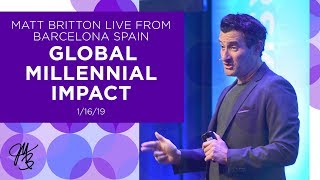
Matt Britton explains how millennials are reshaping consumer behavior, business, and cities. Status symbols shifted from products to experiences. Social media, retail, and branding all changed as a result, with data and 5G technology reshaping what comes next.
How many people in the audience are millennials? Okay, pretty good. How many people in the audience have kids that are millennials? Okay, great. And how many people here in Barcelona acted like a millennial last night? Any hands? Okay, I see the execs in the front row all raising your hand. So you guys definitely work for a cool company. My name is Matt Britton. I spent my entire career helping the largest companies in the world decode the new consumer. The timing of my career is very fortuitous because right when I graduated college, social media digital era had just begun. And I've kind of lived through the ride, as I know many of you have. And Obviously the last 10 to 15 years, the big push for major companies has been millennials. Millennials, Millennials, Millennials. Why? Well, the main reason why is that millennials were the first generation that grew up with the Internet in the household. Think about that for a second. Gen X. Baby boomers. Dinosaurs. Who? I'm often asked, what's the generation before baby boomers? I think it's dinosaurs. Could be the silent generation, some people call it. But essentially everyone born before the millennial age had to actually pick up the phone and talk to people if they wanted to speak. If they wanted to meet their friend at the mall, they'd have to kind of sit around and wait for them. And if they didn't show up, they would be sitting around all day. Right, because they had no phones, their brains are wired differently. I often get asked, well, what about Gen Z, the next generation? And the reality is, the jump from Gen Y to Gen Z isn't going to be nearly as stark as a jump from Gen X to Gen Y, because another Internet isn't being born anytime soon. And why the millennials are so important to everybody in this room is that despite the fact that so many big companies want to shift to Gen Z, Millennials are actually just beginning and having their impact in. In the business world. If you think about it, the oldest millennial is age 38 years old. So millennials aren't kids anymore. They're actually your customers. And as we all know, through consumerization of the enterprise, as these millennials enter position of power at major corporations, the way they think and look about buying decisions, whether it be for software, whether it be for equipment, it doesn't matter, is not going to be the same way anymore. So even though you are not a B2C company, you are a B2B2C company. And you need to understand this new generation. And that's really what I want to impart all of you today. I talk very fast if you haven't noticed already. I wish I could beatbox like that guy. Can I have 90 slides to go through in about looks like 30 minutes. So I'm going to go very fast. If anybody needs me to slow down, just go like this. My Twitter handle is on any page. If you have any questions feel free to just tweet me and I'll try to answer it right after the presentation. And I'm really so thankful to be here today. SAP's been a company I've long admired. I'm really excited to try to inspire all of you guys. I know it's at the end of the day. I promise I'll keep all of you guys awake. So unlike us Gen Xers and us baby boomers, the second millennials and Gen Z are born, instead of staring into their mother's loving eyes, they're staring into a phone. Because their parents obviously want to capture every single moment. And by the time kids are age 3 and 4 years old, they understand how to operate iOS devices in many instances before they actually learn how to speak. And at ages 10, 11 and 12, they are meeting on homework assignments using a variety of different devices. In the cloud schools are adopting the cloud schools are adopting new technology and the advancement of this generation and how quickly they're growing up. And the access to information is unlike anything we've ever seen before. Which leads me to my first major legacy of the millennial generation that isn't changing anytime soon. Kids grow up incredibly quick. I know we said it forever, but right now it's the case more than ever before. But at the same time, the dichotomy is adults are getting old slowly. This is a huge festival called Burning Man. It happens in the desert in southwest United States every single year. And about 70,000 people come to Burning Man. It's actually shaped like a clock. If you want to know where to meet anyone, just since there's no cell service, you have to ask are you at 2 o' clock or 3 o'? Clock? And that's how you know how to meet people. And this goes on for a week and there's not a lot of electricity, cash isn't readily accepted and it's almost a new society. It's also known for these drug fueled parties that go on every year at Burning man. And it's not uncommon to see a 70 year old man like this man partying at Burning Man. In fact, Eric Schmidt, former CEO, then chairman of one of the most powerful companies in the world. Google actually got his job as CEO of Google from meeting Larry and Sergey, the founders of Google, at Burning man, as kind of a cultural test. Imagine that being the case with Bill Gates when he was forming Microsoft in the 80s, or any great entrepreneurs before that. It wouldn't have been, but it's really a sign in the times on how quickly things have evolved with the older generation. This is what we imagine of how people are going to dress in the corporate world. But if you look at the leaders of leading technology companies, whether it's Satya Nadella, the CEO of Microsoft, or Jack Dorsey, the CEO of Twitter, and Square our famous media honcho Arianna Huffington, you'll see they're building their own styles. They are not conforming to our traditional beliefs of what you actually have to wear and work every day. And it's not just how people are dressing, it's how they're acting. Marriage. People are getting married later than ever before. Why? Well, one obvious reason is Tinder, right? If you can swipe left and swipe right your way, why would you be in the rush to get married? But the reality is in a 24 hour news cycle, people for the first time ever that are 45, 50 years old can see what 15 or 20 year olds are doing and they are trying to gravitate towards their youth. And as a result, they are not in a rush to actually get married. And it's happening all around the world. This is also impacting the age at which people have children. The notion of the family is getting older and older, which is dropping fertility rates around the world. So what does this mean for you? It means that your customer that's 35 or 40 years old may actually be into beatboxing, more so than you actually think, because people are holding on to these youthful ideals, the ideals of Youth Nation that I wrote about in my book and that the millennial ideals now actually transcend all ages. And one of the biggest changes as a result of all this is sort of a restacking of the deck of what these consumers think think is most important. And it impacts how they spend their money and their time. What I say a lot is status update is a new status symbol. Status update is new status symbol. In the 80s, 90s and early 2000s, people would define who they were by the brand that they bought. That was the status symbol to society. If you had a Rolex watch or you had a Mercedes or you had an American Express Platinum card, it would show people that you have a certain status. If you think about it, Back in the day before there was social media, if you had an amazing experience, say you climbed to the top of Machu Picchu where you sat in the front row of a soccer match, the only people you could share that experience with were the people who were right in front of you. So as a result, experiences actually weren't something that could be scaled. So it wasn't a status symbol because you couldn't show everybody widely about it. But now with the growth of Instagram and experiences have taken the place of products as the number one way that people are actually showcasing who they are to society. That's why. Excuse me, that's why I love your new positioning around experiences, because experiences really are at the core of how people are going to be spending their time and what they're actually focusing on. Which leads me to the second point of the millennial generation, something called diffty, which stands for did it for the Instagram. Experiences are now actually so important at dictating the jobs that you get, the relationships that you get into. The people are now pursuing experiences not only to enjoy them, but to actually prove that they were there. This is a mountain in Fremont, California called Mission Peak. Fremont, California and Mission Peak have been around for a very long time, especially the mountains, right? Mountains don't grow overnight. And what's really interesting is in the last three to four years, Mission Peak has been plagued with overcrowding, complaints from local visitors, pollution, lack of parking. Why? Because Mission Peak, while it looks like all these people climbed to the top of Mount Everest, is actually just a quick 10 minute walk up a small hill with two Starbucks conveniently located at the bottom. It's also conveniently located off the exit of a major highway. But when you're laying in your bed feeling bad about yourself, scrolling through Instagram and Facebook on Sunday morning and you see this guy climb to the top of a pole and you're going to feel bad about yourself. You're saying, I need to get off my butt and stop eating potato chips and actually climb that pole like he did. But the reality is this guy's going to go back down the mountain, grab a coffee and go right back to his bed, watch Netflix and eat potato chips. But this is the world that we're living in and that consumers are comparing their everyday lives to other people's highlight films. And now all of a sudden, hiking and outdoor activities are taking a huge importance and interest amongst these consumers. People in Russia are renting grounded private jets to take Instagram photos. It would almost be like me posing in front of that mission Impossible helicopter and telling people that's how I flew into the convention center. People are doing it because they know that that's a new status symbol. It's a new product, it's the new Louis Vuitton. People being able to afford a private jet and actually people are paying to do this. This is a place called Black Tap. It's in New York City, and they sell these sundaes for 20 to 25 dollars each. Now, I took my 12 year old daughter there and actually tried to take a bite of the one in the center before she took a picture of it. And I nearly lost my hand. Right. And it's no surprise that Blacktop has lines around the corner. Are their sundaes better tasting than all the other ice cream stores in New York City? Of course they weren't. But young people know that if they actually can take a picture of this Sunday and, and share it at ages as young as eight and nine years old, it's going to showcase to their friends that they were actually able to get in and surpass this line. And it becomes the new status symbol. Not eating the ice cream, but actually showing people the picture of the ice cream. It's impacting the fitness world. This is something called Color Run, which is now a global phenomenon. It's taken the place of many major marathons in major cities around the country and around the world, people that go to Color Run dressed up, wearing all white, and the second they go, they're doused with colorful powder, making the perfect Instagram moment. Of course, in true millennial fashion, the races are untimed. There's no winners or losers in Color Run. And people who finish the Color Run are treated to a live concert from a dj. This is the new era of what fitness looks like, because if it can't be shared, you actually were never even there. And there are so many extensions of this Color Run idea. And it's important to know that this consumer, this, this young consumer, but soon to be, mostly your customers, value experiences this much. When we think about museums, we think about the Louvre, we think about the Tate Modern, we think about the Museum of Natural History. Well, this is the Museum of Ice Cream, which is now in four markets in the United States and soon to expand around the world. Now, the Museum of Ice Cream isn't a museum the way that you might actually imagine it to be. Okay? You don't learn about the pasteurization, about the cows and, and how the ice cream was made. What it does have is a sprinkle room like this, which allows you to jump into a giant pail of sprinkles and take the ultimate selfie. 12 rooms that people go into to actually just take pictures. It's not a learning experience, but if you think about it the way that consumers think, especially younger consumers, is I can look at a picture of Mona Lisa on my iPad. If I'm going to spend time and money, I need to have a shareable experience. And that's why concepts like the Museum of Ice Cream are now becoming a global phenomenon. This is obviously driving a resurgence in travel, in last minute travel, because the best way to build your personal brand through experiences is through traveling places. And when people travel, they're not no longer looking at traditional guidebooks. What they'll do is they'll look up a location like Sydney, Australia, and they'll see where the most influential people are actually taking photographs, photos. And that's where they're going to go. If it's a hotel, they're going to stay at that hotel. If it's a restaurant, they're going to spend money at that restaurant. So why experiences are so important, I think for SAP to actually embrace is if you can impart to your customers the power of experience, ultimately it's going to drive their business because experiences drive personal brands, which is at the heart of what we all care about. Personal branding is why Lexus and Rolex exist, because people know when they wear it, they feel better about themselves. And that's taking the place of experiences that people go to. This is the electronic Daisy carnival that happens in Mexico, in the United states, in the UK, the one in Las Vegas every year draws almost 500,000 people to show up. More people actually went to Woodstock, an event that defined a generation. If you talk to Coca Cola, they'll tell you their fastest growing channel isn't a physical retailer, isn't even Amazon. And it's these live events. People say technology brought younger people further apart. This is proof that actually brought them closer together. Experiences also can meld from digital experiences. Esports is a phenomenon that everybody in this room needs to understand because in many markets it's actually taking the place of actual live sports. As crazy as it thinks, arenas five times the size of this are being packed for people to watch other people and actually play video games, right? And this is not dying anytime soon. Mark my words, five years from now, everyone will know this is actual fact. So the notion that digital is having young people stare at their phones all day and not interact truly isn't true. Because people are using things like video games actually then create events where they bring individuals together. Another huge impact of this millennial ideal is something called the urbanization movement. The notion of a house with a two car garage and a white picket fence and 1.7 children as the path that young people want to go down. So they're married by age 30 and they have three kids by the age of 37. Right. That's what we know as consumers. Well, that's obviously taken a U turn. It's now cities that provide the lifestyle that this generation imagines for themselves. And many major developed cities around the world, small schools are becoming better, crime is going down, and people are staying in cities longer and longer in life as they delay getting married and actually having children. Gentrification is happening as a result of this in major cities around the world. In neighborhoods that you usually wouldn't be able to walk in after dark five, 10 years ago, are now actually being littered with multimillion dollar townhouses. Consumers are not leaving. And the livable boundaries of cities are, are expanding further and further outward. Just look at New York City. You see the light blue is primarily the working class. It used to be when I was growing up New York City, the people who live there were the inner city blue collar workers. But you don't see many blue collar workers in New York City anymore, do you? In fact, the working class is actually being pushed out to the suburbs as millennials actually stay in cities and really redefine the footprint of major cities around the world. This is obviously impacting major industries in the place that consumers traditionally spend the most amount of the discretionary expenditures. Cars. The cost of owning a car combined with the cost of gas, tolls, parking, insurance just doesn't make sense for young people that live in cities when they can compare it to the ease and ubiquity of something like Uber. It's not even actually to use cars anymore. Many consumers are thinking, I don't even need to walk if I'm in a city anymore. And, and you see the expansion of these scooter companies like Lime Bike and Bird. Lime Bike actually just raised over $200 million from Uber, called the last mile for the consumer. I know you see them popping up all over here in Spain. Homes are the second places that are really suffering as a result of urbanization. Look at this drop during the social media era of people in the UK in terms of their home ownership of young people. They want to travel, they want to be mobile, they don't want to stay in one place. And as a result, buying cars and buying houses are no longer a priority when compared against experiences they can actually invest in. They are using tools like Airbnb that allow them to be mobile and not actually stay in one location. One of the main ways that you can keep Millennial employees happy and retained at your company is giving them the possibility of mobility and allowing them to work from all around the world. They would much rather access Airbnb and actually be stuck in one location. And companies are following suit. This is Microsoft sprawling headquarters in Redmond, Washington, where them, like so many other companies, are now moving to cities so they can attract younger millennial talent. And in doing so, they're actually contracting their full time workforce and tapping into platforms like WeWork. How many people in this room have heard of WeWork? Okay, so WeWork is now worth $20 billion. And for those of you who don't know what it is, they take over and lease warehouses in well lit, affluent urban areas and allow people to rent desks for as little as €200amonth. You have a culture and vibe that rivals Google, but you can actually become the CEO of you and more. Young people actually look at this as their dream career, being a freelancer in a specialized skill set where they can offer their services to major companies. And companies like Google are following suit. Google actually announced late last year that they have more contractors than direct employees actually working at the company. They understand that if they contract their workforce, move closer to cities and tap into platforms like we work for contract employees, based upon the changing needs of their business, they can run much more efficiently. And I see this free agent and freelancer movement only growing into 2019. Obviously, in an urbanization movement, young people are sacrificing the space and privacy for connectivity and community. And they're living in small and smaller apartments, as small as 300 square feet micro apartments in Tokyo that Millennials are actually living in just so they can actually be close to the action. Which is driving a whole new trend I call the service vacation era, which is that in a world where young people don't have cars and they can't drive to the suburban mall and actually pack up their SUV with stuff, the ability to save them time is creating a whole new class of services, putting a lot of pressure on your customers. This is Glam Squad, something that's fast growing around the world. It allows women to hit a button and have a team of stylists come to your apartment and do your hair and makeup without actually even leaving the house. Much like uber wag just raised over $200 million from softbank. Allows you to hit a button and have people come and actually walk your dog. This is TaskRabbit where when you buy, I see Ikea right outside this Convention Center, a 110 piece IKEA desk that only comes with 106 pieces and you can actually not put it together. Well, when you actually buy that IKEA desk now you can use a tool like TaskRabbit to actually have people come over and build that desk for you. And it's no surprise that ikea just bought TaskRabbit so you can capture more first party data and actually have an intravenous way into the consumer's household. So you're gonna start to see more traditional companies go into a service education era so they can capture that first party data and go into consumers homes. If I'm l' Oreal or Revlon or Maybelline, well I'm gonna buy a company like Glam Squad and I'm gonna push my products into consumers homes and get first party data that way. In a world where Amazon is destroying everything and moving further out, you see things like PepsiCo developing like SnackBot that can actually go around college campuses with their snacks in the form of an AI driven bot. It actually delivers snacks to people's dorm rooms. So this is kind of where we're headed, but we're obviously not there yet. This is obviously having a huge impact on what we know as shopping malls and retail around the country and around the world because young people understand that they don't need to actually get in a car anymore to buy things. Obviously the biggest disruptor to retail, and I'm not giving anybody any surprises here, is, is Amazon. But what Amazon's going to be doing in 2019 and 2020 to actually capture more of the share of spend from their prime consumers is really fascinating. They just bought a company called Ring, which is a smart doorbell company. And when you push on the doorbell, you actually, if you're, if you own the home, the people's video of their face will actually pop up on your phone. With Amazon actually owning it, you as a consumer will now be able to automatically give Amazon delivery people rights to actually go into your home and drop the package off for you, even if you're actually not there, making the notion of E commerce that much easier. If you live in actually a doorman building, they have something called Amazon Hub that goes in lobbies where you actually can push in a code and actually grab your Amazon stuff, almost like a Larger version of a mailbox. And of course we've all heard about Amazon Prime Air, which they've actually run patents for, to have drones actually deliver stuff in the consumers houses. So as you can imagine, major packaged goods companies are really starting to fret what's happening in this retail era. And on top of that, many consumers are questioning if they need to own stuff in certain categories at all. This is Rent the Runway part of the whole access over ownership trend, which allows people to rent high end clothing, high end dresses, for a fraction of the price and actually return it. Think about the pressure that this is going to put on so many apparel companies around the world that actually built businesses on selling high margin clothing. And now there's disruptors like Rent the Runway that allow consumers to actually rent clothing. So as I look at all these companies, many of which I'm sure are your customers, I really fear the future of so many CPG companies out there. How are they going to survive in a world where they can no longer rely on their brand? They can no longer rely on consumers going to big box retailers and picking their product off the shelf. Speaking of big box retailers, they are obviously struggling as well due to Amazon. And really the dichotomy that CPG companies face is the big box retailers are rolling out private label to actually compete with them right under their noses. If I'm a consumer, why am I gonna spend an extra dollar on Ziploc bags if I can just buy store brand Ziploc bags? So the changing retail habits of consumers combined with private label is putting enormous pressure on CPGs. And the next big shoe to drop for CPGs is the notion of voice. How many in this room have an Amazon Alexa device? Okay, not nearly as many as I would have thought. If I have one homework assignment for everybody in this room, spend 30 to €40 on the Amazon Alexa dot, order it probably via Amazon, get it to your house and check it out and see what it does. Because like Uber, anything that saves consumers time is going to get rapidly adopted by this millennial generation. And what Amazon's doing with the dissemination of their voice devices is going to put so much pressure, more pressure on CBG Companies that have traditionally relied on brand. One of the main things they're doing is rolling out their own private label brand. This is called Amazon Basics. It started with iPhone wires, now it's in batteries. It's going to shampoo and toilet paper. And if you try to order batteries over Amazon Delexa and you ask for a name brand like Doracel, Or Energizer. Amazon's gonna tell you they don't have that. They only have Amazon Basics batteries. They're betting that the ease and ubiquity of ordering from a voice based device is gonna trump the power of a multi billion dollar brand. So what does that mean for the future of branding? What should they do? Some companies like Brandless are actually betting that consumers don't care about brands at all. They've just recently raised over $100 million by selling every product in their portfolio, which spans the gamut for only $3. Promising consumers the best products, the best ingredients, but no brand actually on it. So they have a brand based upon not being a brand at all. And other companies like Tesla are redefining what it means to be a retailer. Subscription services. I know that we spoke, you guys are really going very heavy in subscription services. And I think obviously that makes a lot of sense. Companies like Nike are dealing the same with the consumers. This is a platform called EasyKicks, where parents can pay for their kids, a subscription service every single month. And you measure your feet on your own. And as soon as you're done wearing the sneakers, it could be after a month, it could be after a year, you send them back and Nike sends you a new pair of sneakers. So subscription models is one way that companies are getting around the this change in retail, P and G is making changes themselves, understanding with the growth of E commerce, they need to make real changes as millennials stay in cities, knowing that consumers probably aren't going to be able to pay for huge tubs of laundry detergent. So they've launched a brand called DS3, which is liquid free household and personal care products that they just announced that allows you to order these little packets, add liquid, and there you have the product. So that's how they're trying to innovate, to actually get around all these changes that are happening. But if I'm a CPG company, what I would actually do is think like Apple and actually try to own the ecosystem. Because the reality is the pressure they're getting from private label, from Amazon is really enormous. One idea I've had is why don't they buy the Funk company? If I sell laundry detergent, why don't I buy the Funk company that makes laundry machines and make very small laundry machines that can fit inside the drawers of apartments that millennials now dwell in, but make it a smart laundry machine. And every single time that machine actually runs out of my laundry detergent, it would order my specific brand instead of me Trying to sell to your shop or care for or Walmart, I'll go to the biggest developers of apartment buildings in the world and sell my product to them. So I have an intravenous way to actually sell my product. These are new ways companies need to start thinking about if they want to drive growth in an area that has so much pressure. Consumers are seeing this, and ultimately the only brands that are starting to matter anymore are brands that actually are utilitarian to consumers. Brands that are living on a brand promise are no longer standing out to brands like Google and Microsoft and Apple and Samsung that are promising and delivering SAP, that are delivering utility actually to consumers. And I think that's a really big thought. Moving ahead is what does branding mean in this world to the millennial generation? Another change that's rapidly happening is the barbell economy. And it's happening all over the world, which is essentially that the middle class is rapidly eroding. The top eight richest men in the world control as much wealth as the 50% poorest people that live on this planet. And it's happening obviously at all different levels. The wealth distribution in major markets, it's gutting the middle market because technology has become the great differentiator and the greatest intermediator. And one thing we're constantly telling companies is if you want to win, you have to play in value or play in luxury. But stay out of the middle. Play in luxury like brands like Prada are doing, who still are growing. Despite the fact that brands aren't as important anymore, the luxury side is still held out as a status symbol around the world. IPhone obviously understands the luxury market, selling their phones for over $1,000. On the value side, there's Euroshop, there's Walmart, there's Dollar Tree, Dollar Store, Dollar General getting supply chain efficiencies. Sell products for the cheapest possible cost. But who's struggling? Companies like the gap that sell $100 jeans. See, there's not that much of a market anymore for $100 jeans. Because the value side of the equation, well, they're buying jeans for $20 at a big box retailer. And the luxury, well, they're buying, you know, a name brand, trendy jeans, at a boutique downtown. And Gap actually finds itself in the middle. And it's no surprise that they're now closing stores in malls all around the world. So you're seeing it in airlines, you're seeing it automotive companies, and you're going to see it across all your customers. Pick a side, luxury or value, but don't actually Stay in the middle. And I'll wrap this up by talking about what it means to be young and youthful. Because when I was prepping for this, I spoke to some of your ZECs and I was told, which I often am, don't focus too much on young people. Because we people of all ages and all companies do. And I actually don't believe youth is about an age. I believe it's a mindset. And one thing we've seen through this millennial disruption is that things like Facebook started in the college market and and then got adopted by all ages around the world. It doesn't matter how old you are to understand these changes are occurring and allowed to adopt the way that you actually go about business. And Millennials are not going away anytime soon. They are the largest generation via population around the world. Their spending power is about to overtake Generation X and again. And COO CEOs and CFOs of major corporations. Their way of thinking is going to become paramount to your growth in the next five to 10 years. You know, in the Industrial Revolution as we know, it was all about oil. And we knew when we were building factories around the world, as we expanded the Industrial Revolution, that we needed oil to actually power our factories. But with Millennials, the new oil is data. Data now powers organizations, allows them to scale, allows them to increase their margin, allows them to react incredibly quickly, as everybody in this room knows. And the companies like Coca Cola, like Procter and Gamble, like so many of the largest companies in the world that do not have first party data, are going to be in dire need for sophisticated platforms to be able to evolve their business and avoid disruption. And if you think about it, what if I told you during the Industrial Revolution that in the span of 10 years there was 100 to 1000 times one more oil readily available. How quickly would the Industrial Revolution would have expanded? Well, that's actually what's about to happen with 5G. Because what 5G is about to do with data is take an average download speed of 15 megabytes a second to 1 to 10 gigabytes per second, and that's going to be starting to roll out around the world later this year. And what that's going to do with the proliferation of data and smart devices and self driving cars, going to see a quantum leap forward. And the companies that have not been able to revolutionize their business for their millennial tendencies, you're going to continue to see them go down one by one by one. So learn about 5G, learn about impact, because it's not just going to impact the communications companies, it's going to impact every company. Because companies now live and breathe on data the same way factories did on oil during the Industrial Revolution. We're going to start to see things like the telephone go away in the next five to seven years. That's right. I don't think phones will still exist. I personally believe, and it's on camera, so we'll see if we're right, that they're going to be replaced by smart contact lenses. Actually, especially with 5G, you put them on your eyes and I'll be able to overlay and see all of your names in the room or stare at an overpriced apartment and actually see how much it actually is. With augmented reality. I think this is actually. We're going to be moving now. I may sound crazy to everybody in this room, but if I actually told you 10 years ago that I could speak to somebody in Uganda in high def for free by hitting a button, you'd think I was crazy too. And the rate of change is accelerating so fast that these are the type of inventions that I think large companies are going to try to embrace as the world gets faster and faster. And yes, it's incredibly scary. The other major change I see happening is the disruption of television. As we all know, over $200 billion every year is spent on television commercials. And while the Apple TV looks like this today, tomorrow I think it's going to be looking more like this. If you speak to a 10, 11, 12 year old kid, they'll tell you they do not know what a television network even is. They are not tuning into TV networks, they are tuning into people. They are going to YouTube and actually tune into people. The individuals now have the power over major media corporations. And at this year ces, which just ended, what started to happen is the major component manufacturers like Samsung are now starting to integrate Apple into their devices. And I believe the television is soon going to enter a phase where the TV is a giant iPad hanging on your wall. And considering the fact that so many of your clients are spending 80 to 90% of their marketing budget every year on television, what are they going to do? What are they going to do without data, when I can target people in a certain city who like a certain artist that are planning on going out Friday night versus having to target a monolithic 18 to 34 year old audience. So I think the disruption of TV is going to be one of the last pillars to fall in terms of the impact of the millennial generation. So again, we are not talking about kids, we are talking about your customers. Soon, five to ten years from now, every single one of your customer buyers are going to be millennials and this is the world they're all going to be living. So understanding how these consumers think, understanding how they value experiences and urbanization is going to actually drive their business buying decisions. And I hope that everybody in this room takes the time to understand that this organization is in the place and empowered to embrace these new ideals. And I see nothing but success for everybody moving forward. So I wish everybody here the best of luck and incredible 2019. Thank you guys.
More from Matt




MikMak’s Rachel Tipograph on Consumer Spending, Retail Media & Holiday Shopping Trends



Jaguar Land Rover’s Charlotte Blank on Luxury, Purpose & Experiential Storytelling



