The Global Millennial Impact: Matt Britton Live Keynote Session From Gothenburg Sweden
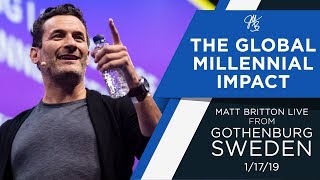
Matt Britton explains how millennials, the first generation with household internet, rewired culture and business. They built personal brands around experiences, driving urbanization, retail collapse, and the rise of platforms like WeWork and TaskRabbit. The shift also accelerated tech adoption: voice interfaces, 5G, subscription models.
They are doing group homework assignments with a multitude of devices, sharing assignments over the cloud. Right. And this is not the world that we actually grew up in. Kids are growing up faster than ever before. The access to information that they've had at a young age where they actually can figure out anything that's going on in the world instantly. Where we had to go to the library, a lot of people don't really understand that. And that is really the biggest difference with millennials and every generation that came before it is. The Millennials were the first generation to grow up with the Internet in the household. And as a result, I believe that makes their brains wired differently. The difference from Gen Y to Gen Z is not going to be anywhere near as stark. It's going to be much more of an evolution where to Gen X to Gen Y was a revolution, because there's not going to be another Internet that's going to be born anytime soon. At the same time, kids are growing up really quickly. Adults are really getting old slowly. The Internet is actually making kids want to grow up fast to, to a certain age. Right. It's definitely not 43, that's my age. It's definitely younger. Let's say it's in the 20s and adults are trying to hold onto that for a very long time. Case in point, this is a festival called Burning man that happens every year in the desert just outside of Las Vegas. It brings about 80,000 people. There's very little electricity, no Internet access. Cash actually isn't accepted. It's a barter system. It's known for its crazy drug fueled parties that happen every year. It's not uncommon to see a 70 year old man there partying because it's now socially acceptable. In fact, Eric Schmidt, who recently was first CEO and then chairman of Google, arguably the most powerful company in the world, got his job at Google because he went to Burning man and met Larry and Sergey, the founders of Google. As part of a cultural test, Larry and Sergey wanted to know if Eric Schmidt could hang at Burning Man. And now he goes every single year dressed like that. So imagine in the Gen X era when people dress like this to work every street relaxed. Ten, 15 years ago, if the CEO of the most powerful company in the world dressed like this as the ultimate social currency. And that's really part and parcel of people living younger later in life. They are pursuing these experiences because they know their online Persona, driven by where they travel to the people they meet. The real experiences will impact the job offers they get the, the relationships they get into the social circles people get into. And because of that, people are pursuing experiences now, not only so much to enjoy them, but to prove that they were actually there. Which brings up a notion I wrote about in my book Youth Nation, called Diffty, which stands for did it for the Instagram. Again, people are traveling to far off remote places just to get photos. Right. Is this a good thing? No. But neither is somebody working hard so they can have a Lexus car instead of a Toyota. So people would think they're wealthier. Right? So I often get asked, well, how are millennials different than Gen X? And my whole thing is they're not. The world around them has changed. You know, there are always people who were socially responsible. You look at all the activism that happened in the 60s. There are always good people and bad people and entrepreneurial people and lazy people. I don't think that's changed. But the world around them has changed. So the insecurity is based upon people needing to build their own personal brand. It's just happening in a different form now, and it's happening in the vein of experiences. This is a place called Mission Peak in Fremont, California. Mission Peak has been around for a very long time because it's a mountain, okay? But in the last three to four years, Mission Peak has been plagued by overcrowding, pollution complaints from local visitors, lack of parking. Why? Well, Mission Peak, while it looks like these people just climbed to the top of Mount Everest, it's only a quick, easy 10 minute walk up the mountain. And at the bottom, there's a Starbucks with great wi fi access. And it happens to be conveniently located off of two major highways. But when all these people's friends are looking at them climbing the top of the pole on a Sunday morning while they're eating potato chips in bed, feeling bad about themselves, these people are able to portray society, that they are adventurous and rugged and outdoorsy, when the reality is those people, as soon as they post on Instagram, going right back to their bed and open up the bag of potato chips, and that's what we're doing. We are comparing our lives against other people's lives, highlight films, and that's a big challenge. I have a 12 year old daughter and raising her in this world where she basically validates her self worth on how many likes she gets, or refreshing with the fervor of a Fortune 500 company to see how much engagement a social media post gets, that's obviously not a good thing. It's something as parents we really need to combat against. But it's the world we're living in and we're not going backwards. So whether it's right or wrong, it's where society's actually headed. People in Russia are renting grounded private jets to take Instagram photos. These jets actually never leave the Runway. But this is the new status symbol, right? It's in the form of an experience. There's a place in New York called Black Tap. They make these amazing looking sundaes that cost an amazing $25 to actually buy. I took my daughter there. I tried to take a bite out of the one in the middle. I almost lost my hand because she didn't take a picture of it yet. And people are pursuing to go to places like Blacktop, which they have lines around the corner. And these Sundays don't taste any different than any other sundae. But it's that image that people capture and the exclusivity of the experience of going to Blacktop that makes this place so popular. And it's one thing that companies need to understand. Whether you're in retail or you sell a product or Even if you're B2B, I would argue this venue is incredibly shareable and it's experience its own, right? The, the first thing I wanted to do when I got here was actually take photos and videos and share with people. And that's great for this company because I now they're marketing through me, not just to me, right. And that's why it's so important to invest in physical spaces and actually invest in the aesthetic of products. This is something called Color Run. It happens every single year. Now. It's a global phenomenon. Now what Color Run is, is really replacing the new modern day marathon. People show up and in all white and they're instantly given this colorful powder which you're doused with. The races are untimed, no winners or losers in true millennial fashion. And at the end, people are treated to a live DJ performance. This is an experience, right? If you look at the Kenyans who are setting records during the Olympics running marathons, they don't have their phones next to them taking selfies, right? Fitness really isn't about that. But there are countless amount of gyms that, that have gone out of business because they're not about an experience. And now you're starting to see this takeover over and over and over again. If people aren't given something to share and build their personal brand, they're not gonna spend their time on it and they're not gonna spend their money on it. So Companies really need to play on the edges. This is another fast growing phenomenon that we're starting to see now happening all around the world. It's basically pop up experiences. This is called the Museum of Ice Cream. It's now in four markets in the United States and to Europe next year. Now when you go to the Museum of Ice Cream, you don't learn about the pasteurization of the cows or how ice cream is actually made. You have 12 different rooms that allows you to take incredible selfies like the sprinkle room where you can douse yourself in sprinkles and take photos like this. People are waiting around the block. It's selling out in 30 seconds. Now is this a museum compared to the Tate Modern or the Louvre? Of course not. But if you ask a younger person, what they'll tell you is I, I can look at a picture of Mona Lisa on my iPad, right? And if I'm going to actually go out and go somewhere, it needs to be a place where I can express my creativity and show to everybody what I'm about. Now there's a Museum of pizza, there's new pop ups that are happening all over the place. And is this a short lived fad? Probably. But I think it's emblematic of where the world is headed that people are prioritizing their ability to kind of create experiences. Travel is another thing that is completely exploding as a result of this. The hospitality and travel industry, for them it's never been better. Last second travel with platforms like Hotel Tonight, where basically you can go into a city day of and actually book a cheap hotel room, are exploding. Travel's more accessible than ever before. And for young people, they are prioritizing that almost the purchase of almost any product besides maybe the iPhone, right? They are putting their money away for these experiences. Travel being really at the heart of it. And when people travel, when people go to Bondi beach in Sydney, Australia, what they're going to look for is where did the most influential people take their photos? And that's where they're going to go. Where do the most influential people eat? At restaurants. And that's where they're going to go, what hotels they stay at, that's where they go, where they shop, that's where they're going to go. They're no longer looking at guides, they're no longer doing research or on Google. They are looking at other influential people by searching locations on Instagram to actually dictate where they're going. Because if those people who have massive personal brands right are actually going to these places. And I want to go as well. Just like how if we see a famous actress on TV wearing a Gucci belt, we want to wear it because she's famous and she has a sense of style. It's the same thing, just sort of replicated in a different manner. And it's fascinating that businesses aren't seeing this. If I opened up a pizza place, I would have 80 foot pizza on the wall that I'd plaster and stay there, that everybody would take a picture in front. If I had a restaurant, I would have a million Christmas lights and flowers everywhere that people would want to take pictures of. Even if my food was worse, I would actually perform better because that's really what's important. I think every business needs to really understand this. I can't drill it down enough experiences. Live experiences, like events like the electronic daisy carnival, which now happens in five major markets around the world. It's growing faster than ever. The version in Las Vegas had 500,000 people attend last year, which is a live electronic dance music festival. More people that attended Woodstock. If you talk to Coca Cola, they'll tell you their fastest growing sales channel is not through a big box retailer, it's not even through Amazon. But it's actually through live events. And what's interesting is one big misnomer about this generation is that technology has actually tore people further apart. This is actually proof that's actually bringing them closer together. Esports is another perfect example. We all know video games has really taken over, especially young males, their lives. Fortnite, I don't know how many people have sons in the room that play Fortnite, but I hear it's making something like $200 million a month in revenue. Gaming is massive. In fact, the leading player of Fortnite, which is an online game, actually made $12 million last year playing video games. Somebody named Ninja. And now what's happening with the video game craze is something called esports. Esports is filling up stadiums where people are watching other people play video games, right? So this is experience in the virtual sense, transcending to real life experiences. And esports is growing so quickly that one day it's going to be as big as real sports. And that's fascinating, right? And that's something. Talk about trends. This is a millennial driven trend that's going to change the entertainment industry and incredibly quickly. Another major change as a result of the millennial generation is the urbanization movement. The notion of getting married, moving out to the suburbs, having a Nice house with a two car garage and 1.7 children, white picket fence. That whole life, well, that's now taking a U turn. People look at cities as the lifestyle in which they imagine for themselves. Cities are becoming safer, schools are becoming better, people. People are pushing off, having children and getting married later in life. And they're staying in cities longer and longer and longer. In a 24 hour news cycle, when everyone's looking at what everyone's doing, the action's happening in the city and not in the suburbs. And that's reflected in real estate prices. Where I live in Brooklyn, real estate prices are up 120% over 10 year period and the neighboring suburbs 2 to 3%. It's happening in Shoreditch outside of the UK. It's happening in Jamaica Plain, outside of Boston. You tell me the city and I'll show you how the livable boundaries continue to expand because millennials simp want to leave. It's creating gentrification all over the place where places that you would not want to walk past at night are actually now building multimillion dollar apartment units, which is fascinating to see. You look at New York City. This from a book that was written by a guy named Richard Florida called the Creative Class that came out five to seven years ago and is really prescient in terms of where the future is going. The light blue is the working class in New York City. You don't see much light blue here. We were growing up as the rough inner city, rumble tumbler, blue collar inner city. Well, now the blue collar workers are actually being pushed out to the suburbs because the millennials are staying there. The real estate prices are going up. Obviously. Tremendous downside to this. Local mom and pop businesses are going out of business. We'll talk about retail in a second. But it's again, it's the way the world is headed. Often people will say, well, isn't that bad for the local business? And my response is, I'm not telling you if this is right or wrong. I didn't make this whole thing up. I'm just reflecting how things are. And you can either go with it or just hold on to the past and get run over. Right? Because this is about business. I'm not sort of the moral compass here because a lot of the things here aren't great for society. But then again, when the airplane was invented, people said it would take people far away from their families. I have two brothers that live in Los Angeles and I live in New York. It's true, right? But I wouldn't be able to be here today with all of you if there wasn't an airplane. So I think with every advancement in society, there's positive and negative implications. And I'm just pointing out both of them here. So I often get asked, well, how does millennials actually afford all these experiences? And the way that they afford it is they're actually shifting money away from where traditionally US grownups have spent the two biggest expenditures of our discretionary expenditures, cars and housing. Let's start with cars. Living in cities, the cost of gas, tolls, parking, insurance, and a car is far outweighed by the ease and ubiquity of Uber. Right? So if you ask young people if they actually where they think of owning a car in a major city, they want access to a car. And many major auto companies are now adopting subscription based services, which I think is where they need to go because they want it. A lot of them want their own car. They want to be able to go out to the country. They like calling it their own or they want Uber. But. But many of them actually don't want to own it anymore. Right. And leasing it really isn't the right solution. It's kind of an intermediate point. So I know a lot of auto companies are shifting a subscription model. I think that's spot on because I'm not one of these binary people to say, oh, they don't want cars anymore. They love cars. It's still a rite of passage, but the business model needs to change. You see these scooter companies popping up. Lime Bike is one that just raised $250 million from Uber. Now they don't even want to walk anywhere. So it's like they're going to rent these scooters. And it's just more emblematic of people staying in cities. And. And that's how these companies are capturing the valuations. Homeownership. Look at this drop in homeownership of young people in the uk. And it just started. That drop started right during the social media era. We could say it was based upon the housing crisis of 2008 that happened in America. I would argue it's just as much emblematic of the social media era and the shift towards experiences and people wanting to embrace mobility and not be tied down by actually owning a home. They'd rather leverage an Airbnb where they can actually rent places all around the world. One of the best ways to keep a millennial employee with you for a very long time is give them mobility, allow them to work from anywhere, and I believe, and I've seen it myself and building my company is that the best employees will be productive whether they're coming to your office every day or not. And the worst employees, just because they're coming every day, they're still going to screw around and be on Facebook until you walk by and they're going to switch the tab and, and you pretend like you don't see it. That's the reality. This generation needs that flexibility if they're going to stay passionate towards what you're doing. Companies are now following suit. This is Microsoft's sprawling headquarters in Redmond, Washington. A lot of major companies back in the 80s built these huge campuses in the suburbs because they got tax concessions and they could build these huge labs. But now what they're finding is I can't get millennials actually to come out here and work for us anymore. We need to move back towards the cities, which is what Microsoft's doing, right? They're saying we're gonna actually relocate. And what they're doing though, when they're moving back to cities is they're contracting their full time workforce. And the one company that's taking huge advantage of this trend is WeWork. Are you guys familiar with WeWork? Okay, so WeWork, I don't think it's in Sweden yet, but they just got valued at $20 billion. They're in Hong Kong and they're in London and they're in major markets. Basically what they do is they lease out huge, you know, warehouses in well lit urban areas and they allow people to rent out desks, you know, share shared workspace environments. I'm sure there's things like that here. It's probably just not called WeWork. Well, this company's exploding because what young people are understanding is that they get a skill set that's really marketable. So say they're a Ruby on Rails developer, right? Or they're a YouTube search engine optimizer, right? Things that companies need, they can actually offer those services on platforms like upwork to companies have that mobility and actually have a culture that rivals Google@Wework. And what it allows big companies to do is contract their workforces. Google just came out. They have more contract workers than full time employees. That's fascinating. So they're actually seeing it. Let's move back to San Francisco, right? We're going to have less people and then we're going to basically account for the fluctuations in our business by hiring people to deliver on certain skill sets. So people moving in the cities is obviously changing their Living environment, right? They're living in small apartments. They are sacrificing the space and privacy of the suburbs for the connectivity of cities. And that's bringing tremendous business opportunity and something I call the service ification era. Basically, as people move faster and they actually don't have that traditional suburban lifestyle, they, they need things to come to them instead of them going to things. For example, there's a fast growing company in America called Glam Squad where a woman can hit a button and have a team of hairstylists, makeup stylists actually come to their house and help them get ready for a night out. This company is growing incredibly fast and if I'm l' Oreal or Maybelline or Revlon, I'm buying Glam Squad because It gets me first party data and gets me into consumers homes. There's WAG, which is raised to $200 million from SoftBank, which is a basically uber for dog walkers. And if I'm Purina, I'm buying wag, right? Because when a dog walker comes, they put the Purina food into your house for you. Intravenous selling model first party data. This is where it's headed, right? You know, there's Test Rabbit, which is a company that allows you to have handymen and people come to your house and actually fix things. Like if you buy, let's say 110 piece desks from IKEA, but it only comes with 106 pieces and you actually can't put it together, you could call TaskRabbit and have you fix it. IKEA saw that and ikea just bought TaskRabbit. Right. And they're saying, you know what, you're right. We need this kind of ongoing communication with the customer. We need to move more towards services. So companies that sell products are seeing, maybe we should move, shift more towards the service layer so we can get that first party data and have the ongoing sales. And in the future you're gonna start to see things like Snackbot, which PepsiCo actually just has in very beta form where on college campuses it's actually a little AI driven machine that goes to people's dorm rooms and actually gives them snacks. Right. Again, having things come to you, this is further in the future, but just interesting to see. So retail, obviously in a world where things are coming to people, is really struggling. Make no mistake about it, right? Retail is really like they need to reinvent themselves. These are shopping malls that are all around the world. They have beautiful landscaping and it's not cause people are planting trees. It's that the trees are actually taking over because they're vacant. And obviously the biggest driver of this is Amazon. I know Amazon is just launching here soon, or just did. I was in Sydney, Australia doing a talk last year. They were just launching there. It's just amazing to go to markets where Amazon was, which where I live is just so commonplace. It's like dial tone. And I think you will all see once it really takes hold here, how much it really changes the footprint in society. And the biggest difference is when Amazon's coming to Sweden now you're seeing a much more well built out ecosystem of what Amazon is when it launched in America as a website. Now there's Amazon prime, there's Alexa, there's a whole ecosystem which we're gonna talk about, one of which is an acquisition they just made of a company called Ring. Ring is a smart doorbell. When your guests ring the doorbell, their photo or video will pop up on your phone. You can decide whether to let them in or not. Amazon was very strategic in buying this because now all of a sudden you can let the delivery people into your home to drop off the packages while you're at work, right? So they're going to try to make it as easy as possible to actually buy from Amazon. One thing you're going to start doing is something called predictive shopping. They see that you've bought diapers two months in a row. The third month, they're just going to ship you diapers whether you bought them or not, and you can always send them back. But predictive shopping, they're going to start do shopping for you. That's a perfect application of artificial intelligence. Machine learning coming to bear in a very practical way, right? You don't need to remember to buy your leg, right? Because when a dog walker comes, they put the Purina food in your house for you. Intravenous selling model, first party data, this is where it's headed, right? You know, there's Test Rabbit, which is a company that allows you to have handymen and people come to your house and actually fix things. Like if you buy, let's say 110 piece desk from IKEA, but it only comes with 106 pieces and you actually can't put it together. You could call TaskRabbit and have you fix it. IKEA saw that and ikea just bought TaskRabbit, right? And they're saying, you know what, you're right. We need this kind of ongoing communication with the customer. We need to move more towards services. So companies that sell products are seeing, maybe we should move shift more towards the service layer so we can get that first party data and have the ongoing sales. And in the future you're going to start to see things like Snackbot, which PepsiCo actually just has in very beta form, where on college campuses it's actually a little AI driven machine that goes to people's dorm rooms and actually gives them snacks. Right. Again, having things come to you. This is further in the future, but just interesting to see. So retail, obviously in a world where things are coming to people is really struggling. Like make no mistake about it, retail is really like they need to reinvent themselves. These are shopping malls that are all around the world. They have beautiful landscaping and it's not because people are planting trees, it's that the trees are actually taking over because they're vacant. And obviously the biggest driver of this is Amazon. I know Amazon is just launching here so soon, or just did. I was in Sydney, Australia doing a talk last year, they were just launching there. It's just amazing to go to markets where Amazon, which where I live is just so commonplace, it's like dial tone. And I think you will all see once it really takes hold here, how much it really changes the footprint in society. And the biggest difference is when Amazon's coming to Sweden. Now you're seeing a much more well built out ecosystem of what Amazon is when it launched in America as a website. Now there's Amazon prime, there's Alexa, there's a whole ecosystem which we're going to talk about, one of which is an acquisition they just made of a company called Ring Ring is a smart doorbell. When your guests ring the doorbell, their photo or video will pop up on your phone. You can decide whether to let them in or not. Amazon was very strategic in buying this because now all of a sudden you can let the delivery people into your home to drop off the packages while you're at work, right? So they're gonna try to make it as easy as possible to actually buy from Amazon. One thing you're gonna start doing is something called predictive shopping. They see that you've bought diapers two months in a row. The third month they're just gonna ship you diapers whether you bought them or not. And you could always send them back. But predictive shopping, they're gonna start do shopping for you. That that's a perfect application of artificial intelligence machine learning coming to bear in a very practical way, right? You don't need to remember to buy your groceries. Amazon will actually do it for you. In major doorman buildings. They have something called Amazon Hub, which is essentially a smart locker system where people can come and actually drop off your packages. They don't have to actually bring it to your house. And in the future, drones, Prime Air is something that they filed a patent for. Scary. But have drones actually deliver things? It's so incredibly hard for retail to compete in this world. Amazon is actually operating retail right now, almost at a loss. And what Jeff Bezos is doing is selling people in the future, on the future, on the future, raising money and putting companies out of business, giving away free shipping, adding all these ancillary services. And by the time they have to turn a profit, no one else is going to be out there. And it's just fascinating to see some companies are shifting the model, like Rent the Runway, which they're saying in apparel. You know what, we don't want to compete with Amazon. We're not going to sell apparel, we're going to rent it. That's right, rent apparel. So Rent the Runway is valued nearly at a billion dollars. And what it allows a woman to do is rent a dress that they normally have to buy for $1,000. For $75, take the Instagram of it, you wearing a dress, give it back the next day. And if you think about it, what I hear from a lot of young women is in the Instagram era, if you take a picture of yourself on Instagram wearing a dress, you can never wear it again anyway because everyone's seen you wearing it. So now at least you can actually don't have to pay full price for it. And with the $900 you save, you spend it on travel or an experience instead. And I think it's really fascinating that this model is now shifting to clothing, high end clothing nonetheless. And now they have not only online, but physical retail outlets. I think the major packaged goods companies, many of which I'm sure a lot of people in this room have worked with, are probably the set of companies that I fear the most may not be in business five to ten years from now. The amount of pressure being put on traditional food, beverage, household personal care, whether it's Procter and Gamble or Kellogg or Johnson and Johnson is tremendous. And there's a couple reasons why. They've traditionally relied upon getting shelf space at major big box retailers, whether it be Euro Shop or care for or Walmart. Right? That's how they actually drove their business. But in the world where people are staying in cities, not actually getting their car and driving and walking through retail as much, the power of their brand and merchandising isn't nearly what it was. At the same time we Walmart's coming in saying, you know what, we're gonna sell our own private label brands for a dollar cheaper. And do millennials really care about a brand of sandwich bags? Of course they don't. Right. It's not gonna build their brand. And private label for packaged goods is becoming a major issue in these low involvement categories, whether it be toothpaste or toilet paper, where consumers don't really care as much. And then there's Alexa, which is really starting to take hold and I think could signal the death of what we know of traditional branding. How many people in this room have an Amazon Alexa? Well, I guess no one because it's starting here. Okay, as soon as Amazon goes live or whenever, buy an Amazon Alexa.it's like €40. It's very cheap. And just get it in your home. Because if all you guys in this room are focused on innovation, you need to understand how it works. Because voice is the future. Anything that saves consumers time, they're actually going to gravitate towards and voice actually saves them time. And what Amazon is doing with their dissemination of voice based devices and is incredibly scary for brands. Because if I go on Alexa and I say, Alexa order me batteries and Alexa will say, what type of batteries do you want? I'll say, I want Duracell batteries and Alexa will say, I will send you Amazon Basics batteries. I say, no, I want Duracell batteries and Alexa will say, I will sell you Amazon Basics batteries. So what they are betting on is the ease and ubiquity of ordering without even pulling up your phone actually trumps the value of a multi billion dollar brand. And they're probably right because saving time is more important than the brand equity of a battery. When I'm sure these work just as well. And Amazon, they're probably the same product. Amazon is taking less of a margin on it. Right? And that's what's starting to happen in almost every single category. So Amazon Basics is the ultimate private label brand. Some companies, like this company Brandless that just raised $100 million is saying, you know what, you're right. Consumers don't care about brands. So we're going to start a company called Brandless. Basically there's no brand on any product. They all sell for $3 and they promise consumers the highest quality ingredients, betting that they can at least angle on the ingredient function. Companies that are trying to survive in retail are saying, you know what, we need to have showrooms and experiences. Going back to experiences. You look at Tesla, they don't have these huge suburban dealerships with lots and lots. They have a showroom environment where there's one car and, and you order it and they actually deliver it to you again. So they're actually adding a service layer and a new brand of retail. Then there's the subscription model, which I think is another opportunity for many CPG and apparel companies. This is something called EasyKicks. It's a subscription service that Nike just launched for your kids. Everyone knows kids feet grow really quickly. So it becomes an issue. What they do is they say you pay us monthly fee, pick the shoes you want, you measure your kids on your own. They actually send you this mat that you can measure the kids. You draw their foot and you upload the picture and they know exactly the size of the kid's feet. And as soon as you're done with the shoes, whether it's one week in or one month in, you send them back and they send you new shoes. That's basically what they're doing because they want that ongoing recurring revenue. So it's basically, it's a new version of SaaS sneaker as a service, I guess you can call it. I never thought about that before, but that's. I mean you're going to start to see more companies embrace subscription models. I thought this was fascinating. Just got announced, in fact. Pierre was saying, I need the deck three weeks prior. I'm like, yeah, I'll give it to you. And then when I came here, I just switched it because the reality is, is that things change so quickly. This just got announced. Procter and Gamble launched a whole new product called DS3, which is taking household and personal care products and selling liquid free versions. And based on these packets, you add liquid to it after it comes to your home. So it's soap, it's shampoo, it's laundry detergent, it's dishwasher detergent that they're selling in packages. Why? Because everybody wants to order from E Commerce. And the shipping costs essentially outweigh the margins of selling cpg. So this is what they're actually redefining their product. An idea that I pitch to CPG companies. If I was running Procter and Gamble or, or Johnson Johnson or Unilever, you name your pick. What I would do is if I was selling say dishwasher detergent, what I would do is actually buy a defunct company that makes actual dishwashers. I would reconfigure them so they're nice and small, so they almost fit into a drawer of a kitchen in a urban apartment. And then it would be a smart dishwasher. And every single time it runs out of my dishwasher detergent, it would automatically order my dishwasher detergent. And I don't actually need to rely on them coming to a retailer and buying it. And instead of me, my sales team actually going trying to sell retailers, I would sell the owners of big apartment buildings and actually maybe even give them the dishwasher for free. Right, because now you actually have a lifetime customer of buying your dishwasher detergent and just don't advertise anymore. Right. So now it's almost like the Apple model. You actually are building an ecosystem. So if I actually want to survive in cpg, I need an ecosystem. I can't just have the software. I need the software which is the detergent and the hardware which is the dishwasher and nothing in between. And consumers are seeing, if you look at the most valuable brands in the world, almost all of them are utilities. Microsoft, Google, Samsung, AT&T, Facebook. They're basically platforms that make consumers lives easier. What you don't see anymore is Nike or Hershey's or, or traditional consumer brands that they used to build their brands on because they actually don't see the value as much in it anymore. Another major driver is something I call the barbell economy, which is something that's happening all around the world in developed markets, which means that there are opportunities in two places in the luxury sector and in the value sector, but really nothing in between. The eight richest men in the world have as much wealth as the poorest 50% of the people that live on this planet. That is really, really shocking if you actually think about it. I can have eight people in the room and they have just as much wealth as 50% of the people that live on planet Earth. And it's happening in smaller factions as well in the United States. Middle America, where I travel a lot, it's a completely different country than on the coast. You go to Seattle, San Francisco, Los Angeles, New York, and you have these developed beautiful urban metropolises. But then you go to Cincinnati and Pittsburgh and St. Louis and there's homeless people and crime everywhere because the manufacturing jobs have all been pushed overseas. They've outshored, outsourced, or offshored. And there's not really a lot of work in middle America anymore. And there's a big debate happening in America where the current administration. I am not getting into politics in any way shape or form in this day and age. But, you know, the China tariffs that the Trump administration is pushing, you see both sides of it, right? Because short term, you know, it makes prices higher. But, you know, an argument be made that all the jobs have been pushed to China and because of it, middle America is going away. And regardless, there's not really a middle class in America anymore. It's dividing like this every single day. And, you know, there's opportunity in the luxury side. There's Prada. And you know, I would say brands still matter in the luxury sector, hyper luxury sector, mostly because it has an older consumer base. You know, what's going to happen with Prada and Louis Vuitton In 10 years, I'm not so sure. But you still have plenty of Gen Xers and baby boomers who are buying these products. And younger people still are into matters. I think it's still holding its weight for brand power. You know, the iPhone selling for $1,000 is luxury, right? And then on the value side, there's Euroshop, there's Walmart, there's Vizio that sells flat screens for $199. There's Ryanair and Spirit Air, they're selling airline seats for $39. You have to pay for the peanuts, but you're gonna obviously be able to, you know, pay the very rock bottom price. There's Dollar Tree, Dollar Store, there's Dollar General. There's all these companies that are doing really well with everyday low prices catering to that value side of the equation. And then there's companies like the Gap, which are in the middle. The Gap sells $100 jeans, right? And the reality is that, you know, people are gonna buy $20 jeans at Walmart, right? Or Fast Fashion at Zara. And then there's people that are gonna buy J Brand jeans at boutique, right, for $200. But not a lot of people are buying $100 jeans. And there's $100 jeans in almost every single category. I would argue that Coca Cola is $100 jeans, meaning that the wealthy side, they're going to buy Vita Cocoa water, right? And the value side, they're going to buy store brand Coca Cola Thai dishwasher detergent is in the middle. The wealthy sector, they're going to buy organic method brand detergent because they're not bringing that crap into their house, right? That's what they'll say. And then the value side, they're going to buy store brand. So you look at airlines and you see fastest growing airlines are ones like Singapore Air and eti, they're going super luxury business class suites. And then you have the super value airlines that are selling towards, and you almost start to see it. You're going to start to see an auto in almost every single category. So that's definitely my number one piece of advice. You look at the Gap, and they're closing stores left and right because they know that they can't sell and they have to redefine themselves. Thankfully for them, they also own a brand called Old Navy, which is on the value side of the equation. So to wrap things up, you know, one misconception is don't make it about youth. Like, it's not just about young people. It's not about an age. It's about a mindset. The millennial generation came in with their brains hardwired in a world where the Internet was where they were growing up. And intuitively they're like, well, why should I need to pick up the phone to call a cab? I should invent Uber, right? And a lot of these new technologies were invented by, by younger people. But it doesn't mean that you can't reinvent yourself. No matter what age you are. You just can't hold on to the past. That you just can't hold on to the past. Because this is not changing anytime soon. This is the world we're in. And all these trends are just going to accelerate moving forward. You know, the millennial generation, in terms of world population, is now the largest population. They now have the most spending power. And what's interesting is during the Industrial Revolution, we all knew that oil drove the Industrial Revolution. We needed oil to power our machinery. And that was sort of like the thing that was able to drive what was driving business. Well, now with the Millennial generation, the new oil is data. Data is the new oil. Data is driving business. It's allowing companies to act more quickly, better decision making, optimize, cut cost, speed to market in almost every industry, whether you're a farm or you're a technology company or everything in between. And so many companies out there, traditional big companies, go back to Coca Cola. They've no idea who buys Coca Cola because retailers have always sold it. So they have no data. So how do you survive with no data? So companies need to go into a market where, where they have data. And now this year, we have 5G. And the crazy thing about 5G is it's 100 times faster than 4G. So imagine during the Industrial Revolution that from one year to the next, there's 100 times more oil. Right. And factories are actually scalable. What would happen in the industrial revolution? What would have happened? Well, that's what's about to happen. So, 5G, when you layer on data and this new millennial movement, that's where you're going to start to see the acceleration really blow up. And I mean, one example I think is gonna happen, and I'm happy this is on camera, is I think the phone is not gonna exist in five to seven years. I don't think we're gonna carry a phone anymore. Now, you could think I'm crazy, but 10 years ago, there was no iPhone, there was no YouTube, there was no Facebook, there was no Twitter, there is no Skype, there was no Venmo. I can go on and on. If I told you 10 years ago, you'd be able to pick up device and talk to somebody in Uganda in high def for free, you would have told me I was gonna. Crazy, right? Or I could hit a button and send you $2 instantly without even knowing who you were. Or get in the car and have it take me somewhere without even talking to the driver. Right. Like, that might have seemed crazy. And now the rate of change is accelerating. I think the future of the phone is going to be a smart contact lens. And this can operate as chips get smaller and smaller and more powerful and battery power gets stronger and stronger. And 5G, you're going to put a contact lens on your eyes and. And I'm gonna be able to look in this room and say, hey, Siri, show me the guy in the pink shirt. Tell me where you went to college. Oh, he went to Oxford. Okay, cool. It's gonna pop up. Hey, Siri, how much is that overpriced apartment building? Okay, cool. Hey, Siri, is that cute girl over there in the corner single? No. Okay, move on. Right. Like, it will be able to do all those things. And Google Glass didn't work because Google Glass was like the ultimate contraceptive. Right? Like, you would wear Google Glass, everyone would run away from you. You would never be able to, like, because it just wasn't something that people actually want to wear. I'm seeing things pop up my screen. I'm like, oh, my God, I hope it doesn't go on the presentation. It's nothing too scandalous. But so I think this is. I think this is going to replace phones. I really do. Now people obviously have a tablet and they're going to have a device, but in terms of everyday walking around and the AirPods are, I think the AirPods and the contact Lenses are going to make life easier. And a physical phone I don't think is going to be here as the main device. And think about it. Ten years ago, nobody had phones. I looked at a video of New York City in 1995 and nobody had a phone, right? And now everybody has a phone. And it's just not going to be this way forever. And I think that change is going to happen more and more quickly. A change I think is going to hit this year. My big prediction for 2019 is I think the shoe is going to drop on television. And I think television advertising as we know it, a $200 billion global market, is going to be disrupted this year. And there was one announcement that happened during CES that actually makes me feel it's going to happen, which is Apple, which is getting a lot of pressure because it goes back to my point about phones. They've kind of pushed the iPhone as far as it can get, and now they're actually getting margin erosion. And you start to see it because they start to sell iPhone on Amazon, which, you know, they need the distribution because of it. And now they're saying, oh, shit, if we want to continue the growth, we need to get it from data and software services. And where do we get that from itunes? Well, we can't just rely on consumers that just have Apple tv. So now what they're doing is they're opening up itunes to Samsung devices natively and Toshiba devices natively, and they're becoming more of a distributed Apple, which used to be kind of a closed garden, is now distributing itunes everywhere. And what itunes essentially will do is, is make your TV a giant iPad hanging on your wall. Right? Kids go up to TV screens and try to swipe them because they think you should. Kids have no idea what a TV network is. They tune to YouTube, they tune into people. Yet if you talk to any major brand, they're going to tell you they're spending 80% of their marketing budget on TV marketing to 18 to 34 year olds. In a world where I can Target Julie, who's 27, whose lease is expiring next month with a car that she's likely to buy, but 80% of budgets are still spent, A, because it's not millennials making the decision, but B, because the technology isn't there. But when the TV becomes a giant iPad hanging on your wall, and when I can actually programmatically target 25 people who are likely to be my buyer, everything shifts, right? And in the marketing advertising industry, it becomes a much Much more interesting equation. And one distinction is I think the future of TV isn't gonna be people tuning into networks. I think they're gonna tune into people. Cause people are the new brands. People are brands. Brands are people. Right. And right now, younger people are tuning into that guy Ninja, the Fortnite player more so than they're tuning into a TV network. People on YouTube creating their own channels is the future. The Beyonce channel will do much better than just a general TV network. Right. Live sports continue to have power along with esports. It's the only thing people watch live. And then I think shows directly, people who create great shows, they're going to be able to go direct to consumer, just like people who sell products do. Why do you need a TV network when I could just produce a show on my own and go right through it? And I think Netflix, actually people are going on and on about Netflix right now. I'm not a big believer in Netflix because ultimately whoever is the biggest checkbook is going to win the content game. And Apple and Amazon have an ecosystem. And Microsoft, you can't count out, they have an ecosystem. They sell other stuff. Right. Amazon can give away Amazon prime for free if you buy their physical products. Amazon sells phones, where Netflix, they just have the subscription service. So if they start to get outbid in Hollywood for the best content, our consumers are really still going to subscribe to Netflix. So I know everyone's going crazy about it right now, but I'm not so sure it's going to continue. But this is going to just dramatically change our industry in general. I think we're going to open up for questions. Yeah.
Yeah. Wow. Thanks, Matt. That was quite a ride. A lot of information and I'm sure you are overwhelmed. We are running slightly over time, but I'm sure that there will be some questions for Matt. I have two microphones here, so anyone having any questions? Questions for Matt? Must be someone. There's one. I'm going to give you a mic. We are recording this whole thing. So I want you to speak in a mic because then we get the question and the answer.
Okay. So do you see any like empty trends? I mean, you talked a lot about sort of the. The major trends that are coming, but can you see sort of anti trends toward that or so defining anti trends? Well, people are moving sort of a lot on, sort of online and want.
To sort of post their status on Instagram. But are there sort of an end.
To trend to that as well? Yeah, they call it Jomo. Joy of missing out. Instead of fomo? Yeah, I think that there's going to be lots of that. I think people, I mean, there are studies out there that saying that their phone phones are creating, especially with Gen Z, the younger generation, so much anxiety and depression that you're going to start to see a backlash. You're seeing an anti trend with Facebook right now. Like. Right. People in privacy and data. That's an anti trend. You know, I think that what's happened with technology is it first started in Silicon Valley, right. That's where Twitter and Facebook were created. Then it moved to Madison Avenue because that's where advertisers were saying sold. That's how they made money. Then it moved to Hollywood because you need content that got eyeballs. I think next year it's shifting to Washington D.C. and legislation. And I think there's a big risk that some of these companies are gonna get broken up. Amazon might have to spin out aws. Facebook might have to spin out Instagram, Google might have to spin out YouTube. And you know, I think you're gonna see antitrust creeping just like you did with Microsoft in the 90s. So that's probably the biggest anti trend on the horizon is data and privacy backlash.
Thank you. Any other questions?
Hi.
I suppose then taking the viewpoint from like China or India, countries that do have slightly different sort of, of culture.
Set up and backgrounds. Yeah, big countries. Yeah. I'm not an expert on China is the honest answer. Obviously I have very deep domain expertise in the developed Western markets and Western Europe. But in terms of China, obviously it's a completely different world. I personally have not done business there. I think, I guess some of the trends in China is, you know, Apple, the most profitable company in the world, was able to drive its profits by selling in China, where Facebook and Google are kind of moving out. Now Google's toying around, do we go to China? What a lot of the big tech companies see is when they go to China, their IP just gets stolen. Right. And they shake the hands of China and they leave and they only have four fingers left and they wonder what happened. So they're creating a walled garden for themselves, I think at the disadvantage of their citizens because they're locking them out of really what's happening in the world. And I think they could be a real powerhouse economically if they just opened it up. But it's obviously not going to happen anytime soon. India, I think, is a developing market that's growing so quickly. You talk to major brands, they're all about the brick countries, right. They're about Brazil, they're about India, they're about South Korea. That's where they're seeing their growth. They're not seeing growth in the US anymore, they're not seeing growth in the UK anymore. They're seeing growth from those markets. But I think that these advancements, a lot of these developing markets like Brazil, they skip the generation, they don't have telephone poles everywhere. They went right to mobile. So I think because of that they could really advance very quickly. I think you're going to start to see that happen. But I'm not in a position to be able to do a whole presentation on China. Unfortunately. I've been asked that a lot, so maybe I will one day.
Thank you. Question from Per.
Hi Matt. So connected to the first question.
Do you see social media as the platforms or do you see already now anything beyond social media?
Well, I think everything is social media. So I think obviously there's linear TV and consumption of video content, whether it over Netflix or tv. But I think anything in the digital realm is now becoming inherently social. News is becoming social, YouTube is becoming social. There's always some type of two way interaction. I think that Facebook isn't going away anytime soon. I think that they have captured the world in a way that no company ever has and there's backlash. But they also own Instagram, they also own WhatsApp. And I think the data they have, even if they become more of a data driven company where they power TV ads, they're not going to go away. But it is going to be interesting because Twitter's kind of faded. Snapchat I don't think is going to be in business a year from now. So what's going to be the next way that how consumers can communicate? Another thing. I'm also fascinated with this notion of anonymity online. Like is that just going to be over? Does everyone need a verified universal id, just like you have to be verified in social media in order to take part in anything anymore? Because I think whether you look at bullying or cyber security issues, I think just like how you need to have a passport to get into a country, that needs to happen. I think online. I don't think anonymity online is a good thing. And I think that's going to be something that will be interesting with these social networks. I think that's probably a big opportunity to validate everybody's. You know, it's hard to do with bots and all these things, but I think it's necessary. Cash is another thing. Cash is going away in so many markets, you talk about the developing markets, they don't really think cash matters. They're using Venmo cryptocurrency. We'll see what happens with that. I think a lot of people are writing off Bitcoin because what happened, the way I look at Bitcoin is when the Internet crashed in 2000, I remember I was working for this company. They're like, oh, the Internet, I told you, was a fad. Like, you know, because it crashed and then look what happened. Sometimes it's just too early for this to be adopted. The governments weren't ready to adopt it, but I think the blockchain and cryptocurrency, it's here to stay and it's going to come roaring back. Just a question of timing. You know, online video was too early. A lot of companies went on there. And then YouTube hit MP3s were everywhere, but they were clunky. And then ipod. You look at any major advancement in technology, MySpace, Facebook. Right. So it's just, it's going to happen. I think that crypto is here and something I would definitely keep an eye on too. Thank you. Yes, I have a question. It's regarding sort of the changes you spoke, but in a business to business perspective, what do you see the implications are you said basically that we're reprogramming the brains of our young in some way. Well, I mean, in a very rudimentary form. As millennials become the business, business buyers, they're all going to stare at their phones all day, just like millennials, which means if you can't get on the phone screen, you're going to be invisible to them. Right. So hiring a PR firm isn't going to get the job done anymore. You need to actually get in front of them. The best way to do it is to create content. I think social Media buying for B2B is one of the most underrated things you can do right now. So I have a software company called Suzy, which is a market research tool. And if there's a big conference of people in the food industry, we'll buy ads Geo fencing people within a mile of where that conference is, and everyone will see it. At the Cannes Lion Festival, I spent a thousand dollars on advertising Geo fencing targeting people from America that were visiting Cannes. And I had people coming up to me everywhere saying, I'm seeing you guys everywhere. I spent $1,000, right? There's companies doing $100,000 parties and huge billboards, but they're seeing my stuff because they're staring at their Phone. So I think you have to be a growth hacker and understand how to target the right people. But most B2B marketers, there's a universe of a thousand people out there that if you reach them and influence them, you're gonna have an amazing year. Right. You don't need to reach 100 million people, you need to reach 1,000 people. How do you. And now there's the tools to actually pinpoint those people and find them. And now you have to figure out how do you create content that adds value and ultimately they're going to come to you. And that's how I've been successful at B2B marketing. Because it's consumerization of the enterprise. Right. The consumer doesn't change, flip a switch when they go into work. It's still the same person. And I think that's one of the biggest misconceptions, huge opportunities in B2B marketing. In fact, I was at the SAP Global Conference speaking in Barcelona yesterday and it was one of the big themes I hit on is you guys need to really embrace this because millennials again aren't kids, they're your customers. Yes. Do you have any trends towards the future of health care? I mean, I think healthcare is going to be blown up by new technology. It's healthcare, education, banking are really like the three biggest bricks to fall because they're the most bureaucratic and they're the most regulated. So I think that that's going to. Regulation is a big thing holding up now in the U.S. tremendous deregulation in the financial services business. Business. And now you're seeing fintech roar in. So I think as regulation goes away in developed markets, that's when you see the innovation happen and it's only a matter of time. And we're seeing in healthcare, whether it be, you know, walk in doctors and things like that, there's a company called Pager where you can actually talk to a doctor and get a prescription. You're starting to see it happen a lot and it's just a matter of time. But it's really regulation driven. Education is another thing. Four year colleges, in a world where you can have wework and actually market your skill sets, why would somebody want to go into debt to go to a four year college, right. And distribute it? You know, MOOCs, which is massive online education is expanding. I just think that, you know, there's new college concepts where essentially you don't pay tuition and then 15% of your salary comes out until you pay it back. But then they work with companies People are getting into debt to go to college, and then when they get out, they can't pursue their dreams because they have to pay back the debt. And then by the time they want to pursue their dreams, they have two kids and a mortgage and they can't go do a startup and they're stuck working at a job they hate for the rest of their life because they went to college. That's literally what's happening. And I mean, in America, college debt is almost a trillion dollars student debt. It's weighing down innovation. So I just don't believe it. If you can't afford it, you shouldn't go. So I think education needs a chance. And then earlier education, we're teaching history books from years ago in the new world. And in Japan, they're teaching kids how to write algorithms at age 10 or 11. And in America, at least, we're teaching kids how to speak French, when in reality, that's not going to help us. In a world where I can ask Google how to translate something in French immediately, or why teach them algebra when I. I can actually ask Siri how a math equation works? I believe that we need to train younger people for the skill sets moving forward. Be much more trade driven and much more skill set driven. Yes. I was just wondering.
How do you.
Tap into the brains of generation Y and forthcoming generation Z? Because, I mean, you are slightly younger.
Compared to me, and I have problems.
Understanding the newer generation. And I want to stay relevant for sure, as you are trying to.
And I'm just curious, what are your.
Techniques for staying relevant? I mean, Twitter's huge research on Twitter. I create lists of Twitter people who I think are doing amazing things. Younger entrepreneurs, I go to a lot of events, I talk to entrepreneurs. I. I try to help them. You know, they say that older people have money and no ideas, and younger people have ideas and no money. Well, if that's the case, well, then help them. You know, helping people and mentoring allows you to learn. So I invest a lot of time helping younger entrepreneurs, and it's incredibly rewarding for me and for them. So between that and constantly consuming information on Twitter about where things are headed and putting it together, that's probably the best answer. There's no magic. All right, so basically, hard work, investing, researching how. How does a doctor know how to become a brain surgeon? Right. You know, 10 years of education. Okay, got it. Yeah. I wish it was easier. I wish I had a pill I could give you for that.
All right, I think we covered all the questions running over time. So again, a huge thank you, Matt. Thank you for coming here and being with us. As you mentioned, your presentation will be available. We also recorded the whole thing, so I think there will be a film version of it for distribution. So if you need anything from us or Matt going forward, don't hesitate to reach out and we'll support you. When are you traveling back to the US Tomorrow morning. Tomorrow morning. Right, Right. We're fortunate we're going to have Matt with us for dinner tonight, so that'll be good.
All right.
Thank you, Matt.
Thank you. Thanks.
One last thing. I forgot. So talking about glasses, and you didn't like the Google glasses, Right? Here's a set of really nicely designed glasses from one of our agencies up here, Ewin, who's actually product design company.
Very cool.
Gonna get that. And then we obviously got you some Swedish fish to bring back the kids.
Y'. All.
More from Matt




MikMak’s Rachel Tipograph on Consumer Spending, Retail Media & Holiday Shopping Trends



Jaguar Land Rover’s Charlotte Blank on Luxury, Purpose & Experiential Storytelling



