The Martin Agency’s Kristen Cavallo on Leadership, Values & Taking a Stand
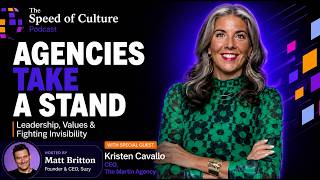
In this Speed of Culture podcast episode, host Matt Britton interviews Kristen Cavallo, CEO of The Martin Agency. Cavallo shares her personal background as a military‑brat and former salesperson, her love for advertising’s invitation‑based mindset, and her career path that has stayed exclusively on the agency side. She reflects on how agencies have shifted from vendor‑focused operations to purpose‑driven partners, emphasizing relevance, conversation, and brand values over pure awareness. Cavallo explains why strategists can rise to the C‑suite, describing the ambidextrous skill set of planners and the importance of delegating to creatives, producers, and other specialists. A day in the life of the Martin CEO is outlined as a blend of client meetings, talent development, creative reviews, and strategic planning. She details the agency’s bold diversity‑in‑production goal (50% minority directors/editors) and the internal processes that hold the firm accountable. The conversation moves to the agency’s differentiation strategy—"fighting invisibility"—and the need for agencies to brand themselves and stand for clear values. Cavallo recounts defending the industry during the Coinbase/Super Bowl controversy, illustrating her willingness to publicly support agency work. She discusses how the firm decides which social issues to champion, the importance of picking a single controversy, and how that shapes client acquisition. Finally, she offers market outlooks, noting recession anxieties, the power of creativity in hard times, and personal practices that help her slow down, such as family time and travel.
Chapters
Up today, we're gonna be speaking with Kristin Cavallo, Chief Executive Officer at The Martin Agency. Kristin, it's great to see you. How you doing today?
I'm good. Thank you.
Thanks for having me. I've been absolutely, I've been so excited for this podcast. I've been a longtime fan. I'm really looking forward to hearing what you have to say, and I think our audience is gonna get a ton of value from today. Before we get started, I'd love to hear a little bit about your background and how you got to be where you are today.
Sure. Well, I don't know how far back you want to go, but like in life, I'm a military brat, moved a lot growing up, only daughter, military officer with two boys. So I always felt a little bit like I had to compete, I think, right, in my father's sights and good graces a little bit. But I fell into advertising. I had never taken a class in it, and, um, and I loved it from the moment I fell into it. I felt people were curious and not beholden to one way of thinking. They were very open-minded and they had kind of a broad aperture in life and the way they felt about problems. And it was different from anything that I had done prior. I, I'd gotten my master's in more math-oriented venue and been in sales, but one of the things I loved in particular about advertising is you walk into everything figuring out how I can grow the audience from where it is today to where it needs to be. So everything is about an invitation. And I thought that was actually a really lovely way to, to walk through life. How do I, for any of these clients or any of these brands or any of these experiences, figure out how to invite more people in? And that just has a way of positively coloring, I think, your outlook. You're not trying to withhold hold or limit or remove. You're trying to use curiosity and creativity to broaden and increase and unite and invite. And I thought that was just the kind of— I don't know, it was a very encouraging way to walk through life and how I spent so much of my day.
So, and just looking at your career, I mean, you've only been in the advertising industry and only been on the agency side, which is rare. I mean, I think you're the 13th or 14th guest we've had here on the Speed of Culture podcast. Nearly every guest who I've interviewed that, you know, is either at an agency or was at an agency also went to the client side. And you've been straight agency your entire career. Was there ever a point where you thought about going over to the brand side, or you're just so in love with working at ad agencies that you had kind of tunnel vision?
I started actually before I got my first job in advertising. I was a salesperson for Bristol-Myers Squibb.
Okay, that was over 30 years ago. That doesn't really count, right?
I've thought about it a lot recently because my youngest is about to go to college, and I feel like I'm at a bit of an inflection point where I could, you know, broaden what— where I live and what I do. And, and, but I feel in a way like I've been ruined by advertising in a good way. Meaning, for someone like me who's moved around a lot and has a high curiosity index and loves change, to only think about one industry or one brand all the time makes me highly nervous. And I love, as a strategist, being able to pop into a meeting with TIAA or UPS or Chobani or Oreo and look for the common themes. And I listen to the strategists and the people talk and I think to myself, well, that's really interesting. I heard that on GEICO, or that's interesting, DoorDash isn't talking about that. And in the last couple years, what's been really interesting strategically as in the past. You know, you've worked really hard to differentiate brands. And so there's always— you're trying to find the differences and the nuances within a brand that differentiate it from, from its competitive set. But in the past few years, we've all had more of a shared experience than we ever have before. So everyone lived through COVID, everyone lived through MeToo, everyone lived through George Floyd, everyone's living through the recession. And so It's rare that all of humanity seems to have as much in common. It's actually really ironic in the way that we're as divisive as we are right now, because we've actually had more shared experience in the past 4 or 5 years than I can think in many, in many times in history. Yeah.
And other than, you know, obviously the massive impact of COVID and the political landscape, how has the agency world changed over the last 30 years? How's the role of an advertising agency evolved in your opinion?
I think it's been polarizing. I think for some, for some people it's become more of a vendor. It's become more a conversation about how do we automate, replicate, and make this more efficient. For others, it's been a conversation that has been more about social good and brand purpose and what do we stand for and the role of values. And we're seeing that where it used to be awareness was the primary driver of sales, then it led to preference, and now it's relevance, it's conversation. And so making sure that your brand is talked about is the most accurate predictor of sales success. So those things aren't about being automated. They're about knowing when and how you show up in the world, which are conscious decisions that need to be made, strategic decisions. And you talk a lot more about tone and voice and the tensions and what you're standing up for and where you're drawing the line and what you're willing to stand up against. And for those good clients, those that— well, I don't— not that the others can't be good, they're just different. We've spent more of our time with the latter.
Yeah, it sounds like really what you're getting into is the heart of brand strategy and brand purpose, etc. And I know your background is as a planner and as a strategist, and you know, that is in some ways an unusual path to becoming a CEO. Most people who become CEOs of big agencies were on the account side where they were driving a lot of business. Not to say strategists don't, but it's just a different role by nature. You know, why is that path important? And do you think that kind of creates a new lane for strategists today to almost get into the C-suite through a different path?
I absolutely think it does. I, in the past, I think 2017, there was a lot written about the paths to CEOs and most prevalent were people who came from operations or finance. I think those were the kind of predictable paths to leadership, certainly account management. There was this, whether it was spoken or unspoken, there was this expectation that the person who became the CEO was incredibly knowledgeable about our business and the business, the agency. I think there aren't a lot of us that are strategists as CEOs, but I think those of us that are have seen and taken the opportunity to shift and say, well, wait a minute, the— what that my people think, whether it's a talent question, what motivates my talent, what motivates the consumer, what do I stand for if I treat myself like a brand— those are the conversations that are going to help in this big talent reshuffle and in the, in the sense of gaining business. And so those are very strategic questions, and I think that's a clear lane for planners to be thought, thought of as valid CEO candidates? Yeah.
I mean, ultimately, right, you want to have that seat at the table. You want to be the partner of the CMO and a CMO going back to your— what you were describing earlier is almost a barbell for agencies, right? Some agencies are tacticians and they're paid to do, and other agencies are paid to think and then do. And the latter are the ones that get that seat at the table. They get to be strategic partners. So I, I totally agree that, that the strategist is in this day and age is a perfect, because, you know, back in the day you look at the Mad Men era and it was all about who could make the best TV spot, right? But now production is so much easier. You can produce a great TV spot from your iPhone, right? So you, not that you don't need great creative behind it, but the strategy and the insight behind it's ultimately what makes great creative ultimately moves the needle on the business.
I think we've learned that what we think is as important or maybe more important than what we do. Yeah, I have learned very well to delegate the things that are not in my zone of genius kind of perspective, and I pick people I rely on. A lot of them happen to be other strategists who I think— I think strategists in general have a set of ambidextrous skills. But I do a lot rely a lot on production people. They're also very much a major part of my leadership team, and creatives. I feel like creative people by definition signed up to take accountability for coming up with the solution. I believe the solution can come from anywhere, but creative people by definition sign up and say, "I will take responsibility for coming up with an idea." I think producers just get a lot done. And so, they're no bullshit kind of people and they have to think inventively and creatively and very quickly. I think planners are ambidextrous. They have to know how to sell. They have to think their way out of a box. They have to make gut decisions. And so I think those types of skill sets are incredibly valuable today in leadership.
Yeah. So obviously, you know, the Martin Agency has had tremendous success in recent years. You're the CEO of this incredible business with over 400 people. What is a day in the life of the CEO of the Martin Agency?
Every day is different. Every day is different. It is, you know, today we have clients visiting. So I got to pop down and, and, uh, and visit with some clients from TIAA. I'm popping into a new business meeting later this afternoon with a potential client. I did a 360 review of an employee earlier this morning. I met with some interns and talked to them about what we stand for and our beliefs. I met with our talent and culture team to talk about learning and development and budgets moving into the back half of the year. So I would say it's broad in its spectrum. I looked at creative work for another one of our clients, some new metaverse stuff that we're making. And so I would say that's the fun part, right? I mean, it's, it's creative, it's thoughtful, but it uses every synapse in my brain. I'm talking about the organization, I'm talking about the people, I'm talking about the clients, talking about the work, and it's some combination of all of those things every day. It might ebb and flow a little bit in terms of its weighted average, but Some days it's more on the people, some days it's more on the clients, some days it's more on the work. But I make sure that, that there's a little bit of each every day.
And I'm sure it's all driven by your annual goals, right? As a company, whether it's financial, cultural, or business goals.
Personally, I'm very motivated by goals. I like having an idea of something that I can surpass, and I like the goal to be out of my comfort zone. I'm very motivated by fear of not reaching things, ironically. So it's not a sense of bullishness that drives me. It's a sense of I don't like to let people down, but I set pretty high expectations. And then I love it when we as a team surpass what we thought was possible. It just feels like a real— I don't know, it's just, it's like when your kid does something great. Not that my staff are kids, but when someone you've invested a lot of time in surpasses their own expectations of what they're capable of. Absolutely. It's a different kind of rush.
Yeah. And what I found as, as my career progresses is it's not only the people that are working for me now, but when I see people who used to work for me go on and do great things, you know, there's no greater feeling to know that you had some role in, in their success.
Exactly. It's fun. It's actually really fun. We, so we set a number of different goals. We'll set a financial goal for ourselves. We'll set this year, one of our goals is we want to make sure that we shoot or produce 50% of our work with minority directors and editors by race, gender, ability. Fantastic. That was spurred on because I watched a Netflix documentary by the Geena Davis Institute called This Changes Everything and was shocked at how little had changed behind the camera. And I thought, you know, we're not as big an agency as some, but because our clients tend to be pretty big, we have some weight when it comes to production. We produce a lot of work. And I thought to myself and shared it with the others on our executive committee, and they agreed that if we made decisions that said 50% of our work for all these brands, GEICO, Oreo, DoorDash, et cetera, we want to shoot and edit with minority directors by race, gender, and ability, that we could encourage more of these production companies to sign on more of these directors.
That's amazing. Good for you.
And we're achieving it. And I remember at the beginning of the year, we were like, wow, is 50% too much? Are we going to be able to get there? Should we set a 2-year limit for ourselves? You know, we didn't know that, but every client we went to in advance said we're on board. And it's not been easy. Sometimes we have to put some of our own money and skin in the game to make sure that treatments look good, or we have to add extra time, or we have to really go on a, on a limit for maybe somebody who has on paper less experienced, but we are achieving that goal. And we believe in the long run it's a different kind of legacy than just making ourselves better. We're hoping it impacts the industry in a positive way.
Yeah, I think as a leader you need to— I mean, that's an amazing initiative, and I'm sure you have similar goals around diversification of your staff as well. And these things aren't easy, but they're not meant to be easy. And I think you're bringing diversity of thought and idea along with it, which will make you stronger and more Hellef as well. Absolutely.
The whole way we tell stories is different because of the way that we're staffed as a company. The stories we tell, the arcs of the stories are different. And the truth is it isn't easy, but we were able to do it a lot faster than I think a lot of people— people give themselves too long a runway. They say, oh, I'll get to this by 2030. No. Well, then there's no fire. You have to have a sense of urgency about the things that are important. And to me, the reason diversity is an easy thing to get behind. It is so clearly tied to business goals. Every study says if you have a diverse leadership team, your business goals are better. So I'm like, well, then that's a no-brainer. I work for a publicly held company. It's my responsibility to deliver business goals. If I know that investing in D&I is going to help me achieve my business goals, then that's a no-brainer.
Done.
Sign. Where do I sign? Right? I don't— those things are— it's like investing in one is actually helping me get further in the other. They're not false binary choices. One is actually a cumulative— has a cumulative effect on the other.
100%. And talking about goals, you know, you can't, you can't achieve your goals unless you compete and you win. And the Martin Agency has been incredibly successful in 2020, uh, won Adweek's US Agency of the Year, uh, which is no small feat. How do you differentiate yourselves as an agency in the crowded world where you're not only competing with other agencies and digital agencies, but now you have the huge consultancies, the McKinseys, the Accentures of the world. At its core, what does differentiation look like?
It's— well, we have a clear line in the sand where we are different from the Accentures, the Havases, the Dentsu of the world. Those, those companies have chosen in many ways, in many cases, to strip out their brand names and go to market as one holding company. And we believe that a client should not hire an agency that cannot brand itself. That should be like—
Eat your own dog food, right?
Absolutely, right out of the gate. And I think too many agencies for too long have believed that they need to act like blank canvases in order for the client to feel like that agency was capable of branding them.
But if you stand for everything, you stand for nothing, right? Ultimately.
That's exactly right. We're not drinking our own Kool-Aid. And I think it should be, you know, a non-starter for a client to bring their business to someone that cannot brand themselves. Our brand proposition and promise is around fighting invisibility. It's based externally for clients on the statistic that 84% of ads go unnoticed, which is a really sobering and shocking number. It's not because the work that's out in the world is wrong. It's because most of it is invisible. It is boring. It is uninteresting. And our commitment is to make sure we're in the 16% that stands out and is talked about because we know that the most talked about brands grow faster. Internally, fighting invisibility means an inclusive culture and it means broadening the aperture of how we tell our stories. And we know that that also benefits us externally. So it's got a nice double entendre, but it is our commitment. And we've vet our client relationships through that common belief and philosophy in breakthrough work, in talked-about work. You have to have a company that is okay being talked about in the press. And a lot of, a lot of clients don't. You know, they want to be— they want to have advertising, but they— and they say they want to be differentiated, but they don't really want to be talked about. And those clients, that— what that reveals to me, if we can't persuade them otherwise, is they don't really understand how brands grow today because it's not enough. I can be aware of Coke. I can even prefer Coke over Pepsi. But the truth is I drink water. So awareness and preference don't have as much of a Pavlovian response now to sales as it used to.. But the brands most relevant to me are the brands that I buy. And because we have such an abundance of choices in every category, I'm choosing those brands in many cases based on their values or principle or how much I think they're interesting or, or they're talked about.
And so, yeah, that really, yeah, that, that comes along with shifting a narrative, right? From moving away from advertising to content as well.
Right?
Cause if you're selling a product, you're talking about the unique selling proposition, 50% more absorbent, right? 350 horsepower. But in the world of content where people are on their phones all day, It's about what does the consumer think about when they wake up? Where do I fit in? How do I stay relevant?
I mean, there are no bad cars on the market today because laws have done a good job of making sure that all cars are safe and that there are airbags and that all of them have ABS brakes. So talking about those things sells me an automobile over a bike, but it doesn't sell me on one brand versus another. Absolutely. And so we have to, you know, so we think of the sums. If I went to market and sold only my capabilities, like I'm capable of doing these things, or here's how I price, or here's how the fact that I don't have, you know, multiple P&Ls. That's like, to me, the equivalent of ABS brakes or heated seats.
Yeah, you're getting the feature war, right?
That's an incremental road. That's a game of inches. What I need to sell you on is a belief and a philosophy, and then have you say, well, if diversity is important to you as it is to us, and a diverse team is important to you as it is to us, then this agency would be in my sweet spot.
Yep. And I think in order to stand for beliefs, I mean, you definitely strike me as somebody who's not only passionate, but has a strong moral compass and understands what you believe and why it's important. Well, that's the perception you give off at least. And you know, I know that has to, you believe in our prior conversations that you feel that that has to manifest towards a brand. And I know you feel strongly that brands and businesses need to take a stand for something. And I think in this world, talking about what you said earlier, a lot of businesses wanna stay outta the press cuz they don't wanna rock the boat. You clearly don't think that way. How does a brand or an agency or any business decide what to take a stand for? And why do you think that's important?
There are so many good and worthy problems. My first advice would be to just pick a problem. Pick one where you can authentically back up your passion in that space. We don't— there's no way I can solve all problems. I can't care about all things equally. So for us, we've picked diversity and inclusion. We've picked a handful of things in that, in that space. I think there are plenty of problems in the world. So I would say to a client, pick one and make a meaningful impact in that space. I think that people want to know where you stand. So the other way to look at it is pick your controversies. You don't want to pick every controversy, but pick the controversies that you're willing to take a stand on and then make sure that you can live authentically in that space. And there will be a market. There is a market for almost every belief out there.
But you're also, aren't you also knocking out a market, Kristin? So if you pick one side of the aisle on an issue, are you okay with alienating the other side? Cause you're cutting your addressable market in half by doing that.
Yes. And I, so I would say you should size your market to figure out the thing you care about, if it's big enough for you to be profitable and grow. But the truth is I'm not going to win every piece of business anyway. So either I spend all my time pitching something where philosophically we don't have agreement on how brands grow and what it takes. And then I lose, and then I have a morale problem, I've got a money problem because I've spent hundreds and millions of dollars pitching things that I shouldn't have been pitching anyway, and I'm distracted from spending my time pitching the things that I do feel matter. I feel if I project a clear image out in the world of the things we care about, then the right— more of the right clients will come to us. And if that happens, if we're sought out more by the people who care about the things we care about, then chances are my win rate goes up, my loss rate goes down, my morale stays high, my people feel more productive, and that flywheel throws us forward exponentially. So I would say, again, going back to the don't be everything to everybody, don't be afraid to shrink the magnitude of your audience. You shouldn't be for everybody. And, and really no brand are ever bought by everybody.
Right. No, you're right. And how do you decide what, on behalf of the Martin Agency? Because obviously that's a business. You are a person. You aren't the business, right? You, you, like you said earlier, you're part of a holding company. So is there some type of process where you will bring together key stakeholders within your organization and figure out what's most important to drive your values?
Sure. Well, I have an executive committee and we, before COVID we met maybe every other week. During COVID we met every single day. Yeah. To make sure we're going to stand up every morning because we had to make sure that the information we were giving our people was consistent. And we were all in different conversations all day long. Today we meet 3 times a week, Monday, Wednesday, Friday for roughly an hour to make sure we're all, we have the same marching orders every day because we live in this hybrid world so that there's a consistent answer to the majority of questions that come from the agency. And then we have an officer's group. And so we'll often go to that officers group and then open up major things to that group. And of course, the staff knows they can come anytime. We have a very transparent culture where it's been built this way over the past 5 years. We had to earn a lot of trust back from people that we didn't have when I first got here, I would say. But we've put in the sweat equity and we've earned it. And so people know that they can agree and disagree at any time. I have found that while I don't agree with everybody, and I know everybody in the company doesn't agree with me, If they know my primary motivation is to be inclusive and it's not to reduce the number of people, but increase the number of people who could enjoy our healthcare benefits or work here or feel seen and valued, that even if someone doesn't exactly share my political point of view, they can understand that my motivations are in this space and they can decide if they align with that. And then it's, you know, they choose to work here or not work here.
When you talk about how the agency role has changed, that's definitely a new twist to operating a business in this day and age. People are outspoken. We have a polarized world. And, but I think in some it's the sitting on the sidelines, especially for a business like yours. I can understand why that's not really an option. There's one thing that you didn't stand on the sidelines for earlier this year, which I, as a former CEO of an agency for nearly 15 years, I just, it really touched me because I, there were so many times when my team put in work and I felt like we didn't get the proper credit or the proper accolade from clients. And you know, I see my employees working day and night and giving up weekends and something similar happened to you with Coinbase where basically you would pitch an idea. Um, it didn't get bought. The, the customer ran with it and then tweeted that they didn't like any ideas they got from agencies and almost didn't give the agency credit and you stuck up for your agency. And I can imagine that your employees really felt like they had a CEO who had their back. Tell us about, like, was that a spur of the moment thing? Were you worried after you tweeted that? Like, when you're like, oh my God, holy shit, should I really have said that? Walk us through that and to whatever level of detail you're comfortable talking about.
Yeah. Well, for me in that moment, which 100% it was a spur of the moment and 100% I was really nervous. I probably curled in the fetal position for a solid week. I was afraid I had immediate sense of anxiety and regret. I really didn't think it would be seen by a lot of people. I think it was just a moment gut reaction. And honestly, I wasn't responding to the IP of the situation. It wasn't— I understand that multiple agencies can come up with a similar idea. So when I saw the spot on the Super Bowl, I didn't say anything. I was frustrated, but I didn't say—
so everyone knows— sorry to interrupt, but I mean, everyone knows this was, which was, I do think was an incredible Super Bowl spot. It was a bouncing QR code on the screen this past year's Super Bowl, and it was just something that was so different. And obviously you had to take a picture of it. QR codes were hot. Pandemic. Really smart.
Well executed. It was talked about. It was polarizing. It was visually arresting. All the things you would want. So again, my issue was not with the content of the commercial. My issue was, was with the way he spoke about ad agencies. And the fact that any CEO would feel the need to go to a social media platform and rip, or, you know, tear down an entire industry of professionals. I just thought, I don't have a single client that would do that. UPS wouldn't do that. GEICO wouldn't do that. Mondelēz wouldn't do that. Like, we don't need to tear somebody down in order to build somebody up. If you want to build up your internal team, build up your internal team, but not at the expense of someone else. And, you know, the architecture industry doesn't do this. I don't know any industry that allows itself to be beaten up as much or beats up on itself as much as the ad industry. And it's why we're ranked so low on the Gallup poll. And I, I just was like, it has to stop. Like, somebody needs to say something. It's not okay. And agencies take it a lot, and we do it to ourselves. We do it to ourselves on our own different social media platforms. And the truth is, then we get upset when we're not paid fairly. Or when we have horrible pay terms, or when we're not given enough time to think, or when we're not valued. And I think, you know, I just thought we have to stop. What I wasn't expecting was that it would have the reaction. I wasn't expecting the solidarity that—
Struck a chord. It really did.
It really did. And I was in my anxiety. I was also incredibly pleased to see the solidarity it created. And that was really encouraging that it's become a bit of a platform for me for the whole rest of this year about sticking up for this industry and sticking up for competitors. Yeah, I will call— I will call out good things about my competitors. I will, I will compliment them on their wins. I will high-five them when they do things that I think are great. We're such a competitive industry and we've gotten comfortable with tearing each other down or judging each other's work. And I think we should always take a critical eye to work and decide if it has real merit and if it's really breakthrough or if it's truly inventive or innovative or new, or if it's really effective at driving business as well. So we should be critical. We should take a constructive, critical perspective towards all those things. But, but we should balance that with huge props when things do go right for somebody and recognize that we build confidence in our whole industry when we build confidence in each other. And I don't know that my point of view is the prevailing one or even the popular one. But I do think it is something I personally believe in. And so I have decided, going back to the earlier thing of picking your controversies, that if I take our mission of fighting invisibility, I can maybe put a third filter on it, which is making sure the ad industry is not invisible. We deserve credit for the, for the thinking that we do, for the inventiveness and cleverness of the people who join this industry. And we deserve to get paid fairly for the work that we do and be valued for the work that we do because we— the work we do can be an economic multiplier to our clients. It can value their business. It can bring new clients. It can bring price premium. It can bring new stories to clients in ways that enhance their balance sheet. And that's worth sticking up for.
Yeah. And until the industry does that, they're going to have a hard time attracting the best talent in the world where Talent can go to Google, they can go to Facebook, these other companies. If you wanna bring them on, then they need to feel like, you know, that, that, that the industry's treated well. And, and frankly, that they're working for a company where the CEO has their back. And you definitely showed that there. So kudos to you. So you, we're wrapping things up here. I'd love to know your thoughts about where you see the market going in terms of, uh, the advertising industry. What are some of the areas you're focused on, um, as we head into the fall of 2022 this year? The year's flying by, the summer's flying by. In terms of how you're positioning the business moving forward and what are some of the opportunities for growth that you see at your organization?
Yeah, I know we just told the staff we're closing for 2 weeks at Christmas and I couldn't believe we were already at that point where I'm like, oh, you know what? Holiday vacation.
Yeah. I think we need to do the same thing today. So thanks for reminding me.
Yeah, definitely do that. I think it just gives people a sense of, then they know that they have time to prepare. Yeah. Right.
And take some.
Awesome time off with their family or by themselves. I think for our industry, I think we're at an interesting inflection point. Going back to your point about we have, we have some major big holding companies stripping out brand names and going to market in a, in a way that accentuates the how of what we do, not so much the why of what we do. On the other side, the side that we're going to live on is the side that is considering their agency as a brand and is becoming very crystal clear on our values, our why, and our purpose, and then hoping to find like-minded clients. I think within the business world right now, it's interesting. I think where there's a lot of talk about recession and softening, I don't know that it's going to get a lot worse. I don't know that it is. I think there's a lot of dramatic conversation. I read something the other day about bad news bias. And about 86% of news that comes out in America is negative compared to 51% of the rest of the world.
Because it sells papers, right?
And I think going into midterm election. Yeah. Going into midterm election, that certainly, and the person in the cast in the story was saying journalism or journalists rather are giving Americans what they want, which is bad news because those are the stories we click on. So I think we're living in this suspended state of fear and anxiety that I don't know is truly gonna manifest itself. So I'm hopeful that it's not, but I'm also hopeful that a lot of clients continue to spend, not because it's helpful for my business, but because it's helpful for theirs. Clients that continue to keep their brand lights on in hard times come out 6 times better. They fare 6 times better. The price of media decreases. You can buy more time. You can increase your share of voice at a lower return on ad spend, and you can gain customers in ways that you don't give that ground back for, for for years. You can also really achieve connection, you know, connection and relevance with consumers by empathizing with them during hard times. So you may have to change up your messaging, but I think the opportunity for brands to show up for consumers is more important in tense moments. So if this is a tense moment, then I think the role of brands becomes heightened and clients need to think about that. But so I think the business world's going through something. I think the ad industry is going through something. But I think creativity has never been more important to kind of figuring our way out of, of business problems and societal problems and knowing who you are and what you're good at and the problem you're going to pick, the controversy you're willing to stand up for has never been more important to consumers and to businesses today. And that is exciting.
Yeah, absolutely. That was amazing. We covered so much in such a short period of time. Thank you again for joining. I just have one final question for you. You know, our podcast is about the speed of culture and how quickly things are moving, but in a world that's moving so fast, what are some of the things personally that slows you down?
Well, on a positive side, my kids allow me to take a break and slow things down. My love of travel is a positive that helps me slow things down, and I invest heavily in both. I am a single parent, so I'm— my kids are a major— not that they're not a priority for other people, but they are my, my everything. And then travel is my hobby. And so I spend kind of those two avenues are where I spend the bulk of my free time. To the chagrin of my Peloton.
A lot of people using their Peloton as a clothing holder these days, for better or worse. Where's the last amazing place you traveled to?
Well, it was— the places weren't necessarily new. I went to Barcelona, Mallorca, and Paris with two other friends of mine earlier this summer. The place that was probably most out of my comfort zone was last fall. I went to Peru and hiked the Salkantay Trail into Machu Picchu. It took about a week. And I think Nat Geo declared it one of the top 10 most beautiful hikes in the world. It was not for the faint of heart, but I was— that one challenged me, but in a really positive way.
Amazing. Well, lots of challenges for you, and I have no doubt you're gonna continue to conquer them. So thanks again for joining. On behalf of Suzy— absolutely— on behalf of Suzy and the Adweek team, thanks to everyone for joining us. Be sure to subscribe, rate, and review the Speed of Culture podcast on your favorite podcast platform. Till next time, see everyone.
More from Matt




MikMak’s Rachel Tipograph on Consumer Spending, Retail Media & Holiday Shopping Trends



Jaguar Land Rover’s Charlotte Blank on Luxury, Purpose & Experiential Storytelling



