The New York Times’ David Rubin on Subscription Marketing & the Future of News Media
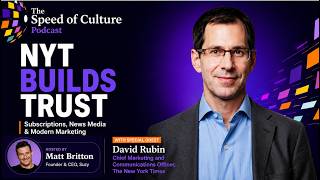
David Rubin, Chief Marketing Officer of The New York Times since 2016, explains how the paper shifted from ads to subscriptions by bundling journalism with Cooking, Games, The Athletic, and Wordle. The Times aims for 15 million subscribers by 2027 and treats the newsroom itself as the product, not just the source of it.
Chapters
Everyone, it's Matt Britton. We are live in person at Samsung 837. It's the brand's flagship experience store located in the heart of Manhattan's Meatpacking District and a place where consumers can experience tech, culture, art, and gaming along with Samsung's latest innovation. So thanks to Samsung for letting us host today's special podcast with our special guest, David Rubin, an old friend of mine. And one of Business Insider's 25 most innovative CMOs in the world. He's currently the Chief Marketing and Communications Officer for the New York Times. David, so great to see you and thanks for joining today.
Great to see you, Matt.
Thanks for having me. Absolutely. I've been wanting to do this for quite some time and let's just get kicked off by getting to know a little bit more about your background. One thing that popped up in looking at your history, which I didn't know, is that, um, after graduating from Yale, you went to the Department of Treasury. What kind of led you in that direction?
I got a job. Um, no, I, I started actually on Capitol Hill working for a congressman from the south side of Milwaukee. Okay. Um, and then after 2 years, I had the opportunity to go work in the Economic Policy Department at the Department of Treasury. And, you know, it was a great first role, a great, great place to really get to kind of make your own way in those kinds of jobs. They're really undefined, and you kind of get to do, you know, you get to meet people who have had really successful careers and work immediately with them. And so it was a great first job to have.
And any kind of memories that you take away from that experience that you think are still applicable today?
I mean, certainly the fast pace of it all. In politics, there's always so much you don't control. I think the— what it teach— what it's taught me and continues to teach me is how much you need to know where you want to go so that when the world happens around you, you stay on that path.
Sure.
And that's more true now than it's ever been.
That's for sure. And then you went back to get your MBA from Wharton. What— what made you decide to do that?
I wanted to go work in the private sector. I never had, and I felt like I would need to get some kind of training to kind of reset and find the right role. And so I did, and I wanted to go to Wharton because I had done a liberal arts background and I had been in politics, and I felt like I really needed a grounding in math and data because it's where I was probably weakest, but certainly perceived to be weakest. And so I always feel like that's the right way to do education is to go fill those gaps for yourself. Work into your strengths and educate into the things that are, that are holes to be filled.
Sure. And what's interesting is you went right from getting your MBA to jumping into Unilever, where you spent a big portion of your career up to date. And one of the first brands you worked on was Axe. And I would imagine the things that you did at Axe were anything like what you were being taught in the textbooks at Wharton, right? You guys were disrupting, you know, a category in a way that frankly the marketing world hadn't really seen seen to date. So, you know, is it fair to say that you were kind of learning as you were going along while you were kind of driving that disruption for the Axe brand?
For sure. So we launched Axe into the US in 2002. Now, not everybody knows this, but Axe actually existed from back in the early to mid-1980s. So I had nothing to do with that.
Right.
I was in my teens or preteens, but we were launching in the US for the first time, and it was really the first launch of Axe. Axe was in most countries, but it hadn't really launched in a purely digital environment. So it was really one of Axe's first launches into a new country in the digital age. And so we were— it was a great experience because some of what made Axe successful really was basics of marketing. Yeah. Understand your audience, understand how you want to be different, communicate out to your audience in a way that distinguishes you from others. But then a lot of it was completely new and never seen before. You know, how do you do this in a digital environment? How do you do this, you know, in a, with formats that people haven't seen before and hadn't been made for the brand before. Um, and so it was very much sort of similar to what we were talking about before, taking a bunch of things that were kind of figured out and applying them in ways that had never been applied, at least in that brand before.
Absolutely. I mean, what a lot of people, maybe listeners to this podcast, don't realize is that right when you were in that role at Axe, 2000, 2001, the internet itself was first becoming sort of a mainstream media consumption habit. And then over the course of those next 6 to 8 years, you had the advent of Facebook, you had the advent of the iPhone, of YouTube. All these tools that we kind of know well as like dial tone today were just coming about and created incredible opportunities for brands that were willing to take the risk to really make a name for themselves and break through that traditional model.
Yeah, so the, you know, this is obviously pre-YouTube, and it's what we used to call viral videos, right? So people, somebody would make a video and they would send it to their friends, and a couple of them would pick up, people pick would pick up, you know, just like happens today through a TikTok or a YouTube, but it all happens sort of unorganized, deconstructed or unstructured. And so almost all of those had been comedic videos made by individual, you know, individuals, just people. And BMW had done a really big series with a lot of money. And I think they were the first brand to really do it, but they had put a ton of money into those. And we, as far as I know, we were the second brand to really try that., and we did it with hundreds of thousands of dollars, and they just took off. So it was that kind of stuff of sort of having the guts to try things that people weren't sure how they would go, but what made it easy for Axe was we were trying, we knew we were going for an audience that the company didn't have a lot of experience with, and so it gave us permission to try, and we were trying to launch something that really needed to pick up very quickly or it wouldn't stay on shelves, which is true for anything in consumer products.
Absolutely, in some ways it's really a harbinger of where we are today, where you have these creators with limited no budget creating massive audiences, and then you have massive media companies throwing endless tens of millions, hundreds of millions of dollars of content that just doesn't connect with the consumer. So I think what was true then is really still true today, is that it's not about the money you throw. It all starts with that core human insight and your ability to execute on a way that gets people to react emotionally, ultimately connect with that content and share it.
Ultimately, what story are you telling, and, and is that story something that people are going to find fresh and different and interesting? And I don't think that's changed in 20 years. It probably hasn't changed in 2,000 years.
Absolutely. So you ended up— would end up spending about 15 years at Unilever, moving on to director of hair at Unilever and then in a vice president role on the hair category. You know, one thing that's been a common with the guests here at the Speed of Culture podcast is they got their experience at a large consumer packaged goods company, whether it be Johnson Johnson or Procter Gamble or in your case, Unilever. What are the core things that you've been able to take away from that career and apply to your role as a CMO today? Today?
Yeah, I mean, first of all is that marketing's job is to grow the business. Marketing's not just out to say stuff and, you know, make a little buzz. And that ends up meaning that whatever you do has to be sustained. It can be different each time, but it's got to have a sustained impact because nobody makes a business on one good hit.
Exactly.
At least not the kind of business they want to. That's the first thing I learned. The second was the balance of art and science. Heart and head, whatever you want to call it, which I think has even gotten more true, the need to understand and be comfortable with and to be steeped in the data, but then to also be able to remember that every category has emotional connections and that you have to pull those out as well. You know, I think if, if deodorants or bleach can have an emotional connection, any category can.
Absolutely. Absolutely. And then from Unilever, you had a quick stint at Pinterest where you had their global brands and this opportunity at The New York Times popped up. I'd love to know kind of what drew you to New York Times and how your role came about there.
Yeah. So, I mean, it's interesting because I actually, while I love The New York Times as a brand, I didn't necessarily think of media as a place where, you know, marketers like me might go. And so I wasn't initially drawn to the role, just wasn't sure what it would, you know, whether it was a fit for me. And I met with my, uh, my now boss, who is now the CEO, Meredith Levian. And she convinced me that the place was a, you know, a digital subscription business, a nonfiction Netflix, HBO, Spotify, right, if you will. And I saw those as places that I would go. And I realized that maybe this is a place that I could really do the same thing. And she was totally right. It is totally that. I joined in April of 2016. And every day has been that, you know, focused on growing the consumer subscription business. And we've had a real run from a couple of million subscribers to now over 9 million.
Yeah, absolutely. I mean, I can see what you're saying in terms of it just being a different form factor. It's words instead of video, but ultimately you're a subscription-based digital media company and content-based company. I mean, exactly.
One of the big differences you see across a bunch, you know, different types of digital media companies is whether a place is more of a platform, which to me means that they're not making the content, and a place like some of the places we talked about, or a New York Times that is making the content. Yeah. And because of that, actually from a marketing perspective, there's a lot more to market in this, in that, when you make the content, because ultimately what people want is the thing they read. Yep. Or experience or listen to or whatever. And in our case, those folks, the people who really make the whole business work are our journalists. They work at the Times, and, you know, ultimately what we're marketing to a potential subscriber is their work and them.
Yeah, absolutely. And we're gonna get into the role of the journalist in a second. So when you joined at New York Times, you became the first CMO after 100 years. So I'm kind of sitting with publishing royalty here, but why did the New York Times think that now was the right time to get a chief marketing officer? How had the publishing industry changed today to necessitate that?
Yeah, I mean, it really is that we've become a consumer subscription business.
Right. Away from what? Just selling physical newspapers?
Well, and I think away from, you know, an advertising-supported news source. I mean, there's always been subscriptions in the print sense.
Sure.
But most of the money, most of the profit came from advertising. And a big difference there is that in an ad-driven model, you're looking for total audience.
Mm-hmm.
In a subscription-driven model where you want somebody to pay you and pay you every month or whatever cycle you're on, In the end, nobody's gonna do that if they're not feeling good about it all repeatedly. And so suddenly you care a lot about repeat customers. And obviously you'd like scale and repeat, but if you had to choose, repeat is more important in a subscription-supported model because nobody's gonna pay for a subscription for something they read once a month or once a year, whereas in an ad-driven model, you don't really care the difference.
Right, you're trying to aggregate impressions for a total—
Total impressions. If you got a billion people one time, that's fine, whereas in a subscription model, you need both. And I think that that creates more need for— because you're building a relationship with the end user, it creates the need for more marketing and more traditional marketing and branding, if you will. The second reason why was that over the 15, 20 years, depending what time period in my story you're picking here, what we've seen is a real decline in how people think about traditional media, right? And a lot of that has to do with technological innovation and other things that are happening.
Social media.
Social media, et cetera. And where people are consuming that media and then wondering about that content 'cause they're not receiving it as it was intended. And so what became clear is that we and the media and news media in general needed to start telling our story. It's been true for hundreds of years. As a brand. Well, and also as an industry. You know, people believed, even when people didn't like the press, they believed it needed to exist, right? It goes back to the founding of our country. And I think that we've gotten away from what's the role of the news media? Why do you need a news source in a digital environment, in a social media environment. And I think we need it now more than ever, and I think it's become, in my time at the Times, it's become more clear to people, get what you pay for, and if you're not paying for the news, ask yourself a question. But I think it's taken some work to get people to realize that.
Absolutely, and it's work that never ends, right?
Yeah, for sure.
So you raise an interesting point in terms of being all things to all people when you're not selling, you know, digital subscriptions, and then it's now about finding your audience who's willing to become a repeat customer. Does that in some ways, as a byproduct, make publications more polarizing because those people are sort of insular? So you're going after the people that like your content, you're creating more content for them, and it sort of takes it more in one direction. And is that an issue that you face at New York Times and you think the industry faces at large?
It could speak more just to the Times. We don't think so in our context. Right. The reason that people love and trust our brand, you know, when you talk to a subscriber who's been there forever, what they'll say is that the Times introduced me to something I didn't know, or I didn't think I cared about, or I didn't believe. They made me think differently about something. And so our whole proposition is doing that. It's sort of the opposite of traditional marketing. Our job is not to give the end user what they want, particularly when it comes to the content itself. Our job is to help you understand the world, and understand the world as it is, not as we want it to be, and not as, you know, we would like to make it, whoever that is. And so that puts us in a position, it's a good thing because it means that that is the expectation of the customer, of the reader, and because of that, that's what we have to give them. That is also what makes for better journalism, and so we're lucky that those things are aligned. But yeah, no, we don't see ourselves in a position, you know, we believe it's really important that we continue to see ourselves as serving everyone, and you know, that's why we have an audience now, you know, a total audience that, ranges in the hundreds of millions.
Yeah, I do think other publishers, obviously not as prestigious, don't have the history of the New York Times, they are selling clickbait. They are giving people what they want versus what they should be hearing, and they're feeding into that. And that has created some hysteria that we've seen in recent past, recent years, especially around things like the election, etc.
Uh, yeah, I mean, you know, again, we spend a lot of time making sure that, you know, we think about our job is to help people, is to seek the truth and help people understand the world. Yeah. And ultimately that is our mission, but but it is also what people are buying from us. And I think it's one of the things— and we can talk about this more if you want— because our mission and our business relationship with the customer are actually basically identical, that puts us in a really healthy position. And lots of brands have a mission or a purpose that's not really aligned with their business dynamics. And I think that makes— at some point, that dichotomy gets exposed, I think.
So in other words, if you did derive all your revenue from advertising, theoretically, if Tesla, say, was a big advertiser and Elon Musk, which is a whole nother podcast, is right, we're saying something that you thought you need to uncover for your readers. Maybe there would be some pressure at some publications. They— well, we don't want to lose the advertising revenue. It's not right against this. But when you don't have advertisers, a big piece of your revenue, it kind of takes that conflict of interest away.
I will say the Times was has been set up for years and years, decades, and continues to be to prevent that from happening. And so I would say that that wouldn't happen even if we were— even if this were 20 years ago. And, you know, we have lots of examples of that happening. You know, the Pulitzer Prize-winning journalism uncovering Harvey Weinstein's misdeeds, that's— that turned into the She Said movie that's currently running. You know, he was a big advertiser, right? Had no impact on coverage that we did, or his company was a big advertiser. So we've been doing that for, for, for decades, if not centuries, I guess. But yeah, I can imagine there are places that feel those pressures quite dramatically. And I'm sure if you're not in a place that you want to be business-wise, that can be quite hard. Yeah.
So you mentioned the reporters earlier on and how ultimately, you know, the aggregation of reporters becomes essentially the brand that you stand on because they're creating the work that, you know, your customers are subscribing to. You know, there's been a recent trend of reporters going direct. You know, you have Substack, you have obviously social media. I'm a huge fan of Bill Simmons in the sports world who, you know, got unceremoniously fired from ESPN, created his own podcast network called The Ringer, built up, sold to Spotify. But I think what he showed is that individuals have very strong brands and some cases it can actually usurp the brand of the publisher they're in. Do you see that as sort of a trend where you want to build up the reporters, but only to the extent that they can be within the banner? And do you find that something that's hard to control in terms of being a publisher?
I should say that mostly that's a newsroom, right, consideration, and less something I work on. Yeah, okay. If you look at the advertising we've been making on the marketing side, we are very, you know, it's normal for us to be promoting the journalists. Sometimes we do that through their work. We even had one campaign where we talked about them themselves, The Truth Takes a Journalist, which was—
Yeah, that was great.
And so, you know, and we also— it also goes both ways. We have some of our marketing now and again, journalists will talk about the need to support the Times through a subscription. The morning newsletter does that some. There can be mentions on The Daily, so our podcast. We sort of see that relationship, you know, through that way. You know, ultimately, I think a lot of people continue to come to The Times to work because it's a great place to work and it's a great place to—
And it's a clearinghouse and validation for quality and trust and things of that nature.
Exactly. It's a great place to see your work get a big audience and have a lot of credibility. And so I think that the truth is, like a lot of these things, people want to put things in a, it's this or it's that. I think it depends on what you're looking to do and probably specific to each individual.
Yeah. Let's talk a little bit more about the product, because I know you've also been involved in some acquisitions that have broadened the scope of what you're able to offer your subscribers. Wordle, which is obviously more recently an acquisition of The New York Times, which is a lot of people's favorites. And I thought that to be a quite intriguing acquisition. And then, you know, you also made an acquisition of The Athletic, which was an incredible success story in the subscription publishing space in the world where a lot of traditional digital publishers were really struggling. They sort of broke through and were able to create a great success story. I'm personally a subscriber of that as well. And then Serial, which is another acquisition, happened back in 2020, which is one of the first podcasts that really exploded in terms of the episodic form factor. What goes into decisions to acquire properties like that, and how does that play a role into your overall storytelling and marketing to your customers?
Yeah, I, I think step back for a second and sort of not think about acquisitions per se, but whether it's buy or build. Sure. The thing that we're, we're up to, and this is all stuff we rolled out almost literally a year ago. Our latest strategy is what we call our Essential Subscription strategy. And the idea is that we're looking to be the, to offer to people news and information for all their passion points. And so prior to that, we were looking at journalism worth paying for, which is still kind of the underlying idea. Yeah, but now we're looking to make sure we're doing that in news and in other areas. Right. And so when we look at people's passion areas where news and information are important. You know, you can look at— we have a cooking product, New York Times Cooking, that has over 1 million subscribers. We have our games product, which includes Crosswords and Spelling Bee. Wordle is actually still free, but is, is kind of an upper funnel play for New York Times Games. We have The Athletic, which is sports and really caters to the fan. And we also, you know, and you can look at other things that may not be subscription-based, right? Like audio. Yeah. We bought Wirecutter a few years ago, which is recommendations. And you can see in all of those, there's sort of a common thread, which is a place where sort of the journalistic process is important to providing quality information that helps people understand. Right. Understand what to buy, understand what team to root for, or how to root for their team, or how their team's gonna do, understand what to cook today, understand what to play.
Yeah, and I would imagine a lot of those tentacles really touch people's passion points and then ultimately become a magnet to bring them into the broader portfolio. So it gives you all these different tools to go after different audiences to find the right fit.
That's right. And even to put a finer point on it, it gives us, you know, multiple routes, but two big groups of routes. One is, is you can come in for the whole thing, you know, our New York Times All Access, right, which we're increasingly making more prominent and making clear to people. Or you can come into any of the independent products. If that's where you want to be. And that can either be a place that you come and stay, or it can be a beginning point to where you then see the, the broader world. Now, we believe that ultimately the best experience is when you get the whole thing, and when you get the whole thing in our environment. But we provide lots of places to connect with the brand in other spaces, and in, you know, and if you want to get an independent product, you can do that too.
Yeah. And as we progress, and you talk about some of these tools being a big part of it, and your audience shifts because now the millennial is the head of the household and pretty soon will be Gen Z. These are people that grew up either with the internet in the household in the case of millennials, or the phone is an appendage to their body as the case with Gen Z. I have to imagine those audiences coming into your framework shifts how you go to market, whether it be using new media channels like TikTok and Pinterest, or maybe leaning more into video. How does that sort of dictate your go-to-market strategy?
Yeah, I mean, the nice thing for us is like we now have a pretty clear sense of what it is we do. Right. Not to keep repeating myself, but we seek the truth and help people understand the world. Our view is that that can then manifest itself however the world develops. Platform agnostic. That's right. That's right. And so our job is to make sure that we're providing content wherever we can best tell that story and help people understand. We less look at it as like, what do we need to do in this channel, and more like, what is the thing we're helping people understand, and what are the different channels we can do that whereby we will help people really understand? And the nice thing is each, you know, lots of these channels have different strengths and things where they can, you know, and ultimately that lets us tell a story for people and show people what's going on in the world in a way that they couldn't through, you know, if it was only reading a physical paper.
But all that being said, do you find that sometimes you have to customize a message maybe for a baby boomer versus a Gen Z in terms of how you take that core premise of the publication and actually translate it to different audiences?
We typically aren't looking, you know, across demographics. I think a lot of entertainment companies do that. I don't need to decide if, you know, they're— how you— what content you're looking for and how you like to see it, right? There can be people who are quite advanced in their age who like TikTok, right? You know, like I think we have these stereotypes and they're just not true, or they're certainly not universally true. So for us, it's more how do we tell the story? Now, there are some exceptions to that. Like for instance, we have a print section that is only available in print, which we have very few of those, that is targeted towards 10 to 13. And it's the same proposition. We write to sort of, you know, smart things to help them understand the world, but for the age that they are. And so we have, we have some examples of that, but most of the time it's much more, we put out the content we think we, you know, works in that format. So take for example The Daily, which is one of the top podcasts in the country and, and around the world. It has a younger audience than our traditional products, but it's not because we, we said, how do I make a podcast for young people? We said, how do we make a podcast and how do we make a daily podcast? And it came out fresh and interesting and the audience found the content, right?
It gravitated. The audience that it was fit for gravitated towards it.
And lots of people listen to it who aren't of the demographic I just described. Yeah, right. But it is certainly true that we have a younger audience to it than we would have in, you know, a traditional print story or even a digital story.
Sure. Absolutely. So shifting gears a little bit, so obviously you guys have had a ton of success in the subscription model, from a few million to now 10 million subscribers if you include The Athletic. You know, subscription business is a lot different than selling hair care products at Unilever, obviously. I run a subscription software company. I know that churn is the one thing you want to avoid. You want to keep those customers, you want to figure out how to keep them happy and grow them, etc. How has that journey been for you as a marketer, and how has it been different? And How does that impact, I guess, the things you think about every day as CMO of The New York Times?
Yeah, I mean, definitely a lot more focused on, you know, sort of the data of the customer journey because you actually have it. Yeah. I mean, obviously a big difference from traditional consumer products is that ultimately you're, you're getting survey information in consumer products and you're running through, you know, but you're selling through a retailer. Right, right. Whereas in our current business today and I think in yours, you know, we're the end— the relationship is between us and the and customer, so we have that data, and that lets us see where we're strongest, where we have issues, and we can go and correct that. And so that's certainly, it's a lot more power that way. It's a lot, you know, you can move a lot faster. I think that's a big difference, is just the pace that you have to move when you have the ability to sort of, I did this, I saw what happened a second later. But I think most businesses are headed that direction at this point.
Yeah, I mean, it's interesting, 'cause I was speaking with the CMO of GoGo Squeeze, who's very hands-on, they're an emerging CPG brand, Mark Edmondson here on the podcast, and he was talking about those very exact challenges where when you sell through a mass retailer, even as a small dynamic brand, you still are at the behest of the data that you're selling through these retail channels. And a lot of CPGs are now thinking about, do we go direct? But does a consumer really want to have 10 different platforms? One where they buy deodorant from, one where they buy shampoo from? No. So where do they go through? They go through Amazon, which still doesn't allow you to have the data.
So ultimately just selling through a channel. Exactly.
CPG company. Exactly. At the same time, a lot of the direct-to-consumer CPG brands haven't been able to survive on their own because consumers still want to buy from the big box retailers versus going direct. So, but you guys are in, you know, you're in a specifically interesting position where you can actually have your finger on the pulse of the consumer. And to your point, look throughout the funnel and see, oh, do they like this ad? Oh, that's what's drawing them in. Are they converting? No. Are they buying more products from us? Why? And you kind of go through that. So is that what generally drives the creative process when you work with your agencies in terms of coming up with these various pieces of content that support the overall mission? Are you looking at the data first, or are you trying to uncover more of a creative insight that's behind it?
Yeah, I mean, one thing to know about us is that our, our acquisition efforts really are first through the product, right? You know, um, product-led growth, product-led growth. And we have said publicly that we get most of our, our starts not from paying an article.
You want to read it, and it's it's paywall and that's what drives you in.
Right. As the most common journey, that's correct. Yeah.
Yeah.
There are others, but that's right. And so, you know, I guess the analogy for us is we do have a lot of interaction with our products through platforms, you know, the social media companies, Google, etc. And then our data there, we have some and we don't in others. That's part of why we see the relationship, you know, end up back in our own platform is so powerful is ultimately We think, you know, what people are coming to us for is to help them understand the world. Yeah. And that happens from more than one article. Yeah. And so ultimately, if you're reading in another platform, our content, our editorial direction, our editorial judgment gets adjusted. Right. And so that's why we think people— and you're seeing this now increasingly— people are consuming it in our own products also as our product gets better.
Yeah.
And that's where they get the better experience. It's also where we—
like your iPad experience when you go through a story and you have the graphical interface is unbelievable. Right.—
and a story is supplemented with some kind of data visualization, and might even be supplemented with, you know, something you get from a podcast. And so that whole experience is something you can't get if you're in the distributed internet, right? Or it's much harder to get from us. Whereas in our own platform, we make that very easy. We now have, you know, our live blog, and our live updates from the newsroom are places where you can follow along with the story as the news comes in, and it makes it easy to sort of see how the story is developing. And those are all things you can't get if you're reading a story just through your feed.
And is that a role also as CMO that you play, is consulting with the product team in terms of the visualization and things of that nature? Because it is an extension of your marketing.
No, I mean, anything that is content is done by the newsroom. Gotcha. It's done by the newsroom and we don't get our hands in that. Right, right. Where, you know, the customer care team, as an example, sits under me. You know, we might be involved in providing insights about like the product experience, but actually like, should this story have a data visualization?
Would never Right, right, right. Yeah. And it makes, it makes it so different than almost every other category, that church and state in terms of marketing, not being able to necessarily drive the product, but taking the product, extracting the core principles and pushing it out versus having, you know, a hand in terms of how it's created just based upon the nature of publishing.
That's right. Well, I think it's helpful. I think even for some people to think about it because, you know, in, in other industries, because ultimately the quality of the content is the only thing that matters.
Yeah.
And that's even true if you're a brand that doesn't sell content for a living, I think. And even if you're the CMO who's then making content, you know, in our case, the content is our product. Yeah. So it is made by our product developers, which in this case is the newsroom. We also have product developers who make the software, but the— in this case we're using product to talk about the content that's made by the newsroom. And it is content first because the quality of that is all we have. I think even if you're a CMO who leads content development in a non-media organization, that mindset of how do I get the highest quality out there? And you actually see some creators really talking about this. Yeah. You know, that ultimately that's all you've got. And I think that there's just too much of how do I just create whatever I can and get some audience on it? I just think that doesn't work for very long.
It doesn't. Yeah. It's like a sugar high.
Yeah. And maybe you have one hit, but then good luck trying to make that hit again and on purpose. Ultimately, what you need is a process by which you're creating really good content, and the thing you see in a content-led company is ultimately that's about the quality of the people who make the content, and about giving them the space to make the content that they believe fits what they're trying to do. In our case, where that's news, it's about having a journalist who figures out what stories they're gonna cover, and then covers it wherever the facts lead.
Right, right.
And that's what the Times is so good at. We have people who are given the space to follow a story for a year if that's what it takes. And that might be all they publish. And then there are other people who are on beats where they're doing, you know, regular updates. And it's just, we have both happening. And that's because it's about the, it's about wherever the story leads. Absolutely.
So we're here in Samsung's A37 flagship experience and we're surrounded by Christmas lights. And, you know, obviously that means that we're headed to the end of the year. And this is the time of year a lot of people start to think about planning for next year. You know, next year is a huge year for your organization, any news organization, because we're heading towards the next presidential election. Um, obviously the world is full of headlines, a lot very scary headlines, not all scary, but I'm sure it's going to be a huge year for the New York Times. What are some of your macro goals or things that you have your eye on and thinking about as you head into planning for next year?
Yeah, I mean, I mean, you know, ultimately it's about that essential subscription strategy and, and getting to 15 million subscribers, which is our stated goal, out into the future. And that's through, you know, like we talked about, through multiple product experiences and also through the bundle itself. I think, you know, doing that and continuing that, and we're very much, you know, have a lot of confidence and a lot of momentum like you talked about, and also thinking about how we do that in an environment where the macroeconomic environment is uncertain. Yeah. And how do we continue to invest in the things that that matter and that will drive our business and from a place of strength, knowing that we still need the flexibility to see both our subscription business and our ad business, you know, how they'll perform if there— if indeed there is a slowdown. You know, ad businesses traditionally are the first and hardest hit or one of the hardest hit, but one of the first. Nobody's really had a digital subscription business in a protracted downturn. Right. Right. It's just too new. And so, you know, maybe a little bit in '08, '09, but it was not really. And so I don't think anybody knows how they're going to respond. Right. And in— and I think also in an environment where I think consumers are starting to feel that there are lots of subscriptions and how do they respond when, when and if money gets a little tighter? And I think we're— we feel very comfortable that we're in a position to be able to do that well, no matter kind of how that shakes out. And then ultimately, like I said before, it's all about the quality of the content itself and having something that people really feel they need and that gives them value. And I You know, that's what we aim for every day. Absolutely.
So to wrap things up here, I have to ask you, you know, a lot of people are sharing on social media about this new OpenAI, you know, platform and ChatGPT where you're putting in questions and it's pumping out stories.
It's fun.
What type of role do you think that is going to play in the future of journalism? I'm hearing, you know, kids are using it now to write papers for them, which obviously will take away a lot of journalistic practice, uh, going forward. But have you guys given any thought into what that means to the future of journalism, or just curiously what your thoughts are?
Personally. Yeah, look, I mean, data and AI are all tools that, that can be helpful to us. But ultimately, you know, what people come to the Times for is our journalistic judgment. Yeah. And I think ultimately, I think we're still pretty far away from robots being reporters, from that starting to happen. And actually, you see that, you know, over the last half decade to decade, the idea that just anybody can report the news is sort of not worked for us.
Well, then it all becomes a sea of sameness, right?
That's right, and ultimately, you end up with a whole lot more content and no idea what to trust. Right. And that's what we've seen in social media and across the distributed internet, is that the lack of confidence, you can get a lot more content that way, but is that content, does anybody know what it means?
Right, it could be made by a bot who's not a real person with no control.
Or even a person who doesn't really, who only knows one angle.
Either or, right.
Or doesn't even know any, or actually is making it up. It can be any of that, and you've got no idea how to know which is which.
And that— and the way you do know is through a trusted brand. That's why brands matter, right? Ultimately, in a space like this, that's why you keep building the brand, you keep building that trust, because over time people know if it comes from you, you know, it aligns with their values and they can trust it, and it's something they're gonna lean into.
There was a process that went into this to make sure that you could— to make sure that we were providing you a the facts that we could verify.
Absolutely.
Absolutely.
So we're going to wrap it with that. Um, just two quick questions before we, uh, finish up today. First and foremost, is there a quote that you live by, uh, that kind of drives your career and your mantra?
Unilever used to send us through these trainings to determine your true north. Like, how do you tell your own story? And what I came up in that was, um, I like turning the mundane into the magical. I like that. Look, I don't think the New York Times or news is mundane, but it is a sea of sameness. And it's really about how do you, in a place where, in any business where people are all giving the same thing, how do you put a magical spark into what you do? How do you connect with people's, not just the functional value that you can provide, which is super important, but also make them want to? Yeah. Yeah. And I think if you can do that in deodorants, you can do it in anything.
Absolutely. And then lastly, obviously we're about the speed of culture moving so fast. What slows you down? What's the yin to your yang that slows you down? You obviously, or in a very high-pressure role, what's worth David Rubin taking a step back from all the madness and getting some calm in your life?
These days, it's driving my daughter to field hockey. Oh, yeah. That's kind of the answer. You know, I— time with my family. Yeah, for sure. And, you know, make it happen even, even against all the madness.
Absolutely. Well, thank you so much, David. This has been amazing. Cannot wait for our listeners to hear this. You're obviously in a fascinating role, and I think some of the insights you uncovered today are really going to enlighten people as to all the things that you consider in your role as CMO of The New York Times. So on behalf of Suzy and the Adweek team, thanks again to David for joining us. Be sure to subscribe, rate, and review the Speed of Culture podcast on your favorite podcast platform. Until next time, see you soon, everyone. Take care.
More from Matt




MikMak’s Rachel Tipograph on Consumer Spending, Retail Media & Holiday Shopping Trends



Jaguar Land Rover’s Charlotte Blank on Luxury, Purpose & Experiential Storytelling



