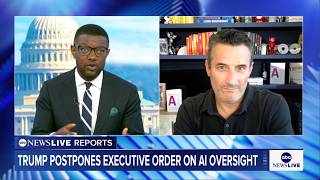
Matt Britton, author of Generation AI, explains the tension in U.S. AI policy: too much regulation risks losing leadership to China, too little risks deepfakes and fraud. He warns that a slow approval process like the FDA's could leave America behind on competitiveness and national security.
Chapters
And joining me now is AI expert and also the author of Generation AI, Matt Britton. Matt, thank you so much for the time today. And listen, Matt, we heard from the president. He said that this executive order would have gotten in the way of the US leading China. What did he mean by that?
Well, I mean, his hesitation really reflects the defining tension of the era, which is speed versus safety. You know, the White House, they clearly recognize that cybersecurity risks of advanced AI models, but I think Trump's instinct is that overregulation here could really hand momentum to China. And this tension is really going to define global policy for really the next decade and beyond.
But one of the things I was curious about, you mentioned that this EO was meant to put up guardrails for Gen Alpha, which is the first generation with AI as basically like an invisible copilot here.
Yeah, I mean, well, Gen Alpha is the AI generation, currently age 0 to 15 years old. They're the first generation to grow up with the AI in the household. So they are never gonna know a world without AI. They're never gonna know a world without a technology that you can interact with just like a human. And we are really entering unprecedented territory here, both from a geopolitical standpoint, a business standpoint, even a parenting and education standpoint. So it's not surprising to me that Trump and the administration would kind of waver and go back and forth because there's no real roadmap for how to move forward here.
Well, and the order as it was was focused heavily on deepfakes and misinformation. That seems like a critical piece in this equation here.
I mean, there are so many opportunities for nefarious actors to use AI to harm society. Everything from fraud to, as you mentioned, deepfakes that could shift the social discourse based upon you seeing someone on social media say something that they really didn't say. I agree also was said earlier that Anthropic's Mythos announcement clearly rattled policymakers. You know, when AI companies themselves are warning that models could trigger a cybersecurity reckoning, the government needs to open up their eyes to it. But again, the tension here is if you look at something like the FDA, it can take years sometimes for a new medicine to be approved and come into the market. And if that starts to happen with AI models, we're going to quickly find our ourselves behind in a critical race that again defines not only the future of business, but in many ways our national security. So on one hand, you want to put down guardrails and be careful, but the other hand, if you put down too many guardrails, you're going to find yourselves behind and that's going to be really hard to catch up from.