The Weather Company’s Randi Stipes on AI Weather Intelligence & Industry
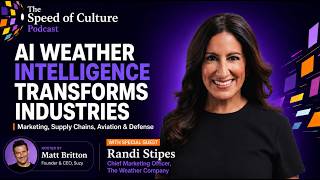
In a CES‑based interview, Matt Britton talks with Randi Stipes, CMO of The Weather Company, about how the firm leverages data, AI, and creativity to turn weather into actionable intelligence across consumer and enterprise markets. Stipes explains the company’s dual‑track business model – a consumer‑facing Weather Channel app with over 360 million monthly users, supported by advertising and a paid subscription, and a suite of enterprise products that deliver hyper‑granular forecasts and insights via APIs, the Weather Engine, PilotBrief for pilots, and emerging defense‑training simulations. She highlights the role of weather intelligence in marketing (e.g., ice‑cream sales patterns), aviation safety, supply‑chain pricing, and mental‑health impacts, noting that 76 % of app users seek health‑related information and 81 % say weather affects mental health. The conversation covers the company’s evolution from an IBM subsidiary to an independent “Weather 3.0” organization, its partnership with NVIDIA to improve AI‑driven forecasting down to 1‑km resolution, and the push for personalization, retention, and new distribution channels such as TikTok. Stipes also discusses talent development, AI experimentation sandboxes, and a leadership mantra about standing for core values. The interview ends with reflections on growth mindset and the future of weather‑driven decision‑making.
Chapters
We're here live from CES in Las Vegas, and we're thrilled to welcome today Randi Stipes, the Chief Marketing Officer of The Weather Company, a trailblazer in harnessing data, AI, and creativity to drive innovation, societal impact. Randi, it's so great to see you.
Thanks so much for having me.
Absolutely. You know, it's not lost on me that you work with The Weather Company, and we're here amidst the tragic wildfires that are, that are ravaging Southern California. Um, you know, The Weather Company obviously is a tool that consumers really rely on, especially in times like this. What do you think the role is of the brand to help shepherd consumers through tragedies like this that are increasingly happening?
Unfortunately, they are, um, and we'd be remiss not to talk about it. I'm actually born and raised in Southern California. My family fortunately is safe. Good. Um, but It's absolutely tragic to witness this. And you're right, it's becoming far more, far more common. I like to say, and we like to say, weather's predictable.
Yeah.
But it is getting more volatile. It's getting more erratic. And so we are fiercely committed at The Weather Company to giving people the facts to help them make more informed decisions. And that can go from kind of the basic everyday what to wear to certainly the more extreme events like we're seeing unfold now, um, in terms of keeping people safe. But, you know, I think it goes, it goes beyond that. It's also when we get into the— we don't only have a, a consumer portion of our business, it's also from an enterprise standpoint, how can we actually arm marketers, brands, and other functions within organizations with weather intelligence so that they could make smarter decisions.
Impacts demand. If there's a snowstorm, people can't go to Walmart. They can't buy as much. It impacts inventory, all sorts of things.
And so there's this, you know, we can all kind of fall victim to Mother Nature. Or we can try to harness her power and get smarter based on the data that we have so that we can not only be prepared and be safe, but hopefully drive business growth.
Yeah. I mean, as I was preparing for this interview today, just dawned on me how many different ways the weather impacts us, impacts our mood, impacts our health, stuff like allergies, obviously impacts our safety in times like this. Um, and it's such a daily ritual. There's really nothing else like it if you think about it. I mean, I guess the closest thing would be like the stock market because that's an external factor that impacts your wallet, and this is kind of like the, the manifestation of this in the physical realm.
You know, it's, it's so true. We are a daily habit, we're a utility, but it's always, consciously or subconsciously, to drive that decision. And so you mentioned health. One interesting stat is that 76% of the people who use the Weather Channel app are coming there to mitigate a health challenge or a health illness.
Wow, that high.
It gets even higher when you think about mental health. 81% say that weather impacts their mental health.
Of course.
I mean, Right now, kind of going back to what's happening in Southern California, think about the angst that that creates for people.
And it will for weeks and months and years.
Of course. Yeah. From the most immediate safety concerns. But then when we talk about air quality. Yes. And the aftermath. And so, you know, consciously or subconsciously, the weather really is impacting so many of our decisions. I think, physically, emotionally, mentally that we're making.
Yeah. So for those who don't know, tell me about The Weather Company's business, its business model, and the different lines of business you operate in.
Sure, I'm happy to. So I think most people are probably familiar with our consumer business. I'll start there. The Weather Channel being our flagship app. So we have, you know, it's really a great kind of great power and great responsibility that comes with it with more than 360 million people who are— Wow. Yeah, it's a lot— who are visiting our, uh, our digital properties every month. Um, so we have a thriving consumer business. Um, we also— that, that is available, it's ad-supported, but we also have a subscription.
We have a paid version.
Thank you. And there is, you know, diversified revenue streams that come in there from an advertising standpoint We love partnering with brands so that they can, you know, run within a trusted environment, be part of that daily habit and daily ritual. But it really goes beyond that. We were talking about the weather intelligence and the insights. It's also giving brands that intelligence so that they can leverage it across their advertising campaigns. So how do we plug that intelligence into DSPs?
Intelligence meaning where people are?
Beyond that. So intelligence meaning— I'm glad I talk about it like it's second nature, but I mean, let me unpack that for a minute and then I'll kind of come back to the rest of it. Fantastic. So when I say weather intelligence, what I mean is that we know that weather impacts consumer behavior. We can extract insights that we then help brands recognize and activate on. So we'll do an example.
Okay, great.
Because I think that helps crystallize for people. So what would you think are the weather conditions that drive ice cream sales? Like what kind of weather would motivate you to buy.
Well, most people would think if it's hot out, you wanna buy ice cream.
Yeah. Right. Logical. And that's true. However, we know weather's relative. Like what might be considered a warm temperature to you versus me.
It's like those people in Florida that complain when it's 60 degrees.
That's me. Right. Yeah. I live in Florida.
There you go.
I, you know, in Vegas right now it's 60 degrees and I'm legitimately cold.
Right. I think it's amazing.
Right. So it's relative. Back to the ice cream example. What we found is that in the Ohio Valley, which right now is getting pummeled with snow, but in the Ohio Valley, when it drops to 57 degrees, people— that starts to feel a little bit cold. People go inside, they consume ice cream because it's a comfort food. Wow. And so that's just one example. We have 40 years of historical data that we can go ahead, we can correlate it with first-party data, with third-party data. Fascinating. To give brands these insights and then they can activate them. Right. Anywhere. We don't believe in walled gardens. They can certainly run with us across our O&O, but they can run anywhere. The same type of weather intelligence, how it can be leveraged though, in a lot of different places beyond marketing. So how can that be used in supply chain and pricing?
Yeah, we were talking about earlier, right?
Exactly. We also have a thriving aviation part of our business. So working with global airlines, 25,000 flights a day, rely on us and our products and our services, our meteorological expertise to take off and land safely.
I would imagine with the growth of sports gambling in the US and the impact of weather on professional football games, that probably has an application in your business too.
I mean, given the impact and really the influence on every industry, yeah, we like to say like everyone needs a weather strategy, um, and but we have some more specialized products and solutions, if you will, to for, for given industries.
I've always been surprised, like, you want to go on a vacation. Yeah. Maybe you live in the Northeast, it's freezing, and you want to go somewhere where it's not raining, where it's sunny out. And if you go on a travel site, you can't really do that. You can't search by what the weather is that weekend. Yes. And I would think that's such like a, we talk about AI, we'll get into that in a second. Sure. You know, basically synthesizing that data into searches and other non-endemic things. To help paint a picture.
Well, you're exactly right. I mean, you can get a forecast a million different places. You can't necessarily get the most accurate forecast, but you can get a forecast from— there's over 10,000 weather apps out there.
That many?
Wow.
Staggering.
Right.
A lot of them, by the way, I know are nefarious in terms of how they take your data, how they use it, etc.
Exactly. Glad that you said that versus me saying it. However, I think where the value comes in and what we're really focused on is how do you translate that forecast so that we go beyond data and we're actually giving people the actionable information. So when's the best time that you would want to travel to Vail to go skiing? When's the best time you might want to travel to the Virgin Islands to ensure that you're getting the maximum days of sun? How do we kind of remove that cognitive load for people and take the guesswork out of it? Yeah, that's, that's the key.
When you say it's getting— it is predictable. Yeah. Is the technology such where you can predict further out now? Like, say someone's getting married a month from now and they want to know Is it more reliable now than it was, say, a decade ago to understand the weather?
It is. I mean, certainly, it's still the case where the closer that you get to a given day or an event, then the more accurate you're going to be. However, where the technology has really improved is the granularity. And so right now, you know, we are working, I believe, like, you know, in solving kind of these big global challenges, we certainly have a lot of expertise, but you need strong partners also that you bring to the table. So one example of that is we're working with NVIDIA. And together we are focused on how can we use AI to create more of, to best leverage that in our forecasting, but also create better visualization capabilities. And so—
I think it's a big opportunity. Like a lot of people don't know how to read the radars.
Yes.
I know how to read the radars and everyone's like, I don't know how to look at that. Like I don't look at the forecast, I look at the radar.
Or for, and a lot of people do that. Yeah. I mean, everyone consumes information differently. Yeah, sure. But right now, knowing that we can get down to the zip code level, That's great. However, there can be a ton of variance in a given zip code. So our goal with NVIDIA is, and it's doable, is how we get down to really that 1-kilometer radius to get that precise, to get that granular, to give people greater confidence. And think about the applications that has for marketers to be able, like, if we can get the forecast down to that level, continue with our industry-leading accuracy, I think that's what becomes really valuable for marketers.
Yeah, I think ultimately AI, you talk about the companion and, you know, the ultimate sidekick to your life, and this plays such a perfect role. And in the world of AI and AI-driven products, having this data point in terms of where you are, what the weather is, now all of a sudden it impacts the clothes you're wearing you might want to buy, or the activities that you plan, the places you travel, what you eat and all these different things. And you could see very quickly how it unlocks it to be a layer in your decision-making framework in a way where before it's kind of compartmentalized. You went and checked the weather, then you did all these other things.
That's right. Right. Yeah. And I mean, listen, everyone of course is talking about AI. I mean, someone should have started a drinking game here. It's like, yes, we'd all be, we'd all be on our, on the floor. Yeah. But it's not new to us in our business. We've been using machine learning to, in our forecasting. Right. For decades. Our meteorologists look at over 100 different models when they're generating the forecast. There's no way that they could do that without the help of technology, or specifically machine learning. Where we've expanded it is in analyzing that forecast, like we were talking about, extracting the insights around the consumer behavior. Like the AI is what unlocks that richer understanding and more dimensions beyond, oh, it's raining, you need to go get an umbrella. You don't need AI for that.
Right. So let's talk about the business model of the Weather Company. I believe you start— so part of IBM, correct?
So we were part of— you were part of IBM for about 7 years. Okay. And our time with IBM was great. IBM was good to us on a lot of levels, kind of going back to AI, where AI is the new kid on the block for so many companies. AI really became part of our DNA when we were there, and a lot of great hygiene. Um, you know, I think that our time at IBM transformed us from a media company into a data and technology company.
Yeah, for sure.
But about a year ago, we separated, I like to say consciously uncoupling, if you will, right? As IBM began to focus their portfolio.
So it spun out as its own business.
We spun out. So we, I like to say we're in our Weather 3.0 era right now.
How does that change things for the business?
It's unleashed us.
Really? Because you're smaller, more nimble.
Exactly. I mean, we again, great, great upbringing through, through IBM. We were a standalone business prior though. And so I feel like now we're a rocket ship. Like we just, we needed to be unleashed so that we could run very faster. So the trajectory is strong.
So what are the core business models of the company? We spoke about the app and the ad-supported and paid version. And I'm more curious to hear about the enterprise and how you're monetizing this incredible platform with the enterprise and where you're focused on here in 2025.
Yeah. So the— we again, thriving consumer business, but from an enterprise standpoint, it's all about the data and the insights. So how we are using that, we talked a little bit about aviation. So we have very strong foothold in the aviation space.
Do you have an API? You have an API to tap into the data?
Beyond even APIs, we have products and services. I'll give you one example. Something called PilotBrief that pilots use in the cockpit to help— that helps inform them about turbulence and other weather parameters that impact our safety as passengers. I happen to know who all of our airline partners are, so I make sure that I fly on those airlines. In all seriousness, we do have a strong relationship with most global airlines. We also have long been in the media business, and so we work with local broadcast affiliates across the country to supply them with a lot of the graphics packages and other data and services. So for people that haven't cut the cord, if they're watching their local news affiliate, chances are we're working behind the scenes with them. Interesting. And then we have, you know, really the emerging part of our business, though, is our intelligence platform. It's something that we call Weather Engine. That is the vehicle that allows us to analyze all of the data. Yes, you can go ahead and you can access it through an API. For marketers, we make that available via targeting. That's really where we're focused. It continues to be how we unlock the intelligence behind the forecast.
Fantastic. And really fascinating business model because a lot of people just think about the weather on its surface and it's so much more than is it raining or not.
I'll give you one more quick example. That's an emerging part of our business that we don't talk a lot about just because it's early phase, but I personally find it fascinating. Is we're starting to talk with the defense industry as well. When we think about the importance and the power of weather for our soldiers. Yeah. Working with corporations and governments to give them real-time weather to use in training simulations. So kind of going in training simulations, going back to the visualization capabilities, not only for consumers to look at our radar map, but how are we arming defense companies and governments with real-time weather to better prepare people for when they're in the field? To date, all of those simulation exercises, they use synthetic weather. They don't use real weather. And again, our weather is crazy right now. We need to be— we should probably take that out. But our weather is crazy right now. So we need to be able to provide kind of those real-time conditions to better prime people for being in, in combat.
For sure. So shifting gears, we wrap up here. You know, it's— CES is always exciting because, you know, beginning of the year, new possibilities, new budgets, new everything. Where are you focused and how do you spend your time? Because we just went through so many different business models, consumer, enterprise, all these different applications. Where are you focused in driving the business forward, especially given this new autonomy? That you have as a business?
So with the technology that we have available, I feel like sky's the limit. Yeah, I think actually that it's a, it's a blessing and a curse because there's so many areas of possibility and potential growth. Really where our focus is, I'm going to sound like a broken record, but it's on the insights. Yeah. First, how are we bringing those insights to bear for consumers? So how are we making the app more personal?
Right.
How are we making it more intuitive? How are we making it stickier? How are we also ensuring that we're not only providing the weather to people who are on our properties, but how are we partnering with, you know, with companies like TikTok, where we just launched a partnership where it's in a beta right now, but in New Zealand and Australia and Canada, where knowing that so many people now are using social as basically their search engine. Yeah. So if someone goes in and they type Auckland weather when they're in TikTok, right, we're providing that weather. So we're focused on also ensuring that we're providing weather to people where they are.
Yeah, meet them where they are.
Sure.
Exactly.
So what are those distribution partners? We're also a big area that I'm focused on and my team's focused on is how do we futureproof our brand? Yeah. So that's one example. But we have, you know, we have over 16 million followers across social, how are we creating a great organic experience for them there?
And then what type of content works when you like?
Yeah, it's a, it's a great question. I'd say it's a mix. So first and foremost, it's probably, probably no surprise. It's like it's the short digestible, bite-sized, snackable, right? Yeah. Content. No one, you know, we're not going to put up, you know, someone in front of a map giving you the weather report. You can get that a lot of places. But how are we doing the quick video hits? Videos, you know, prove to be really engaging. We're ensuring that we're creating the right style of content for those platforms. A lot of polling, things that are more interactive. We're also working with creators so that it's not just coming from our voice, but how are we, how are we working with creators and organically telling that story? Yeah, yeah. Having them tell our story for us.
So the business seems like it's very entrepreneurial and fast moving. Yeah. You know, I can tell that you have a passion and excitement for what you do, which is probably one of the reasons why you're so successful there.
Well, I have, I have a good team.
I'm sure you do. What are some of the areas that you and your team are trying to hone your skills on and refine and, you know, optimize for in 2025, given the new world that we're continually living in every day?
Oh my gosh. How much time do we have? Exactly. So I think, first of all, it's honing our skills, certainly to drive the business, but also I'm committed to— I want to just help cultivate the best talent possible and give them the opportunity. So it looks like a few things. First of all, let's— I think starting with AI, a big thing that we're focused on is how are we using AI to not only drive efficiency in our work and drive productivity. I think it starts there, and that's probably where most of us are playing right now. But it's also experimenting with how can we use it to inspire creative? Still big stickler, and I think I will always remain a stickler, that with the human brilliance that has to come in over the top. But we've created a sandbox environment, um, not unique to marketing but across the company, that all functions can kind of experiment with, um, bringing in external AI, our own AI tools. So AI, I would say, is the— AI experimentation is the first thing that we're doing to upskill talent. Um, you know, another thing that I think we're seeing is, as we talk about our premium version of our app, our subscription business, big thing that we're focused on is not only— we know how to get people into our funnel, we are— I've gotten really good at acquisition, but it's the engagement and the retention and the upsell. Yeah, um, that I think is a very different— it's a different skill set. And, um, we have that freemium model of, of bringing people in, um, and then Another thing that we're really focused on beyond those kind of traditional marketing tactics is I firmly believe that our marketers have to be embedded with our product teams. Not only from an audience standpoint, again, and getting them into the funnel, but what are— we should be working hand in hand to understand how they're engaging. Yeah.
Use cases and how to unlock new business opportunities. I was thinking as you were talking like, you know, and you guys probably are in this business, but people who have big backyards or sensors now and those sensors can detect rain. If it's raining, you don't need to use a sprinkler and then you're not using as much water. Like there's just so many different applications to help save you money and drive more efficient decision making, which probably all unlocks new business opportunities. Exactly.
Yeah. And I'm probably a bit biased. I, I started in product when I first started gosh, two decades ago at the company.
Wow.
That's one of the reasons I've stayed.
I bet you never thought it would be doing all the things it is right now.
No, it's a different business. And that's been part of the joy is helping, having a seat at the table to help drive that transformation. And so I'm a big proponent of working cross-functionally. Yeah. So that, you know, hopefully we're not only providing value, but, you know, vice versa. And last thing I would say to kind of round out the skills is that data, data, data. Yeah. And certainly when I'm looking for new talent on the team, it doesn't necessarily have to be someone from a traditional marketing background. I want the data analysts on my team the same way that I want a great storyteller.
Exactly.
Creative.
So we, as you probably know, round out our podcast by asking our guests if there's a saying or mantra that comes to mind that guides their professional journey. So what comes to mind for you? Yeah, and no weather analogies because that's too easy.
Oh no, I won't get that.
That's not how you roll.
I won't get that cheesy on you. Um, the thing that immediately comes to mind, um, and lots— I don't even know where the original quote comes from, I think it's been attributed to several people— is that if you don't stand for something, you will fall for anything.
Yeah.
And while I think that we have to always have a growth mindset. I firmly believe, like, you've got to stick to your core values and your ideals and your beliefs and kind of never lose sight of what motivates you and of your value. Yeah. Um, I— that's, that's served me well.
Yeah. I mean, there's another saying like, be yourself, everyone else is taken. And yeah, so many times, especially younger people, it's easy for them to just try to compromise and try to fit in in a certain way, and then over time you become part of the machine and you lose who you are and what makes you special and unique. And then you find yourself 10 years later, like, what am I doing here? I'm not happy. How did I end up here?
Have that conviction. That's what's going to give you— this is what's going to give you confidence.
Absolutely. And of course, to have conviction, you need to have passion. You need to love what you do. I think it's so important. Yes.
Yep. Couldn't agree more.
And clearly you do. So thank you so much for taking time out of your busy schedule here at CES to chat today.
Yeah, it's been a blast.
Fascinating business. And obviously you've been very successful there and can't wait to see where you're going to take things next.
Thanks for being a weather fan.
You got it. On behalf of Susan, Ivy team, thanks again to the great Randy Stipe, CMO of The Weather Company, for joining us today. Be sure to subscribe, rate, and review the Speed of Culture podcast on your favorite podcast platform. Till next time, see you soon. Take care.
More from Matt




MikMak’s Rachel Tipograph on Consumer Spending, Retail Media & Holiday Shopping Trends



Jaguar Land Rover’s Charlotte Blank on Luxury, Purpose & Experiential Storytelling



