Tropicana’s Monica McGurk on Innovation, Legacy Brands & Cultural Relevance
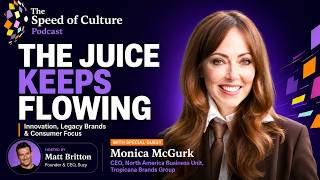
In this hour‑long interview, host Matt Britton talks with Monica McGurk, CEO of Tropicana Brand Group’s North American unit and bestselling fiction author. Monica walks through her unconventional career—from growing up on a family farm and a contract cucumber‑growing job, through a management‑trainee program, consulting, and senior roles at Coca‑Cola, Tyson, and Kellogg—explaining how each step taught her to spot growth opportunities in legacy consumer brands. She details how Tropicana sustains innovation at scale: clear financial and strategic objectives, value‑creation pillars, cross‑functional incentive alignment (OGSIM), diversity of thought, agile research, 30‑day sprint cycles, rapid pack‑structure testing, and disciplined risk‑management frameworks that balance speed with reversibility. Monica shares cultural‑relevance activations such as Tropicana Crunch cereal, the Mimosa Maker, and the AI‑free “Tropkin” campaign, illustrating how the brand inserts itself into emerging consumer moments. The conversation moves to portfolio strategy, describing the “New Horizons” pillar that guides both internal innovation and M&A (e.g., Naked, Kavita Kombucha, Izzy), leveraging Tropicana’s chilled DSD distribution, R&D centers, and zero‑waste orange processing. Monica also discusses sustainability—using every part of the orange, reducing packaging waste, and pursuing eco‑friendly formats. When asked about the CEO role, she emphasizes strategic focus, culture building, people development, and accountability to the board, shareholders, and consumers. The interview closes with Monica’s parallel journey as a fiction writer, explaining how writing fuels empathy, storytelling, and personal energy, and offering career advice about financial acumen, consumer observation, and self‑knowledge.
Chapters
Today we're thrilled to be joined by Monica McGurk, the CEO of Tropicana Brand Group's North American business unit, and also bestselling fiction writer. Monica, so great to see you. Uh, can't wait to dive in today.
Yeah, great to speak with you. Excited for our conversation.
Absolutely. So let me ask you a question. When you were growing up, did you think one day that you would be in charge of selling the most beloved orange juice brand around the world? Is, did you ever imagine that this would be where you would end up?
Never in a million years. Although I will say my affinity for food and the entire agricultural production chain does go back to my childhood. Oh, I grew up, you know, in inside of long tradition of family farming. My first real job actually was as a contract grower of cucumbers for a pickle manufacturer. So maybe I should have known, but no, I had no idea.
That's amazing. So walk me through your journey, just high level of how you got from there to where you are today. Kind of the steps you took in your career that led you to end up here.
Sure. It was not entirely purposeful, to be honest. Never is. I ended up No, no. And that's the beauty of a great career, right? You get mentored and you have great opportunities that you stumble into and are able to take advantage of. So I went to college, first-generation college attender, didn't really know that much about the route I was taking, kind of got steered into a pre-law type of program. I thought I was going to be a diplomat, go into international relations, and had a change of heart. Kind of late in the process as an undergrad, had in the meantime accumulated quite a bit of student debt, something I think a lot of, uh, your readers and observers can relate to. So— oh, lost my headphone here. Let me put that back in. Um, still hear me?
Yeah.
Yep, great. Okay. Um, so anyway, I, knowing I had a lot of debt and wasn't really crystal clear on my career path, ended up going into business simply to have a job and start to pay down that debt. I ended up being lucky enough first to take a role in manufacturing operations in a management trainee program and then pivoted into consulting, which is a fantastic proving ground and training ground for people who don't know exactly what they want to do and also don't have a real business background. You know, I had never even opened a spreadsheet.
How do you do that, Monica? Sorry, like how do you pivot into consulting? A lot of people would think that you would have to have certain chops or relationship or connection to even be able to do that?
Yeah, it is a great question. The college I happened to go to attracted a lot of recruiters in investment banking and consulting and probably is overweighted there. So there was a pipeline. But honestly, when I went through the process, I had the same question. I was like, it's kind of sketchy that someone like me could be a consultant when I don't really know anything. But I got, you know, to know many people during the recruiting process. I ended up taking that operations trainee program because I really wanted to have a link to something tangible.
Right.
But a few months into it, I wasn't learning at the pace I thought I wanted to. And then I was capable of if I were with a consulting firm in kind of the big playing space. So I was lucky enough that they were able to re-pick up or re-offer me that opportunity. And so I joined a consulting firm and ended up over time shifting my focus from what started out as operations into more strategy, marketing strategy. I founded the innovation practice for consumer in the Americas along with some great colleagues. And from that, got really, really interested as I kind of grew in my partnership to think through why it was so hard for so many of my clients to sustain innovation. Right. I was fascinated by that question because successful innovation on the one hand is super cross-functional. You have to think like a general manager and understand everything, soup to nuts, you know, sourcing, supply chain, the market opportunity. And it's a leadership and cultural challenge, which I think many of us in our industry have struggled with. So I ended up jumping into the organization practice and did a lot of leadership development, culture change, large-scale transformation, and commercial capability building. And that just really reminded me how much I liked being in the tangibleness of a real company, as I called it, and that I wanted to kind of go back into industry. And so I made that jump in 2011, 2012, ended up going into startup land, then was lucky enough to get recruited to Coca-Cola where I spent several years ultimately leading strategy, brand planning, and the e-commerce business along with analytics and insights for the North American business unit.
When e-commerce was very much nascent, especially for CPG industry versus dairy.
Yeah. Yeah. Whitespace for us. And so that was really, really a fun charge. I then moved to Tyson where I started out leading global strategy, founded their venture fund in some really cool food tech spaces, wound my way through leading the food service business and a stint as chief growth officer, and then rejoined a former boss at Kellogg where I was also the chief growth officer.. And now I'm at Tropicana. And I think the thing that threads all of those experiences is first my passion for growth and commercial capability building, my ability to reframe problems, to help unlock opportunities in what many would consider kind of stagnant legacy companies, my passion for brands and my ability to lead teams and really help them rethink the art of the possible in service of customer, profitable, sustainable, mutual customer growth and the consumer for whom we do what we do every day.
Absolutely. So you mentioned, first of all, fascinating career. And you— we haven't even gotten to the fact that you're a fiction writer. We'll get into that at the end. But, you know, you talked about sustaining innovation. And I have to tell you, Monica, like, I run a company that now is 300 people and already at our small size, I find it challenging to keep that startup mentality where when you have a startup mentality, innovation is somewhat easy because you have, you know, a small amount of people in a room. You're like, let's just do this. And then the more layers, the bigger you get. What I found is just ultimately it's like you need alignment of incentives because there are some roles, especially with like the onset of AI right now in a technology company, you know, AI is scary. So the incentive of embracing something new I think can be juxtaposed with somebody of, well, is this gonna take my job? Do I really wanna embrace change? Right? And so how have you been able to manage, I guess, the people part of innovation? Because ultimately, you can't drive innovation without people, and you can't get those people to embrace what you want without them getting them to believe and in a lot of ways change the way that they've always been thinking about things.
Yeah. It's such a fascinating topic. We could, like talk for days about this topic. You know, I start with first clarity of purpose and strategy. Yeah. Right. And I think one of the things that we're really crisp on at Tropicana Brands Group is our goal. First of all, as I carve out, right, we have a very clear financial objective over the time horizon that we're focused on right now. But also how to get there. We went through a very clear strategic planning process where we defined what we call value creation pillars, which were all defined consumer back, right? Understanding occasions and need states, how our brand portfolio was deployed against them, where we had white space opportunities to take advantage of, layering in channel insights, geographic insight, consumer cohort insight, so that we were able to define very clear focus areas and do the math basically of how each brand would uniquely contribute to driving those outcomes. So we have very, very crisp articulation of the what and the spaces to target. That lays the groundwork for the how, which is where innovation can come into play. And, and so I think we're lucky in that we've spent a lot of time defining that. And that creates the alignment of incentives. And every year when we do our planning process, everything links up to that algorithm. We just, you know, are completing the cascade of what we call our OGSIM, doing a cross-functional round robin to make sure those are aligned and that our incentive scheme reinforces that as well. So that's one angle into it. The other is the role of the cross-functional perspectives and diversity of thought. And there's been a lot of academic research, I think, on what I'm about to say, which is diversity. And I mean that with like the capital D, any way you want to slice and dice diversity, is really, really great for generating ideas. It actually can be counterproductive or more of a challenge when you talk about execution.
Have you ever heard, there's a quote, Monica, in all your towns and all your cities, there are no statues of committees because it's true.
This is a great one. Yeah. Yeah. So it's how do you get the best out of that front end and the development and tap the genius of not just the people in your organization, but all of the people in our ecosystem of suppliers and partners. To come up with the brilliant ideas and bring them to life. But then how do you get super disciplined on execution and not get in your own way? And so we're spending a lot of time on that and infusing both parts of that problem with agility. So whether it's on the front end driving really agile research processes, moving like pack structure and what we call design to consumer value, figuring out what in our formulas are actually value adding and that consumers want and are willing to pay for, what's actually just cost and complexity that we can take out. In past times, that probably would have taken us, you know, 6 months to do a project on that. And we've been able to hone our processes to do 30-day sprints and come up with multimillion-dollar opportunities, whether it's top line or bottom line, that are really going to change the needle of how we go to market. We've been able to take 6-month processes for pack structure and consumer feedback, whether that's in-home handling to quick reactions to concept designs. And compress that down in really meaningful ways or have deployed new research techniques that can capture what consumers are saying, but also what they're actually doing. Yeah. How they're reacting subconsciously to a shelf set, to a claim and move again, things that would have been $20,000 to $50,000 a pop to $2,000 to $3,000 at a pace, quick turnaround under a week to be able to keep things moving. And that's just on the front end. Right. So I think all of those things work together when you have clarity of purpose and deliberately tackle the sense of fear or risk aversion that can be inherent in some of these companies. And I think when you've got big beloved brands like Tropicana, like Naked, there can be that tendency to be like, I have to protect.
Right, exactly.
Don't mess it up, right? You know, yeah, this crown jewel, I have to protect it and not mess it up. And what we're really challenging our teams to do is, you think beyond that, we've got your back. Let's think about risk management in a very tailored way so that everything we're doing, encourage people to think, okay, is this a 2-hour, 2-day, 2-week, 2-month kind of problem? And how are we going to deploy ourselves against it in light of the answer to that? Is this a reversible decision we're about to make or an irreversible decision? Is the risk that we're taking on catastrophic or minimal? And that enables us to be really bold in the choices that we're making.
Absolutely. I'll never forget, Monica, once I spoke to I, I was meeting with a lawyer and who was telling me why we couldn't do all these things for our business, who had stayed in an Airbnb and took an Uber to the meeting. And I was thinking, if you told them they couldn't, your entire life would've changed, right? Because those companies basically bucked the trends. And that, although it's easier when you're a startup, when you're a larger company, you have more to protect. I think those two directions become even more diametrically opposed because you don't want to— Tropicana is a beloved brand. Right? It's an institution. You don't want to mess it up, but you have to keep innovating.
We have to keep innovating. We have to make sure we're relevant and relevant in culture. And so it's a fun challenge from a cultural standpoint. You know, we often say we're the biggest startup that we'll ever have the pleasure to work in because as we carve ourselves out, we do get the chance and need to stand up new systems, new processes, new ways of working, everything from scratch. So it's not, divorced from the past. It's informed by the past, but definitely with an eye on the future.
Yeah. And you've now been a CEO for a couple years now. Um, did that role kind of have to change the way you went about how you spend your time? And because a lot of people, you know, they'll be an associate and then they become a director and like, well, can I actually really be a director? I've never been a director before. But you never are until you are. A CEO is kind of the penultimate role in any organization, let alone a company like, like Tropicana. How were you able to prepare for that role and, and how is it different?
So, I, you know, on the one hand, I would say people have this funny sense of a CEO as being like the decision maker. Right. But you always have a boss.
Mm-hmm.
That's for sure. Even a CEO like reports to a board and ultimately you report to your shareholders and your responsible and accountable to your consumers, your customers, right? So anyone who thinks that you're totally free from having a boss, so to speak, that's just a false assumption. And in fact, the responsibility, I think, is even greater at this kind of a level. That said, I think the mindset of focusing on what only you can do in that role The things that no one else will be able to do is a really powerful one because it helps you really hone what you spend your time on. And you can be very purposeful in that. So strategic clarity, culture building, people development and succession, those are things that if you're not doing them, whether you're a business unit CEO or a global CEO, like no one else is gonna pay attention to those or has the ability to unleash those things. So I think it's being very purposeful about that and then knowing kind of your own strengths and weaknesses and making sure that you're deploying your team and building the right team around you so that you've got the best, highest performing team possible to go to market.
So let's talk about Tropicana. I saw a post a couple months ago that I actually saved because I thought it was so inspiring about how Tropicana's founder, Anthony Rossi, arrived in the US, Italy, which is $25 in his pocket. And you're now embarking on the company's 75th anniversary, I believe. So obviously so much heritage, so much love for the brand.
How do you—
how do you think consumers see the Tropicana brand today? Where do you want to take it tomorrow? And what are some of your plans to bring that to life?
Yeah. So Tropicana remains market leading in terms of equity and share in the United States and North America. So it retains this incredible relevance in consumers' daily lives. The opportunity that we have and where we want to take it is on the one hand, from the orange juice heritage, right, which is deeply rooted in the founding story really creating from scratch this category, right? Before Anthony Rossi had his vision, it was really hard to get fresh-tasting orange juice at scale. The lengths he went to and the team around him went to, to innovate how this is made are incredible. Whether it's pasteurization in a gentle way to preserve the nutrition and the quality and the taste cues, or coming up with entire new routes to market, like ships and chilled distribution, all these things. Like, right, it was pretty incredible how he innovated. And that was all in service of fresh taste for all. So as we think about how we remain relevant to consumers, It's no secret there's been a lot of inflation in food, and orange juice has been no exception, in part because of challenges in the supply chain. Yeah. So thinking through how do you remain affordable and accessible to all families while you continue to have that incredible quality is job one. Yeah. Right? Relevance. Is first of all, accessibility. Second, our grounding is in natural nutrition, right? This is a very unprocessed, minimally processed category. We squeeze and we bottle. There's a little bit of pasteurization to make sure that it retains all that goodness. But other than that, it's pretty simple. That is very relevant to today's consumer.
And very unique in the marketplace.
Yeah, yeah, it's unique. It's very relevant for people who are looking for clean, clean offerings. We have no added sugar. That's often misunderstood in this category and for Tropicana brand. So the fact that the only thing that is in there is the natural sweetness that comes from an orange is something that we want to make sure people know about. And then we need to make sure that for those who are concerned even about the naturally occurring sugars that come from the fruit, that we're offering them alternatives. All right, so our Light offering, which has 50% less calories and sugar than regular orange juice. Again, very naturally occurring, a real great innovation that provides those consumers for whom that is important, a choice. Our zero drinks. Similarly, great tasting, refreshing, but an additional functional offer for those to whom that is important.
Packaging, right? I've seen you guys really innovate in packaging as well.
Yeah, yeah. We've done great innovation in packaging. Our Naked brand did not take, you know, abandon the discussion on Tropicana per se, but Naked was the first national brand to bring Arpet to scale. And we continue to look at ways to drive sustainability in our end-to-end supply chain. Fun fact that many people don't know, we use everything in the orange. When we process an orange, everything is utilized. Nothing goes to waste. So it's a zero-waste production. The peel, the rind, gets used in other end products, whether it's providing oils that go into fragrances in another end market or into animal feed. It's a very, very sustainable production. So that's another element that we're trying to drive to ensure we remain relevant because consumers and shoppers increasingly are looking for brands that reflect their values, and sustainability is certainly one. There's also the opportunity to broaden the occasion lens. We have this very fast-growing arm of the Tropicana brands in our drinks portfolio that's been very incremental at shelf for retailers. So it's a win for them to have us in the market. And it offers great, again, accessible, premium-tasting drinks for afternoon refreshment occasions, for evening meal accompaniment occasions. And then there's the continued penetration of other occasions that are on the go through our single-serve portfolio where we've invested a lot in, in new capacity and continue to drive investments in our sales capability, our routes to market to make sure that anywhere a consumer wants to have a Tropicana, we're there at that moment of choice.
And you would—
so those are all really important focus for the Tractor Canada brand and our portfolio writ large.
And it all completely makes sense. And you know, I think, you know, the playbook from where you sit, you probably understand where you need to go. Executing, you know, as you kind of alluded to earlier, is, is, is the hardest part sometimes, right? And landing the plane. So Monica, from a consumer engagement standpoint, what are some of the things that you're kind of particularly proud of in terms of how the brand is creating engagement and connection?
Yeah, thanks for that question. The mandate for cultural relevance has really driven the Tropicana brand to embrace these moments of cultural relevance where we can insert ourselves into something that seems really true to the brand identity and its role in consumers' lives, but do it in a really unique and refreshing way. For example, we were observing through our high levels of social engagement this trend of consumers pouring Tropicana Pure Premium over their breakfast cereal. And as we then commissioned some custom research to understand that behavior, we found that there were literally millions of consumers, more than the populations of, like, New York and, you know, 3 other cities combined doing this. So that led us to launch this limited brand-appropriate Tropicana Crunch cereal, right? Inserting us into that conversation. Similarly, we launched the Mimosa Maker, recognizing that that brunch moment wouldn't be the same without Tropicana Pure Premium. In that part of culture. More recently, with all of the conversation around AI and almost like AI fatigue, we saw the opportunity to show up at CES, you know, this spunky consumer brand, to really tell the story through our Tropkin limited edition of how Tropicana Pure Premium has never had artificial ingredients. And to prove it, we're taking the A and the I out of the brand name for this moment in time, right? So great. And so it was this really cool activation that is relevant in culture, seizing that moment of conversation, but in a way that's truly deeply related to the brand's equity and reason for being.
Yeah, that's a fantastic idea. And again, a great way to kind of fuse cultural relevance, especially contextually in a place like CES. In terms of what consumers are talking about into the brand.
Yeah, we got like 1.2 billion impressions out of that, which is incredible.
You'd mentioned Naked, um, Smoothies, which is, you know, under your portfolio as well as Kavita Kombucha and Izzy Carbonated Drink. So these are acquisitions, I assume, that the company has made over the years, or were they one? Right. So when you look at build versus buy and driving growth in the future, How much time are you spending looking at new emerging consumer trends to drive M&A in the marketplace versus really focusing on innovating on the, on the kind of mothership brand, so to speak?
Yeah, great question. It's a both. It's definitely a both and. We have in our, our strategy, our corporate strategy, one of our value creation pillars is what we call New Horizons. And that could be internal innovation to enter into even new categories, or it could be whether it's opportunistic or strategic, M&A, tuck-in, big deals, what have you. We remain quite open on both fronts. So as we think about portfolio strategy, it, it's how do you deploy the brands that we currently have? Where are the white spaces we want to target? And there's always that discussion of make versus buy. And that's informed by the things you would expect on the list. You, capabilities, route to market, if there's someone who's already gotten a head start, if we think there's something unique that we can bring to the table. And I think for brands that are thinking about partnering or selling, finding a natural home, the kinds of things that we offer are pretty unique. You know, we've got The— as a platform, only as a platform, we've got the only true scaled chilled DSD distribution path in the United States. It's an incredible asset that we have. We've got leading shelf position across a number of the segments that are really relevant. So we've got very top-of-mind presence with retailers in almost every channel that you could think of. We've got an incredible investment in research and development to complement whatever an emerging brand is already doing on their own, including having opened new R&D centers in the United States and Europe in the last 2 years. We've got incredible pilot plant facilities and incredible manufacturing expertise that we can deploy and a very unique transportation system to get things to market.
So, sure.
Right. Yeah. It's, it's great. We're super open to it. You always have to be clear about the value that you can add, and I think we are.
So if you have an amazing natural food startup in the drink space and you're looking to sell, maybe keep Monica in mind.
Yeah. Give me a call.
Exactly. So, let's shift gears a little bit, Monica, to you because, you know, not only you're a mom, which I know is a massive job, as well, but you also are a fiction writer. Um, a lot of people who have gone down the path you have would have put something that they're passionate about, like writing, on the side and kind of maybe regretted it one day, but you didn't. You stuck with it. Why is doing that and, and kind of flexing that creative side of writing important to you? And tell us a little bit about that journey that has paralleled your, your career.
Sure. Um, so it started over a decade ago when I had what I like to refer to as my mini midlife crisis. I was still at the consulting firm at which I was a partner. And I had this moment in time where I'd just gone back, or this actually was over a couple of year period, but I had gone through my third maternity leave and reentry into the workforce. And I had some real challenging personal issues that my family was dealing with, and I found I was struggling at work. Um, and, and as I was trying to figure out like, what's going on? Yeah. Like, why, why is this suddenly so hard for me? Um, I realized that I had been so focused and all in as a mom, and probably if I'm honest, my husband were here, I'd say probably underdelivering on the whole wife bit of the equation in that family focus. And so in and focused on being a partner and serving my clients that I had let everything that was just for me, anything that was like just fun and pleasurable kind of get squeezed out of the equation. Um, and so when things got tough at work and in my personal life at the same time, I just had nothing in the tank, right? Like nothing. And around that same time, um, a colleague of mine passed away suddenly. And it's a cliché, but it really was that wake-up call of, oh my gosh, I'm not, I don't have an endless set of decades ahead of me.
It's not a miracle, right?
Also, yeah, I could also be gone in the matter of a blink of an eye. And it caused me to really step back and think about what I needed to do differently because I wasn't doing any good for anybody in the state I was in. Um, and that's when I made a commitment to make some changes, to create some space for myself. I was still getting on a plane almost every day, so I had to find something that worked in that kind of a schedule. And writing was something that I had enjoyed in the past. That I felt I could do, right? I could carve out time on a plane, not do an extra memo, but do a little bit of creative writing. I knew I liked it because I had worked in my professional setting on business writing, so I knew I enjoyed it. Um, so I figured I would give it a whirl. And at the time, one of my mentors had been talking to me about how he and his son were scanning all of the Harry Potter fan fiction. In the world to try and predict what was gonna happen in the final installment of the Harry Potter series, which put fan fiction on my radar screen. And I decided, oh, that's an easy entry. Like I can start writing fan fiction. I don't have to come up with something completely from scratch. And so that's how I started dipping my toes. What did you put into it? And after fan fiction is basically when you riff on something that someone else has already written. Got it. You take, take the characters, you take the setting, the plot. People do prequels, they do sequels, they do alternatives. Um, you know, some authors embrace it. Some actually have said, no, I don't give the rights to that. But generally it's been pretty well accepted, um, as a form of, um, homage and a new form of pop culture.
Well, I just, I've been with an existing kind of story arc, so you could just write and you don't have to create the stuff because you have a day job.
Exactly. Exactly. So it was a great way. And there are all these platforms. Um, I got on fanfiction.net and you can just upload a chapter at a time. And for someone like me, it was brilliant because I thrive on feedback and you could just watch the reviews coming in. So it was a great way to learn as well, because you get all this feedback from people. You're like, oh my God, I can't believe you did this with my favorite. Um, so I did that for a bit. And then after one of my. Fanfiction novels won an award, my husband really encouraged me to write something original. And so I did. I didn't think that much of it other than, you know, I was tired of writing about vampires, so I was going to write about angels. And, you know, a few years later, I'm now on my 5th book. Wow. It's about to come out on, on March 26th. And it's just been a real joy for me. It, it's a creative outlet to me. It's problem solving, like how you piece together a plot and a character arc and all of these really interesting things. I've met a ton of interesting people doing this, um, as I've done research, because I'm very fact-based. So I like to meet people who are doing the kinds of things that I'm writing about and learn about the places that are featured in my books. But most importantly, it's given me a lot of personal energy. Yeah. Um, and I just encourage everybody to think about that for themselves. You can't sustain the kinds of ups and downs of an executive career, especially given what's going on around us, if you don't have ways to reenergize yourself. Absolutely. So people always ask, how do you find the time? It's just like anything. Some people like to do a round of golf. Every weekend I do this. You know, it's, it's not about what it is. It's just whatever it is that's going to bring you joy and energy.
And I'd also imagine it's also helped you as an executive, right? Having that creative outlet, the time to think, probably in ways that you didn't realize at the time have allowed you to be a more well-rounded leader.
I, I believe it has. Um, and for me, writing First, yes, it's storytelling. Yes, exactly. And at the end of the day, CEOs, executives, we're storytellers. If you recognize a good story, you're going to be that much more effective when you're talking about creative. If you can tell a good story, you're going to be that much effective, that much more effective in leading people and helping them find their own source of inspiration in the journey you're inviting them to join you on. Um, it's also an exercise in empathy, right? Because you have to understand your characters, and even the villains. If you don't have some empathy for them and you don't understand what makes them tick, you're not going to tell a good story about them, and characters will fail to connect with your readers. And so I think it's made me much more in tune with empathy and understanding where people are coming from and what it takes to help them on their own journeys.
Yeah, absolutely. So wrapping up here, first of all, thank you for sharing so much of this. I just know our listeners are getting so much value from your learnings and your journey, and I just can't wait for our audience to hear about it. When you look back at your career, what are some of the decisions that you actually think you made right along the way? And you alluded to some of them during this interview. That allowed you to be in a position that you are today as an executive, as a leader, that maybe we could impart on some of our younger listeners?
Let me answer it in a couple of ways. One, just generally, and one about marketing specifically. And it's kind of— I'll start with the latter for marketers. You know, I think great marketers, particularly marketers who want to make it into the C-suite as a CMO, a CGO, as a CEO, right? Start with following the money and understanding end to end how products get to market. Yeah. Because you can have brilliant ideas, but they have to make money.
Spot on.
And if you don't understand where where the, the sinkholes are, it's really, really hard. Right.
I see sort of whiffing at agency ideas and they're like, well, how's this connect to my business goals? And they don't really understand it.
Yeah. Yeah. I mean, it is so powerful when a marketer can do that. That sometimes means beyond the financial acumen, also understanding your consumer in ways that I think are getting lost in today's environment. You know, we're so focused on data and data, AI enablement, all of the things that you can do with agile methods are amazing. But I think we've swung too hard and we're losing out on observation. Like people will tell you things, but if you're not watching them as they shop in their home, seeing what they're actually doing, you're missing the boat. Yeah. Like the value of that ethnography, and I'm not talking about focus groups. I'm just saying like really getting out and seeing things, getting out in stores, getting out in homes. It's incredible. And it's so more, so much more important now than ever because digitization and AI, which enables us to create all this content at scale, it unleashes this flood of consumer and shopper outreach that, if it's not relevant, just gets turned off. It becomes actually a dissatisfier with your brand. So as a marketer, like, you've got to be better at the fundamentals than ever before. Otherwise, you're going to get tuned out. Yep. Um, so it reminds me of that quote from Picasso, right? Learn the rules like a pro so you can break them like an artist. And I think that's really, really important for today's marketer. From a bigger picture career standpoint, I've always just really believed in knowing yourself and what makes you tick, because what makes me tick is different than you, Matt, is different from anybody else. So knowing your own motivation. And then acting accordingly is really important for me. I follow people. Um, every decision I've made where that was very top of mind for me has worked out great. When I've not been true to that, maybe not as, as well. Like, I always learn and get a lot out of any situation I'm in, but I'm more motivated than that by you know, financial remuneration or some other things, but everyone's different. So it's really just knowing what makes you tick, what kind of an environment is going to enable you to thrive and do your best work and live in the way that you really want to live and make your mark and search that. Don't, don't search what other people tell you to do. Like don't chase the title if that's not important to you. You've got to be a little bit humble in doing that, and you have to have a lot of self-knowledge and not second-guess yourself. And it'll change over time. And so I think probably my other bit of advice on a career standpoint would be don't beat yourself up if you don't have it all figured out because careers are long, life is long, and you can change your mind. Endless redos, um, and keep finding the thing that makes you happy.
It's amazing. We're gonna leave with that. It's been an amazing interview, Monica, and I cannot wait again for our listeners to hear this. So thank you so much for taking time out of your busy schedule, which is clearly busy, um, you know, to talk with us today.
My pleasure. I appreciate the opportunity.
Absolutely. On behalf of Susie and Adweek team, thanks again to Monica McGurk, the CEO of Tropicana Group's North American business unit, for joining us today. Be be sure to subscribe, rate, review The Speed of Culture Podcast on your favorite podcast platform. Till next time, see you soon, everyone.
Hey!
More from Matt




MikMak’s Rachel Tipograph on Consumer Spending, Retail Media & Holiday Shopping Trends



Jaguar Land Rover’s Charlotte Blank on Luxury, Purpose & Experiential Storytelling



