Uber Advertising’s Mark Grether on Retail Media, First-Party Data & Mobility Ads
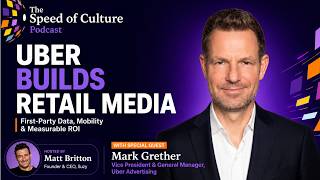
Mark Grether, GM of Uber Advertising, discusses how the company uses first-party data from rides and Eats to build retail media and sponsored listings for CPG brands. He also outlines mobility ads: in-car tablets that personalize content during rides, and car-top digital billboards that reach a captive audience.
Chapters
Up today, we're going to be speaking with Mark Grether, General Manager at Uber Advertising. Mark, great to see you. How are you today?
Good. Thanks for having me.
Absolutely. So really excited to dig into all things Uber and Uber Advertising, but let's start by kind of, you know, winding back a little bit in terms of your career. Where did you get your start in your career and the road that led you to where you are today?
Yeah, originally from Germany. Okay. I have a deep marketing background, have a PhD, was even a professor in marketing, right, back in the days. And then I joined the German version of Yahoo, Web.de, where I basically learned how to run an advertising organization, a sales organization, and where we actually also built the first advertising technology. Okay. And then moved on to WP and GroupM, was the founder of Zaxis, which became the largest— Sure. Uh, programmatic trading desk, which is fantastic. Uh, 8 years over there, um, moved on to become the CEO of Seismic Advertising Technology, and then we, um, sold the majority of that business to Amazon Advertising. Spent 2 years at Amazon Advertising, uh, learned a ton, and then I joined about 2 years ago Uber Advertising to build that business. Got it.
And, and, and from being a, a professor at first to then being an entrepreneur starting Zaxis, like, that's a, that's That's quite a journey. Many people who start off in the education route don't end up, you know, turning into building one of the most, you know, prolific ad tech companies. How did that transition kind of play out for you?
You know, I always joke I have a dad who is an architect. So I like to build things like he likes to build houses, right? Yeah. And my mom is a teacher. So the way how I'm doing it is by explaining as opposed to really selling, right? And that served me well. So this passion of building something and explaining what I'm doing and yeah. And what side do you gravitate towards more?
You know, in terms of the building versus selling?
Um, I think it's more the building, right? For me, it's really having a vision. Where do you want to be? And then working backwards, how do you, how do you get there? That was the case with Zaxis. That was the case now with Uber. It's really exciting to have this clear kind of north star in your mind.
So let's talk about Zaxis a little bit because obviously the advertising market and the ad tech market has been through so much disruption, so much change. Um, and now we're in an interesting spot today here in 2023. But what was the original, um, insight that got you to start Zaxis?
Yeah, the idea really was at a time that most advertisers, they still basically booked webpages, content, right? It was all about the content in the hope that you will indirectly meet the audience. And the idea of Zakkos was how can we flip that script on its head by really going after the advertiser audiences directly? How can you reach someone who's interested in finance no matter where he's on the web?
Right.
And how can you do that at scale, right? And it was the birth of audience data. It was the birth of programmatic, which enabled us to do so. Because before that, you were buying on more cookie-cutter demographics versus psychographics. Yeah, and not even that. It was more, hey, I'm going after the finance website. Right. And then I cross my fingers that I will find someone on the finance website who happens to be interested in my finance product, right? And with Zarkas, it was all about this kind of how can we build audience profiles? How can we have a deep, deep understanding of who my audience is? And how can I then reach an audience no matter where he or she is on the web? And that was kind of the idea. It was also the idea about how can I actually build a media network, powered by audience data, right? Again, how can I use programmatic? How can I do things like PMPs and PGs? And how can we expand TV dollars into video? All of that was kind of part of, of Saksis. It was really about audiences. It was a lot about data. And it was also about agencies investing in its own technology. And all three things were quite unique, as well as the fact that we had a different business model where we ran as a principle. We owned media as opposed to the agency model of just acting on behalf of an advertiser. So all of that kind of became part of the Saks story.
Gotcha. So when you first started and you saw this unmet need in the marketplace, you obviously have to take it from original concept to blueprint, ultimately going back to your architect example, building a house and a thriving house where people live in. Um, you know, as you take those steps, um, are there kind of common stumbling blocks you see entrepreneurs commonly having, and what are some of the ways to overcome them?
Yeah, I think one key The first thing is that you have to really have passion and you need to be convicted and convinced about your north star, right?
Yeah.
And if you go to, let's say, a conference, you will hear a million things. Yeah. Everything sounds exciting and better, but you need to really believe in yourself and you can't change your strategy every 6 weeks.
Because people always say, hey, you know, this company is doing that, there's this competitor, etc. And it can make you very reactive and frenetic almost.
Exactly, exactly. And yeah, you have to have your mindset set and you have to change, you know, you can't change it no matter what kind of Obviously, you have to make sure that you're betting on the right strategy. But if you do and if you're not changing your story, and people learn about it, they will get excited about it. And what I'm always saying to my people is that you have to tell the story 5 times. The first time, people just don't listen. The second time, they realize, oh, actually, I should listen. The third time, they actually do listen.
That's great advice.
The fourth time, they understand it. And after the fifth time, they can tell your story themselves.
Yeah, and some people, I think, make the mistake. I've made it in my career. Where we're thinking, oh, I said it once, that's our vision, people should understand it. I don't want to be repetitive, but when it comes to something like a vision or, you know, describing a North Star, repetition is a mandate.
It's key, right? And sometimes it becomes boring, right, to tell a story again and again and again.
For you, right?
For me, right? And sometimes you can't remember, did I tell a joke already or not, right? But that's what you have to do. And then people really leaning into it, they understand it, they buy into it, right? And then they actually follow you.
Absolutely. And the other big piece I would imagine you wouldn't have gotten to where you are by yourself is talent and your ability to find the right talent to surround yourself by. So what has been your strategy as an entrepreneur and even now in, in your role at, at Uber Advertising about identifying and retaining and growing talent?
Yeah, I was really lucky that I really had the pleasure to work with really, really great people, uh, during, uh, during my career. And many actually now followed me from even back in the days from Germany to—
It's a great signal.
To Zaxis, to, to Sizemake, to, to Amazon, right? And there are a couple of things, one of which we need to really share the the vision, and the passion. But at the same time, you also want to make sure that your people are actually empowered to make their own decisions, right? And so I'm always telling my people two things. A, you know where I'm coming from, where I want to be, which means you can actually yourself judge whether I will like it or not because you will ask the question, will it help us to get one step closer to our North Star? If yes, then let's just make the step yourself. The second thing is everyone on my team can make a decision as long as he or she will take responsibility for the decision. If she feels uncomfortable or if he feels uncomfortable with the decision, come to me. Right. We make the decision together, but I take responsibility for the joint decision, right? And so it's empowerment, but also knowing that there's kind of a safety net if needed. Again, I have had the pleasure to really meet really, really great talent which joined me from even back in days in Germany, and then they helped me to build ZAXA, Seismic, and even Amazon Advertising, right? And there are two things which are key. The first one is they all have the same passion in building the same kind of North Star. Yeah. And so whenever we make a decision, we ask ask ourselves the question, do we get one step closer to the North Star? And if so, they should then make a decision themselves. And the second piece is, if someone actually makes a decision, he or she should take responsibility for the decision. But if he or she is uncomfortable with making a decision, they should always come to me, and then I make a decision together, but I take responsibility for our joint decision, which means they always know that they have kind of my trust, my back, and they have a safety net they can, they can come to.
And then you're not micromanaging people, you're empowering them. Yeah. And is that a decision-making framework framework and the accountability framework that you impart on people right after you hire them? When in their journey are they familiar with that? Because I would imagine it's something that's also hard to scale beyond you to them and telling them to impart that on the people who work for them.
Yeah, again, it's, I mean, obviously the trust kind of comes with time, right? Yeah, of course. That's definitely the case and you have to make the right decisions over time. But the key really is, is you have to really clearly articulate where you want to be. And if you have that clarity, then for people, it's much, much easier to make the decisions because again, they're all adults, right? They've all experienced in the advertising industry. And so they can then judge themselves, why not we are going closer to this north star. So it's really key, having a clear strategy, having a clear articulation of that strategy, and then again, check in from time to time, where you're making progress towards that strategy. Absolutely.
And I have to say, in looking at your background, you don't strike me as somebody who likes to sit around. I mean, you go from one major thing to the next and next. What drives you to move so quickly and always want to grab on to the next thing? What drives your, I guess, your inner motivation?
That's a great question. Again, it's on the one hand, it's this kind of passion to build things, but it's at the same time also the idea that maybe I'm fortunate to see things very quickly.
Right, or around the corner.
Around the corner, right? And so sometimes I'm kind of 3 or 4 or 5 steps ahead, right? But that gives me the opportunity to see what is really next, right? And so Uber, for example, I clearly saw, That's really the big next thing in the media industry, right? Which is why I was really interested and excited to really kind of help to shape the strategy for Uber Advertising and then make it a reality.
So let's unpack that a little bit. As I was mentioning before the interview, I've been a longtime customer of Uber, right, from its early days, right after I found it. And, you know, it didn't come as a surprise that Uber jumped into advertising just because there was such strong frequent engagement with the consumer and you have this powerful first-party data, et cetera. What was the insight on what you saw around the corner that led you to kind of leap into this opportunity?
I mean, if you think about Uber Advertising, right, you have, you have, we have two different options, one of which, and opportunities, one of which is on the delivery side. And that is a little bit like Amazon Advertising where I was before, right? It's a lot about what we call now retail media. Yeah. So the idea is—
Which is huge right now.
Huge. Everyone talks about retail media. It's the hot thing right now, right? Everyone wants to be a retail media network. And we happen to be one, which is actually quite big already. And so in our case, we have a tremendous amount of first-party data. We have an opportunity to engage with avatars right in the moment— sorry, consumers right in the moment when they make a purchase decision.
On Uber Eats, for example.
On Uber Eats, right? And we also have the data about measurement, yeah? And so for a big restaurant provider, but also for a small SMB, we can show to them how much actually when they do spend into our advertising program, what is their return on investment? How much do they actually get back, right? If they participate, they typically get more menu views on our platform, they get more orders, and they see exactly what is the incremental ROAS. And therefore, for them, it's really easy to scale that business.
So an example of that would be I'm ordering from a restaurant, Uber Eats, and it says, would you like to add something from 7-Eleven to your order?
For example, right?
Exactly. For example, right? You're in the— it knows that if you buy pizza, you might want soda or beer or whatever it may be. Exactly. And it's almost like you have the permission then to say, would you like something additional?
Exactly, right?
Same delivery.
Exactly, right? And we can then show to the soda provider how much actually in incremental sales did they generate on our perform because of that type of advertising. And that's measurable, right? And it's super, super powerful.
Bottom funnel, it's kind of a no-brainer. They can see straight off they're not.
Exactly, it's performance, it's CPC. That's how basically you start every advertising business. You start bottom funnel, you start performance. It's easy to measure, it's easy to justify for marketing.
Well, tell us how you start every advertising business. There's still a lot of people selling impressions with no connection to the bottom of the funnel.
Yeah, but in our case, right, it was really clear to start from there. Of course, yeah. The trick is then how can you actually grow this business over time by going after mid and upper funnel. And that's where the mobility, I'm sure we'll talk in a bit about it, that's where mobility advertising comes in.
So mobility advertising is essentially within the ridesharing business. Yeah.
So let me give you a little breakdown where we do advertising. Please, yeah. So on the delivery side, we have Uber Eats, yeah? And that's where we have a sponsored listings program. So big and small advertisers can participate CPC-based, performance-based to really get more exposure, more eyeballs, more, more volume, just more volume. Yeah. Very simple. We have now also expanded into groceries, similar strategy. The big difference is now we are going after CBG advertisers, right? And CBG advertisers can advertise on our platform to your example, so that you buy more sodas, more beers, more—
So instead of advertising the retailer, you're advertising the actual skew.
Exactly, exactly. And there's a huge opportunity for us, a huge growth business. And so we are investing heavily into that business. That's still on the delivery side. And then on the mobility side, um, we have 3 main services. The first one is the mobility app itself. We know that you are right now in an Uber, uh, let's say on the way to your school on the Upper East Side, or on the way to the airport, or on the way to the retailer, wherever, right? Office, you name it, right? You're in the Hamptons, you name it, right? We know that. We also do know where you are, and we also do know what you have eaten on the Uber Eats platform. And we can use all of that for targeting purposes. Powerful. It's super powerful. The key here is that on average, you spend about 20 minutes in the car. You open up the app for about 2 minutes. But the 2 minutes are where we are kind of uninterrupted. Imagine this, you go into the car, you close the door, You have finished one task, especially in hectic New York, right? And you have now 20 minutes before you do something else. And in those 20 minutes, we give advertisers the opportunity to interact with our riders.
Captive audience.
Captive audience. Super, super powerful, right? That's just one opportunity. The other opportunity is now we have launched in LA as well as in San Francisco and India an in-car tablet business. Big Screen, yeah, which is really about video awareness CTV. And I'm super excited about that because in the US, we're spending about 8 hours a week in a car.
So it's ways to engage you when you're in the backseat. I'm sure there's like trivia games, just different things.
No, no, it's actually not.
Oh, really? Okay, because I've seen a lot of that in the past.
Yeah, yeah, hold on, no, no, no. It's actually not because again, if you're in, let's say, a New York taxi, right, no one knows who's in the taxi. Right? We do know that you are in the car, so you can be greeted as such. You know who the driver is. We know what the destination is that you're going to. So again, we can personalize the content in the tablet towards your needs, which is very different and very, very unique. If you think about the in-car tablets, you're in the car, 20-minute ride. And why I'm so passionate about this is that it's not just the 20 minutes today. It is is you spend 8 hours a week in a car. Today, you spend most of the time trying the car yourself. In the future, it's either an Uber, it's a self-driving car, which means the 8 hours become in the field of time where you can actually consume content. And the car will become your next living room. Right. Right? Which is where, again, you will consume content, where you will consume ads. But again, we know who is in the car, and therefore we can personalize content and ads. And that's kind of what is super, super powerful for us to really make sure we are owning the kind of consumer experience in the car. And we then tell interesting stories when someone is in the car. And it's really, really, really, for me, super, super powerful. And then last but not least, in addition to the mobility app, the in-car tablet opportunity, we also have car tops in 7 cities in the US, including New York. And here, the idea is really to give advertisers the opportunity to tap into digital out-of-home. It's really about creating awareness. It's about driving retail traffic into into stores, but it's also a powerful instrument for us to give back to, to the earners. Sure. Which means we are sharing ad revenue back to the earners, which means it becomes more attractive to them. Uh, we can therefore, um, you're partnering with them, we partner with them, we can get more of the earners, right? And so it helps us to, to accelerate the flywheel.
Yeah, I mean, it's pretty powerful. I always thought that Uber should— and maybe you guys have discussed it— launch its own sort of programmatic radio station because you also know what type of music that people like and the drivers are always turning on music and why wouldn't you just run programmatic ads? And I would think that's another opportunity then.
Yeah, or maybe even go a step further in the in-car tablet, why not launching our own TV channel? Right, right, right.
That's very smart.
And maybe it will be so attractive, exclusive content that it's not a reason why you're taking the Uber in the first place. Right.
So overall better experience.
Exactly. So there's a lot what we can do. So again, it's really, really for us early days, and that's super exciting.
So in terms of the brand, I mean, Uber's unique in that it's been around for so long. It is a verb, right? Uber there. I'm an Uber. And now you are not pivoting, but you're adding on a whole nother layer to the business. And I would imagine that creates sort of a branding challenge for you or a branding opportunity, depending upon how you look at it, within the advertising community, which is probably why you're here at the POSSIBLE conference in terms of making sure that advertisers, agencies know that Uber's doing this. So how are you bottling up all these exciting opportunities into a message to the ad world?
Yeah, yeah, and that's the deal why we're here, right? It's really kind of sharing the word, right? Advertisers, they know about social networks and other stuff, and they need to learn what Uber actually can bring to the party.
In ways other people can't.
Exactly, ways other people cannot, right? Whether it's now our global scale, it's the one-to-one targeting, it's influencing real life behavior in a car, right? What we can do on eats, retail, even measurement, right? Let's imagine you run a TV campaign and suddenly more people take an Uber to the retail store, right? We can even measure TV success. So there's a tremendous opportunity that we can do. And so that's why we are here. We are at our conferences. We're talking to avatars. We're talking to agencies to just educate them on what are the opportunities that we can do together. And I must say, avatars and agencies are leaning into it. I'm really, really impressed to see how much kind of inbound interest we see at a conference and beyond. And it's really, really exciting.
Yeah, well, I have to say, I speak to a lot of people in ad tech, and after they describe to me what they do for 15 minutes, I still have no idea what they do. And I know a lot about this industry. And when you describe it, it just makes sense. And the fact you have the first-party data, the captive audience, and really the bottom funnel metrics, which is really what I think in this, you know, economic downturn, CPG marketers need that. They can't throw money at a wall and see what sticks. They need to understand what the ROI profile is.
Yeah, exactly. And we have all of that, right? And we have it at global scale. Yeah. And that's also quite attractive for especially the big CPG advertisers. It's not one solution here, one solution there. They have a global team, one size that gives them access to a global footprint, which is also kind of compelling. Absolutely.
And if I'm a CPG advertiser, I would imagine one of the things I'd want to get my arms around is what's the creative approach on how I can best leverage this? Because it's not just stick up a logo or maybe give an offer, although I'm sure the— an offer is important, but are you also working with these advertisers on sort of the creative activation and how they roll that out within your platform?
Yeah, especially on the mobility side, right? We do a lot, we do a lot in terms of the creative and, and how can we, um, also change a little bit the, the creative kind of landscape, uh, um, whether it's now on the app itself, whether it's now, uh, on the tablet. And so we have also a kind of internal, um, resources to help the advertisers and their agencies to, to brainstorm, to think about what's the next level from a, from a creative perspective. Yeah.
So So in terms of the consumer itself, post-COVID, we are seeing lots more consumers working from home, going to the office less, although many companies are saying you have to come back. Amazon most recently said you have to come back to the office. Have you seen those consumer habits impact your business at all? Because I would imagine people working from home is not a good thing for Uber, or are you not seeing that at all in your data?
Well, if people are working from home, they more likely order Uber Eats, right? Which is Uber Eats.
You guys saw that during the pandemic, right?
Exactly. And, and as they now go back to the office, they take an Uber, right? More often. So, um, what we actually do see is both, um, uh, the mobility business as well as, um, the delivery business are both are really, really growing, right? Delivery is now, um, as big as the mobility business. The mobility business is not big as it was prior to COVID, right? So both businesses are really, really growing and, and we are really doing well from that perspective, now quite happy. And yeah, I mean, there's kind of no end of that growth.
And now you have the advertising business.
We have now the advertising coming up, right? So it's really great. And then we've, again, our push into our grocery business, which is a huge, huge opportunity. So there's a lot of growth that we can capitalize on.
Yeah. And you had mentioned autonomous vehicles, and Elon Musk is presenting here at the conference, at the Possible conference, and Tesla's obviously done a whole lot in that area. Where are we? Just curiously, I know this is not your specific area of expertise, but you do have a senior position at Uber. I'm sure you know more than the common person does about where we are on the adoption curve of driverless vehicles.
I mean, I can't comment on the details, right?
And I think— not necessarily for Uber, but in general.
I think it's certainly early. And I would even imagine that maybe trucks will become first, right?
Yeah, makes sense.
Before passenger cars, right? But I was, for example, the other week in Dubai. And you see self-driving taxis there already, right? So maybe it's not as far out as we think. But the point from, from an advertising perspective is that even if you are in Uber, you're not driving the car yourself. Right. Which means you can already engage with content and ads. And that's kind of why I'm so excited about the mobility advertising opportunities.
Absolutely. So, so to wrap up here, you've had an amazing career, and it seems like you have a limitless thirst for curiosity and new things. And, For— we have a lot of young listeners here at Speed of Culture Podcast. And for younger people in their career entering the workforce, what piece of advice would you give them in order to have a similar path in their career and be equally as excited about where they are maybe 10, 15 years from now?
That's a great question. I think one thing is really, you mentioned, is excitement, right? You really need to do something that you're really, really excited and passionate about. And then just stick to it, right? Right. Try to become better in what you're already good And then I think another thing for me which helped me a lot is to ask the why. Why are people doing something they are doing? Ask 3, 4 why questions.
That curiosity.
The curiosity, to really deeply understand, right? When I was at the agency world, right? For me, it was really important to understand why are acting agencies the way how they act. And sometimes you think it might actually be irrational the way how they're performing, and if you ask 3, 4 questions, of why questions, suddenly it becomes rational. It suddenly makes sense. And then it helps to really deeply understand the ecosystem. And then that helps you to really build clear strategies. And then you know how to execute because you do deeply, deeply understand why people behave the way they behave.
Yeah, absolutely. Very cool. So to wrap things up today, Mark, is there sort of a mantra that you live by, something that has kind of consistently driven you throughout your career that comes to mind?
Nothing, nothing, nothing specific. But one thing I will try to be consistent in what I'm doing, right? Again, I have this North Star and I'm trying to be consistent. And sometimes it's boring to stay focused. Stay focused. It's sometimes boring to always do the same thing. And there's so many sexy, shiny things left or right. But you have to just believe in the thing that you're doing and just stick to it. And then you will be you will be successful.
Yeah, I mean, I think it's a great insight in the world of shiny objects and everyone's trying to grab the next thing. Sometimes they lose the ability to create traction and build anything substantive.
Yeah, and especially I think for the younger generation, right, where everything is just a mouse click or a swipe away, right? Staying to something and even in the beginning, it's hard, right? You're not playing soccer on day one, you can't ride a bike on day one, right? So you have to make sure you stick to it, and then you can actually mastering it. And I see a lot of younger people who try it a little bit, and then they jump to next one. Yeah. Try, jump to next one. If you're always jumping to the next possibly better thing, you will never be good in anything. So you have to stick to something.
It's true. Absolutely. We're gonna leave it at that. And I have no doubt that Uber Advertising under your leadership will have the discipline needed to create scale, and you're already doing that. So on behalf of Suzy and the Adweek team, thanks again to Mark Grether of Uber Advertising for joining us today. Be sure to subscribe, rate, and review the Speed of Culture Podcast on your favorite podcast platform. Until next time, see you soon, everyone. Take care.
Hey!
More from Matt




MikMak’s Rachel Tipograph on Consumer Spending, Retail Media & Holiday Shopping Trends



Jaguar Land Rover’s Charlotte Blank on Luxury, Purpose & Experiential Storytelling



