Under Armour’s Eric Liedtke on Regenerative Fashion & Plastic-Free Innovation
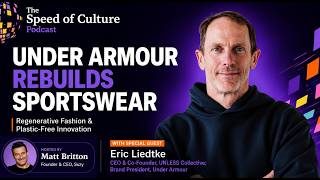
Eric Liedtke, CEO of Unless Collective and Under Armour brand president, built a two-decade career at Adidas by rotating through product, marketing, and geography roles. He founded Unless Collective, the first 100% plant-based, plastic-free fashion brand, tackling material-science challenges like replacing petro-based glues and dyes. Under Armour recently acquired Unless to scale regenerative fashion.
Chapters
Up today on the Speed of Culture podcast, we're thrilled to be joined by Eric Lidtke, the CEO and co-founder of Unless Collective and brand president of Under Armour. Eric has spent over two decades shaping the future of fashion from his leadership roles at Adidas to pioneering a regenerative, plastic-free fashion revolution with Unless. His work with Under Armour and Unless is driving innovation and sustainability, pushing the boundaries of what fashion could be for both consumers and the planet at large. Eric, so great to see you.
Wow, I love that.
That was a great opening.
Yes.
Thanks, Matt.
I'm gonna hire you for the future. If you could do that every time I walk into a room, that'd be fantastic. Sold.
I'll just be on your shoulder saying that. So I'd love to hear a little bit about your career journey, how you ended up in the world of apparel and fashion, and what you're really passionate about right now.
Well, great. I came outta school in 1990, so middle of a recession, and basically had a journalism degree with philosophy emphasis and went into advertising. I loved it, but I was a suit, right? So it was, I was working on Cadillac and floors, Trans World Delivery, and I did a little Chiquita Banana on the side. And I just realized that like, I had one of those Sunday night moments where you just like, you're a little nauseous, you don't wanna go back and you're like, what do I really wanna be doing with my life? And I quickly realized if I wasn't doing sport, thinking about sport, having done sport, I wasn't gonna be happy. So I found a friend of a friend who was designing shoes for Adidas or Adidas in Germany. He put me in touch with Rob Strausser, who, if you know, if you've watched Shoe Dog, the movie, or anything like that, Rob Strausser was the genius behind signing Michael Jordan. Anyway, he had left Nike and left Phil Knight and went over and started Adidas America. And I got in touch with him. And after a year of correspondence, the old way, and this is before email, and this is like handwritten notes and phone calls on landlines. Yeah. He finally took the chance on me and brought me in to be a sweeper in training. And after that, I never looked back. 26 years later, I was brand president at Adidas. I just finished a great run. I left Adi and started my own company called Unless, which you said was the first 100% fashion brand made of plants and no plastic. And we were acquired last year by Under Armour about a year ago. And now I'm sitting back in the big ship with Under Armour. So it's a— Yeah. It's been a circular, but it's been a joyful run.
Yeah. Congratulations, by the way. And a lot to unpack there. I mean, it all starts with that moment where you said, you know, it was a Sunday night and you just felt like you weren't doing the right thing and you knew what you loved and you weren't doing what you loved. Like, what gave you the conviction to say, you know what, it's time? Because I bet so many people right now are in that same position where they just don't love what they're doing. And this, as you know, like, this is not a rehearsal. We have one shot at this. So I guess what gave you the conviction to make that leap and what advice would you have for others that maybe feel stuck right now?
Yeah, it's great. I mean, I think we all have been there, right? We've all suffered that Sunday night blues where you just don't want to go back to work the next day. And I think, you know, it wasn't one Sunday, I paraphrased, it was a year of Sundays. And it was at a certain point you gotta say enough is enough. And you know, and you, it's a hard break because you've gotta a well-paying job and you're in a career, you're doing your thing, you're putting it together. But the good thing is I didn't have to make a leap. I just started working my network. I started working my friends and family. I started like talking to people and understanding more about myself, like when I am really happy. And I think that was the big thing. So there's two things. One is what makes me happy in life? And it's, I've always been sports-oriented. I love the dopamine and the endorphins you get, the endorphins you get from doing sport, but I love watching sport. It's the only unscripted drama we have in our lives, right? So it's like, it's something that you can really get into. At the same time, when you start to realize that about yourself, it's like, oh, maybe I wanna go work in sports. Maybe I'll go work for a sports team. Maybe I'll work for a sports league. Maybe— there's so many ways to get into sport. I just started working at— and then it just happened. A childhood friend of mine, Paul Gaudio, was designing for Adidas in Germany, Adidas in Germany. And it was like, oh, he could introduce me to some guys over here. And then, but then it took another year. But, you know, so you just have to start and take— start taking bites of the elephant. And it's like, take— and, and I always tell people, like, don't let perfect get in the way of better. It's like, take one step and then another step and then another step. And soon when you look—
Right. Versus getting overwhelmed with, like, the whole thing.
Yeah.
Take it one step at a time.
It's like, it's like, do one thing and do one thing every day for your future. Like if you can do like, whether it's save a little money or read a book that's different or like something, reach out and shake somebody new's hand and, and re— and I was like, do one thing for your future every day. And it's like, all of a sudden it adds up, it compounds like anything else, right?
Yeah. I saw, you know, Rick Rubin, the famous music producer, was saying like, don't do things for the outcome because you have no idea what the outcome's gonna be. I'm sure you had no idea that you'd be where you are today, today, right? But do things because it feels right to you and just take, and that's kind of what you're saying. You're, he was saying about the what and the why, and you're basically saying the how, right? And a lot of people just get consumed. Well, why would I do that? What's the job I'm actually gonna make? Is it more than I'm making now, et cetera. But we have no idea what the outcome of anything is gonna be that we're putting into life.
It's, it starts really small. It starts with understanding what really makes you happy. And that takes a little reflection, a lot of reflection sometimes. And then it starts with picking up the phone and just connecting and talking and like, and now it's not even the phone, it's social media, it's everything else. But it's like, and getting people to, to, to, you know, network with and contact with and see what comes. But yeah, I love the fact that I was just quoted with Rick Rubin. So I'm in.
Yeah. Respect. And did you know when you joined Adidas, like, or when you went down that path, I should say, that— do you know what actually you'd be doing for them, or you just knew that you want to be involved in sport and you just levered any relationship you had?
To me, to me, I was— so it's funny, I— so I wrote a letter once a month and I called every week and I would call Rob Strauss's office and Rob was too busy for me. I was a, I was a young, young little, you know, nuisance. So I would always talk to his, his, his chief of staff, Owen Clements. And it got to the point where Owen would say, hey, Eric, how you doing? Like, he would know my voice. And like, it was like, I'm just checking in, like seeing if Rob's available, maybe I could talk to him. I became such a repeating offender, if you will, that when a job popped up, it was any job, it didn't matter. It was like, Owen's like, you gotta talk to this guy, Eric, he's relentless. And it was just like, okay. And then I got the job because I was relentless, I was resilient, and I had a friend that, you know, in Rob's words, gave me a good pedigree. And that was about it. My friend recommended me. And then it was just me and my resilience and my relentless follow-up that got me in. And then I was a sweeper, which means I worked next to the mailroom. So, it was a demotion from where I was in the account world of agencies, if you will. So, I was a sweeper, which means basically I did a little bit of everything. And, but it was, you know, it was next to the mailroom and, you know, 26 years later, I was brand president leading the greatest turnaround in the company's history. So, little things can come from, I mean, big things can come from little steps. Yeah.
So let's talk about that because you, you were at Adidas and, and witnessed so much there. What are some of your takeaways from your time there? And tell us about sort of your ascent at Adidas from being next to the mailroom as a sweeper to ending up in the position where you did at Adidas. Like what were the, what you believe were the major milestones and kind of the business evolution that you witnessed along the way?
I mean, I, I think, you know, it's, it's hard to point at one or two things in a, in a, in a multi-decade, you know, experience, but I would say like the one thing I made sure is like, I think so many of us get boxed into a vertical, you know, function, if you will. Like, okay, you're a product person, you're a footwear person, you're a footwear developer, you're an apparel person, you're a marketing person, you just do comms, you do PR and whatever. And so my whole thing was I never wanted to be labeled. So as I came in from advertising, I had that comms background. It would've been very easy to pigeonhole me into comms. I intentionally took the job as a sweeper, which was on the product side. And the product side was like, it was everything from like, you know, really helping the product line managers do stuff to helping designers get stuff done to helping the sales guys to fulfilling orders, whatever it took, going on sales calls. But it was more about the hard coding of the product world. So I had this comms background in product and then, you know, 3, 4 years later, 5 years later, I switched back to comms. And then 5 years after that, I switched back to product. So. I think what I was able to do was diversify myself between different disciplines of expertise. So, when there was a job of, I don't know, when there was a job of head of footwear for America, I was offered it. When there was a job of head of brand marketing for America, I was offered it. I was able to play multiple positions, which like any sports team, and again, every analogy for me goes back to sports. It's like, if you can play, if you can be a long snapper, and a tight end and play special teams. And, you know, like all of a sudden I've got multiple things the coach needs to, you know, I'm going to make— Yeah, I'm going to make—
I'm never going to have to worry about getting the next deal. If that's the case.
Yeah. And then at the same time, I was then, you know, to really sell me, I had all this great market experience from America. And so when I got the opportunity to go to Germany and the headquarters was like, absolutely. Now I've got international experience in America. I've got the— I've got the world's biggest market, most important market on my resume. And now I've got headquarters experience. So now I've got this bifurcation of multidiscipline, multigeographies, and now you're building up your resume. And some companies do that for you. And again, Nike does that exceptionally well. They rotate their teams around really well from geographies and functions. Some companies don't. I don't know other companies that do that. So you have to do it for yourself. And as younger marketing executives that listen to this podcast, I would really encourage everybody to try to diversify yourself as much as possible and, and get that, get that multiple, get, get that different disciplines, cuz it does make you more attractive to executives that are looking to fill next jobs.
So when you went to Germany in the headquarters of Adidas, like what were some of the, I guess, cultural nuances working there? And, and what, what did do the Germans, and especially at a place like Adidas, do really well to have gotten that business to where it's gotten to?
Yeah, listen, it's, it's the, the cultural differences are far and wide. I actually, I ended up, I loved it because I love learning. I find myself to always try to be intellectually curious. So learning new cultures, learning about new people, learning new languages, which I did not, but I've got enough to be, to order at least my meals and get my wants and desires, wants and needs across. And basically, I think, you know, just appreciating that. I mean, Germany, I mean, from a quality of life, it's unrivaled. I mean, the highways, the infrastructure, the buildings, the beer gardens, you know, it's like the beer, like just like the— they've got so many things going for them. And you know, when I was— When I got into more executive position on the board level, one of the biggest issues was the divide between the Americans and the Germans and the collision of two very strong cultures coming together. We're German headquartered and the Americans need to take what we give them. And the Americans are like, "Screw that. We're not allowed to do that. You guys are going to do what we want." So, it becomes this constant battle. One of the cultural breakdowns I had to do was say, guys, we're all— it's not us versus them internally. It's us. And what are the roles each of us play? So the Americans, you're going to be the creative. You're going to be where the creative director sits. You're going to be the storytellers. You're going to lead our digital efforts. You're going to be that essence. You're going to be at co-headquarters in Portland, Oregon. And in Herzogenaurach, Germany, you guys are all about the innovation. You're about the infrastructure, you're about the systems that make it go. So, how do we make 1 and 1 equal 3 and be a multiplier versus 1 minus 1 equals 0? And it's this, I think that was the big cultural fix that one of the things I had to do was get rid of the us versus them internally and start to point the guns out, if you appreciate that analogy. So, to me, it was more about romancing the strengths of both and bringing them together to be, you know, a multiplier effect and versus this detractor effect that we were experiencing when I took the role.
Yeah, and I'm sure another factor that you probably faced a lot, especially in the product role over time, is the Adidas brand, or Adidas, however you pronounce it, had a lot of—
It depends where you live.
Yeah, had a lot of ebbs and flows in terms of being a brand about performance or lifestyle fashion, right? You know, like ever since like, you know, Run-DMC, and I know, Rev Run really well and obviously what his impact on that business and Run-DMC's obviously is profound, but that sort of introduced them more as a fashion lifestyle brand where before that maybe they were just about sport. It went back and forth. Is that something as you kind of went deep into product development that was top of mind for you in terms of like, why do people purchase this brand and where does this brand really lean into?
Yeah, I think the aha moment was recognizing that the culture of sport doesn't stop when you leave the pitch or you leave the court or you leave the field. It goes with you into the hallways, into the streets, in the music venues. So, once you appreciate that and you hardcode that into your strategy and your approach, you start to look at, you say, "Okay, this isn't forbidden territory. We don't have to just be by, we don't have to be one or the other. We can be all." And then the third thing we added on to that was like, really, if you really take a consumer-first approach, they also care about their world. So we always used to talk about game, life, and world, and how we would tell stories and how we make product to approach all three of those things. So to me, it was really understanding that you have to go where the consumer is. And yeah, we have to make product to help people run faster, kick stronger, jump higher, but— We have to recognize that the culture of sport comes off the court and goes with you into the streets of life. And also, like, we all doomscroll 24/7. And let's recognize the fact that, you know, the world is stressful, or at least it's more readily stressful to you every day because you get a constant drip of the news. So how do we help kids feel more relaxed and destressed? And sport can help that. But maybe we can do something about, I don't know, climate change or plastic pollution or, you know, MeToo movement or LGBTQ+. It's like there's things out there that maybe we can lean into and take more active role to really, again, make a stand, but also win advocates to our brand. So to me, that was a— it was really being, being a balanced approach. And I think Adidas was very well balanced to that because they had the history with Run. They, you know, we leaned into Kanye, we leaned into Pharrell, we leaned into Beyoncé, and we had these different things that would allow us to have that multiplier effect. But because when I got there, we had the performance logo with the mountain logo, and we had the trefoil, and we had Y3 and stuff. So we had multiple things to play from a branded portfolio standpoint so that we could really lean into some of those things that— the important thing for me was to always ground ourselves in sport. Because ultimately, there's nothing goes out of fashion as fast as fashion. So if you're a sports brand, no, there's always a need for sport product. So you have to ground yourself there as a sports brand, and then you can use fashion to, you know, as commercial opportunities.
Yeah, I like that. There's nothing that goes out of fashion as fast as fashion. It's a nice one. And obviously now, like, not only has culture been injected into sneakers, now there's like sneaker culture where you have StockX and people buying and selling sneakers and waiting in line for limited edition. Has that boom surprised you or is this something that you've always kind of seen brewing?
Yeah, I mean, I mean, I think the, the last, you know, it happened slowly, but, but it's, it continues to accelerate. I, I think, you know, sports industry, you know, is, is, is, is, has been discovered as a growth industry. There's no doubt about it. I mean, it, it continues to go and it continues to happen in, in different ebbs and flows, but it's always, it's always strong CAGR up to the right. I mean, and, and I think that just, that's just because it is such a— it is such a life-friendly thing. I think everybody loves sport. I don't care what your political affiliation is. Everybody can appreciate sports. And I think the look of sport is something that's bled into, you know, the business atmosphere and the business environment. And, you know, then you bring in COVID on top of that and all of a sudden you've got, you know, people are sitting at home, they don't have to get— so now we're wearing sweatpants all the time. And now it's become— it's become like, you know, dressing sweatpants is okay if you go to work. Yesterday I went in a tracksuit. It's like, it's okay to wear these things. And it's become much more appropriate. So it just continues to grow. And then you see LVMH coming down towards sport. You see these fashion houses coming in. So the proliferation of the sporting goods industry continues to run ungoverned, in my opinion. It continues to go in different iterations. But it's always continuing to climb and out-climb other industries.
Absolutely. So eventually you decided to leave Adidas after being there for over 2 decades to go out on your own and start your own company.
Yep.
What gave you the conviction to do that? What was the concept behind it? And tell us about your journey at Unless Collective.
Yeah, I mean, I think it was 2015, I would say, a gentleman by the name of Cyril Gooch walked in my office and said, hey, would you like to save the oceans? And I was like, yeah, I love the oceans. Who doesn't love the oceans? I mean, it's like, but I'm kind of busy. I just became brand president and I got this thing going. He goes, no, you don't understand. The footprint you have is affecting and actually killing the oceans. I was like, huh? So he started educating me on the state of the oceans from a fish stock standpoint, from a pH standpoint, from a, you know, it's just an implosion, but ultimately, the plastic pollution is coming through and the footprint that the fashion industry was responsible for. And so you start going into— down this rabbit hole of understanding, you know, the amount of stuff sporting goods industry makes and fashion industry in general makes and the amount of fast fashion that's disposed and where that goes and how that ends up degrading the environment and degrading the oceans and breaking down to micro and nanoplastic that then goes in and kills the krill and the microorganisms in the ocean. The ocean is responsible for every— Yeah. Every second breath we take. So, it's like, holy shit. It was basically a mind opener. And so, I got busy with him and we started doing some cool stuff. And we did this Parley for the Oceans Adidas collaboration and we did activations like Run for the Ocean. We did product around ocean plastics recovered and it was fantastic. And I got to meet a lot of brilliant people like Captain Paul Watson, the founder of Greenpeace and Sea Shepherd. Yeah. I got to meet Sylvia Earle, her Royal Deepness. I mean, it's just like unbelievable amount of smart people and they started educating me more and more. Once you get this education, you can't unhear it, you know, you can't unsee it. And you know, so as you, you can, and you can only whisper yourself to sleep so much at night. Like, it's like, oh my God, okay. Like, like, you know, I'm doing what I can, but I'm still commercializing all this stuff. So at a certain point I'm like, all right. Yeah. I'm young enough, foolish enough, and cocky enough to think, I can do this. I can solve the problem of plastic waste in fashion. So I took the bold move at end of 2019, the lucky move, to exit Adidas at that time and go and pursue starting the first ever 100% plant-based fashion brand. As you may remember, 2020 was the start of COVID and everything shut down. So I did not have to do any of the Zoom calls and all that stuff I've heard, the horrors of managing large teams from a virtual seat and all those pieces and deal with that business. But I did have the challenge of raising money, starting a company, and building a new product range during COVID which is a whole nother podcast we can do one day. But that was my impetus. My impetus was to solve the problem of waste in fashion.
And so, I mean, so you wanted to solve that problem, but not a lot of people obviously know how to action that into a business. What was the next step in terms of turning that into an actual business that you can create enterprise value from?
Yeah, so we raised a little bit of money thanks to our partners and we got to work. You know, really, it starts with the research and development. Okay, what is gonna be a holistic approach to it? How are we, you know, and the end goal was always making a shoe. You know, how can we make a shoe that's the first 100% plant-based shoe? Which means, you know, and the things you have to solve for are, you know, most all glues are made from plastic today. You know, you've got stretch that's primarily melted plastic, so you can't solve for that. You've got foams that are primarily all polyurethane, which is a form of petroleum-based plastic. You've got prints and dyes on your product that's primarily plastic and synthetic. So we had to solve for those big 5 things, plus a slew of other things, all during COVID and finding those things. So it was quite the experience, but I'm happy to say we did it. We started to get some traction. We set up our own website. We based ourselves here in Portland, Oregon. Mm-hmm. And we got to work, and Alessa's still a viable opportunity to continue to grow. It's growing slowly but surely, month on month, year on year. We're in our 5th year now, or 4th year really, with product in the marketplace. And we were acquired like a year ago from Under Armour. So, you know, we think now with the combined effort of Under Armour's research and development and Alessa's pioneering spirit and— And vision. Expertise, the two are going to really change the industry. And that's what we hope. We did our first collab in Milan at Milan Design Week earlier this year. So it's been a fruitful relationship so far, and we're excited about what the future holds for us.
And what was the experience like running your own business as an entrepreneur versus working at such a large organization?
That's a big one. So I think the experience is super liberating. I like the idea that I didn't have to ask for permission to get stuff done, and you're able to really do it. But you learn, you think you've got the entrepreneurial spirit, but you don't know what that means until you try it. And I mean, it's all the little stuff. So all of a sudden, you're in charge of HR, you're in charge of IT, you're in charge of the website going down, you're in charge of a warehouse and shipping out, you're in charge of retail experience, you're in charge of personnel. So you're basically all the jobs you had friends doing or colleagues doing on a regular basis is all now compressed onto you. So you wanna do a pop-up shop in LA, guess what? You're driving the U-Haul down, you're setting it up, you're manning it, you're closing it back up, you're taking it back. But you know, all these different things, the PR opportunities, the marketing opportunities, the wholesale opportunities, every little thing falls to you and your small band of startup founders. It's not for the faint of heart. So to me, it was like, it was liberating, it was fun, it was exciting because you had the permit, you didn't have to ask permission, you could do these things, these radical things of trying to create the first 100%, you know, fashion brand out of plants. But it's hard, it's hard yards, there's no doubt about it.
Absolutely. So now you're part of Under Armour and it's a whole new phase of your career. What do you hope to accomplish as part of this new partnership? And talking about what you're most excited about moving forward with both businesses.
Yeah, I think my focus is still the same. I wanna systemically change the fashion industry to move from petroleum-based feedstock to plant-based. I mean, I'm here to build it, to play it forward, and so I can look my kids and my kids' kids in the eye and say, you know what, I may have committed a lot of shit in my life and done some stuff that maybe I'm not so proud of, this one I'm proud of and I'm giving you a better opportunity. So, to me, it's like I'm completely driven by this mission of solving the plastic crisis in the world of fashion. And, you know, I talk a lot about that in the documentary on Netflix called Buy Now if you want to hear more about that because it's a lot about this journey, even a little bit more so. But the— And, you know, at the same time though, I now have fiduciary responsibility to Under Armour shareholders. So, I do believe as we grow this thing, I think there is a wellness community that's growing every day and every week and every month in popularity, whether it's about longevity, whether it's about the foods we eat, whether it's about the beauty care, they're going to care a lot about the clothes they wear. That education is coming to a tipping point. And we'll be the brand—
Mm-hmm.
Under Armour will be the brand that brings solutions to them. So when you wear your leggings, and where you wear your tights and where you wear your product in the future, you will know it's not full of microplastics and nanoplastics and phthalates and chemicals that are bleeding into your body. You'll know that you're wearing healthy plant-based solutions that are natural and will go back to soil and become plant and worm food when you're done with it. And that is super compelling. And if I can do that with Under Armour and we can start to win consumer minds and heart share, right? Heart and mind share. And wall share, And then you've got— then the industry follows because we know one thing, the industry is a fast follower too. When something gets going, others will come quickly to it. So I'm very bullish on the future. The partnership between Unless and Under Armour is right on target and right on time and right on the pulse of where consumers are going. So I'm excited about that, and I'm excited about the mission of systemically changing the industry against that.
And to drive that forward, How important is the support of athletes? Like, you know, obviously, you know, we think about brand Jordan and it was obviously revolutionized this, the industry of sneakers and apparel and fashion and all that. But it was about ultimately one transcendent athlete.
Yeah.
Does the same dynamic exist today where when you launch new products with Under Armour, you need a Steph Curry or you need an athlete behind it? Or are there other ways to go about it where perhaps you lean on the creators or other mechanisms to build that brand and awareness?
I think it's more collective. I think there is still those singular athletes like the Lionel Messis of the world that can really drive. But, you know, let's be clear. Messi drives— sorry, soccer boots. I was going to say football, but soccer boots. Like, he drives soccer and he does a really good job at it. He's a celebrity, but that's his niche. And I think basketball, Anthony Edwards of the world and those guys, I mean, they're great, but I don't see the impact that Jordan had back in the day. And I think you have musicians now, you have artists, you have content creators, you have TikTok influencers, you have a lot of different—
Exactly.
Look at MrBeast. Well, he's got 500 million followers on YouTube. It's like there's so many different legitimate athletes, entertainers, influencers that can help you here. The important thing for me to drive this initiative is it needs to be mission-aligned. It can't be transactional because, I mean, kids— I think everyone sees right through a transactional thing. And word of mouth and purpose-driven and mission alignment is the most important thing. And people see it when it's authentic and they feel it and they can really speak to it. So to me, it's the authenticity that's most important. And then we can work with whoever it is. And again, Hyperlocal influencers are, are really interesting as well. It's like, because the word of mouth on a local area almost has more credibility. It just takes a little bit longer. It's not a single bullet. You have to win street by street, block by block.
Yeah. Very cool. So to wrap up here, and this has been, I mean, it's crazy because Eric, you make it seem so matter of fact, almost like in the rearview mirror, but what you've accomplished is remarkable in my opinion. And I'm sure there's so much more on back. So first of all, congratulations on your success as an entrepreneur is really inspiring.— to see not only what you've accomplished, but how you're so purpose-driven now at this point in your career to change an industry and really have an impact on something so much bigger than the business that you're in. When you look back on your career, what are some of the things you can point to that you think you've done right in terms of your ability to harness certain skills or focusing on certain areas that's put you in a position to be so successful?
I think ultimately I've been blessed with unbelievable family background and family, so I am I am lucky, and I will be the first one to say that. I come from a very privileged background in that regard. If I have one secret power, it's to believe in the people around me and the teams and inspiring them to believe in themselves to do better. And I think I've always tried to demonstrate that and try to lead by that. But my secret power of doing anything I've been successful at is unleashing the potential of the people around me.
Yeah.
And I think that's easier said than done because it requires a certain operating model that empowers people and holds them accountable. It requires a certain strategic direction to give them, to show them, you know, what winning looks like and where we were, what that upper right-hand corner of the whiteboard is, and let them get there. But tell them the destination is very clear and you're measured against it and hold them accountable and empower them to get there. And then finally, giving them the culture to thrive. And making sure that you're, you know, speaking to them and inspiring them in any way, shape, or form, whether it's at the water cooler or whether it's on a stage with 1,000 people. It's like you have to continue to behave in a way that inspires others to follow and succeed you.
Yeah, I love that. So we always wrap up our podcast by asking our guests if there's a saying or mantra they go by? Given your background, I'm sure you have no shortage of them, but what comes to mind?
Well, there's two of them, and I gave you one already, which is, "Don't let perfect get in the way of better." I think that's something I quote and say relentless. I know it's a slight nuance to an engineering term, but I do like that. "Don't let perfect get in the way of better" is a key one. And then I'll quote my first— well, the former CEO of Adidas, Herbert Heiner, who, when he gave me my first appointment to the board, you know, the brand was not in a good place. We had to reset the brand and it was really bad actually. And it was a complete reset. And he looked at me and he said, "Don't ask for permission, ask for my advice." And I love that. And I think I took that with me and I've kind of, I tried to act that and apply that to as many people that have ever worked with me in the past because ultimately, we all wanna stretch our legs and we all wanna run, but if we're constantly looking for permission, you don't get that. You're on too short of a leash. So come back and check in for advice. I like that a lot better. But you know, in the meantime, run until, you know, until your rope runs out.
Yeah, I love that. I think too many people ask for permission, wait to be told what to do. And I think this day and age, it really, the spoils will go to those who take initiative and are proactive and asking for advice and having them mold it In terms of where they point their energy to is a different story, but I agree, don't ask for permission. I think it's a great one.
Yep.
Great. Excellent. Well, this has been an amazing conversation. I feel like we can go on forever, but I wanna be respectful of your time. But really appreciate you sharing your wisdom and your feedback to the audience today. It's been amazing to hear, and I'll continue to follow your journey from afar. So thanks so much for joining.
Appreciate it, Matt. Thanks for having me. And I hope there was some words there that were useful.
Absolutely. On behalf of Suzy and I, we team. Thanks again to Eric Lidtke, CEO and founder of Unless Collective and brand president of Under Armour for joining us today. Be sure to subscribe, rate, and review the Speed of Culture podcast on your favorite podcast platform. Till next time, see you soon everyone. Take care.
More from Matt




MikMak’s Rachel Tipograph on Consumer Spending, Retail Media & Holiday Shopping Trends



Jaguar Land Rover’s Charlotte Blank on Luxury, Purpose & Experiential Storytelling



