Unilever’s Ryu Yokoi on AI, Retail Media & Social-First Marketing
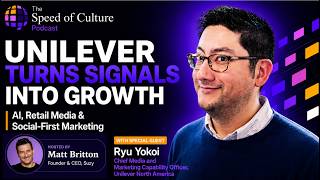
In a live interview at the POSSIBLE Conference, Matt Britton talks with Ryu Yokoi, Unilever’s Chief Media and Marketing Capabilities Officer for North America. Yokoi walks through his 19‑year journey at Unilever, from brand roles to leading the company’s e‑commerce transformation and now overseeing digital marketing, media, shopper and commerce capabilities. He explains how the explosion of real‑time first‑party data and AI has collapsed the traditional marketing cycle, enabling rapid iteration, better signal‑to‑noise, and more personalized shopper journeys. Yokoi details Unilever’s first‑party data collection tactics despite limited direct‑to‑consumer sales, the importance of tagging, activations, and partnerships with retailers (Walmart, Amazon) that turn retail platforms into media channels. He emphasizes a “social‑first” mindset, leveraging creators and influencers for authentic, culturally relevant reach, and discusses the challenges of scaling creator partnerships. The conversation shifts to sports sponsorships, especially the 2026 FIFA World Cup and Dove’s body‑confidence campaign, illustrating how large cultural moments serve as canvases for brand storytelling. Yokoi shares his talent philosophy – hiring people who “give a damn,” caring deeply, and using AI as a force‑multiplier to democratize expertise. He closes with his guiding mantra, “build worlds, don’t chase moments,” underscoring a proactive, long‑term vision over reactive firefighting.
Chapters
We're here live at the POSSIBLE Conference in Miami, and today we are thrilled to welcome Ryu Yokoi, the Chief Media and Marketing Capabilities Officer for North America at Unilever. With an impressive career that spans leadership roles at Unilever and Schmidt's Naturals, Ryu is at the forefront of driving digital transformation, leveraging data, and creating purpose-driven campaigns at scale. Ryu, so great to see you today.
Wow.
Thanks so much for having me.
Absolutely.
Yeah. It's quite the introduction, but quite the career you've had.
I need to have you with me at all times for my hype, man. Done.
I could be your little AI, uh, person that everyone has joined to post.
Big, big AI person.
There you go.
Yes.
I'll take it. I'll take it. So tell me about your current role at Unilever. You've been there for a while and have had a variety of different roles and tell me where your focus is right now.
Yeah. So I came up within the organization, um, all brand stuff for like the first 13, 14. So I've been with the company— I should start, gosh, I've been with the company for 19 years now. Wow. So it's been a minute. Yeah. Yeah. And great experience, you know, a whole start of the journey, just brand roles. You mentioned Schmitz's. That's sort of a one foot in, one foot out thing where I went to actually lead an acquisition that we had done of Schmitz's into the Unilever world and integrating it in. I did that for a couple of years. And then I've been on a slightly different journey. So I came back in during COVID I came in to lead our transformation into e-commerce marketing. The whole world was changing how they were shopping. We really needed to take a step up there, transform our capabilities.
Like direct-to-consumer?
Well, we don't do direct-to-consumer primarily. We have some of our acquisition brands have direct-to-consumer practices, but for the most part, it's omnichannel. And, you know, some pure play, obviously with, with Amazon as a massive source of our growth. But we needed to really step up our act in order to be competitive and drive growth and compete in that space.
In places like Amazon, Walmart.com, etc.
Exactly, exactly, exactly. So, you know, at the same time that was happening, we've had this massive convergence thanks to data of the commerce and the media space. And so it was natural. I started doing more and more in digital marketing, first taking on, then media, and now I'm the chief media and marketing capabilities officer. Which means I look after, you know, everything from our digital marketing, our media, our digital commerce practice, our shopper marketing, sort of other say at scale sort of practice. So I get to look after and it's a real— it's a privilege. You know, I joined Unilever 19 years ago. I wanted to work at the company that I thought was, you know, the best marketing company in the world. And it's this just incredible honor now to be in a position where I get to kind of shape, you know, what our marketing practice should look like and what we think good marketing looks like. So, you know, I get up out of bed every day really fired up about it.
So how is marketing a CPG company like Unilever different today than it was two decades ago when you joined? Obviously, lots of ways. But if you— what comes to mind?
Well, I think the biggest one that fits into sort of into your world, I would say, is— so I went to, I went to B-school at Penn and, you know, there's such an emphasis there, data-driven marketing, data-driven marketing. I had like amazing professors there and we ran all these simulations and in all of them, you know, you'd be with your team thinking, what should the marketing plan be? And then they would give you like different— this happens and then, oh, I go to that. And it seemed like the kind of thing where you could make all those changes so fast. And when I graduated, this is like 20 years ago now, right? I had the stark realization that the data didn't flow that fast, right? The data wasn't constructed and structured the way that you were seeing it there. And so, you know, it was just much less iterative. And today I think data is this incredible equalizer. So I was just thinking about this over the weekend where I feel like now so much of the stuff I did like academically is like really possible for everybody all the time now where, you know, the data is sort of rewarding you with that signal all the time in terms of how you can make better, you can make changes. And now with AI, you can actually respond to them so much faster. And so I think in both fronts, you know, it's easy academically as a student when I was first graduating, say like, oh, you know, those are the signals, then I'll do this and we'll come up with a campaign that does that., in practice, you know, between waiting for those signals to come in to using whatever tools we had available to process those, to then doing whatever the prep would be for the next mix that we would go to respond against that, uh, you know, those were, those were cycles that were really different. So I would say cycle time is the biggest change. Yeah.
But even that being said, in CPG, it's not like you can, you know, learn something new and have a, a new product evolution on the shelf tomorrow, right? You have a, there's a whole supply chain. There's a lot of steps in between. So how do you—
well, from a product standpoint, yeah, from a product standpoint, I think from a creative messaging, media investment, what's working, what isn't.
Absolutely. Right.
I think about the stuff that you guys do, you know, being able to understand what the trend is and how to react to it. You know, nowadays all of that is so much more democratized and happening in real time. Yeah.
That, that changes so much more quickly, right?
It's a huge change.
Yeah. I mean, you think about what AI is obviously doing for business. I think one thing that's not talked about enough is what it's doing to the consumer, especially the younger consumer who's being born to a world where no longer is there a gap between their imagination and what's possible, whether it's something that you want to create visually or, uh, you know, something you want to write or whatever it may be. And it also is changing, in my opinion, what it's going to take to really future-proof in this new world. So like, What skill sets do you think are most valuable moving forward at a place like Unilever, let's say, to allow somebody to really optimize their potential?
Look, you know, I made the same reference to when I first graduated school that we were just talking about. And I think if I think about it today, it's such an amazing time to come into marketing. Yeah, scary too. It's— yeah, it's intense.
It's actually a scary time to be in marketing, probably more so than it is to come into marketing.
It's disrupted, but it's disrupted by all the good. It's disrupted because, you know, we were used to a certain way of working. Yeah, but in practice, just as you're saying, we can now ideate, concept, and come up with things so much faster than we used to before. You can then illustrate and have— you can really visualize it the way that you couldn't before. You can then share and collaborate with people in ways that, you know, you couldn't before. And then, you know, we can bring things into market and understand how they're performing at a rate that we couldn't before. So all of that is just so much more rewarding and you know, for me, I used to think of, you know, you used to gear up and prepare to go to war once a year. You know, the shelf set is getting landed and then you kind of know within the first, you know, 6, 7 weeks, the first 100 days, whether you got something. And then it's either going to be a great year or it's a slog. And while you get to do it again the next, and you know, that would fill me with all kinds of ajna.
You know, because you're using up valuable shelf space for a product that's not moving off the shelf.
Yeah, that happens.
Packaging's wrong.
Right. Or the opposite, right? Or you have a winner and you know you've got, you know, several months before the competition and we, you know, we compete against the best in the world too, you know? Yeah, you do. Before they have a chance to come in and do something different also. Right. So I think you're right. I guess you can look at it one of two ways, right? For me, I sleep easy at night knowing I've got an awesome team. We've got where, you know, we absolutely have some of the best marketers in the world at the firm and we have, you know, fantastic measurement and data work that allows us, we think, to be able to optimize, you know, I don't know about the speed of culture, but, you know, you know, at speed and hopefully at the speed of culture and, you know, that's the desire. And that helps me sleep at night because I know if something isn't working right today, you know, you can learn from that and you can make the thing better. In a way that you couldn't make things better for a long time before. I don't have to live with that anymore. I can do something about it. So I find that, you know, really empowering. Now the opposite side of it, to your point, is, you know, uh, you know, until you crack it, that iterative, you know, cycle of doing it over and over again until we, you know, we land something that's meaningful. But I think more and more we're getting more insightful about what, um, we need to pay attention to and distinguishing signal from noise so that we can be productive because I see it all the time that we're putting, you know, to your point, you know, comms to market and understanding how to make them stronger. But, you know, not just that. I mean, we get signal now off of response to communication that's really helpful for us to understand what's, you know, more insights into what's really working with our packaging. Just the difference, for example, between, you know, we see sometimes people offtake of product off a physical shelf versus what's working in a listing. Online and what it is that we're featuring there versus what we got on the pack. Super interesting. Those kinds of signals that you have now that you can play with that we never had anything like that before.
Right. I mean, just bring— manifesting a physical retail environment online. I mean, I know there's some— this is also people normally grab right at checkout where, you know, that's not really the same thing where they're much more intentional when someone goes online in terms of what they're looking for. So then passing by something. So I imagine all those things are different now in terms of how you look at where you're focusing, where the opportunities are, different packaging sizes, things like that.
Absolutely. Absolutely. And, you know, a large part of what we do is try to earn those secondary placements that you're talking about. Yeah. You know, in a physical environment, 'cause those things are really sort of massive in terms of bringing in an additional impulse shop and driving additional, you know, mental awareness of the things that we're bringing into the market. And so we think about all of that.
Yeah. So as we spoke earlier, so I know you don't do direct-to-consumer for the most part, yet having your own first-party data right now arguably is more valuable than ever before. That's right. And you're a bit— because AI can unlock so much more without the needs of tons of analysts, and obviously it can do a ton for your targeting, etc. So when you say data is incredibly important, how does Unilever get its hands around data if you're often not selling to the consumer direct?
Well, we try to make sure that we're capturing the right signals at every interaction point that we do have with the consumer. Got it. Right. So it's really important for us to have the right tagging, pixeling in place that we're really—
With your ads and other messaging put in marketplace.
Yes. Yeah, yeah, yeah. Anywhere, but not just, right? If we're doing an activation IRL, making sure that we're capturing, you know, signal there and understanding, getting feedback from you know, the shopper in that instance, anywhere is a source today. Interesting. If you're being, you know, if you're thinking about it and being proactive in that way. And you're right, the 1P asset is a massive asset. We, you know, depending on our categories, we have some that are really high engagement where people, you know, really want to or are very open to sharing data. Right.
Sign up for a newsletter or something like that.
Yeah. Yeah. You know, like people— I worked on Hellmann's for a long time. People love recipes. They will gladly give you, you know, consent for data for recipes. Right. You know, it's a different kind of challenge when you're operating in categories that are lower engagement or that traditionally have been. And it really becomes the job of the marketer to understand how we're creating value that should earn that kind of consent so that we can keep building on that. Right. You know, I'd also say, you know, our, our publishers and platform partners are sitting on mountains of data too. And it's important that, you know, we operate intelligently to understand how to stitch those things together so that we can make the best decisions. Yeah.
One company that's sitting on a ton of first-party data is Walmart. And we just spoke to their retail media group and Ryan Woodward, who runs that. He was here for an interview just before you. And, you know, we were talking—
I just spent the morning with him.
Oh, there you go. There you go. So worlds colliding. But obviously, you know, companies like Walmart has such tremendous first-party data because they're obviously the front end for companies like yours. And now what they're doing smartly so is they're unlocking that first-party data to allow brands like yours to reach consumers not only just in-store, but really throughout everywhere that they interact with any type of content, including television. Right. How important is retail media in a data-driven approach to be able to drive your business since they are so important to the overall funnel?
Yeah, I mean, you know, we, our mantra is we want to be social first. We really want to connect with our shoppers through the communities that they're in, in ways that are relevant so that we can be, you know, sort of the most desirable to them and, and truly reach them authentically. The critical thing with the data is that it allows us, as I was saying before, to stitch together that journey so that we're then rewarding their interaction with us with the right next message to them along the path so that we're trying to get them through to closing, helping find exactly what they need. Sure. So they can close out and convert as soon as possible. The— as you were just referring, you know, the, the team at Walmart and, you know, lots of these retail media partners, at this point are really beginning to harness that, you know, for power. And it's a real great tool for us as marketers to be able to, you know, drive people all the way down the journey. And I think, you know, you mentioned the work that Ryan's doing. I think his team, you know, they at this point, they are a full media shop, right?
Isn't that fascinating? Because they used to be the advertiser and now they're the platform competing with traditional media platforms, right?
You know, and they're, they're a real partner. And I think it's, you know, you, you got to recognize, you know, they're bringing now not just, you know, a data product, but also more and more opportunities to interact, a real canvas wherein we can, you know, reach their shopper, you know, across physical and sort of digital environment. And, you know, I'm, I'm really intrigued with their acquisition of Vizio. I'm curious what that's going to— Yeah, we discussed that as well. There's a ton of opportunity for them.
I'm surprised that you know, companies like Netflix and others didn't do the same thing. Because if you think about it, the last mile is where you really control the power and the consumer. You can put whatever you want on the remote control and on the interface, et cetera. And TVs, you know, these companies that produce the components, televisions, it's a very low margin business. The, the power of the margin's in the data. And the data powers content that runs through the TV. And I think that's why that acquisition was so brilliant because Now they're having a device in someone's home where the person is that's making the buying decisions on what type of mayonnaise they're going to buy. Right. So it really does close the entire loop.
I think as a marketer, it's exciting between what the Walmart team is doing. You see what's happening at Amazon, at Roundel with, you know, really across the gamut, Sam's. You have work that's happening and there's a race to the top amongst these guys to truly earn that. And we try to nurture that, right? So from a, you know, our approach to this is always that retail media is media. And, you know, we hold and we, we hold the retail media partners to be media, right? And to deliver against, you know, our KPIs. And, you know, in doing so, what we find is that they're continually bringing more sophisticated ad product and that it works harder. So I think, you know, it's, it's a, it's, it's exciting because to your point, it opens up a whole avenue for closing that journey, you know, with the shopper and converting the shopper, you know, that, that wasn't there just a few years ago.
It's so interesting because 10 years ago we would have been talking about a whole different slew of companies that were vital to a company like yours to reach the consumer, whether it be in the past Viacom or News Corp or traditional publishers. Right. And now we're talking about Walmart, we're talking about Amazon. You know, Chase rolled out a media network. Because they have first-party data on how people spend money. PayPal did as well. So it's like there's a whole new realm of companies that traditionally were more like advertisers, but since they have first-party data, they can power media platforms. Maybe not to the extent Walmart can because your product's actually on their shelves. But it's interesting to see how this is evolving. Just wondering where you think it's all headed.
I think, you know, Paramount, you know, you just referenced, you know, Disney, Warner, they all have incredible, um, high quality assets.
But you can only spend money in so many places, right? It's, it's—
They do, but I think—
I'm saying you, you—
No, I— You don't live here. Yeah, yeah, yeah, yeah. One can, but I think the, the point that I would make is, um, uh, I, I tend to think of these at a certain point, it's all media and we're making the decision on what works the hardest.
Yeah, of course.
I think there's been a ton of really interesting collaboration between those ideas. And so for example, we partnered just last year on doing several, we say like sort of three-way deals with Paramount and Walmart, wherein we're leveraging sort of Walmart data to power reaching shoppers, you know, our shoppers we know based on the, on the, on the signal, you know, in really high quality, you know, inventory on, you know, Paramount and Netflix. Exactly right. Right. And so, you know, I think it's around finding what the right values— like I said, The key thing for us is, you know, how do we use data to then interconnect these things so that we can be reaching people where they are in moments of culture where that matter to them in ways that are relevant? And then we use the data to make sure that we're, you know, bringing them through and that the next time we talk to them, bring them the right message.
Yeah. So one place that's, you know, relevant content is coming out every single day, especially for Gen Z, who is staring at their phone all day, is creators, right? They're staring at their phone. They're the iPhone generation. And when they're looking at their phone, it's normally from content from other people. And I'm just wondering what your take is on creators, how important they are as part of the overall planning cycle and what are some of the ways that you're leveraging them?
Oh man, I mean, they're more and more important. I think you gotta think of them two ways, both, you know, highly relevant to, you know, as I started out, you know, again, for us, the whole game is how can we drive more desirability against our products at scale in a way that can have a meaningful business impact for us. And today the creator brings both massive reach, right? And they are, you know, increasingly arbiters of desire. So true. And relevance in a world where people are more and more cynical about any kind of messaging that they're receiving. Well put. And, you know, the more relevant, the more especially contextually relevant someone is that's delivering them a message. If, you know, if they have, you know, a voice or, you know, sort of known use case, you know, for this kind of a benefit. And then they're, you know, they're the ones that are communicating that to you. That has a, that has a different impact. And so, you know, it's of huge importance and it's, our creator and influencer practice over the past few years has been one of the things that we've been, you know, really building up and need to continue to do so.
Do you find that hard to scale just because you're dealing with people versus platforms?
There's different models for doing so. I think that, you know, they're humans. Yeah. And so there's different sort of considerations that one has to, of course, you know, has to have because you're really developing a partnership with a creator over time.
And you're putting your brand.
It's not a spot on the dot, right? That's what I say when they're humans, right? They're real people. And, you know, it's also different because the best creative work comes when you really understand that creator, their voice, how they're delivering. You know, you want If you want this to work, you want it to come across authentically from them, or why are you doing it? You know? And so people need to, you know, receive that and feel that it's, you know, it's really coming in their voice and that they believe it.
Yeah.
You know, and you gotta choose the guys you work with the right way and gals that you work with the right way. So, you know, ideally you're finding creators who really do find value in your work. And we're lucky we have great products, so that's not hard.
Yeah. Yeah. So another area I know that you can really drive a lot of engagement through is through sports. When we talk about television, it's arguably the last, like, kind of fashion of live entertainment at scale, right? We just had Tim Ellis here earlier this morning, the CMO of the NFL, talking about all the things they're doing.
I was not with him all morning.
Okay, there you go. I was like, oh, you're pulling yourself. But obviously, you know, it's a big part of your go-to-market strategy and you have sponsorships like the 2026 FIFA World Cup. So talk to me about sports and how it plays a role in overall how you activate.
I think sports is, sports is culture.
Yeah, it is.
It's massive, right? As you were just saying today, it's harder and harder to find sort of those monoculture things that really sort of transcend because, because of the social age and the way that we spend our time and time shifting. We're all in our own bubbles. There's only so many things that interconnect those, right? And it's like, you know, it's, I think you were referencing it, something crazy stats, like 96 of the top 100 broadcasts are sports. And then like the others, like the Thanksgiving Day Parade and the Oscars. Right.
Maybe the Grammys or Oscars or something. Exactly.
Right. Those are the few moments that connect. And thanks to sort of the digital age, it's not just the event itself. It's everything that surrounds. Right. Right. Yeah. You know, athletes are kind of their own digital product, you know, media channels themselves, you know, these days. Everything has become sort of an entrée into culture. And you see, we have, you know, we see fans now who don't watch the game. They're just doing it for the fantasy side of it. Yeah. Highlights. Tons and tons of them who only watch highlights, don't watch the games. Right.
Video games, gambling, fantasy sports.
Video games, gambling, fantasy sports. The Taylor Swift of it all. People who are tuning in just for halftime shows because that's going to become part of the discourse. They need to have seen it. Um, so it's a whole different environment. And not to mention this, the massive turnout that you also have physical. It's like one of the rare instances where you can have sort of efficient, um, you know, efficiently reach an audience in person and give them an experience.
And it's a global language. Like I was just in Saudi Arabia for speaking, um, about the book and, you know, in two of the executives' homes, 'cause they invited me to their homes, there's Kobe Bryant posters in their homes. It just shows like it is a global phenomenon and especially American athletes, increasingly in Europe, you know, FIFA and UEFA, like these athletes really command global reach.
That's right.
That's right.
Yeah. And so, you know, we've got, you know, we have been participating in the big game for a few years now with Dove and with our Hellmann's brand and our, you know, our single biggest partnership that we have is the partnership for the '26 World Cup. We did the Women's World Cup. In '23, which is wonderful. We'll have the Women's Cup again in '27, but we are, you know, all, all focused right now on preparing for just a massive opportunity. You know, it's something like every one of these games is like a Super Bowl.
Yeah.
For a market in the world. Of course. And, you know, this is going to be the biggest—
It goes deeper than the game of golf.
Biggest sporting event in living history, right? So it's really exciting. I think in general, sports and these sort of spectator cultural moments just create really sort of unique opportunities for us to show the value of our products in ways that are, you know, really special. And if we can deliver them in ways that are authentic, it can be meaningful. I'll give you an example. So we were activating in New Orleans around the big game this year and had the opportunity to really activate the Dove brand which, you know, we activate, you know, in sports with Dove. We are really consistent with our message to drive, you know, self-esteem that we've had for more than 20 years now.
Great campaign.
A huge element of that in the past few years, which we've celebrated in the beginning of the past few years, is, you know, research that we did together with Nike, actually, to understand, try to get a bit more understanding of this question of why we see girls dropping out of sports. Specifically, I think it's as they move into their teen years at a much higher rate than, than boys and boys, you know, that I think the participation rates are much closer until that window. And, you know, the research shows you that, you know, the leading cause of that is body confidence. And so much of that can just be addressed with the way that coaches talk to their players. And so, you know, we've developed this Body Confident curriculum and, you know, we've been utilizing, you know, our activation around these events as a way of raising awareness of that. And it's, it's really meaningful. You know, one of the audiences that we find has had the biggest connection to this stuff is girl dads. And a lot of those girl dads are coaches, right? So we feel like, you know, if we really do reach them, if they, you know, this is something that's meaningful and different to them according to, you know, that's the kind of thing where we can, we can have a positive impact hopefully on this and hopefully encourage and keep.
Yeah. I'm one of them. So I'm behind this. Fantastic.
Yeah. Fantastic. You know, that's, that's the whole mission. And so we, you know, we look. Very much to try to make sure that, you know, we're continuing to build that over time in ways that are meaningful. We just signed our first kids sponsorship. So we're official sponsors of Gotham FC, which is in our backyard in New Jersey. They are the NWSL team for the New York, New Jersey area. And, you know, they had a mission around keeping girls in the game. Keep Her in the Game is their mission. And we were like, my God, we're— our mission is about keep her confident. This is incredible.
Right.
Perfect fit. So you couldn't find, you know, you know, a better fit that way. And so in general, you know, we think these events create just an awesome canvas for us to deliver our brand stories in ways that are meaningful in categories and in spots where, you know, you know, you build a much deeper connection, understanding of what a brand can stand for and how you can relate to it. Awesome.
So shifting gears, we wrap up here. I'm just curious, like we've spoken about such a wide panoply of topics today from data to retail to sports to culture, etc. And that's rare in these interviews where often they go down sort of a unique rabbit hole of whatever they're focused on, which probably is reflective, I would imagine, of your role at Unilever and that you wear many hats. Tell me about what is a week in the life like for you? Where do you spend your time? Where do you like to spend your time and why?
That's a great question. You know, I really try to focus and be— I'm trying to bridge two worlds. I— the mantra is we want to be 3 steps ahead and be as externally oriented as possible so that we continue to drive our capabilities and, you know, stay at the forefront in terms of understanding how we can be using, whether it's technology or the right practice, so that we can be more efficient. We want to be the most outcome-oriented advertiser in the industry. That's like the mantra I try to push to my team at all times. And so that requires us to both be really external and thinking about what's going on outside and at the same time, you know, really focused on driving impact at scale internally.
And having your finger on the pulse of the data, make sure you— That's exactly right.
—impact is being driven, right? But, you know, it's less me having my finger on the pulse, and I do do that because I'm— Clearly. —like really obsessive about this stuff. But for me, it's more making sure that we at scale are implementing and establishing the right practice so that my organization is consistently doing this. That's, that's when it becomes a real competitive advantage for us. And we've seen that pay off for us, especially, you know, recently with a lot of return as we've been shifting into social first.
Yeah, for sure. So obviously, you know, I'm sure a big part of your role is also building a team, managing a team, finding great talent. What is true amongst people who turn out to be real stars, rising stars at a company like Unilever? Like what attributes they normally possess and maybe some advice for some of our younger listeners in areas they should focus on, man?
Um, I always recruit for, um, I always say, you know, for give a damn. Yeah, like, this is my number one.
Within Unilever, how many people don't give a damn? Yeah, unfortunately, at all stages. Within—
I'm blessed because I've really, you know, I've recruited for that. And, um, this is like the emphasis for me. If you talk to anybody on my team, these are, these are people that are, you know, they care. Um, and as a This is one of the attributes from an overall Unilever standpoint we're looking to really highlight is sort of the importance of caring deeply and, you know, putting that in. And so the advice I always give to folks, because it's a lot easier to care deeply when the work that you do feels meaningful and when the work that you do isn't something that you feel passionate about. And so that's really what I look for. Is do I believe that this person cares about this and would find meaningful this outcome? You know, like a lot of this stuff is data analytics, rigor, understanding an audience, trend spot, you know, what is the right ad tech I should be using to identify the trend or to be making this thing better? It can feel like a lot of inside baseball and people use the term inside baseball, but inside baseball is like fascinating to people that really care about baseball, right? So ultimately, like this is, you know, this is, was the point I'm trying to make, you know, I think the more that you find whatever you're doing fun or interesting, the better you are as a partner to other people, the more time that you'll wanna spend, you know, if it's the thing that you would be doing anyway, you know, you're gonna be better at it.
And what are some of the ways, going back to AI, like, do you think it's gonna play a role in the development of future talent? Like 20 years from now, as I continue this podcast 20 years from now, and I'm old and gray walking in here, I'm already a little gray, um, interviewing people., and, you know, the new stars 20 years from now will have used AI to power themselves. In what ways do you think they will have done it?
I think of two ways. I think the first is, you know, I can think of, and, you know, there's, I know the zeitgeist right now is agentic AI, but in principle, I think there's really something to it in that, um, at almost every stage you can find ways to leverage AI to bring either more rigor or to bring more speed into something that you would have been, um, you know, doing.
A force multiplier. Right?
And so because of that, I, I do think it's the kind kind of thing that has a major impact and that, you know, we need to think of it from an end-to-end standpoint in terms of where it can help. What I'm, you know, I was talking about a second ago around how I want to make sure that we're implementing practice across the organization. So it really has impact. And I think, you know, this is, AI is one of those things that can really help us to do that because I find it potentially really empowering. So many things in the past have been the purview of subject matter experts. Or had major barriers to entry to people being able to do them. And I think, you know, if we, if we do it right, it can be a huge sort of unlocking moment where people can take on different kinds of work and democratize a lot of things. Yeah. Yeah. You know, and it really becomes about the power of your thinking and, and, you know, how much you care.
Yep. It's well put. So the wrap up here is there a saying or mantra that you think guides your professional journey to date? My professional journey? Yeah. Or personal.
Oh man. You know, you're saying do I have a mantra? Yeah. What's your mantra?
What's your tagline? What's your—
What struck me right now, I've been thinking a lot. I have, um, uh, I have a, uh, dear friend, uh, we work with at WPP named Janet Levine, who works in strategy there. She wrote this article, uh, like a year and a half ago that really struck me. And her big headline was, you know, build worlds, don't chase moments. And, uh, I haven't stopped thinking about it since. Uh, why is that? And, uh, because I think so much— we lose so much by not being proactive and by, um, you know, not taking the moment to step back and think about what it is that we want to build. Yeah.
And then we're in the grind of everything.
Yeah, you end up in the grind when, when you don't know what it was that you wanted to do.
It's urgent versus important. Like, a lot of people focus on what's urgent versus what's important. What you're talking about is what's important, right?
Once you figure out what's important, then you're prepared for all those things that are going to come at you later. And it's like, I, you know, it's something I have been trying more and more in my life and with my team to think about, you know, how do we take those moments to take them, to take a beat and think about, you know, what is, what is the world that I want to build? Yeah. For my team, for myself, for my brand.
And so, yeah, it's so easy to be reactive and what, and the, the fire alarms of the day. But if you're only doing that You're never really moving yourself forward and getting to ultimately where you want to be. Exactly. Awesome. Well, thank you so much. This has been a fantastic discussion, as I knew it would. I know you're really busy here at the conference, but I really appreciate you taking the time to speak with us today.
Oh, it's my pleasure. Thanks so much for having me.
Absolutely. On behalf of Susan and the Adweek team, thanks again to Ryu Yokoi, the Chief Media and Marketing Capabilities Officer for North America at Unilever, for joining us today live at the POSSIBLE conference in Miami. Be sure to subscribe, rate, and review the Speed of Culture podcast on your favorite podcast platform. Till next time, see you soon. Thank you. Hey!
More from Matt




MikMak’s Rachel Tipograph on Consumer Spending, Retail Media & Holiday Shopping Trends



Jaguar Land Rover’s Charlotte Blank on Luxury, Purpose & Experiential Storytelling



