United’s Richard Nunn & Maggie Schmerin on Loyalty, Starlink & Airline Marketing
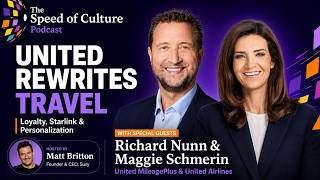
In this episode of the Speed of Culture podcast, host Matt Britton interviews Richard Nunn, CEO of United Airlines MileagePlus, and Maggie Schmerin, United’s Chief Advertising Officer. The conversation covers the evolution of airline loyalty programs toward hyper‑personalization driven by a new United ID graph and AI‑enhanced data insights. They discuss how large language models (ChatGPT, Perplexity) are reshaping travel planning and the need for brands to appear in AI‑powered travel agents. United’s partnership with SpaceX’s Starlink is examined in detail, highlighting gate‑to‑gate Wi‑Fi, real‑time streaming, gaming, and the potential for seat‑by‑seat programmatic advertising in the sky. The hosts explore Connective Media, United’s first‑party data‑rich travel ad network that enables brand‑to‑traveler messaging across digital touchpoints and multiple verticals (luxury, auto, finance). Maggie explains United’s shift from generic destination photography to culturally relevant content, citing the Wrexham football‑team sponsorship as an example of embedding the brand in entertainment. Both guests describe how consumer expectations have moved from price‑focused to experience‑focused travel, and how United is adapting its app, in‑flight content, and marketing mix. The interview closes with career advice: Richard emphasizes curiosity, risk‑taking, and continuous learning; Maggie adds the importance of being a lifelong student, consuming diverse media, and viewing pressure as a privilege.
Chapters
Up today on the Speed of Culture podcast, we are thrilled to welcome two people at the top of their game at United Airlines. We have Richard Nunn, CEO of United Airlines MileagePlus, and Maggie Schmarren, Chief Advertising Officer. Richard and Maggie are leading the charge in transforming how United engages with travelers through innovative advertising, data-driven insights, and cultural relevance. From launching Connective Media, the first of its kind travel ad network, to redefining customer experiences both in the air and on the ground, they're pushing the boundaries of what's possible in airline Marketing. Richard, Maggie, so great to see both of you.
Thanks, Matt. Great to be here.
Absolutely. Richard, let's start with you and let's start with the big picture. Obviously loyalty is so important. I'm a big traveler and I know how important loyalty can be in all aspects of travel. How has the concept of loyalty evolved over the years and more specifically, how have consumer expectations evolved in that realm?
Yeah. Well, thanks for inviting us. Loyalty. So I've been in the role a couple of years. We're kind of looking at what next-generation loyalty looks like. Because if you think about sort of loyalty programs, whether you're a retailer or an airline, they haven't actually kind of evolved. They've pretty much been the same for the last 30 years. But ultimately, at its core, driven by data and a better understanding of the individual. So we've now created a united ID graph, which is, which is important. So that's one aspect. Secondly, technology, whether that's kind of core ad tech technology or new emerging AI-based technology. And then that, that will enable a world where we can move into hyper-personalization across all our digital channels by better understanding like who that individual is and be more probabilistic in terms of at the start of the year, I may want to go skiing and a backpack holiday in the summer and flop on a beach in October in the fall. How can we join the dots of inspiration through content that we create through the amazing stuff that Maggie's team talks about from Destination, all the social content that gets created to our Digital Hemispheres, new content about 3 Perfect Days. The destinations, and then start tapping into their MileagePlus account. How many miles have they got? How can we curate packages together so that that friction point of, I've got a bunch of miles and I want to go on a specific date and time, ah, damn it, I can't because the flight's busy, right? That becomes a friction. So we're looking at how we better join the dots internally and then better understand the consumer and our customer, and then start packaging things up with a bow. For what they want to do and all the experiences they want to do in the future. So that's kind of where we're going and we're on that journey. We're not there yet, just to be clear, but that's how we're redefining what loyalty looks like for our customers.
Yeah, I mean, I think you touched on a lot of points there, one of which is hyper-personalization, right? And I think I do believe AI is unlocking that because in the past they said data was the new oil, but you really couldn't use it that easily. You would have reams of data that are in databases that you couldn't easily access. But now with AI, you could essentially take a lot of information that you've pulled together and enriched on a user, whether what their favorite sports team is, when their birthday is, if they have children, where they work, and all of a sudden you can really start to customize your offering to them, both in terms of the in-flight experience, but of course relative to loyalty, that we think could be really powerful over time.
Yeah, 100%. And I, you know, obviously we're in a fortunate position where we work for an airline and we can go off wherever we wish around the world. And now even if it's a weekend away or a week's holiday. I'm going to South Africa and Cape Town in the fall. And I literally went to ChatGPT. I said, I'm going for 7 nights. This is what I want to do. I want to do Tabletop Mountains, culture, some restaurants, a beach, this, that, and the other. It gave me a full itinerary of like a full day for 7 days, which hotels, which restaurants to go to. Now that's great for inspiration. Now, how do you then execute that in a frictionless way rather than having to go to all these different websites to execute? That's the world that I want to kind of move into. So we own— because the first point in the travel is booking the flight. So how can we create the curation of content and execute around that? So that's, that's, it's pretty exciting. But there are technologies out there that are starting to unify that.
So, I mean, there are, I mean, we're taping this in mid-May and just yesterday Perplexity, which is a leading large language model, announced that they, and they launched basically an AI-powered travel agent. Right? Yeah. So I think increasingly for anybody in hospitality, it's really gonna be about, cuz obviously sometimes they're gonna come to United, but a lot of times they might just go to ChatGPT or Perplexity. Yep. Right. And when they do, I think brands need to figure out how to show up there. I don't know, Maggie, if you have any thoughts on that in terms of what the new consumer journey's gonna look like over time in a world of AI relative to travel.
Well, I think you're exactly right. You know, it's been interesting. We've figured out a lot over the last couple of years, you know, what type of travel inspiration and information can we best provide our customer? But then what are moments where, you know, United is maybe not the first place that they're coming? So one, you know, really small example, if you go follow us on Instagram, you don't see a lot of destination photography. We fly to, you know, all of these incredible places, but we're really focused on airplane photography on Instagram. And it's funny, every time I interview a new candidate to join the team at United, they always say to me, you know, I was looking at your Instagram and I had a thought, I had an idea. On what you might be able to do, you know, more destination photography. That's not right for us on that channel. You know, who's following us on that channel are what we call avgeeks, you know, aviation geeks, aviation enthusiasts. They love photos and videos of airplanes. So we find other ways to make sure we're serving you the destination content. You know, Richard mentioned 3 Perfect Days, which is, you know, a great digital offering that we have. Our website has an amazing, you know, search by and booking tool where you can say, I have, you know, this number of days, to go on a short, you know, long weekend trip, or I have 2 weeks off, I'm interested in a beach or a cold weather destination. And so really meeting people where they are in the moment, I think, as opposed to just, you know, hey, we're a travel brand, so we should just cram kind of all this destination content down people's throats. I think we've been much more mindful about how to do that in the last couple of years.
Yeah, I mean, in that regard, I mean, first of all, I totally get it. I think destination photography isn't necessarily ownable. By United. Yeah. Because, you know, right. So that's another reason why you wanna reinforce what's distinct about the brand.
Yes.
So you're gonna see that stuff everywhere. Yeah.
Yeah. You're so right.
In that regard, I mean, I think, you know, we can all agree that air— the— what differentiates airlines, and this kind of goes to your point a little bit, Maggie, has changed because it used to just be on price and routes, but now it's really more about like the brand experience and the actual product experience, if you will. How do you think United is showing up differently in terms of customer experience and what are some of the areas that you guys are leaning into?
Yeah, that's the number one thing we talk about. You know, if you hear our CEO on the earnings call or really any press that he does, we're really talking about, you know, being a brand that people choose to come back to over time. And so how does that show up in truly every element of the customer experience? We like to talk a lot about our app, for example. It's industry leading. It's the most downloaded airline app out there. It has a ton of bells and whistles that are just not intuitive to, you know, competitor apps. We're rolling out Starlink, so we will have the fastest Wi-Fi in the— we're about to break the Wi-Fi barrier, as Richard and I like to say. Yesterday was actually our very first commercial flight for that. And so those things that are truly differentiating for the customer experience, because when we know when we have those, people will come back to us and they will choose us because it's not necessarily always on price. And then to take it down to, you know, what Richard and I and our various teams do, how do we differentiate? You know, that's been the journey we've been on with our advertising and our marketing the past 5 or 6 years. You know, I don't think it's a secret to say that the airline category was largely a sea of sameness. You know, I like to talk about the fact that I have this great slide sometimes I present that has the Pantone color chips of most of the world's major airlines, which, oh, by the way, all have blue in their color palette. United is no different. The Department of Homeland Security uses blue, TSA uses blue. Up until a couple of years ago, we used the same clear, you know, we all read the same research that blue is, you know, a calming color and, you know, something that customers want to see, I guess. But up until a few years ago, we used the same family of font as the Department of Homeland Security. I mean, imagine subliminally going through an airport and what that experience must have been. So we've totally, you know, rewritten the playbook on airline marketing. And the number one goal is differentiation. So I think we take that inspiration from what we're doing with the customer experience and bring that down to both loyalty and how we market to say, if another airline, if another travel brand could easily come in and swap out, you know, our logo for theirs on here, then we're not on the right path. And that I think has really been a guiding, you know, north star mantra for us.
Yeah, I mean, the Starlink partnership I think is a huge deal. I mean, Despite whether or not we're entitled to or not, people do complain in a tin can at 30,000 feet that their Wi-Fi is down. As a business traveler, I understand why. If I have 5 hours in the sky uninterrupted, that's critical time to move my business forward. And if I can't get connected or I have choppy connection, and there are some airlines that I fly more often than not that, that have gotten worse over time for whatever reason with their Wi-Fi connection, it makes me rethink frankly, when I'm about to book, do I want to fly this airline or not? Um, and, and with Starlink and his technology, I can only imagine it really stands to set the bar at so much of a higher level. Richard, I would love to know your thoughts on Starlink and what it can do to the customer experience.
Yeah, well, I was fortunate enough— I, uh, drove a lot of the thinking around that, and I was in the inaugural media flight last week. And Maggie said yesterday was the first commercial flight, and it was I've done a lot of lab testing with all the technical teams, and it is pretty awesome. But to see in the sky, and we had lots of media and influencers, people were— and it was a unique flight, wasn't a commercial flight, so you could call because we're not allowed to do that. We were having live calls, people were playing high-fidelity games. I'm not a gamer, but then we had people from various amazing game companies, hardware configurability people, we were people having watching live sports and shopping and talking to their mum. And it was just mind-blowing. And so there's a massive behavior change. And I think the important thing is, it's interesting. And we've seen this through our MPS studies that where we have great seatback screens with great content, the food tastes better, the service is better. And even if the flight is delayed, maybe, the flight isn't delayed because that whole experience kind of just changes people's perceptions. And I think what we're going to see, and as we announced, you know, with Starlink, and it takes Wi-Fi connectivity to a different level, which is what we're talking about. It breaks the Wi-Fi barrier. But it's not just about that. It's about what that will enable us to do to provide an even awesome experience for our customers. So, Yes, we're going to allow people to have multiple streaming platforms. So scenario is you could be halfway through watching a movie at home on said streaming platform. If it's account-linked via your MileagePlus account, because Starlink is free to MileagePlus members, you can resume halfway through that exactly where you stopped off from your home. You'll be able to game, you'll be able to shop. So it's interesting. And we have this notion about how we create a living room sky. When I came here sort of 2 years ago, it is a bizarre mindset that all the stuff we do 24/7 on Earth with our devices, and we can do anything, and then you go up in the sky and you go to a different world. So yes, it has to be about awesome connectivity, which Starlink is the best player in town. It's like 5 or 6 years ahead of anyone out there due to its tech. But it's what that's now going to enable us to do, which is going to take customer experience in-flight to a different level. And the feedback, the quality of feedback we've had, literally, Maggie, I was seeing some stuff this morning on some tweets that people are putting out on their first commercial flight. I mean, it's— you can see it now. I'm really excited that this is rolling out at speed. We're doing about 40 planes a month. So at the end of the year, we'll have all our regional jets enabled. So it's exciting. It's really super.
You guys planning on tagging that in your messaging? So if I'm searching for a flight on United, I'll know if it's Starlink enabled or not?
Yeah. So we've got a comms program that it's great when you do a fleet, a certain fleet type, because you know that clearly if something's gone wrong and you have to change the tail number out. But yeah, we, from a pre-comms perspective, to say you're Hey, get ready to be checking in tomorrow. That flight's going to be Starlink enabled. So we are doing that comms side.
Yeah, just really quickly, the coolest story I heard from that media flight that Richard was on, it happened to be the day that the new Pope was announced and it happened to be right as the plane was taking off. And, you know, you're not going to lose that time anymore. You know, now you have to wait until you're above 10,000 feet you will be able to connect gate to gate. And you think about business travelers, oftentimes they're, you know, people that have, you know, loyalty at a level where they get to board first. So they are seated on that plane sometimes for 45 minutes. And, you know, if you're in a Dreamliner, if you're in a composite aircraft type, sometimes your techs start going through when you're on the ground. So you're losing all of that time as well. And so to be able to work gate to gate, not kind of have that, you know, 30 minutes when you're taxiing and the new pope was announced, you know, literally as the plane was flying above the skies of Chicago, which turns out where he's from. So that was just some awesome feedback that I heard from people to really show, you know, just how reliable it is, you know, obviously fast. But I think the reliability, once people really experience the gate-to-gate aspect, is going to be amazing.
Yeah. I mean, so I flew an airline that wasn't United in first to CES in Las Vegas and you have a bunch of Wi-Fi data-hungry travelers and the, and it just didn't work. It broke the system. So often the routes where Wi-Fi is most needed right now is where it works the least just because of bandwidth issues.
So it's bandwidth issues. And without getting super technical, but Starlink technology is called LEOs, low Earth orbit satellites versus GEOs, which are a damn sight higher. So even across the States, that's exactly the issue that people take, 'cause it goes from satellite down and up, whereas LEO's obviously lower and they go from satellite to satellite. So you, you're not gonna get that uninterrupted service even over the US, let alone when you go Pacific and places like that, 'cause Starlink is global. But yeah, no, it's exciting.
So United has a global media network called Connective Media. Which I imagine is built to help partners reach, you know, your passengers in the right place at the right time. Talk to me about that network and how it's evolved over time and what the vision is for it moving forward.
Yeah, thanks. Well, we're almost— with CAM coming up next month, we're almost at our 1-year anniversary, which I can't quite believe. But yeah, just taking a half a step back, this was predicated on back to what I sort of mentioned earlier, that we have a huge customer base. It's the sort of biggest, best airline in the world. We've now created our own unique identity graph. So if we flew 174 million people in 2024, we've got about 111 million unique IDs. That's an audience of scale. And then we talk about getting to a more personalized world of messaging from United. Messaging from our partners, and then now messaging from brands and advertisers who want to get in front of our audiences. So what we've done, we've enabled all of that. We've enabled it across all our digital channels. And it's great. And I think the response we've had back when we launched last June— and you've all heard about retail media, that's massive now, now emerging into kind of commerce media and all the various verticals that are now playing this game. Predicated by high-fidelity quality first-party data, which we have. It was important for us. Yes, we're an airline. So yes, the default would be we'd be pretty awesome at all things travel. But it was important when we launched that because of the digital channels we have from our dot-com to our app, to someone sitting in our club, to gate information displays, to the awesome experience in the sky and beyond. And at home, that we can enable multiple verticals, not just in the travel vertical. So luxury brands, auto, finance. And that's a very different play to retail. Retail plays very well in the CPG vertical. It's very hard for them to break out into multiple verticals. You know, a Kroger or a retailer doesn't sell cars, right? It may sell financial products, but you know, at what sort of depth and breadth? So that was important that we banded across verticals. And then the last point was that we can play both in the brand game, brand-based advertising, whereas performance, and that differentiates again to retail. So it's gone great. We're sort of fully enabled with all the team. It's been a fantastic first year, great case studies, great reception from the market, and we've got a pretty exciting kind of roadmap in year 2. And then clearly, as we ended on the last point, Starlink is going to enable a very different world of real-time ad decisioning in the sky with low latency. So we know exactly who's sitting in that seat. And unlike just having a generic ad across 250 people in one plane, it's seat-to-seat enabled by Starlink. So fully programmatic in the sky, which is pretty, pretty cool. So it's lots.
It's crazy just because, you know, the advertising landscape is shifting so dramatically. You have the retail media networks, right? Like you have Target and Walmart offering CPGs the ability to reach the Walmart shopper anywhere. Chase just announced they powered, I think, $10 billion of purchasing in the last year through their media network. Then you have PayPal that's also rolling it out. So it's interesting just like the companies that used to be just primarily advertisers are now advertisees, if you will. But a company like United has such powerful first-party data, which you were referring to earlier, can be mined and really unlocked for anyone that wants to reach that high-value traveler.
Yeah, 100%. That's exactly right. And I think there's an ecosystem that's emerging across all these commerce, broader commerce players where we can all play together. So unlike publishers in that sort of the ad network game, where everyone was fighting for eyeballs. The difference here is each of those players that you've mentioned, we all have an awesome customer base. But guess what? I fly United, but I might shop at Walmart, right? Or I might use a banking product. I use Chase, obviously, because that's our partner, but I might use PayPal too. But the point is you can start sharing data in a privacy-safe way to the value of the brand advertisers. So there is that sort of emerging ecosystem now across all commerce media players that are starting to play together rather than fight, which is pretty, pretty cool.
Very interesting. So moving on and talking a little bit about the consumer, Maggie, like we've seen a huge shift through many different reports that the consumer is now decidedly focusing on experiences over stuff. And obviously during COVID experiences, as you guys probably well know, uh, weren't really an option. And people bought a TV for every room in their house, including the bathrooms, right? And then you had this revenge travel phase, which doesn't seem to have let up just by my own anecdotal evidence of being on airplanes and, and, and checking into hotels. What is the shift you're seeing from the consumer and how are they prioritizing not just travel, but different types of travel? And what are you seeing in terms of demand? Within your routes that support that.
Yeah, you're exactly right. I like to say, you know, we definitely don't have an awareness problem. We don't have to, you know, sell people on what we do. Those trends, I mean, it's been so interesting watching them take shape, you know, throughout the last 5 years. And, you know, people ask me all the time, I'm at dinner parties, you know, are Tuesdays still the best day to, you know, buy airline tickets? And all of those, you know, trends have completely been jumbled and changed up. And so we do see, you know, that people are able to combine, you know, working with leisure. They're able to go longer. They have a wedding in Florida. You know, they're able to get there on a Wednesday or Thursday instead of a Friday, you know, work remotely. And so we've had to be, you know, really responsive to that with our marketing efforts. And I think, you know, really force ourselves out of, you know, travel endemic media. If you talk to us, you know, 5 or 6 years ago, that's a lot of the places that we showed up, you know, the various travel sites, just the things that were more expected, even if you think about, you know, a big broadcast partner and what we were focused on, you know, with a morning show, let's say, for example, we were probably, you know, talking to them about, well, let's send your anchors, you know, somewhere. Now, because it is so crowded and I think there is such attention on this, we again, in that, you know, play for differentiation has really, really pulled the brand out of that. And I think want to be much more responsive to overall culture in general, you know, whether that's sports, music, pop culture. And then what is the travel lens that we can layer on top of that?
Absolutely. I'd also love to ask your opinion, Maggie, just in terms of AI and how you see it impacting your role and your team's everyday lives in the advertising and marketing space. And where are you putting it to work currently?
Yeah, I would say it's definitely an art and science. I don't think we're getting, you know, too ahead of ourselves. What the volume of ads that we create here at United, you know, those are still humans that are making those ads. You know, AI is helping empower insights. I think, you know, what's really interesting, more and more focus group testing, you know, with segments that we build throughout AI, it obviously takes a lot of effort to stand up, you know, a focus group. But how can we build some stuff there? We do way more testing than we've ever done. You know, that's been a trend of ours at United the last couple of years. You know, when we have the seedling of an idea, when we have a final line of copy. And so that's been really cool to be able to, you know, build those personas and those audiences and use AI there. And then I think carry that through again, that in combination with the first-party data to get much more specific about who we target. You know, 5, 6, 7 years ago, it was just kind of the general mass traveler with, you know, a one kind of size-fits-all audience. And we know that is not the case at all today. We have, you know, a traveler who might be, you know, more in tune to a basic economy fare all the way through our Polaris business experience that we just announced, you know, kind of a second version of that earlier this week. And so I definitely think more on the targeting side and kind of the gut checking and less at United with actually making the creative.
Yeah, totally makes sense. So with the time we have left, I'd love to just shift gears and just talk about about each of your own, you know, roles and, and just professional development and where you focus your time. Let's start with you, Richard. When you look at, you know, your role, obviously, you know, United Airlines MileagePlus is obviously a huge business in its own right. And obviously from our discussion today, there's several tentacles to the business and to the initiative. Based upon that, where do you find yourself spending your time today and what are some of the areas you're really focused on to really drive the business forward here in 2025 and years ahead?
Yeah, we've talked about data. I'm a sort of data media technology guy that I don't come from the airline industry. So it's been kind of a very interesting challenge to kind of look at how we better join the dots. So we talk about this sort of flywheel or turbine wheel. If you think about the airline and it's, yeah, it's doing great and that's growing exponentially. That growth sort of feeds the growth of the loyalty program, which then gives us opportunities to sell our Chase credit card with the partnerships that we're now enabling. Yes, in the travel sector, but outside of that, there's some really exciting new partners that will be launching this year. And it obviously predicated that with the media network. So this sort of flywheel of interconnection, the customer's like dead center. So a lot of my time is how we really make that flywheel spin. And there's some great examples where it's like one of the launch partners last year about all 3 of these, sort of all 3 or 4 of these elements was Televisa Univision, one of the biggest sort of media companies in the world. Spanish-speaking. So we launched VIX, their streaming platform, on our seatback screens in the plane. It was supported by media targeting Spanish-speaking people. Then you can sign up to get that subscription and get miles on the back of that sign-up, or you can then redeem your miles against that subscription or use your credit card to pay for that subscription. So that touches all parts of the airline. So what we're finding is a lot of these emerging, whether it's a media relationship our partner relationship, our banking relationship, and the core airline, how can we enhance that overall customer experience for our customer in many, many ways? Yes, driven by data, technology, great new technology such as Starlink. So that's where we're trying to sort of drive that big flywheel effect. That's where I spend a lot of my time. So touching a lot of those businesses and then different—
Absolutely. And Maggie, from your perspective, obviously, notion of advertising has changed so much over the years. I know you have background in PR and working on the agency side, et cetera. Like how has brand building and marketing generally changed over time and what do you think the skill sets are needed for the modern CMO to be able to remain relevant today?
Yeah, great question. It's something I spend a lot of time thinking about. I get a little bit, you know, allergic and I start to itch a little bit when people talk about the glory days of Madison Avenue and they kind of evangelize Don Draper and that era, there's, you know, definitely some lessons that are still tried and true in terms of, you know, how do you resonate with people. But obviously so much has changed down to, you know, the channels that we reach people. There are more ways than ever to tune out advertising. You know, you pay more so that you don't have to watch a commercial. You have, you know, ad blockers on your web browser. And so how do we show up in a way that you can't ignore? You know, oftentimes that's inserting yourselves in the actual content itself, you know, like, getting out of what feels like a traditional ad. I think the best example that we might have of that at United is our sponsorship of Wrexham, which, you know, people know is Ryan Reynolds and Rob McElhenney's team. You know, we are the front of jersey sponsor. Season 4 just launched actually yesterday of the Hulu show Welcome to Wrexham. You cannot ignore us. We are running around, you know, all episode. It's great. Yeah. Emmy Award winning. So I think, and you know, that's a good example. We— that's a club that's in Wales. We don't fly to Wales even though We're the largest airline, you know, in the world. And so that was an opportunity, again, to really tap into culture and what Ryan and Rob are doing and the massive footprints that they have on social. So I will say, you know, a lot of what Richard was saying, I think, you know, what his team does and what my team does really is relationship building. So we can move really quickly when there is this moment to say we can take advantage of something with, you know, a partner that he might be talking to from a connective media side, or there's something happening in sports or culture that we can be responsive to, you can really only move fast because there's that baseline relationship that exists. So that's where I spend a lot of my time, you know, ensuring that we are ready to go and we have the right connections and we really have our flag planted out there as a brand that, you know, wants to do cool stuff and wants to move fast and isn't afraid to, you know, take some opportunistic risks.
Yeah, absolutely. So I guess to wrap up here, just to each of you, we have a lot of young listeners here on the Speed of Culture podcast. Just curious, we could start with you first, Richard. For somebody at the beginning stages of their career, just based upon your experience, what are some of the key skill sets you think need to be developed at early stages to end up in the C-suite one day, um, as both of you have managed to accomplish?
Yeah, it's a— that's a good question. Um, I think you can only answer that in hindsight. I started as— I was a trained accountant originally, and look where I've ended up. Um, I think my mantra that I learned relatively 8 to 10 years into my career was— and I started off in meet— accountancy to media, um, and I echo exactly what Maggie said— things never change the same. So stay curious, take risks, keep learning. Is actually my mantra that I tell my kids because things, and that things are only accelerating. So you've got to push yourself. We're now in this world of AI and I think I was around when the first, well, internet actually was launched, then mobile phones. AI is like 10, 100x generational change to what we thought that was a pretty monstrous change. And in fact, I even remember as a kid, having the first calculator and my parents are saying, that's outrageous, you're never going to learn how to understand math. So that's 4 iterations that I've seen in my lifetime, which is showing my age. But stay curious, take risks, learning is the mantra for me.
And Maggie, from your end?
Yeah, very similar. You know, the learning doesn't stop when you graduate university. You have to be a student, you have to read. You know, if there's work out there that you like, you see a Super Bowl commercial, find out the agency that did it, find out the CMO who did it, you know, start to develop that point of view in terms of, you know, this is work that I gravitate to or this was, you know, a really interesting piece of tech or how they went to market with a media buy and, you know, start to zone in and keep studying that. The other thing I always remind people, watch 60 Minutes every week. That was advice I got in my very first job. I think, you know, it's still relevant if you watch 60 Minutes. Regardless of your age, your level, you are light years ahead of your peers. It just makes you interesting. They cover good stuff on there. So I think you have to read and be a student of your own industry, but you have to be interesting beyond that and know how to hold your own and, you know, a conversation at a work function, at a social function. And so always be learning, always be reading.
I love that. So the wrap up here, we always ask our guests if there's a saying or mantra that helps define their professional journey today? And Maggie, we'll stick with you. What comes to mind?
Yeah, my favorite quote is by Billie Jean King: "Pressure is a privilege." And I oftentimes say that, you know, if I'm backstage about to give a speech and you can't help but feel, you know, a little bit of nerves, it's a privilege to be in that situation. And, you know, you've gotten there because you have a good story to tell on behalf of, you know, a great brand that Richard and I have the privilege to work for. So Pressure is a privilege.
Yeah, I love that. Richard, from your end.
This is a real one, but it certainly helped my life and I've taught it my family. Yeah, keep driving. I think that's the context of flying, right? You're flying. Yeah. Because I think you've got to— I know you can be taught drive, but I think it's important that you have drive because I think that makes you curious, adventurous, interested, interesting. About the world. And I think that's so important now because the world is a lot more connected, but it's also a lot more confusing. Keep, keep driving.
Yeah, I love that. And I'm really thankful for both of you guys to allow our audience to keep driving by sharing all your wisdom and insights today. And obviously we're at the dawn of what will, I'm sure, be a huge travel season for United. And wishing both of you the best of luck with all your new launches and everything that's to come. So thanks so much for joining today.
Thanks, Matt.
Absolutely.
Thank you. This was great.
On behalf of Susan and every team, thanks again to Richard Nunn, CEO of MileagePlus at United Airlines, and Maggie Schwerin, Chief Advertising Officer, United Airlines, for joining us today. Fly United this summer and check out Starlink if you can. Be sure to subscribe, rate, and review the Speed of Culture podcast on your favorite podcast platform. Till next time, see you everyone. Take care.
More from Matt




MikMak’s Rachel Tipograph on Consumer Spending, Retail Media & Holiday Shopping Trends



Jaguar Land Rover’s Charlotte Blank on Luxury, Purpose & Experiential Storytelling



