UPS’s Kevin Warren on Brand Repositioning, Digital CX & Customer Trust
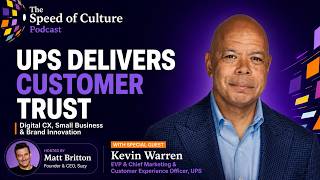
In this Speed of Culture podcast, host Matt Britton interviews Kevin Warren, EVP and Chief Marketing and Customer Experience Officer at UPS. Warren recounts his journey from a finance student who discovered a passion for people and sales, through a 30‑year tenure at Xerox where he learned to navigate technology change, corporate politics, and leadership. He shares the "Success Triangle" framework—performance, behavioral collaboration, and continuous learning—that guided his rise. Warren explains his strategic move to UPS, attracted by scale, growth, brand trust, and DEI values, and describes how he has been revitalizing the UPS brand, shifting perception from "old‑stodgy" to digital‑agile, especially for small‑and‑medium‑business (SMB) customers. He details UPS’s focus on a "phygital" end‑to‑end customer experience, integrating UPS.com, mobile apps, and the UPS Store franchise network. The conversation also covers his work with the Black Executive CMO Alliance (BECCA), mentoring pipelines for diverse marketing talent, and his advice to young marketers: be bold, take risks, and build resilience. The interview wraps with a legacy quote from UPS founder Jim Casey emphasizing that determined people create conditions rather than being victims of them.
Chapters
Up today, we're gonna be speaking with Kevin Warren, the EVP and Chief Marketing and Customer Experience Officer at UPS. Kevin has over 3 decades of experience in the marketing world and was recently named in Forbes' 2022 World's Most Influential CMOs list and recognized by Adweek as a 2023 Brand Genius. Kevin, so great to see you. Thanks so much for joining today.
Thanks for having me, Matt.
So we're gonna take, we're gonna go way back here, Kevin, and you might not even remember, The earlier parts of your career, but at which point do you remember where you knew that you wanted to be in the world of marketing for your career?
Well, you know, look, I think really kind of understanding the things you enjoy and what you're good at. Although I studied finance in university, I knew I was a people person. I like being with customers. I like really kind of understanding how do you compete. So it was just a really good fit. And I started out my marketing career really on the sales side. And then as I matriculated up through Xerox at that time, I got more and more marketing experience and started leading marketing organizations as well.
Yeah, I think it's interesting. Sales gets a little bit of a bad rap. Sometimes it's typecast, but, you know, ultimately the purpose of marketing is to sell stuff. And I think understanding what it means to sell as a foundation of how you're building yourself is incredibly important for anybody entering the marketing space.
Well, not only the marketing space, but look, you know, I don't know how a company can be successful if they're not selling things, whether it's services or products, etc. And also that face-to-face connection with customers and the customer experience and the competitive landscape and pricing. I mean, it was a really good training ground for for marketing going forward.
Yeah. And I'm sure that you've been on the receiving side of many sales pitches over the years, as well as given sales pitches. What do you think makes a good salesperson?
So first of all, a good salesperson has to be relatable to their customer.
Yeah.
It's about really enabling what the customer needs and wants as opposed to what they're selling. And then once you kind of build that trust and that credibility, then it's just about doing business as opposed to like a hard sales pitch.
Right. Less transactional.
Less transactional, more relational. You're absolutely right.
Yeah. In some ways that's a lost art. And these days, I mean, in this AI-driven era, a lot of companies are trying to build AI salespeople. Obviously, we're in a Zoom-based world right now. And, you know, I think a lot of the core tenets of sales is about relationships. And sometimes that can get lost based on the evolution of how business is done today.
Yeah, I agree. I think, look, I think there's, there's absolutely a role for digital and technology. Um, from a sales standpoint, we like to say it's about meeting the customer where they are. Uh, it's about how they want to buy, not about how we want to sell. But if you start talking about a more sophisticated, a long-lasting, uh, relationship, um, that's where people come into play. And, and those tend to be less transactional. And when they get out of that transactional space, it's amazing that financially, that can be good for the company because it's more of a value-based, long-lasting relationship, which tends to come with higher margins and happier customers.
Yeah, without a doubt. So taking you back in your career, you joined Xerox in the mid-'80s and would stay there for over 30 years. And that's something that we often don't see with young employees who leave school and join a company. They usually look at it as a stepping stone to where they go next. How were you able to, I guess, continue to stay interested at the same company and also for your sake, stay relevant at such a business for so long? And what are some of the key learnings that you remember from your long, you know, career there at Xerox?
Well, Matt, look, I was looking at it as a stepping stone too. I mean, it wasn't my plan to be there all the time. I'm sure. And my first instinct was just to go there to get some experience and then go to Wall Street and do that thing. And a funny thing happened along the way in that I really enjoyed the company. I enjoyed the people, the relationships. Best friends I either brought there or made there. Godfathers of my children.
Wow.
I met my wife there. And so when you have that connection between the company culture and your own values, at some point, the work and the living just kind of go hand in hand.
Sure.
And so I really enjoyed it. And then every time I considered going somewhere else, I would either get a promotion or another cool opportunity to grow, to go outside my comfort zone. And then the next thing you know, you look up and you've been there for a good little while, but you've enjoyed— you've enjoyed the ride.
Yeah. Now, Xerox is obviously a company, I mean, a lot of people know them for making photocopiers, as I'm sure you've heard a million times before, but I really look at it as a company that really reflected over the last several decades kind of the current state of technology, 'cause it was sort of a biz-to-business company that had to continue to offer innovation through digital technology for its customers. Like, did you find it to be a challenge or did you really focus on really understanding where technology was headed to stay relevant?
Well, you had to understand the technology piece because first of all, it was a way to kind of differentiate yourselves from your competitors. But also, I mean, think about, look, in one lifetime, just the amount of change, right? So, you know, in the '80s, as you mentioned, that was before really the internet or digital printing.
Right, long before it.
Yeah, so you really had to kind of understand the impact that technology was going to have on how consumers were going to buy. And what the value proposition had to be and what the competitive landscape would be. There would be winners and losers in that. And then also there would be pressures and opportunities on the business model. So yes, you know, that, that technology and, and staying relevant and really kind of adding to your game so that you can continue to be the best is really important.
Yeah, and I also imagine another piece, and we've kind of touched upon this, is just understanding the dynamics and in some ways politics of an organization. Because, you know, you started off as an intern, and by the time you left, you were basically in the C-suite of the company. And you don't do that without, you know, I understand, like pushing the right buttons and understanding the right people. And I mean, is it about corporate politics or like what advice would you give someone who wanted to work their way up the corporate ladder at a big company today? Like, what worked for you in doing that?
Yeah, so look, I'll say a couple things. One is I was, yeah, my mom was a teacher, my dad worked for the local government and drove a cab part-time to kind of make sure we had food on the table and could pay the bills and all that stuff. So I didn't have a corporate titan having dinner with me every night at home, but my parents really provided a, a really good life for me and helped support me kind of go through school. But I did have an older sister who's a librarian, and she gave me this book called What They Don't Teach You at Harvard Business School. And it was really kind of the unwritten rules that kind of help you matriculate through the corporate culture, how to dress, how to take feedback, where to sit in a meeting and meetings. Up front is better than in the back, by the way. And then as I, as I started working in the company, I really realized I gave a lot of thought to the question you asked. I said, okay, how am I being successful? And then when I see other successful people, what are the things they have in common? And I really, from there, I came up with this framework of success. I call it the Success Triangle. Okay. And it's really kind of 3 major things, all right? So the one is the top of the triangle is performance. So you're not going to get promoted and have all sorts of success or go to company to company if you aren't able to deliver on your performance goals. And when I say deliver, I mean deliver consistently and at high levels. And, you know, whatever your KPIs are, you know, whatever the measurements are, you have to nail them. And the ability to be able to kind of get things done day in and day out, weekend, quarter in, year in and year in. So delivering performance consistently, that would be the first part of the triangle. Okay. By the way, you can't, you can't do that. You don't pass go.
All right. Right.
Okay. Now I've seen people that have been excellent at that, but still have not done well because there are two other parts of the triangle. The second is what I call kind of behavioral. So corporations, it's not like working in a lab. You know, you're working— they're social institutions. You're working with people. We were talking about importance of people. So that means how are you able to collaborate?
Right.
How are you able to give credit, not take credit? How are you able to take feedback? Are you the type of person when somebody interacts with— they walk away and feel energized? Or are you the type of person when somebody interacts, you just drain all the energy from them?
Yeah.
Right? So there is a social aspect. By the way, a lot of people that deliver on that first part, you know, they don't do too well on the second part because they're trying to take credit. They're, you know, they're backbiting and all this stuff, whatever. So you have to be able to do both. And then the third part, you kind of asked me about earlier. And that is if you plan on being in business for a while, business is going to change, right? So the ability to constantly up your game and improve your skill set. And I like to give the analogy there, like if you're a company, kind of your R&D engine.
Yeah.
And if you think back to the iPhone, they just launched the 15. You know, the iPhone, when it first was launched, BlackBerry owned that market. And the iPhone 1 was revolutionary. Well, imagine how much trouble Apple would be in if all they had is iPhone 1 now as opposed to the 14.
For sure.
So when you think of yourself, think of yourself like that, that product development, you have to every year, 2024 Matt has to be better than he was in 2023. If he isn't, the competition's gonna catch up with him. So it's really those 3 things, performing at a high level, From a behavioral standpoint, getting along with your colleagues and collaborating, and then constantly adding to your game and getting smarter and smarter. Those three things.
It's really interesting, Kevin, 'cause I see the signed jerseys of Mario Rivera and Magic Johnson behind you, two Hall of Famers.
Yeah.
And you look at their careers, they did just that, right?
Yeah.
They obviously had great stats.
Yeah.
But they were also great teammates.
Yes.
And they also continually evolved as the game did, whether it's changing hitting patterns or playing plays. And there's some players, as we know, being sports fans, that put up great stats, but they don't make their teammates around them better.
Boy.
Right? And ultimately, they don't make the Hall of Fame.
That is a great observation, Matt, you made.
Thank you.
Because we did webcasts for small and medium-sized businesses where we bring in celebrities who are also good business people and have good leadership skills, and they tell their story. As what made them successful as an athlete or maybe a celebrity, and then how that translated to their business success. So you're absolutely right. You know, Mariana and Magic, people, their teammates loved playing for them. They could trust them. They delivered in the moment of truth.
And they both made their teammates better.
Yes, they did. And they enjoyed making their teammates better.
Yeah. I'm sure you feel the same way that, you know, I've, I've run several companies, and one of the most rewarding things is looking back on the people who used to work for me and seeing that they went off to do great things.
Yeah.
And they're creating their own Hall of Fame careers, if you will. It really is one of the most rewarding parts of being a leader in business.
Without question. And that's a legacy that stays with you forever.
Yeah, absolutely. So let's go back to your career. So you spent over 3 decades at Xerox and then made the decision to make the leap and go somewhere else. Can you talk to us about that decision-making framework? Because I'm sure it was not something that you took lightly back in 2018 to jump to UPS. What was behind that decision? And, you know, what's your takeaways from that process?
Yeah. So, at that point, my last position at Xerox, I was the chief commercial officer of the company, which is— the only position above that was the CEO.
Right.
And so, and we just hired a new CEO. He and I, to this day, are good friends, Jeff Jacobson. So it was really about, OK, what's next? And the options were either to go run my own company or to go to a big company and drive impact. And so this opportunity at UPS kind of came my way. And it was just— to me, I just saw it as really attractive. I mean, this is a company of massive scale. So, you know, roughly, you know, anywhere from $95 to $100 billion depending upon the year. That's with a B.
Yeah.
Over 550,000 employees, 220 countries and territories. And so from a scale standpoint, it was probably 12 to 13x easily what Xerox was. So that was attractive. It had a brand that was very respected. From a trust standpoint there as well, really kind of a halo effect we get from our drivers because everybody loves our drivers.
Yes.
It was in an industry that was growing, you know, Xerox at that time, printing was in a secular decline. So the growth piece was really appealing to me as well. And then from a diversity, equity, inclusion, they had a diverse organization, diverse senior team, diverse board. So from a values perspective, it kind of locked in. And then, you know, headquartered in a world-class city of Atlanta was a great place to live and work. So it had all those things. And then the final thing I would say is it was also a place where I thought I could make impact and make a difference. So those things kind of came together. And thank goodness, you know, UPS had me. It's been a terrific almost 5 and a half years since we've been together.
Yeah. And obviously it's had a great turnaround in many areas since you've joined. I'm going to touch on a couple of those. First and foremost is just kind of the brand itself. So when you join in your role as essentially, among other things, head of the UPS brand, how do you look at the importance of brand and kind of like establishing those brand equity pillars to continue to make sure you're differentiated in the marketplace?
So, yeah. So, you know, one of the things I found is you can have a great brand, but if you don't continue to feed it, that brand could lose its luster. I don't care how great the brand is. I mean, we just talked about, you know, the company, um, that I started with, um, and Xerox was iconic brand. It was kind of like Kleenex and, and some of the others where it was a verb. I'm going to Xerox something. I'm Xeroxing something. Um, and now not as much, you know, uh, you know, my personal email has Xerox in it. I have to kind of spell out what it is because some of the younger people don't You know, the company is still, you know, still obviously in business, but they're not aware. So even something like a UPS brand, if you don't feed it, it either can become passé, um, lose its luster or even forgotten. So it was really about how do we kind of build the momentum of the brand? Because when we talk to the customers and the most profitable customers were the small and medium-sized business customers, we interviewed like 800 of them. And we said, okay, tell us, tell us what you think about UPS. What's it going to take for you guys to do business with us more? And what they told us was, hey, you know, we trust you, you're reliable, you have integrity, all those sort of things, but we kind of see you as old and stodgy.
Right.
So when you start talking about attributes like, is this a company whose best days are ahead of it versus behind it? This is a company that's digital, agile, innovative, cool. We didn't score where we need to score there. And you think about now e-commerce and the impact that's going to have on industry. We had to kind of work on that part of the brand. And then the final piece of the equation is, you know, UPS is primarily an operations company. You know, we deliver packages.
Logistics.
Yeah, logistics, right? And so this thing marketing, you know, this could be a discretionary You know, kind of when you can afford to do something, it can mean just kind of tickets to the game or the golf match, et cetera. So making sure that we could tie a direct line to the money we were spending and the impact on the results was going to be really important so that marketing wouldn't be perceived as a discretionary spend, but rather a value driver for the shareholder.
Yeah, and I know that you really focus on both small and medium-sized businesses, and there was diminishing share at the time you've joined, and it's turned around. And it's interesting, 'cause I was thinking and prepping for this interview today just about what it means to be a small business owner. Because in the past, maybe in the '80s or '70s, it was you had a bakery, right? You had a dry cleaning shop, whatever it may be. But now the barriers to entry to start a quote-unquote small business are lower because you have platforms like Shopify, or Etsy, right, that lets anyone really run a small business. And I would imagine, as you mentioned, e-commerce is a huge piece of your growth. So are you seeing changing demographics for what a small business person is?
Oh, 100%.
Yeah.
100%. So look, we've got the UPS Store network. Actually, it reports into marketing and it's a franchise network. So we have 5,200 of these stores in the US. These are entrepreneurs. And oh, by the way, the people who— the customers who use the UPS Store are entrepreneurs. And we've actually kind of took a look at the demographic shifts over just over the last 10 years. And we found that these customers who go to our stores, they're demoing younger, they're demoing more gender diverse, ethnic diverse, and then also international as well.
And so— Wow.
I mean, just even over a 10-year period, right? Just drastic changes there. So, yeah. Yeah, these, you know, these SMB customers, man, they are fighting the fight. They're into the grit and the grind. You know, they've risked, you know, everything, everything for their businesses, a generational wealth impact as far as their families and their children, whatever. And so, yeah, everything is so important because their life's blood in doing business as opposed to, just being an employee of a company. It's a very different dynamic.
They're all in.
They're all in 100%.
Yeah. And I would imagine UPS, they're shipping. You talk about reliability and trust. It's also saying that it just got to work and has to work in a way that fits their life. And it should be the last thing they should think about because you want them to spend time thinking about their customers and their business, not where's the where are my shipments, how do I access tracking, or a variety of different ways to interact with you?
Yeah, look, so we, we have an impact on their customers. So we're, we're not just B2B, we're B2B2C.
Exactly.
Um, and so we can be really impactful on their customer satisfaction and their competitiveness when we do what we do the right way. And we do that at a really high level. But we also have expertise. Where we can help these small businesses, whether it's in supply chain, whether it's, you mentioned pivoting to e-commerce and the pandemic was an accelerator there on that.
Sure.
And just overall knowledge, business knowledge. And we've leaned in to really kind of leverage that to help these small customers whose products and hustle factor are equal, if not greater than their larger competitors. But they might not have the capital or the cash or the resources or the real estate footprint to compete. So we try to level the playing field by advising them and giving them resources and leveraging our connections so that David can compete and win versus Goliath, if you will.
Yeah, I love that. So, and some of the investments your company has been making in terms of customer experience around visual technology and social media, I imagine are with the customer in mind. So what are some of those investments that you're really leaning into even heading with Nyon 2024 that your customers really need to gain a better experience in working with UPS?
Yeah, so look, so our customers, so UPS is a 116-year-old company, right? I told you, I already gave you the stats on how big it is and, Yeah. Geographically, you know, so if you're not careful, a customer can get lost in it. And so we're really kind of focused on what we call the end-to-end customer experience. Whether they start at ups.com and then they interact with our operations people or they interact with our UPS store, which is franchise-owned, or backwards, we need to make sure that from an end-to-end perspective, any sort of friction, or if they're calling our call center, want to get an update as to where the package is, that that experience from end-to-end is a good experience for that customer. And that's easier said than done. But that means that we really need to kind of make sure that our digital experience and our digital game and how we show up on ups.com, how we show up with our digital partners, you mentioned Shopify as one of them, Mobile app. Yes, it's consistent. Yeah, mobile app. It's consistent with what they're going to get when they go into our UPS store. So we talk about the digital and the physical. We call that phygital. That needs to be integrated in. And so when we go to our website, now you can see where your closest UPS store is based on where you are geographically. And when you go to the UPS store, the UPS store is going to know who you are as well. So really focusing on that end-to-end physical and digital experience. So the customer, both the shipper and the recipient, has a better experience has been a huge focus for us.
Yeah, I'm sure. So let's shift gears a little bit because you've spent a good deal of time in the diversity, equity, inclusion space. And more specifically, you're a founding member of the Black Executive CMO Alliance. Tell us about that experience and then just Zooming out, like, how far has the advertising industry come in terms of embracing diversity? And what still needs to happen to improve, in your opinion?
So, you know, Gerry DeVard, who was the founder of BECCA, and Gerry's an icon in the brand CMO world, she called me, I guess it was almost 3 years ago. And she said, Kevin, I'm thinking about this idea. And she asked me a question that was poignant, Matt. She goes, how many Black CMOs do you know? I said, you and may have been one or two others.
Right.
And she says, I think that's an opportunity 'cause we're all having similar challenges but maybe isolated. And then she asked, okay, let's talk about the talent feeder base. And how do we feel about that as far as up-and-coming marketing talent, Black, uh, diverse marketing talent who will be the CMOs for tomorrow? So that was really kind of a compelling reason for us to get together. And I, I wanna say, I'll get the number right. It was maybe 32 or 33 of us who were founding CMOs. I think we're up to like 38 or so now. Of, you know, fantastic marketing powerhouse companies. And I'll tell you, the talent of these, I am awed by the talent of these executives. And we share best practices.
Awesome.
We cheer each other on. We pick each other up when, you know, the invariable business challenges kind of come our way. And then a big part of our focus has been on what we call, you know, the Becca Playbook, which is really the emerging marketing talent and really kind of helping nurture and curate the pipeline of talent. So each of us mentors a marketing— Black marketing professional at another company. We've got a 2-year curriculum. The first graduation is going to be this November 30th in New York City. And UPS, I'm proud to say, we've put in more people in this academy than any other company, and we'll be sponsoring the graduation process. So it feels good to kind of give back, to be able to network, to be able to share. It's been a fantastic experience.
Yeah, I love how you're creating a pipeline for the future. I think a lot of these executive forums are just focused on the here and now and the people who are in it today, but it seems like you guys have an eye towards the future. So 20 years from now, when maybe many of you are retired or at the, you know, a different phase of your career, that this continues to thrive and grow.
Absolutely.
Yeah, it's amazing. So wrapping up here, you know, you've had an amazing career and you're obviously in the seat that most people, if not all, that enter the marketing world want to be in, right? CMO of a $100 billion company and, you know, overseeing a really exciting business. What would you tell 20-year-old Kevin right when you were starting that he had to know based on your experience today to basically maybe facilitate that in an easier way? Or maybe other people who are entering, other Kevins around the world, what they need to know?
I think, look, I think the primary message would be, and this might sound odd, 'cause I've been blessed to have some success in my career, would be to be bolder, to take bigger swings, to bet on yourself, to take those risks. You've got it. You are probably better than you think you are. There are going to be some trade-offs you're going to have to make along the way. You're going to have to move your family, probably to a bunch of different cities and even outside the country. Um, there's going to be a work ethic, uh, stress tolerance, uh, that you're going to have to be able to withstand. Um, But the victories in which you can do for your people and for your customers and for your family are well worth it. So, you know, buckle up, go for it. You've got this.
That's amazing. I love that. And finally here, Kevin, is there a quote or mantra that you like to live by that comes to mind?
So look, you know, one of the things I'm inviting you into the, and to the offices of UPS. So I mentioned we're 116 years old, and it was— the company was founded by this guy. His name is Jim Casey. It was a small and medium-sized business in Seattle in 1907, you know, with a couple of bikes and a messenger company. And part of what we do as a senior team is every— our monthly staff meeting, we start that meeting with somebody doing a reading for what we call the Legacy Books, which are a group of speeches that our founder or other past CEOs have given. And so I did a read, and by the way, each ELT will be appointed, okay, you're gonna do the quote or the reading this month and then next month. So I just had one last week. And it was really about Jim Casey at his 40th, at the 40th anniversary of UPS, which was in 1947. And he was giving a speech, and he was really kind of challenging the team because as great as the expansion had been, it was really on the heels of World War II. And so the performance had dropped off and the standards had dropped off. So he was really challenging them to get back, no matter, you know, whether it's COVID or whether you just went through a labor strike. Mm-hmm. Negotiation or whether you were in a retail recession and, and, and. Those were his issues was World War II. And he gave just a fiery speech. And there was one line that I ended the quote on that he said. And he said, basically, determined people, determined people create the conditions. They're not victims of it.
Wow.
And I, I am so—
That's fantastic.
I just, I just love, don't you love that? Yes.
Especially coming outta COVID where you look at, you know, all the companies that thrived and the ones that kind of didn't is, you know, they, they created this new reality.
Yes.
And they were able to thrive during it versus them being a victim of what happened. Abs—
100%.
That's fantastic. Well, we're gonna leave it with that. It's been such a pleasure, uh, getting to know you, Kevin, and your journey and, I can't wait to see what you do next. I really want to thank you for joining us today. It was awesome.
My pleasure, Matt. Thanks for having me.
Absolutely. On behalf of Suzy and the Adweek team, thanks again to Kevin Warren, EVP and Chief Marketing and Customer Experience Officer at UPS, for joining us today. Be sure to subscribe, rate, and review the Speed of Culture podcast on your favorite podcast platform. Till next time, see you soon, everyone. Take care.
Hey!
More from Matt




MikMak’s Rachel Tipograph on Consumer Spending, Retail Media & Holiday Shopping Trends



Jaguar Land Rover’s Charlotte Blank on Luxury, Purpose & Experiential Storytelling



