Upwork’s Melissa Waters on the Future of Work, Freelancing & Business Growth
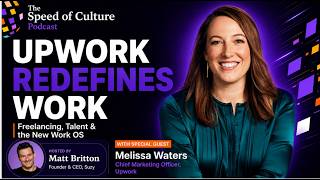
In this Speed of Culture podcast episode, host Matt Britton interviews Melissa Waters, Chief Marketing Officer of Upwork. Melissa traces her career from nonprofit advocacy and CPG marketing at Diamond Foods, through tech roles at FlipVideo, Lyft, Hims & Hers, and Instagram at Meta, highlighting an empathy‑first approach that guides her marketing philosophy. At Instagram, she helped establish brand fundamentals for a product that had outpaced its brand identity. She then joined Upwork, attracted by the company’s need for a transformational marketing leader to guide its next chapter. Melissa discusses the secular shift toward portfolio careers and a new "work operating system," emphasizing that both workers and organizations must adapt. She explains Upwork’s positioning as a resilient platform serving both supply (freelancers) and demand (clients), with a current focus on client‑side change management, helping companies move from scarcity to abundance mindsets. Use cases extend beyond typical developer or creative hires to include large‑scale customer support teams and department‑wide resourcing. Melissa stresses building resilience across people, processes, and systems, and shares personal practices for slowing down, such as daily walks with her dog, listening to podcasts like The Slowdown, and spending time in nature. The conversation underscores Upwork’s role in the evolving gig economy, the importance of brand storytelling, and the need for organizations to embrace flexible, talent‑as‑a‑service models.
Chapters
Up today, we're gonna be speaking with Melissa Waters, Chief Marketing Officer at Upwork. How are you?
I'm good, Matt. How are you doing?
Good. Thanks so much for joining. Really excited to have you on and share with our listeners your awesome journey. We're gonna start by getting to know a little bit about you. You were at some of the early pioneer internet companies like Pandora, off to Lyft, Hims Hers, most recently Instagram and now Upwork. An amazing journey, so many cool companies. Tell us what first drew you to marketing and how you ended up where you are today.
Yeah, absolutely. Well, I'm so excited to be here and chatting with you. I got my start in marketing because I have always had a really strong sense of empathy for whoever I'm working with. I actually started my career in nonprofit management doing advocacy work and the through line between that work and then going into corporate marketing later in my career is empathy for others. So whether that's, you know, on the advocacy side or whether that is as a corporate marketer, I always start with trying to understand what's going on with the consumer and the person I'm trying to reach. So getting my start in post-business school CPG world and consumer packaged goods many moons ago, actually at a company called Diamond Foods here in the Bay Area, which is kind of what you do. You do your postdoc in CPG after business school.
Cut your teeth, right?
Cut your teeth in that. And I got started in doing that work and learned the fundamentals of CPG marketing. And then I caught the tech bug. You know, it's really hard to be in the Bay Area working for a 100-year-old agriculture business when you're working with some of the, you know, hottest startups and biggest internet companies at the time. And my husband was actually a Wall Street Journal reporter covering startups at the time too. So I was going to work every day, you know, in a suit in a 100-year-old ag business and coming home at night talking about the startups. Landscape. So I got recruited to go over to FlipVideo, and that is where I fell in love with the tech space and fell in love with the pace of innovation in technology and took my deep reverence for starting with the customer first and starting with what the customer needs and wants and then figuring out how to turn that into something that we build and produce and make and take to market on behalf of them. So that was the through line of my career, and I have I have, like you've outlined, I've had a chance to work on a lot of exciting brands and see the journey across a lot of different categories, which has been a ton of fun. There's, it's both amazing to get into new spaces and also incredible to see the through line that is the same across all of these different categories that I've covered in my career.
And prior to joining Upwork, you were at Meta, formerly known as Facebook, working on the Instagram business. Tell us how you landed there and what your experience was working there.
Yeah, I landed there because Antonio Lucio called.
Very, very good friend of mine. Dear friend of mine. Oh, yes.
I adore Antonio. And it was a once in a lifetime opportunity, as you probably will respect and admire, to go work for him. Yeah, it was, you know, he is such a special human and near and dear to my heart. And I can't wait to catch up with you after this on your experience with Antonio. But I just, I adore him. So when he called to help problem solve around Instagram and talk with me about that role, it was just too good of an opportunity for me to pass up the opportunity to work for him. Unfortunately, our paths didn't sync up for too, too long. He moved on to, you know, his next chapter in life and focusing on diversity in our industry, which I commend him for doing. But I was there to help steward Instagram into its next chapter. And it was a really, it was a little bit anomalous for me. You know, I'm always, I've always been at high growth companies that are ushering in net new behaviors, you know, whether that is the digital camera space to the digital radio space, to introducing ridesharing, to introducing telehealth. You know, I've always been kind of at the emergence stage of different brands, right? And Instagram is a little anomalous, but funnily enough, and I'm sure you can appreciate this with all the marketers you talk to, despite being so big and serving so many billions of people across the globe, Instagram hadn't yet done a lot of its marketing and brand fundamentals. Yeah. So So I was there to solidify the foundations that the team needed.
The brand almost had to catch up with the user base, right?
Exactly, exactly. The product was highly adopted, obviously, but the brand still had a lot of definition to do. So I worked very closely with Adam Mosseri, head of Instagram, and at the time Antonio and later Alex Schultz, who I also have deep admiration for, to lay the brand fundamentals for Instagram. And that allowed— all of the innovation that was happening with the product and with the brand communication to feel as though it was drafting off the same songbook, same playbook. So it was a really rewarding and rich experience for me to be there and to do that work, which, you know, had a lot of importance internally to the organization.
And then you joined Upwork. How long have you been in Upwork for?
I've been in Upwork going on 6 months. Okay. And, you know, kind of to bridge from Meta, you know, I didn't expect to leave Meta. I was not looking to leave. Really happy there. And I have great reverence for that organization and all of the things that they're working on. And I got to know Hayden to advise her on how to hire a CMO. I'm actually friends with a woman who's on our board, Leela Srinivasan, who introduced me to the organization and said, hey, can you come and advise Hayden and the team and the board on hiring our next CMO? And I said, sure, happy to. And then 5 months later, after many, many, many conversations and a lot of relationship building, you know, I had an opportunity to join and And it reminded me of all of the other chapters of my career in the sense that while Upwork's been around for a really long time, you know, 23 years, it's a product of a merger of two companies, kind of from a former chapter of Silicon Valley. You know, it's having a moment in the sense that people are waking up to what we've been talking about for more than two decades, which is, you know, this conversation about, you know, how people work, where work happens, who works on what work, you know, kind of the category of work is going through a renaissance. Sure is. And it's an opportunity for us to rethink, you know, how people know Upwork and understand what we offer and make sure that more people are aware. So I got to know the team. I was very compelled by Hayden and the board and the vision for the organization. In every other decision I've made in my career, which I continue to make, you know, I only join if marketing has a very strong role to play in the next chapter of a company. If marketing is simply just a, you know, optimization, we're just gonna optimize what we've been doing, I'm not particularly interested. If there's transformation, transformation work that needs to happen, that is my calling card. That's what I like to do best. So I was, I was very compelled by Upwork's next chapter and compelled by the team and compelled by the marketing job to be done.
Yeah, and companies like Upwork and Fiverr obviously had a huge acceleration during COVID because everyone's working from home, everyone's doing side gigs. We actually found a couple hires where one of which was working on two jobs, two full-time jobs at the same time. Which to me I'm not cool with as a CEO. But then a lot of other employees have side gigs, which frankly I am cool with because I, I, what I always say is that your passion, your journey isn't necessarily theirs. And just because your business means everything to you, other people might want to do something else down the road. And if they want to moonlight and make extra money and do something, that's totally fine. Um, but it really accelerated this notion of the, you know, the gig economy, which was sort of brewing before COVID You know, now that we're kind of coming out of COVID knock on wood, hopefully, what's the future of a company like Upwork to sort of sustain that momentum?
Yeah, it's a great question. The thing that I find so fascinating though is that this is less about, you know, just the trend of COVID and more about an underlying secular trend that's happening across generations and across mindsets. So we've studied the audience that we serve and, you know, both on the B2B, you know, kind of client side as well as the B2C consumer side. And The reality is that the future of the workforce is young graduating right now and has no precept that they're going to be, you know, pretense that they're going to be working in traditional jobs. Yeah. So the reality is that secular trends are moving this direction and it's not going backwards. And so for those businesses who have, who, you know, kind of hold out for hope that they're going to move backwards and back to something that existed before, the reality is that that's not the case. And for the next generation of folks coming up, as well as everyone, just like you outlined within your, you know, example, but people across generations, across different demo spectrums, everyone is questioning what they want their work life to be.
Yeah, and I think it starts early.
Skills to be— it starts very early. We're seeing a record number of what you might call portfolio career makers, meaning, you know, people who want to acquire a range of skills and knowledge, and folks who are not taking a traditional path. People graduating right now from college are having that experience. So you imagine the workforce is changing and it's really on corporate America and the global corporate landscape to catch up with the fact that this is the way the world is going to work. And this is how we work now. And if that is our reality, then, then we need to be good change agents and stewards. I kind of, you know, you might appreciate this analogy in the sense that, you know, we've been so close in marketing to the transformation that's happened with our channels over the years and the proliferation of digital. And if you think back, like, 15 years ago when people were all having, you know, chief digital transformation officers and all of that. I kind of think that we need a little bit of a chief team transformation officer right now. And everyone is wrestling with what does it mean to comprise my team differently and think about how I get work done, who I work with, where those people are, how we collaborate.
A new operating system, really.
A new operating system. Yeah. Exactly. And so, if you're not thinking about your work OS, you know, you're late to the party and this is the way the world is moving. And so it's really time for us to be not just demonstrating what Upwork does, but helping people make those transformations.
So when you look at the new workforce, I mean, one problem I have with my kids' education, they go to a prestigious school in Brooklyn and they're taught how to identify different types of leaves, but they're not taught how to use a spreadsheet, make a spreadsheet, right? And I think in the world that we're headed into, having those specialized in-demand skill sets, And using platforms like Upwork really can make you marketable in this new world where I think companies are going to be continually pressed for more efficiency and output and have less layers. Do you believe that sort of the education systems change to kind of reflect this new, you know, this new world that you just described?
Wow, that is such a provocative question and I love it. I think that there's room for, you know, maintaining fundamentals and challenging status quo. For sure. And we actually see this happening with people coming out of college, joining Upwork, starting to do a portfolio of work and using it as a way to acquire skills. Yep. Meaning they can go and say, okay, I've built proficiency in a certain area, but now I need practical application of, you know, that skillset. And so they're joining teams with other people, they're learning skillsets, they're getting trained on certain things to be specialists and in various areas, and using this as a way to build up your, you know, career portfolio in order to do more and more and more specialization over time. So I do believe the concept of specialization is true. We see that. I mean, I joke with my team all the time that marketing is the sea of specialists. So as a discipline, you know, marketing is an example of how specialization has proliferated.
Although at the same time, not to interrupt you, but you said that what interests you is not being necessarily so tactical in marketing, but for being kind of a transformation agent, which really rises above specialism because you have to sit on top. Some, somebody needs to manage the brand and, and that, that's sort of a higher calling.
That's right. And I see it as my job to, you know, that's such a great point. I see it as my job to pull people out of their specialization and help them see the big picture. You know, what knock-on effect does your work have on other people? Are you paying attention beyond just your channel optimization or beyond just you know, your creative optimization to understanding the systems thinking about how marketing affects, you know, we all affect each other. So, yeah, stewarding the brand for sure. And that goes back always to who are we working for? And are we paying attention to what's going on with our customer? And are we deeply reverential about, you know, studying what is working and not working for our customer base? Where are they confused? Where could we help them, you know, improve their experience? How can we help answer their questions? How can we make sure the products that we're building, you know, are designed for them.
Yeah. And in terms of where the freelancer industry is going, or the gig economy, however you want to phrase it, obviously there's kind of competing factors going on. We're entering an economic downturn. So in some ways, you know, consumer— I mean, businesses may need less services. But what I would think is that companies might want to shrink, and we're seeing it across Silicon Valley, their full-time workforce and have more of a variable cost structure. Which allows it to be more flexible and basically lean to seasonality. Maybe you need SEO in December when holiday season, you need more developers in the first quarter. So is that a driver of your business in terms of companies wanting more flexibility in their cost structure?
Absolutely. We actually quite well poised for a variety of economic situations, meaning when you're in a boom time and you're trying to hire as fast as you possibly can and you need a range of specialized skills, it's a platform. We operate in 180 countries across the globe. We have talent in you know, new— so many places that you, you don't even think about when you think about hiring. So we have abundance of talent available, you know, high specialization across that, thousands of categories. So when you're in a boom time and you're trying to fill seats faster than you can probably keep up with, it's an amazing platform for helping with that. And then when you're in a time in which you're really resource constrained and trying to figure out how you remain flexible and keeping your business you know, you know, focused. This platform allows you to be able to, you know, change your composition of talent in a different way. So, yes, we see ourselves as quite resilient. And we're already seeing that, you know, in our, in our business today. So, we are a resilient platform that, you know, can really span a range of different, you know, business realities.
And is your time split both between the supply and the demand side? And how do you look at sort of the overlap of those two?
Yeah, so we actually spend more of our time right now focusing on the client side because frankly, I think that's where the change management comes in.
Sure.
You don't have to convince the world's freelancers that change is here. They already know it. They live it every day. They are specialists in this and they're really talented at managing their businesses. They're small business owners very much. You don't have to convince them. They're organically coming to us because they see the future of the way the world is going to work. The client side, you know, if you think about who manages and who's in the C-suite and who's in the kind of management layers of organizations, they are people who oftentimes are tethered to the old way of doing things. And so, we see our job not just in supplying talent to them, but we see our job as ushering in a new way of thinking to help them with a new way of working. And it starts with the thinking. It starts with being open-minded. It starts with seeing the world of possibility. It starts with seeing a world of abundance instead of seeing a world of scarcity. And I think that we've missed the movie a little bit during COVID where Corporate America and the corporate world is just talking quite a bit, probably taking up way too much oxygen in the room about where people are going to work and what seats they're going to sit in and how many days a week they're going to sit in those seats that they used to sit in and all the things that are in every headline. And the reality is that we're missing the movie here. It's not about where people are going to work and how— what construct, you know, you think you're going back to. It is, do you have the right talent? If so, How are you getting them to collaborate well? If not, how are you augmenting your team with, you know, talent that you need? And talking about the ways in which you build best-in-class, you know, collaboration across your groups. That's where people should be spending energy. And we have an opportunity to help usher in, you know, a new way of thinking so that they can think about a new way of working.
So let's dig in that a little bit. If I'm a CMO or COO listening to this podcast, what's a use case of Upwork that they may be surprised to hear is actually in market right now?
Yeah, so I mean, I think you probably, everybody thinks first about, you know, oh, I can hire a developer, I can hire a creative person, I can hire, you know, kind of some of those top categories that we might all think about as marketers. SEO, channel specialists, you know, copywriting, you know, all of those disciplines are absolutely abundant on the platform. One of our other really large disciplines, which if you're a marketer who looks after customer experience or you think about ways in which you're trying to better understand your customer base. But one of our biggest categories is also customer support and customer experience management. So, you don't think about that quite as much, I don't think, as somebody who might come to the platform thinking about transactional relationships. But the reality is that a huge portion of our business is repeat relationships or payroll-based relationships in which we are supplying a large swath of talent for companies to be able to help with backend, you know, operations that they need help with. So we do, yes, of course, things that are more on that kind of, I just need someone to come help me with a project, more transactionally based. But a lot of that builds into retentive behavior in which people hire people for more and more and more work all the way through to, I need to hire a whole department and I'm going to need to payroll them differently and I'm going to need to manage them differently. We supply the ability for you to be able to scale up at a department-wide resourcing versus just transactional, you know, individual resourcing. So we have quite a range of talent on the platform, thousands of categories. And I think people think of us kind of in one way, and we're out to change that mindset.
So if I'm an e-commerce platform running on Shopify and I have heavy demand for my product during the holiday season and I need to, you know, up the, you know, my output in customer experience, I can tap you to have a team that can talk to the customer and make sure they're getting what they need, etc.
That's right.
That's right. Without taking on this full-time heck out. Yeah, and I think ultimately that's gonna be, it's not only the ability to be flexible for a company, but I think the world has changed and the consumer has changed so much in the last 24 months. And now obviously supply chain's a big issue and understanding pricing dynamics. And there's so many new things that are entering just the overall list of tasks for a marketer or a business builder that I, and I think it's gonna continue to change over time. Who knows where we're gonna be a year from now?
Absolutely. I mean, there has never been a time in which I think we felt less certain about things. You know, the world is just— the shifts underneath our feet are happening. We feel like we're on, you know, all standing on sand. And if that's the case, you've got to be able to build resiliency in your business, not just your culture. We talk a lot about cultural resiliency with our teams, cultural resilience with our teams. And I think that if we're not talking also about systems resiliency, so like resilience. So like if you're thinking across people, process, and systems, which is a, you know, kind of classic way to think about how you manage your business. Do I have the right people? Do I composition of people? Do I have the right processes for how they work? Do I have the right systems on the back end to help them succeed? If you are thinking across all of that, if you're building resilience across, you know, each one of those layers, then you're probably planning properly. If you're thinking in a, I just need to get back to the way it used to be, you know, and thinking that the sand underneath our feet is going to, you know, proverbially just, you know, become clay, I think we're, fooling ourselves. So, we've got to build resilience inside of all the layers, not just in the people part of the business. So, your example is accurate, which is, and it's something we talk a lot about here too. How do we move from being, you know, a platform that people know and they can come to and type in a search bar, I'm looking for the exact thing.
Point solution. Really a point solution.
Point solution. Exactly. To I'm bringing you a business problem. I'm bringing you a business question, and we're consultative in helping you solve for that. And that's where we're headed, where we are— we actually run that, you know, inside of our, our products. We have a consultative, um, you know, salespeople who help people problem solve around what their business challenges are. So the more that we do that type of work, the more that we will be a core partner, um, to folks who are just facing challenges and need help.
And I would imagine that, you know, it's— the brand could be a lagging indicator of that, meaning you could start doing that work, but to be known as that and to change that perception in the marketplace, that involves customer stories and that involves content. And so how are you telling that story to your constituents?
Well, that's what I'm here to do, Matt. I mean, that's my job. So, you know, we're starting with communicating the brand so that we have very low awareness. And so when we've been in a single-digit awareness environment, we need people to be obviously aware of Upwork before we can even storytell around what we offer. And then for those who do know us and we have crossed the awareness chasm and maybe they've tried us for one thing, our job is obviously to be able to round out the portfolio of how they see us. So do they, are they familiar with what we offer? Do they really understand our product portfolio? So we're doing a lot of product marketing. We're doing a lot of customer storytelling. So all of that is in the works. And you'll see much more from us across that entire spectrum of awareness to familiarity and consideration. To product marketing and customer storytelling.
So cool. Well, I have no doubt, Melissa, you were the right person to lead Upwork through this transformational journey. So super cool. And thanks for sharing so much about it. We talk about the speed of culture at Suzy on this podcast, but in this fast-paced world, obviously everybody needs to slow down from time to time and take a deep breath. What does Melissa Waters do to slow down personally, to catch a breath so you can kind of recharge?
Oh, I love that question so much. I think a lot about this. For myself and for my teams and for my family, actually. Two things. One, the word slowdown. I take a walk every morning by myself with the dog, you know, and listen to a lot of podcasts. So, I'm a big fan of podcasts, including yours. And one of the things I've gotten addicted to lately is The Slowdown, which is a poetry podcast.
Oh, wow.
It's called The Slowdown and it's little bite-sized kind of commentary about a poem. And then reading of a poem. So in case you need a little bite-sized daily slowdown, it is called The Slowdown. And then the other thing that I do to counterbalance the pace of life that we have is get out in nature as much as possible. I grew up in a small town in Texas back when it was just forming called The Woodlands, which is a suburb of Houston. And it was really— I mean, it was actually being built when I lived there. So I grew up very much in the country. And I find my kind of happy place is in the trees. Yeah. So I do a lot of walking in the woods and trying to get out in nature. And so important, my 3 kids.
Yeah, it's important to get the kids out too. Haven't put the TikTok down and, you know, breathing the fresh air, especially over the summer months. Exactly. Very cool. Well, on behalf of the Suzie and Adewi team, thanks again, Melissa, for joining us. And for those of you out there, be sure to subscribe, rate, and view the Speed of Culture podcast on your favorite podcast platform. On behalf of Melissa, myself, thanks again. We'll see you next time. Take care, everyone. Thanks, Matt. Perfect.
That was great.
More from Matt




MikMak’s Rachel Tipograph on Consumer Spending, Retail Media & Holiday Shopping Trends



Jaguar Land Rover’s Charlotte Blank on Luxury, Purpose & Experiential Storytelling



