Urban Outfitters’ Dmitri Siegel on Creativity, Gen Z & Retail Experience
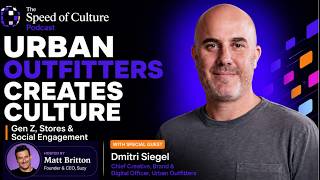
In this Speed of Culture podcast episode recorded on June 10, 2026, host Matt Britton interviews Dmitri (Dmitry) Siegel, Chief Creative, Brand & Digital Officer at Urban Outfitters. Siegel recounts his early career at Urban Outfitters (2006‑2011) where he progressed from digital creative director to executive director of marketing, launching early social and performance marketing initiatives. He emphasizes that creativity is integral to business value, not a silo, and that creative work must be tied to P&L outcomes. The conversation explores the pendulum swing from performance‑driven, pay‑to‑play advertising to a landscape where paid media is increasingly costly and less effective, especially as big‑tech platforms shift focus to AI and reduce subsidies. Privacy changes and the demise of third‑party cookies further erode performance marketing efficacy. Siegel reflects on his tenure at Sonos, describing the strategic challenges of navigating relationships with Apple, Amazon, and Google during the rise of voice‑controlled audio and the need to reposition the brand when larger tech firms entered the market. Returning to Urban Outfitters in 2024, he notes internal evolution—advanced data platforms and analytics—and an external shift: a distinct Gen Z consumer whose values differ sharply from millennials, favoring nostalgia, vintage, and tangible in‑store experiences. He outlines merchandising strategies centered on vintage/remade apparel, exclusive vinyl releases, and quirky collaborations (e.g., a mushroom‑growing kit with Wiz Khalifa) that generate cultural buzz. Siegel discusses Urban’s e‑commerce approach, highlighting fulfillment parity with Amazon but challenges in traffic acquisition amid rising platform costs and AI‑driven trend cycles that accelerate fashion fads. He warns that AI‑generated, disposable trends risk consumer fatigue, while also recognizing AI’s utility in rapid prototyping and sustainable design. Finally, Siegel shares career advice—follow industry tailwinds, pursue opportunities over pure dreams, and “take your lumps” by owning mistakes quickly—and a personal mantra inspired by Patagonia’s founder about focusing on the process (the archer’s string) rather than the target. The interview weaves together insights on creativity, brand strategy, technology disruption, and generational consumer behavior.
Chapters
Up today, we're excited to be joined by Dmitry Siegel, a seasoned creative executive currently serving as the Chief Creative Brand and Digital Officer at Urban Outfitters. Dmitry, so great to see you. Thanks for joining today.
Thanks, Matt. It's great to be here.
Absolutely. I was looking at your background. It was interesting to me because it looks like you had a stint at Urban Outfitters way back in 2006 and you were there for 5 years and then kind of going round trip and coming back to the company. Talk to us about your original experience at Urban Outfitters and what drew you there to begin with.
I had an amazing experience my first run at Urban. I think it's indicative of the kind of company it is too. So I came to Urban as a creative director. I had studied design, got my MFA, and came as a digital creative director. And, you know, in my time at Urban in that stint, got the opportunity to, take on a whole bunch of marketing functions. We launched social marketing. That was the early days of performance marketing. So I ended up doing like really ad buying on a spreadsheet. You know, we used to just send in an actual spreadsheet to Google AdWords, which you can, which is crazy to think about. And ended up as the executive director of marketing. So overseeing e-commerce business. Back then there was a catalog business too. And the creative. So it's a kind of career opportunity that wouldn't happen at a lot of places, you know, a young person with design degree, but Urban is such a creative-driven company and they really taught me so much at, at that time in my career and, and unlocked a lot of potential in me that I, I didn't even really know was there. So I had an amazing experience at Urban the first time around.
Yeah. And I, and I noticed, I'm just reviewing the notes that you actually reported to the CEO. At the tail end of your stint there when you were originally there at Urban Outfitters. Talk to us about, I guess, the benefits. I'm sure there's so many of them in terms of reporting to a CEO and getting that type of exposure at such an early and formative point in your career.
Yeah, it's a, it was, it was an amazing opportunity and I'm still, you know, I'm grateful to have had the opportunity to report to CEOs and founders and learn from them, but also, you know, learn that creativity, it fits in many different places in the P&L, if you will, and really understanding how creativity is part of an overall business. It's not something that, you know, operates in isolation of the business. I've come to believe that all value is created through creativity in business. So it's either a product or marketing campaign that creates growth and value, and that's been validated in everywhere I've worked. But when when you're working with a CEO or a founder, you realize that there's a lot of other pieces to the puzzle and marketing has to be part of an overall business strategy and fit with that business strategy. It's really, it's kind of not productive to come in with like your idea of what the marketing strategy should be without understanding how that fits into an overall business strategy.
Yeah, I'm so glad you said that because You know, I've been at the Cannes Lions Awards, which I'm sure you have as well over the years. And you sometimes you see this creativity celebrated and there's no mention of business results. And I think in this world of performance marketing and the amount of data and big data that brands have access to, there's really no getting around the fact that you have to be, your creative has to be accountable and you can come up with some great whiz-bang idea that quote unquote buzzy. But if you can't connect it to business results, Well, then you're not really playing in the world of business. You're just playing in the world of art, which is fine, but then don't go work for a for-profit business. Do you think, I guess, has that changed the way that you've approached creative? Like having that impact early in your career, were you able to see the correlation between ideation and creativity and business results? Has that as a result changed the way that you look at sort of the creative process?
Yeah, I think like, like I've been fortunate to work for amazing founders and CEOs who intuitively and in their bones, like, understand the value of brand and that that's— there's a real business imperative, particularly with the brands that I've worked on. And to use Urban Outfitters as an example, I mean, there's no question that creativity adds value when you work at Urban Outfitters. Like, that, that isn't something that you have to argue for. I've definitely been in other situations where you do have to argue for it, and that is painful for sure. So, so look, I've been, I've been fortunate, but the way it changes my approaches. I've always had a left-brain, right-brain experience as a marketer. I grew up with that sort of performance marketing revolution, even though I had this creative background as a design student and an art student before that. And now I think we're at the tail end of that, you know, performance marketing wave. I think it's really, it's kind of run its course. But, you know, there's always been this sense of the balance and that you have to understand the art and science of what we're trying to do. And because I've also run an e-commerce P&L, usually in tandem with running marketing, you sort of like have to connect that into an overall P&L structure and your strategy into an overall P&L structure and not think like, you know, in the abstract, I'd love to do this creative thing. I do think that that is how value is created. So I don't want to underplay the really cool ad that you saw at Cannes. I think that probably those things do create value. There's a reason why people do this. But, you know, that has to be put in the context of like, are we in growth mode as a business? Are we optimizing for profit? Are we about to go public? Are we— you know, there's just a lot of bigger context to what a marketing objective is in that moment in a company's life cycle.
Yeah, I mean, I totally think creativity— and I agree with your point earlier in terms of whether it's on the product side or the the marketing side, creativity is where value is created. I guess my only point is there have been instances where I've been exposed to where it was sort of disconnected from it and the whole notion of measuring how that creative drive business results sort of got thrown out the window. And I think I agree, I also agree with you that we then went to a point where the pendulum swung the other way, where it's all about performance marketing. When you say we're at the tail end of, I guess, that kind of momentum swing into performance marketing, why do you say that?
I think that the, you know, it's sort of an observation about the online experience. It's become so pay-to-play. If you just think about Google's search results page, you know, when it started, there were 3 ads that you could buy at the top of that page and the rest was organic. And now I challenge you to find the organic search result on a Google search results page. Page. And, and that applies to all these quote unquote performance mediums. And so the, the ability to break through and the ability to actually connect with consumers that way is becoming just really a function of how much you're gonna spend. And so I think that's what one reason it's at the tail end of it. I think also that there's a big disruption happening in big tech itself where their priorities are shifting. AI is becoming the North Star priority for these platforms and helping us lowly e-commerce businesses, you know, generate traffic is really not the primary priority anymore. And I think what we're seeing is that you need to have great creative, you need to be able to actually connect with consumers for real. And you, you know, in a broader sense, those tech companies and those platforms, they were taking a whole bunch of venture capital money and subsidizing all of our marketing efforts with it to convince us that this was like, these were the greatest advertising platforms in the history of the world. Now when they have to become profitable and they can no longer subsidize our marketing efforts, all of a sudden it's like really becomes a question about whether that dollar is best spent on a tech platform or a brand activation or, you know, more traditional advertising medium. I think that just sort of the playing field between platforms has leveled out a lot more.
Not to mention the changes in privacy and cookies and pixels and everything else that kind of create that magic that we saw from, let's just say, 2017 to 2021, 2022, when you had the birth of all these D2C companies, whether it be Warby Parker or Allbirds, you know, these companies that were able to drive dramatic returns for their shareholders because it was incredible targeting in a lot of cases violating, some ideals of consumer privacy. So I think as that has and continues to get torn down with the crumbling of the cookie, I think that also takes away some of the efficacy of performance-based marketing.
Yeah. And don't forget, most of those companies were never profitable. So, you know, they were subsidizing all that activity and it was great for us advertisers for a while. But certainly, you know, when Facebook went public, I think that was the first penny that dropped in terms of how this was going to go. And I also think like, you know, there's— I've been hearing the phrase a lot online, the internet just isn't fun anymore. And I think there is really a shift in the experience of users that is undermining that as a marketing platform for us. And we as like marketers, we always have to be adapted to what the consumer experiences and where they want to be and what's fun for them. And, you know, I wouldn't say whole cloth that the internet's just not fun anymore, but it's not as fun as it used to be, you know. I think I can definitely say that.
Well, we live in such a more divisive culture too. I think if you look at any open platform where people could freely share ideas, so much of it has become political and ugly as well, and that's kind of taken over the tenor of so much user-generated content.
Yeah, you know, I think there's also just— it's a regression to that balance between art and science. Like, there's always been art and science to marketing, you know. Media mix modeling is 50 years old. It's not like a new technology. There's always been that sort of analytical component to it. And I think we went way into the, you know, you could just give this platform money and they'll give you back traffic. Now we're just regressing back to like, it's, you know, I always grew up with the rule of thumb of like, you know, creative is a 40% kicker on your media spend. And, you know, I think we're getting back to that understanding of like, it's not just enough to like buy the media. Like, that the creative and the brand and the message all really matters as well.
So you also had a pretty interesting experience and there were there for quite a while at Sonos, which I'm personally a huge fan of. And you know, it piqued my curiosity in terms of your time there because Sonos is such an interesting brand to me because it's not a big tech player, so to speak, but plays such a big role in terms of the ecosystem of, of the, of the smart home. And, and kind of the consumer entertainment experience. What was it like during those, I, I guess, high-growth, exciting years at Sonos and what were some of your takeaways throughout your experience there?
I had an ama— the experience at Sonos was amazing in a lot of ways, but one of them you alluded to there was just being really in the center of the big tech competition frenemy system that exists between those giants. Giant tech companies. And we were really there for the advent of voice control, um, which was a massive disruption. It was really the first wave of this AI assistant thing that's still happening. And Sonos were really at the core of that. So two big disruptions of technology: streaming, so like audio streaming, Sonos was right in the middle of that, and AI voice control, right in the middle of that. And some of the crazy experiences of just having to triangulate between Apple, Amazon, and Google at the highest levels of their product organizations to say like, no, you're going to be able to listen to Amazon Music and Apple Music and Spotify all on the same device. I mean, no, no other— there's no other tech platform that does that. So it was a very unique position. We had to do some very interesting things to maintain that position. And some of those had to do with marketing. Some of those had to do with relationships that we developed through marketing. But that's where I think I really became also very aware of like any company existing in the world today has to develop a strategy about how they relate to big tech. You can't avoid it. It's like it's an index fund of the entire economy and what they do drives a massive disruption for everybody downstream from them. That's all of us. So it really, we were constantly evaluating our strategy in relation to those companies and what they were doing next and what their priorities were and what their strategies were, which of course change over time. So one of the most sort of like traumatic experiences that I've had in life or business, shortly after I started at Symantec, I I was headed to my first executive offsite and I was in the car with the founder and I was like, what do you think we'll talk about today? And he said, oh, Apple's launching a Sonos killer speaker and they're building it in the same factory as us.
HomePods, right?
This was the launch of the HomePod. And it's like, yeah, you can imagine that's your worst nightmare. Okay, Apple is directly targeting us. And then Tim Cook goes on stage at WWDC and puts up a picture of a Sonos speaker and is like, we're going to destroy Sonos with the HomePod. Like, I mean, it's like literally business nightmare.
And yet they didn't, right?
So, yeah, it was, you know, and prior to that, Amazon had come out with the Echo, Facebook had launched speakers, Google had launched speakers that ended up losing a lawsuit to Sonos related to the IP that they put in them. So it was this existential experience of like, okay, we're the little guy, you know, or this independent tech company in Southern California. and we got all the biggest companies in the world that are targeting us basically because they want to get their voice assistants in the home. And we really had to like find our center, play our game. Like there were just so much that went into surviving that and going public and having great IPO and all that stuff. It was the best learning experience that I have ever, could ever hope to have in the end, as hard as it was in the moment. But brand played a huge role in that. You know, we had to change what we meant to consumers. Like Sonos was the tech disruptor in an audio category. And then all of a sudden you had all these tech companies coming in and we couldn't be the tech disruptor anymore. Like we couldn't out-tech Amazon and Apple and Google. We had to change what our brand meant to people. So yeah, it was great. It was a great experience. Amazing people there. They have an amazing CEO, amazing founder. So yeah.
Yeah, we actually have the CMO of Sonos on an upcoming podcast, so looking forward to that. Oh, she's smart. Yeah, she is. The other interesting thing about Sonos, I think, is if you look at hardware, which has generally been an unsexy category unless you are named Apple, right, in the last decade, I think one thing that Sonos did or does that other hardware component manufacturers don't is they do they do create good software that's easy to use, that creates some type of lock-in effect. Where if you look at like your television, you know, at whatever television that you have in the home, you're probably not even using their interface. You're probably using, you know, Apple TV or using a Netflix interface or whatever it may be. 'Cause they just aren't good at it. And ultimately that just means they're a low margin component company that's ripe for disruption. And that's why a company like Vizio could come in and have a lower priced product and really disrupt the market. Where I think Sonos, there's an ecosystem where at a minimum, just the notion of you connecting your Spotify account and you connecting these other accounts to Sonos, and then you having the speakers that are all connected and naming the speakers and setting it up, that creates a very high switching cost for them. You to come in and just get one HomePod device, like there's no way I'm going to switch out of Sonos because I'm just too invested in it at this point.
Yeah, I mean, they really are predominantly like a software company. They're like 50, 55% software, 45% hardware. I'm sure DJ will have another, another clever way or better way of saying, but it's really true. And you know, it, it's, it's what we, they always talked about the fear of being a dumb speaker. Like if you're a dumb speaker, then you could just go buy a $75, you know, Bluetooth speaker, right? Race to the bottom, right?
Yeah, absolutely. So, and so this year in February, you rejoined at Urban Outfitters as Chief Creative Brand and Digital Officer. So what led you back to Urban Outfitters? Did you ever think that you'd be coming back to work there one day when you left, 15 years ago? And, and, and tell us about the impetus behind your return.
I, I always had an amazing gratitude to Urban for what they did for me in my career, the opportunities and education that they gave me, the, the talent of the founders. So, so I was always open to coming back, I would say. And another thing for me was like, I've had 3 sort of personal experiences with Urban Outfitters as a customer walking into Store 5 in Georgetown, seeing the broken glass window, thinking, what the heck is that? Walking in, seeing the display of vintage Levi's. I mean, and then going downstairs into the men's. I can picture every moment of my first Urban Outfitters experience. So as a customer, and someone who was in a band and went to art school, it just, I was like, oh, this is a place for people like me. And I didn't feel like that about other stores. I felt like other stores were trying to sell me a uniform to fit in with everybody else. Then I had this amazing experience in my career, which we've talked about, where I was like, wow, this company is made up of people like me and they're successful and they're using creativity and all these things that I love to actually win in the marketplace. And then I had kids and now I have two Gen Z weirdos living in my house and I'm like, I want there to be a place for them. You know, like I really do see Urban as filling this place in the culture of, you know, a shopping experience and an outfitter, if you will, for people who are creative and define themselves against the mainstream. And, you know, I see in my kids' lives, they have a lot more options for sure than I did, but but they still resonate with the brand. They still see it as like different and speaking to them. And so I don't know, there's partially like a sense of that sense of purpose in coming back as well, as well as just like loving the company and, and the people involved.
Yeah. When you described the store layout when you first went there, you know, it's very much the same today, but at the same time, you know, no company can be successful have the staying power that Urban Outfitters has without evolving with the times. So as much as things have stayed the same, what were the biggest changes that you observed about the organization, either internally or externally, from your first stint there to you returning to the company this year?
One internal thing is just the sophistication of the company from a data perspective, platforming perspective. You know, when I left, like I said, it was really early days of digital. We were, you know, just go in and put up our Facebook page like any consumer would do, you know, we again, we're like doing performance marketing on a spreadsheet and completely disconnected from any other, you know, reporting in the business. So coming back, I was like, wow, this company has great data, has great platforms. You know, the, the, the level of, of analytics that are, that are possible, I would say is like, I don't want to say superior to what I experienced in working for a tech company, but like definitely on par. So that was, that was one thing. I think the biggest difference overall is just that their customer has changed. We have a Gen Z consumer and, you know, the millennial, the gap between millennials and Gen Z is really profound. It's a lot like the gap between baby boomers and Gen X. There is a generation gap here that I think like it's forcing us to really, really think about our customer much more deeply and really like spend time with them and listen to them and really understand how their points of view on things like coming of age, which is kind of our age, that's the life stage that we service. They're really different. They have a really different experience than millennials and people before them. And we're only going to be successful if we really are obsessed with who they are and listen to them and know them really well. So, you know, the archetype of Urban hasn't changed. It's really this, you know, brand for that, you, you know, creative person in their coming of age time, but that person is so different now. So different. And that's really what's driving a lot of the change and a lot of the things that we're doing inside the brand and externally.
And from a merchandising standpoint, I have to believe that that's not an easy challenge to solve because it's not like you just sell one type of goods, right? Like when you go into Urban, there's all different sorts of things you can buy there from record players and records to t-shirts and accessories and all sorts of different things. So I guess paint the picture of your new consumer through your merchandising strategy must be something that's quite complex to make sure everything kind of fits together to the genre of who is your current consumer.
Absolutely. Urban is a very— I describe it as a very thin slice of a department store for a very specific person. It's got every got men's, women's, home, and then merchandising, which is not, not what I do for, you know, the company, but like, I'm, I'm in awe of what they do. It's really insight-based. It's really specific. It's like one thing about this consumer, for example, is they really put a high value on things that existed before the internet. So like we're selling CD players and tape players and vinyl through the, like, like crazy. And part of that is this, it's, it's this nostalgia for the past, but it's also But it's also like a value. They think that if something could be important before the internet, then it's really important. You know, like if something's important now on the internet, they sort of discount that a little bit. Like, yeah, that's just the internet, you know, that's just TikTok or whatever. So there's just these really interesting specific, you know, insights about like what drives, what they're interested in. And, and we have a team of amazing merchants that are just all day, every day thinking about that testing product, looking at what works, listening to consumers, it's endlessly fascinating.
And in terms of effectively reaching those consumers and breaking through the clutter in a way that isn't, you know, the performance-based, more like, you know, race to the bottom type of activity that we were discussing earlier, but instead focusing on outreach and content that really adds value to the lives of your consumer. What are some of the things that you have your eyes on in terms of things that are working or that you want to be doing more of?
Well, one of the things is, one of the things we've heard in all of our conversations with all of our consumers, every segment, is that they shop vintage, that they love the experience of vintage. It's something that Urban Outfitters has always had. Like I said, when I walked into the store, you know, in Georgetown all those years ago, vintage Levi's was the, I remember the very first merchandising display. So it's always been a part of our mix. I think that we got fragmented in how we presented that to the consumer and we didn't really stand for it as something that you, that was part of the Urban Outfitters experience. And so this month we, we did a big relaunch of that under the Vintage and Remade banner. We brought together all of them. I mean, we have an incredible team in Los Angeles that sources one-of-a-kind vintage and also does these amazing remade projects where they'll take deadstock or other items and, and make, you know, current items out of those. They collaborate with artists to do that. So we're putting a big push behind vintage and remade because it's something that we're hearing from the consumer they're really interested in. Similarly with music, like we were talking about, music has always been a part of the Urban Outfitters experience. We're, I think, the second biggest vinyl retailer in the United States and certainly the broadest assortment. So the biggest ones would be those major retailers selling millions of copies of Taylor Swift's, you know, CD. What we're doing is a much more broad, you know, we just had an exclusive one-of-a-kind vinyl release with Billie Eilish. We do a lot of exclusive vinyl releases. Like I said, we're leading the way on the CD trend, which blows my mind. So music is another component of that we're leaning into. Our store experience too. I mean, we have a couple hundred stores across the United States that are, you know, really platforms for interacting, creating community. And that's really what we're seeing drives online too. So like obviously TikTok, social, huge focus for our consumer. But what works there we're seeing is really real life experiences amplified through that channel. And the more we issue content in our stores or hold events in our stores, that's the best, you know, performing stuff on our, on our social channels. So, you know, I think those are the three of the things that we're really focused on. And then there's always this what the fuck factor with Urban Outfitters. Like, there's always a product that will make you laugh or make you smile or start a conversation. And that might be a really cool collaboration or it might be, I mean, we just had Wiz Khalifa did a mushroom growing kit and we were selling it. It's like, that type of stuff is just fun and like people talk about it and it's in culture. And so we're really focused on amplifying that. That, that's part of who we've always been that maybe got lost in the mix over the years that, that we're seeing this Gen Z consumer really respond to.
And when you launch like the, that collaboration, the Gen Z mushroom growing kit with Khalifa, like how much testing goes into a launch like that? Because it's so eclectic, it's so random. Part of it makes me feel like it's more like a loss leader. Like you're not really relying on a lot of volume, but it's more something that creates buzz, but how much thought goes into those things?
Again, this is, that's a merchant-driven process that is, it's an art and science just like marketing. Like there's so much research into, you know, what might be coming down the pike and then there's iteration and testing. So I'll give you another example. Like we do incredibly well with these Sunny Angels small figurines. So then the merchants are like, you know, Well, what other small— this is— so what people like about it is that it's this figurine, they can carry it around. It's like a totem. All of them are different. You know, what else could we do? And then this year we're launching Monchichi, like, is another kind of stab at the same thing. And, and they'll test a bunch of different things, products like that, and they go after what works. So, um, the beauty of e-commerce in particular, but our, our, our platform is that we can launch products in the market really fast and learn really fast about what works and iterate on that really with like really what the consumer's buying and what they're interested in. But a lot of the stuff like the mushroom growing kit, like I wouldn't say it's a lost leader, but it's definitely our founder, Dick Haines, was telling me like, you know, they put wind-up toys in the front of the very first store. Like that was there from the very beginning because he's like, people would come in. First of all, it wasn't it wasn't intimidating. Like, do I go to the men's section or the women's section? Or are they going to judge me for what I'm wearing? Super not intimidating. Go in there, you play with these wind-up toys, you get relaxed, you sort of have fun and you're smiling and you're laughing. It just sets the tone for the, for the experience. So I think that's, it's, it's part of the overall like fun of shopping. And I think that's like one thing it's easy to forget. Like, the Roman Forum was part entertainment. You know, it wasn't just a place to go and like get goat's milk or whatever. It was like partly a thing to do on a Sunday, you know? Yeah. I think Urban's always been really, really good at that part. And, and part of it is this, they're a huge part of it is the merchandising strategy.
Absolutely. And speaking of merchandising, another area of the business you oversee is Urban Outfitters' e-commerce business.
Mm-hmm.
So when you look at the world of apparel and all the other products that you sell. What makes e-commerce a unique opportunity? What are some of the challenges that you face in competing with more mass e-commerce players like Amazon in terms of creating value? And obviously convenience is a huge piece of e-commerce. So when you look at loyalty and shipping and all those things, how are you looking at the e-commerce strategy?
I mean, I think one of the good things is that the operational and fulfillment components have really become commodity. So like, I think we can do fine on, on shipping and, and people's expectations. I think we also saw people's expectations lower on that front during COVID Like I would say the first early years of e-commerce, it was like a race to just fastest, cheapest, freest. Like that was a mantra. Like you've gotta be as fast and free as you can possibly be on shipping. And then I think people have now moderated on that a little bit. Like I'll preorder an item. Well, you know, if, if it's not like food or something, I can wait for it. So part of it is the consumer's expectations. Part of it is just like the capability at Urban Outfitters is pretty much on par with Amazon in terms of fulfillment. I think the challenge right now is really around the, the traffic driving and marketing side of things. Like, like we were talking about earlier, costs are going up for everybody. Big tech disruption around AI intercepting traffic. So you got the big tech platforms generating all this AI content and directing that traffic where they want to versus, you know, the authors of content or the creators and culture like ourselves getting that traffic. So I think there's a real challenge there with e-commerce in general. And I hear that from all my peers who are running e-commerce businesses. I think the beauty of e-com is that you can offer really a really wide assortment, you know, without necessarily having that depth across the whole assortment. And I think we do that, we do that really well. So you get a clean look at like the really full idea of Urban Outfitters. But it's a super, super disruptive time. Like, you know, how much are people going to want to, you know, and I wouldn't even say about this what the consumer wants, but TikTok's going to want you to buy within TikTok. For sure. And they're, you know, they've launched TikTok Shop. We're up on that. We're up on Instagram Shopping, testing that, understanding it. But those, you know, particularly TikTok is like, you know, I see them as much more of a trying to create a walled garden experience where you go all the way through the transaction. And so how much, how many times will people actually come to our product detail pages anymore? You know, when they check out with us, you know, and what percentage and So it's not a huge part of the business right now, but certainly there's, there's always a lot happening in e-com. It's part of why I love it, why I like, you know, got into it in the first place. It's so dynamic. And I do think we're at one of those generational shifts right now with the advent of AI and TikTok as a different kind of platform.
So let's talk about AI and, you know, obviously it's growing importance to society and business overall. I'm sure, you know, Urban Outfitters is not immune to, you know, a company that's looking at its impact and trying to figure out how to put it into play for the business. Where are you right now and where do you see AI's impact head in the future for Urban?
Well, I think for our consumer, what they're experiencing is this ever-accelerating trend cycle around, you know, cowboy cutie or coquette cutie or, you know, cottagecore. And then it's, you know, The AI is accelerating the generation and also the speed of death of these trend cycles. And we're really hearing from the consumer. And then there are retailers who are really bought into that and are really like their whole model is to basically spin up these TikTok trends, bring cheap product to market that capitalizes on them, and then get out and get on to the next one. And they're AI-driven as well, those companies. You know, we're really a people-driven company. You know, we're a bunch of like, like creative weirdos trying to like, you know, make cool product and, and sell cool product. So our model is, is really kind of anathema to that. And I think what we're hearing from our consumers, they're getting exhausted by it. They're really exhausted with trying to keep up with all these trends. They don't like the waste of like buying a, you know, a mob wife aesthetic outfit and wearing it once and taking a picture and throwing it away. Like they kind of, it's kind of starting to creep them out and, you know, and, and really just the exhaustion of keeping up with it because it's not human driven, you know, it's like it's machine learning. And so it's actually moving faster than humans can really like enjoy at this. So I would say that's the biggest impact on our, on our business right now and, and, and where we're really having to listen to our consumer and position our brand in a really, in a way that's really relevant to them to say like, We're about your personal style, like not about manufacturing TikTok trends. You know, if your personal style involves a leopard print, you know, coat, you know, we're all for you and we'll have it for you, but we're not going to cram down the latest, you know, AI-generated trend down your throat. We're not expecting you to like have a disposable approach to your aesthetic and your personal style. But AI is really impacting us there, I would say. In the positive sense, like, it as a tool within the creative process is really interesting and actually, like, has some really positive benefits even for the environment where we're able to design samples and create, you know, first versions of things without having to get product shipped from China back and forth or from different factories around the world. So there's ways that it's really helping us on the empowering creativity, a human creative person trying to get a bunch of versions going and stuff like that. But, but I think culturally, I think there's this sense of like, and we, again, this isn't, this is like what we're hearing from our consumer of like, sure, do I even know what I like anymore? Like, do I like this because I like it?
Or so interesting.
I've read it so many times that I like, think I like it. And they're really starting to question like, what is my personal style? What's my taste? How do I, how do I define my own self in a world where, look, every, every generation has to answer the question, who am I?
Right, right.
There's never been a generation that's, that has, is being force-fed more answers to that question. We had to go out and seek it and find the answer to who am I. They're getting bombarded with like, this is who you are. No, this is who you are. It's this trend. It's that trend. This is cool. That's cool. And so I think we play a role in sort of like really building a community where like they can answer that question for themselves.
Yeah. And I think that to your point earlier, the, your physical stores gives you a distinct advantage because there is this notion of authenticity and discoverability that you can't really get with e-commerce, just having e-commerce platform. So, you know, that's a huge part that's central and core to the brand that, because that experience is different. There's no ifs, ands, or buts about it. When you go into an Urban, it's unlike any other store. And I think being able to hold onto that will allow you to kind of carry through that sense of uniqueness online as well.
And that's coming through in the, in the data too. The Business of Fashion published a research study about that, that Gen Z is higher, much more highly likely to want to shop in a store than millennials. So they're also having that shift back to, to physical retail.
Interesting. Cool. So shifting gears, uh, Demetri, as we wrap up here, you know, you've had such a cool career and obviously in a great role. At an iconic brand, Urban Outfitters. When you look back on your career journey and we talked about Sonos and, and, you know, you, we, we didn't even get a chance to touch upon your stint at Patagonia and you, and you've worked at so many cool places throughout your career. What are some of the decisions that you think you've made right along the way to set yourself up to be in the seat that you're in today?
I guess there's, there's 3 things I would say. One is look for tailwinds. In the economy. You know, I was, I was, I was lucky that I went into e-commerce when I did, and there were massive tailwinds in that. And then I went into the streaming, you know, business at a time when there were tailwinds. So, you know, realize that the world is bigger than, than you are. And, you know, there's, there's things that are driving the economy that can really help you along the way. I would say follow your, you know, your dreams are important, but, but opportunities are more important. So follow, follow the opportunities, not just your dreams. And then finally, you know, I think something that's really important is like, take your lumps. Like when you make a mistake, you know, own up to it, take the hit on that. And that could be something as big as like, we bought the wrong product and we need to mark it down and make that decision fast and take your lumps on it fast. Or we launched this campaign and it just didn't work. Admit that to yourself as fast as you possibly can and take your lumps on it. You know, you, you gotta disrupt yourself before something else disrupts you. And I think when people are very precious about, you know, the idea that you had or, or a risk that you took, you know, there's a, there's a huge cost to not accepting the truth faster and not taking their, taking lumps faster, you know. So those would be 3 things I would, I would encourage people to do.
Oh, great advice. And I love the point of, of following the tailwinds of the industry because I think a lot of people get romantic about what they think they're going to be and then they, the timing just not, might not be right. And timing is so much of what constitutes success in business. And a lot of the timing has nothing to do with you, but to your point, external factors and putting yourself in a position to win, I think is half the battle.
Yeah. And I mean, you know, if you're ambitious, like I also, like I went to grad school and for design with a lot of people that wanted to make art books., right? And I love, I love art books and I'm so, you know, I, I covet them, I buy them. And there are people who are doing that to this day that are super happy with what they're doing. And, you know, but if you're, if your goal is, you know, ambition and, you know, and if you're kind of, you don't have that like craftsman, I want to do this thing your whole life, be flexible, like really be open to what's happening in the world and, and recognize that this, Marketing and it's a commercial art. It's intertwined with business. That's what makes it fun. It's not isolated in a gallery somewhere removed from the economy. It's like, it's, you're in there in the streets, you know, and that's cool.
That's fun.
Absolutely.
So finally here, Dimitri, is there, you know, we've covered so many great points today and interesting tidbits about the business and yourself. Is there a saying or mantra that you like to live by?, um, that comes to mind in terms of how you approach your career and your professional life?
Um, one thing I learned— so I work for Yvon Chouinard, who is the founder of Patagonia, and he says in his book Let My People Go Surfing— I don't know the exact quote of how he says it, but he talks about the Zen archer and that the Zen archer does not focus on the target. They focus on the feeling of the string between their fingers. And I go back to that a lot of like process-oriented focus on what you're doing, not obsessing about the outcome. Um, and, and that's a mantra for me in terms of like, you know, as what we're doing today, the right things— does this feel right that we're going in the right direction? Because like, the arrow's not going to hit the target for a while now, you know. So you really have to focus on the feeling of pulling back the bow much more than, than the target. Um, so You know, that's, that's easier said than done, but that's something that I go back to a lot.
I love that. Well, this has been an awesome chat. I'm so appreciative of you taking time out of your busy schedule to share your background and thoughts and insights here with our audience at Speed of Culture Podcast. So thanks so much for joining us today.
Thank you, Matt.
Absolutely. On behalf of Suzy and Adweek team, thanks again to Dmitry Siegel, Chief Creative Brand and Digital Officer at Urban Outfitters for joining us today. Be sure to subscribe, rate, and review the Speed of Culture podcast on your favorite podcast platform. Till next time, see you soon, everyone. Take care.
Hey!
More from Matt




MikMak’s Rachel Tipograph on Consumer Spending, Retail Media & Holiday Shopping Trends



Jaguar Land Rover’s Charlotte Blank on Luxury, Purpose & Experiential Storytelling



