Verizon Value’s Cheryl Gresham on Gen Z, 5G & Digital-First Wireless
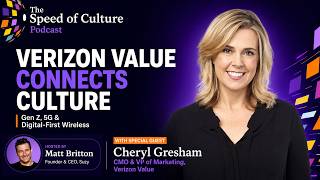
Cheryl Gresham, CMO at Verizon Value, built her career at Taco Bell, Google, and TikTok before landing here. She's combining Visible and Tracfone's prepaid brands to target Gen Z through 5G services and flexible payment options. Gresham credits networking and saying yes to curiosity for her unconventional path.
Chapters
Today we're gonna be speaking with Cheryl Gresham. Cheryl is CMO and VP of Marketing at Verizon Value. Cheryl, so great to see you. Thanks so much for coming today.
It's great to see you. Thank you for having me.
Absolutely. I've been looking forward to this. Huge fan of Verizon, been a longtime customer. Oh, yay, good. And really interested to hear how you're continuing to push the business forward. But before we dive into what you're working on at Verizon, I'd like to go into a little bit of your background. You, amongst other roles coming right outta school, spent a lot of time working in the advertising industry at agencies.
Right, right.
Tell us about that experience and how that kind of helped prepare you to ultimately go on the brand side.
Yeah, absolutely. You know, it was something I'd always been interested in, even since I was actually in high school. I took a marketing class in high school and I remember learning about demographics.
Yeah.
And I found it fascinating as a 17-year-old.
Why?
I have no idea.
Okay.
But I remember thinking like, wow, if you send different messages to different people, you know, you can, you can, you know, make their behavior potentially change. Right. And so I just remember I always thought it was really interesting. So, you know, coming into the agency world, what I loved about it was a couple of things. I'd say just the energy of the people you're working with. I mean, to be in your 20s and working at an ad agency is a pretty magical time. Right.
And the relationships you build.
Exactly.
Working on a variety of different businesses, I would imagine.
Exactly. Exactly. And that was— it's funny, I actually just had lunch earlier today with some people and I I was talking about some of those variety of businesses, right, that I had worked on. And it gives you different perspectives and different understandings of, you know, what the goals are, the purchase cycles, you know, is someone going to turn right into a QSR, you know, because they're hungry right now, or is somebody going to take 6 months to research a new Toyota? And so really like learning about the different companies and how their business runs was really interesting to me. And then just learning, you know, the different aspects of how we do our work from you know, I always call it from the hands on keyboards up. And, you know, and I am, you know, old enough to say, like, I remember going to like our research team and they would point you to like file cabinets where they had books.
Right.
And you'd have to like pull the books out and, you know, look things up.
And so— I'm sure that was super current research too.
Right, right, right. Exactly. But like, it just, it sort of taught you the ins and outs. And I think it makes you a better marketer as a result because you've had to do some of that work on your own. You understand the pace, you understand what's realistic, not realistic, what's possible.
Yeah.
And so, and then again, just, it's almost like I feel like an extra layer of college for marketers.
Yeah.
So—
We hear that a lot.
Yeah.
Which is really interesting.
Yeah, yeah.
And some people never leave the agency world.
Right, true.
You decided to about 10 years out.
Yeah.
And went to go work at a, at a really iconic brand, Taco Bell.
Right, right.
What was the experience like working there?
Yeah, I mean, you know, if working at the agency was like college, Taco Bell was an MBA.
Okay, in what way?
MBA on steroids. I mean, first of all, I will say that the leadership at that company, particularly at that time, we had Greg Creed as our CEO and then Brian Niccol came in afterwards. Greg, is now doing, you know, some other work. And Brian's over at Chipotle, but, you know, incredible leaders there during that time. But I started during what we called the beef crisis. And, you know, I have a knack for that. We'll probably get to that later. But I started during the beef crisis, and there had been some press out about Taco Bell not using real meat. And, you know, sales were plummeting. And so, it was all hands on deck. What are we going to do? How are we going to move fast, you know, and fix this? And so, probably probably about 8 or 9 months into it, we did a complete what we call brand, you know, turnaround. We came around, came up with the idea of Live Más, rebranding Taco Bell. It sounds so long ago now, but, you know, focusing on those millennials.
Yeah.
You know, who were just coming of age, right? That was a big deal, right?
The first generation to grow up with the internet.
Exactly.
So, they looked at how they consume media differently.
Exactly.
They look at brands differently. Yeah. Yeah.
And I mean, when I, you know, when I got there, it was, you know, 2011, but we were using like our pop merchandising that we used in store. We would take pictures of it and that's what we would put on Facebook. Right. You know, because that's what you did. And then, you know, you would— and it was all about like getting as many followers and likes as possible, right? Before the evil geniuses, as I like to call them, you know, figured out how to monetize.
Programmatic.
But exactly. But it was, it was a great time. The people, my colleagues, I worked there, have so many of them have gone on to wonderful roles, wonderful places. We've all stayed didn't touch, like it was very collegial. And I think we felt really safe too, to push, try different things. You know, we have this saying, you know, a lot of people say it, but we, I would say we did it. Best idea wins.
Yeah.
And, you know, people could come up and I remember one time an agency or digital agency, we had to go find one because we didn't have one in the beginning. But our digital agency pitched this idea of let's make a movie. And let's do it at South by Southwest, which was something—
I remember that.
—important to the brand. And they pitched it, this great idea. We ended up making it. And at the time, gosh, I can't remember if he was CMO or CEO at the time. But I remember Brian Niccol in the room was like, yeah, let's go do it. And we did it. And we took a big swing and wanted to make sure to align well with our community, the music program we had established, but then also, quite frankly, get people talking talking about Taco Bell in places that wouldn't normally talk about Taco Bell, like a Rolling Stone magazine. And so that was sort of our—
It's how a lifestyle brand is creative from just the place you go get tacos, right?
Exactly.
They also made a hotel, I remember.
Exactly. Yes, yes, yes, yes. So yeah, just great people that I worked with there. And we have all stayed in touch. We're on text chains. And, you know, events like this, we'll follow up with each other. But definitely, I think that was a great, great— you know, not only learning experience, but we turned, you know, we turned the brand around. So, you know, after we had that decline, we started hitting all of our numbers quarter after quarter, year after year. And that was really fun too. And we had this mentality of like, we called it BYA, beat year ago. And you always had to beat year ago. And what are we going to do? What are we lapping? What's coming up? You know, no surprises.
Right.
You know, and you'd have a plan and then you'd have a tested backup plan in place. And, you know, really, I think week learned just some great marketing fundamentals. And again, back to the business, right, of like what's going to drive the business. Uh, you know, you know, our, our intention was to drive people into the restaurants. And so if we launched marketing on a Sunday and by Tuesday morning we didn't see, you know, traffic picking up at the restaurants, you know, what's going on? Did this work? Did this work? Did this work? And we'd change it. And by Thursday we'd have something else going on. So it was a really, um, great way to learn too about how to move, how to move, you know, at the pace of retail and the pace of QSR and those who sit and wait, you know, you know, you just get left behind. And, and so I think, you know, I think about that a lot too. I think we operated that way because we were a challenger brand. And I think just the type of people that, you know, we had there and, you know, I continue to watch what they're doing and they're, you know, doing— continue to do great things. But You can't— I love this saying, we can't admire the results.
Right.
You have to keep thinking about what's next, what's next, how am I going to beat it? And I think having the freedom and the permission to take some big swings, and maybe you fail, but you've got to try and take those big swings.
Yeah. And I mean, being at a place like that where it sounds like the people were great and the opportunity was great, how do you know when it's time to leave? Because a lot of people could be in a situation like that where they stay forever. Did you know? You know it was right? Were you kind of unsure? You jumped over to Mattel from there where you were for a couple of years. Like—
Yeah.
Talk to me about that decision.
Yeah. Oh, it's tough. You know, it was great. And it was a tough, tough decision to leave. I think what I saw with myself was, you know, just probably like many of us do is sort of that career planning.
Yeah.
Where am I going? What's my next move? Is there opportunity for growth? Does that opportunity for growth mean I stay, you know, in the state that I'm in, or do I have to leave to go live in another state?
Or the same category. You could have stayed in QSR.
Exactly. Exactly. And I will tell you, and maybe it ties back to, you know, my time at the agencies, but I also was mindful in my own journey of wanting to make sure that I wasn't the QSR person.
Right.
Right. And so what—
Why? Why is that important to you?
Yeah, I felt like I would— I'd say two things selfishly. I just am curious. I I am a curious person. I'm the one who might ask the silly question in a room, but then maybe other people have the same question and wouldn't ask. But I find myself to be a very curious person. And then also, I think what I saw for myself, I have to tell you, I didn't know where I was going quite yet. And maybe I still don't today. But I had this mindset of try new things, take different challenges, and sort of see where life takes you. Yeah. And I figured, you know, I would be, you know, smarter and better for trying something different. And a new opportunity came up. It was really hard leaving Taco Bell. The people were incredible and excellent, but it was time to make a move. Yeah.
Yeah. So we're gonna jump around a little bit, but then you later in your career spent some time at two very prolific tech companies.
Yeah.
Google and TikTok. I know both in their own right, very different.
Right.
But how was the technology space, the consumer technology space, different than the experiences in CBG, QSR, et cetera, that you had had prior?
Oh, God. It was like a hit in the face, to be honest. I mean, I remember coming into Google, which is an incredible company and people and everything. I always joke that Google employees do not know how good they are treated, the ones who have only worked there. It's a very good company. But I do remember talking to one of our agency folks that I worked with and saying, like, you know, what is going on? They want us to do a special study to measure the Super Bowl. And I think we were doing— it had been aligned before I came in, but we were doing something in the Super Bowl, just like a unit in the pregame show.
And you were working on YouTube.
I was working on YouTube TV. Yep. Or YouTube Business, but this specific example was YouTube TV, I believe. And I was like, what do they mean they need to study the Super Bowl? It's the freaking Super Bowl. Like, we look at this data. We look at this data. Like, duh. But the person I remember that I worked so closely with at the agency, she said to me— I think the fundamental belief was at some of the other companies, there was a belief in marketing because the marketing grew the company and built the company. And I, I think in tech, right? Usually the model and, you know, particularly with an incredible company and products like Google, the products—
100%. Right? The company. If you think about it, most of the most successful tech products were not built from advertising.
Right.
Facebook, Spotify, Google, YouTube. They all just kind of had this viral loop to them.
Exactly.
Right? Yeah.
Exactly. I remember someone, um, an engineer said to me once, you only need marketing if you have a crappy product. Right. And I was like stunned, you know, coming from my background, I'd never had someone who, who thought that differently.
And that's 'cause those are pure utilities. So you're building utility for the consumer. So the utility should sort of sell itself.
Exactly.
I don't know if that's the case with like bottled water.
Right, exactly, exactly. But what was so interesting about that and what I love about my experience from being there and, and, and getting faced with that, I'll call it skepticism. Right, was I think it made me smarter, right? Because I had to be able to explain what the marketing was going to do to drive the business and why the marketing investment would, you know, return the results we wanted. And how would I measure that and how would I prove it? Because no one would accept the fact that a Super Bowl spot equals success.
Right. Or impressions or—
You had to prove that it was successful. And I think that, that experience at Google and honestly at TikTok as well made me look at marketing from a different perspective. You can't take for granted that your budgets are always going to stay where they are or that, you know, whatever, you know, business— that business is going to have an impact and that you are a driver of the business. And you, you know, I think about it that way, that you know, you're a stockholder, you want the stock to be good. If spending a dollar on marketing is not going to be as good as spending a dollar somewhere else in the company—
—on a salesperson, hiring an engineer.
Exactly. And you have to have more of a, I don't know, like a neutral mindset of like, yes, you're the marketing leader or marketing person, but for the success of the company, where's the right— what's the right thing to do? And so I think it gave me a balance in my understanding that You know, people definitely have different perspectives, different point of views. And, you know, I definitely would say I probably understand our CFOs much better now.
Yes.
Right. Which, you know, you need to be really close with your CFOs and your finance people. So I think that's really what, what helped me there. I mean, there were, there were many things, but that was one of the biggest changes I would say I noticed coming from, let's call it marketing-led companies to, you know, into the tech space.
And all these great companies you've, you've worked at, I would imagine, and you mentioned this specifically your time at Taco Bell, is that you've come in contact with such great people.
Right.
And over time you're moving around. How are you able to, throughout your career, just maintain that network? Because I would imagine that's a huge part of your success is—
Yeah.
Is keeping in touch with these people, learning and growing with them.
Right, right, right, right. Yeah, I'd say, I mean, A funny story I'll share with you, but how do you keep in touch with the network? But I'll say this, you got to be kind. And you've got to be kind to everyone you work with. And one of my favorites is when I was at Taco Bell, they had, as we all, many of us did pre-pandemic, I call it the cast system of who gets what desks and offices. Yeah. And depending on your rank, where you get to sit. So I—
The corner office, right? Right, exactly.
So I had an office with a window. And I remember I had this big sliding door. And I would get in early many days. And outside my door was this little cubicle. And our intern was sitting there. And our intern was, I think, finishing up his MBA at the time. And we would just chat in the morning. And he would come with these ideas. And a lot of times— he might not get support from other people for the ideas. And he would come and sort of pitch me these ideas and be like, what if we, what if we did this? Or what if we just, what if we could just try it a little bit? And what if we could just do this?
Exactly the type of intern you want to have, right?
Exactly, right? And so he and I developed like a friendship, a partnership. And I, you know what? Yeah, let's try it. Let's do it. Let's try it. Let's do it. So anyway, long story short, he continues a very fast rise, you know, within his career. And one day he calls me me and, you know, we had always stayed in touch and, you know, seen each other along the way. But he calls me and offers me a job, my intern, you know, he wasn't my intern, but he was the intern.
Yeah.
And offers me a job at TikTok.
Oh my.
And, you know, so back to your point of like, you know, networking, building relationships.
You never know.
You never know who is going to be, you know, someone who's, you know, you pull people up sometimes and they pull you up other times. And I think That's what I think about a lot is like, you know, how would I want to be treated? You know, if somebody reaches out to you on LinkedIn that maybe you've lost touch with or something and, hey, could you help me out here? You know, just trying to do that and trying to stay consistent there. And I think, you know, I don't know that there's a masterful way to do it, but I think like that— it sounds corny, but like kindness, like, right?
It makes sense because I find a lot of people, especially younger in their career, they only focus and prioritize on the people who can help them in the moment. It. Yeah. So you work for Procter Gamble, oh, I'm going to be nice to you. But if you work for a nonprofit, I'm not going to sit next to you at the conference. I'm going to look right past you. Right. I think that's— it's something that I think people don't learn until later in life, is that that person can't help you today, but who knows where tomorrow is going to bring. And even if nothing ever comes back, you feel better about yourself by helping other people, right, over time. So it's just such a positive benefit to doing that.
Right, right, exactly. And so, yeah, I just always— I think great people that I've gotten to work with. But staying in touch with people, certainly, text, obviously social media, all those things now help us even more.
For sure.
But I think it's just always been this idea of, on the early days, it was me reaching out maybe to people above me or people to right and left of me. But over my career, even building relationships with people like I said, like an intern or at Google, there was a great group of folks that were on my team who were straight out of college or their MBA program. And I just, I don't know what it is. I love the energy, the enthusiasm.
Well, it comes through your curiosity too, right?
Right. Right. And I remember they, oh God, I forget what we called them at Google, but it was this group and it was a program and they come in And they built like a Google Slides deck on, I think it was like millennial slang or Gen Z slang, one of them. And it was like all this slang that we were like the olds, you know, in the group who like you're old at Google if you're over 30.
Right.
But like the olds in the group, we were like, take us through this, teach us. And so this whole team was like taking us through like slang and language and this and that. And I remember something— I learned enough to learn it, but— or I had enough time with it to learn it. But then I remember they had to like eliminate it quickly because it wasn't like, you know, something they wanted floating around.
Right.
But it was just, you know, it was something of like they'd put some time and intentionality into it. And we were wanting to make sure that we were still staying relevant in our communications, that we were, you know, mindful about how we showed up in social. Yeah. You know, you have to study it. And if you're not, I just, I so passionately believe that like as marketers, you have to be like a student at all times, no matter if you're 50 or if you're 25.
100%.
And that, you know, you might be 20. What's interesting right now, one of our brands, you know, one of our brands, I haven't worked on a brand this old in a long time, but like the core consumer is like a 45-year-old.
Right.
And so, to market to a 45-year-old is very different than a 25-year-old. And so you've got to think about, okay, put yourself in the mindset of who that is. Where are they, you know, where are they, you know, having interceptions with marketing messages? How do we reach them best? And I think that back to the curiosity and the constantly educating yourself, you just— you have to force yourself. I don't love some of the social media, you know, that that I have partaken in over the years. But you have to know it.
Of course.
I just don't know how you cannot know it and be one of those—
Yeah, fingers on keyboard. Yeah, be a practitioner.
Yes. Go and figure out how to download that app on your television and search. Do you like it? Do you not like it? By the way, how do the ads look on it if there's ads? You just have to be in that mindset. Walk up and down the store aisles. My team gets crazy. But I like go on the weekends to different stores and I'll like take pictures, I'll take video, you know, here's what this looks like, here's what this looks like. Have we thought about changing this? Why? You know, you just— you've got to— you've got to stay in that mindset of the customer.
And talking about staying, you know, relevant and in the right mindset. So that intern did hire you to go on TikTok. You were there for a short period. While you were there, you were awarded AdAge's AdAge's Marketer of the Year for 2020.
2020 being a crazy year in our history.
What did you see about the product and the brand that made you believe that it would achieve such success? And what do you think TikTok's prospects are moving forward now that you're not there anymore?
Yeah, absolutely. Well, first of all, I wanna give credit to the intern who brought me to TikTok, who was Nick Tran. Wonderful, you know, friend, partner, colleague. And he had gotten there as the global head of marketing and, you know, had talked to me about coming over. And so took that leap of faith. And went over to TikTok and it was pretty crazy. It was the day before I started, I believe, the president announced that he wanted to ban the product.
Right.
So it was a pretty like jarring start. Kevin Mayer was the CEO at the time who had come over from Disney.
Disney, yep.
And it was very chaotic. But I'll tell you what I thought was so interesting. I had been on music back to, right, trying new products, new apps, right? I had been on Musical.ly, what, 2014, 2015, maybe '16, I don't know, somewhere in there. And I remember using Musical.ly with my kids who at the time were, you know, just very little. And so then when TikTok came and, you know, took over Musical.ly, you know, I was using the product, you know, just as a consumer.
Yeah.
And, you know, quite frankly, being at YouTube, I had my own little like research case study at home and my kids at the time had been totally addicted into YouTube, like all the, you know, YouTube Kids and just watching it, watching it. They knew how to work the iPads and use YouTube. All of a sudden I saw this shift where their time spent, like, marketer, but their time spent was going into TikTok.
You have like a focus group in your own home, right?
Yeah. And I remember being like, there's something going on here. And, you know, certainly, you know, YouTube didn't miss that. That TikTok was in existence and was growing. But I remember one day one of my kids said to me, Mama, I like TikTok more than YouTube.
Right.
And I remember just thinking like, wow, like that was fast also.
Yeah.
And so, you know, and just, I think what made me excited about it was like, it was, you know, obviously the short form, the interactiveness with like, you know, rather than maybe I'll call it the more passive of watching, you know, videos, which, you know, both excellent products.
Obviously. Excellent products.
But there was a different aspect, I'll call it, of like community. I think that was— it was a different type of community than on YouTube and just how like trends could break and how it didn't matter— you know, you could have 2 followers or 2 friends.
And it could be an instant hit.
And it could be an instant hit. And I remember it must have been— I think I started in August of 2020. And in October, remember the guy, his name is Dogface, or he goes by Dogface, the Stevie Nicks song, and I'm not going to remember it, but he's drinking the cranberry juice on the skateboard. To the Stevie Nicks song, or maybe it was Fleetwood Mac. Landslide, was it? No.
OK.
I would hum it, but I don't want to. But it was fascinating. This person that you would never expect to even, A, be into that music.
Right.
B, doesn't look like a kid riding on a skateboard. It looks like he's on his way to work.
Yeah.
And then drinking cranberry juice on his way. And that just became such a hit. And I remember we had built this team where we were like, We have got to move at the speed of culture.
There you go.
You know, there you go.
Shout out.
Right? And we were like, we've got to be able to turn stuff around in 48 hours.
Yeah.
And so we started making the calls. We reached out to him. We talked to our agency. We're like, you know, we've got NBA playoff inventory. It was— or no, was it playoffs? No, it was like October. So it must have been new, the new season.
Right, in the bubble. Maybe it was the bubble. They had to turn on the bubble.
Oh, yeah, yeah, yeah, yeah. I think that's what it was. So we knew we had— that's right, because there were like September games.
Yeah, yep.
Yes. Yes. Because it was September, I feel like.
The season got paused, and then it didn't finish until around— I don't want to say Halloween, and then the next year in October. Halloween's such a hard time.
Anyway, so— but we had NBA inventory, and we were like, let's get this in. Let's get the spot made, and let's get this out into the world. And it was so crazy because what we were trying to do— what we were trying to do at that time was not be banned, but also, you know, at that time, TikTok was like a kid app, right? Most people whose kids were using it were even under like 12 years old. I mean, my—
Like Facebook started in college, but TikTok started with 12-year-olds.
Yeah. And they were all doing, you know, oh, the— was it Megan Thee Stallion? I can't— Renegade. Yeah, right. Renegade. So they were all doing the dances and everything. And so what we were trying to do was like show— get older audiences onto the app. I remember one of our agencies said, you're the only people trying to like get age up, right, you know, that we work with, but we were trying to age up. And then we were also trying to showcase the fact that like, TikTok is us, right? TikTok is us. It's, you know, it's us, all of us, and brings us together. And so we were able to turn that creative around in about 48 hours. We ended up being able to get Stevie Nicks onto the platform.
Imagine how far that is from the day of going through a file cabinet and digging up research.
Exactly, exactly, right? We were able We'll get Stevie Nicks on the platform, which is great. Like, she can help us age up a little bit. I remember a friend of ours who we worked at Taco Bell together, and she's at a different place now, but she sent a picture of her Target. All the cranberry juice was sold out on the shelves. And it was just one of those moments of like, God, this platform has so much power and so much relevance. And You know, and it sounds corny, but like, it was so joyful. You know, that, that video that he made was just like, I'm chilling, I'm having a good day.
It's so crazy because that juxtaposed against the, yeah, the political landscape. Exactly. How even today TikTok is viewed. Exactly. You hear the state of Montana is, yeah, you know, planning on banning TikTok. So exactly. What are your thoughts about that? Yeah. Society relative to being a Chinese-owned company?
Oh, yeah. I, you know what I would say, I think that they're having some good conversations that they should have.
Yeah.
So I think they need to have those conversations. Yeah. And I think that, you know, I think, you know, to be honest, I just don't think we as, you know, America have really been in a situation before where we've even had to think about this.
Yeah. Most of the innovation to me has come from America.
Come here. And you know, China's been kicking our companies out for decades.
Yeah.
You know, so, so I, you know, it's, it's an interesting thing if you step back and think about it, like they've been kicking our companies out. And so we just haven't really gotten to that point, I don't believe, before where we've, we've been in this position where, you know, one of their products is so meaningful and important here. I will tell you, I know there will be a lot of sad sad folks if it leaves. But—
Absolutely.
You know, I know Reels and Shorts are making a run at it. But I think they're— it's good that they're having the conversations they are.
For sure. So let's switch gears a little bit and talk about your current role. You've had such an amazing career that it took us a while to even get to what you're working on now.
Thank you. Thank you.
But I'm sure all those learnings are very much relevant to your role today as CMO and VP of Marketing, Verizon Value. For those who have already audience who don't know what Verizon Value is relative to Verizon Wireless. What is it?
Yeah.
And what are you working on there? And where do you see the business going?
Yeah, it's really, it's an interesting shift. I was talking to somebody the other day about this. And, you know, Verizon Value has really only existed since about January. So, you know, Verizon has always been Verizon. And you had, you know, the wireless service, home internet, et cetera. But what has happened over time is Verizon's been very purposeful I'll say about two paths. One was, I'll call it innovation with Visible and thinking about back to like that idea of following the puck. Where is our consumer going to be 5 years, 10 years from now? And so how do we get wireless service to our customers if our young, you know, Gen Z, Alphas, Millennials don't want to go in stores anymore?
Right.
And don't want to sit on hold with 1-800 numbers. So Visible was established sort of to play that out and to see like, could we bring, you know, wireless service to people in an all-digital way? And then by doing so, you know, pass the savings along to those customers.
Kind of what digital banks are doing right now for consumers as well.
Exactly. Exactly. So there was that aspect that was already brewing. But then the secondary piece was that Verizon actually acquired Tracfone at the end of '21. And, you know, Tracfone, I'd heard of Tracfone. Before. I think a lot of people have. What I didn't know was Tracfone is like a house of brands. And so there's Tracfone, Straight Talk, Total, Simple, many other brands that really served what we call the prepaid community. And I'm going to guess probably a lot of people listening to this podcast probably are what we call postpaid. You get your bill from your wireless carrier and you pay it when it comes.
Right.
Right. But with prepaid, you basically, I call it more, a little bit more like a Netflix, but you pay and then you get your 30 days and then you pay and you get your 30 days. And so—
Gives people more flexibility. You can stop paying, it turns off and—
Exactly. Exactly. And so Verizon Value was created to put all these brands together and make sure that we're looking at them, you know, across the portfolio and in what consumer segments and targets are we going to serve? And, you know, maybe visible is right for our digital savvy.
That's back to your fascination with demographics.
Yes, exactly. And now I'm like selling wireless service to 45-year-olds, right? There you go. Right. So, you know, and we've got another brand that, you know, is targeted a little bit older. And so, and then we also look at channel, right? So the unique difference I'd say with Verizon Value too is that we don't own all our distribution. So like a CPG company, we are reliant on—
Walmart.
Retailers like Walmart, Target, Best Buy, hence my video and photography, you know, going into all these locations on weekends because we're reliant on how we're merchandised there, what part of the store we're in, what competitors we're next to, and how much space they do or don't want to give us and how they want to work with us. So it's a very different, like, business model than, you know, I'll call it the maybe traditional Verizon.
Which is more vertically integrated solution.
Exactly.
Although even in the traditional model, you still have your authorized distributors as well.
Yes, yes, yes, exactly. So yeah, so we put the— so the team put the Verizon Value org together. Angie Klein, who is a wonderful person as well, 23 years at Verizon, she is the CEO and President of Verizon Value. And then I lead marketing rolling into her for these brands. And so that's a little bit of that.
So where do you see the wireless space going. I mean, you have 5G, you have now people— I, I, I forget what the terminology is, but instead of running cable into the household, you're basically just putting 5G in the house and you're streaming TV in general. You don't even need traditional cable anymore.
Exactly.
So I mean, I think that the space is gonna be completely different in the next 10 years as always.
Oh yeah.
So how does that impact your go-to-market strategy, the products you're selling to the consumers, maybe how you're bundling it, et cetera?
Exactly, exactly. So yeah, so one of the interesting things, to your point about how it's changing in 5G, you know, when we were moving from 3G to 4G or I mean, my goodness, even probably 2G, right? Remember how like every 2 years you'd get a new phone?
Oh yeah.
I got to get a phone. I got to get a new phone. Right. You know, the phone sales are declining because, you know, now that we're at about 4G and 5G pretty much everywhere, you know, people are turning over their phones less. And so, you know, Verizon obviously has led in network network, I'll call it dominance for a long time, and that has had great reputation for that. So what one of the things we're looking at is, you know, how can we bring that network dominance to be, to be blunt, into these value segments, right? And, you know, provide these customers who, you know, I always say you could walk in with a handful of quarters at Walmart, and buy one of our plans. And we will not do credit checks, we are not going to, you know, require all the things that a a postpaid customer would have to do, and they can get that service for 30 days and they can get it on the Verizon network. So that's one thing is how do we, you know, get more people onto our network?
Basically expand your total addressable market.
Exactly. And then also, you know, the team is working a lot on fixed wireless, as you said. So back to, you know, at home, not having the cords and the cables and all of that, but, you know, kind of like having a super big mobile hotspot.
Right.
Right?
That's exactly what it is.
That you just have in your house.
Right.
You know?
And with like YouTube TV, which, you know, Exactly. now is like, combine those two together, it's a completely different— Oh, yeah. —way to get content.
Yeah, we're Sunday Ticket subscribers as of Sunday on YouTube TV. My husband was so reluctant. We were— sorry, tangent, but like DirecTV subs for over 20 years for that.
I put a sat— I hung a satellite outside my apartment building and got fined so I could see my Philadelphia Flyers in New York. I got it sent. I had this big satellite. I put it up myself. So I remember all that.
Yeah, the funny thing was we had YouTube TV the whole time. But my husband would insist on watching DirecTV and I'm like, do you know how much? Anyway, I won't turn into that side. But anyway, so we are Sunday Ticket subscribers as of Sunday afternoon. He's learning the new user interface.
Yeah.
But it'll be good. But to your point, it's all changing, right? And I think what's exciting to me about that is it's going to give us like more addressability with how we can reach our consumers in their homes or their places where they're living and just make us all more mobile. I was— somebody the other day was talking about, I think it was someone in Florida that we work with, that he's a Starlink subscriber and he drives around on like road trips with it.
Yeah.
You know, and just the mobility that it will allow us all to have and the connectivity. So I think, you know, value is here to like bring— I'll call it bring, you know, this great network and then bring ease and flexibility, you know, to a lot of different people who have different needs. Some of our customers are are literally just fresh coming into the country and they have a phone that does not work and they go to the bodega, they pick up a Simple Phone Plan card and now they're connected. You know, some of our folks are senior citizens who just want, you know, talk and they want to flip songs.
So you basically need different applications for different segments of the population based upon their unique needs.
Exactly. And different ways to pay, like can they pay through PayPal, Cash App, You know, yes, they can pay in cash, like however they want to pay and having different ways to pay. And I think what I, what I like to think about with our space is there's a lot of choice and flexibility. And, you know, we're even looking at things like if you pay your 30 days, but, you know, maybe your next payday is another 4 days out.
Right.
You know, we're looking at programs where like we will, you know, cover your data during that time to like carry you over so that you don't lose your number and have to sign up again. So we're looking at different opportunities like that.
So I imagine a big part of that is just listening, going back to curiosity, listening to your consumer, understanding their lives, their needs.
Right, right.
So you can meet them where they are.
Exactly, exactly.
With the power of the network.
Yeah, yeah.
Awesome.
It's, it's, yeah, 'cause I mean, I mean, I'm, we're even getting down into, are you paid every Friday? Are you paid on the 1st and the 15th? You know what I mean? Like, and it makes a big difference to folks, you know, who are in that space and a couple days really can make or break you. So making sure that we're building, we call it the products, but building the plans to be able to support people who have different needs and then, you know, giving them great service.
Yeah, absolutely. So shifting gears as we wrap up here, I mean, you've had an amazing career and as you mentioned earlier, you don't know where you're even going next, but it sounds like, you know, you have such great experience and there's a million places that you can take the Verizon business and beyond. As you look back on your career, you talked about curiosity as being a big driver of your success. What are some other things that you'd point to in terms of decisions that you made right along the way that helped you get to where you are today in the CMO role?
Yeah. You know, something— I don't know if it was a decision I made at the time, but looking back something that I don't know that I knew was as valuable coming up as I see it now and think, huh, that is really good. So I would say this is working with someone that is your boss, your leader, and having confidence and respect and safety with that person, someone who is an advocate of you, is your direct manager.
You're saying choosing who you go to work for based upon those attributes.
Yeah, choosing who you go to work for. And then also, you know, it can't always just be that one person because people change, right? But then who else are the leaders? Who else are the leaders of that company? And are they people that you respect, admire, think are incredible people? And what I've found is when I've worked at companies where the answers are all yes, like massive success and massive, you know, just growth and opportunity. And, you know, you know, sometimes people are at companies where, you know, maybe the leadership isn't the best. I remember early, early on in my career, I worked at Coca-Cola. And no shame to the leadership, but I think we had 3 CEOs in like 18 months.
Right.
And it was a period of big, big change for the company. And that, you know, that was tough. And so, you know, it makes you, you know, tougher and stronger to go through tough business as well as great business. But I'd say, looking at that direct manager and, you know, what's your relationship with that person? Did they— do they support you? Do they want to lift you up? Do they want to grow you?
Do they invest in your growth and your success?
And the people around you? Yeah, the people around them. And, you know, and it may sound corny, but like, even do their values align with your values?
Yes.
Right? And are they someone you would be proud to, you know, be on a team with? And so I think that's something really important to look at.
I love that. So finally here, Cheryl, if you had a quote or mantra that you live by— we always end up our podcast with this question because I think it's a good way to sum up how people look at their careers or their personal life. What comes to mind? First thing that comes to mind. No wrong answer.
Yeah. I would always think— I'd say the curiosity is a big one. But I think that leads to saying yes and taking some chances and taking some chances. And you know what? But there have been times where an opportunity has come my way, and I even have thought, I don't want to leave this company right now. But saying yes, taking that leap of faith and trying, I think. So I'd say, say yes to your curiosity or something like that. I love that.
That's fantastic.
You made up a new motto right on the spot.
So I love that. Well, thank you so much for joining. It's been a fantastic discussion. And cannot wait for our audience to hear it. On behalf of Susie and Aditi Keen, thanks again. Carol Gresham, CMO and VP of Marketing at Verizon Value, for joining us today. Be sure to subscribe, rate, and review The Speed of Culture podcast on your favorite podcast platform. Till next time, see you soon, everyone. Take care.
Hey!
More from Matt




MikMak’s Rachel Tipograph on Consumer Spending, Retail Media & Holiday Shopping Trends



Jaguar Land Rover’s Charlotte Blank on Luxury, Purpose & Experiential Storytelling



