Verizon’s Angie Klein on AI, Personalized Content & the Future of Connectivity
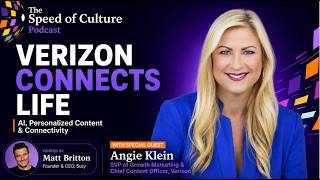
Angie Klein, Verizon's SVP of Consumer Growth, explains how the company bundles Netflix, Max, and Disney+ into customizable plans so customers pay only for what they use. Verizon is expanding broadband through fiber and fixed wireless, using AI to predict customer needs and enable on-device features like voice-activated ordering.
Chapters
We're here live at CES in Las Vegas, and I am thrilled to be joined by a return guest here at the Speed of Culture podcast. Angie Klein is the SVP of Consumer Growth, Marketing and Content at Verizon. She's working on some amazing things with a brand that has really made huge waves with the consumer over the last couple of years. I'm just so happy to have you back, Angie.
So great to see you. Hi, so great to be back.
Absolutely. So tell me what CES means for Verizon here in 2024.
5? Yeah, so CES is always a place I'd say we look at it as a great place to get with all of our partners primarily. Also get a little inspired about what's on the floor. Yeah, not that, not that a lot of us get to spend a lot of time on the floor because there's such a great opportunity to meet with everyone that's just here. And in my role, which I have, you know, Verizon, our value props, our pricing, I also have our promotions. So I get to deal with, you know, manage with all of our OEM partners. So get to meet with all of them while they're here. And then as the Chief Content Officer, a lot of our content partners are here. So it's just a great place. It's been a great time to get together to really set the course for 2025, right as we're starting the year. Yeah. And get a little inspired about what's the potential is with all the technology to come.
Yeah. So let's unpack that. So when you say as Chief Content Officer, you are overseeing the content partnerships. Yeah. What do content partnerships at Verizon look like?
Okay, well, there's a few things. So we're probably the largest direct-to-consumer relationship in the US. If you think about how many customers that we have.
Yeah.
And we've really built our value props around providing that differentiation. So on one side in our Fios business, we have Fios TV. Yeah. So we're traditional linear TV partner, but then with our perks, with MyPlan, and then last year we launched MyHome, we provide this hugely differentiated savings and value with all these SVOD services. And we allow customers to really customize their plans. It's a really unique differentiated feature that only really Verizon can provide. You know, we have a bundle of Netflix and Max for $10 a month. We have the Disney bundle for just $10 a month. We have YouTube Premium for $10 a month.
And you bundle those in with your subscriptions, right?
And you, with any plan you get, you get to choose what you want and you're going to save on every one and save substantially.
I should do that. I'm a Verizon customer. I think I pay for a lot of those things separately.
Yeah, you should do that.
It's so hard for the consumer to know. There's just so much out there. And even for somebody like me who's savvy in this stuff, I just wouldn't think about it. And for all I know, maybe I am paying for both. Like, I'm not even sure, but there's just a lot of choice with the consumer now.
Yeah, and we make it easy to like bring it all together. So it's an easy way for a customer to look, you know, with all of the most popular services. And then of course, we have our own services too that we provide. Just instead of saying, hey, we're going to pre-choose what goes into your plan for you, we have kind of an entry-tier plan on our mobile side that, you know, it has most of the basics all the way up to our ultimate plan that gives you unlimited international, like, you know, massive amounts of hotspot, all that. That's what I have. But in all of these plans, you can choose the perks that are right for you and your family. So you pay for what you want and not for what you don't.
And you essentially are just getting a login just normally. You just— you guys are a reseller.
Yeah. And well, in the way that we do it, like, we make it easy for the partner. So I look at that as a win-win-win. It's a win for the consumer because they're going to get these products that have a clear value in the market at a price. Better from us. It's a win for our partners because, you know, our cost of acquisition and how we market and talk to our customers because of our great relationships we have every day with 80 million customers. And it's, you know, so it's a win for us because we're looking at, you know, this is a revenue opportunity for us in a way that customers can be more differentiated than any of our competitors out there because we provide breadth of choice.
And it's getting them more value out of your services.
100%. Value for money. The more the Verizon is I think we provide more value for what you pay for your wireless service than any other carrier out there, hands down. And a lot of that's, you know, beyond just our network, which is amazing. Yeah. It's that you can save more on the things that you love. And we provide all these additional features and benefits that are just, you know, unmatched. They're unmatched right now in the market.
So when you think of the different packages and how you're kind of piecing them together, Do you— I imagine you first start looking at your overall customer base and go through kind of a segmentation approach and then you try to match plan. Is that kind of the— because how do you know how many packages to come up with, not being too confusing, who the buyer is, how to price them, etc.?
Yeah. And I've, you know, I've been lucky enough to be a part of Verizon for so long that, you know, when I last talked to you, I was leading our value organization, which when you talk about segmentation, we even have brands that and distribution that are really centered on specific customers in the postpaid world in Verizon. You know, that's— it's our largest, right? And, you know, we serve over a third of the market specifically with just postpaid. That's a very diverse market. And we— when we've created plans in the past from our original mix and match that I created back in the day. Yeah. You know, we did look at segmentation with specific plans, specific features in them. What we've realized is you were always still having, you know, your paradox of choice can happen. And if we were bundling too much stuff in, you ended up kind of saying, hey, we have to go like with Plan A that has this feature and we're going to try to hit this segment. What we've done now with MyPlan is allowed a lot more personalization and allowing us to really go out to a much broader segment. So if you are single, but you're going to have like Netflix and Max and maybe the Disney bundle for you could be great because it's got Hulu in it, right? But, you know, there's different choices for everybody, you know, and I think that's to me what's, what's so exciting about what we've created. And then last year, mid-year, we actually expanded this to MyHome. And so we launched our home plans, which is becoming a much bigger part of our business. You know, we had Fios internet and now with fixed wireless, with our 5G rollout continuing to get bigger. And I love that, you know, if you look at the industry, you know, telcos are taking all of the net adds, you know, in broadband. And that's just a major growth area. And we're going to double down there. But we've brought this— these kind of two things together now that say, you know, for your home and we provide YouTube TV or Fios TV, we have different choices. Again, for everybody, no matter who you are. And we don't force fit anything. We don't force fit bundles in our home packages either. Like, you don't have to take TV and internet. Like, you know, you can choose just internet. In fact, a lot of our customers just choose internet. And if they want traditional linear TV, we've got that as an option. They want all these S-Pods at better deals than you can get anywhere else, we got those as options. So I love it. And we're going to double down in mobile plus home this year and really—
To bundle them together.
Yeah, and to provide better value. And again, not even forcing bundling, but when you have more, you unlock more.
Yeah, of course. And now that we have perks on both sides, you'll I'll see us like lean into how, how that can. And I would imagine, 'cause like I live in New York City and the building that I live in does not allow me to get Verizon internet. They, they, the building.
Well, let's talk to the owners.
Well, right, exactly. Yeah, we'll do that afterwards. But the building, that's how it works in New York. Yeah, yeah, for sure. But that's because they have the, the wires coming in. Yeah. But with the fixed home internet, then that doesn't matter anymore, right? You're, you're tapping into 5G directly. Yeah. And then you just use the box, you just turn it on.
Yeah. And there's still like some technology like into certain buildings depending on the infrastructure that we might have a solution that we still work through the building to make it work.
Like, I'm lucky I have— They have a lot more distribution.
They have a lot more, you know, we have a lot more capability with that. And, and we're, by the way, it's wireless, it's exciting. And the, it's been great. In my house in Denver, I have our ultra wideband home and I love it. I'm also lucky and I have a little place in New York and I get Fios there, so I get the benefit of that. I mean, you're never going to beat that fiber, direct fiber connection. And that's one of the reasons that we're expanding our fiber footprint both organically and of course with our acquisition of Frontier, just to really look at that fiber footprint. But I think we've got the best of both. We've got this great entry kind of broadband that we can serve really broadly across the country. We're becoming a very formidable, like, nationwide player in broadband. And, and that's exciting, was based on our mobile footprint being what it is too.
So how much of the country still actually has cable wires, coaxial cables, and cable boxes running into their home? And when are we going to reach a point where everything is going to be just streamed in the household?
Well, I mean, I think, you know, whether it's coax or fiber or some of those, like those direct connections still have massive appeal and massive, like the kind of the capability can be there, which is why I believe heavily in our fiber rollout.
And, you know, but the fiber, you're still streaming, right? It's Or I guess you're hardwired.
You're hardwired and then you're going to Wi-Fi off the router there. And that's same as kind of cable. But, but the capabilities of fiber are, are more limitless, you know, and on the wireless side, you know, that's a way to get fast. And there's a lot, you know, and it's good and it's quality and it's probably a little bit more of a price point that's attainable. So there's a little bit of a balance between those two. Like you might have multiple gig services and speeds in one side,, but you've got a really great product in another. So it all depends on where you are and what your choices are. And choice, I think, is good. But for me, it's how do we compete as Verizon and provide these unique value props and really provide choice for a lot of customers in a lot of areas of the country. They haven't had a whole lot of choice in broadband.
So it sounds like you have a wide-ranging product and flexibility and customization for the customer. Obviously, Matt Britton, it's up to communicating that. To the customers, both your existing ones you can sell into more services and getting new ads and new people into the franchise. What are the most effective channels at you in driving that growth on Verizon?
You know, I think what we've learned over time, so, you know, we're very good at marketing and, you know, we have a lot of sports sponsorships. We're going to see, you know, Verizon is never going to be quiet with our media and our messaging. And, you know, with Leslie and her team, CMO, like the way that we just redid our brand, And, you know, we're really focused. If you think about what our brand stands for now, we power and empower the way people live, work, and play. And you see that come through the, like, the life of our brand. So when you think about channels and marketing, I mean, people's lives are more spent on digital. And I think so much more of where we're going is kind of the creator, the influencer telling these stories. You know, we've got products and services that I think are better told through creators. So when you think about like Verizon Family, our credit card, which is unbelievable, it's got some— it's like 4% back on gas, groceries, dining out, which are basically where I spend most of my money. You know, and then what? And you also get $10 off every line on your bill when you use your credit card, Verizon credit card. It's actually a very strong one. And where does that work marketing-wise to tell our story? Probably less than a TV ad over time, more in like a true— like, where are you going to go to find out about that? People that really know and they're comparing. And so you'll see us talk with more creators and influencers, I think more and over time, but also just more in digital and telling the story. The other part is all of our stores, you know, we have about 6,000, 7,000 stores across the country.
Do they still matter was my question.
They hugely matter more. Like we have gotten even better at stores and the more we go local in our communities, which is, you know, we are a big, big company. Yeah. But at the end of the day, we operate as a local community player. We're there when things go right, we're there when things go wrong. You know, we want to be there in these local communities. And we've been focusing— Sampath has made a big focus, our CEO of Consumer, about getting back to local. And he's really invested in our local teams, our local marketing, our local feet on the ground, and of course our technicians and everybody that's there anyway that do such a great job representing our brand. That's what we want. And our local stores are where that really comes to life. It's the human interactions. So what we need to do from like the corporate side is make everything easier for our reps. So then the delightful experiences every customer has when they come in, because every— the more that we can use AI to predict why you might be coming in or why you might have a question or actually get rid of those things before you you even know you have the question. So then the reason that you're coming in is just experiences to learn, to learn what might be available to you.
Touch and feel the devices.
Yeah, there's so much more now available. When you think about, I was skiing over the holidays. We were taking a picture on the slopes. I had my Google Pixel. I was telling the Google team this. And I had my Pixel out. We took a picture of my family, my cousin's kids. He was so excited. My Pixel Fold, I could open it up.
People love that.
Yeah, and it was the AI. I took the picture. And then it immediately came up to say, do you want to erase these extra people in the background? I was like, boop, boop, boop. And off you go. And now it looks like this. We're the only people on the mountain. Right. This pristine picture.
Yeah.
Yeah. It's fantastic. And it looked great. And my cousin's kid was so impressed by it. And I was like, well, you should get yourself a new phone. Yeah. With all these AI capabilities. It just makes, it wasn't hard to do. Right. And as these technologies come forward, people don't understand how easy it is. Yeah. And it's going to change everything on how we do everything. And it's going to make things easier for people. And if we, we focus on AI to make life easier and more delightful, what a great use of technology.
Yeah, in a way that doesn't have big consumer adoption hurdles. Yeah, like you don't want consumers to have to figure out some hard-to-understand technology. You just want it to be one button, you're getting rid of those extra people, and it's working. And if you can prove the value of that, then they're going to connect the magic of AI to the magic of Verizon.
Now, the only thing about this AI that I didn't like at first is the first time it asked to erase me, and I was like, no, no, I'm I should stay. I was worthy. My cousin was like, no, maybe you should.
Don't throw out the baby with the bathwater, right?
I'm like, I look good in that picture. Leave me.
How are you using AI personally on a day-to-day basis related to your job?
Yeah. One of the things that I think about AI, I am good at editing. Like, when I start, like starting on a blank sheet of paper, even though I'm generally pretty creative, I find my creative juices flow when I have something to build on.
When the plane's off the runway.
A little bit, yeah. And that's where I think AI gets me started. I end up like saying, hey, I wanna write a note to my team on something. I change 90% of it after AI, but my creative juices flow because of it.
And I think that, um, so that you'll start to write something and then you'll start to use AI.
Yeah, I'll use AI to start something and then I go edit it and I'm like, my ability to edit is better. And I think if you know your own strengths, I know that like it'll take me a while to, to, to do something in innovation for myself. But if I can edit from something like it gets my juices flowing and the AI can trigger thoughts for me. And so I use like in terms of the writing stuff of that, I mean, just generally there's a lot of areas in our work that we think about how, how does AI help our front lines? Like that's a place where I'm like, how do we make these processes easier for consumers that they don't have to wade through stuff? And I think about I used to run our call centers back in the day. I've been in Verizon a long time, had a lot of jobs. And the job aids that our reps used to have to read through when there was a question that may not come up very often, right, was pretty intense. And two things. Number one, it helps the reps immediately get to the right answer instantly, right? But also it helps the customer not have to be on the phone or in the store.
It increases customer satisfaction.
Yeah, it's like, oh, I got the right answer faster versus like just, just, just simplicity of life. It's so much better. I'm like, how great is this? Yeah, it's great.
A lot of companies that manufacture mobile devices are now starting to build AI compute capabilities into the device. Yes. Because there's so much compute power and it's like almost like too much for the cloud.
The cloud. Right. Yeah.
And you know, we were talking today with the folks from Lenovo who are building it into their laptops and you're hearing it really everywhere. How do you think the actual cell phone experience, the mobile device and how people are going to use it is gonna change with this because it's just, if that happens, you have a much more powerful device in your hand leveraging the compute power on the device and your network to unlock completely new things.
Yeah. And I think, well, I mean, the, every one of these devices over time gets more and more powerful with what the chipsets and capabilities are. And, and so having some like just native on the device is good with a 5G network or ultra wideband network. Like I have no worries about the cloud capability and the edge cloud, you know, edge compute and all that stuff either. I don't, I, I think that The technologies are coming together to just provide these experiences that are going to just unlock next level. I think like just the simplicity of ease of use of everything. It's not, you know, we were talking with some about like, you know, just like order my coffee and it knows what I order in whatever app I'm in. Like, wouldn't that be great? Like, I don't even have to like functionally—
or even with Siri and Alexa and all these voice platforms working better and allowing people to trust the use of voice I think is going to be a big positive impact on the consumer in the year ahead.
Yeah. And just the predictiveness of it, like it's going to learn your rhythms when you're driving, you know, to the office one day, but you typically stop at your local Starbucks. It's going to know that and say, you want me to go ahead and place your order? And like, I didn't have to think about it or remember it. It was doing it for me. Like, you might just confirm really easily. How great would that— it's just going to be predictably helpful. Yeah, it won't get everything right. It'll learn over time. And that's just like anything. But my God, it's already it's already fascinating what it can do. And, you know, I think about every other conversation I have about AI now, and 2 years ago we didn't talk about AI at all. Like, it's just fascinating how quickly—
how quickly it happened, and now how quickly it's going to move. Yeah.
And the people that don't have these devices yet, like, in terms of the upgrade cycles, you know, people are holding on to their devices longer.
That's what I was going to ask you about.
It's like your next, um, your friend sitting next to you that is doing something on their phone, it's going to be quite interesting to see, wait a minute, I didn't realize mine is— mine now looks pretty dated. Like I can get all these, these features and these functions that I didn't realize I could have. And, and I said, so for Verizon, like, you know, one of our goals is to be the world's best applied AI. And that's really in how we support our customers and our front lines and everything that we do that just makes being a customer of ours easier and better. In some ways, it should be fairly transparent. Where our partners with all of our OEMs and what they're doing on the devices makes it our customers' lives even easier. So I think it's all coming together in this beautiful way.
It also can help with your home products too, right? How do I set up my Wi-Fi? What's my password? All those things AI can obviously make consumers' lives easier in managing their home networks as well.
And it's even realizing how much you have connected. I don't think people have any idea. The 60 devices now that are all connected to their network. And yeah, you know, when you think about, you know, your lights over the holidays and it's telling you what do you want to, you know, smart, hey, the sun's going down earlier, do you want to have your Christmas lights on? Or, you know, like there's just so many ways that it can help you manage your life, your household, your latchkey children if you have them.
Yeah, absolutely. So it sounds like, and I'm hearing a lot of this here, it's a yes that this could drive a whole new buying cycle. Where in the past, even looking like the iPhone and a lot of the companies is like, well, am I really just going to spend more money just for slightly better battery, slightly better phone? But now it seems there's a reason all over again for people to really say, I want to switch, I want to upgrade, I might want to switch carriers. So it sounds like it could create a big opportunity of growth if you can execute the right way.
Yeah. And I mean, look, as customers are generally loving what they have on their phone and a lot of the, a lot of the AI features are coming into like N-minus as well. It's not just the latest. So in some ways some of them will have that. But over time, if you're holding on to a phone that's 5, 7 years old, which some people still are, I'd say it's high time to upgrade, you know, where you're going to really unlock this next, next level of capabilities. And if you're going to upgrade, you should do it on the best network out there. And that's Verizon.
Yeah. So shifting gears a little bit as we wrap up here, I know that you really focus a lot on your leadership style and your ability to build a team and surround yourself with great people. And I would just love to hear some of your learnings in terms of what's worked throughout your career at building teams that are built for success at a company like Verizon.
And I think one of the things I talked to you about last time, and I, it's like I hearken, hearken back to my 3 I's, you know, that you have to be inquisitive. Like to me, like I want people on my team, I want to lead this way that we're always interested in what's next. What we possibly— what's the part of the possible? What could we be doing that we're not doing? And then how do we stand out? So, you know, being just students of the industry, being students of the technology, being students of marketing and how do you like reach customers in different ways and being authentic is really— that's my first I is being inquisitive. Being intentional is my second. I'm intentional with where I spend my time, who I'm spending it with, who I'm talking to. And that's not always easy because your calendars, as your jobs get bigger, get a lot of your control. I think Hans Vestberg, our CEO, does an amazing job at this. He counts, he tracks every like minute of his days and like where he spends time and makes sure that he's allocating it accordingly to where he knows most. Yeah. So whether that's our, you know, stakeholders, our employees, you know, with strategic alignment, like I think that's a— he does it differently than I do, but I think like just being intentional is a really important part of it. And then lastly to me is being inspirational is my third I. Like if I show up and I'm not in a great place or whatever, I'm not going to drive good team behavior. I'm not going to drive good collaboration with my peers. And so coming in every day trying to make sure that I'm like, am I— am I people— am I someone that people want to work with?
How do you stay inspired?
Yeah. And some days I'm not. Like, some days I'm not. Like, you know, it all depends. But I'd say most, most of the time it's a mentality of I've got to show up, um, like with that, that we can win and we can do better than anybody else because I'm with a company that I know we can. You know, that's one part about being at Verizon. It's kind of nice. You're kind of naturally inspired, you know, like every day you're naturally inspired because you're part of this great company with a bunch of great colleagues and, and they show up and conspire you as well. But I think it's just part of being a leader. Like ultimately it reflects down into how your team reacts is how you show up and like that, that, that ability to drive the art of the possible with a large organization. Um, and it's something I take very seriously as well.
Yeah. I mean, it's a tremendous platform because you're not just bringing data in the household, you're bringing entertainment, connectivity, financial prosperity, all the things that people feel like they need for their happiness ultimately. For sure. Like when your internet is out, it's like you feel like that you've gone back 100 years. It's like, it's almost worse than not having water or electricity in the house sometimes. Right.
When we say like live, work, and play.
Right.
I mean, the only thing we kind of don't help with, and we probably help with a little bit of that, is sleep. Right. You know, like, you know, like I guess it's kind of how you live, like, you know, and frankly how you eat. I wouldn't eat if I didn't have my phone based on my Uber Eats and Seamless subscriptions.
Exactly.
Right. Yeah. As a New Yorker, you know those very well. Yes.
And also the other thing about Verizon, I just think it must be fascinating, is the companies you work with every day. You know, you talked about Netflix and you work with Google and you work with Apple. And all these incredible companies and you get to see their product roadmap and what is important to them and their device doesn't work without you. And that just must be really cool because it keeps it interesting every day.
Yeah, I think that we are very lucky to work with literally the best companies in the world. Yeah. As our partners, whether they're creator, creative content with all of our, you know, the content industry and creating some of the best shows that we love, you know, and some of them are on the same companies meeting with Apple today talking about, you know, the shows that we all love on Apple TV+ right now or Paramount or with anybody. And I think about like, we get that opportunity to see that creative and then the technology creative, what's coming. You know, and I have to be careful sometimes. I'm in some of these meetings and I'm getting really excited about what I can talk about and what I can't talk about yet because it's not out. We do, when I think about what Verizon does uniquely for these companies is there is no Apple without the network that Verizon has built. Yep. You know, like, The capabilities that we built that allowed the technology to be built on that hardware without the network, you know, there wouldn't have been the app stores, there wouldn't have been all that. And so the underlying power of what makes all of these phones such amazing gadgets is what we do at Verizon, of course, which connects it all. And, and I— that, that's the foundation. And the foundation is what we do. And we do it better than I think anybody else. And but the other part of that is then we also bring customer differentiation with what we bring to them because of our ability to partner and understand their needs. Yeah, the companies that do it the best. And that's what my job is, is like I always think of we're the tip of the spear. We've got the Why Verizon, which is kind of our value props on our core network experiences. We got the Why Now, some of the promotions that we do and the partner with OEMs. And then Why More as we get more into our family services, the credit card, all these perks that we can provide. There's just so much breadth that we bring to the table. And I'm lucky that my team, you know, is the tip of the spear for all of it.
Awesome. Anything new or interesting that you can talk about that Verizon's working on for 2025?
I mean, I think you'll see us really double down in like our home broadband. Yeah. You know, we've had a really good momentum in 2024. You're going to see us really continue that as we look forward to our phone growth. Business. I think that's exciting. Nothing specific that I'm going to put out there, but I would say what I, what I teased before with mobile and home, you know, the convergence is quite different in the US than it is in other markets in the globe. We think it's going to grow a lot in the US, but we're going to be one that are driving that. Now that we have a broader home broadband footprint, how do we get more people that can unlock additional value because they have mobile and home with us? And you'll see us focus a lot across the company on loyalty and really delighting our customers in every aspect, making those flawless experiences. So those are not necessarily the products and services and all that new, but ultimately what we want is the customers every day when they have an interaction with us, it's like, I love Verizon and I will tell everybody about it. And we know we're getting it right when everything just works. And we're spending a lot of, a lot of time and money across the company focused on how do we take every pain point that we might have and make it go away.
It's awesome. Well, thanks again for joining us. As you might remember, we wrap up every podcast by asking if there's a quote or mantra that comes to mind that guides your professional journey. So I'd love to know what comes to mind for you.
You know, one that comes to mind from when I was in college. So if you're young out there, someone once told me that people that know how will always work for the people that know why.
That's awesome. I've never heard that before, but I love that.
Yeah. And I think it's a good way to think about, do I know why we're doing this? Do I know why people do it? Like, you know, if you're— if you— how is it really important to understand? But ultimately, to be a leader, you got to know why. And I think that's a quote that like stuck with me on how I think about every role I'm in. Yeah. What's the why?
Yeah. Well, that's where the purpose and the passion and all the good stuff lives.
That's right.
Right. And that's what keeps us motivated every day. Thank you so much for joining. On behalf of Susan Ivey Team, thanks again to Angie Klein. SVP of Consumer Growth and Marketing and Content Verizon, for joining us here live at CES in Las Vegas. Be sure to subscribe, rate, review the Speed of Culture podcast on your favorite podcast platform. So next time, see you soon, everyone.
Take care.
More from Matt




MikMak’s Rachel Tipograph on Consumer Spending, Retail Media & Holiday Shopping Trends



Jaguar Land Rover’s Charlotte Blank on Luxury, Purpose & Experiential Storytelling



