Verizon’s Angie Klein on Segment Marketing, 5G & Wireless Growth
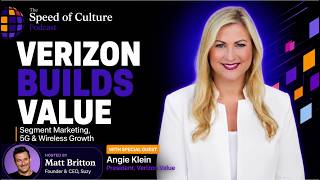
In this Speed of Culture podcast episode, host Matt Britton interviews Angie Klein, President of Verizon Value, about her 20‑plus‑year career at Verizon and the evolution of the company’s consumer‑focused businesses. Klein recounts her early, non‑linear path into marketing, the shift from landline to wireless, and her role in building and marketing a portfolio of 11 distinct brands—including Visible, TracFone, Straight Talk, Total by Verizon, Simple Mobile, SafeLink, and others. She explains how she applies commercial marketing fundamentals (the 4 Ps, segment marketing, pricing, distribution) to create differentiated value propositions for varied consumer segments, such as Mix‑and‑Match, MyPlan, and single‑line positioning. Klein discusses the disruptive launch of FiOS, the rise of 5G fixed‑wireless home internet, and the potential of generative AI to personalize creative at scale. She shares her leadership philosophy—authenticity, inquisitiveness, intentionality, and inspiration (the “3 I’s”)—and how she builds and aligns teams across multiple brands and cultures. Throughout, she emphasizes data‑driven decision‑making, the importance of understanding distribution contexts (retail, Walmart, Target, digital), and the need to continuously innovate to retain customers in a membership‑based business model.
Chapters
Up today, we're going to be speaking with Angie Klein, President of Verizon Value. Angie is a consumer marketing expert with over 20 years of experience under her belt. She's known for leading groundbreaking consumer initiatives such as the award-winning Verizon UpLility program, as well as spearheading brands such as Visible, TracFone, and Straight Talk. Angie, thanks so much for joining today. It's great to see you.
Thank you. Thanks for having me.
Absolutely. So did you know back in the day that you always wanted to be in marketing, or is it something you kind of just fell into?
I wish that I always had like a grand plan for my career. I did not. Um, in fact, I actually give a lot of credit to a friend of mine in college. You know, I didn't know what I wanted to be. I think I was, uh, pre-med, and then I shadowed somebody in, uh, in an ER one day and nearly passed out. So I thought, well, that's not for me, you know, because that sounded smart. Pre-law sounded smart, but it also sounded boring. Um, and, uh, I had a friend, it was like she was majoring in marketing I was in broadcasting, marketing, journalism. So I ended up with basically on a track for 3 different degrees in my undergrad because I was just interested in a lot of things but not certain on what I wanted to do. But the more I got into marketing and advertising, I ended up with 2 degrees, one in business, which I loved the business side, which is where I'm— I'd say I've spent most of my career as a commercial marketer more than a traditional kind of creative marketer. But I also got a degree in advertising, which is in our journalism school. And it was because of her that she's like, hey, have you thought about marketing? And I just started to love it. I loved the idea of consumer insights, actions, stories, building products, and really beyond the creative side, which I become even more passionate about later in my career. It was really more about the business side of marketing that, that I think I've spent most of my career on, which I think has enabled me And it might be a different part of a conversation than maybe what you normally have here on the full end-to-end business leader to become a CEO, because it's a lot grounded in distribution and the what, the value prop, product, pricing. Yeah, measuring results. It's the financials and then telling the story that enables it, that enables you to connect with customers. And so it all comes together in that. And I love the side of commercial marketing, and I don't think there's enough focus on that to say, though, the what and the why and the price points, um, is, is as big a part of marketing as then what the ad campaign—
the 4 Ps, right?
Like, exactly, like old school 4 Ps.
Yeah, but that's what it's about. And I think what happens is, I mean, you know, as an entrepreneur, I always think about marketing as the business side, but as somebody who also ran an ad agency, I've also been exposed to the— every— all marketing should be about business, but there is a side of marketing, like the Cannes Lions, where people celebrate creativity and they talk about cool creative, but there's not really a second line is, and it drove sales, which is a head-scratcher to me. And these big brands have these big budgets, and I think it's often kind of get disconnected as to why you're really doing it.
Absolutely. And I think for me, like my CFO becomes my, you know, as a marketer, like your nemesis and your best friend, right?
Actually, it's 2023, right? In the wake of an economic downturn.
Yeah. And everything has to be measurable and impactful. And, and like the way that we have— so what I love about my current job, which we'll talk about, is I have 11 brands all selling the same effective thing. So the power of marketing is not just about the creative and the message. It's about the pricing, the value prop. It's, you know, remarkably in our world is about distribution, like where we're selling it.
Yeah.
You know, and it's really touching the customer, understanding who you're for and creating something specifically for segment marketing, which is the other part of commercial marketing I love is segment marketing. I was the segment marketing leader in the Verizon postpaid side and we created Mix and Match because look, Verizon as a brand serves everybody, but we can't have all, you know, you can't have one product serve everybody so exquisitely.
You have to have different needs where they are.
Yeah. And I think now with our prepaid portfolio, 80 million customers in the US. It's a huge part of the market are in prepaid. The more in postpaid, you're going to hear a lot more from the big 3 carriers and how much they spend. But there's a whole market that's looking for something different. They buy differently, they shop differently, they want to pay differently. They might be more cash buyers. They might shop at Walmart more. We've got very— we've got exclusive brands with Walmart. They're a huge partner for us and we love them. But it's a really exciting part of marketing is figuring out how to go after smaller segments better than trying to be the big behemoth. And you know, that's the other thing that I love about marketing is creating solutions for specific people in specific markets.
Absolutely. Owning, owning individual niches at scale.
Yeah, exactly.
So let's wind back the clock a little bit because you are unique in that you've been at the same company, you know, now for over two decades, your entire career. So many people we talk to here at the Speed of Culture podcast, I've jumped around, you know, to roles every 3 or 4 years and not saying one is better than the other, but I think there's something special about growing with an organization and seeing the organization grow while you're also simultaneously growing. And when you joined Verizon, it was in 2001, long before the iPhone came out in 2007, right? Long before, you know, platforms like Facebook and YouTube were dominant. It was a different world back then. And they were still called, I guess, cell phones. We don't really use that word a lot, but it was the era of the cell phones. Talk to us about your memories about when you first joined Verizon, what you had hoped to achieve, and what were some of your early learnings there? And at what point did you know that this was— that was a place that you wanted to really spend, you know, a long period of time versus it just being sort of a stepping stone for you?
Yeah, it's a great question about, I, you know, know so many people have these amazing careers of, you know, moving companies to companies, companies. Well, I've had that within a company.
Right.
Because if you think about the last 22 years in telecom, everyone has a personal relationship with how that has changed and how technology has changed. Well, my career couldn't stand still. The industry that I'm in has holistically changed in that time. When I joined Verizon, majority of our revenue at the time, it was was a consolidation. It just merged from GTE, which was a, you know, carrier in like Texas-based, and then Bell Atlantic. It was landline. It was primarily home phone. That was where majority of our revenue was. And we had Verizon Wireless, of course, at that time. And people had their Star— I had my StarTAC phone, or people probably had their Razrs a couple years later. I know, and I loved that phone, like my little antenna, um, you know, analog It's so different. It was just about voice. And I joke about remembering like an $800 phone bill because I had way gone over my minutes or something. This is not like—
no child— I gotta go. This call is so expensive. We only have 2 minutes.
What is it? Like, call me after 9 PM.
I was returning a beeper.
Right. It was just a fascinating time to think about how different everything is now, like with so much at our fingertips, like the entire world. But it was landline focused. And that's actually where I started my career. I spent most of my time in the landline side of our business talking about like then long distance, right? Which, you know, there's a lot of people here like, what are you talking about? Like, yeah, you actually just pay for, you know, calling someone that was across the street.
Angie, how old are we?
I know, I know. I mean, but we both look young and no one can see us on a—
Exactly, we're fooling them.
We look good. But I think about that, that change. And when early in my career, it was actually the landline side and we saw that there was disruption that was going to happen there.— and this is kind of a framing of what I've done my entire career— was what do we need to do differently? Well, everybody had like two phone home phone lines at the time because they had their dial-up connection for internet. Well, broadband was coming out.
Right.
Right. And we were like, we need to disrupt ourselves. So we invested $20 billion at the time. And I was on the original business case for building FiOS, what became our fiber-to-the-home business. And I really had a unique voice. I was in my early 20s. And I had a different perspective and I was loud. And I think about that like of, hey, we should do this differently. This is what the market wants. Who cares what we did 20 years ago or 10 years ago? This is a whole different thing. And I— my career really was a— it was a really good grounding area for me to understand the perspective I brought was different and unique. And I ended up within— I think by the time I was 27, I was in my first executive role at Verizon. Was director of customer experience for our new fiber optic services, which Fios Internet, Fios TV. And we were disrupting the cable industry, which is a huge fun place to come in to have a lot of investment. You had an industry that had been there. People didn't love it. Everyone had their negative NPS scores against cable.
Right.
And we're like, well, let's do something different. Let's make it better. Let's take those pain points and design something that customers will love.. And that was my job, was director of customer experience. So not only do we have a great product, we, we, we did the surround of the experience design as part of our value prop.
Um, and that probably explains, Angie, why you, why you like the business or commercial side of marketing is it's not like you joined as CMO this company that had billions of dollars of budget and you just got to buy Super Bowl spots. You were at the ground floor of these new business innovations and you had no choice but to prove ROI because you were essentially not only proving marketing, you're proving that this, these new business models for Verizon.
Exactly. And Fios was like a great lesson of disrupting within something that was standard. Like how do we disrupt ourselves? Like every business is gonna go through massive change and we knew our landline business was gonna decline. Well, where's the new growth area? We knew wireless was gonna grow and wireless of course had this huge tailwind, but we were balancing out as a company, lot gonna be losses, years of losses in landlines as people, and we knew that was coming. And so it was fun to create something new like Fios. And really, we took 50% share, I think, in 7 years of the markets we went in. We operate now in 9 states with that product. So those people that can't get it, I'm sorry. It's a great product, our Fios product. But after that, like after we kind of built that reputation, we built a solid product, solid brand, solid marketing. I looked at like, all right, what's next for me? I had done kind of every role in leading big operations, call centers, field ops, etc., marketing. And one of the things that I love about the business that Verizon's in holistically is it's, it's a membership business, if you will. You don't change that often. And it's a big change when you make the choice, whether that's your home services or wireless. So it's an ongoing relationship that you have every day. And so consumer product, good marketing, I think about that quite differently than than what I do in marketing here in creating a product that customers have to pay a fair amount for every month. As a result, they use it every day, right? But they don't make a decision to change that often. And when they do, it's quite impactful for us. It's a big change for them. So creating that ongoing marketing to your base is as critical in what we do as marketing your brand externally for prospects. And I don't think a lot of other companies, when you're in like maybe consumer product goods, you kind of consistently are talking about like the recycle of the next purchase behavior.
Right.
Us, this is more as much about retaining the customers that we have and reminding them why they chose us in the first place. And that's a big part of what I've done. And I went to wireless then at some point created, I guess that was in 2017, the world of Unlimited came out and we said, hey, how are we going to make money? With the world of unlimited, once everybody's on unlimited, is there any path to increased ARPU? And that was when we really looked at what the industry was doing. Everyone's like multi-line plans and you say, all right, you buy one premium plan, everybody in your account has to have it. And we're like, not everybody in the house's household or on their same accounts are the same. And I looked at my plan because I'm here, my family, I naturally was paying for all their wireless services, like my extended family. I'm like, wait a minute. I'm single, don't have kids, and why am I paying for 7 lines of wireless? But that's the joy of being an employee, right? But the needs of my family, each person there was quite different, yet we were all on the same plan. And so the idea was prompted on mix and match that we did back then. We created different plans with different features, like whether it had Apple Music or the Disney bundle or those kind of add-on features or more premium network access. And that was the start. We did 4 years, different rounds of that, of mix and match. And it really created revenue growth, but also differentiation. And then the Verizon team, I'm no longer part of this team. They just launched MyPlan, which is even more customizable and personalized. And it's a pretty cool thing just to provide differentiation. And what I got to do then, I was like, all right, I've done our home sides. I've done wireless. I worked for our CMO for a while doing creative and new product innovation. I'm like, what's next? And Visible became what was next for me. I became the CEO of Visible, which was another disruptor brand inside to say, hey, let's start a startup operating somewhat independently, but leveraging the power of the Verizon ecosystem to create a disruptor brand that's digital-only wireless. And when I came into Visible—
What do you mean by that, Angie? Visible, digital-only wireless.
So we don't have stores, we don't have call centers. And so, and the difference is like if you think about how Verizon, we have 10,000 stores, there's a lot of, you know, operational might to that. It's also great customer experience. We can serve customers no matter where they are, where they want to be served. Yeah, but there's a whole group of customers, millennials and Gen Zs primarily our target, that chat is just fine. And they'd rather not.
There's a lot of banks now that are digital only. They don't have physical banks anymore. Exactly.
Yeah. And for us, we just pass that savings on to the customer. So Visible is $25 for unlimited data on Verizon's network for a single line. And when I got to— this is a marketing power.
I think I need to sign up for this.
It is a great product. And it's a great brand. And there's a lot of social impact side because that's another part. We recognize who our customers are, what they expect of the companies they do business with.. And when I got to Visible, I was— there was a lot of talk about what we should do and how we should maybe take multi-family, family plans and create multi-brand or not multi-brand, but multi-line plans. And I was like, you guys don't know what you have. You have the most innovative brand that's, that's leaning into what the rest of the industry is not. And that's, that to me is the power of marketing is recognizing that own single line customers. It's a third of the market that only has one line. They don't have 2, 3, 4, or 5 lines. And you have the price point of what everybody else does for 4 lines. Like own that. Tell people you're not penalizing them. Like as a woman, I'm always like, there's like a pink tax. Well, there's like a pink tax on single people in wireless. Like, right. So own that. And so we really leaned into it and We've like led the brand on that and we've seen massive growth with the brand, a lot more of the identity and understanding of who we are. And we've evolved the marketing. In fact, one of our big ad campaigns that we started last year, I think it was early 2021, if I recall, or 2022, maybe early, like my years blend together, was I joked it was like my sister's family juxtaposed against mine in our ad campaign that we had a family and This couple got married and they kept having kids for the more wireless savings. And until I talked to my sister and she got Visible and she's like in this serene life without all the chaos of the family. And you know, $25 unlimited data, no family needed. And I think it's just speaking to a different customer group that, and this year for Valentine's Day, you know, there's a lot of stuff about Valentine's Day that all the wireless carriers do stuff or all the companies do for marketing. And we lean into Singles Awareness Day. Um, instead. And we did, um, Benny Drama as a partner of ours, and like an influencer partner, and he was Youpid, Cupid's brother that doesn't believe you need someone else to be happy. It was a great campaign focusing on being single is something to be celebrated too. So that's what Visible's for.
I mean, it's great that it sounds like throughout your career you've had to solve these consumer-based challenges, understanding that different consumer segments have different needs ultimately you're offering, as you put it, you know, kind of the same product on the same network, but you have to package it differently with positioning and pricing to appeal to them so they feel like they're spoken to and it's something that meets their needs.
Exactly. And, and now we have this portfolio of brands and Verizon Value, um, which is your current role. Yeah, so I expanded from just the Visible team. Um, at the start of this year, we consolidated. We had bought Tracfone. We closed in late 2021. And we had Verizon Prepaid. So now we have a portfolio of 11 brands that I oversee. They're all with very distinct distribution market purposes. Brands like Straight Talk or Total by Verizon, Visible's in the portfolio, TracFone itself, SafeLink, which is a government subsidized primarily brand for— from a needs-based perspective. And so we really serve the entire market and we're focused on how we distinctly talk about each of those brands and how we create value props that meet different needs. Simple Mobile is a very urban, like international communities. We have international elements of that brand. It's definitely more bring your own device versus— so Straight Talk is a Walmart exclusive. Yeah, it's our biggest brand. It's an awesome brand and really partnering with Walmart to serve that customer that's in Walmart. And we just launched multi-line family plans there. We just launched a new campaign with Jim Gaffigan. Really speaking to the truth of use your family to save, save on wireless and his comedy and every man, it really fits that brand. So it's a really fun part of what I get to do now is really look at every one of these brands and say, who are they for? Why do they exist? And how do we hone in to make it really speak to that segment?
And right.
And then we got to, you know, hey, we have to have purpose for each of these brands over time. Not all brands. We have a few that are probably don't have enough distinct purpose. So we're going to be, you know, Putting those to the side over time will, will support the base that we have but not put a lot of new effort in marketing toward them.
So I would imagine by overseeing 11 different brands, all that serve different customers and customer needs, a big part of your role is really spending a lot of time listening to the consumer and understanding new consumer trends and behaviors. What does that look like? And how does that fit into the general pie chart of your day in, in your current role? Because I can't imagine the amount of things you must have to juggle overseeing 11 brands for Verizon, given such a large segment of consumers that you're trying to serve.
Yeah, absolutely. Like, the customer is front and center. You know, I'm a huge believer in data-driven decisions. You know, there's gut and there's instinct and there's those things that kind of bring you to a hypothesis. I found that my hypotheses and instincts with data have been proven wrong. Many times. And I trust the data. Yeah. I don't remember who the author is. I probably should go— I should remember the name, but like the Hippo versus Geek. Have you ever heard of that? Like the highest paid person's opinion?
Well, we talk about the Hippo, highest paid person's opinion all the time.
Yeah. Yeah. And it's critical. And I find myself, you know, the higher roles you have, you know—
Everyone looks at you.
Naturally as the Hippo.
Everyone knows the answer, right?
Yeah. And I'm like, look, I've got to— we got to rely on the data. There's stakeholding, stakeholdering, and there's, there's selling the story even internally that you have to do. When the data is on your side, by the way, it makes it a hell of a lot easier. Yeah. And that's the reality of market research and insights and understanding, you know, how you would bring something to market because the data on the what can be quite powerful. But if you fall down and how people are going to find out about it or understand the, the dynamic of where people buy and how they buy. Let me give you an example. We are— we serve in My Brands. We have over 100,000 retail locations that we sell My Brands in. They are very distinct, different types of distribution from dollar stores.
Verizon retailers too as well. Yeah.
To exclusive branded doors for like Total By Verizon, where that's the only brand you're going to find in that to some multi-brand dealers to, you know, a national retailer like Target or Walmart where there's multiple brands on the shelf and thinking about how you merchandise and market in the way that people are rationalizing or your digital brands like Visible, you have to think about the market research could tell you that there's a lot of things that you could sell and be complex. But when customers in a Walmart looking at the shelf, the storyline becomes far simpler than even what you might be able to do in market research. So I think that's a critical part of understanding not only the insights from the research of what customers might tell you, it's putting it in situ. Yeah. You know, that's a key part of research too that people may not realize. And, and for me, it's bringing that all together for the storyline of how you're going to tell, tell why this brand is for you.
Absolutely. Zooming out a little bit into the industry that you play in, you had spoken about this period of time early in your career where there's a shift from landline to wireless, but you— but landline was sort of the cash cow. So you had to kind of, you know, manage that transition. And I see a similar transition in your industry now as it relates to in-home internet, because from everything I've read, there's a big shift to 5G and soon consumers are going to be streaming 5G for their— for their television. Right. And— and everything else in the home. And you won't really need to have a wired access point in the house anymore. I would imagine that is a similar cash cow to you, and it's sort of like a cycle reinventing. Is that how you see it at Verizon with the industry in general? And what are some of the other big industry trends, uh, that you have your eye on, um, you know, looking to the future?
Yeah, so for us, the 5G home internet, or, you know, our fixed wireless products right now, which I have in my home in Denver, I've got our Verizon Home Internet, which, you know, displaces your traditional cable or, you know, landline carrier broadband. And I love it. And that is the power of our 5G Ultra Wideband network. You know, look, we're growing that business big. So in our Fios footprint where we have fiber, that is, I mean, that is world-class connection. I mean, it is the absolute cream of the crop, pristine of the pristine. It's the best-rated carrier.
Yeah, I have it here in New York.
It's— yeah, it's fantastic. Um, so where that infrastructure is already built and exists, right, we're going to continue to use that. It is, it is by far the best internet product out there. Um, where we have our, our 5G connection though, it's a heck of a product and it will be quite disruptive. And you don't have to have the physical line into your house. I mean, you still have your in— inside, like, kind of Wi-Fi connections, if you will, with the routers and repeaters and all that, depending on the size of the home, but it's— I think it is going to be quite disruptive where really like the merging of leveraging this kind of spectrum and what the technology, wireless technology continues to evolve to is it can handle all of it. It can handle all of that massive amount of data that we use in our homes. That's very different than how much data you use on your phone, even if in your phone all day, the screen size, you're not pulling down, you, you know, ultra high-def TV for multiple hours a day on multiple TVs. That's right. The level of, of usage is massively different. Um, but that's the power of 5G. And you've been using wireless as long as I have, that, you know, from 3G to 4G to what's happening now with 5G. I mean, you just can imagine what the world looks like in the future. The ability to have everything is in the cloud and connected and, um, our lives become just infinitely more connected and easier in so many ways. And I think with the big disruptive things, of course, now, which probably everybody you have on this podcast is talking about, is like generative AI and how that is going to fascinatingly change. And it, for me, it scares me as much as it excites me, you know, and, and to make sure that we don't miss out, that For us, it's about improving the customer experience, getting ahead of like predicting—
100,000 doors. I mean, the ability for you to customize, create messaging that speaks to individual consumers. I mean, there's a huge unlock, I would imagine, for you and all your brands.
Yeah. And not having to have all the human resources to be that personalized.
Exactly.
Because at that point it becomes non-scalable. If every single piece of creative for all these different versions, well, you know, with your brand standards and with what AI can do, ultimately marketers, it's, it's fascinating. I, I just think it's like what you can even— creative ideas for creative people, that people's brains work well, you know. There's some— I think I saw something the other day that was really, really good. Like, somebody had asked, uh, um, ChatGPT to create like ball gowns based on different fast food restaurants. And what it came up with, you're like, oh my God, that is so good. Like, the Arby's dress was amazing, you know. Like, you're like, gosh, like the creativity that, that will inspire, because it's not necessarily that everything is going to be coming from, from AI, but it will inspire us differently to think differently. And I think creativity is only going to get better from creative minds because of it. Right. And all the experiences that we, we spend so much time trying to figure out today can be more easily figured out so we can focus our energy and our resources on things that are more impactful for consumers. Higher value. Just fixing what might be broken, right?
So that's what I'm excited about. I agree. So shifting gears as we wrap up here, you know, you went through your career journey at Verizon fairly quickly, and obviously we don't have time to go into detail about each individual role, but, you know, it struck me as you went through it, I mean, when you talk about roles of CEO and President, you must be managing large teams. How did you grow your leadership and management skills over time? What is your management style and what are you looking for in building a team? Because I imagine you've had a lot of, you know, highlights and lowlights in terms of building a team and an organization across all these roles. You know, what are your main takeaways in terms of what allowed you to be successful at continuing to grow as a leader?
Yeah, I love that question. And, you know, as you grow in leadership, I mean, you learn as you go. You certainly have probably had more foot faults than most in that space, but My authenticity is probably the thing that stands out. Like, my team knows exactly where I stand. We have real honest conversations. They know I'm always willing to roll up my sleeves. Like, I don't, I don't expect— I still probably spend way too much time doing a lot of, like, deck work myself and thinking about how we're telling the stories. So I've never kind of separated myself from the work. I think that's an important part for me as an authentic leader, is that, like, I love the detailed level of work. I love going through CX experiences and UX design at the most granular level. The worst thing that my team probably gets from me is a deck when I went through an experience and made a bunch of comments through it. But, but I, but I love that because it puts me close to what our customers are experiencing when I'm out shopping and like going to a store and seeing what they're experiencing. And so for leaders, to me, it's picking— a lot of it's about having the right team, the aligned on the goals that we're trying to accomplish. And I've changed roles about every 2 to 3 years. So I've had a lot of different teams. And I've had to flex different muscles on where the team status is like, you know, do we need to revamp the organization structure? This has been one of the hardest jobs I've had because it's 3 organization cultures, 3 companies. Visible was operating as a different company. Tracfone was an independent company that we acquired. Verizon Prepaid, bringing those all together, culture alignment on priorities and goals and over— like I'd say overcommunication to the team on what that is. To inspire that we can do more. And I've often talked about my 3 I's, I call them, on how I lead. And number 1 is to be inquisitive. Like, I need to always be really interested and be a student of what's happening, being, you know, talking to my team. I just love the industry that we're in. I love the customers that we serve. And so being quite inquisitive. Number 2 is being intentional. The bigger roles you have, you have to be far more intentional with your time. And where I spend it and what's going to be the most impactful. Intentional, more intentional with my words, which, you know, I tend to say what I feel. So I have to be a little bit more cautious in certain roles that I'm in or in certain contexts. But intentionality is important and intentional with where I spend time in developing my team and making sure that I have the right team on board to lead our organization. And the last one is to be inspirational. So like if I'm not showing up every day, if I've had like a rough week and I'm not inspirational for the team, I'm not a good leader. And by the way, there's many days that I'm not and I have to check myself on that to say if I get really frustrated, I'm, you know, fired up about something like how you show up as a leader is ultimately to inspire the team to believe that we can go win the market, take the hill. Like, you know, there's a lot of competitors in this space and we're better than all of them. And I have to believe that. And I have to inspire the team to go think differently. And, and that's really my 3 I's.
So I love that. We're going to leave it with that. I love mantras and I love sort of general frameworks to approach, you know, life and career. And I think that's a great one. So it's been great talking to you and it's clear that your authenticity shines through in this conversation as well. So thanks so much for taking the time today.
Yeah, Matt, thanks for the time. And I love your podcast. I love the work that you do and and what you do at Suzy. So great.
Thanks so much. Uh, on behalf of Suzy and the IWe team, thanks again to Angie Klein, President of Verizon Value, for joining us today. Be sure to subscribe, rate, and review the Speed of Culture podcast on your favorite podcast platform. Till next time, see you soon, everyone. Take care.
More from Matt




MikMak’s Rachel Tipograph on Consumer Spending, Retail Media & Holiday Shopping Trends



Jaguar Land Rover’s Charlotte Blank on Luxury, Purpose & Experiential Storytelling



