Visa’s Frank Cooper III on Purpose, Culture & Building Iconic Brands
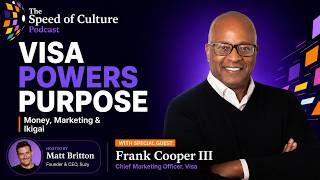
In this Speed of Culture podcast episode, host Matt Britton interviews Frank Cooper III, Visa’s Chief Marketing Officer, about his unconventional career journey and his philosophy of culture‑first marketing. Cooper recounts how a pivotal conversation in law school redirected him from a legal career to marketing, leading him through iconic music labels (Motown, Def Jam), a tech stint at AOL, a transformative decade at Pepsi, a role at BlackRock focused on financial‑literacy, and finally to Visa. He explains how music taught him that culture shapes perception, prompting him to reject traditional demographic segmentation in favor of shared values and aspirations. At Pepsi, he pioneered culture‑first strategies, leveraging music and emerging social platforms. At BlackRock, he sought to humanize finance by integrating money into broader wellbeing conversations. At Visa, he is repositioning the brand around the idea of removing friction to enable extraordinary human actions, while embracing fintech, gaming, music, and sports as new payment ecosystems. Cooper describes his 100‑day immersion at Visa—listening across the organization, mapping the ecosystem, and extracting insights to drive profitable growth. He outlines Visa’s upcoming media mix: social‑first (LinkedIn, TikTok), cultural partnerships (sports, music, gaming), and a nuanced view of linear TV versus streaming. The conversation also touches on brand stewardship versus community elevation, the rise of independent artists, and the promise and ethical concerns of generative AI in marketing. Finally, Cooper shares career advice rooted in the Japanese concept of ikigai, emphasizing purpose, resilience, continuous learning, and transferable storytelling skills.
Chapters
Up today, we're gonna be speaking with Frank Cooper, Chief Marketing Officer at Visa. Frank was named in 2002 by Forbes as one of the world's most influential CMOs. Frank, it's so great to see you again. Thanks so much for joining today.
Great seeing you as always.
Absolutely. You know what's interesting to me? I was looking at your background and you are actually the first CMO that we've had on the Speed of Culture podcast that has a law degree. So how did you get started? Did you always think that you kind of wanted to be a lawyer or what kind of precipitated that?
I never knew I was going to be a marketer. Didn't really know what marketing was when I went to undergrad. I was at Berkeley, went to Harvard Law School and loved the law actually. And it was in my second year of law school, I had this incredible experience. I was working on this litigation around the game Tetris and a partner pulled me aside and said, so tell me why you want to practice law and what you want to do your career. And he said something that changed the trajectory of my whole career. He said, look, whatever you do, look first at like, what's the things, what are the things that energize you? What are the things that make you feel fulfilled? And then couple that with your career. That's what's going to make you feel, you're going to be successful no matter what, he said. But the thing that would actually make you feel fulfilled is by tapping into those things that energize you. And what I learned over time was that what I like doing is I like building things that actually help brands grow, companies grow through stories, experiences, creating memories, building relationships. And it so happens that thing is called marketing. And so I didn't know it at the time. And so people say, well, man, damn, you wasted 3 years, right? You were in law school for 3 years. And I'll tell you, every single day I feel like I use that law degree because it's not so much about learning the letter of the law. It's a way of thinking, you know, how do you identify issues and analyze those issues and come up with solutions. That's what the legal process and legal thinking is all about. So I'm very grateful for the legal background. And by the way, there are many lawyers who have made that transition. Ken Chenault at American Express, he went into marketing, became CEO of American Express. Clive Davis, legendary music mogul. Absolutely. Law degree, they make that transition. It's those who kind of think about the law process and the way of thinking about the law and applying it to different areas that can transcend it.
So did you know when the person told you that and you were at law school, did you know right away or did it kind of send you down a path where you had to really kind of do some introspective thinking to kind of uncover what it is that you really wanted?
Yeah, it almost pissed me off at first because I was like, oh God.
You finally got to Harvard Law.
Yeah.
It's like, I'm here.
And then I'm like, the pathway is clear. You know, it's like, you know, there's an easy, The path of least resistance would be either go into a law firm and go on the partnership path or go teach somewhere. Path of least resistance. But it rang true to me. And I got to tell you, it was tough. And it wasn't like a singular evening of introspection. It was really going deep and thinking about what are the things— what do I actually want to become? What are the things that actually inspire me? What throughout my life has given me like these moments of joy? And it's not always work. It's like, how do you interact with people and where are those moments that actually bring that joy to you? And it was a tough thing. It was really tough. And I can't say I landed on it right away, that I suddenly popped up, you know, after a deep dream one night and then said, here's exactly what it is. But it became clear to me that I love this idea of helping expand the potential of people, both individually but also collectively, and particularly people who have been historically marginalized. I love giving any kind of opportunity for them to advance. And so that's been my source of inspiration. As I went from job to job, I always went in with that lens in mind. And I knew the things I had to do in order to perform that job well in relationship to the other executives. But I also kept in mind my own personal sense of purpose and mission and my intention. And so it was extraordinarily helpful, but it was introspection. And it's constant, and it evolves over time. And it's not easy.
It never ends, it sounds like.
I don't think it ever ends. I think the core doesn't change. Very much, but how it manifests itself has to change because the world around you is changing, but the core doesn't change.
And ultimately you have to also take risks to follow your passion. You know, you were at Harvard Law School and you talked about the easy path. You easily could have went to a, you know, a blue chip law firm and, you know, your career path would've been set, but instead, you know, you went to Def Jam Recordings, which probably, you know, I don't know how many people graduated Harvard Law School and went and write to Def Jam Recordings. I would probably guess not too many.
Not too many. And look, and at that time people thought you're absolutely crazy, right? But I actually went to Motown first. Okay. So I was very fortunate in retrospect. I worked at two of the most iconic urban labels, but definitely maybe even record labels in the world, right? Started at Motown and then went to Def Jam. But part of what became clear to me was that, and I had played music before and I knew a lot of people in the entertainment industry, but it became clear to me that who's shaping people's perception? Who's shaping culture? You know, why do people freak out when they see a musical artist come, a musical star compared to any other star, like a big celebrity, a big film star. People like it and they cheer and they go, but they actually lose their minds when they see a musical artist. Why is that? And it became clear to me that music was a vehicle for changing the way people think about themselves and the world around them. And I love Motown because Motown did that in terms of, in the era of integration, it took Black culture and said, hey, I can actually shape Black culture and music in a way that is digestible by a wide range of people. And I can elevate everybody through that. Barry Gordy's genius was that. And he did that across the board, whether it was the Temptations, Diana Ross, and Michael Jackson, all the way up to the '90s, you know, Boyz II Men, and Shanice Wilson, and others. And Def Jam did it the opposite thing. They said, what the world needs right now and culture needs right now is when you have falling institutions, when people are losing trust in institutions, People were like, "How do I do it myself? How do I operate outside the mainstream?" And hip-hop was a manual for that. That's what it was all about. And it's all about finding your community of people that are going to help you move along. And so for me, those were like the sources of inspiration, because if you want to expand the potential of people, you have to give them both the confidence that they can do it, but also the mechanism, the systems to do it. And so I think music was, for me at least, the way I perceived it, the most powerful vehicle to do that. And I just kept applying that even when I went to Pepsi and other places. Yeah.
And, and we'll get to Pepsi in a second. But it was interesting to me also, you had a stint then at AOL after leaving, you know, the music industry because at that time there was Napster and everything was becoming digital, digitized. It was like the Wild West. Yeah. Of music. Were you seeing things in the music industry that led you to go to AOL and kind of what did you take away from, from that experience?
Yeah. You know, I, I was at a conference down on Wall Street and at the time I was in the music business And there were probably about 8 people on the panel. And 2 of us were saying, oh no, no, no, it's over. Like the original way in which we actually produce and distribute and market music, that world is done. And we were the outliers on that. And so we went up and we talked to Nicholas Negroponte, who was the co-founder of the MIT Media Lab. And he started showing us around and giving us his view of the future. I did, so I said, you know what, I gotta get deeper into technology. I had an unsuccessful startup in ubo.com, but it taught me so much about the way in which technology and culture were coming together. And that's what I wanted to do when I came to AOL. Short stint at AOL because I got a call from this guy named Clarence Avon, who's probably one of my kind of lifelong mentors, Clarence Avon. And there's a film on him on Netflix called The Black Godfather. But Clarence actually called me and said, hey, I know you're probably enjoying what you're doing. Great. I know you want to, you know, technology culture. But I got out of this meeting and people were saying the way things are going to move now, it's going to be much more about technology. It's going to be much more about culture. It's going to be much less about just celebrating the celebrity. And we're going to try to shift our marketing toward that. I think you should come in and talk to Dawn Hudson, who's the president of Pepsi-Cola North America at the time., and that was my switch. I had no experience in CPG, had no intention of going there. If you asked me at the time, I would say it's technology and entertainment is my sweet spot and my passion. And so I kind of stumbled into it until I had that conversation with Dawn.
Yeah. And you joined Pepsi and you were there for well over a decade.
Yeah.
And obviously, you know, look at a time horizon from early 2000s to 2015 and the world changed in such a dramatic time during that period. You had, you know, the internet becoming a mainstream consumption habit. You had the iPhone, YouTube, social media, et cetera. So I'm sure by working on the world's leading brands, trying to navigate through that, I'm sure you learned so much. What are the main takeaways if you had to summarize your time at Pepsi in terms of what you learned and how that kind of helps you in your current role today?
Yeah, I mean, Pepsi was, I would say the most formative period of my career in terms of how I think about marketing. And Matt, it's in part because of all the change that happened. Yeah. But here's what I kept in mind. I said, you know what, most of my counterparts right now, they're looking at the industry, they're analyzing the industry, the competitive set. They're looking at traditional marketing levers and they're trying to improve those things incrementally. I decided based on what I learned through music and what I learned through the tech companies, I decided to start in culture first. So I said, let me look at how are things happening within culture? How are people grouping themselves? And it's always vastly different from any of the research organizations I went to. I was like, I said—
Like the cookie cutter demographics.
The cookie cutter demographics. I say, you know, what I know for sure is that those traditional demographics of age and gender and income and geographic location and ethnicity are no longer great proxies for how people think and feel and behave. I said, I know that for sure. And then, so then if you remember, then they came to psychographics and all these kind of weird terms. So, hey, these are lemonheads for Sierra Mist, lemon-lime. Can someone show me a lemonhead? Like, in person, can someone show me somebody who actually self-identifies as a lemonhead? And you can't do it. What I did know is that people were starting to group together based on shared values and shared aspirations and passions. And that to me was the link. And so I started to look at things. We took, you know, the street skating to the next level. I looked at music again and leveraged music, but it was always around this idea that culture is gonna inform how we communicate to people and how we build products and how we market to our core targets.
Yeah, and we were just talking before this podcast, 15 years ago I was running my agency, Mr. Youth, and we actually worked together on the Mountain Dew brand on a program that I hang my hat on as one of my career highlights called Do It Yourself, D-E-W. It yourself because it was at the time when social media was first starting to bubble up. It was the MySpace, early Facebook era. And we worked on a program that essentially open sourced the Mountain Dew brand to consumers.
Yeah.
And my memory from that is how hard it was to push through legal at a big company because there was the lawyers at large companies weren't used to kind of giving up control of these brands.
Yeah. Yeah. First of all, so, so think about the Mountain Dew brand. It's crazy. It's crazy that I was running Mountain Dew brand because, um, Mountain Dew, is the name is a euphemism for moonshine. Right. Grew up in the hills of Tennessee. And if you look at the earliest logo of Mountain Dew, it's a hillbilly charging up a mountain with a shotgun going towards the shed. It's the first logo of Mountain Dew. And people are like, how do you get from that to this kind of do-it-yourself platform? Which was, I think, on the leading edge of what was happening and a precursor to the maker movement and a lot of the—
Creator economy, all those things.
The creator economy, precursor to all of that. And what stood out for me is that the values of that brand was always about do it yourself, operate outside the mainstream, and remain true to yourself.
Right.
And when we had Mr. Youth, we just carried that forward and said like, now how do you apply that in today's world? And that was one of the great projects. I thought it was a lot of fun and had an impact on the business. So it was a great moment.
Absolutely. So, you know, you would go on and achieve great things at Pepsi and then after a short stint at BuzzFeed, I saw that you took on a role at BlackRock. And I have to say, when I saw that you took on that role, I had to do a double take because I just didn't think that you would enter that world of, you know, institutional finance.
Yeah.
And I had always wondered what you were doing there and how you were going to make out there. And I'd love to hear how you did make out there because it's not like you came and left. You were there for 5 years. Your time's valuable. So yeah, tell us about that.
Yeah. That was a remarkable experience, I tell you. And again, knew nothing about investments. Yeah. You know, at, at the time. But what I did know, my whole career has been built around this idea of, of change, right? So what are industries that are undergoing significant change and who are companies and leaders that actually wanna lead the change? And investments and finance in general felt like it had escaped the digital economy in, in, in many respects. 'Cause they could still muscle things through.
Highly regulated too.
Hard to make change. Highly hard to make change. Highly regulated. You know, barriers to entry are difficult. But then it started to happen, number one. And so I said, okay, change is happening. Number two, for someone like BlackRock, you know, BlackRock grew— when I joined, there were probably about $5 trillion of assets under management. It's hard to be quiet and invisible when you start to hit those marks. And when I left, there were $10 trillion of assets under management. And so it became apparent that they were public and— but no one knew who they were, why they existed. Were they making a positive contribution to the world, or were they in some ways, you know, similar to how people had perceived Goldman Sachs years before?. And so it became clear that they needed not only to amplify their brand, but to decide how are we going to build this kind of base of customers and stakeholders in a way that they support us. And so I saw that as a fantastic challenge. But there's one more thing that I started off with what my own personal sense of purpose was, this whole notion of expanding potential in people. And the thing that I had not thought about until I started having the conversations with BlackRock was that you know, we, we think about health and, and nutrition and, you know, physical fitness and, and mindfulness and all that. And we say like, this is part of our overall sense of wellbeing. The thing we never really talk about is money. Yep. And our relationship with money and how you earn it and spend it and borrow it and invest it and give it, which also impacts relationships too.
100%.
Yeah. 100%. Right. And it became clear to me, I said, wow, you know, that frontier, you know, no one's ever explored it. We don't get taught, no matter what level of schooling you've had, You don't really get taught anything about financial literacy. And then if you, if you walk into a place where they're teaching financial literacy, your eyes will gloss over and you'll pass out, right? Because it's like so boring and jargon-filled. And so I just saw it as an opportunity to bring some of that, again, that cultural dimension back in to finance, which had historically thought of itself as being divorced from that, to bring that back in and do some things that I could actually, I thought, help communities and hopefully large groups of people.
It's interesting you say that because I had dinner the other night with an artist who makes great works, and I asked him how everything's going. He's like, it's going great, but I have to admit it's been pretty hard lately. And I asked why. He said, because ultimately I'm responsible for selling my art. And I got taught growing up, I went to this school and I got taught how to be a great artist, but I never was told to take a class on actually how to market myself or how much to price my works or how to distribute. They don't teach people that.
At all, right? At all. I mean, it's partly a failure of the schooling system overall. I think since that they're really designed to create people to work in corporations for the most part, and they're doing a better job at that now and teaching people more about entrepreneurship. But that's a gaping hole in terms of—
I couldn't agree more.
How do you build a healthy relationship with money across that full spectrum?
I mean, my kids are getting taught to identify certain types of leaves, but they're not being taught how to use excel. And I just think, talk about all this generative AI and stuff, but it, I think the education system really hasn't kept pace with the changes in technology and culture. And it's leaving kids in America, I believe, behind, especially when compared to other more progressive parts of the world.
Yeah. Yeah. We could spend an hour on that.
Whole other podcast.
Because first order of business though, pay teachers more. Yeah. And continue to attract, I think, a new set of thinkers into that profession. That's right.
Yeah, that's right. So, you know, you took that financial expertise and what sounded like a, a passion or an insight you developed and you ended up at Visa just last year. Yeah. So you've been there almost a year now.
Yeah.
You know, one of the most iconic brands in the world and, and as we were discussing, one that has so many different applications into culture, into passion, really in many ways seems like the culmination of everything you learned or, or I guess touched throughout your career to date.
Yeah. I mean, it really is.
Yeah.
And it's funny because I thought about that way, but I didn't realize until I got there like how true it is. Mm-hmm. You know, it has the, the lifestyle aspect and the cultural aspect of Pepsi, the social media perspective from, from BuzzFeed, the B2B aspect of BlackRock, all that coming together. Yeah. And people say, well, what about music? And again, to me, that was my, that was the deepest training I had in cultural branding was in music. And I feel like all that's coming together now. So, so now if I look at Visa and I look at a, a property like FIFA World Cup, I look at it both through the cultural lens,, but also the industry lens, also the B2B lens. Absolutely. And so it's been a great ride so far. It's a great company, great brand, but it's also an industry that's undergoing massive change, right? Payments technology and solutions, you know, with the rise of fintechs, with more people using their mobile phone as a device, right, for any kind of value exchange. And then you have a whole new layer of value exchange happening. It's not just about paying for something that you see within a store or on an e-commerce site. What's happening in video games. It's the way creators are getting paid. Yeah. You know, musicians and their platform, you know, what are the rails that are allowing, allowing them to get paid and to pay other people? And so it's a fascinating time. And, and again, I love this, this moment of change, you know, and, and change is happening in that industry. And, and I, I'm very excited that Visa's, you know, wants to be on the leading edge of that.
So you joined Visa and, and you're the global CMO. What does the first, I guess, 100 days look like there in terms of, absorbing all that Visa is and setting yourself up for success as you move on?
Yeah, I mean, you know, so I, I've been fortunate to move across various industries and a few things I've learned is that before speaking to anyone, trying to just understand how is money made, you know, just like where's the money, right? How does it move within that industry? The second thing I try to get a snapshot of the ecosystem of the industry, who are the players and how, how do they relate to each other? But really, I spend 90% of my time, at least in the first 60 days, just talking to people and listening. Right. And many times they want to hear my story or want me to share something about what I've learned. But I try to resist that as much as possible because I'm just trying to understand how they think, how the business works, what's not on paper. And what I find is that by having the conversation more than— and I'll get all the documents and I'll get the full download. I got binders and stuff. Sure. They're sending me. Folders and email, and that's great. What I find is that most of the real answers aren't written down anywhere. How do decisions get made?
That's so interesting.
What do you see around the corner? What's preventing us from innovating? I see changes happening in the industry. Do we see those changes? And if so, why are we not on the leading edge of that?
Right. What's our plan to react to them?
Exactly right. Exactly right. And so I just ask a bunch of questions and I do it. I try to do it at all levels. And across all regions. And so I'm not just talking to the CFO, you know, I want to talk to somebody who's recently hired in the past 3 years or something like that and get their perspective. You know, why did you come? What do you see? What are you disappointed by? So I just ask a bunch of questions and listen and try to digest. And one of the things I think I'm pretty good at is then taking all that information and pulling out of that some key insights, some key ideas about, okay, here's where I think there are some opportunities. And more important, here's how marketing can help be a growth engine for profitable growth for the company. So that's kind of what I do.
Yeah. So, you know, you have these insights and I imagine doing that, you're formulating a plan and that plan, I guess, then gets executed in some way, shape, or form. Does that plan start with the brand? Does it in terms of like, who is Visa? What are our brand equity pillars? Why are we different? Or does it start with, you know, business metrics? Like how do you look at then actioning those insights?
Well, so one, I definitely don't do it alone. So I don't go into the basement and come out with the plan and say, Okay, here it is. What I try to do is find a group of people and make them my leadership team. Different thinkers, different capabilities, and put them together and start thinking about what are the things— here's our ultimate goal. Our ultimate goal of marketing should be to help the business drive profitable growth. Here's how we've— my understanding of how we historically have driven that growth. What do you think we need to do to change? And I just ask that question and I'll have some ideas about what we can do. For me, brand always has to come up at some point. And then on brand, I just push hard on going back to kind of the founding ideas. And we're lucky at Visa because Dee Hock, you know, who was founder of Visa, was so far ahead of his time, you know? And when you go back, you start to see the seeds of who we are today. And so pull, get rid of all the taglines. If you go back, Dee Hock said things like, if you remove friction from money, ordinary people can do extraordinary things. And that was like, for us, oh, that means this possibility in what we do. It's not about the credit card, it's not about Visa as a payments technology. It's really about how do we help people move forward. And so for me, that's like a rich gift. And so we did the whole dig around the brand ethos and our brand belief, and we're repositioning the brand based on that.
Okay. And that must be exciting to do.
And for me, I love it because I love it. Not because it's something new to do because people say, oh, you know, a new CMO is going to come in and turn everything over and, you know, his or her own people. And that wasn't my way of thinking. My thinking was more of like, so where's the truth? Let's go find it. And if the truth is where we are today, then let's figure out how we make that sexy and more engaging, etc. But let's find the truth. And the truth to me is always exciting. And so I'm super excited about it. I think we've unearthed a positioning that is going to be powerful. And then it's about how you do it. And I think we're going to go about it in a way that's modern and effective.
So first of all, I can't wait to see the positioning. But, you know, here we are in 2023 and it sounds like a lot of that work's been done. And, you know, you'd mentioned sort of now executing the plan or this new brand positioning, bringing it to the consumer and your other constituents. What are some of the things that I guess you have your eye on in 2023 that you think are going to be effective? Channels and strategies to get your message out to the consumers that matter?
Yeah, I mean, so a few things. One, and some of them are very obvious, I think. Sure. You know, one, I think it's social first, and I think brands are built in social now more so, but it's not this generic view of let's be in social. It's like, what parts of social are gonna be effective for Visa? And so I'm super excited about on the B2B side in particular, LinkedIn. TikTok's gonna go through its phases, but we're gonna be very aggressive. On TikTok. But the logic behind it for us is not so much about let's see if we can get advertising space on it and see if we can improve the, the interruptive aspect of it. The logic of it for us is how do we add value to the user experience? And so we're gonna go hard against that. And then there's cultural spaces that we're gonna play in. We're def— we're already in sports. We do sports and, and I think we can continue to reimagine that. And, and we have a great team and great leadership on that. We, I think, did an incredible job at the FIFA World Cup in Qatar, but then we'll continue with sports. But we're going to go into music and video gaming in a way that I think will be very different from how we've done it in the past. And I'm not, I'm not here to diss sponsorship models, you know, and say like, hey, the traditional sponsorship model doesn't work, but it only adds a limited amount of value because people know what it is and they, and maybe it creates some, some layer of awareness. But why can't we partner with these different platforms and spaces and companies in a way that actually in the music industry, for example, helps artists or helps fans and help the fan experience? Why can't we do that? And if you can do that, then that's real value that you're, that you're adding. And we're in a unique position because not only can we do that, I think we are in a position to help people pay and get paid. And so, and in those spaces, that's interesting. Being an enabler. Being an enabler of value exchange basically on those platforms. Absolutely. Yeah.
And, and big brands like Visa traditionally have also put a significant amount of their spend into linear television. And this past year we heard for the first time that streaming overtook linear television. Yeah. In terms of audience, how do you look at that channel, which has been so critical for traditional brand marketers in the last couple decades?
Well, well, look, I mean, I can't get my mind wrapped around the idea that there's any medium where the engagement has been, has been decreasing, the viewership has been decreasing, but the prices keep going up.
Right.
I can't get my mind wrapped around that. And I recognize the exception though, of live sports. And that's why there's a premium around that. But I, but I, despite all that, I think there's still a role for linear TV and like if you want the flare in the sky and you want simultaneous viewing, live sports is fantastic for that.
Especially like something like the Super Bowl, which captures scale unlike anything else.
100%. Yeah. It captures scale, but also this cultural conversation around it. Exactly. Same with FIFA and the World Cup. Women's sports in general, I think is on the rise and, and, and there's kind of a cultural currency and, and, and energy around all that. But where most of the energy is, is not in linear TV. And so I wanna play and be where people are and where ideas are getting exchanged. And if I look at how ideas move around today, it's not necessarily happening in linear TV. I don't see that. It happens occasionally, but it's rare. And so you're gonna see us much more social first, digital first, culture first, and more permission-based in terms of how we market. We may reach fewer people,, but the people we reach and the way in which we engage them and the relationships we build, I think will be much more valuable for us.
Absolutely. I mean, I think the biggest change has happened since we both entered our careers, which is around the same time, is that the power has changed from the boardroom, meaning like the execs are gonna dictate what happens to the sidewalks. Consumers dictate what a brand becomes.
That's right.
You know, execs can no longer just force that down consumers' throats.
You know, so it's funny if you remember at one time people used to call the role brand, brand stewards, right?
Like, right.
Protect this brand from all these crazy people. Yeah. That want to touch it. Right. And that model's been flipped completely. And actually someone from the music industry helped me understand this. It was Snoop Dogg. So I was working with Snoop and I just asked him, I said, so you've been, you know, you're 18 years old, 17 years old when you came in the business and hip-hop changes rapidly and it's not very forgiving in terms of shifts that happen. So most people don't last. And I said, well, why do you think you lasted? So long. And he said, I thought he was going to say that because I'm the greatest rapper alive or something. He said, well, he said, most stars, they get on the pedestal and they want all their fans to bow down to them. He said, I get on the pedestal and I pull people up with me and that's my whole energy. I'm just trying to bring people up with me. And then when you bring people up with you, they want to lift you up.
Yeah, you create community around.
Exactly. And I think brands can learn from that. You know, it's not about having people bow down to the brand. It's not about protecting the brand. Nor is it about just relinquishing your brand to, to people. It's like, let's figure out why we're in it together and then elevate each other. Yeah. So I think that's the energy that, that's the—
Yeah, man, I think music industry is a perfect example where it used to be, if you were in heavy rotation, you know, from Clear Channel, you were all set. Right. And now it's the long tail. Now you have to earn your way in and just getting played on the radio isn't gonna dictate your success anymore.
100%.
Right.
Yeah. And look, and the most exciting part, since we're on the music industry, the most, for me, the most exciting part of the music industry right now is independent artists. I see that growing. Yeah. And I see a need for people to, for companies to provide tools and systems to help independent artists thrive. Absolutely. So yeah, marketing.
Stay tuned. Yeah, yeah. That's a little foreshadowing.
Yeah.
So let's shift gears a little bit as we wrap up here into, you know, your career. We have many young listeners here, Speed of Culture Podcast, and they all aspire to be where you are today, right? You're the chief marketing officer of an iconic brand. Having gone through an incredibly exciting career, what are some of the things that you can take away from all your experience that we talked about today that you would impart to others as wisdom so they can kind of increase their chances of success in the world of marketing, advertising, media?
Well, I mean, I'll start with advice that I was given long ago is really know yourself. And this is Japanese concept called ikigai. And basically what it says is that to find your own personal sense of purpose, you need to know what you love, what you're good at, how you can make a positive contribution to the world, and what you can get paid for. Those 4 things, right? And some people know like, oh man, I love this, and they're not good at it, right? That's why American Idol and X Factor and those things are always so funny because some people are like, I love singing, and they can't sing a lick.
And sometimes you find out early in life, sometimes you find out later in life.
100%, right?
Yeah.
And that leads me to the second point, which is it's okay to fail. You're not going to hit it out of the park every single time. In fact, if you did, you're probably not stretching yourself in any way. So to find out what you're good at.
Yeah. I mean, you know, such a thing as you said, I'm sorry to interrupt you, but like, I wonder if Frank Cooper was born 25 years later and went to Harvard Law School, Frank Cooper would still make that decision to not be a lawyer because there was no social media back then.
Yeah.
And the social pressures people have, it's like, oh, my son got into Harvard Law School, my daughter got in here, and then all of a sudden they're not a lawyer anymore and they're working at Def Jam.
That's right.
I wonder if in this day and age it's harder to make a decision like that.
I don't know. I'll say this though. My son went to Harvard, came out, he worked for a year or so with a VC firm, but he's an actor. He's like, you know what?
Yeah.
Woke up early. He's like, you know, this VC thing is good. They love me here. It's a great firm. He said, but the thing that drives me and what I know I'm good at is acting. And by the way, I was sitting back there, you know, I'm giving all this advice now, but I'm sitting back there like, oh my God, anything but getting in front of that camera because it's such a risky proposition. But you know what? I thought everything is risky now. Yeah, like, what's not risky? True. Go to the biggest— pick the biggest firm in the world right now and you think you have security in some way. It's not really about that anymore. It's more about, you know, are you developing the skills that are both transferable to other areas but also going to be useful in the future? And so that's what he decided to do. And so if that's a version of me 25 years later, I mean, he took the leap and went for it. But I would advise anyone don't view it as a leap. View it as an experience where you're going to build a set of capabilities and skills and do it really well. But then think about how those skills can be transferred to other things. If I were an actor and said, "Hey, I don't want to do this anymore," it wouldn't be so much that I now have to go into a film company. I might think, "Actually, I know how to tell stories really well," or, "I know how to communicate really well. I know how to connect and understand people really well." How is that transferable to these other areas? Right. Yeah.
So you were going through the 4 tenets. So the second was, am I good enough at this?
Yeah.
I wanna bring us back there to what else you were saying.
100%. And you know, can I get paid for it? And then does it make a contribution to the world? And that's really kind of your broader sense of purpose. You gotta have that piece of, but the second thing is, is that I think you gotta maintain curiosity. If you're not continually learning, it's not gonna work out well for you long term. Because as you and I just talked about, think about how much changed from 2000 to to 2010, and then from 2010 to 2015, and even over the past 3 years, how much has changed. That accelerating change is going to continue. And so the question is, how do you meet that? Well, I think you have to continually learn, continually be open, and be willing to adapt. And so I think that's the second part of it, is continuous learning and adaptability. And then the last one for me is— and this may sound easy for me to say because when you look back on it, It's resilience. I believe in that 100%. Yeah, because it's not— every day is not going to be great. They're going to be setbacks. And in the industries that I've seen that are the most unforgiving to people in their careers, almost everyone who's resilient and persistent has gotten a shot, has gotten their window of opportunity to do something extraordinary. And so I think you have to have that resilience and push through it. And the only way I see having that resilience in a way that is sustainable is that you have to realize you can't do it alone, that excellence won't happen independently. You need people to help you along the way, whether it's somebody driving you to your practice or whether it's someone kind of emotionally giving you emotional support. Excellence requires help.
Absolutely. Absolutely. So final question, is there anything that you have your eye on that's sort of on the bleeding edge? You were just talking about CES and all the changes, whether it's talking about being curious. Are there any emerging trends that are going on in the marketing media world that I guess have you intrigued?
Yeah, look, I've been intrigued and I've talked about this before about AI and machine learning, and I've been intrigued and concerned at all at the same time, you know, because I think that it has an extraordinary potential for changing marketing, particularly with generative AI, ChatGPT, etc. But I'm also concerned because there's an ethical dimension to it that I think we have to keep in mind. And most important, I think we have to keep in mind is that, again, we're doing all of this to improve life. And so where's the human element in all of this? And so I think we're in an extraordinary moment where human and machines can work together, but it's not inevitable that we'll end up in a place where it benefits us all. And so I'm concerned about it, but I think it's an extraordinary opportunity. We're going to definitely experiment with and apply generative AI. I think there's some some low-hanging fruit around that. But I don't think you'll necessarily see me putting up a generative AI poem or a song or anything like that in the short term, but I may, so don't hold me to it. But I think there's some very straightforward things that can be applied there that would actually free up capacity for people to do more extraordinary things.
Absolutely. It's going to be fascinating and both scary as we see this evolve.
100%.
Yeah, absolutely. So is there one mantra that you like to live by? How would you sum up everything that we talked about today? Is there a mantra that you wake up in the morning and think about that sort of defines who you are?
God, man, it changes so much. I don't think I have a consistent mantra. If there's anything that I think that continually inspires me is that I like— for me, it's more about think big but work small, right? And so I like to think really— I'm always thinking about what's next, what's the big idea.. But I also realize that it takes hard work and discipline and consistency to get there. And so the, the small steps are oftentimes much more important than the, than the big thought. Absolutely. But I like to have both together.
I love that. It's great inspiration and I cannot wait for our audience to hear this conversation. You're such an inspiring person. You've had such a great career and congratulations on everything and wishing you nothing but success this year. Appreciate it, man. Absolutely. Absolutely. Great to see you again too. Likewise. On behalf of Suzy and the Adwee team, thanks again to Frank Cooper of Visa for joining us. Be sure to subscribe, rate, and review the Speed of Culture podcast on your favorite podcast platform. Until next time, see you soon, everyone. Take care.
Hey.
More from Matt




MikMak’s Rachel Tipograph on Consumer Spending, Retail Media & Holiday Shopping Trends



Jaguar Land Rover’s Charlotte Blank on Luxury, Purpose & Experiential Storytelling



