Vuori’s Karen Riley-Grant on Product, Community & Global Growth
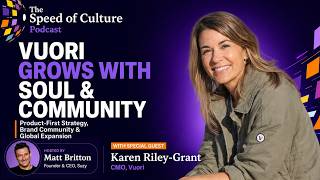
In this Speed of Culture podcast episode, host Matt Britton interviews Karen Riley‑Grant, Chief Marketing Officer of Vuori, to unpack the brand’s evolution from a digitally‑native, product‑led DTC startup to a rapidly expanding global athleisure label. Karen explains Vuori’s origin story—a Southern‑California performance apparel brand that filled a void in the men’s market with high‑quality, versatile pieces—and how its success stems from an obsessive focus on product excellence, direct‑response performance media, and deep consumer insight. She details the brand’s marketing playbook: leveraging data‑driven programmatic targeting, building a loyal fan base before scaling, and using creators and influencers with rigorous vetting and KPI alignment rather than relying on celebrity megaphones. The conversation covers strategic distribution choices, notably Vuori’s deliberate avoidance of Amazon to preserve first‑party data and brand equity, and a measured approach to global expansion that balances speed with local relevance. Karen highlights the importance of physical retail as community hubs, describing in‑store experiences, active‑club events, and localized partnerships that foster emotional connections. She also shares Vuori’s emerging content strategy—long‑form storytelling series like “The Rise, The Shine” and “Design Philosophy”—that leverages founder narratives and brand values to move up the funnel. Finally, Karen reflects on her 40‑year apparel career, emphasizing the need to listen to consumers, take uncomfortable assignments, and live by a “everything everywhere all at once” mantra. The interview offers actionable insights on product‑first branding, data‑centric marketing, creator partnerships, distribution trade‑offs, retail‑community integration, and career advice for marketers.
Chapters
Up today on the Speed of Culture podcast, we're thrilled to welcome Karen Riley Grant, the Chief Marketing Officer at Vioree. Karen's played a pivotal role in shaping Vioree into a leading brand in the athleisure space with her expertise in consumer insights, innovative marketing strategies, and brand growth. She's been key in expanding Vioree's global presence and staying deeply connected to its core values of community and wellness. Karen, so great to see you today.
Thanks for having me, Matt. It's great to be here.
Absolutely.
Absolutely.
For those who aren't familiar with the Viore brand, would you mind just telling our audience about the brand and maybe some of the early reasons for the brand's incredible success?
Absolutely. So we are a Southern California-based performance athletic apparel brand. We started about a decade ago as a vision that Joe Kudla, our founder, had when he saw a void in the men's market. And then 10 years ago, you can imagine kind of studios out there were full of lots of Lululemon leggings on women and lots of big, kind of, you know, flashy logos from all the sports apparel companies and found a real void, an opportunity to provide incredible, well-made, crafted product that could hold up on your yoga mat or out on a run, but also be kind of fluid enough to kind of take you from one event into the next. So there's an elevated kind of simplicity to the aesthetic., and kind of a lifestyle that really inspired the brand 10 years ago. And here we are today growing fast as ever and kind of taking on the global kind of opportunity and with the ambition to be the category leader.
Yeah. I mean, it's not easy in this day and age to start a brand in the apparel category just because so many of the brands that are tried and true in this space were built during like an era of linear television. Where, you know, companies like Nike were able to essentially corner the market and obviously signing Michael Jordan helped. But, you know, back then, if you were able to capture some scale, you were really able to just pound your message over and over to the consumer where when Viore started, it was a much more fragmented space. Right. And there were much fewer barriers to entry for brands to be able to enter. So there was a lot of noise. Like, why? I understand that you obviously had the right addressable market and there was a core insight, of having something more fashionable, more stylish, and athleisure for men. But like, what else was it that kind of allowed the company to break through?
I've been in apparel my entire career, 40 years in this industry, and came— grew up through the brands that did. You had one TV spot, you kind of put it out there, and then it kind of came. It was a simpler time and kind of worked almost backwards into here we are today, which is super complicated marketing mix, heavily dependent on performance media. And Buori has the, the opposite challenge where we started as a direct response performance media, digitally native brand, and connected with our humans who love the brand based on the product excellence. And so I think that you can have an incredible brand with product that doesn't stand up and you're never gonna last. And you have, I think, a fortunate problem that we have, which is incredible product. Now we have to go out and build our brand awareness.
So I understand what— how Vuori obviously hit the market right in terms of there was a core insight of a huge opportunity of a new type of athleisure brand for men. But there had to be other drivers that allowed the company to really capture the breakthrough success that it did. I mean, what do you think some of those things are?
So I think it, it sounds overly simple, but it's we have the best product in the market. And I think as Joe found that opportunity in the void in the men's market, we quickly introduced women's many years later during COVID and actually so I can kind of came into the world for her in a very different way, kind of through comfort and lounge, where we entered the market for him in a space of fitness 10 years ago. But it really was about bringing the best product to the market and meeting our consumers through direct response performance media ads. It wasn't about the big TV, it wasn't about the big, big partnerships, it wasn't about kind of big celebrity endorsements. And so now we find ourselves 10 years in with still incredible product. And again, I have worked in this apparel industry for nearly 30 years. It is the most incredible product I've had the good fortune to work with. Um, and now it's about building our fan base. So what we have found through expensive consumer research and discussions, quantitative, qualitative, understand like what is it that is working. And what's incredible is our product is working hard. Those who know us love us, and you have your love of Yuri, and it is— it's this really exciting kind of discovery, and this discovery into this love and obsession, and those who know it, like, if you know, you know, I always say it's like kind of like the Jeep nod. You're like, oh yeah, okay, you got on Be Right, cool. But awareness is low, right? So now as we head into our, you know, the next 10 years and, you know, I joined the company to be part of this opportunity to build the brand and to take this incredible product out into the world and really meet new fans.
Yeah. I mean, in many ways that's a marketer's dream, right? Because you have a killer product that's obviously in the right place in the right time and you do have those super fans and now you know, as you put it, really it's just about unlocking them to create scale. What are some of the ways that you're looking to do that?
Yeah, so I think I love how you said it is a marketer's dream because I've always worked with big legacy brands and so I never had the chance to come in and help build something. So to be able to have playbooks and I think sitting with my incredible, you know, leadership partners that have playbooks from previous lives of how do you enter a market, how do you open and really grow your D2C fleet, how do you connect the omni touchpoints that are required to create a really, you know, beautiful, seamless consumer experience. Um, we get to build that now. So it is a dream, and to be able to do that, um, working with incredible product that stands on its own and work alongside a founder, which is a pretty incredible opportunity on, uh, of itself. So all of this is very new for me and has really been, um, quite inspiring. It's been a year and a half now, and I, every day I get excited to come into work and, um, work with these incredible humans and get to build this brand. And so to answer your question, you know, the way it looks is building that consumer connection. Again, like we learned that no, those who know us love us, and they're more than love us, they're kind of obsessed with us. So fantastic, let's go meet new people, continue. And this is where I think some brands get it wrong. They kind of go, great, got you loyal consumers, I'm going to focus on the new folks. Like, no, no, no, no, no, we have to really respect and honor those loyal consumers we have, foster that relationship, give them lots of reasons to continue to love us while simultaneously building and reaching and attracting new fans and really understanding what it takes to connect and cut through all the crazy clutter that's out there that you've already acknowledged. How do you connect with them emotionally first? Um, and understand that like, oh yeah, we have a product solution for you. And then they get their hands on the product and there we go. It's that simple.
You're talking about marketing through consumers versus to them. Obviously so many consumers are finding out about products and services through other people, especially Gen Z, the iPhone generation. And that leads us to creators. And I'm sure you in your role think a lot about creators, influencers in the fashion and apparel space because they're so very important. What are some of the efforts Flooree is thinking about or has executed in the creator space and, and how do you see playing that a role in your strategy moving forward?
Yeah, I think we, what has happened in this space of creators and influencers and all the tiers of all the partners that you have in the world has been really exciting to watch. You know, I mean, I think it goes back you know, to the Mad Men days of having a celebrity in a Scotch and in advertising. I mean, they've always— having the endorsement of someone that you know and trust is more powerful than any kind of single linear spot you can put out there. So I think that is, that is something that has held true over the decades. Now there are so many layers and so many different categories and so many different types of creators and partners across every tier that it is a very surgical approach for how, who, and how you define them. So even just the filtering process that it goes through to make sure that you've got the right brand filters in place and you aren't just grabbing people because they have a lot of followers. And I think when you do that, you could put your brand in a really dangerous place. So the vetting, the internal alignment of what must be true across all the tiers, the ones, the tiers twos, the tiers threes, sports, all the different categories, your growth creator. There's, again, it's, it's overly complicated, but, um, it provides a really clear path for teams to really get very surgical about the types of, um, people they want to work with and why. What are the KPIs that you're putting against with partnerships? Some partners are about more brand awareness and they're about building credibility and relevancy. You don't see those tomorrow translate into organic traffic for your site. You have some creators that actually do work really, really hard to drive the sale. So we spent a lot of time talking about the KPIs, what needs to be true before we ever do a single piece of content with that creator to make sure we understand how we need that, um, work to work. And then My last point on this, and this is what I think is where I think brands— I watch brands right now that are, that are becoming overly dependent on partners. And I think the danger is we as marketers need to be in the game of driving the short-term revenue today, but most importantly, protecting the brand in the long term and being a brand that will sustain, you know, time and endure the test of time. And so at the end of the day, if a consumer sees your brand only on celebrity, or they will only remember the celebrity. So you have to find times that you speak or you connect with the consumer just as the brand, not through a partner as your megaphone. And that's why I think brands are having a hard time finding room that we're not— and that's a slippery slope.
Going for the short-term easy spike, but long-term, yeah, what's the equity in your brand? And Karen, I mean, that follows through to your distribution strategy. So if you go on Amazon and you search Viore, you don't find Viore. In fact, you find a knockoff brand called Libin, which I would— yeah, I wouldn't you know, I've never heard of. And because of that, I wouldn't buy it. And I'm sure that's a conscious decision, right? That you're not selling Amazon. Obviously you could drive a lot of value there, but for those I'm sure listening, no, if you sell on Amazon, you don't get first-party data. And when you sell direct, you do. Talk to me about that decision, 'cause that's a fascinating one. And Nike recently, they capitulated. They're, they're selling on Amazon for a while. They said they never would, and they do. You guys aren't. So tell me about that decision because I think it's fascinating.
It is fascinating. I think that what I've been so impressed by, I'm really, you know, as Joe setting the tone and followed by, you know, our leadership team to help build and create this brand is very strategic decisions and not to be tempted to go fast because the opportunity is there. But really think I'd say the same would apply to our global expansion strategy. Like, absolutely, we have opportunity, but we're not putting 1,000 stores into China tomorrow. Right. We're going to take it really strategic and be thoughtful careful and test and learn and understand before we scale. And I think for me, this is exciting because I've been in places where it existed already. So to be part of a team to go, hold on, and they always say, we don't have to undo it yet. You know how fortunate we are? We don't have to undo it yet. So let's really do the laps around it. And I think that, um, you make no mistake, I think we have, you know, the ability. I think we are small, we are agile, we are fast, we can move faster than any place I've ever been a part of, which is exciting. And temptation is there and demand is there, but you shortsighted decisions to hit the bottom line, those are really hard to undo. Those are really hard to undo. So to be in a place of privilege, you know, do we, do we not? That could be an opportunity. Let's monitor, let's look, but let's grow this. And I think our retail strategy is really smart and sharp and allows us to really build. And of course, the marketing person, like, I want to build the brand. I want to be able to not build through other parties. And we have those strategic alignments around the globe where it makes sense. But it is a different type of strategy. And I think it is one that takes patience and And, you know, in, in deep discussion and testing and learning and understanding the consumer, right? We have a shared obsession with like, what is the consumer thinking and what are we delivering to them that is true value? And so, it is a fascinating move today that is about speed and quick and get it and capture it. And it's very shortsighted. And this is about being in the long game, right? If you wanna be an iconic leader, category leader that is here for decades to come, it's about the long game. And it's hard in today's climate to remember and keep your eye on, on the ball.
Well said. And, you know, you mentioned earlier that the company got out the gate and still has its growth driven by a lot of direct-to-consumer. And a lot of that has been driven by programmatic data-driven targeting. Obviously, there's been a lot of changes in that world with, you know, the, the demise of the cookie and then, then the rebirth of the cookie. And then obviously everything that Apple has done in the privacy area at the device level. Has that business model become harder to achieve over time at scale? And on the flip side, what are some of the benefits at the same time you've been able to unlock by having all this first-party data, data of your customers, which is something that a lot of your competitors do not?
Yes, I would say, kind of starting the last, it's, we're just scratching the surface. We're just scratching the surface. I think we are in a very privileged position and we have so much to learn. And internally we are doing laps and laps around really unlocking that omni-consumer, really understanding the behavior, where are the new customers coming in? What is their second purchase, third purchase? What do they buy? Like really understanding how our cohort right now is behaving and then be able to understand that. And then as I said, our brand awareness currently is, is low, right? 1 in 4 actually know us. So understanding that cohort and then be able to kind of repeat or evolve and change to make sure that we're capturing the right qualified consumer to kind of build the brand for the long haul. But if I Yeah.
So obviously the online only gets you so far. And, you know, as of May, now VRE operates over 80 stores in the US and 5 international locations. And I know you're on track to exceed 100 stores by next year. How important is the physical store to your overall business model?
Yeah, stores are incredibly important. I think, you know, we have— we were digitally native. We grew through e-com and still, you know, our bread and butter and continue to be an incredibly important channel for us. Absolutely. But stores provide us the opportunity for a tactile experience. And I just, you know, maybe it's still kind of the hangover of COVID where we didn't have that. There still is this deep desire to touch and to feel and to smell and to hear and to talk to a sales associate who can tell you about the product. And I think that we take great pride in our stores, great pride in our store experience. And so that that portal for us to be a portal into the brand and who we are and, and what we represent and being able to bring a slice of the sunny California, you know, Southern California that is our backyard and the sense of optimism and, you know, what inspires us every day. How do you translate that to sound and smell and the, you know, the talk track for the store staff? So I think that retail stores are incredibly important for us. That said, I think that as we kind of go on this global journey, you have to make sure that we don't go too fast, that we really understand the kind of local market. And that's where our stores as community hubs become even that much more important. So we do a lot of community events on a regular basis across all of our stores, you know, around the world.
And that— what does that mean, community events? What does that look like?
We do Active Club, we do run clubs, we do Pilates classes. We partner with local fitness studios and organizations to really activate community events at our store.
Localize it, basically make it seem accessible.
Absolutely. So we can only do so much here from San Diego, but to kind of bring the ethos of the brand out, that's where— and as we go on a global journey, it's even more important to how do we actually connect with that consumer in Beijing as we open the market to really create that emotional connection. And that's why I believe, you know, stores and retail stores moving forward play a really critical role. But, you know, as a brand person on a charge to build that emotional connection, we need the online, we need the offline. But those community moments give give us a reason to connect beyond our product. Because at the end of the day, we make product. But as much as I'd like to think they're buying our product 365 days out of the year, they are not. And they're not coming to our social to look for product messaging for 365 days out of the year. So we need to connect with consumers on something that transcends products. And that's what those community events allow us to do. Brand storytelling allows us to do that. But that's where that real emotional connection really happens. And that's what gets your loyal consumer base over time.
Absolutely. And as you push forward internationally with global expansion, I imagine you're spending a lot of time thinking about what localizing the brand looks like on a global basis, right? Just the cultural nuances, the competitive landscape, just the sensibility and the fashion and style around the world is different. So what does that process look like in terms of globalizing a brand? Because I'm sure there's a lot of twists and turns to such an approach.
Yeah, I think, you know, having been in brands that were on big global journeys and saw what happens if you kind of become untethered from the brand values or untethered from look feel, you can enter a market and go, wait, what? This doesn't feel like the brand that I, that I was part of. And I, when I was at Levi's, I sat in Singapore for a few years and I got to work with those markets. And I love global markets. I love the complexity of the markets. But it was about how do you bring a brand value proposition and a brand purpose to life in a market without making it cut and paste the same, same everywhere. And so that challenge and how to bring that consistency through, but really relying on back to consumer insights, what is important to them, how do you value the brand and thread it through what is important to that consumer in the UK or in China or Dubai or whatever market you're expanding in and spending a moment really understanding. And this is where back to the community events that we do or the partners, back to the partnerships Conversation, who we align to, to help build that dimension on the local level that gives it that local relevancy without diluting the power of your brand value proposition and who you are and what you represent. And I think there are a lot of brands that take a detour and all of a sudden 10 years later they go, wait, what? What did we look like? Hold on a sec, let's back up. And then they're kind of in reboot mode. And so again, back to my earlier statement, they don't have to undo anything yet. So that incredible International partner, we talk a lot of how do we do this and how do you do it right so that globally you have a unified point of view, but locally you drive relevancy on another level that gives the consumers a reason to fall in love with you.
Yeah, easier said than done, obviously, right? I mean, the devil's in the details when you go from market to market, I'm sure.
Yeah, it is not easy. It's way easier said than done. It's way easier on a page in a PowerPoint to say global and locally relevant, but it takes I think listening more than anything and not kind of getting ahead of yourselves and thinking that, you know, from your HQ that you know how that level— you got to like really listen.
So from a brand building perspective, you know, how are you looking at content and reaching the consumer with your message, whether it's at the top of the funnel where you're trying to establish a brand identity or obviously during key buying seasons like the holiday season, you're obviously pushing a lot of offers. Like what's working in terms of the channels and the types of content that's really resonating with your customers?
Customers? Yeah, um, so I think the, you know, the hard-working product marketing has been working for us. This being a time that, you know, paid social, what is it, why does it exist, why do we need to buy it? What we're exploring now is we kind of, you know, move up the funnel and start to build brand is what are the brand stories that we can tell, some that kind of transcends the seasonal product, um, that give the consumers a peek into the world of Vior and why we exist. Because we haven't told a lot of those stories. I think we started last year with a longer form, um, series called The Rise, The Shine. The Rise, The Shine is not about get up and go, rise and shine. It's about the kind of an internal mantra that we use that really represents the human spirit, right? The rise and the obstacles that you go through in life, and you kind of get to this point and you have a moment to kind of celebrate. So, um, we did some longer form with some of our partners. Taylor Knox is one, Liam Gouge is another, really telling their story of kind of where, how they achieved the success and kind of their journey. So that was our first kind of foray into this, like, is this something that is interesting? Is this helpful? Is this something that we can provide content that is valuable and inspiring to consumers? Um, and then from there, really building and deeper storytelling around our, our products. Actually just launched a new series called The Design Philosophy last week, which kind of pulls the curtain back and talks about how we create our product. Um, you know, making great product is one of our, you know, core values. Making great product, being great relationship, and living extraordinary lives— those are our three internal values. And so really using those values to fuel and inform the content that we create, but also back to like listening to the consumer, making sure we're delivering something that is indeed valuable not talk about ourselves. I think a lot of brands like make cool things. They think it's cool and it's kind of self-serving. Like, is anyone going to find this valuable? Yes, let's go. And right now we are just starting to tell our brand story. We also actually just launched a longer piece with Joe, our founder, talking about the last 10 years and our brand story. Like, it's time to— yeah, it's time to tell.
You have a brand. I mean, a lot of people, a lot of companies don't have the story or they don't lean into it. And, you know, we at our core, ever since we were kids, we love to be told stories by our parents, right? And the founder stories are often so inspiring. And really within those founder stories is that aha moment, which at the core is the essence of the brand.
That's right. I mean, back to, you know, your question of what is working. I mean, even taking content that we've recently created in that longer form of 10 years, Joe's journey, but even Joe as a founder speaking to the product. I mean, those ads, and we have Joe talking about the Core Short, the Shotati, they're some of the highest performing, like, performance media ads. So again, it's back to credibility, and, um, you trust that the founder— Joe's also our fit model, which I love to use that fun fact because he literally is touching and approving every bit of men's product. But, um, it is, it is a dream to have that, um, have the opportunity to be part of a team and a brand and work with a founder that has real depth, um, in, in the journey, in the drive and inspiration to get here. And now I feel like I'm kind of like late to the party. Okay, yeah, now let's take this go tell everyone, like, we don't have to make it up. It literally is living and breathing in these walls. We get to turn on the camera and capture it and figure out the best place where, where do we put it in the funnel so that it is meeting the consumer with the right message and the right time with something valuable that really moves them to be part of this brand.
Yeah, for sure. So shifting gears a little bit, Karen, just to you and your career, you mentioned earlier, you know, you spent some time at Levi's and also Converse, and obviously you've been around the apparel lens your entire career and now you're CMO of one of the most exciting brands in the space, certainly one of my favorite. When you look back at your journey in your career, what are some of the decisions you think you made right along the way, areas you focused on, relationships you built that put you in the CMO seat?
Ah, that's a great question. I laugh, I say sometimes to Joe, this is like my everything everywhere all at once moment. We're literally, I think my journey, I've always been in apparel. I was actually an engineer major, which is like a fun fact because I changed gears, but it tells you how like brain thinks like, you know, the art and the science. I love retail, I love fashion, I love— but as I become more kind of seasoned, I love brand and I love the values and the people. So I think I've kind of learned the tactical thing of how to do the marketing. I've obviously— we are all on a sharp learning curve these days with all of the tech enablements and the complicated kind of mixes that we get to build and work with. But I mean, for me, I've always worked for brands I've truly loved. If I need to tell the story of a brand, I mean, my short— I have a very short list of brands: Gap, Bank, Nike, Converse, Levi's, now Viore. I need to be a personal consumer of the brand. I need to understand it. I need to align with my values. I need to have a role in my life. I am going to be better at my job. And then I think as I've grown in my career, you know, I've taken assignments that put me in really uncomfortable— or, you know, sitting in Asia for a few years was the best experience I ever could have had. And I think that was something that I wanted to really push myself and learn and just understand. And so I think it was that taking the projects that were just, hmm, interesting, really, and kind of building on my love for brand. And I think now what really inspires me every day are the people. I don't know if it's the cybersecurity ego, the people, the culture, the values. Okay, this aligns with me where I am in my life, and I get to use all of the marketing skills and the capabilities that I built over the years, and I get to work with product that I love. Like, okay, yeah, that's— everything kind of comes together.
Pretty good deal, right?
Yeah, exactly. So I am, um, feel very, very fortunate, but I'd say every day what does fuel me really are the people that I get to work with, um, and the culture that we're creating. And to be part of a build, uh, and part of taking my experience, whether it's in building teams or fostering personal, you know, team development, or taking and building marketing and content and building, um, new strategies that I get to be part of the build and introduce that to new people, which is new and fresh and been a really exciting chapter for me in my career.
Yeah, I'm sure. And for people who are in the earlier stages of their career, just starting out, knowing what you know now, what are some of the areas that you would suggest they should focus on here in 2025 to put themselves on the right track?
Broadly speaking, or just in marketing?
Uh, in marketing, apparel, you're in your world, knowing what you I would say as like from a functional standpoint, marketing, listen to the consumer.
Like, just do not underestimate how much time and attention you need to spend listening, understanding, observing. Get out of your— get away from your desk. Go get in the world. Go be where they are. It was something that I learned a long time ago. I thought they were like teeny boondoggles, like, we get to go where we get to go to Coachella. And just like, no, actually go to where your consumer is and really observe. And so I think that is like know, was ingrained in me early on in my career. And still, I mean, we are really obsessed with our consumer insights here at VRS. We build that part of our marketing organization. But go listen, listen. And sometimes you are going to learn something that you have no idea and it'll be humbling and you'll get to maybe take it to pivot in your direction and your, you know, strategy and your evolution. But that by far would be the one thing that I'd say, do not underestimate the power of what consumer insights can provide to you and inspire you to really build amazing work and put out there in the world.
Yeah, I think obviously the consumer is changing so very fast and, you know, if you don't understand where they're at, you're going to quickly find yourself irrelevant either as a marketer or as a brand. So you always have to keep your finger on the pulse of where things are at for sure. Exactly. Absolutely. So to wrap things up, Karen, we often ask our guests if there's a mantra or a phrase that helps define or encapsulate their career journey. I was just wondering what might come to mind for you.
I go full throttle. It took me a long time to understand how to harness that, and I think I was afraid of it. But I think it's— I do live this everything everywhere all at once. Like, you take in everything you have, you take in all the experiences, and you put everything you got into it. I feel like it's my journey here at Buori, but I think it's definitely how I've kind of lived kind of unapologetically and really understand kind of how to harness what I have in the energy, in the passion, and the drive. And, you know, bring some sense of hopefully some optimism and progress to the world.
Yeah. Well, it's been great catching up with you. And again, I'm a huge fan of your brand and I can see why you're a big reason for the brand's success. And I'm wishing you guys nothing but success for the rest of 2025 and beyond. So thanks so much for taking the time today.
Thank you so much for having me. This was really fun.
Absolutely. On behalf of Suzy and Adweek Teen, thanks again to Karen Riley Grant, the Chief Marketing Officer at Vioree, for joining us today. Be sure to subscribe, rate, and review the Speed of Culture podcast on your favorite podcast platform. Till next time, see you soon, everyone. Take care.
Hey!
More from Matt




MikMak’s Rachel Tipograph on Consumer Spending, Retail Media & Holiday Shopping Trends



Jaguar Land Rover’s Charlotte Blank on Luxury, Purpose & Experiential Storytelling



