Walmart’s William White on Customer-Centric Marketing, Community & Social Commerce
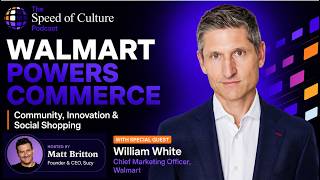
In this Speed of Culture podcast episode recorded at the POSSIBLE conference, host Matt Britton interviews William White, Chief Marketing Officer of Walmart. White recounts his unconventional path to marketing—from early internships and a stint at Starcom, through a dual‑degree MBA, to senior roles at Coca‑Cola and Target—highlighting how curiosity about people and brands shaped his career. He discusses the challenges of joining Walmart two months into the COVID‑19 pandemic, describing the crisis‑driven onboarding, the importance of frontline workers, and the need for rapid decision‑making. White explains how Walmart balances its historic brand purpose of "helping people save money and live better" with innovation, emphasizing community presence (4,700 locations, local assortments, social media engagement) and a culture of experimentation inherited from Sam Walton. He outlines the company’s omnichannel evolution, focusing on BOPIS, social commerce, the Walmart Creator platform, shoppable livestreams, and personalization powered by first‑party data and Walmart+. The conversation moves to AI and supply‑chain automation, illustrating how technology enables faster, more relevant recommendations. Finally, White shares leadership lessons—observing good and bad leaders, valuing curiosity, patience, and a daily focus on progress—advice aimed at younger marketers. The interview blends personal anecdotes with strategic insights into Walmart’s marketing, technology, and culture.
Chapters
Up today, we're gonna be speaking with William White, Chief Marketing Officer at Walmart. William, so great to see you. How you doing today?
I'm fantastic. I'm excited to be here and thanks for having me on the show.
Absolutely. We're down here in sunny South Beach, uh, for the POSSIBLE conference. I was so excited to hear that you were gonna be joining us. Curiously, you know, you're the CMO of Walmart, one of the most, uh, prestigious positions in all of marketing. Did you know at a young age that marketing was gonna be an area that you'd end up in one day?
Well, in 1984, I wanted to be Eddie Van Halen. Okay, certainly, certainly not always. But, and even when I was in college, I was a public policy major and I did an internship at a policy foundation, did an internship at a lobbying firm, and I ruled that out. I tried one more thing, doing an internship at an investment bank. Also not for me. I think the moment that clicked for me where I knew marketing was the right field was my first job out of college. I was working at Starcom. And I went there because, well, you know, as I said, I had other interests along the way. I've always loved brands. I mean, even at a young age, I've loved brands and I've always loved people and getting to know and understand people. And so I think, you know, kind of that combination of a brand, being a fan of big brands and wanting to get and understand people kind of led me to go into advertising role out of college. And I was at Starcom the second client that I worked on while I was there was KitchenAid. And I was in my early 20s, living in a really small apartment in New York. I had a few roommates. We did not use the kitchen. In fact, one of my roommates put— stored his jeans in the oven because his closet was too small.
Yeah.
And we never used the oven. So I couldn't have been farther from the KitchenAid target audience. And yet I loved getting into that mindset to understand who KitchenAid was trying to reach. Which again was so far from me and how I was living. But sure, I appreciated that so much. And I, I kind of knew then that marketing was a thing for me and I could, I would want to make a career out of it.
So you were fascinated with the consumer, sort of the insight behind their go-to-market strategy, and that curiosity led you to believe, hmm, maybe this is the area I want to go into. And then you ended up a few years later at Coca-Cola as on the brand side. What was the process like trying to get hired by Coca-Cola? Going from the agency world?
Well, I did a stint in between in business school. And so, you know, I think that really helped, you know, set me apart. Although I went into—
was that a good decision in retrospect?
I think it was a great decision.
Okay.
Learned a ton. And, you know, I really expanded my, you know, own toolkit outside of more of an advertising or even media specific. And I did— I actually did a dual degree in marketing and finance. And so I really tried to round out from a business perspective. I— a lot of people out of business school programs go into, you know, kind of CPG marketing roles.
Yeah.
I actually didn't do that route. So I made it a little bit harder for myself by not going into sort of the program, you know, the programs that those companies were recruiting for. I went into more of a corporate strategy job. So it was a little bit harder to make that move. A little bit of hustling, I think, to find the right opportunity. But The time at Coke was fantastic. I spent about 9 years there, learned so much from just so many great leaders. And it's a great, great—
Iconic American brand. Iconic and global brand. Yeah.
And 2/3 of my time was actually on the global side of the business. I was based in Atlanta, but was a global brand director. And I think that opportunity to travel the world and really, you know, understand rich culture around the world had a huge impact on me, my development, my career.
And working at such a large corporation early in your career, obviously you had to quickly learn how to kind of learn the ropes and navigate such a large organization. Talk to me about your experience in doing that, because I think a lot of people, some of our younger listeners, think, you know, it'd be intimidating working at such a big company and not really knowing how to spend their time and where to focus on.
Yeah, that's, that's— I, to me, I certainly felt like, you know, I'm here to build my marketing toolkit.
Yeah.
But at the same time, where I felt like I could differentiate myself was a little bit more on the how than the what. So I was a real observer of leaders within the company, and I was trying to hone my own leadership style from great leaders and maybe the not as great leaders. And in terms of, I guess, navigating, I was focused on that and understanding how the company worked, how leadership worked. And I had a great deal of focus on that. And I think that that has helped me across big multinational companies. You know, some people I think have a desire and a passion to work at smaller companies and some have, you know, wanna be at a big company. Sure. I think my orientation and, you know, the skills that I've built allow me to navigate a big company well.
Absolutely. And after your time at Coca-Cola, you jumped on to another iconic brand, Target, you know, your first foray into the retail side of things. So I imagine that was a completely different landscape than working at a CPG company like Coca-Cola. In what ways was that kind of a, I guess, a shock to your system in some ways in terms of how they work?
Listen, they're both big companies.
Yeah.
And they're both great brands. And so there are a lot of similarities. But I think probably the biggest difference that I found is the pace in retail is a bit faster than in a CPG. And, you know, you have a daily scorecard. You open that morning, you know, that early morning email and you see what the sales results were the previous day. And I think, you know, the pace of change and the pace of moving along the way in retail is pretty different. Also, I think you really see the full marketing spectrum down to purchase, and you see that in terms of understanding customer behavior and insights there. And so it's just, I think, even more rounding from a marketing mix standpoint to have both CPG and retail. And that was a very intentional move for me going from Coke to Target. There are a couple other things that I had opportunities to do, but I was really excited at the opportunity to kind of put those things together.
Yeah, and during your time at Target, obviously, you know, a little company called Amazon rose to prominence. And, you know, it was always striking to me that some of the more established big box retailers were late to jump on e-commerce, but not, not to the extent that it knocked them out. And we'll talk about all the great things Walmart's doing, you know, in the e-commerce space in a little bit. But, you know, how do large companies react to a disruptor like Amazon? And what are ways that you think they can, you know, I guess react quicker or maybe even get ahead of it because it, I was always wondering like how in the boardroom or a place like Target or, or another company, how they're responding to a, to a dis— huge disruptor called Amazon just nipping at their heels and eventually becoming something substantive.
Well, I mean, I think broadly speaking, when a big established company sees a disruptor coming in, you don't realize it at first, right? Because they start small and they grow. And I think there's also this notion of wanting to protect your core and protect your base. And it, you know, you know, you're not always seeing around the corners. I think that for the companies that do navigate well, and I would put Target in that mix, and of course I, I think of Walmart in that regard as well, is they are very open to looking at what's happening in the landscape and being a student of that. And a business as big as Walmart, our, the things that we sell and the way that we help serve our customers is across so many different businesses that we've gotta be aware of what's happening in the grocery space or in, you know, the, the fashion category, right? Healthcare, financial services. And so, you know, I think we're doing a really good job of being eyes wide open to trends that are out there and making sure that we are ready to be nimble as we need to make a pivot or to move in a different direction.
Yeah. So let's dive into your current role at Walmart. I had in my notes originally was going to ask you what it's like to be the CMO of a Fortune 100 company, but it dawned on us that Walmart's actually the Fortune 1 company. Yeah. Right. So number number one, uh, on the Fortune 500. You know, you're driving marketing. You know, you, you took on the role in 2020 in the midst of the pandemic. First of all, what was it like grabbing that role? I'm not sure if you joined before the pandemic or during or—
I joined 2 months into the pandemic. And so that was, that was absolutely a wild ride.
I'm sure.
Uh, I mean, one, changing companies is always challenging. Changing companies in a different city, you throw that real crisis into the mix. And it was, I think, in many ways, a great way to get really immersed really fast.
Yeah.
And it was, you know, people were in crisis mode. I mean, our customers were in crisis mode, but in a company, you know, people were in crisis mode of, you know, how are we navigating all of the challenges that this is presenting for us and how we do business with, you know, making sure that we're serving our customers and all the challenges.
And Walmart was a vital supply chain for consumers during that time period.
Absolutely. Absolutely. And so, and I would say, you know, we often talk about, you know, the heroes in the pandemic or in times of any crisis. And listen, frontline retail workers, certainly Walmart as the biggest one, they were absolute heroes. Yeah, during, during that time. And so anyway, I felt like it was all hands on deck to get there. There wasn't a lot of time for fluff or extraneous stuff because we were navigating a crisis. I was doing it remotely. I was still living in Minneapolis, but everyone was remote. So in some way, I wasn't on, you know, I wasn't on a different playing field in that some people were in the office and I wasn't. I mean, everyone was remote, although I didn't have the opportunity to build an in-person connection with my team and that sort of thing. And so I made, made sure I made time to really listen and learn and understand from people and try to make those connections via Zoom such that, you know, we could build trust and rapport and the types of things that you have to have when you're, when you're, you know, in a battle together.
Yeah, it's interesting cuz often when you join such a high-profile role, you know, companies like to take their time onboarding a new executive. And here you are, you're entering in essentially retail wartime, for lack of a better term, and you have to make decisions quickly. That's right. And that's a juxtaposition because, you know, Walmart is, is a massive organization. And obviously, as Walmart moves in a lot of ways, so does the US economy and all the merchants that count you as a large customer.
Right. That's exactly right.
Yeah. So as joining as CMO of Walmart, obviously you're coming in, you have ideas, you have differentiated experience. They brought you on for a reason. At the same time, Walmart is an institution. In retail and has so much heritage. I've been down to the first Walmart in Bentonville, and for those listeners who haven't been there yet, you definitely want to check it out. It's fascinating.
And Bentonville is an awesome town.
It really is. Bentonville growing and lots of direct flights from major cities and super cool to be there. But, you know, how do you balance, I guess, preserving the heritage and what was Walmart, what makes it special, with making sure that you're continuing to move the ball forward and contemporize it? Because I imagine it's a balancing act.
It is a balancing act. And I think that is something that is important for any marketer at any company. Sure. But when you take, you know, these big iconic brands, Walmart, you know, go back to Coca-Cola the same way. I think for me, I have, and this was something I learned at Coke, to be a student of the archives and to really make sure that you understand the essence of the brand is, is critical. Yeah. I think in Walmart's case, we have a very defined and felt and lived brand purpose. To help our customers save money and live better. And that's a guiding light for us, and I think helps inform the decisions that we make. But I certainly came in and tried to understand the brand and how customers see the brand, the good, the bad, you know, and all the things. But I also wanted to make sure I learned from the associates. And there are so many long-term associates at Walmart that were able to help educate me not just in the brand, but in how the company works. And that, I think, was, was important in getting off to the right foot. At the same time, there is a culture of innovation and change at Walmart. I mean, if you go, you know, you look at how the company was founded. I mean, Sam Walton disrupted the world of retail with the idea of bringing access to rural communities and doing that at a low price. And he scaled the business, you know, to where it was in the '90s when, when when he passed and set it on a course to continue to grow. But along the way, I mean, he disrupted retail. And but along the way, he was an innovator and willing to move. And that culture of innovation does exist. And so even at—
it's in your DNA.
Even at a big company, it's part of the DNA. And I think has allowed us to not be precious about things and to test and learn and be nimble.
Yeah, you can tell with the innovation, especially as of late on the Walmart side. And, you know, joining during the pandemic wasn't probably only crazy just because what was going on at the time. But then since that point, it's really been a whiplash, you know, 2020, 2021, boom times, a lot of fiscal stimulus. Consumers felt way more wealthy than they probably were. And that obviously led to a whole era of inflation and increased costs and, you know, economic pressures. And then where we are today, where we don't really know if we're at the bottom of the economic cycle or at the top. It's so hard to predict. And I imagine as a retailer, everything from understanding what type of inventory you want to bring in, how to price, what categories you want to lean into, I'd imagine you having your finger on the pulse of the consumer is just so important. The company, you yourself, in terms of where to lean into, in terms of the brand equity pillars that matter at any given time.
Yes. I mean, I certainly think that given our size and scope and scale and the fact that 150 million people come through the doors every week, we are able to see things emerging maybe, maybe before others through buying patterns.
Exactly.
Exactly. And huge credit to our merchandising team, our operators, supply chain to, to navigate what was, you know, a very rocky road. Yeah. For a couple years. But I think that, you know, you reference the economic environment, the inflationary environment, and that is very real and meaningful in the impact that it's having on the wallets of, of Americans.
Absolutely.
And you know, there's the inflationary pressure. Is still where we are today, very real. As you mentioned, many of the pandemic-era benefits are ending. And so that's going to make people feel, you know, even more constrained. In many ways, this is Walmart's time to shine.
Yeah.
I mean, we are a company that was built on helping people save money and live better.
And now they need it more than ever.
And they need it more than ever. And so, you know, we've, we've said in our last few earnings calls that we are seeing share growth coming from higher household income customers.
So people who are trading down. Yeah.
So people, I would say, you know, people who aren't maybe in the exact sweet spot, we, we appeal to everyone and we have room, but people who aren't in the exact sweet spot for us, who are in the, you know, $100,000+ household income, they're spending their dollars with us because there is real value. And I think that we are very meaningful for households today. We, you know, when I first got to Walmart, I would talk about, well, you know, we need to evolve beyond just price because that's functional. Yeah. Today, price is very emotional. And so, you know, I think people really recognize the brand promise and are drawn to that.
Yeah.
And I think that we have real opportunity to continue to delight those customers going on and to to earn their trust for, for some time to come.
Yeah. And speaking of earning their trust, I know Walmart also puts a huge emphasis on the power of community. Absolutely. And making sure that you have your threads or hooks into the community at a variety of different levels. Talk to me about how that impacts your marketing strategy.
Well, you know, I think I'd start with, we are in 4,700 communities across the country.
Wow.
And, you know, I mentioned 150 million people come through the doors each week. And so we are in the community for the community. 90% of America lives within 10 miles of a Walmart. And I think we show up through a locally relevant assortment. I think that we show up through the organizations and events that communities have. And beyond the physical, I think we also show up in a— we have a very robust local social, local social media platform where we're engaging in meaningful ways in social on a local level as well. And I think that's, that's a part of because our associates live in the community and in many cases are, you know, a beacon within the towns where they're operating. You know, we want to make sure that we're earning that trust and building, building a lifelong relationship. Absolutely. And I think that's been a meaningful part of why we've, we've grown to where we are today.
Yeah. And in terms of the future and where you see the consumer headed, obviously, COVID accelerated a lot what was already happening in terms of e-commerce, omnichannel. Now there's BOPUS, buy online, pick up in store. There's so many different angles. There's mobile commerce. What are some of the big growth areas that you see for Walmart in the years ahead?
Well, one of the things that we have invested in and are continuing to do so in building capabilities is around social commerce. Yeah. And I would, I would define that ultimately as shortening the distance between inspiration and purchase.
Content to commerce. Exactly.
Yeah. So you think about, you know, in your life, the social feeds, like how you're consuming content, inspiration can strike at any moment. And for us to be able to be there with the right relevant assortment in a very seamless transaction is critical. You know, if, if the time, if the moment passes, you know, you, we were not at a point to be able to close that transaction, or if you make it clunky, and you got to move to a a different place. Right. And so, you know, within marketing, we talk a lot as a marketing industry about the full funnel and upper funnel, lower funnel. Social commerce is the full funnel in a very condensed, you know, transactional experience. It is brand building, it's driving consideration, and it can drive a sale right there in that, in that moment. And so for us, that has been a real investment. We have created, we launched late last year a pilot beta program that we call Walmart Creator that we're scaling, which allows us to have a direct relationship with creators, providing them with a one-stop tool platform for them to find product, have shoppable tools, have data and insights on how they're doing.
And, you know, they're incented to help drive sales and monetize their audience in a way that fits into what they're already talking about.
That's exactly right. And so that has been a really exciting development for us. Shoppable livestreams are something that we've, we've really been early in for this country.
Huge in China and the world.
Yeah, but we were the first across a whole host of social platforms to have shoppable livestream. Last year we did over 350 of them. That's something that we're continuing to scale. But we also think about shoppable recipes, visual ingredient search. So, you know, to build recipes and to be able to, you know, close the loop on a basket to make a meal, you know, across all aspects of our category business from food to apparel and everything in between, we see a real opportunity in this social content, content-to-commerce space. Yeah. And Americans are spending $300, Americans are spending 2.5 hours a day in social feeds. And so, you know, there's real opportunity to make a connection with them there.
I would also imagine with all the changes that have happened in advertising technology that your loyalty programs and the first-party data you have just allows you to be so much more in control of being contextual and reaching the right consumer at the right time in ways that other companies can't.
That is absolutely correct. I think that, you know, personalization is a big trend that we're seeing right now. And I think our ability to have the data and insight from our customers allows us to have a better experience for them and to personalize the digital experiences that allow us to serve them better. And I think that absolutely leads to greater engagement and loyalty. We have membership program Walmart+.
Yeah.
And, you know, as our customers kind of grow in their relationship with us, we see more and more coming into Walmart+ where, you know, we can provide even greater level of, of personalization and experience for them there.
Yeah.
So it's, it's, it's certainly an exciting time for us.
Absolutely. And with the footprint you have at Walmart, you talk about 150 million consumers walking every day. It's nearly half of the American public, right?
Yeah.
Being able to scale things, right? Yet also customize them. Customization at scale is probably something that is incredibly important to the company. And with the advent of all these new AI tools here in 2023, I imagine it has to be something you're looking at. And just curious what your take is on all this and where you think it's all gonna be headed.
Yeah, I mean, technology is, I think, helping us across all aspects of our business. Yeah. I mean, in our supply chain, it's allowing us to, you know, better understand what needs to be where. There's automation happening in our supply chain that allows us to be more efficient and get ultimately get, you know, products to customers faster. Within AI, I think it helps our ability to understand what the customer is going to need next and to build the right kind of recommendations for them and offer them the right kind of solutions. And so we have, we have a very aggressive, you know, technology and innovation agenda that helps to power across our business to serve customers better.
Yeah, absolutely. So shifting gears here as we wrap up, William, I mean, met you for the first time today and you strike—
we just missed each other yesterday.
Yeah, we just missed each other. But you strike me as somebody that's way more approachable than someone who I would think would be the CMO of Walmart. Meaning I've met a lot of executives that are in high-level positions that kind of, for whatever reason, feel like they need to make it— make me feel like they're a big executive. And you come— you strike me as someone who's very approachable and personable, and I imagine that's had to help you throughout your career. How have you been able to be successful as an individual, and what things would you impart on some of our younger listeners? Sure. In terms of things that have worked for you throughout the span of your career to end up where you have today.
Well, first of all, thank you for the compliment. I think that was a compliment.
Absolutely.
I have to give credit to my parents.
There you go.
Shout out to your parents. For raising me well, I guess. But I talked a lot about early in my career, observing leaders.
Yeah.
And like I said, I really tried to observe the good and the bad. And I have a real passion for progress. And I think, you know, that notion of improving every day in all the things that I do is really important. That's what drives me as a leader. You know, taking all those tips and observations along the way, I think, has helped shape my leadership style. I don't like to work with a-holes. Right. And, you know, I think most people don't. And the power— I mean, I can't do anything without a great team. Yeah, nothing. And I think the best way to recruit and retain and engage talent is to be a great leader. So, you know, that's something that I'm trying to hone my craft as a leader to make sure that, you know, building the right kind of environment there. So I guess, you know, advice for young people in their career, I mean, that's a part of it. I mean, definitely make sure you're observing. I think curiosity is a hugely important—
very consistent theme we get from people about being curious.
I mean, to be— I think to be successful, you know, that's going to help you no matter what you do, but particularly in marketing, being curious about how your business works, being curious about what the needs and motivations and drivers that your customer has, being curious about culture. All of those things are really important to being a successful marketer. So you've got to be curious. The last thing maybe I would point to as advice for, for young people in their careers, patience. I mean, if you're in your 20s or if you're 30, you're probably going to be working for double, you know, you're, you're not going to double the time that you've been alive in the workforce. There is a long, long road ahead. And, you know, sometimes I find that there are young people who have a path that they feel like they've got to check the box and they've—
it's written out, especially in these days with the social media pressures.
Absolutely. Absolutely. And so I think that Be patient. Your career can move in a number of different ways. And make sure that you are learning along the way and you're getting all that you can out of an experience. And don't get hung up on, well, I need to be here, or I need to have this job title by such and such a date. I think focus on the experience, the what and the how, in terms of your own capabilities and leadership style. It's going to lead you to good places.
Yeah, as it has for you. So lastly, William, I mean, you've imparted a lot of wisdom on our listeners and me as well, so I really appreciate it. If you had to kind of sum up your learnings into a mantra or something that you like to live by, does anything come to mind?
I mentioned progress. I mean, for me, I have a real passion for progress, and there are a whole host of things in my life that I think has pointed, you know, pointed me in that direction and, and led me there. But I I really try to in all aspects. I mean, as a, as a dad, as a leader, the very specific work that I'm doing as a runner, which is hugely important to me, like I want to be better, you know, today than I was yesterday. And that's something that I really live by.
Yeah. Focusing on progress, taking that step forward each day. Well, thank you so much for joining. It's been so great being able to spend time with you. I have no doubt Walmart's going to continue to flourish under your leadership.
Thanks for the time. Really enjoyed it.
Absolutely. On behalf of the Suzy and Adrienne team, thanks again to William White, Chief Marketing Officer at Walmart for joining us today. Be sure to subscribe, rate, and review the Speed of Culture Podcast on your favorite podcast platform. Till next time, see you soon, everyone. Take care.
Hey!
More from Matt




MikMak’s Rachel Tipograph on Consumer Spending, Retail Media & Holiday Shopping Trends



Jaguar Land Rover’s Charlotte Blank on Luxury, Purpose & Experiential Storytelling



