Warner Bros. Discovery’s Jon Steinlauf on Streaming, TV Ads & the Future of Media
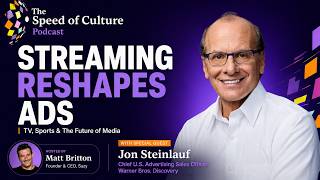
Jon Steinlauf, Warner Bros. Discovery's ad chief, says advertising is fundamentally a relationships business. He explains how sports and news keep linear TV alive, and how WBD bundles content and branded sponsorships like GMC's title deal on True Detective to create wins for advertisers in a fragmented streaming world.
Chapters
Today we're thrilled to be joined by Jon Steinloff, Chief U.S. Advertising Sales Officer at Warner Bros. Discovery and 4 times named in the Adweek 50, the annual list highlighting the top business leaders in advertising and media. Jon, so great to see you. Thanks for joining today.
My pleasure. Thanks for having me.
Absolutely. So you've been at CES, I'm sure, a bunch over the last several years because it's kind of become a hub of media and innovation. And it comes at an opportune time at the beginning of the year when lots of brands are planning, lots of people are thinking about the future. What do you personally try to get out of being here in Vegas?
For me, it's networking. Yeah. Having a lot of clients, a lot of agencies, a lot of ad tech companies, a lot of media, being able to do a podcast. Yeah, it's all part of the process. So I'm here for the, the people that, you know, I do business with all the time.
Yeah. And, you know, you've obviously been doing this for quite a while. And when you started, Yeah, you know, you were director of ad sales at ESPN, um, in the mid to late '80s. And it was the, the world was different then, right? Like we were still a while away from, um, you know, the, the internet becoming a mainstream consumption habit. And it was generally a world where cable TV was kind of the new thing. Um, and now we're in a completely different world. How have you managed to kind of evolve with the changes in the broadcast and, and broadcast advertising world and, evolve yourself as a professional?
Well, I think it's part of what made this a very long career for me is I like all the changes. You get a competitive advantage if you are ahead of it. And I've always tried to stay on top of what was going on with technology and with marketers. Cable, at one time when I first started, that was the new medium that was— Yes. That was innovative technologies. I saw that from the early, early days. And today it's, we call it video more than we call it anything else, but it's still at the backbone of the business is TV-type content.
That engages the audience. And when you talk about obviously being here at CES to network and meet people, I guess in that regard, like throughout all these changes, what stayed the same about your job in terms of what's still important today that was when you started out in your career?
I think the number one thing that stayed all the way through is because it's a relationships business. Yeah. Which, as I said, which is why we come to these events. We come here, we come to Cannes. Super Bowl's coming up back here in Vegas in a few weeks. It's a business that a lot of money gets transacted without attorneys. And you don't get to stay in power in this industry for the long term if you don't have the trust of the people in the marketplace that you're doing business with. It's amazing that we transact, you know, $10 billion a year at Warner Bros. Discovery in ad sales, and 90% plus of it is done without attorneys. So your word is what's most important and your relationships. And the people change, but for the most part, the people that are in the senior level roles, in this industry have been at it for a long time.
Yeah. And what has been sort of a success of, secret success of yours in terms of managing and maintaining those relationships at scale? Because one mistake I think a lot of people who are in the sales and marketing world make is that they gravitate towards people who can help them in the moment. Like whoever has a big budget this year, that's who I'm gonna spend time with, but I'm not gonna worry about other people. But obviously down the line, It's a long road. How have you been able to manage relationships at scale and, and grow that network over time?
It's just working as a partner. Yeah. Knowing that the same people you're gonna negotiate with every June, June is the main month for upfront transactions. Knowing that you're gonna see these people again every June and then in between the Junes and not thinking short term. Markets swing. Markets have been swinging wild volatility. Two upfronts ago, in the '21-'22 upfront, which was negotiated towards the peak of the pandemic, the rates of change in that marketplace were 20% in many cases for highly—
You're saying there's so much demand because of COVID Highly sought-after properties.
And then it drops down and it goes back up again and it moves around. So I think if you take the long-term view of pricing and partnerships, knowing that some years it's gonna go with you, some years it's gonna go against you, but not to try to think more than, you know, if you think one year at a time, it's not gonna work. If you think about 3, 5 years and a lot of the clients are gonna be with you all the way through, You want them to feel like they're getting a win-win, and they want us to feel sometimes like it's a win-win too.
Is there a system that you've kind of developed or anything you put in place in terms of how you spend your time to make sure that you are keeping the relationships warm, adding value? Because I imagine that's something that you have to be pretty intentional about.
It's just connecting with people. Today with Zoom, it's easier. Right. One of the changes that's happened in the marketplace since the pandemic is we all learned how to work remotely, and it's easier to stay in contact with people. 15, 20-minute Zoom calls every couple of months with major clients, major advertising agency folks, takes the place of what we used to do, which is we used to fly all over the place and have lunch, you know, go to lunch all the time. And I think it's more efficient right now to be able to just check in with people. We call them the catch-ups. Yeah, this is a lot of quick 15, 20 minutes. So we've adjusted how we work together because of the the changes, the disruption that the pandemic caused.
Absolutely. And talking about those changes, I mean, the TV advertising world and just the TV ecosystem is more complex and confusing than ever before. There's so many streaming services, there's devices, there's fast channels, there's so much, uh, so much different jargon that most people outside the industry don't really understand. Given all those changes, what's most important to the advertisers you're talking about? What do they most focus on today and how's that may be different than 5 years ago?
To me, the biggest change in the last 5 years has been the importance of targeting.
Yeah.
So addressability. Addressability, targeting, being able to eliminate waste. So if you are a company that, you know, there's 330 million people in our country, but there may only be 50 million that you really, really want to reach. And streaming allows for more of the waste-free approach, but data-driven linear as we now call it, where you can look at all these options and say, I only wanna buy content in linear that has a 125 index on those 50 million people that I really wanna reach and I'm gonna reach others too. So there's been a real premium placed on advertisers having first-party targets and sellers, media companies having first-party targets or great data on their audiences and being able to blend advertiser data with programmer data and be able to try to reach as many people as possible. I think that— so the targeting to me has been the biggest change. Streaming, of course, and Netflix got the ball rolling in 2010 as the first major streaming service. Yeah. And I would say Netflix and Hulu were the pioneers in this area. And now a lot of people have jumped in, but streaming is a, is, has been disruptive. Um, maybe more so than anything in my career. I, I haven't seen as much in terms of being able to displaced the ads. So the viewing experience, people have gotten used to watching a lot of content without advertising, and now it's shifting back more towards advertising, which is—
TiVo first came out. Yeah. It must have been a big, you know, oh my God moment because, oh, people could just fast forward past the ads or they weren't gonna watch ads. And now with streaming, it's kind of bringing it back with the, the addressability on top of it.
Yeah. And the DVR, VCR, all that TiVo, that, that was a big disruption, but not Not as much as Netflix and streaming has disrupted. That's, I would say, that would be the number one change in, in my career.
Yeah. And the form factor of television has also changed in terms of how consumers are finding content. I mean, one big thing I'm gonna be personally fascinated with this weekend, and we're filming this in early January, is the NFL has a major playoff game that Peacock is streaming. And you know, it's a mainstream, NFL is like as mainstream as it gets. A lot of people aren't gonna be able to find that.
Well, you know, it's gonna become, it may, become an interesting test of streaming as pay-per-view. Yeah, exactly. Like we're used to UFC and WrestleMania pay-per-views.
I used to do WrestleMania all the time. I used to beg my parents, spend $20, WrestleMania.
In the old days, I remember Mike Tyson fighting. It was $50 and he would knock somebody out in 30 seconds.
Yeah, I remember.
But the way I look at this is Peacock's in about 30 million homes. They've got maybe the first or second best matchup of Wild Card Weekend. They got Miami, Kansas City. The other one is Dallas, Green Bay. I think Dallas and Kansas City are the two glamor TV teams right now. And so the league did them a favor. Peacock, I think NBCU paid about $115 million premium to get this game just for Peacock.
Just for that one game.
So if you're living in Miami and Kansas City, the league requires those games be available on broadcast signals, but the rest of the country, so there's 30 million homes that have Peacock, there's 100 million homes that don't have Peacock, there's maybe a million homes in Miami and Kansas City. So now you have 99 million homes in America that are going to have to decide, if I want to see this game, I got to either figure out a way to go to a bar that might have it, which might not be easy because I don't think a lot of bars have Peacock, or can I subscribe for $7? I think it's $7 and there's a minimum 1-month commitment. So you could see the Peacock sub base swell to maybe 40 or 45 million in one night, and then it could contract.
Assuming they remember to cancel.
Yeah. Well, I think that's the bet that NBC's making is we'll get them in. We got a great game. Maybe they'll see the promos and they'll like what they see and they'll they'll keep it on. We did something similar at Max. Max is our big streaming service. We have two streaming services, Max and Discovery+. What we do with Max is during Black Friday Thanksgiving week, over a 7-day period, we gave an introductory trial rate for Max with commercials at $2.99 a month. And we made Max with commercials significantly bigger. It's about— it's been around for a couple of years, but within one week with this $2.99 locked in for 6 months, then you would have to roll to —right— the full price of $9.99. But the goal was really to get the service with ads, the AVOD version of Max, get that into more houses.
You have more scale for the addressable product you're selling.
But it's a way to say, try it out for 6 months. It's loaded with content. And the key for us is there's so little advertising. And I think what we're seeing is with AVOD services, you know, the first thing you think about when you hear Netflix with ads, Disney+ with ads, Max with ads, Hulu with ads, the first thing you think about is, is it going to be like the linear experience? Is it going to— we call it the ad load. Is the ad load going to be like linear or is it going to be less? So by allowing people to get it in, get it for $2.99, they're going to see how good it is and how little advertising there is on it.
Why is there little advertising on it? Because you can charge higher rates because of addressability? So the economics work?
We just want the experience to be different than linear. Yeah. Not only is there less advertising, the model is less advertising, scale it more. But also targeted advertising. So you pay $5 less, you get a little bit of advertising, but the ads are so targeted through programmatic channels and data targeting that the ads are more relevant to people that are in market for the products they're seeing.
So true. I mean, I watch YouTube TV and all the ads I get are for software and stuff that they just know I'm logged in and who I am. It's on TV. It's a little jarring at first because you're used to TV. Talking about like how things have changed, targeted towards a cookie-cutter 18 to 34, 34 to 49 demographic. And now when you're watching YouTube TV, it's kind of anything but. Mm-hmm. So it's fascinating.
Yeah. And you, I mean, you mentioned earlier how it's a crowded space. The streaming is crowded. AVOD is becoming the trend. I think this is one of the stories of this year is gonna be, you know, who's gonna do well with AVOD. Amazon's coming out with their AVOD. Netflix is just getting started. Disney+ is just getting started. We've been out there for a while. Um, Hulu and a couple of others, Peacock and Paramount+. So you have a lot of competition that's moving towards AVOD streaming. And I think it may take a year or two for the audience to really understand what shows are on what streaming services, how much advertising is there, and what are the price points. Yeah. We have a bundle right now where we're doing where Verizon is offering Netflix with ads and Max with ads. For $10 a month. So the retail price for Netflix with ads and Max with ads—
Verizon's offering that from their home—
Verizon Wireless. Not Verizon Fios. This is Verizon Wireless. Streaming over your phone. So no, not over your phone. This is over your living room TV on the big glass. So you get it with your Verizon Wireless subscription. If you're a Verizon Wireless customer, and I think you have to have a certain level of plan, you can now get a bundle with Verizon Wireless that includes Netflix with ads, Max with ads, for $10 a month, those services in retail would be about $17. Another example of trying to get people into the, into the base, get more people to sample it so that we can make most of the money on the AVOD side of it.
So one question I always had is that the consumers that are in the higher income brackets might pay the version to not see ads, right? Because maybe they value your time more. They— so does that create a challenge for you for advertisers because maybe your AVOD product only reaches a certain household income because the higher household incomes are paying to not see the ads.
Yeah. This company that Warner Bros. Discovery, where I am, is only 2 years old. We merged Discovery and WarnerMedia in first or second— second quarter of 2022. So it's slightly under 2 years. And what we found is that the HBO brand, while it's been around for over 50 years and it probably had its best year ever with Last of Us, Succession. Succession just swept the globe the other night. My favorite show, yeah. You know, House of the Dragon, White Lotus. This Sunday night, we're premiering an incredible series. We just screened it with Jodie Foster. It's called True Detective: Night Country. And what we see with HBO, when we first started studying the numbers, It was more of a coastal brand. And it had, as good as it has been for the 50-plus years, it never really made it more than 35, 40 million homes.
And even Entourage, I remember, was like a coastal brand. It was a huge thing in the people of New York. But you go to middle America, people didn't watch it.
So what we decided to do is, knowing that it was more coastal, we said, you got a lot of people who are used to watching HBO on the coasts. That are paying $15 a month and not seeing any ads and enjoying it and staying with it. But can we open this up to a $9.99 customer and add a lot more product to it? So now you have sports on it, you have news on it, you have all these Warner Brothers theatricals. Barbie's been on the platform now for a couple of months. All of the, the Scripps brands, HGTV, Food Network, Travel Channel, all the Discovery brands, Discovery, TLC, Oprah. Animal Planet, all that content is on. And then a lot of the Turner content. So you have Turner, TBS, TNT, Adult Swim. So we've made Max so big, so complete, and have so little advertising on it that we've actually said we want to go after that $9.99 customer. Got it. So it may not— you know, in your mind, you're saying, do you really want people who are used to watching TV without ads? They may stay in the ad— you know, these upscale people you're talking about. They may stay in the ad-free, but there's also the option of the $9.99. And when it comes to the upscale, real upscale demographics, the cable bundle, the 72 million homes that subscribe to pay television today, those are the most upscale 72 million homes. Those people who are paying $100 a month, they want the whole experience. Yeah. And they especially want the sports and the news, the live news channels. So we have the mix, we can mix and match and try to find the upscale people. Whether they be in the cable bundle because they, they want to, they want everything, or if they're in the, uh, streaming side, we, we can find them as best as, as best we can in the AVOD.
That makes sense. And do you see a world where, just given the success that we've seen with Google and Meta, that TV ad buying, addressable TV ad buying might become programmatic for like maybe the mid-market? Like I'd love to ad run my software company's ads on your network. Just targeting people who went to my website or who match my first-party Salesforce data and just buy that programmatically. Is— are we in a world with that? We can see that in 5 years from now? Well, we, we already see it in streaming. Right. But the target, it's not as good as it is on buying on Google or Facebook with the programmatic interfaces that they built.
We, we think our programmatic business on Max is growing fast. Really? And, and we have, we have the capability of really targeting in streaming. We have plans at some point to be able to do a lot more linear targeting. There's a lot of technology that's now available where you, the approach in certain MVPDs, certain virtual MVPDs where you can target the way you can in streaming on linear. So it's happening, but I think it's gonna become more of the commoditized inventory.
Right. I think almost like display and things like that. Right. You're not gonna buy a Super Bowl ad over programmatic.
Yeah. I think the big sporting events, the big entertainment events, events, I think, will probably continue to be sold in the traditional way. And, but I think a lot of the other inventory in TV over time will be sold programmatically with, with real targeting.
Yeah, because, you know, you look at Facebook and I think it's two-thirds of their advertising base is small businesses. So that makes me think that there's a huge market that's underserved through this channel, that you can open up new markets if you can open up programmatic channels, even if it is kind of the more general basic display equivalent of banner ads on this, I think people would still buy it because that's where people's eyeballs are. When they're not on their phone, they're looking at their TV set. It's kind of like where you capture the consumer. So I want to hear just about Warner Bros. Discovery. And obviously, you know, the merger happened and it's now a major player in this space. Talk to me about the overall portfolio of assets you have and what the story is that you're talking to your contacts and advertisers about in 2024.
Well, at, at Face value, Warner and Discovery look very similar. Uh-huh. They're cable networks. There's a lot of brands. There's a lot of history and tradition to the businesses. But as we got to know the combination better, let— in 2022, as we really started to look at the portfolio side by side, what we found was, coming— me coming from the Discovery side, Discovery was known for highly targeted categories like home and food and travel and pets and science and Motor Trend. So a lot of these verticals, a lot of well-branded lifestyle-type networks. And what Warner was really, really good at was sports and news and Hollywood, three things that Discovery really didn't have in the United States. So the sports portfolio at Warner has been performing off the charts. We have the NCAA men's basketball tournament, also known as March Madness. We have that for— we've done that in partnership with Paramount and CBS for— this is— we're going on our 11th year. We have a 20-year contract to do those. So we have this year plus 8 more. But the sports portfolio was NCAA tournament, NBA, NHL, MLB, some soccer. We just picked up NASCAR. So that is all additive to us. And that was— sports is the most important genre. Sports is the new primetime. It's the most important genre in ad-supported television, no matter what platform you're looking at. Then there's CNN. And we're in a highly active news cycle right now. That's for sure. And it's going to be this way throughout the rest of 2024. We didn't have that at Discovery. And then all this Max and the Hollywood side, the Warner Brothers side, DC Studios. All the IP. Yeah. And all that IP coming from the HBO original series, which we just mentioned. But Wonka is now— this has been the holiday movie hit of the season. It's approaching, we think, $600 million domestic— $600 million global and about $200 million domestic. So we— all of that content becomes part of this bigger portfolio. So I think we've created a really complete company from an IP side. And we're getting our arms around it. And it's— we're going through the process of truly trying to make sure that we know every part of this portfolio and we can make it all available to advertisers with a partnership and a marketing opportunity that is customized for them.
And now that you have this wide portfolio, I would imagine a big part of your conversation with advertisers is matching the assets to the brand based on who their audience is and where those eyeballs live.
Yeah, we're doing something— an example would be, we're doing something— I mentioned this series, uh, True Detective: Night Country with Jodie Foster. We're about to do 6 hours of it. It was shot It's set in Alaska. We shot a lot of it in Iceland, and we sold the presenting sponsorship to GMC for their Sierra rugged truck. Sierra. What we did for them was in the homes that have the ad-supported Max, in all of those homes, when you watch it on this Sunday night, when we premiere it, there's going to be a pre-show like you would see in cinema. We call it a title sponsorship. We've created custom content with this truck. And there's billboards and bumpers that say, "This episode of True Detective: Night Country is brought to you without commercial interruptions by GMC Sierra." So they get the attribution before the show starts. They get the attribution of all those ad-supported homes of bringing this episode to people who are paying less to not have it, paying less to see ads. They don't see ads, courtesy of GMC. And the video that we created that we load before the show starts is all about the truck in rough terrain. And this series is really— contextual. So it feels like it was produced. And this just comes out of a— before Discovery, I worked at Scripps. And out of the Scripps playbook, we used to do a lot of this with HGTV and Food Network and Travel Channel, where we would create content for advertisers that seamlessly flow in and out of the food and home and travel content for those demographics.
It didn't feel like— jarring advertising in the middle of what you're watching.
Yeah. And that's important. So it's not so much, you know, people think that there's too much advertising, it's clutter, but advertising can actually be additive to the experience. Yeah. Because if it's content that people who are in the right mind, frame of mind to watch, because the programming is setting themselves up to see products that might be able to help solve some of the things that they're seeing in the shows. I think that's a great model for today. And in the sports business, if you think about watching sports today, I'm watching the college football playoffs on ESPN, and they have Dr Pepper and Nissan. They have these continuing campaigns, the story within the game. And Dr Pepper has a story that's related to their Fanville town. Nissan has the Heisman, has all these Heisman winners and the mascots. So what we're seeing in sports, and we see this with our Charles Barkley, who does a lot of advertising Capital One in the NCAA tournament with Spike Lee and Samuel L. Jackson. We're seeing in sports a similar approach is using celebrities, using themes, using marketing partnerships you have with sports leagues to create content that advertise, that viewers think of as being a story that you're following along.
Branded entertainment, basically, right?
Branded entertainment. Yeah. And, and it's, it's probably best— the best use of it has been in sports.
Yeah, you're right. Advertising used to just be you're watching something you love and all of a sudden it's like you break for commercial and you see a 30-second spot that has nothing to do with what you're watching. And that's what did make people tune out. And it just dawned on me when you— when I asked you the question about the premium consumer maybe paying to not see ads. I mean, I guess one of the solutions is you give like behind the scenes additional content that is part of the ad package and it's woven within the ad product. And I could see that working really well with sports as well, where like an ad could be an interview with an athlete in the game, which is sponsored by a brand that you wouldn't get if you didn't buy the ads.
Like State Farm is, is a, has done a great job in trying to get people to come to State Farm to see additional content. So when they have Travis Kelce or they have, Patrick Mahomes, or they have Andy Reid. They're really big with the Chiefs, State Farm and the Chiefs. Yeah. So what they do is they test, they use, I think EDO might be their partner, but they have an attribution partner that they work with and they actually can gauge when an ad with these Chiefs celebrities come on, how many people actually will immediately click to State Farm, not necessarily to get a quote from State Farm, which is what they would like, but to actually see additional content. From state— within the first few minutes after those ads run, go and see more, engage more with the kind of content that they're seeing in linear. Yeah. So it's a driver to social and apps where they're going to be able to experience more of the kind of content they see in ads, which is pretty amazing.
And do you see commerce being a part of the future where you can watch something on TV and then click on it and then you get brought to buy it? I see Amazon Prime doing a lot of that right now.
Yeah, they tried it on Black Friday with that Dolphin-Jet game with the NFL. Not a great game. Not a great game, but they've had a good second season. Give them the credit for that. Sure. But we see it more with— back to HGTV, Food Network, Animal Planet, these networks, Motor Trend. These are networks that are really set up for endemics to be able to show the the way their products are being used by consumers.
Content to commerce. I mean, they're built for that.
Yeah. So if there's a project being done in a show, if you're watching the Property Brothers and they're doing a makeover and an ad pop shows for Sherwin-Williams, or an ad were to come up for flooring or lighting or outdoor pavers and people are engaged with that, we can then put up a QR code. I think the QR codes in linear will be the way it's going to scale. Yeah. In streaming, there's a lot of ways through— there's an ad an ad tech partner called Brightline. And then when you're watching on a mobile device, you're watching a show on streaming and a break comes up, they give you a choice of 2 or 3 ads. And if you, whatever, whichever one you pick, whichever one you pick, now there's data capture opportunities, there's commerce opportunities. So those are, but it's hard to scale when you're talking about that kind of content in streaming. So I think the big opportunity will probably be when it comes to linear using QR codes, which is what Amazon was trying to do on Black Friday.
Yeah, I was thinking more like you're watching HGTV and there's a lighting fixture that's in the show. I want that lighting fixture and I click on it and then I get a notification or something and I can buy it.
Well, we do that with Wayfair. They're a home fashion e-tailer. So what we do is they are the primary sponsor of the HGTV Dream Home. And what they'll do is they'll set up the dream home. They'll set up a landing page. So if you're watching an ad for the dream home and it's brought to you by Wayfair, they'll say, come to the landing page, be inspired by the dream home, come to the landing page and, and they'll have rooms set up where you can actually do commerce live on a, a landing page. Right. Makes sense.
So where do you see this all going in terms of linear TV? Are we gonna hit a point 5 years from now where, because all the new TVs that are being sold are all smart TVs, right? Mm-hmm. So are, are we gonna enter and, and there's 5G that's streaming to the home. Are we gonna hit a place where linear TV is no longer 5 years from now, or do you think it's going to be one of those lagging things which will always be a part?
Well, I just was reading this morning Wells Fargo came out with a study. It was written up, Hollywood Reporter had the story this morning. And they were saying how pay television today, 72 million homes have pay television and about 60 million don't. And their projections going out for the next 5 years were that the pay TV erosion would be about 5 million a year. And somewhere around— plateau somewhere around low 50s in 2028, I think it said. My view of it is, Matt, that I think the big glue to the linear bundle is going to be sports. Yeah. The NFL's contracts. We're doing new contracts with the NBA, the college football playoff, the— The March Madness, which we have, the Olympics. So I think that broadcast and cable bundle linear will stay very solid over the next 4 or 5 years, primarily because the sports fan will always want to have the bundle. The sports fan, the casual sports fan will work with Amazon and, you know, we have, we're going to have an offering. Max is going to have a sports offering and ESPN will have an over-the-top direct-to-consumer offering. So I think the sports fan will, you know, may— the casual sports fan may be able to cobble together a set of streaming services to give them the regional sports networks and the national sports. But the true sports fan or the true sports family is going to need to be in the bundle for the long term because, well, the contract's already set. So I think that covers about close to 50, 55 million homes are going to probably stay with the It'll be $100 and something a month, but they're going to stay with it. And then I think there's another cohort where they'll be the wealthier, more affluent people. They're just going to say, you know, the $110, $120 a month, I want everything. So between the wealthy and the sports families, I think this is going to be a pretty critical mass of linear and bundle that'll stay in place.
Gotcha. It's great insight and perspective. So wrapping up here and just shifting gears into your career. You know, you've had a great career and thank you. You know, you're, you're working at an exciting network in an exciting time in the, in the streaming world. When you look back on your career, what are some of the things that you think you did right? You talk about the power of networking and the power of relationships. I mean, I think sales is the most underrated part of business. It kind of gets a bad rap, but every good entrepreneur I know is a good salesperson. You have to know how to— selling is about persuading. It's about storytelling and it's about ultimately driving action, right? And you've obviously done a great job at that. When you look at your career, whether it's within the sales realm or just decisions you make, what are some of the things that you think you did right that maybe the future, um, exec listening to this could take advantage of?
Well, I'm not a natural-born salesperson, and I got into this chair— there aren't that many chairs in the network business in sales— and I got into one of those chairs, and I feel fortunate to be there. Without being a natural born salesperson. And I was able in 1985, my sales career started and it started at ESPN. And there was a comfort for me selling sports as my entrée. Because you're a sports fan. Yeah, I'm very passionate about sports. And there was a comfort for me knowing that I was selling something that I knew a lot about, that A lot of the work that I needed to do to be good at selling sports, I was going to just do anyway as a fan, just studying teams and games and ratings and contracts and rights fees and players. So I just was comfortable doing it, going through the sports door. And then when I got in, I started to realize I needed to find my own path, my own way into a successful sales career. And for me, it was just following the viewer really carefully. And listening a lot to my clients. Not every salesperson has to be a work the room, be like a big personality— Smoother, right. —that hangs out and does all the social stuff. I had to be good enough at that, but what I found my style was really to outwork people and outread people and now listen to podcasts like yours. So I think that What I noticed during the pandemic, living in Manhattan and having the AirPods and just walking around Central Park just to be able to get out of the apartment during the pandemic, and the podcast replaced a lot of the energy that I was getting from— that I used to get from being around people. And so it's becoming, I think, the secret weapon to stay up on things is people like you and Puck and Pivot. These companies do such a great job covering our industry that I'm finding that I'm being able to absorb the information better through audio than I can sometimes by reading. So I've just felt like I had to outread people. I had to outstudy people. I had to know more about the viewer. And, but I think listening more than you talk is probably an interesting way to think about Sales.
Yeah, I always tell my sales team, if you take a 1-hour sales meeting, if they're— if the client's talking 50 minutes and you're talking 10, your chance of doing a deal is so much higher than if it was the opposite. You want to— if you let the customer talk long enough, they'll kind of tell you exactly what you need. Yeah.
And then to get into leadership, to get into the senior, senior levels of ad sales, you know, it takes, takes, uh, I mentioned earlier about trust and reputation and not having a lot of contracts and people taking you for your word and you being good to your word. So I think being unflappable as a leader, having the trust of your team and then having the trust of your clients, listening more than you talk, to be there for your team. No one can do this. No one can do this successfully without a strong team. Yeah. And I've learned my lessons about making sure that I had my team's back. And they had my back and they supported me as their leader. And they have to believe in the leader. So all those things really matter. It's like being able to teach and motivate and mentor and listen and to be there for your team is as important as any other part of the selling and managing process. 100%.
And to wrap up here, is there a mantra or quote that you like to live by that comes to mind? We always wrap up our podcast with this question.
I have one, which is one of the ways that I look at my life and my career. Instead of looking at what you don't have, look at what you do have. Have gratitude. Be appreciative. This is a pretty glamorous way to spend your career. And while there are ups and downs, and this isn't maybe the best market we've ever been in, But markets go up and down and people can grow and learn and adapt. And when you have a portfolio like the one we have at WBD, you just have to keep growing and learning about the new platforms and the new devices and how people are consuming video. So it's an exciting time to be able to learn and adapt. And I really appreciate the opportunity that I've had to be in this industry for as long as I have. And it's, it's been an incredibly rewarding career.
Absolutely. And we certainly appreciate the chance to hear your story. It's been awesome. And I can't wait to see what's next for your organization in the year ahead. So best of luck to you and thanks so much for joining. Thank you. We're here live in Vegas. And on behalf of the Susan Ivey team, thanks again to Jon Steinlauf, Chief U.S. Advertising Sales Officer for Warner Bros. Discovery, for joining us today. Be sure to subscribe, rate, and review the Speed of Culture podcast on your favorite podcast platform. Till next time, see you soon, everyone. Take care.
More from Matt




MikMak’s Rachel Tipograph on Consumer Spending, Retail Media & Holiday Shopping Trends



Jaguar Land Rover’s Charlotte Blank on Luxury, Purpose & Experiential Storytelling



