WeWoreWhat’s Danielle Bernstein on Influence, Authenticity & Personal Brand
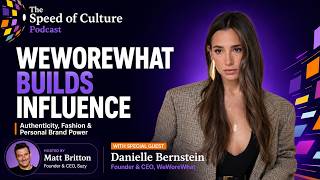
Danielle Bernstein built WeWoreWhat from a college blog into a multi-brand empire. Her swimwear line sold $2 million in a day. She stresses authenticity over constant content, treating influencing as a side-hustle unless it pays, and protecting your mental health by setting boundaries.
Chapters
Up today, we're delighted to host Danielle Bernstein, the founder of WeWoreWhat, a Forbes 30 Under 30 honoree, and a bestselling author. Danielle has had a remarkable impact in the fashion world, starting as a college student and rapidly growing into a trendsetting fashion icon and successful entrepreneur. Danielle, so great to see you again. Thanks so much for joining today.
I should have you do my bio. That was great.
Thank you.
Done, done.
We'll talk about that after, but so excited to do this one. As I was just mentioning to you before the interview started, it's great to talk to leaders of big organizations, but as an entrepreneur myself, I just love digging into people like yourself who have such a great story in terms of the perseverance in building to what you're obviously only in the middle of building. And I'm sure there's so much more to come, but let's just rewind a little bit into your early days high school, college, whatever the point is where you knew that you had a passion for what you're doing today.
Yeah, well, WeWoreWhat started while I was in college back in 2010. So, oh my God, almost 13 years ago now. And most people don't know this, but it started as a street style blog. So I had just transferred from the University of Wisconsin-Madison to FIT, the Fashion Institute in New York City. And I was photographing street style around campus to provide this daily source of outfit inspiration for my friends who were not in city schools. And I created a blog at the time, We Wore What, which was we as in the girls of New York City, sort of a play on words. So it never really started to be just about me, even though that's what it turned into. And was blogging and linking to similar outfits to what the girls I was photographing were wearing. Slowly but surely at the time, Instagram launched shortly after and I was an early adapter.
Yeah.
And transitioned my entire career to be basically on Instagram. And pretty much started to define an undefined industry that was the influencer industry, the creator economy. What did it mean? We were disrupting the most, becoming the most modern form of advertising, disrupting the fashion industry. And there was no playbook for how to do this. So we were really making up the rules as we went along and trying to define something that was so new. And then, you know, over the years had hit a lot of early career milestones from, Forbes 30 Under 30 at the age of 24, writing a New York Times bestselling book of my first 25 years of career/life, which is very early to write a book, but I always say it was just part one.
Yeah.
Yeah, I mean, 5 years ago, or more than 5 years ago now, in 2015, I started WeWoreWhat as a brand. So really transitioned the influencer career that I had created to own and sell my own products, which is really what we were, what is today.
So I mean, in the rearview mirror, it all seems like, oh, that was a natural next step. But going through it, you know, as a young woman trying to make a name for herself and trying to figure out what you wanted to do, a lot of people who say they wanna be influencers, you know, outta college, I'm sure you get a lot of pressure from family saying, well, why don't you get a job? Like, is that really something that you wanna do? And I'm sure there were so many points along the way where you just felt like it wasn't worth it and maybe you should do that. Talk to me about how you've had to have perseverance throughout all those steps that you just talked about to continue to build and grow and kind of stay focused on what it is that you want to accomplish.
Yeah, I mean, there was a lot of having to prove myself and the career that I was building to either the industry, to people like my parents, to people who just didn't understand really what the value of paying an influencer meant and, you know, why advertising dollars should be put towards a creator. And so, the early days of my career were really just about, you know, I talk about like the disruption of the fashion industry and advertising, but it was really about just proving that we could sell product and that we were actually influencing consumer purchasing. And so that's like the first 3 to 4 years of my career were spent doing that.
But a big part of influencing what consumers purchasing is getting them to care about you. So I know one thing you do really well is you get your audience to really care about you, your life, everything that has to do with your life. So then when it comes to you recommending things, they actually care. I think one place a lot of influencers have gone wrong is they just sort of, you know, constantly sell, sell, sell, and they'll sell anything. But at the end of the day, it's not even what they're passionate about. How are you able to keep that balance? And how do you know what your audience actually wants to hear from you?
Yeah, absolutely. And that's a great question. And it's so cheesy to sort of say like this authenticity and staying true to yourself is the most important thing when you're an influencer, but it really is. Like I will never promote a product that I don't believe in, that I don't test out myself for a period of time. And I'm always transparent with my audience about those products that I'm promoting. So I'll let my audience know how long I've been using a product, what kind of results I've seen, if I'm just starting out, what I've heard about it. And if I don't like a product, I either won't share about it or I will share, this didn't really do it for me. So over the years, I've been doing this for 13 years now, I've always had that very transparent relationship with my followers and that's allowed me to have longevity and trust so that when I release my own product or I promote products, my consumers and my followers are buying it because they know that I'm not promoting something that I don't truly believe in myself.
Yeah, and but interspersed with the products you're recommending, you're also talking about your life. You're talking about if you're having a good day or a bad day or what restaurants you're eating at. I can't tell you how many times.
Millions of it all. I mean, sharing about my personal life has helped my followers to feel like they've grown up with me. So sharing—
And that they know you.
And that they know me, yeah. So sharing about relationships, different career journeys, family situations, really just authentically giving a behind the scenes day-to-day look at my personal life, and that includes my business, but also includes all of my relationships, has been something that has really helped my followers feel I guess somewhat attached to me. I like to say that, especially in the early part of my career, that I was giving this perfect mix of relatable and aspirational because that's really, I was just up and coming, I was a young New Yorker like hustling in the city.
Right.
But I was making it in a certain way. So once I was able to financially support myself and show that and get my first apartment, and I've moved 7 times in the past 9 years. And so I've been showing each step of the way like my career's growing, I'm getting a bigger apartment, you're gonna come along this journey with me. So I've really taken my followers on this journey with me over the past 13 years. And that's why I've been able to have a really engaging community that also wants to buy my products.
And how hard is that to basically, because your work life and your personal life, most people, they come home from work and they're done working and it's their personal life. And with you, it's all one. So you're constantly having to think about your career, your brand, your audience, whether you're brushing your teeth or you're going to eat with friends or whatever it may be. Like how much of a strain is that on you personally? And do you ever just wanna like turn the camera off and say, I can't do this for a week? Because I don't think it's something you could afford to do 'cause everyone would start saying like, where is she? What happened, et cetera. I can't imagine the type of pressure that is for you just to always be on.
Yeah, the always being on aspect of my career has sort of changed in the past 2 years, I would say. But for the first decade I was always on and always sharing. And that meant weekends, nights, when I was with family, friends, like it was just never, nothing was off limits, which is part of what has helped my career grow so much, but definitely can take a toll on your mental health. And I learned, I think after COVID and after going through things as a public figure, that that was a balance I needed to find that I never actually had.
Yeah.
And so I've, you know, put some limitations in place as to how much of my personal life I share and when I share it so that my followers still feel like they're getting all of me without actually getting all of me. So I'm a lot more curated with what I share as far as my personal life goes with my followers, just because I know the way it's affected me over the years. And finding that balance is something that has also just come with growing up and wanting to have more of a balance for my mental health.
Absolutely. And speaking of mental health, I mean, one thing, one thing that I think stops a lot of people from posting on social media, because everyone knows at this point you know, in modern business, the best way to build your personal brand is to create and post content, whether it's what you do, or for me, it's posting on LinkedIn, whatever it may be. And what stops a lot of people is just the fear of rejection, the fear of, I'm gonna post this, I'm only gonna get one like, or people are gonna think it's not smart, et cetera. What advice do you have as someone who's kind of gone all in on what you've done in your career to people who might be hesitant to put stuff out there? And how have you dealt with sort of the criticism and haters in your life, which everyone at your level has to deal with? Right.
I used to always say haters mean you're doing something right, which it does. And you know—
Right.
Cancel until your haters ask if you're hiring. There's these are all these funny sayings that I used to say about the haters and cancel culture that exists, especially in being a public figure. But I really don't give too much thought to what I put out there in the sense of I'm not overthinking my content. I always make sure that I'm not saying anything stupid for all intents and purposes.
Right.
But, you know, I don't overthink it the way somebody who has a lot less followers might think about it because I'm posting so often. So I always know that, you know, what I'm putting out there is based on a lot of experience and years of posting. And so I'll know if something is gonna resonate with my audience or not very quickly. And I'm an extremely decisive person. So I won't take an hour to make a decision on posting. If I like the photo, I'm gonna post it. If it doesn't get a lot of likes, likes are not everything. I still know my followers are gonna be buying products and that at the end of the day is more important to me than even the community engagement for my brand. So I think that, you know, yeah, I mean, there's a lot of different ways to address haters and the best way is to actually not address them at all. And that's what I found over the years is what you put out there is what you'll receive. So if I'm putting out this defensive addressing haters, negative commentary, accusations that might come my way, that's what I'm gonna get back. And that is a way that I do not run my business at all anymore. I did a lot of that years ago and now I just won't address it whatsoever. And if you don't address it, there's nothing to fuel, so.
Right, I love that. And what about, I mean, is there a piece of advice you give the people? Because it sounds like what you're saying is you, and I've heard this before, like document, don't create. 'Cause when you create, you put too much thought into it and then you kind of perseverate over it and then maybe you don't post anything at all or, becomes overproduced. What you seem to do really well is you document your life, right?
Yeah, the less curated organic content that's just taken on your iPhone in the moment, not that many photos to get the shot, that's what people really respond well to. They just wanna feel like they can relate to you. And that's way more relatable than these highly produced, overly curated feeds that you might see on some fashion accounts.
Yeah, absolutely. So let's get to the business side of WeWoreWhat. I mean, you first started, as you said, sharing outfits and sharing fashion trends. But they weren't your own lines, they weren't your own clothing. And at a certain point you made the decision that instead of— because you could have had a great career just promoting other brands and just doing that, but you decided to take a leap and create your own brand and create your own product. What was behind that decision? What gave you the confidence that you could actually dive into the fashion world as somebody who was actually producing and selling product?
I always believe that as an influencer, you know, your time can come and go. And the way you have longevity is by owning the product that you're promoting. And that doesn't just come with, you know, I'm gonna go produce a bunch of clothing. You really have to find the right partners and put the right pieces in place to make that successful. And it's not easy. Like any influencer that's out there that's thinking, I'm just gonna go create a clothing line, it's not easy.
It took so long. Many have failed.
And many have failed.
Just doing what you're trying to do.
Exactly.
Yep.
Many, many have failed. So I found the right business partners and I thought if I can sell this much product for somebody else, then I need to own my own product and create product really strategically. You know, I need to find a space in the market, a niche that I can fill. And it started with a line of overalls, and then that's transitioned to a line of swimsuits where I just personally couldn't find swim that was really nice quality and that was flattering to the body. And as somebody who was a young woman growing up in the industry, I was self-conscious in many different ways and needed something that I felt really good wearing. And so I set out to create that. And when I launched my first line of swimsuits, we sold $2 million worth of swim in one day. So on the day of launch, I just knew that this was, this was something that we should just keep pursuing. And so swim transitioned into a full ready-to-wear line and activewear and then pajamas and accessories. And now we have all these different product categories and we were what the brand has become my main source of revenue as opposed to the influencer part of the business.
And where are you getting your inspirations from in terms of the style? The look? Is it just from your personal taste and what you're seeing out there? Do you have a team? Are you talking to your community to get feedback?
It's a combination of all of those things. I have such a direct line of communication with my audience, which in turn is my customer. And so I'm able to ask them, what are you missing from your wardrobe? What do you guys need to see in shoes this season? Do you like these kinds of swimsuits? What colorway should we produce? And so I'm always polling and engaging my audience when it comes to the design process. And then it really comes from personal taste. I have a whole team of designers. We source from editorial and vintage and we go to trade shows and, you know, we source from all over the world really. So the products that we put out there is A, things I just want in my own wardrobe and things I know my customers are asking for.
Yeah, and I saw today you had a big launch. So tell us a little bit about that.
We did. We launched basically 45 minutes ago and have already almost sold half a million dollars in How often do you refresh Danielle to see your sales? I have my Shopify open.
Refreshing it.
Refreshing it, yeah.
I would do the same thing.
This is the launch day. This is one of our, so the intimates collection, which is pajamas, a little bit of lingerie, not too much. And then these cozy sets that we call them is one of our biggest new product categories that's doing the best for us. So yeah, we had an event last night with influencer marketing. We launched this morning with the collection. We're sold out in a bunch of styles. And we'll do probably close to $1 million in sales today.
Wow. And I saw that you also recently did a pop-up store where you actually, 'cause you sell direct mostly. Are you in other retailers? Are you carried by other retailers or are you just direct?
Yeah, so 60% of our business is direct-to-consumer. We do have a big wholesale business with Revolve, specialty stores around the world, hotel boutiques. And then the pop-up concept was actually a marketing initiative that we did with Coach Cotton. So we created an exclusive collection for Cotton. It was a big 6-figure deal that we did with them to open our first ever retail experience for 3 months. So it's ending at the end of this month. And it was an amazing experience. It allowed our customers for the first time to really come and touch and feel in our own environment, something that everybody said felt like an extension of my home, which was exactly the goal and the, and the aesthetic I wanted to give off with the pop-up. And we were able to also do so many partnerships with that space, bringing in other vendors and other brands that we've worked with over the years to activate, to really give a really nice customer experience.
Right, I mean, it's fantastic. And I mean, I would imagine that you enter each week, I mean, you basically have two different personas that you have. We were what the influencer, we were what the fashion line. When you enter a week, how do you plan your weeks in terms of the pie chart of each day? Knowing where to focus, where to spend your time? Because, you know, what strikes me is what you have the ability to launch products and drive a lot of volume because you have this built-in community that wants to buy from you, that cares about what you're talking about. And that gives you a distinct advantage over other brands that don't have that. So you have to keep both going, right? So how do you balance all that in terms of how you spend your time?
Yeah, my time is, there's something booked basically every hour on the hour or every half hour on the half hour. And I have Mo, my 10-year COO, who, does all of our scheduling and books out what I have going on for the week. And keep in mind, it's not just WeWoreWhat as an influencer and a brand. I also am an advisor and an owner of a company called Wellbell that takes up a lot of my week. That's a hair growth supplement that is completely amazing. It's taking on Nutrafol in the best way possible and everybody should be on it. That's my shameless plug for the day. And I have so many other business ventures that I work on. I sit on the board of, of a few different companies. And so my time during the week is very scheduled out. I know where I'm supposed to be, when I'm supposed to be, what I'm supposed to be shooting, what I'm supposed to be wearing. And then I have time set aside to be creative. So there are times in my schedule that's set aside for me to just do whatever I feel in the moment needs to happen for either my Instagram or the brand or something that allows me to keep the creative juices flowing. But my life is extremely scheduled out and I would not be able to function any other way.
Well, we're thankful we were able to work your way into your schedule for sure. Let's talk a little bit about the creator economy, which has kind of become such a popular thing. In a lot of ways, it's oversubscribed. There's way too few people like you that have real substantive businesses and way too many of people that wanna be influencers that don't put in the work, that will never create products, that have sort of a failed vision of what a career is. How would you describe the state of the creator economy right now And do you see a big shakeout coming or where do you see it all headed?
I mean, it's completely oversaturated. We know everyone and their mother is an influencer in the sense of the word. And I actually, I celebrate that because even the most micro influencers who have 5,000 followers, some of them can really sell product. And those 5,000 people that follow them may be more engaged than somebody with 500,000 followers. So I celebrate everyone to be a creator creator and an influencer in their own right. However, should it be your full-time job if you can't support yourself financially from it? Absolutely not. It's a really great side hustle to have for people that aren't necessarily making it yet as an influencer or creator. And it's, it's an oversaturated market that makes it hard for the consumer to know who to trust.
And— Right.
I'm really thankful I've had a lot of longevity in my career and have never taken on— like, learning how to say no has been one of the hardest parts of my my career. And thankfully, it's helped me to have the trust with my followers because if I said yes to every deal that came my way, I would be promoting every tummy tea and, and gummy bear supplement, you know, that—
Right.
And that just wouldn't be that authentic to my brand.
Absolutely. And what are some of the channels? So you obviously made your name on, on Instagram, but now there's TikTok, Snapchat. What's your take on all the channels? Let's just start with TikTok. Are you spending a lot of time on TikTok? Is that a growing channel for you?
You know, I'm not, and I think that just shows my age, even though I'm only 31, but my team is on TikTok and I'm really thankful for that. And do I wish I was an earlier adopter to TikTok? Probably. When it first came out, you know, I kind of brushed it aside and I was like, you know what, if anything, my team will handle it. I don't really need to have a personal voice on TikTok. And if I had started earlier on and did actually have an authentic personal voice on TikTok and figured out a way to strategically post on that that was different than Instagram, I'd probably have millions of followers there as well. I just never really paid too much attention to it 'cause I was so much focused on Instagram as my main platform and then the other business ventures that I had. But I'm really thankful that the team has created a brand account and a brand voice where it's really the team and the ambassadors that are other influencers for WeWoreWhat, and that's how we have our voices on our other social platforms. So WeWoreWhat is still very much me and me posting every day on Instagram. And then on TikTok, it's all about the team. Mm-hmm. And the other ambassadors that we have.
Got it, got it. So looking ahead, you know, you obviously had a big launch today. You're constantly refreshing. I'm sure the millions are coming in. What's next for you heading into 2024? Are there other big plans that you're able to talk about in terms of expanding your brand and the products that you're involved in?
Yeah, we have a few new category launches coming over the next year, and we very strategically have launched new categories. So they've taken years of product market research and fit and polling with our customers and really making sure that we're delivering quality products at an affordable price point and maintaining our brand aesthetic when doing so. So we'll have some new product launches this year. I also signed a big licensing deal for a new category that I'm very excited about that we can't talk about yet, but podcasting may be in my near future. So we'll see.
Love it. So shifting gears as we wrap up here, If you look back, you know, we started off this podcast with the story of how you're getting started. What would you tell 20-year-old Danielle based on what you know today that maybe would allow you to take other steps? You know, obviously you've been very successful, but what do you know now that you wish you knew then?
I mean, when you're in your early 20s and you're starting a career and you're a public figure, there's just so many things that you mess up. And I think that all of the mistakes I've made have been learning experiences. Do I wish I knew then what I know now? I'm not sure because then I wouldn't have had the hard learning experiences that I had.
Yeah.
As a young adult and somebody who was, you know, did I know to read all the fine print in contracts and how important having a great lawyer was? And, you know, all of that probably would've been helpful at the time and would've avoided a lot of mess. But I think that it's just all part of the learning experience. I owe a lot of early part of my career to just being a fearless networker and being a go-getter, being very decisive and wanting to prove something that I knew had—
Why?
Was legit.
Why did you wanna prove something? Where did that come from, do you think?
I've always been that way. I have this inherent confidence and drive that I've always had my entire life. And even when I was a kid, I was always, the one organizing events or creating new like business opportunities at my high school. And I was always very entrepreneurial. And I think maybe that comes just inherently. I wasn't really exposed to that much of that as a kid from like my family and stuff. So.
Amazing. So to wrap up here, is there a mantra that you like to live by every day that when you wake up in the morning, I'm gonna do this?
Yeah, I mean, my like sort of life motto is that the most important relationship is the one with yourself. And until you can be happy with yourself, you can't be happy with other people. And as corny as that sounds, it really, you know, working on the relationship with myself, because I have 3 million followers and exposure to so many people and so many opinions, that's been something over the years. I work with a life coach, I have a nutritionist, I have a therapist. Like I have so many people that I have worked with for self-improvement and to show myself love and to work on my mental health and my confidence and my, and you know, just being happy from within. I think even in the past 6 months, I've become the best version of myself. And I still think there's better versions to come, but always working on myself has been like the most important. And that's just the life motto I live by.
Fantastic. We're gonna leave it with that. Wish you nothing but success in 2024 beyond. I'll be continuing to watch you from afar on Instagram. So thanks so much, Danielle.
Thank you.
On behalf, absolutely. On behalf of Suzy and Adweek team, thanks again to Danielle Bernstein, founder of WeWoreWhat. Be sure to subscribe, rate, review the Speed of Culture podcast on your favorite podcast platform. Till next time, see you soon, everyone. Take care. Hey!
More from Matt




MikMak’s Rachel Tipograph on Consumer Spending, Retail Media & Holiday Shopping Trends



Jaguar Land Rover’s Charlotte Blank on Luxury, Purpose & Experiential Storytelling



