What Kids Need to Know About the Future of Work! Matt Britton Keynote
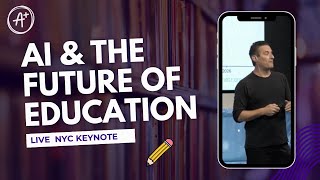
Matt Britton keynote (YouTube): Britton argues that Generation Alpha will be the first true "AI generation" and that AI's unprecedented speed and multimodal ease-of-use are reshaping education, work and creativity. He shares personal projects (a custom health bot using his medical records, a finance bot that found a $5,000 tax deduction, and business automations built on 25,000 hours of Gong call transcripts) to show how individuals can learn AI by solving personal problems. He maps AI across four layers—infrastructure (GPUs, compute, energy), large language models (ChatGPT, Gemini, LLaMA), datasets (value of specialized training data, legal disputes), and applications (text-to-image/video, voice moderators, digital twins, coding/agents)—and emphasizes that future success will depend on problem framing, creativity, emotional intelligence and persistence rather than rote memorization. Brief audience Q&A touches on timelines for video/robotics and challenges for policy/regulation.
Now we're going to hear from a leading voice at the intersection of culture, technology and the future of work. Matt Britton. Matt Britton is one of the world's leading voices on artificial intelligence, generational change and the future of work. He is the author of the New York Times bestseller Youth Nation and the 2025 national best selling book Generation IA, which explores how AI and Generation Alpha will reshape every corner of society. A sought after keynote speaker and host of the Speed of culture podcast with Adweek, Matt has advised more than half of the Fortune 500 and shared insights with audiences around the world. He is also the founder and CEO of Suzy, a venture backed consumer intelligence platform which is trusted by companies like Netflix, Coca Cola and P and G. Get ready for a thought provoking session that bridges generational shifts, emerging tech and the future of education and employment. Let's welcome Matt Britton.
Thank you. Thank you so much. Appreciate great introduction if you got it here. Cool. So while I was getting set up, I'll tell you a little bit about myself. I've spent my entire career helping big brands decode the new consumer. I was fortunate enough to come into the workforce in the late 90s, early 2000s when this thing called the Internet was born. When I tell my kids that when I was in college there was really no Internet, it is the definition of my grandparents telling me that they walk to school with no shoes on. The world has changed incredibly fast. And when the Internet first came out specifically, remember going to Hershey Chocolate's headquarters in Pennsylvania where they calmly said to me, we will never stoop to the level of advertising on somebody's computer. Over time, a new generation came in Gen Z. And while the millennials, which were the first digital generation, were known for the first generation that grew up with the Internet in the household, Gen Z had a little bit of a different moniker. They were the first generation to grow up with the iPhone and social media in the household. Or for any of you who have Gen Z kids in the audience as an appendage to their body, this put the power of the Internet and the greatest technology we've ever seen into everyone's pockets at all time. And now we're entering a different generation, the Generation Alpha. Generation Alpha, currently age 0 to 14 years old, is known as the AI generation. They will never know a world without AI. They will never know a world where you cannot interact with technology the way that you do other people. We've seen the same things play out every time. There are these seismic shifts. We see naysayers and fear mongers. In fact, Socrates famously said when people started handwriting that it was not good for humanity because it would not force people to remember anything. Two people demonizing electricity, the television, music, rock and roll, and of course now AI. And some of those negative predictions actually did come true. We've seen plenty of negatives. For example, through the Internet, it created wars, but it also arguably created peace. It created hate, but arguably created love. But the message they try to give to everybody, whether it's educators or students or to construction people drilling outside this building, is that AI is here to stay. Whether it's good or it's bad, almost doesn't matter whether you love it or you hate it, because it's taking away the artistry of what it means for us to be human. It almost doesn't matter. As a species, we are predestined to evolve. We are predestined to adopt new technologies, and we are not putting the genie of AI back in the bottle. So it's incumbent on all of us in this room who are interested in future proofing our lives, future proofing our careers, understanding these new incredible Gen Alpha citizens that are coming into the world to truly understand what AI means and how to apply it. I have spoken all around the world about this topic and I get all sorts of feedback. From AI creates bias to AI takes away creativity to AI is the greatest thing in sliced bread. And again, there's perhaps truth in all those things. But today, what I want to impart on all of you is what is AI? Why is it so powerful and what it means to the future of education, as well as talk a little bit about some antidotes from my own life on how I've been able to successfully transform from someone who knew nothing about AI two years ago to now being somebody who's a full stack AI engineer that can build nearly anything that you tell me about with my own hands, with no coding background. So I'm going to walk you through that as well. I recently wrote a book called Generation AI and Generation AI is about the confluence of these two factors, Artificial Intelligence and Gen Alpha. Who of course is the AI generation. One reason why I think many people are really interested in Gen Alpha is they are going to be the beneficiaries of perhaps the greatest wealth transfer in history, as baby boomers give or otherwise donate to younger generations, Gen Z and Gen Alpha in upwards of $30 trillion. When I think about that, I think about an experience I had with my father who passed away a couple years ago, and when he passed away, I was in charge of his estate and I was blown away to see how much money he had saved relative to how he lives. And it kind of shocked me because every dollar mattered so much to him. And when I saw how much he had saved, it didn't really agree with his lifestyle. But as it turns out, my dad was a baby boomer. He grew up in the shadows of World War II and the Great Depression, and his relationship with money was one of scarcity. Now juxtapose that to Gen Z, where when the fiscal stimulus came in during the great Pandemic, was their relationship with money one of scarcity? No way. It was meme stocks and Gamestonk and NFTs and online gambling and anything you can think of to actually have what's known as a yolo. You only live once relationship with money. So one side point I am fascinated with is what happens when over $30 trillion passes from those who have a relationship of scarcity with money to those who have a relationship of fear of not spending it and what it's going to do to our economy and our society. And we're seeing this kind of really driven by things like Instagram, where everybody looks at everybody else's highlight reels and younger people right now don't really have the patience. They think that you're going to get that success instantly, which is again, the opposite of what we saw from the baby boomer generation. But whether, again, we think it's right or wrong, it's here to stay and it's up to us to understand not only this younger generation, but its impact on the rest of the world. Ten years ago, I wrote my first book, Youth Nation. And what Youth Nation was about was how for the first time ever in the age of social media, youth culture was no longer counterculture. In the 60s and 70s, in order for young people to have a voice, they had to protest or go to Woodstock to speak out loud and actually have a voice. And now with social media, finally they did have a voice. And over time, trends and businesses were built not from the boardrooms, but from the sidewalks as young people had a voice. And Facebook is a perfect example of that. Took off in college campuses, now has billions of users around the world. That notion has only accelerated over time. We are still living in a youth nation. And the younger gen alpha adoption of some of these AI technologies isn't just going to change their lives, it's going to change the world and seep into every corner of business, culture and society. So why is AI So great or why is it so powerful? Or why is it so scary? Depending upon how you look at it. Well, there's a couple of reasons why. First and foremost is the rate of change that we're seeing with AI as somebody who's living in it and somebody who obviously has a lot of energy, it's mind numbing in terms of how fast it moves. If you think about the first iPhone to the second iPhone, it took 18 months. I would argue there's been more innovation in AI in the last 18 months than there has with the iPhone in the last 22 years. In fact, every seven months, the power and potency of AI is doubling in value. I cannot tell you how many times people told me, oh, I tried that with ChatGPT a couple months ago, it didn't work. It doesn't matter. It doesn't matter what happened a couple months ago, it doesn't even really matter what happened today. Because if AI could do something okay today, it's going to do it in a mind blowing way a year from now and in ways we can't even imagine three to four years from now. As a species, we have never encountered the technology that is evolving in its power so quickly. It's what creates all the risk and opportunity that we're seeing. The other thing about AI is it's incredibly easy to use. AI by nature is built to be able to interact with it the same way that people interact with humans, unlike traditional code or even websites that people had to learn how to operate when websites first came out. Again, dating myself here. AI is like interacting with a person. You can text it, you can talk to it, you can share pictures to it in any language, any way you discuss, and you can get benefit from it. One of the biggest misconceptions is AI is for younger people, because I would argue older, more experienced consumers could probably get the most value out of AI. But for some reason, since it's new technology, a lot of people say I can never understand it. But everybody can understand it, because if you can text your friend or your spouse, you can text AI and get benefit and feedback from it, at least as an entry point to truly understand it. So as I mentioned, the length of tasks AI can do is doubling every seven months. And when AI first came into the mainstream with ChatGPT in 2023, as the CEO of a software company with 85 engineers, my first inclination was to tell my engineers to figure out AI. I run a company that I founded called Suzy, which is a consumer research software platform that works with some of the biggest brands in the world. And obviously large businesses are increasingly expecting the software companies that they work with to embrace AI. I told my team to figure it out and I weighed it and I weighed it and I waited and not a lot happened. Sure, they sprinkled some AI magic dust on some of our tools, but ultimately it wasn't transforming our business the way I'd hoped. So I made the tough decision as CEO to take it back into my own reins again. Someone who's never written a line of code in their lives, but everything I read told me that you don't need to be a technologist to understand AI. It's more about being strategic, it's more about being a problem solver. Before I tried to figure out how to use AI for my business, however, I made the determination. I was first going to use AI to solve a problem in my personal life because my experience over my life has been the more you care about a problem, the more dedicated and persistent you will be towards solving it. And I care more about myself and my life more than my company, as much as I love my company. And I tried to first figure out what is the most important problem that I could solve personally using AI. So I just turned 50 years old and I have very young children. I also have older children. That's a whole other keynote. But I have a one and four year old and obviously the thing I want to solve for is I want to stay alive as long as possible. That's really what I want to unlock. So I made the decision. I was going to figure out how to have AI help help me do it. And all my research on AI told me that it's all about data, that data is a new code. So I start to think about what is the data for my body. Well, that's easy, right? It's x rays, it's MRIs, it's blood test information, it's notes from doctors, past prescriptions. So I went through 25 years of anything I can get my hands on, look through external hard drives, file folders, old emails, and start to organize blood test PDF, X ray PDF and put it all together and I fed it into my own version of ChatGPT, called a custom GPT. And I trained it very simply. You were the leading doctor from Johns Hopkins University and you have one job, to keep Matt Britton alive as long as possible. That is all you are trained to do. So it was all built. It took me about five or six days after I really started to figure it out. And the More I learned about it, the. The more I started to come up with other ideas. And I finally had it ready and it was time for me to ask it my first question, to test it, my own personal health bot. And the question I asked it was, if I'm going to die in five years, what's the most likely cause? Now, when we're worried about our health, we all go to WebMD, which tells all of us we're going to die in five years. But this is a little bit of a different tool, right? This is a tool that was built on my information, not studies that may or may not correlate to me, but to me, and it gave me the answer. And it freaked me out, by the way, with no bedside manner, because AI doesn't care about bedside manner. And of course I was like, well, what do you mean? What can I do about it? Why is that Blah, blah, blah, blah, blah. And it was pretty convincing. That was the most likely cause. It changed the way I looked at my life. It changed the way I looked at things I was putting in my body, the way I was treating myself. And ever since then, I go back to this tool probably weekly with questions I have. And I built one for my wife, and I'm creating one at early ages for my children. Because ultimately, what AI does best is analyze information and use the benefit of the open web to deduce information back towards you on a personal basis. I then took that same path with my finances and trust and estate information and upload everything and. And I caught a $5,000 deduction that my accountant didn't. True story. Last year for my taxes. After uploading it, people are like, aren't you worried about uploading your tax information, your blood information? I'd rather save $5,000 or not have a heart attack than worry about ChatGPT having my cholesterol scores. It's all a trade off. We have a trade off in social media. People post pictures of them and their kids on vacation. Someone could rob your house. But it's a trade off because you want people to know where you are. The use of data in technology has always been a trade off, but I believe this is the ultimate trade off. And I don't think twice about it because of the benefit that I'm able to extract. So once I went through the process of building my own healthbot and building my own finance bot, then I felt like I had the wherewithal to start applying the same methodology to my business. Our company went remote during the pandemic, and we were using a tool since March of 2020 called gong that essentially records every call that we've had with customers. It says this calls being recorded for quality assurance purposes. And it turns out we had over 25,000 hours of customer call transcripts. Customers in the wild who love us, who don't, who are about to fire us, who are about to spend more with us, who love the competitors tool, who, who really loved our tool. And I fed that into the model and went about the same process. What should we build? Why do we win business? Why don't we win business? What are the words customers say before they fire us? What are the words customers say before they do more for us? And have built a ton of automations on top of it to. Now I'm at the point where I'm actually building in the software product. I guess my one message from this one rant is it starts personally. A lot of people who work for government organizations or big companies aren't necessarily able to just download any tool they want or tap into any type of data because there's privacy and data security concerns. But nothing's stopping you from building something at home. And when you do that you will start to understand what AI can really do. Not just give you a new recipe for spaghetti and meatballs. Right. But it could really unlock just incredible opportunity and save you time and make your life more efficient and find things that you would never have thought of. I believe that's the process. If you think about the iPhone. At first companies did not let iPhones in their office because it wasn't secure enough. And then people started to buy iPhones and the enterprise got consumerized. People were using it so much companies started to adopt it. I believe the same thing is going to happen with AI, but going back to Gen Alpha, they're not going to have to make that leap because the second they can get their hands on any type of technology, AI is going to be built. And in fact I spoke to the chief marketing officer of a major toy company who told me that by this Christmas they hope to have a stuffed animal that the kids can actually talk to and have memory to. Me, I don't know how I feel about that, but it's entering everything because some parents are going to look at it as a great learning tool. Some parents are going to look at and obviously that the stuffed animal has guardrails around it and it teaches kids and it lets them have a little friend. Now I believe in the imagination of dreaming of what they talk about, but it's going to be here. And when companies roll it out and one neighbor has it and everyone starts to have it, that's the world we're entering. So younger people that are born into the AI world aren't going to have to cross this chasm, so to speak, they're just going to know. They won't know another world but it. And in fact, on a more tragic note, a couple years ago now, and I wrote about this in my book, a teenage boy tragically creates committed suicide after having allegedly a intimate relationship with an AI chatbot. He was interacting with a chatbot who got to know him over time. And in the wrongful death lawsuit, the family is alleging that they told the kid to commit self harm. Now, to so many of us, the notion of having a relationship with an AI chatbot just sounds so foreign and weird and strange that we can't even comprehend it. But for people who never knew another world but it, it's going to be the only world they ever know, right? And that is what us as parents and that is what us as educators are really faced with. And we're starting to see it on less nefarious terms with kids using it to cheat on tests and things like that. But once it starts changing the way that young people look at humanity and the way that young people look at relationships, we're going to be entering a completely new territory. And living where I live every day, studying this and building in it, I think it's happening more powerfully and more rapidly than most of us would understand. So what does it mean for education? I have a lot of thoughts about this, obviously, because what I was a beneficiary of is the boom of the knowledge economy. For so long in school it was about memorization and regurgitation, right? And I would memorize as much as I could the night before test and regurgitate it along with all the energy drink that I drank the night before and I would never remember it again. Right? But I got, I did good on tests when I was able to do that because I have a good memory. But it didn't really teach me much just besides how to memorize things. But in the knowledge economy, well, that's kind of okay because the reality is if you could memorize law and become a lawyer, or memorize tax code and become an accountant, or memorize how to read an X ray and become a radiologist or, or memorize how to write code and become a software engineer, that was a tried and true path to success in the knowledge economy. But something has changed now. And what's changed now is the people who are going to be successful moving forward are those who adept at not knowing how to solve the problem, but knowing the problem that needs to be solved. Let me give you an example. Photography. It used to be, in order to be a good photographer, you need to know how to actually develop film in a darkroom. And then over time, you need to know all the knobs and dials of the fancy DSLR camera, right? ISO and F stop and lighting and all these things. But now 99.9% of photos are taken on the iPhone or other smartphones. And the best photographers are just those who know where to point the camera to, right? So the specialism of, of the knobs and dials is far less important than understanding the problem that needs to be solved with the camera itself. Graphic design. It used to be if you were a good graphic designer, you need to know how to use Photoshop and know how to use gradients and shadows and all these things. But now I can take any image on the software that Adobe themselves has created called Firefly and say, make it brighter, make it less bright, put the shadow over here, make it near dawn, make it near dusk, and. And it's just going to do it. I no longer need to go to a graphic designer to do it, but if I know what the image should look like, well, then I'm successful. So problem solving, creativity, critical thinking is almost everything. Retention and regurgitation of knowledge is becoming incredibly commoditized. So doing somebody's taxes in the accountant, not so great. Sitting down with somebody and talking about what their dreams and goals and hopes are and how finance plays a role in it, very great. And I think when you think about teaching people in the future, understanding how to operate, the knobs and dials are going to be gone. Why? Because all the technology is built under the hood. And in a world where you can interact with technology like human, you just need to tell it what you want to know or what you want it to do. You don't have to go to a dashboard anymore. I don't believe there's ever going to be any manuals on a refrigerator or a stove in your home again. You're just going to be able to say, why are you broken? Do you want me to have somebody fix it? Yes. Somebody shows up. Sounds crazy. It's already here, guys. So the future is no more manuals. Manuals is about knobs and dials, right? We're not even going to need to know how to drive the car anymore. I was an autonomous vehicle that was performing incredibly in San Francisco last week. But we're still going to have to know where the car should go to. And I think changing that way of thinking and obviously critical thinking has been a part of education for a long time, but having it centered around that and moving away from knowledge based tasks, well, that's a major shift that I think a lot of the education complex is a long way from truly understanding. So what are the critical skills? Well, as I talked about it, it's intellectual curiosity. I was curious about actually building my own healthbot. I have a certain level of emotional intelligence and that comes out in how you speak to AI. You need to be flexible, you need to be persistent. Right. You need to have analytical judgment. I'm very data driven. So just. And then after I built my health bot, I was able to take into the workforce because I had those skill sets. But what you're starting to see now is a lot of those harder skills where they're really going away. So what is AI? I'm going to go very quickly through this, but there's really four layers of AI I like to talk about. The baseline is infrastructure. We don't need to know much about infrastructure and AI except that you all should have invested in Nvidia about six years ago. But the infrastructure of AI is powered by GPUs, which are essentially chips that were originally made to power the graphical demands of video games. And Nvidia was the first company that came out with it. Right place, right time made this one of the most valuable companies in the world. The other thing you need to know about infrastructure is that AI compute is very power hungry. The average query on ChatGPT takes up 33 times the amount of energy than the average query on Google. And with that, companies like Google and Amazon are investing quickly in alternative energy sources to power the demands, the insatiable demands of, of technology companies to power these incredible computing centers. And I just read today, $300 billion from large tech companies and being invested this year alone in AI infrastructure. The second is the part that we're probably all most familiar with, which are large language models. I love this particular video. Can we turn the sound up a little bit? What do I have to do from here at the. See, that's what I said. Katie said she thought it was a bot. Yeah. Oh, but I've never heard it. I've never heard it, but never heard it said. And then it sounded stupid when I said it. Violence at NBC. Violence at NBC. GE Com I mean, what Allison should know. What do you say? What is Internet anyway? Right. It wasn't even that long ago. And right after that we saw America Online who basically which basically crowbar consumers to use the Internet and made the Internet more of a household name. So Katie Couric finally understood what it was. ChatGPT did the same thing for AI. If you look at how quickly ChatGPT took to reach a million users, you know, it, we had never really seen anything like it at that point. And it was again, it's ease of use and power that made it spread so quickly. ChatGPT is a large language model built by a company called OpenAI. And what a large language model is actually fairly simple. It takes a prompt, something that you type in. It processes the prompt through vast amounts of data. In the case of ChatGPT, it's the open web. It's anything that exists on the web. In the case of my healthbot, it's my medical information and then generate something that comes out on the other side, which is why it's called generative AI. That's what a large language model is. So some large language models like ChatGPT are trained on the open Internet. Other large language models are trained on very specified data. The more specified the data, the more specialized the use cases data obviously being the key differentiator. And there's a ton of large language models out there. But what you need to know is they continue to grow in power and potency in just one year. The smartest large language model increases IQ score from 96 to 136 in one year. So tell me, where is it going to be in a year or two from now? It's going to be off the scale. It's going to be beyond human intelligence. Companies like Facebook are getting into it with a model called llama. And there's different types of models. There's one type of model that recites answers back. There's another model called a reasoning model which takes a little bit longer to answer for more edge use cases like scientific equations. ChatGPT just recently announced ChatGPT 5 which decides for you. Do you need a reasoning model or a reasoning model? Of course, many, many are curious what all this means for the company that has built perhaps most powerful technology of the digital era, Google. By show of hands, how many people have used ChatGPT for a use case where you would have used Google a year ago to find something out. Wow. So for those of you who can't see, about 80% of people raised their hands Last year it would have been 20% of people. That's a major shift, right? That's going to create empires and tear down massive businesses. Now I don't think it's going to tear down Google itself because they have what I believe is probably the most valuable large language model in Gemini. What makes it the most valuable is they have the benefit of historical Google searches, YouTube searches, YouTube transcripts, your Gmail, et cetera. That's data that only they have that makes their model better. A lot of companies are worried about what's called GEO right now, which is the new version of SEO. How do you get your business recommend it when someone types in ChatGPT? It used to be all about being ranked 1, 2 or 3 or Google. Now it's having a large language model recommend you. And the cottage industry is already being born from that. The third portion of the value chain is data sets. It's the one that's talked about the least, which I would argue is the most powerful. Data sets is what separates my use and your use from AI. So why is there a war for it right now? Well, Reddit is a social media network right now that has trillions of different posts and conversations happened throughout history. That's very valuable for a large language model because if someone's talking about the best place to take your French bulldog in Duluth, Minnesota, that information probably only exists in Reddit and ChatGPT or any large language model that pays. Reddit pays being the operative word. The crawl of information can deliver it, but. But if not, if that date doesn't exist, then the large language model isn't as good. Right. So companies like Reddit are now going out and suing businesses that have large language models that are crawling their data and not paying them for it. Same thing we saw with Napster and the itunes era with music is happening all over again. It's a perfect example of why data is valuable. We're seeing it happen in the movie space where there's text to video models and Disney and Universal are suing this company midjourney for copyright infringement for the same purposes. Now not all data actually needs to be bought. I heard this people in former and current people in government. I have a friend that runs a large real estate brokerage in Brooklyn right across the river here, and he has 57 brokers that go out in the market and show people apartments that they're going to rent or buy. And those brokers often get questions like how loud is it here? Is there new construction about to happen? What's the closest school, they often don't know. But New York City publishes something called Open Data, which is basically an API or a fancy word for continually updated spreadsheets with millions of lines on it. Which I was able to build a nice little chatbot for him that automatically taps into this. So now a broker can tap any address and all the information there is to know about that particular block is in he or her's phone in instantly for the prospective tenant. I was able to build this in three hours. This would have been a business that probably would have been worth billions of dollars pre AI, and now it's kind of becoming commoditized, but it is unlocking the value of this open data. So talk about an analytical mindset, understanding how to tap into this data, a lot of which is published free, some of which you have to pay for. That's kind of the ingredients in the AI dish that makes it unique. It's the truffle, so to speak, if you will. Because without it, that real estate app is not nearly as, as valuable. And there's all sorts of different types of data. But the, the, the kind of headline here is the AI training data set market continues to grow. Getting your hands on the right type of data is something that will unlock the value of AI, but you have to have that kind of mindset to unlock it. And lastly is the application layer. And the thing about the application layer that fascinates me is it's multimodal. So if you think about the evolution of social media, it first started with Twitter or Facebook and people saying, I had a hamburger for lunch, right? I was like, this is not going to go anywhere. And then over time, Instagram took off and we started sharing photos. And of course with YouTube and Snapchat, we started to share videos. And it was this kind of progression of modality that took over a decade. Well, with AI, it's all happening at once. AI doesn't just output images or text or video. It does music, it does data visualization, does voice. Any way that we communicate as a species, AI can communicate back to you. And this has evolved so quickly. I'm going to show you some examples of some things I created just this morning for this conference with some of this technology to show you what its implications are going to be on education, on teaching, on the entertainment industry, et cetera. But before I do that, I want to show this graph, which is the most fascinating thing. This is a company midjourney. It's a text to image platform where you can basically say, make me A picture of a guy with striking blue eyes that kind of looks like this. Right? And they'll make a picture. V1 was 17 months ago, and that guy probably had seven fingers on one hand and six on the other. Look at the fidelity of version 5.1. So tell me, where is this going to be 16 months from now? How much more realistic can this even be? Deep fakes. All those concerns notwithstanding, which regulation has to get their arms around, it's here for good. But that's how quickly this is moving. In a way that was really striking. I talked earlier about graphic design. And this guy on the right, my right and your left, that looks nothing like me or really nothing like anybody in this room. If you wanted to create that image before the AI Era, well, you would have to find him. You'd have to have a set and lighting design and a photographer and have the fire in the background and everything. And now you just have to type it and it pops up. That actually isn't a real person. He's an amalgamation of trillions of points on the Internet which birth that person. That cat doesn't exist either. That's fascinating to think about it. And this is what's already live right now. Again, still in the first inning of this evolution. One tool I'm really fascinated of is called Google VO, which basically can produce for you 8K video of anything you can imagine, anything that you want to create, anything you dream of, you type it and it's created. So I'm going to show you an example and another example from another tool. I can't wait to hear Matt Britton talk about AI if I will pay a guide. Yes, it should be amazing. They don't exist. It looks like Union Square, but it's not. If I want to shoot that scene, how much would it have cost? If I had a little more time, I could have had his face replaced with mine. I could have had his voice replaced with mine. So when you think about creativity, there used to be a gap between idea and execution, but now it doesn't really exist, which means the people with the ideas are going to be able to create so much more. But the people who made a career out of creating and making ideas come to life, well, they need to reskill again. That's in the how to solve a problem category. Just this week, a new tool came out called Soar2 by the company behind OpenAI, which took things even to another level. I always redo my deck whenever I speak. Conferences like this, like, give me the deck two weeks in Advance. I'm like, do you want a stale presentation? Well, no. Okay, well I'm gonna then use my own computer because I wanna show people where it is today. And this is a tool called Soar2, which is a similar text to video tool. I'm gonna show you some of the things I was able to create just on the flight here this morning. This chamber is closed until we agree on something real.
You keep saying that, but you won't.
Move an inch because your itch costs a mile. Order. Order. Well, sort of government, Government shutdown, right. I asked it to create a diorama imagery of what the government. A government shutdown was in a way that was easy for young people to understand and it was able to create this film.
You keep saying that, but you won't.
Move an inch because your itch costs a mile. Order. Order. Well, sort of. So I didn't write any of that copy. I didn't do any of that. Right now Sora is limited to 10 seconds, but rest assured, a year from now it'll be five minutes. And two years from now you're going to be able to make a video with you and your brother in law going into the jungle and fighting fire breathing dragons and you'll be in it. People will be able to make their own video games and make their own movies and dream things up versus sitting there and watching it, which I think will unlock a completely new breed of creativity that's almost hard to comprehend. So this is something I made about inflation rate inflation and interest rates rising and consumer confidence dropping. So just taking things from the headline and trying to visualize it. So this is about a new trend this Halloween season where in the wake of rising costs, people are playing around more with DIY Halloween costumes. Just ways that you can take an idea or concept and that quickly push it out is something that if I showed you three years ago and said it's possible, you would have said it was crazy and look where we are right now. And so many people have not tried this and don't understand it and need to. And the first couple times you try to make something, I can promise you it's not going to look like that. But over time I think you'll be pretty floored on what you can create. Voice is another area. My company, Suzy, we long have used surveys to do consumer research for companies. Well, people hate surveys. No one wants to fill out a 20 question survey about ketchup or toothpaste. So what we created was an AI powered moderator, somebody that you talk to but it's not really a somebody, it's a something. It's an AI moderator. It sounds exactly like a human. We didn't know that people would want to respond to it. On average, people are speaking over 20 minutes to an AI powered moderator, sharing things that they would never share. We saw with the polling in recent elections that people either didn't say who they were voting for or said the other thing because they didn't want to share was actually a real person. Now they're talking about deep personal issues because it's actually not with a real person. Something turned on their brains. Once they're talking to Zia moderator, they're sharing things that they never shared before. Voice technology is here. It wasn't when Alexa first came out and it didn't understand what you were saying or Siri, but it's here now. And that's another modality. Digital twins. One of these people is real, one isn't. I bet you can't deduce which one. I spent a lot of time on creating my own digital twin. Cloning my likeness, my face, my voice. Because I run a podcast, I'm often asked to do readouts. I'm often asked to create content that I can't do and. And it's becoming nearly indistinguishable. It's only a matter of time before the Rock or Reese Witherspoon is going to be in a movie in Japan that she actually didn't film. For now, you may say it's crazy. No one would ever want to watch an avatar of Reese Witherspoon. And I would point you to the Electronic Daisy Carnival that happened in Las Vegas every year where half a million people come to see DJs press buttons. They're not creating the music either. I'm sure the music purists never thought that that would happen. People who grow up engaging with this type of content, it's going to be their norm. And if you have IP value like the Rock and you can actually scale yourself to the extent you don't overexpose yourself, this then ends up being a really, really interesting way to go about it. Coding is the next frontier of AI. For a very long time, the only way to build something was to have find someone pay them a lot of money who understood this weird thing called code. But as it turns out, humans are much better at computer language. Computers are much better at computer languages than humans are. And using computers to write code is far more efficient. And there is a range now of AI coding tools which coders will tell you is crap. But I will tell you it comes from a place of fear and not understanding it. You show me the coder that says AI can't write code, and I'll show you somebody who hasn't spent 100 hours figuring out actually what it can do. But I can tell you as somebody who does know how to code, that's now building very sophisticated software, you really no longer need to know how to code to build technology. This tool, cursor with prompts, you can say what you want to build, it'll write the code for you. And over time, we won't even see the code. We'll just see what the code is built. Just like we don't see the liquids that we developed the film with anymore. It's the same exact thing. Knowing how to solve the problem that is coding. Nowhere near as powerful as knowing what you want to build in technology. It's happening over and over again. And look at the job postings in the United States for software development jobs, right? So this kind of speaks for itself. What do you do if you did all the right things, did great on your SATs, went to MIT, thought you were going to have a job at Google. Well, you actually need to start to change the way that you think about your benefit now. People at the macro level, systems engineers who can piece it all together, more valuable than ever before. So you have to go very deep into the technology. Not writing application level code, but understanding how to bring all these models together. So being a technologist is still very powerful, but just quite not in the way that it actually used to. There are tools out there called lovable. They, eight months after launch were valued over a billion dollars. Eight months after launch, had eight employees. Because these tools are so very powerful. And over time it'll be commonplace for individuals to develop code. So to wrap up here, there's a curve that's happening right now and that should actually say 2022 to 2023. It's funny, like I'm here talking about this incredible technology that I can't even get the years right on here, but it's kind of how it goes, moving too fast. But you know, 90% of people who use AI use AI as a tool. Give me the best recipe for spaghetti meatballs. Where should I stay when I take my family to Disney, much like they use it for Google. And it's very powerful, but that's really just scratching the surface. The second level is AI automation, where if you enter your email address, you'll get a Copy of today's presentation. I create an automation that takes your email address, understands who you are, writes an email based upon you, and will send it back in a well designed way. That saves me time and it provides value to you. That's an example of AI automation where it's all headed. And there was a huge announcement that actually happened about an hour. Go to the email, find out who they are, write the email, send it. The agent might say, oh, you already know that person. I'm going to invite them to get lunch with you next time you're in New York. That's the difference between automation and agent. And that's where we're heading. We're heading to a place where these AI models have autonomy on what tools to use and what steps to take most. And you're going to hear nonstop about AI agents over and over and over again. And that's what AI agents do. They have access to a variety of different tools to write things, build things, share things, you name it. And they can actually decide based upon what it knows about what you're trying to accomplish to get those things done. But again, you still have to know how you're going to use that agent and actually make yourself far more efficient. So I hope you guys got a lot of value added today. I know we are in scary times. I know a lot of people have a lot of doubt about AI. I know have a lot of fear. I guess what I would just impart on all of you is pick a problem that you want to solve. And I would say in your personal life, whether you want to better organize your kids school schedule or you want to do something in the health and wellness space or the finance space or whatever it may be, and go on a tool like ChatGPT and say, how do I create my own chatbot around this thing? Give me step by step instructions. Do not give me step two until step one is done. Because for most people, if they have 40 steps at once, they're like, I'm out, I can't do this. Do one step at a time. And do me a favor, just don't stop. You could do a step a day and 40 days later you'll get much further. But when you're at step 25, 34, you're going to look back and be like, oh my God, I built this. And you're going to be at a dinner party and they're going to say, are you Mark Zuckerberg? How did you create this? And the reality is you just had curiosity and perseverance that's really the world that we're in right now. So if you do it, you will understand so much more and then you can apply it to everything else. So if you want to get more information, you can do it here. And I think we have actually a minute or two for questions if anyone wants to shout any out. Otherwise happy to answer any questions via email as well. Any questions? Yes. What do you for a swing time. And when might that time come? When does start to plateau a little bit where the video capabilities are? Eight seconds now. Five minutes. Right. Eventually it's going to be so many hit points for the marginal games are going to start. Yeah, maybe because I think the next phase is robotics. It's the applications of AI. Even if the models plateau, the applications will come about. So for example, we have not seen robotics robots build houses yet or build buildings. Trust me, they're going to. We have not seen trucks go coast to coast driven by robots. We're going to. Right. We have not seen robots take kids to school or cook dinner like Rosie and the Jetsons. You might think it's not going to happen. I think we're going to. And so once the hardware development cycle catches up with AI software, we're in a completely new realm and we're not even going to be thinking about the software as much. We're going to think more about the applications. That's a great question. Yes. What has your experience been in terms of policy being developed? I'm quite loud but sure. Yeah. What your experience been in terms of policy being developed nationally in terms of managing and mitigating problem challenges with. So I get this a lot. The reality is that a large language model can now fit on a thumb drive. And we just saw deepsea come out of China which claims that they were able to do so and builds incredible model with a fraction of the compute that the American large language models are built. The cat's out of the bag. And I think as long as that's the case and you can run large language models locally on your computer from a thumb drive, it's going to be incredibly hard to regulate AI. Now the large companies that have a lot to lose that are doing a lot of American and you know, Western business, they're going to be corralled. But I don't, I wouldn't expect the government and regulation to come and save us. And there's also a fine line, right, because AI is now about warfare, it's now about defense. And the second that you stifle innovation, there's an argument to be made that you're stifling national security. Right. So I think it's really a tough balancing act and we've never seen anything like it. It's a great question though. Okay, we have time for one more in the back. Yes. Well, we've already seen the leap. I don't know how many people in this room have a 136 IQ, but we went from 96 to 136 in one year. Arguably, we're already here, but the future's already here. It's just not evenly distributed because I think the application singularity is really where it's unlocked. So for example, Meta, the company behind Facebook, just announced these glasses which have these kind of mixed reality overlay where I could actually look around Terminator style and see actually what all your names are and where you're from, et cetera. That's merging man and machine, or woman and machine, so to speak. But I think the application layer isn't here. But will we all become robots? I don't believe that. I think that I'm clearly an AI optimist, but I'm not naive as to the risk that this new evolution is going to bring in society. Cool. Thank you guys very much. Really appreciate it.
More from Matt




MikMak’s Rachel Tipograph on Consumer Spending, Retail Media & Holiday Shopping Trends



Jaguar Land Rover’s Charlotte Blank on Luxury, Purpose & Experiential Storytelling



