White Claw’s Isabelle Sakai on Innovation, Consumer Insights & Brand Growth
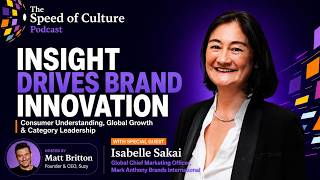
Isabelle Sakai, global CMO of Marc Anthony Group, built White Claw into 63% of the hard-seltzer market by solving for what consumers wanted: light, low-calorie, gluten-free. The brand's new platform, "Grab Life by the Claw," targets post-pandemic loneliness, and White Claw 0% launched after social listening revealed demand for non-alcoholic options without the stigma.
Chapters
Today we're excited to welcome Isabelle Sakai to the show. Isabelle is the Global Chief Marketing Officer for the Marc Anthony Group based in Zurich. She's in charge of marketing, planning, and strategy for the many brands they look after, including White Claw, very popular brand, which you're here to talk about today. Isabelle, so great to see you. Thanks so much for joining.
Well, thanks for having me. I'm delighted to be here.
Uh, absolutely. And where are you joining in from today?
Actually in Dublin, Ireland, where Mark Anthony Group has its international headquarters.
Gotcha. And do you travel often around the world for your role? Because it seems like a very international company with many different locations.
It is. You are absolutely right. So I'm actually located in Zurich, Switzerland. That's my home base. I'm very often here in Dublin to be with my team, my global team, but I travel a lot around the world, in particular in North America. So Chicago is our, you know, home office for the US, and then we have Toronto and Vancouver. We are a Canadian company originally. Our founder, Anthony van Mandel, is Canadian.
Gotcha. Now, and, and just to kind of wind back the clock a little bit, you started your career at P&G, uh, where you actually worked for nearly 20 years. Um, I say this all the time, but it is such a common theme at the podcast that so many people that end up in the CMO seat started their career at P&G. What is it about P&G that makes it such a special place to work, and what were some of your core takeaways from your time there?
P&G is truly a remarkable company. I'm extremely grateful for having joined that company at the very start of my career because it's truly a learning ground. So, you are extremely well trained in everything that can make you successful as a marketeer, but also as a leader. So, I think that explains why you have so many CMOs that are coming from P&G. You are trained in, obviously, brand building, advertising development, consumer and market understanding, data analysis, and more. You know, you have a very regular program of training courses. But they also invest a lot in you as a leader and as someone who really understands how to build organizations. So, it makes us very, very complete. You know, we have a very broad profile after working at P&G. And then, of course, you have that diversity of the company in terms of the number of categories, the beautiful brands. Marketing is also the lead function. So, obviously, a lot of— yeah, you're entrusted with a lot of responsibilities very early on, but fantastic company.
Yeah, and on top of that, I also see that you worked in many different markets, you know, during your stint at P&G. You know, what impact do you think working globally and being a true international executive has had, especially starting in that path early in your career?
I recommend warmly to anyone to try to relocate and to work internationally because it's been such a growth experience for me, Matt, really. You know, when you go to a different market and you leave there, you go to a different country, you're discovering a new culture, new food, a new language, you work with very different people, you're also rediscovering your own country because you look at it differently with an external lens. You learn to be more adaptable, more flexible. You, you overall, you broaden your perspective. So it's really an incredible experience to do that.
Yeah, I think often, especially here in America, you know, we kind of get the misperception that the way it is here in America is the way it is everywhere and the cultural norms exist everywhere. And that's anything but the case, as you know better than anyone. So I think being worldly And having that larger worldview just helps you understand different perspectives and the way that people live around the world, and they'll just make you a better professional. I think also earlier in your career, you're probably less likely to have a family or have things that are holding you down. So you actually do have that opportunity.
Absolutely agree with everything you said and more.
Yeah, cool. So, so, so you made the decision after being at P&G nearly 20 years to join Mondelēz, another fantastic global CPG brand. What goes behind the decision to leave a company, you know, like P&G? You're obviously working your way up the chain there and working with new categories, and then one day you wake up and you decide you're leaving. What goes behind a decision like that?
It's not a light decision to take. And frankly, I've loved every single day at work at P&G. So I think what is important when you're changing companies is actually not to run away from something, it's actually to run towards something else. Because there comes a point in time where, I don't want to say you've seen it all, but you are in your comfort zone. You know, after 17 years at P&G, I felt I've, you know, I've seen so many different categories in so many different markets, and I've worked in local and regional and global marketing. I worked also corporate on the P&G brand and have done a lot of things. But at the end of the day, especially because the culture is so strong, you know, it's always the same ways of working, it's the same codes, it's the same approaches. So if you really want to develop again and stretch yourself, changing environment is actually a good idea. And this is what happened to me. It coincided really with, you know, me passing the 15-year mark. You start to say, okay, hmm, it's been a long time really. And then Mondelys knocked at my door. So it was the combination. Again, I was excited by Mondelys, discovering the world of food. As you said, an amazing company, great product, great brands, great people. So I wanted to, to go and discover a different world, really.
Yeah. And I think you're right. What you're talking about is basically complacency and people get used to, you know, the way that things are and why change it? But I think sometimes growth comes by embracing, you know, the discomfort and going to something new and obviously allows you to grow. As a professional. So, and then, you know, you spent some time, you know, working in other organizations in the marketing function. And then in 2023, last year, you joined as global CMO at the Marc Anthony Group. For those that don't know about that organization, tell us a little bit about the Marc Anthony Group.
So Marc Anthony is a founder-led business. So our founder is Anthony von Mendel. After 50 years, he's as excited and enthusiastic and passionate about the company as on his first day. A visionary leader, someone that we really all look up to. Um, he's someone who is passionate about wine, so owns a lot of prestigious wineries in British Columbia, um, in, in Canada. Um, and he's the one who invented the flavored malt business or category with Mike's Hard Lemonade. I'm sure you know this brand, 25 years this year. Yeah. Um, and then of course, um, launched White Claw, the creator, the OG of hard seltzer. And so difficult to create brands or launch brands that are creating a new segment for consumers. And Anthony did it twice.
So yeah, I mean, that's a lot of respect. Yeah, for sure. I mean, to create a new category in such a competitive industry is nearly impossible to do because it almost feels like at a certain point everything's already been done, right? And I had no idea before you just told me just now that they also were behind the Hard Lemonade category, which obviously was another huge hit. You know, so I guess what goes behind that process? And you probably know a little bit more about the White Claw brand because it's more recent, but what goes behind the R&D and innovation process to have the conviction to essentially create a new category?
Matt Britton, it all starts with really understanding the consumers and what they are missing. So whether they know it or not, by the way, but it's really truly understanding what are those unmet needs and what is the gap in the market. So if I take the example of Waclo, so there's a need for products that are very sessionable, right, that you can drink a lot of. And typically beer was meeting that need, except that when you think about it, it's not the best product when you want to drink a lot of something over a long period of time because it's quite heavy and it leaves you a little bit bloated and it's high in calories. Anthony saw that and said, okay, we need a product that is going to be much lighter, 100 calories and, you know, some nice airy bubbles, but something that is also full of flavors, beautiful flavors, because when you're drinking a lot of something, flavor is actually making it much more enjoyable. And gluten-free because he saw that it was a little bit of a concern as well surfacing with, you know, with well-being becoming a rising obsession. So he saw the opportunity. He said, yeah, I'm going to get out there and I'm going to carve out my space with a very sessional product that is going to answer better the need that consumers have. And it worked.
Yeah, because one thing I noticed personally about WhiteCall And I don't know what the data shows, but females, um, really gravitated towards White Claw, uh, because there wasn't really, you know, something that spoke to them that was kind of in the same form factor. So, you know, there's obviously wine, but wine is not in the same form factor and it's not as easily accessible. And then there's beer, but this is sort of something that I kind of— it filled the need of being easily accessible. Um, the— had the form factor of beer, but to your point, it was much lighter. And have better taste. And I think those are probably core drivers. Is White Claw today a brand that's focused more on the female demographic and how does it break down in terms of usage?
It's pretty much 50/50, which is remarkable in this category. Mm-hmm.
So you come up with a new category and obviously it starts with— I totally get identifying the consumer need, but your category has all these other key elements in making it successful. First and foremost being distribution. I would imagine, given the fact that Marc Anthony had other brands in their portfolio, made it easier to get distributors to carry it and to gain adoption. But I guess what sorts of hurdles does a brand have in a new category gaining distribution?
I think it's really about being able to explain to, to customers, or actually through our distributors, as you know, the structure of the alcohol category in the US, to explain that it's really going to come incremental. Yeah. So everything that I just explained about you coming in and carving out your own space, you know, better answering consumers' needs is critical because then they see, ah, okay, so really we're going to be able to grow again because we're going to provide a product consumers are really looking for without really knowing it, and it's going to create new volume for us. Right. This is what is absolutely critical to be listed. And then it's all about driving velocity. Because consumers are actually picking on it. And as you know, we literally exploded in 2019, became that huge phenomenon everyone was talking about. Everyone tried to copy us, by the way. They still are. Yeah, and they still are, you're right. So yeah, that's what it takes. You need to first explain well why you are going to come incremental to the category and create value for them. And then you need consumers to embrace it fast. So it's so much in demand that basically people were asking for it. We ran out of stock, as you know, the beginning and because we could not meet the demand.
Mm-hmm. Yeah. I mean, I remember that in 2019 and I guess when something takes off so fast, especially in this category, it always runs the risk of being a fad that, you know, people look back at and say, oh, do you remember what Lightcol everyone was drinking at this summer? And now the other big competitors have come in and they almost become sort of a Trojan horse for the category, but then ultimately they go away. And White Claw has had staying power. What does it need to do to continue to have staying power in a category that, again, is highly competitive and is going to continue to have new entrants into the space?
One of the reasons why we're still there strong, actually stronger than ever with 63% of the segment— Wow. —is because we never compromise on product quality. So when there was this what we call the gold rush, you know, everyone, every single competitor out there said, ah, we want our fair share. Of the, you know, hot salsa category. They launched so many different products, and frankly, they were not really differentiated, and the product was not always of a great quality. We stayed the course on having superior product. You know, we continued investing behind the brand even though we were under attack everywhere. And, you know, we are now really entering what we call the consolidation phase. We are the clear leader. We believe one or two brands will stay. And all the rest will disappear. That is what is happening typically when you are a true market disruptor. So, no, same course.
Obviously, as important product is, the other big piece in terms of the consumer is brand and building the brand. With that, you recently announced the launch of a new campaign from White Claw called Grab Life by the Claws and a whole new brand platform.
Tell us about that. Hmm. It's a It's a beautiful brand platform, actually. And you said it correctly, it's so much more than a one-off campaign. It is a true platform. It was born out of consumer understanding, again, really listening to consumers. And what they told us is they have never felt more isolated. The pandemic didn't help. But in this hyper-connected world, what they are telling us is they actually feel lonely. I was listening to the news this morning and heard about I don't know if you've heard that, but about Korean consumers actually having what they call a pet rock. It's something that we used to have in the US. Yeah. Because, you know, and because they are so desperate for having— yeah, equivalent, but so desperate for having, you know, someone to talk to, sadly enough. So it's a true human need. We know that actually strong personal interaction, social connection is the first driver of happiness. That's what makes a human being fulfilled. And health before everything. So you need contact with other people. So when we heard that, we said, wow, but this is us. This is, this is what we do. White Claw is all about that. Consumers talk about having a White Claw moment. So when they just want to socialize with their friends, swap stories around a White Claw or something impromptu, fun, lighthearted. And this is really the way that the role we play in their life. So that, that was really what was the origin of the Grab Life by the Claw campaign. It's all about celebrating togetherness, having I think a great moment of shared fun.
Yeah. And it, it obviously we had this big rush of the experience economy where it was all about experiences and not things. And then the pandemic hit and then everyone retreated and, and ran up their Amazon bills and, and bought TVs for every room in a house. And then we had post-pandemic, we had sort of like this rage travel era where everyone was kind of going out. And now we sort of settled into, I think, where we were before. But I think with that, you're right. People are, are scarred from going through the pandemic. We also have now people talking to AI, right? I mean, there's all these new technologies and the more people rely on technology in a lot of cases, the less they rely on that human interaction. So I guess in some ways it is counterculture and, and it is driving that human connection. And I guess your brand, you see your brand as a big part of that human connection.
Mm-hmm. Absolutely. Absolutely. Yes. We, we are committed to, um, help people, you know, reconnect with their old friends, meet new friends, be part of that to make their lives a little bit better. Yeah, absolutely.
Totally makes sense. And when you look at media channels or to get your message across and connect with consumers, where are some areas that you're focused on here in 2024, given your consumer segment you're trying to target?
I'm going to surprise you by telling you we invest a lot in social media. This is where a lot of things happen those days. Not new, but something that might be a little bit different than what other brands do is, is our commitment to meet our consumers in real life. We are very invested in being present at festivals, in particular music festivals all around the country. And we have what we call the Shore Club, which is, you know, a platform, our bar, if you want, where we sell our product but also invite them to have experience with White Claw.
Oh, within— you're creating your own.
Yes, absolutely, absolutely, absolutely. And, and we want to, to further develop that, uh, to, you know, foster that two-way conversation. That's really what we're committed to, very much in line with, with what we stand for, right? Togetherness, bringing people together, refreshing social connections.
And, and does WhiteCall also play a lot in more traditional media like linear television building its brand, or has that not really been a big part of your story since, since the launch?
TV is not dead. Absolutely. I'm with you 200%. You need that for broad awareness and a little bit of prestige as well. So it's, it won't surprise you.
Especially as a new brand to gain trust and loyalty in, cuz you're still such a relatively new brand compared to some of the other brands that play in your space. I would imagine that that kind of gets you that gravitas that you need for consumers to trust the brand over the long term and make sure it isn't a Exactly.
You said it very well.
Yeah, absolutely. So let's shift gears a little bit to you and your career, because obviously, like, you're in a really important seat for a company that obviously has a huge success on its hands. And it's your job to, A, not screw it up, which I know you won't, but you can find growth opportunities. How do you stay, I guess, in a growth mode as a professional so you keep learning and growing? Because the marketing and media space changes so quickly. What do you do personally to make sure that you have your finger on the pulse of where the market is and where the consumer is?
So we do a lot of social listening, Matt. I think it's really, really important. We do that very regularly. And we learn a lot about what consumers say about our product, but also how they use our products, what they're missing in our product, what they want to hear from us, what— they talk about everything. It's unbelievable. It's such a source of interesting data points. It's particularly important for us when it comes to innovation because obviously we are aware that they love our White Claw Hard Seltzer. But things, you know, the drinking habits keep on evolving. And so we've listened, we've listened, we've seen, for example, just as an example, that they are changing their drinking habits. They want more and more to experience with non-alc. And that led us to actually launch our White Claw 0%. Absolutely. I mean, 70% today of the population is actually considering a damp lifestyle, you know, so not really abandoning alcohol because it's still a lot of fun and pleasure and everything. But, but from time to time, you know, looking for something that is a true alternative. When you think about it, there's not a lot of options out there, frankly. You have just bland waters or you have very sugary cocktail. You have, you know, non-alcoholic beer, which is the same taste as beer. So that's why we thought we had an opportunity and we learned all of that from listening to consumers. Wow.
So talk to me about your efforts in the non-alcoholic space. I wasn't aware that you guys had entered that category.
Oh yeah, we launched actually in January, so it's very recent. But we really saw an opportunity. For us, the unlock was to realize that when you want to have a non-alcoholic drink in a social setting, you are a little bit ostracized, or at least you are you are a little bit ashamed, right? So I'm sure you've been in that situation where for whatever reason you didn't want to have alcohol. Yeah.
Why aren't you drinking?
People are looking at you like, why? Why? Are you sick?
Or if you have a bottle of water, it kind of like it almost advertises that fact. If you're holding a bottle of water at a bar.
Correct.
Or they'll say, like Liquid Death, I think they've had some great traction because it almost looks like a can of beer. So you could drink water at a bar. And I think that's probably a key insight behind their entire go-to-market strategy.
That's correct. And when it comes to White Claw, we know we are a badge. We're a badge for consumers. So when you are having a can of White Claw Zero Percent in your hand, you know, it feels like an Arc— it blends in— a brand. Yeah, exactly. So that avoids a little bit of the scrutiny and the interrogation and frankly, the judgment that you're facing. Plus, it's delicious, so it doesn't hurt.
Yeah, it almost feels like you're not asking consumers to change their habits or behaviors. Because they're used to buying the White Claw brand on premise and that they're still doing it. It just happens to be a different type or, you know, extension of the brand that doesn't have alcohol. Yeah. Well, let's talk a little bit about your role as CMO of White Claw. So are you just focused on the White Claw brand? Are you focused on a larger part of the portfolio? And then secondly, what does the pie chart of your day look like as CMO?
Oh, so I am responsible for everything which is RTD, so ready to drink. And we have 4 big brands. White Claw is the biggest, of course, but we have Mike's Hard Lemonade, as I mentioned before. We have, we have Cayman Jack, which is the new kid on the block, but he's doing extremely well, tequila and margaritas and etc. And then we have Mixte, which is a much smaller brand, but you know, a brand that really packs a punch, um, you know, really fun, all about cocktails. So that's, that's my world, if you want, and I'm really in charge of everything related to brand building, communication strategies. That, that's what I do. So that's my day job. My night job is also to, to be really the CMO when it comes to building the function, the marketing function at the Mark Anthony. So, you know, coordinating, setting the bar higher, engaging with our community, making sure that we are training ourselves and sharpening the saw on a day-to-day basis. Yeah. So these are broadly my responsibilities.
And in terms of your team and who you're looking for when you look for young or emerging talent to broaden the skill set of your team, what do you look for and what advice could maybe we impart on some of our younger listeners here at the podcast in terms of areas they should be focused on?
So first, I believe in diversity, if I may. So I'm trying to build a team of different profiles, different experiences, different personalities, because I think that through diversity you are getting to better outcomes. So, yeah, I want to say that in the first place. Obviously, in our case, we believe in recruiting people who are well trained in marketing and who ideally understand the Alkbeer category. But again, for the sake of diversity, we are definitely opening up and not just looking for people who come from the industry. Actually, I'm an example of that. So, you know, it's It's important to have people coming from a different perspective. And then, this being said, you know, depending on junior, more senior, we need, again, diversity. So, sometimes we— people that we can completely mold, and in other cases, we want people who can come and hit the ground running.
So, when you look back at your career, Isabelle, and you look at, you know, all the choices and decisions that you made, you know, since being at P&G and maybe perhaps before then, what are some of the decisions that you think you made right that put you in a position where you are today, where you're CMO of an important, fun brand or group of brands and obviously enjoying what you do and working around the world?
Hmm. Hmm. I think early on in my career, I decided I would not stay in my comfort zone. So I did move actually after 9 months. It was the first time I changed country and relocated from Paris to Brussels in Belgium. And I've done that several times in my career. We already talked about that, but I do believe that taking risks in, you know, changing the environment I was living in, changing category, changing, you know, everything was a stretch, but definitely helped me grow faster. So that's one of the things I did very early on. Something else I committed to is really to enjoy what I was doing. So I was extremely fortunate at P&G. I really enjoyed the journey. As I said, never a dull moment, always something to learn and to develop. But it was very, very important to me. I work far too many hours a day not to enjoy what I'm doing. So that's the other thing I committed to do something that I like. And if I don't like, you know, then I really need to challenge myself and say, okay, maybe I'm not in the right place or, you know, I need to change. So I think that's probably the second biggest commitment, something that helped me further develop in my career.
Yeah, I think obviously you want to make sure that you love what you do and I think I think a lot of people lose sight of that over time, and then it obviously has a direct correlation to their performance and why they're not spending that extra hour, or why don't they come up with that good idea, because they just want to get away from work when they're done. And it's hard to do something if that's— if you're running away from it.
Yeah, absolutely. And something else I have seen is sometimes you get obsessed with, you know, being promoted or, you know, going faster on your career ladder and everything instead of just enjoying the moment and what you're doing. That's right. So it's really important to enjoy the journey, not be obsessed with the end goal always. Yeah.
And with that, is there a quote or mantra that comes to mind that you like to live by that kind of defines your professional career?
It's a great question. This is something I actually do think a lot about. What is this compass that drives me? And the mantra I follow since my time at P&G is "Consumer is boss." It's really, it's really something that I find is critical, you know, truly understanding the consumers, what they want, what they need, and do everything you can to really meet their demands, you know, and try to make their lives a little bit better. So consumer is boss.
Big fan of that mantra and big fan of you and your work on what you're doing for WhiteCall and the other brands you oversee. So thank you so much for taking the time to join us today. I can't wait for our audience to hear about your journey.
Thank you so much, Matt. It was a pleasure to talk with you. Likewise.
On behalf of Susan, the Adweek team, thanks again to Isabel Sakai, the global CMO of Marc Anthony Group and one of my favorite brands, White Claw, for joining us today. Be sure to subscribe, rate, review the Speed of Culture podcast on your favorite podcast platform. Until next time, see you soon, everyone. Take care.
More from Matt




MikMak’s Rachel Tipograph on Consumer Spending, Retail Media & Holiday Shopping Trends



Jaguar Land Rover’s Charlotte Blank on Luxury, Purpose & Experiential Storytelling



