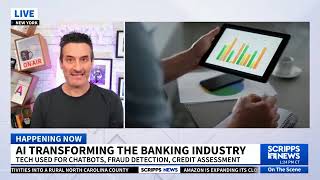
Matt Britton warns that banks trading your financial data for AI-powered tools create privacy risks. He points to bias in algorithms and inaccuracies that could hurt you, and predicts physical branches will disappear as digital banks take over.
Well, welcome back to on the Scene. Many of us use AI on our phones, our smart home devices or in our cars. But now artificial intelligence is transforming the banking industry. Chat bots can now process your transactions and even analyze you to assess your credit worthiness. But with all this new technology, should you have concerns about privacy? Joining us now live is Matt Britton. He's an AI in consumer trend expert in the author of Generation AI Way. Generation Alpha in the Age of AI will change Everything. Matt, thanks for being here. I'll start by answering my own question. Yes, you should be concerned about privacy. That's something that I am always concerned with, especially with all these new trends and in the digital age. But specifically when we're talking about banks, how are these financial institutions using AI right now?
Well, you know, there's a trade off with tools like AI as well as there is a trade off with tools like social media. And that trade off is ultimately you're sacrific privacy for some type of benefit. So in the case of social media, you know, people are sharing where they're going on vacation, they're sharing pictures of their children. The trade off there is they're generating some type of exposure or changing the way that people perceive them. AI is the same trade off. People are essentially trading data for the benefit that that data provides. So for example, if you want to create your own personal finance bot, you might upload your mortgage information, your bank statements, your investment holdings, and in exchange, you're going to get an incredibly powerful agent. It's going to help you make investment decision decisions and frame your financial life. So ultimately it's that trade off that many consumers are going to have to make. And I understand the stakes are much higher when it comes to your financial information. Yeah.
And when you talk about AI in banking, there are a number of concerns in addition to privacy. They include bias and algorithms, the potential for inaccurate information. What can people do to ensure that their information is both accurate and protected?
Well, I think it's the same way that consumers need to make sure their information is accurate. If you're dealing with a wealth manager, you know, wealth managers are people and on the way to taking their daughter to school, their daughter might be bragging about, you know, Crocs or Kate Spade or a brand. And then that wealth manager, without knowing it, may recommend that stock to their customer because we're only human. And I think in the case of AI or in the case of dealing with humans, you have to be your own best advocate. You have to have your own source of research. The good news with AI is we allow limitless access to research. Really incredible first party research that can be powerfully delivered to you with tools like Chat, cbt. Well, tools like Perplexity or Claude. So I think, you know, consumers need to be their own best advocate at having their finger on the pulse of the market and their investments to make sure they're setting themselves up for success.
And thinking about the future of the workforce. For a bank, for example, you don't even have to go into one to cash a check anymore. You don't even have to go to an atm, just take a picture of it on your phone. How will I change the workforce both in the banking community and perhaps even larger scale?
Well, you know, the legacy banking system is riddled with legacy real estate debt if you will. Not debt in the PNL standpoint, but debt in terms of the legacy infrastructure. You used to have to walk into a bank to cash your check, to get a loan, to get financial advice and now you don't really need to do any of that. So I think there's going to be a big unwind of physical banking locations across the country and really around the world. What you're seeing in replace of that is a new wave of banks, neo banks if you will, companies like Chime, companies like so far that were built with a, with an infrastructure that doesn't involve physical locations and they can pass those savings on the consumers. So it's no wonder why those companies are performing so well with Gen Z, the new wave of bankers.
Yeah. All right, Matt Breden, AI and consumer trend expert. Matt, thank you for your insights.