WMX’s Maria Weaver on Music, Fan Culture & Artist-Led Brand Growth
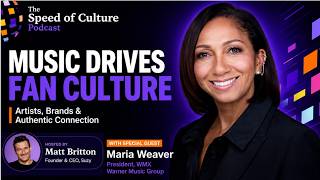
In this Speed of Culture interview, host Matt Britton talks with Maria Weaver, President of WMX at Warner Music Group, about her unconventional career path—from an early passion for acting to senior roles at HBO, a personal film‑finance venture, a startup within Radio One, and senior advertising leadership at Comcast—culminating in her current mission to expand Warner’s music‑related revenue streams. Weaver explains how her acting training gave her presentation and storytelling skills, how she helped shape HBO’s original content and early digital initiatives, and why she deliberately stepped away from the workforce to raise her children before re‑entering via Interactive One, a digital‑first radio venture launched during the 2008 financial crisis. At Comcast she merged traditional TV ad sales with digital data‑driven strategies, positioning herself for the WMX role where she now oversees a portfolio of owned‑and‑operated media assets (including FAST channels, Uproxx, HipHopDX), artist e‑commerce stores, and first‑party fan data. The conversation delves into WMX’s approach to brand‑artist partnerships—highlighting a Coca‑Cola program and an Ed Sheeran hot‑sauce launch—emphasizing authenticity, long‑term equity opportunities for artists, and the importance of matching brand and fan demographics. Weaver also shares her leadership philosophy: allocating time across media, e‑commerce, and people; fostering diversity and culture; and maintaining a positivity‑focused mantra that frames the business as a joy‑bringing enterprise. Throughout, she stresses intentional decision‑making, avoiding shiny‑object distractions, and trusting gut instincts when navigating career pivots.
Chapters
Up today, we're gonna be speaking with Maria Weaver, president of WMX at Warner Music Group. Welcome to Speed of Culture. Thanks so much for joining, Marina.
Thank you so much for having me. I'm so happy to be here.
Absolutely. Um, so it was interesting. I was looking through your background and then one of the things that kind of stuck out to me is that when you were early in your journey, you wanted to be an actress. And you know, I find a lot of people who want to be in the acting field early in their life end up either in the entertainment field or in the creative industries, because not everyone ends up as an actor. But the things that you learn along that path of wanting to pursue the arts generally are things that are helpful later in life. So is that what you experienced? And tell us about kind of that journey.
Wow. You, you, you dug way back. Yeah. I don't know that I've had anyone ask me that before. Yeah. I mean, acting was a, was a real passion for me when I was younger and I really found myself in acting because my dad wanted me to be a lawyer. And so he put me in an acting class when I was about 8 years old so that I would learn to project and learn how to present. But then I fell in love with acting. And it wasn't until I was in college— I actually went to college for acting. So I went to performing arts high school and thought I was going to be an actress. And then decided, you know, I don't want to be in front of a camera. I don't want to be on a stage. I want to be in entertainment, but in the background somewhere. There. Um, and so that is how I ended up— my first job was in TV for that very reason. Um, and so it was a very intentional decision that I pursued going into television. Um, but thank you for that question. Absolutely.
Do you remember the moment when you realized, you know what, this was my passion and, and I'm so thankful for this experience, but it's not what I want to do? Because we have a lot of younger listeners at our— at the Speed of Culture podcast that might want to go down a different path and they don't really know. And when did you know that?
It was in college. I mean, in college I was exposed to so many different classes. I took different classes. I was exposed to so many different people with different majors who were pursuing all different types of, you know, careers and passions. And that's, you know, was a real click for me that I could do something in the arts or art adjacent and not have to do what I was doing. I had already started to fall out of love of the process of auditioning and putting yourself out there. It's a grind. It's a grind. And the constant rejection. I had already become a bit enamored, or unenamored, I should say, with that process. And so I think once I was in college and I started to realize I could do something else, but still be in the field, it was really eye-opening for me. And so I do encourage young people, and I have two daughters myself, you know, you can, you can pursue your passion, but in so many different ways.
Yeah.
And so don't think of it in a linear, that's exactly right way. Like think of, look at all the areas that touch it or impact it. And so there's, there, Yeah, it was definitely a very intentional decision and I'm, I'm thankful, I'm grateful. Yeah. That I was able to, to figure that out while I was still in college. Absolutely. And, and make that pivot.
Yeah. I mean, I have teenagers as well and I think the world they're growing up today is obviously so different than the world we grew up in. Yes. And you know, they're on social media and they're looking at people's successes or perceived successes and it puts undue pressure on them to decide the path they want to go down. At a premature stage in life. Yes. And you know, like yourself, I thought I wanted to be a lawyer. I didn't really know what I wanted to do, but the process of learning about law, I was able to extract some of those things I still have today.
So, right.
Of course. Just because you start into something, you start learning about something, you don't end up there, doesn't mean it's a waste of time.
That's right. Yeah. Not at all. I mean, I think a lot of my skills that I learned when I was pursuing acting are skills that I bring with me now, you know, the ability to get on a stage and present to a large audience is something I learned at a very young age, even though technically I'm actually a fairly shy and introverted person, but I know how to turn it on when I get onto a stage. It's just because that, that was a training though for me. And if I hadn't gone through that training, it's kind of interesting whether or not I would've been able to get over it on my own, just in a process. Right.
So yeah, those are things that are hard to learn.
Right.
So not too many years after leaving college, you joined HBO. In 1997. And that was really the beginning, or I guess mid-stage of the peak of their ascent, because HBO has been a transformational force in media and entertainment. And you were there for 7 years, you know, in various different positions. Tell us about your journey at HBO from what you remember and what you took away from that experience.
It was an amazing experience. I was actually at Showtime right before HBO, which was very interesting because they both were pursuing original content at the same time. And I made the choice choice of leaving Showtime and going to HBO because it felt like HBO was going to be the leader in the space. And sure enough, I mean, we know the kind of content that they made. It was also interesting to be a part of the journey of original movies, is kind of where they started. And that's when I joined the company. It was right after, I think, the Don King movie, which was a really long time ago. And then the exploration around series and other types of formats. Um, you know, the interesting thing about being a part of HBO during that time was that it felt small, and it felt like a family. And we were all keenly aware that we were doing something that was incredibly disruptive, incredibly innovative, and we all wanted it to be successful and to win. And so, there was just this— this camaraderie. And it was also just interesting the way the programming teams and the marketing teams worked. And I was on the marketing side and it was very collaborative, which I think in a lot of organizations you would think, oh, programming just goes and just does what they wanna do. But marketing was really an integral part of the process. And so, that was really interesting for me as well. It's just a, a young age being a part of that energy and that excitement. Absolutely.
I think around that time period, Sopranos had just come out and that was sort of like a landmark.
Yeah. Sopra— I was there for Sopranos and Sex and the City and Oz and The Wire and, and yeah.
Some of the greatest.
Some of the greatest.
Pieces, pieces of content ever created.
That's right.
Many would say.
That's right. And we were also exploring and playing with digital, you know, we, we, we thought we were really doing something when we created HBO.com and like tried to figure out how to give content to consumers over the web.
And you know, it was just a— Yeah. That was the dawn of the internet.
It was the dawn of the internet. Yeah. So it was just a, an interesting time. I was there when AOL bought Time Warner. Mm-hmm. So that whole process of a, of a big mer— major merger and, and what that, um, can do and how that can, you know, kind of break up a system, if you will. Yeah. And how that gets rebuilt. And so I, I learned a lot during my time there.
It was fun. Absolutely. And you were there for, for 7 years and, you know, many folks who join a company like that, that's a fast-growing prominent brand, stay there forever. You made a decision after 7 years to leave. Do you remember what kind of precipitated that decision? And then tell us about where you went next, which was, uh, Interactive One.
Yeah. So it, so I left there, um, I left HBO, um, after I had my second child and decided to spend time with my children. And so I pursued a personal passion of mine, which was once again linking my love of film, TV with a passion around helping young directors and filmmakers get their films made and created a film finance company. And so I left HBO and was in some ways a stay-at-home mom for 5 years, although I had Triple Threat Films. But it really was a pivotal time, I think, women, especially at that moment, because it was the transformation of kind of what digital is today.
Yeah.
We hadn't really blown up yet. We had to make a decision. You were either pursuing a career and not getting any reasonable time with your children, or you were staying at home. And so I made the difficult decision of leaving HBO to be with my children. And then I came back into the workforce and went to Interactive One. Now, I'm grateful that most women don't have to make such a hard decision. I mean, they can, you can actually have the balance of the two. And because of work from home and because of work from home, because you can get emails on your phone. I mean, I couldn't get emails on my phone, right? I was walking around with a, a trio. I don't know if you, of course I had a trio too.
I had them all. Yeah.
You know? And so you couldn't really do but so much on those things. And so I literally was going to work in the morning before my youngest, or either of my children were waking up and I was coming home after they were in bed. Right. Literally was not seeing them at all. And so that's— so that's actually why I left HBO. HBO is a great place. It's— you're right, it's not a place you just leave. The godmother of my children I met there. You know, like, some of my closest friends are from HBO. But yeah, when I came back, I came back and went to a company called Interactive One.
Yeah. And so, I mean, it's interesting when you say that because, you know, the choices that especially women had to make, and all parents really, um, you know, when they had children and they knew that it, like, it was a light switch off and on. And when it was on, you weren't home, you weren't really accessible. It was often longer commutes. And it was just, it was a different world back then because the accessibility of data and communications was not what it was today. And that's right, you couldn't really be around your kids. And many people missed out on that. So I think that's something that hopefully people now, you know, that may have young children in their workforce maybe could realize is that it's, it's an incredible opportunity if you can balance it all. A lot of people have a hard time balancing it all.
It still is hard. I think it's actually in many ways harder to balance it. Yeah. Harder to— because you're taking your work home with you. Yeah. Right. So, you know, it, it's, it's hard to say which is better truthfully. Right. Because when I was home, I was home. Right. And I, and, and no one could call me, no one could reach you. Right. And no one wasn't asking me to, you know, check that email or, or read this contract or anything like that. So at least when I was home, I could be hyperfocused. Um, it's a great point. And now, right, you take your, you take your laptop home.
You're at the Little League game, you're getting a text from your client and you're, you know, oh yeah. Right.
And people will say, oh, you know, I need to go home and, and have dinner with my kids. They're like, oh yeah, yeah, yeah. You'll get back on later. Right? There's an expectation that that's the balance, right? Oh, okay, sure. Yeah, you can go home now, but like at some point in time you're gonna respond to that email. Right? Like, and so people then start working again. At 11 o'clock at night. And it happens in a lot of households. And so that's not necessarily 100% better.
Totally. I mean, COVID was the penultimate example of that where you had people bouncing their babies on their knees while they're on Zoom calls trying to figure it all out. So it like completely blended those lines.
And I actually think it was so beautiful to see.
Yeah, it was.
It was also beautiful to see from the standpoint of seeing a lot of dads in those scenarios. I was at Comcast when COVID happened and there was a newly appointed GM of one of our divisions effective, and he had a very young baby and his mom, his wife, also very successful in her career. And they would go back and forth with the babies. And so you could be on the middle of a big, huge budget prep call with him and, you know, he would be rocking his baby. And, and I think the nanny had COVID or something. So, you know, it just, but it was a real, I, everyone commented on how much that humanized him. Yeah. For the company. And so I actually think it had a lot of positive from that standpoint as well.
Totally. I've experienced the same thing. So, so going back to your journey.
Yes.
So you, so you had, the time off to be with your family. And then you joined Interactive One, where you were at for an equally as long stint as HBO. You were there for 8 years.
Yeah.
Tell us about Interactive One and what your takeaways were from that experience.
So when I decided to reenter the workforce, it would have been a natural thing for me just to go back into a television network, having been at, you know, Showtime and HBO, etc. But I really wanted to try and do something different. And there was this opportunity of, of a startup, if you will, within an established business, a publicly held, um, company where they wanted to kind of disrupt the radio business. And I oftentimes find myself in these intrigue, intriguing opportunities of disruption. And so I joined Interactive One for that reason. Essentially they gave us X amount of dollars similar to the way we would've normally gone and raised money. And they said, you know, go start this division. I think initially the plan of the thought was that it would spin off or would, they would sell it off or something of that nature. But I think it's still a part of Radio One to this day because it diversifies its radio. It, its revenue streams, if you will. But it was, yeah, I was employee number 5. I was one of the founders. We didn't even have a name for any of our dot-coms yet, but we started this endeavor. And right there is when, you know, Wall Street kind of fell apart. Yeah. It was right at that pivotal time. And the financial crisis, the financial crisis of 2008. And You know, the ad market fell apart and, and so it was very interesting time to be at a startup trying to create this business. Facebook was really just starting to blow up. Twitter was just starting to really establish. I think there was Foursquare. I mean, there was all of these different digital companies that were at the forefront of, of, you know, where they are today. And we were a part of that. And, and trying to figure out what that meant for us and how we were gonna grow our business and, and create a business around it. So a really interesting and really interesting time to be at a digital company. It was digital first, digitally led versus it being a dot-com within another company, right? Yeah. And so it, it's a different experience when if your site goes down, you've just lost a whole lot of money.
Mm-hmm.
You know, that had never been my experience before. If HBO.com had gone down, HBO was fine. Right. Right, right. And so here we were in a different place, um, and so I learned a lot. I learned a lot about the digital industry during that time.
Yeah, I mean, it's crazy to think of all the changes that have had— that happened from, say, the year 1999 to 2020, um, not only in terms of culture and society— we talked about COVID— but, you know, you mentioned some of these digital tools which have changed humanity forever, whether it be Twitter or Facebook or YouTube, and, um, we were there as those things were being invented and trying to figure out what are we going to do about this? How is it going to impact the consumer? Does my business even matter anymore? That's right. Many companies are doing the same thing today with what's been happening with AI over the last 6 months. So being able to understand the impact of these things, quickly respond to it, take a leadership position, I think is really what has separated people who have been successful in their careers and others maybe not so much. Right.
So I have to cough. I'm sorry. I was just trying to let you finish that sentence.
Oh, fine. You did great. Thank you for that. So, and then— Yeah. And then after Ascendant Interactive One, you were at Comcast, which is obviously a much larger company. When you started there, I'm sure there wasn't 5 people at the company. It's one of the largest communication and media companies in the world. And you were there for 4 years, right up until 2020. Tell us about your experience at, at Comcast and what your takeaways were from there.
Yeah, the decision to leave Interactive One was a, a conscious decision of, of feeling ready to, and wanting to be at a bigger organization. Yeah. And have an impact at a bigger organization. And, you know, there were many people who thought I should look at one of the platforms as a next step. Versus going back into more traditional television media kind of, um, company. Um, I knew I wanted to go someplace where I felt like I could have a real impact. And, um, the opportunity at Comcast was, was just that. I mean, there's a, a, a large portion of Comcast that thinks of itself, um, at the forefront of technology. And, and, and it has been when you think about what, they created with the voice control and the voice remote and Xfinity and how that has evolved. But on the advertising side, on the ad sales side, it was still a fairly antiquated business. It was still very much spots and dots. And they didn't really have a digital go-to-market strategy. And, and so that's what they hired me to do. And, and I do think it was my background in both television, historically in television, um, as well as in the digital space where I had just been and being able to bring that together, speak the, the language and the lingo of my television colleagues while trying to transform the digital, um, business is, is, is really what was attractive for them of me. And yeah, for me it was attractive to just be a part of transforming that business. And it's, you know, a fairly sizable business within Comcast. And we really set out to think about the go-to-market in a different way. What are advertisers really looking for? How can we utilize our data in an interesting and differentiated way, etc.? And it was, it was a fun, it was a fun time.
Yeah. And now that, you know, in 2020 you joined where you're still today. As president of WMX at Warner Music Group. You know, it sounds like such a cool job when I, when I was looking at what WMX does and the artists that Warner serves, you know, why did you take the role and just tell us about the company and what you're working on?
Well, at Comcast, I was chief marketing officer of the division of Comcast Advertising. And I wanted my next role to be much more of a general manager kind of opportunity and role. And that opportunity may have come at Comcast. I definitely enjoy all of the people and Comcast has some of the nicest people I have ever worked with. But this just came about, someone recommended me for the role, And when I first met with, when I first met with Warner, my first interact, my first inclination was I don't come from music, so I'm not really sure that I would be the right person. Right. But what they were really looking for was not someone that came from music, but was for someone who understood other commercial opportunities that could enhance the work that they're doing in music.
Go to market for their artists, if you will.
That's right. Right. And expand the revenue opportunities outside of music. So whether it be merch and touring and in, you know, other types of revenue streams, media, advertising, et cetera. And that was really intriguing to me. Warner did not put its inventory in Vevo the way Universal and Sony did. So Warner had an entire media opportunity that hadn't really been fully exploited. So they were sitting on all of these different revenue streams.
Assets.
Monetizable assets. That's right. O&O platforms that they had bought. They had bought Uproxx and HipHopDX, but they were sitting there. They was, for me, it felt like they were sitting on a gold mine and it just needed, it needed a story and it needed a, a transformation of, of just structure in, in many ways because the bones were there. Right. Those decisions had already been made before I got there. They just had all these assets that they had, they hadn't fully figured out how to monetize. Gotcha. And that was really intriguing to me. So that's why I joined.
So you have these monetizable assets and then you have the artists And then you have, I suppose, brands or the consumer markets that want to take advantage of these assets. And then you— it's up to you to put them all together. That's correct. So what does that process look like? Like, where's the artist fit into all of this?
Well, it's really interesting. I think historically it was— it was all very siloed, if you will. And so this was the opportunity is how do we create packaging opportunities for brands that are more valuable than they could get anywhere else, right? Because we do have the access to the artists. We're putting on their tours and helping them with their touring. We're doing these pop-up experiences, which is another fan touchpoint, if you will, for a brand. And then we have these O&O and media assets. And recently we launched our FAST channels, right? So the opportunity to bring All of that together is really at the core of, of what we're, what we're figuring out and working on together with brands. I wouldn't say it's all 100% all the time happening that way.
Mm-hmm.
I think we still operate a lot of our media assets transactionally in one place and a lot of our kind of like branded experiences like in another place, et cetera. And so a big priority for us in '23 has been bringing these together even more and offering them and packaging them up for opportunity.
Gotcha. So can you give us an example, I guess, of something that you can talk about in terms of how a brand has worked with WMX to activate across your inventory?
Yeah, sure. I mean, we have, you know, we, we have a lot of, as I said, transactional opportunities, which are really just leveraging a lot of our YouTube inventory and then our O&O. But I do think our secret sauce is around our branded experiences that we create and the unique opportunities to work with, whether it be our artists or emerging artists that we help a brand, you know, identify, et cetera. We recently did a program with Coca-Cola, which has been really interesting at looking at emerging artists, but being able to bring them to the forefront in, in an experience or in platforms that they normally wouldn't have been in. And You know, we also then partnered them up with an A&R person from Warner Records to coach them on what it means to be in the music business. And so really trying to bring like the business side together with the artistic side and the creative side has really been interesting. And then that can run not only on Uproxx, which is one of our, um, flagship— flagship.coms, but also on our FAST channels.
Gotcha. So ultimately these brands need content. And they want to play into consumer passion points. So if you're a big brand and you want to enter into the music sphere, it's how do you do it? And you come to WMX and you have this wide variety of, of assets and artists and you can kind of connect the dots and come then with a custom package or program that allows them to essentially activate within the music world.
You said it 100%, right? I mean, I think most brands are trying to figure out how do they either impact culture or drive culture. And oftentimes they're trying to figure out how do they do that and leverage music or musical artists. And so being at the forefront of that and being able to bring that to them is, is, it's a no-brainer and it feels very natural. And so when brands come to us, it's, it feels very authentic. It's just about us figuring out the right, package opportunity, if you will, the right artist to bring it to life so that it does feel authentic for them and authentic for us.
Yeah. I would imagine also the, the audience of the particular art, you know, of the audience of the artist needs to match the audience of the brand. Correct. And that's a big part of it.
That's correct.
So is that data that you have that this artist, you know, attracts a certain demographic and this fits with this brand's profile and that's how we think it makes sense?
One of the key differentiators for us is that we, in addition to the media piece, which is a big important part for us, we operate— WMX operates all of our artists, most of our artists' websites and e-commerce platforms, which means we have a lot of first-party data, right? Which is huge, right? We have over 200 artist stores that we're managing every single day out of WMX. So our first-party data and our understanding of the artist super fans, what they like, who they are, where they go, et cetera, is right at our fingertips. And when we can look at that as well against the third-party data and then data of our client, we really can help them say, okay, this is the right target market for us to go after. And we do try to, every year we're always trying to think about how do we expand our O&Os, right? So that we're, we're reaching even more audiences. Authentically, but more and more audiences. So recently we launched a platform primarily on TikTok called Lasso Nation, which is targeting country music artists, right? Because our Warner Nashville is a big part of our business. And so we know that we need to continue to segment the audiences the same way our, you know, clients and our brands do. And so that we make sure that we're reaching as many people as possible.
Yeah, it's interesting because the whole creator economy has been such a hot topic and such a buzzword as of late. Many people who are quote unquote creators really don't create much. These artists create art. They, they create art that moves people. And I think it's the ultimate example of tapping into a creator is a, is a musical artist. And music is something that has been proven to just eviscerate emotion in people that brands probably want to connect with. So I think the story there is really strong, especially in a world where traditional media is far less impactful right now. But make no mistake, every single day on every subway and every schoolyard, people are listening to music.
That's right.
Yeah. And that's not going away anytime soon.
It's not going away anytime soon. And when you think about artists, I mean, they're, they're, um, artists are truly creative and their value is in their ability to connect with their fans. Through their art in a, in a different way than I think kind of the average creator does. Right? Yeah. Like it's, it's, it's coming from a place that's really authentic for them. Most artists aren't thinking about, oh, well my fans like this, let me go write this song. They're writing songs or they're creating music that resonates with them. Right? And then they're hoping that their fans can feel it too. Which is a very different way. Right? I think oftentimes even when you think about, how a lot of brands approach things, or you think about what does a consumer want? What does the consumer need? Everything oftentimes starts with the consumer.
Yeah.
Right. When you're working with artists, it's starting with them. That's a great insight. Right. And it's really about so much more authentic in some ways. It's so much more authentic. Close to their heart. Right. That's exactly right. And that was a, that was a learning for me coming from TV and film, um, to coming to the music industry. It, that is a key differentiator. In, in how the music industry operates and supports its musical artists versus how TV supports its TV shows.
Yeah.
Very, very, very different. And so, you know, when I think about brands and when I'm talking to a CMO, like, think about it from the standpoint of the artist, right? It's almost like we have to think about the marketing as a marketer, but let's also think about it from the artist's point of view. And what's going to resonate with the artist, because that's how you're going to get the most out of them.
Well, and don't, don't you also run into situations where you actually have to sell the artist on the brand because they have artistic integrity? They're pushing things out that are close to their heart. Do they really want to partner with, you know, a cookie or soda brand? Absolutely.
Yeah. Oh, no, it has to be authentic to them. And they say no more often than I wish. Right, right, right. Because oftentimes they're not they're not motivated necessarily just by a check, right? That's not how they think about who they are. That's not how they think about their brand. That's not, you know, how they think about their go-to-market, if you will. And so yeah, we pitch artists all the time on different opportunities, and I think it's really up to us at WMX to make sure we know that what we're pitching aligns with what the artist is looking for, what the artist wants.
Yeah.
Right. Because what we don't wanna have to do is go back to a brand and say, no, they don't wanna do it. We wanna actually make sure we're working with the brands that the art, we know the artists already have interest in, that they already feel aligned with. And so that it becomes a win-win and everyone's really excited about it. And that's not always easy to do, but yes, it's completely the artist can do. It's not in their contract. Yeah. Right. Versus in TV, it's in your contract. You have to show up at the upfronts. You have to like, there's certain things you have to do. You have to do, you know, X number of press junkets, et cetera. And so it's very different on this side.
Yeah, I mean, what's interesting is that many prominent artists, more so in the hip-hop space, have made most of their income or wealth from actually launching their own brands. So you look at Diddy, Jay-Z, even 50 Cent with his Vitaminwater deal. The list go on and on and on. Do the artists you work with, are they also interested in equity opportunities with, with these brands or getting involved in startups versus just renting their name and likeness to larger, more established entities, just given what some of the larger players in the space have been able to accomplish?
Wow. That's a really, really great question. I think there are some artists who think that way. I think more managers think that way than artists. Yeah. And we at WMX are really, um, bullish on that. Um, because I, I think it's not only an opportunity for the artist long term. Yeah. Right? Like it's going to be sustain— potentially sustainable wealth for them. Right? Even if their music career doesn't take off. I mean, when was the last time 50 Cent made a song? Right. I'm not, I'm not even sure, but I know his last 3 TV shows. Right? And I, you know, I know his Vitaminwater and I know some of the other things. So it's thinking about like your longevity. Right? What's your career going to turn into? And I don't necessarily know that artists are trained to think that way. Yeah. The way, the way athletes are, right? Like one of the first conversations an athlete has with their agent after they sign their contract is like, if you're, if you break your leg or, you know, if something happens and you can no longer play basketball, or like, what are we going to do? And they start mapping that out. That's not the conversation that happens with artists. And so it's a real miss, I think, for a lot of artists because there's, there's lots of opportunity. So, I like to think of when I'm speaking with brands is rather than it being just a one-off transactional thing, what can we do with the artist that is more long-term? And whether that be creating products together or whether that be getting equity in something, um, it's, it's, I think the future and for sure it's high on WMX's list of of how we should really be working with our artists and, and helping them grow.
Absolutely. I mean, I don't know if you saw the movie Air about Michael Jordan and—
but I haven't seen it yet. I know.
Yeah, it's out now. So I know, but you know, that the, the famous deal he made, um, driven by his mother with Nike, where they're like, we just don't want a check, we want a piece of every sneaker that's going to be sold. And it's, it's made Michael Jordan a billionaire. And I think while not every deal will make your artist billionaires, it really does create an annuity for them. And if I were launching a startup in food and beverage or CPG, etc., and I want to create a partner, my partner would be an artist or celebrity because they have built-in distribution, you know, and they have a, they have a fan base that creates sort of like the catalyst to create brand love. Yes. And it's a huge differentiator, you know, like what's really the difference between this bottled water or the other? That's really nothing. But the artist actually gives it a taste of flavor, no pun intended. That's right. That, that is differentiating.
That's right. That's right. And we do have examples of where we've done that. I mean, we're, like I said, we're, we're at the start. Yeah. Of where we think that can be. And we definitely see it as a big part of our transformation of, of how do we create even more intentional long-term relationships with our artists. But recently Ed Sheeran launched Tingly Ted's, which is a hot sauce. Hot sauce that we launched with him. Very cool. Which is very cool. And it's authentic to him. He loves ketchup and he loves hot sauce. And that is a known fact if you're an Ed Sheeran fan. And so it works, right? Because it's authentic.
It's authentic.
It's something that means a lot to him. And he was highly engaged through the whole process. And so none of it was done for him on his behalf where it just slapped his, you know, slapped his name on it. His name is actually— I don't even think is on there. I'm thinking of the logo. And so it's really authentic to who he is. And, and so I think there are, there are more and more of those types of opportunities that we can bring forward.
Absolutely. So shifting gears a little bit as we wrap up here, can you tell us a little bit about your— the pie chart of your day? Because I just, as, as I'm hearing you talk about all these different things you're working on, I can't imagine what a normal day looks like if there even is a normal day for you. But like, how do you you spend time planning out your week and how you allocate your time so you can make sure you're moving the business forward?
That's a really interesting question. My, my, my role at Warner is unique in that I do feel like I work in several different industries at one time. Right. So of course it's the music industry, but the media industry is its own separate— advertising is its own separate industry, right? With its own lingo and, and, and how things are measured is very different than in the music industry. Um, we operate in the retail space, so that's its own separate, um, e-commerce, et cetera. And so it's really important for me that I focus on the key areas of the business that I think are gonna have the most, um, uh, opportunity of growth and not try to focus on everything all at once. And that Right this very moment on the media side, we are really focused on our fast channels and the, you know, of course it's also available VOD, but the distribution and expanding distributors and getting more distribution and also adding some additional channels over the course of this next year because I think that is a really key differentiator for us. I spend a lot of time on that. On the e-commerce side and in our areas where we're touching our fans, really important that we are, um, meeting our fans where they are, all of these different platforms, social commerce, T-commerce, et cetera, and making sure that we're creating real value for them. So I spend a lot of time also thinking about our fans. Um, and then I would probably say the third bucket is around the people. It's a, you know, WMX is a sizable operation and all different types of people, meaning, you know, we have folks that are very dedicated and focused on, you know, music and the touring and they're out there literally on the tours, you know, traveling and, you know, and spending a lot of time in their trucks, et cetera. And then we have, you know, strategists who are thinking about kind of like bigger picture businesses. And, and so how do we create an environment, um, where everyone feels connected?
Yeah.
And everyone feels included. And diversity is really important to me. And I do spend a reasonable amount of time on thinking about the company culture and how do we ensure that during this time of what feels like a level of instability in the marketplace, companies laying off, you read in the press thousands of people, et cetera. It creates a level of angst. Yeah. How do I ensure that we are creating a level of stability and across, you know, 1,000 people, et cetera? Not easy, but I do spend a reasonable amount of time on that because we won't be successful if I don't have the right people. And if the people aren't motivated to be on this journey with us, it's a, it's not an easy journey. Right. It's a, it's a, there's a lot of hard work that has to go into it.. And so you have to be inspired to wanna be a part of it and, uh, wake up hopefully every day feeling good that you're a part of WMX.
Yeah. And, and not to mention, I mean, you talk about the sort of financial angst that's happening in economy right now, but from a social standpoint, you mentioned diversity and all the issues our country has and the polarization.
Yes.
Uh, that we're seeing, it's, it impacts a lot of people as well. Um, absolutely. Of, of diverse backgrounds. And that's something that you also wanna manage, you know, moving forward to build that diverse organization.
That's right.
That's well-rounded in its worldview.
That's right. And we work in an industry where, you know, free speech is encouraged, right?
Yeah.
When you think about music, I mean, we wanna work with all different types of artists and different types of people have different types of views. And we have to be able to be respectful about that and honor that. And at the same time, still feel really good about, about our work. It is a, it is an interesting, it is an interesting time when it, when it comes comes to that, for sure.
100%. So to wrap up here, Maria, and this has been an amazing interview, just experiencing your journey. You've clearly made a lot of right decisions along your path, and now you're at a really exciting position at WMX. When you look back on your career, going all the way back to your aspirations to be an actress, what decisions do you think you made that were most impactful to your career along the way that maybe we would want to impart on some of our younger listeners here at the podcast?
I think I was always fairly intentional with my decisions. I think I could have been wooed, if you will, by, you know, shiny object syndrome, right? When I was at HBO is when dot-coms were really— the first dot-com bubble burst, right? And there were a lot of people who left HBO, you know, going to a dot-com. And I, I knew that where I was, was where I wanted to be. And so I think as you're going through your journey, it's always taking a moment to step back to think about, does this align with where I wanna be long term? Does this get me to where I wanna go?
Even the time you took off, right?
Even the time I took off was very intentional. And, you know, it was not easy coming back, right? It was not easy because companies did— don't really, have an acceptance of someone who steps away for a number of years. Yeah.
There's a, there's a gap in your CV and they're like, where were you? Yes.
And why? And how do you know you wanna come back? And how can you be sure? I mean, the questioning and some of the, the lines of questioning were really interesting. I know though that that was the right decision for me. I have no regrets in that. But when I came back, I had to be really intentional about how I wanted to handle that. When I came back, people were, you know, I always tease that I left, I left during the Stone Age and I came back in this, you know, in this technology age. And it was really interesting, you know, I was getting text messages at 7 in the morning. I'm like, what's happening? How's, you know, how are people operating in this fast-paced kind of way? But yes, every, every moment was very intentional. And I knew when I stepped away that there would be a time I'd come back. Like it was never, I'm stepping away and this is, you know, I'm gonna, you know, be a stay-at-home mom forever. That was never the plan. The plan was I wanna step away until my youngest is in kindergarten and then I wanna go back. And I probably oversimplified it in my head. I think in my mind, and maybe that's a good thing, right? Because if you really stop and overanalyze, you will talk yourself out of things that seem really difficult because it was difficult to come back. And it did take me a minute to find the right opportunity that felt right for me. Where I was at that moment in my journey. And I think it's a blessing that sometimes I just take a leap of faith, even leaving Comcast and going to Warner. You know, it's an industry that I didn't know, and people, so many people I don't know. I could walk into a media room at any given day. I can walk into a room at CES and I'm going to see a whole room full of people that I've known for a really long time. And now I walk into a music, you know, event and I don't know a soul. Right. And so it's almost like you're restarting, right? Reestablishing yourself. And so each of those moments can feel really scary if you start to really analyze them. I think I'm intentional, but I don't overanalyze it. That's right. I just, I just trust my gut and I go for it.
So with that, and finally, is there a mantra that you like to live by or kind of like your thing? If someone's like, well, what is your mantra? What is the thing that drives you every day? What comes to mind for you?
I don't know. I, I have mantras that are more about, um, uh, more about being positive. Okay. And focusing on, um, sending positivity into the world. And so I start most of my days with mantras talking to myself about it's gonna be a great day. Everything's gonna be optimism, optimistic, and everything's going to be, um, everything's going to go the way you want it to go. And knowing that, luckily enough, the industry we work in, um, for the most part is bringing joy to people. And I say that to people all the time. You know, we were just talking about, you know, the impact of music for most people is a lot of joy and happiness. And so if you focus on what we're trying to do, whether you're trying to get them their you know, a fan their favorite t-shirt or box set, or you're trying to make sure they get their, you know, tickets for a tour, et cetera, it's bringing some real joy and happiness to them. And if you focus on that, all of the stuff that can get through, um, get in your day is really just stuff. And if we focus on what we're really trying to bring for the fans, it really just makes it, it makes it all worth it in, in my mind. And, and so I, Oftentimes it's what I say in meetings. I'm like, we're bringing joy to people. Like, let's, let's have joy ourselves and feel good about it. But I definitely try to have positivity in my day every day.
Absolutely. Well, I have no doubt you're going to continue to, to spray positivity around everyone you touch in your career. And I really appreciate you taking the time with us today. So a special thanks to Maria Weaver, president of WMX at Warner Music Group. Special thanks for joining us today. Thanks to our Suzy team for helping us pull all this together. Be sure to subscribe, rate, and review the Speed of Culture podcast on your favorite podcast platform. Till next time. See you soon, everyone. Take care. Hey!
More from Matt




MikMak’s Rachel Tipograph on Consumer Spending, Retail Media & Holiday Shopping Trends



Jaguar Land Rover’s Charlotte Blank on Luxury, Purpose & Experiential Storytelling



