WndrCo’s Jeffrey Katzenberg & Justin Wexler on AI, Storytelling & Venture Investment
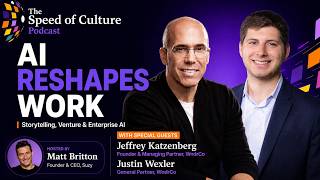
In a live CES interview, host Matt Britton talks with Jeffrey Katzenberg, co‑founder of DreamWorks and managing director of WndrCo, and Justin Wexler, partner at WndrCo. They discuss why CES matters as a convergence point for tech, media, and commerce, and outline WndrCo’s investment thesis focused on AI‑enabled enterprise tools that empower marketers and creators. They highlight portfolio companies such as Rytr (AI‑generated content), Orbi (automated expense reconciliation), and Alembic (full‑funnel brand attribution powered by super‑computing). The conversation explores the rise of citizen‑developer tools, the challenges of procurement and data security, and how AI is reshaping storytelling, productivity, and the future of work. Katzenberg reflects on his career, emphasizing mentorship, partnership, and the principle of exceeding expectations, while Wexler shares his path from a cold‑email outreach to becoming a partner. The interview wraps with advice for younger professionals and a vision of AI as a catalyst for both creative and operational breakthroughs.
Chapters
Up today, live from CES in Las Vegas, we are thrilled to welcome Jeffrey Katzenberg and Justin Wexler from Wenderco. Jeffrey, along with David Geffen and Steven Spielberg, co-founded DreamWorks all the way back in 1994, and he's remained with the business through to 2017, where he left his role as CEO of DreamWorks, and now he's a founder, managing director at Wenderco alongside his principal, Justin Wexler, a business major with 10 years working as an investor for high-profile clients. Jeffrey, Justin, so great to see you guys today. Thanks for having us.
Yeah, nice and early in the morning. Absolutely. And, uh, so pretty exciting.
So why did, uh, the two of you prioritize coming to CES this year?
Well, I have to start with I've been coming to CES for decades.
Okay.
I mean, literally decades. I don't even want to think about my first CES, but it's—
it was still when the adult show was connected to it, right?
Well, there was an adult section.
Yes. Yeah, actually it was connected with the adult show.
Yeah, that is why that literally was like where it's— I don't remember whether that was I know there was a connection. Yeah, to it. There was the other side of the convention center.
Yeah.
Which I happily never saw.
Right, right, right.
But it's many, many, many decades. Yeah. CES has always been a great gathering spot and, you know, an opportunity to see sort of amazing, great innovations, both mainstream in terms of consumer electronics and how that was evolving. And, you know, you always look forward to seeing what's the next big TV, what's the next great device, communications device in this. And so if you think about the 30-plus years that I have been coming to CES, how the world has changed, it's an amazing lens to look at. Absolutely. But what's happened in, I would say, certainly the last decade is that it blossomed into something that was much broader. And it became basically the sort of nucleus of bringing people together of related areas of which advertisers, CMOs, marketers became an essential ingredient. And that's where we are today. And so you know, it's why you're here.
Yeah.
Yeah.
I mean, you have digital technology, you have entertainment, you have commerce, you know, you have the CPG and the big brands are all kind of colliding and there's just so much overlap in marketing and media today. You know, you have companies like Chase that are selling advertising, right? So you have banks selling advertising and then you have retail companies like Target and Walmart selling advertising. So it's not as linear as it used to be in terms of what defines a business.
Right. So for us, it just, um, you know, becomes, uh, as I said, just sort of the center of gravity. Yeah. Which in a few days you can just literally— we've been every day starting at, you know, 6:30, 7 AM, you know, since Monday morning. And over the course of 3 days, you know, really, uh, just touch base with ton of people. It's the beginning of the year, you know, people are setting up their agendas. And so it's been incredibly valuable for us, and we're on day 3.
Very cool. So Justin, you spend a lot of your time talking to emerging startups in AI, in enterprise, etc. Over the last year, what are some of the trends you've seen with some of the more successful companies, either in your portfolio at Wender Co or just people that you've been talking to that you're excited about here in 2025?
Yeah, no, appreciate it. Uh, So for us, our lane at Wonderco is really to find really high-quality technology that can serve the enterprise and serve the needs and desires and roadmaps of some of the largest brands in the world. And that's a big reason why we're here at CES, 'cause many of those individuals, you know, yesterday we were at the Delta Sphere, their keynote, and we do a lot of business with them on their AI initiatives. So really great to be here for that. Over the years, we've invested in software companies we're super proud of, you know, Figma and Airtable and Webflow. Many of those serve the marketing community. Over the last 3 or 4 or so years, we've invested in products now that are leveraging large language models and generative AI in different lanes, particularly marketing, but other areas as well. Two that, you know, we just wanna highlight, one's called Rytr. Yeah. And that founder's here actually right after this. We're gonna get a breakfast and Jeffrey and May, the founder, are gonna speak at that. Phenomenal platform, uh, that leverages a full stack, uh, from their own large language models that are really great for content creation, PR, blog posts, all those use cases, all the way through to software on top to make it easy for teams, uh, to actually get going within the organization.
Yeah, I've tried it before. It's a great tool.
Yeah.
Uh, you know, and had extraordinary acceleration in this last 12 months because a lot of people have technology but doesn't even know how—
they don't know how to go market the right way.
The way, the way, sort of the way we frame it at Wonder Co is, is that we think of this as the future of work and at work, how do we, and, and both at work, but also at home, how do you empower people to be able to be, you know, more productive, to be better informed and, you know, just giving them tools to be the best version of whether it's at work or at home, uh, and doing it. Writer is a phenomenal tool. Very, uh, strong deployment, uh, in the, uh, CMO advertising.
Yeah.
Lane. And so, you know, exciting to see May build that, you know, virtually in almost overnight into now multi-billion dollar company.
Yeah, I mean, it's interesting being an investor in AI because it's moving so fast and now there are tools out there that allow a one-person team to code on their own. And the question— Absolutely. The question becomes, like, as somebody who runs a late-stage venture-funded software company, this is what keeps me up at night is, What's to stop somebody who understands AI just to build their own tool? What used to cost maybe $50 million in R&D now doesn't anymore. And I think since the barrier to entry for a technology company in a lot of ways is no longer technology, the qu— it becomes risky with a lot of upside in investing in AI companies. And we're seeing a big bubble obviously right now.
So there's this concept around citizen developer where even business users within enterprise can now build their own tools to leverage that are personalized.
Yeah, yeah.
Uh, and you know, we have another investment, Airtable, that's really core to their thesis. But even, you know, Writer, they have AI Studio. You can build full-fledged AI applications as a marketer. You don't need developer resources to do that. Uh, we have, you know, with Webflow, you can design, go straight from design to code without needing developers. So I think the developer's role within organizations will continue to evolve and seek out technologies that then the business team could use on their own without having to ask for as much engineering resources.
Right, which is just a massive change.
Yes, and when you have that, you can have real personalization of tooling at scale within these organizations. The other big aspect of that is procurement takes so long. We see, you know, particularly the last 3 or so years, the innovation from Silicon Valley and early-stage companies is unlike that we've ever seen, you know, since Wonderco started. Uh, getting through procurement and, you know, legal and security takes a while. And so you could have a 9-month lag time of innovation that could help and impact today. And so one of the other big advantages to the citizen developer trends is that as technology evolves with platforms already past all that, teams can then leverage it without having to seek out new tools. They can effectively make their own tools with the vendors that they currently have.
Yeah, of course there's some of the complications in that is that you get legal and data security and privacy involved, and they may not want citizen developers.
We're just— there's a push and pull on— we're seeing it happen. It's uncharted territory.
Yeah. So no one really knows because it's heading so fast.
Yeah. So it's incumbent on the vendor if they're going to enable that citizen developing trend to make sure the proper controls are placed for the IT teams so you don't run into those problems where, you know, someone might not be as sophisticated to understand the implications if they build a tool in a certain way within a broader platform.
Makes sense.
But then the other part of it is, is that there are many aspects of work processes that are just repetitive.
Yeah, they can be automated.
And are so simplistic and yet so time demanding. And they're honestly, they're terrible jobs. The one that goes right to the top of the list for us is expense reconciliation. Now, expense reconciliation is a legal requirement, you know, that all corporations are required to do.
It'll all be scraped and submitted for you.
Well, no, it is. There's a company today called Orbi. Yeah. Which again, we've been invested in from very early on. Group of brilliant talent that came out of Google and built this platform that automates, you know, reconciliation here, expense reconciliation to like literally 100% accuracy, saved them in the first year of deployment $4 million.
And that's a big play for AI is efficiency, cost savings.
Right. And so taking drudgery out and freeing people up to be doing higher value, higher value work is, you know, so, you know, there's sort of these, you know, uh, uh, almost diverging paths here, which is there's pie in the sky, you know, let's, uh, solve the greatest, you know, challenges of mankind that AI is hopefully going to, you know, do some incredible things. And those promises are huge and scary. Yeah, well, I'm gonna stay on the positive side. Yeah, exactly right. Uh, and then the other side of it is, is, you know, uh, taking drudgery and, and taking that out of, uh, people's day-to-day, um, you know, work and making their jobs more fulfilling.
I have a question for you about AI. Yeah, if you— if AI would have been at the state it is today when you first started in Hollywood making amazing stories. How do you think it would've changed your trajectory over your career? And what do you think that means for the future of Hollywood in terms of everything you're seeing?
Well, I, it, it would've had, you know, incredible impact. I, uh, you know, have been, you know, feeling, you know, as I've watched these, uh, extraordinary, uh, innovations and that have been going on around generative AI and the applications around it, whether it's for language or for storytelling or for visuals. Yeah, it's incredibly exciting. And I— you're talking to someone who has always wanted to be on the forefront of having the best tools for my storytellers as a competitive advantage. I've been going to Silicon Valley literally since the late '70s. And, you know, when Silicon Graphics was coming out with their first, you know, workstations and how do you apply them for special effects. You know, when Steven Spielberg made Jaws, he took a piece of plywood, cut it out in the shape of a shark fin, painted it gray, and dragged it behind a motorboat. That was called a special effect.
Wow.
So the— what I have seen over these years in terms of digital effects, in terms of animation, CG animation, in terms of 3D, in terms of digital distribution. It is, to me, these are opportunities. And I've always tried personally, maybe it's just my own interest in seeing, you know, what's a better paintbrush? Yeah, right. What's a better— I'm going to use a word nobody uses— typewriter.
Yeah.
You know, these are tools to enhance artists and creators and storytellers. And so If I were in the center of this today, or were those tools available, you know, back in the '70s and '80s when I started, I'm supremely confident that I would be jumping into it, you know, hook, line, and sinker.
And that's your advice for younger people?
100%. And it— there, there are going to be new forms of story and storytelling. Yes, it's going to disrupt some preexisting and, and, and processes that exist today that no longer are going to, make any sense. But when I arrived at the Disney studio in 1984, there were several hundred workers in the ink and paint department that painted animation cells by hand. Wow. Literally, there were maybe 200 of them. It was literally the ink and paint department. There's a building on the Walt Disney Studios lot that's on the top of the things that ink and paint—
I didn't know anything at the time, but You know, that's how animation was made.
Now going back '84, so, you know, 40 years, 45 years. And so, uh, seeing how these things change and evolve— there are no ink and painters anymore, but there also never been more people employed in animation than there are today.
The question— that's fascinating, and, and I appreciate the insight. A question that is just like burning in my mind as I hear you talk is over time, since you talked about when you first got to Disney and all the innovation, those were tools that would enhance storytelling. The question with AI is, is it gonna replace some of the production and storytelling skills versus enhance? Because now what it can output, it, it's, it's not just a step forward. I would say it's a massive leap forward. And probably unlike something that you've I mean, you tell me, but probably something you've not really seen in your career.
Well, I don't, you know, it's hard to say. Yeah. You know, uh, certainly the impact of, uh, digital both on the making of content and maybe even more profoundly on the distribution of content.
Distribution. Yeah.
Has been utterly disruptive. It's turned everything upside down. Yeah. I mean, that, that is the foundation of Netflix, right? Right. And, you know, which is now the dominant media entertainment company globally today. You know, you add up all the, you know, the market value of all the other entertainment companies and one company, Netflix, is worth more than all of them combined.
Right.
Which is extraordinary.
Yeah.
A company that 15 years ago, you know, was barely, you know, they had envelopes.
I remember I had them. I actually still have one of the envelopes.
The red envelopes that arrived. With your movie. I know. So, you know, that's a— could there— is there a bigger tsunami than that? I'm not sure.
Well, I guess the qu— what comes to my mind is like, but Netflix is still a company. So Netflix still had to have investors and raise capital, et cetera. With AI, you could have an individual now with the right prompt and the right technology.
Well, you just said the right thing. So if you really wanna hone in on this, I do. The word is prompt. Prompt. Okay, and now prompt to me is just another word for author. Yeah, writer, director, cinematographer. I, I mean, I can go through virtually every aspect of it. Okay, well, I'm not sure that a single person will be able to wear all of those hats effectively as, quote, the prompter.
And there's the answer.
And so My guess, and it is only a guess, is that there are going to be very specific skill sets and very specific artists that are going to perfect the deployment of those tools around whether it's a visual, whether it's a sound, whether it's around music, whether it's around speech, whether it's around scripting, whether it's around storytelling. I, I, you know, all these things are possible. Now I will tell you, as someone who is finding enormous, enormous productivity and satisfaction around using, you know, if I opened up on my phone and you would see on my opening screen here, Gemini, Claude, ChatGPT, and Perplexity, right? That's like literally, you know, everybody on your phone, you organize the most important things to the bottom of your front screen.
The real question is, who's the most famous person on your contact list?
Okay, that's what I want to know. I don't know. That's a scary thing. Exactly. So my point is, is that I'm finding these tools are empowering me to do things I never imagined before. They are helping me compose things and write things and create things. And I have to say, they get me a lot of the way there, but they're not doing it for me. No. And that's the thing that at least I continue to have great optimism around. And so I've had to write a couple of speeches. I've had to do a couple of interviews with people like this and people that I'm only meeting for the first time. And asking the right questions, the right prompts, it has just empowered me to be able to do a quality of work that is significantly better than I've been able to do on my own in the past.
That's saying a lot.
I know it. I know it.
And I think the one word you said there that is really at the center to all of it, not just all of AI, but CES, brands, it's storytelling, right?
And that's— Okay. So you're, you, this is why Wunder Co exists, not why it exists. It's, It is one of the most valuable and singularly unique aspects of us as a venture firm. I mean, there are a lot of great firms out there today and they all find their lanes of things that they do because money is now fungible. There's every, anybody who's got a, any great founder today with a really good idea has many, many, many choices as to where they're gonna take investment from. So remember, and you know, this is where Justin's a rockstar. He's become a partner, by the way, since in the beginning of the year.
Congratulations.
So thank you. You know, we're truffle hunters. We're out looking for the rarest of rare. We want the unique founder with a great idea, you know, has made that sort of zero to one impossible journey. To actually build, create something and, you know, has a product, has product market fit. Those are the things that we're looking for because our value, we believe, and I think we've shown it now, is 1 to 10. So, if 0 to 1 is impossible, 1 to 10 is improbable. And we could— there are thousands and thousands and thousands of companies that got to 0 to 1. And were never able to actually get out into the world, into the market. What stops them? Everything and anything. You know, I mean, how do you get in the door? How do you, how do you meet a CMO to demonstrate, you know, how do you get Mae in front of the right people in the right way to be able to show her product? Yeah. You know, think about what's on the other side of that, you know, from,, you know, in terms of a company, how many people are knocking on their door every day saying, I've got a great idea for you, I have a new product for you in this and it, there's thousands, tens of thousands.
You gotta go about it a different way.
Well, or you want a competitive advantage. Yeah. You want to, everybody's looking for a cheat code.
That's exactly right.
Right? And so what we've tried to focus, a lot of our energy on is that go-to-market. And that's why, frankly, being here at CES, in which we are continuing to build out and connect our market, our connection with the C-suites where they now, I think, recognize we've become effective at sorting through those hundreds or thousands of ideas and finding the very best. And we don't bring them to them until we have proof of concept. So if we walk in the door and knock on the door to a CMO with May to talk about Writer, we have proof of concept about that and they now trust that we've, we've done our work here. Yeah. So if we bring it to them, tried, true, tested, it will deliver. And so that's what we've been building out the last couple of years. It's exciting because I think we've had some real great successes. Before we run outta time, we should talk about one that, um, we're particularly excited about. Very much focused on the advertising market, which, um, uh, when it achieves its 1 to 10, may be the most disruptive and transformative, um, uh, of companies that, that, uh, you know, we've come across.
Okay, so tell me about it.
Uh, it's called, uh, Alembic. Okay, A-L-E-M-B-I-C. And, uh, I'll say something to you that, uh, you've heard many, many times over the years. Um, so this is a, this is a company that focuses on brand marketing and being able to deliver attribution, cause and effect in brand marketing. And I've been doing brand marketing for 40 years. I'm sure responsible for many, many billions of dollars spent in brand marketing. And I, like every single other person, would say to you, I'm 100% confident that 50% of my brand marketing works. I just don't know which—
John Wanamaker, right? That's literally—
And that has continued to be the case to today. You can walk around here.
It's a huge problem that needs to be solved.
And you have this conversation with any CMO. We had it last night with frankly 3 CMOs of Fortune 50 companies. Each one of us says they're sending, they're spending hundreds and hundreds of millions of dollars a year. Each of them. Yeah. There's a trillion dollars a year spent on brand marketing. Yep. Justin found this amazing founder, entrepreneur, genius about a year and a half or so ago. And I'm going to let you— let him tell you.
Yeah, please. Yeah. So Tomas and his co-founder came from big— they worked in big data. Actually, John Adams, CTO, was head of infrastructure. He built that from seed stage to IPO. And then Tomas Puvík, who's the CEO, worked at NASA and then he was a CMO himself. So he saw all the challenges around brands effectiveness and attribution. And so the two of them noticed during the pandemic contact tracing and the advances there that take huge, huge datasets and bring them together and structure them in a way where you can see how one cause leads to an effect, right? How infections lead to the spread of the virus. And so they thought to themselves, well, what's the difference between an infection and spreading of a virus and spreading of marketing? Because in many ways, Mathematically, they're quite similar. You get exposed to a virus, you're exposed to marketing, it spreads, and then there's an A/B outcome, you know, get sick or not, or you purchase a Delta flight or you don't, right? So mathematically, they're quite similar. We have not had the amount of compute needed to, to calculate, you know, the tens of billions of rows in the marketing world. We've had it for a little while in climate, disease, nuclear, leveraging supercomputers, but never for marketing teams. And so Alembic has built a platform and algorithms that can take TV, social, radio, podcast, digital, all comprehensive, not just testing, you know, on TikTok and A/B, you know, test of ads. We're looking at comprehensive and holistic and then seeing how that leads to down funnel effects.
Very cool. Attribution, full funnel attribution. Yes, brand builders.
Exactly.
And NVIDIA, who's been a really close partner in developing this, has provided one of the top 200 supercomputers in the world that Alembic physically owns.
I got to check it out. Sounds really cool.
It changes the world. If you, you know, if you actually— when I say it changes the world, I think in a way in which for brand marketing, if you actually now can have the quality of data around effectiveness that you have for performance marketing, it— that's— it changes a trillion-dollar-a-year business.
Yeah, because right now they're bifurcated. It's like we have performance marketing that we know is highly, you know, has high attribution, but brand Doesn't—
well, we're looking out the building, looking out here, and there's a thing called Allegiant Stadium. Yeah. How much is the value of putting that name on that?
Right.
Versus how much stadium. Right, right. And so our—
actually had the CMO of Allegiant on the podcast.
Yeah. And so this morning we were actually doing a press interview or interview with the CMO of Delta Air Lines, Alicia. And Alicia boldly and bravely, when we brought this to her last summer, there are two paths here. You can unleash an army of data engineers and data scientists to try and understand and, you know, get at the core of what this does. And it's all there to do it, but it takes you months and months to do that, going through all the clearances and things that you need and approvals through CISO and all of, you know, to do it, or you can do what she did, which is say, you know what, I'm just going to do a POC.
Well, CMOs have the, the power to do that, and she, you know, she—
and particularly her, particularly this moment at Delta. And so she did a POC around the Olympics last summer where she said, show me what value am I getting out of our sponsorship. They're a very, very big sponsor of it.
Yeah.
And this was deployed in weeks. Her results came in almost instantaneously. They were invaluable to her, and she literally gave them a multi-year, multi-million-dollar contract.
Wow.
Awesome.
Great to hear about it. I'll definitely check it out. So shifting gears, we wrap up. I actually have a final question for each of you guys. But before I do that, Jeffrey, I want to thank you for supporting BU College of General Studies. I'm a graduate of BUCGS, and I didn't do well in high school and I would not have gotten into BU if there was no CGS. And once I got into school communications, I kind of found my place and went the same path as Howard Stern and so many other famous alum. But I was, well, I was actually, it was my daughter who I told her, cause she's an aspiring actress. And I told her I was interviewing you and she started to do some research and she's like, oh my God, dad, he invested. I mean, he supported College General Studies. I just want to thank you for that.
Thank you. And my kids went there and yeah, no, you know, uh, it's a great university and proud to have been able to support it.
Very cool. So to wrap up here, I have one question for each of you and I wanna start with you, Justin. You know, it's not lost to me that Jeffrey Katzenberg, a legend in business and Hollywood, just said you're his partner. For those who are listening, Justin's a very young guy. Um, most people at your age don't get to be partners with somebody with the stature of Jeffrey. Obviously he knows how to find talent, but you know, you would not be in the seat if it weren't for specific things that you did. Tell me what the 2 or 3 things that you did that put you in the seat you are today that maybe we can impart on somebody younger.
Yeah, no, I appreciate that. So, you know, I first met Jeffrey when I was 23 years old. How, uh, I got into venture right out of college. And so it was, you know, you talk about Netflix, I was at a firm that was the biggest investor in Netflix. So got to see a little bit when they were moving towards their own content. And so that's how I got my start. It was a cold email outreach when I was a senior in college.
So, you know, you just emailed Jeffrey?
No, that was how I got my original. Oh, got it. So that's how I originally got into your original. After. So Jeffrey and Su Jie, who's one of our other founding partners, you know, we're starting the firm. I got connected. Actually, there's another partner, Chen Li Wang, who previously was a product leader at Dropbox. So he was my initial contact. To Wonderco. I remember, you know, obviously we hadn't made any investments. You know, the first one hadn't been fully raised. So it was kind of the ground floor, but knew I've learned so much from each of them. Right. And so I was really, really excited to be the young guy when I joined. You know, Jeffrey has been my mentor, incredible over the last 8 years. And, you know, when he speaks about when he came through the ranks with Barry Diller, right? And how Barry had him do different tasks at Paramount before going off to Disney.
Yeah.
And that experience has been provided to me at Wonderco. When I first joined, you know, had no portfolio. So it was all about sourcing new investments and trying to build that up from there, all the aspects of doing diligence and closing deals and then just kind of grew the skill set and, you know, very much so because Jeffrey designed it that way. And so now we're at a point where you know, being kind of on the boards of some of these companies, developing that skill set, and particularly over the last couple of years, interacting with CMOs and other leaders, hearing their needs. You know, Alicia, interesting enough, she was the one who said attribution effectiveness was a challenge for them. And that's what we love, is to hear the needs and really try to find investments like with Alembic that can solve those needs. And so the skill sets just developed over the last 8 years and the right system and the right firm. And, you know, Wunderkost provided that to me.
It's awesome. So, Jeffrey, the question I have for you to wrap up is, you know, if you look back on your career, what are some of the common themes that you would point to, maybe 2 or 3 of them, that were decisions that you consistently made right in terms of how you were going to approach your career that made you the success that you were?
Well, I mean, there are a couple of these things. I've said them, you know, before. And, uh, you know, um, you know, they're just sort of fundamental things that I, uh, sort of adapted to my own, um, sort of work and work ethic and ambition and stuff. And the first and probably most important one was just two simple words, which is exceed expectations. And so, uh, you know, I learned early on that if you exceed the expectations of somebody that you work for They give you more to do. They provide greater opportunity. You get rewarded for that in many different ways. Exceed the expectations of the people that work for you. Exceed the expectation of your customer, of your consumer. Every movie, every television show, every animated show started— the foundation of it is, can we make something that will exceed the expectation of our audience? Now, you don't always succeed at any of those things that I said, but that has been a sort of driving theme to me personally that I, you know, sort of embrace. And I continue to embrace it today, which is that at everything that I do, my ambition is to exceed the expectations of someone. The second thing is the value of partnership and mentorship. I put those things together. I have had maybe the greatest set of mentors that anyone— you said, you know, who are the people in my, you know, that would come up in the top of my contact in that. But, you know, I had Barry Diller as a mentor, Michael Eisner as a mentor, David Geffen as a mentor, Steven Spielberg as a mentor, and partners. They weren't just mentors, but as I deliver, just as Justin has become my partner. Yeah. I started mentoring him. Today, he is now my partner. We spent most of our time talking about Ryder and Olympic. He found both those companies, right? So, we hopefully created the platform and gave him the resources to go do it, but he's the one that's delivering the goods there in that. And that's what— so again, mentorship, partnership, exceed expectations.
Love that. It's fantastic.
And I'll give you the last one, which is what drives me most of all, because you say look backwards, and, um, I don't look backwards other than when someone engages and asks me. I never wake up in the morning and think about, oh, The Lion King.
Do you ever watch old movies? No, you don't?
No, no, ever. You know, I don't—
I watch these old movies.
My daughter watches them 100 times a day.
Yeah, you know, but I, but I don't— I never wake up, and I'll tell you why. 'Never let your memories be better than your dreams.' And honestly, think about those words. And I will tell you, I got up this morning at 4:45 excited for my day today. A little concerned about the fires in LA, but, you know, excited for today and tomorrow and all of the things I have coming. I'm— my 50th wedding anniversary.
Amazing.
Talk about partnerships. There you go. Is this weekend. And Next week I'm in New York and already have an amazing schedule of things. And so, my dreams are still what drive me every day and therefore don't actually, you know, I'm in my car and I'm driving 100 miles an hour and I metaphorically, by the way, and I don't have a rearview mirror.
That's amazing. And I think it's such great advice. I think a lot of people, wallow in regret, or they look backwards all the time. And we all make mistakes, and, and that's, I think, a bad place to look backwards as well.
Well, it's a blessing to neither have the regret of something that you didn't do or you did wrong that you wished you could fix— not that we don't have them, but they're not front of mind for me— or relying on moments that happen sometime in your career that you're still living off of. And, you know, that's— I think it's one of the hardest things being a great athlete.
Yeah, Michael Jordan never got too high or too low.
And, but I'm just saying, you, your greatest moments are in your youth, right? And to, to move on, to find some new career, you know, to, to find that new outlet, that new opportunity, um, you know, it's like I look at Peyton Manning, he seems as happy as he's ever been. He's found a great path forward for himself. And so he's not living in the past. He's living today and in the future.
Yeah, I think it's fantastic advice. And it's advice that applies to people at all ages because we all have pasts. And whether you're 20 or 40 or 60 or 2 months. Yeah, or 2 months.
Exactly.
That's exactly right. Well, I want to thank both of you guys for taking time during your busy schedule at CES to speak with me today. It's been really inspiring and it has motivated me to do a lot more and think bigger and definitely dream forward. And I think it will for our audience too. So thank you for that.
Exceed expectations.
Oh, we will. On behalf of Susan, I, we team, thanks again to Jeffrey Katzenberg, the founding partner of Wynter, along with his partner Justin Wexler for joining us today. Be sure to subscribe, rate, and review the Speed of Culture podcast on your favorite podcast platform. Till next time, see you soon, everyone.
Bye-bye.
More from Matt




MikMak’s Rachel Tipograph on Consumer Spending, Retail Media & Holiday Shopping Trends



Jaguar Land Rover’s Charlotte Blank on Luxury, Purpose & Experiential Storytelling



