YouTube’s Adam Stewart on Creators, Advertising & the Future of Media
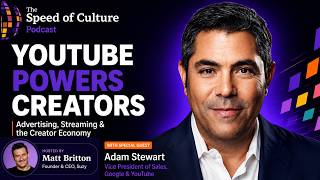
In this Speed of Culture podcast episode, host Matt Britton interviews Adam Stewart, Vice President of Sales at Google/YouTube. Stewart walks through his 14‑year tenure at Discovery and 16‑year journey at Google, highlighting the cultural continuity that helped the YouTube acquisition succeed. He explains how YouTube’s focus on the user experience, its massive creator ecosystem (2 million partners, $50 billion paid out), and tools such as BrandConnect enable brands to partner directly with creators. The conversation covers measurement (MMM, search lift), full‑funnel advertising, the rise of Shorts (1.5 billion monthly users) and its impact on advertisers, and commerce integrations (Shopify product feeds, live shopping, Coachella activation). Stewart also reflects on the shift from linear TV to streaming, noting that YouTube now rivals Netflix in living‑room viewership and that smart‑TV form‑factors accelerated adoption during COVID. Finally, he offers career advice for aspiring sales professionals, emphasizing a learning mindset, customer‑centric listening, and the importance of measurable impact. The interview blends historical perspective, strategic product insight, and personal leadership lessons.
Chapters
Up today, we're gonna be speaking with Adam Stewart, Vice President of Sales at Google and YouTube. Adam, great to see you today. How you doing?
I'm doing well, Matt. How are you?
Good. You've had a long, really interesting career that obviously has now netted out at you being at YouTube at this exciting role. But would you mind by starting by just giving us a little bit of background in terms of all the steps you took to get you to where you are today?
Yeah, of course. So I started my career, I'll date myself here a little bit, in the earlier days of cable television. I started at Discovery Channel when it was just the Discovery Channel. There were about 300 of us who worked in the company at that time. I spent about 14 years at Discovery, a little over 14 years. It was an incredible experience.
Wow.
Started as a sales planner, left as the national sales manager over 12 networks at Discovery. And I found myself at Google not too long thereafter. I've been at Google now for almost 16 years. I came over really just after the YouTube acquisition to run media and entertainment, and now I'm the vice president of sales over multiple verticals, consumer packaged goods, automotive, media and entertainment, tech, government and advocacy. And I love my role. I love what I do.
The younger people that I talk to that work for me, or especially my children, don't understand there was once a world without Google, right? It's such a huge part of our culture and everyday lives. 16 years is a very long time. Time to be at a company like Google. I'm sure you've seen so much change. Tell us about some of that change that you've witnessed firsthand. You've had a front row seat to the evolution of one of the most important companies in history. Would love to hear what you've observed and some of the key lessons that you've picked up.
You know, the ethos of the company, I think the value system of the company is the same today as it was 16 years ago. And I think that's one of the reasons why the company has been so successful. I mean, really, I've been very, very close to YouTube since the early days. When I came to Google, there were actually two video products. There was Google Video and YouTube at the same time. So if you remember, remember those days. And I've really had a front row seat to so much of that change and really being a part of the building of the YouTube business, you know, since we started. And, uh, it's been incredible. A lot of change, a lot of very positive change, and an ecosystem that I think, you know, we would have never imagined, you know, 16 years ago in terms of the creator ecosystem and the creator economy to being what it is today.
Obviously the YouTube acquisition was a pivotal acquisition in the lifecycle of Google. So many big deals don't work in technology. This one not only worked, it's probably being looked back as one of the most successful acquisitions in the history of, of the consumer technology space.
Yeah.
Why do you think it worked out so well? Why was YouTube such a good fit for Google?
Again, when I think about what the company has stood for forever is really that focus on the user. And it is that kind of relentless focus on the user experience that, you know, permeates Google. And it really, I think in large part is a huge reason, uh, for this to the success of YouTube.
Yeah, absolutely. And obviously YouTube, it's not only successful, it's sort of, it continues to sort of grow on its impact on consumer culture. I'm a huge fan of YouTube TV, which so many people still don't realize you can actually watch live TV through it. They hear the, you know, name YouTube and they're like, oh, but I wanna watch live TV. They don't get it, which shows how much more growth a platform like that has to grow. YouTube obviously isn't just a channel, it's a platform. And in that regard, as VP of sales at YouTube, What is your role? Where are you focused from day to day in terms of trying to extract value from that growing importance the platform has?
That's a great question. So I spend a lot of time with our customers, working with them on their marketing objectives, their business objectives, and thinking across the suite of our platforms, all of our platforms, not just YouTube, in order to drive those objectives. It's a large team, you know, that are in service of these customers. So I obviously spend a tremendous amount of time with them. And I spend a lot of time, you know, thinking and working on YouTube. Think about how it is that we are bringing YouTube solutions to market, as we're looking at different products and things as we continue to evolve YouTube, what are the things that we can do that can deliver outcomes for our partners?
Gotcha. Okay, totally makes sense. And obviously, you know, the advertisers who you're working with right now that are looking to leverage the platform, so many brands I'm speaking to right now are focused on one thing, and that's the creator economy. As we all know, Gen Z specifically, they have their phone as sort of an appendage to their body. They are not viewing linear television the way that so many of us Gen Xers did. Growing up, they are looking at content, both long form and short form, not from networks, but from other people. How do you see YouTube's role in the overall creator economy and what are some of the trends you're seeing in terms of brands trying to leverage this?
Yeah, I love the question and I love that brands are having that conversation with you because we're having the same conversation with them. Look, I think it's important to kind of take a step back and, you know, I was, I was probably one of the very first, maybe 2 or 3 people that came over from television. To work at YouTube 16 years ago and to work on YouTube and Google 16 years ago. And if you go back and you think about what made that content economy work, I mean, I was in the room when we would sit there and say, look, for if we could get to 30%, if 3 out of every 10 shows that we created worked, we'd be successful. I was also in the room when we would— at hours, what seems so crazy, like, well, the 7 o'clock lead-in, what are we gonna put at 8? And it sounds now coming out of my mouth like absolutely prehistoric.
And then I think you— Crazy, right? Yeah. It's kind of crazy.
And then you If you think about where we are right now, in a way, you know, the creator economy, and if you think about how, you know, information became so readily available, people were able to tap into all of those interests, the things that they were truly excited about and truly passionate about. And the creator economy is just a true expression of that in video. You know, it allows people to access all the content that they care about, allows communities to, to really connect. And I think, you know, where YouTube sits in this is really at the center of that. The heart of it. You know, there are over 2 million creators that are in the YouTube Partner Program. YouTube has paid creators $50 billion over the past 3 years. And so I think when creators, you know, there's obviously a lot of choices that creators can choose, but I think YouTube has really sat at the heart of it and we've been at it for the longest. And I think there's a tremendous amount of work and effort that continues to go into this community to ensure that it prospers and thrives. And then I have my responsibility with that, along with others, to ensure that advertisers truly embrace the creator economy and all that creators can do for them.
What are some of the paths that you've seen advertisers take in leveraging the creator economy that have been successful? Are there any sort of tried and true strategies that you would really impart onto advertisers?
Look, at its core, it's really about, you know, investing in creators and investing in ads on YouTube and other platforms that support the creator economy. Because at the end of the day, and YouTube's obviously a well-known example, 55 cents of every dollar that a marketer spends is going directly to that creator. And I think that stands in great contrast if you think about how other, you know, kind of more traditional content economies have worked. So how can advertisers be involved and support? It's exactly that. And I think, you know, the other piece of this too, and I think there's a lot of things for marketers to consider, but we obviously pay really close attention to measured results. And that is really, I think, kind of— Sure. Rings true. And so time and time again, you know, we're working, there's a great article in Digiday today about MMM and, you know, marketers evaluating some of the things that they're doing from linear versus digital and other things.
Mixed media modeling, right?
Yeah.
Just for those who don't know what that means. Yeah.
Yeah. Yeah. Sorry. Thank you. Appreciate that. And look, I think at the end of the day, measurement matters. And so one of the things that we're responsible for is really working closely with our partners to understand how that investment works. So when you talk about it at its very core, in terms of really supporting the creator economy. It's investing in it and it's a good investment because time and time again, case study after case study, research piece after research, what you'll find is that investment is delivering results.
So what are the brands actually investing in? Are they actually paying the creators to make content for them? Are they placing their ads juxtaposed next to creators' channels? How has this actually come to life?
Yeah, I mean, so there, there are in-stream ads that run along, you know, alongside this content just as it would in, in other content. That's probably, that is the same. Single largest. And then, you know, there are tools like BrandConnect within Google that allow marketers to work directly with creators to create content that supports their brands.
Wow. So that is something that's definitely new because I think, you know, in-stream advertising, to your point, is really something that YouTube has been doing for quite some time. But now with BrandConnect, brands have the ability to say, you know, we are a skincare brand. What beauty influencers have an audience that overlaps with my audience, and then what happens then? You make the introduction?
There's basically a suite of tools that are available to help you understand which creators are most interested, are most valuable for that particular brand. That connection is made, content is made, it surfaces, and it works.
Wow. I mean, and that's something I think you're gonna start to see more and more of. I think, again, you talk about what the program at 7:00 PM or 8:00 PM, I remember growing up, was all about. Must-see TV on a Thursday night, right? And it was just brands would overpay to aggregate those eyeballs on a Thursday night. The time part doesn't matter anymore. It's all about the audience of the creator, what their key insight is to their consumer audience, and does your brand fit in? If you can fit into that, then you're gonna be able to aggregate today's eyeballs in the right way.
And I think it's so important. You know, I think you're right. 'Cause I was thinking about this a little bit. I grew up with, you know, I think you watched Disney on Sunday night on ABC.
I did.
Young children. That meaning of what I did growing up, it means nothing to them. And so I think, you know, for marketers right now to really be conscious of like, like the change in the shift that's happening is real. In fact, this was what this piece was about earlier today. It is real and it is happening. And so that shift from linear, which I think, you know, people of my generation certainly grew up with, has absolutely now changed. And it's really important for marketers, I think, to really be thoughtful about how it is that they embrace the creator economy, how they think about their marketing dollars going forward. Because, you know, the consumers have already made their choice. They've already shifted.
Yeah.
If you look at— for us, I know you mentioned YouTube TV, but YouTube actually in the living room right now on connected TVs, there are two surfaces that share the most watch time in the living room. They're Netflix and YouTube. So, you know, again, there's— I'm not saying that there isn't value in what's there within linear and in sport and all of those other things. But I think it's really important for all of us who think about marketing to really be thoughtful about not where things are going, where they already are.
Oh, of course. In August, Nielsen said that for the first time streaming overtook linear television in terms of viewership. And that's, I think that was a seminal moment. I think that the advertising industry is still a little bit behind. You look at things like upfronts and the way that television is bought, and a lot of it is still looking in the rearview mirror. And it's always been shocking to me that advertising, the advertising industry, which should be an innovative, industry has taken so long to see what consumers are seeing, where, which is we don't tune into television the way that we used to. But I definitely think it's catching up. When you talk about YouTube being so big in the living room, you know, one thesis I have is just that smart TVs are become almost every new TV purchased right now is a smart TV, like by Samsung, and it has some type of interface. So it's just easier to find. I think when I used to, 3, 4 years ago, put YouTube on a television for friends that came over, they thought I was some tech genius. Yeah. And now everyone knows how to do it. So how much of this, I guess, new accelerated adoption is based upon the form factor of the television and it just being easier for people to be able to pull it up?
Look, I think it, it certainly helps, um, for sure. And I think part of the viewing shift certainly took place during COVID Sure. When people were home. I think if you look at the rise of, of YouTube in the living room, there was certainly an accelerator in that period. So I think you're right. It's about the accessibility.
Yeah.
But again, I think it really, I get flashback, you know, many, many years ago when I was sitting in that room with folks trying to think about what people wanted to watch and trying to be, you know, in that time, if you were 3 outta 10, you were successful. What is it now? If you think about where that percentage, like what is a hit today and what it takes to do that. And then you flip the entire model on its head and you say, you know what, in a way, like with the creator economy and essentially by bringing this to you, I can find the things that deeply resonate with me. So what's on my living room screen is that content because it connects with me. And I think when we look at Gen Z, and you know, again, I'm far from Gen Z, but it's not, you know, it's across generations. It's not just limited to one, but it is this like kind of next generation that's coming up that will always look at the device in a different way than what we looked at it. And their starting point would be a platform like YouTube.
Yeah. And Adam, if I were you, and I don't expect you to respond to this, but if I were you, I would be pushing my executive team to purchase a company like Vizio and basically just give those TVs away for free and subsidize it with subscriptions to, you know, premium YouTube and YouTube TV. And it's almost like the razor blade model, right? Because if you had your interface and the first things that came up were YouTube TV and YouTube, then it would be even easier to watch. And I think the television has played such a big role in the adoption of streaming because for a while you had to know how to use, you know, a Roku device or an Apple TV, and now it's integrated, but still Samsung is almost controlling the rails. They're the equivalent of Apple and the phone, right? So I think the rails of TV viewing ultimately is the television device, and I think it's the next great frontier for companies to get into because it's low, razor-thin margins, but it is the things that consumers touch and feel that ultimately access the content, which you're talking about.
Like you set it up, I, I won't comment on that, but I will say I think people find the content that they love. Right? And I think that's really kind of at the core of what this is. So, I mean, for folks to have—
If they can. Good luck trying to tell your parents to find it. You know what I mean? That's the thing is younger people can find it. The easier it is to find, I think the more accessible it'll be ultimately.
I appreciate the sentiment.
Yeah, absolutely. So let's talk about the expansion of the YouTube business model. So, so many people know as YouTube is just sort of an advertising-based channel, but more and more commerce has started to happen on YouTube. People are buying things. I'd love to hear what you're seeing in that area and what are some of the opportunities that YouTube's taking advantage of in the commerce space?
You know, I always kind of think about this question almost on the personal basis. You know, in fact, I'll use a recent example. I'm in the process of looking for a new car. Lease is up, and I don't think I would buy a car if I didn't know the Doug score. So if you're a car enthusiast on YouTube, Doug Demuro does these incredible reviews. They always have a Doug score at the end. Like, I want to sit and see that content. And what our users tell us, you know, 89% of the users trust the creators that they're seeing when it comes to different products. And there's a lot of value in that. So I think we know that at its very core, like, there's fundamental value for merchants and for advertisers, for products to have an opportunity to sell their products within YouTube. So I think we've done a couple of things. You know, one, there's a very skilled way of getting at this, as you would expect. You're talking with us within Google. So there— a merchant's feed, a product feed is essentially available within Google. It surfaces in a bunch of different areas. So that same surface, is available to surface within ads within YouTube and YouTube Shorts as well, which we haven't had an opportunity to talk about yet, but I'm looking forward to discussing with you. For creators and merchants, we have a great integration with Shopify. And what this integration allows you to do is to seamlessly have a shopping experience within the YouTube environment, and you can actually make that transaction within the YouTube environment, which we think is incredibly valuable. We're also, like many others, are experimenting with, with live shopping. And understanding what that can mean. And I think one of the great examples of this, which is, I think, you know, in a way unique to YouTube, is Coachella. You know, where you— we did a shopping experience during Coachella. You have this massive audience that's coming there to be a part of it. There were some goods that were available for folks who were passionate about what's going on at Coachella. That transaction was able to happen as part of it. So we continue to think about shopping as a huge opportunity to platform, again, kind of going on that kind of core foundation that, like, this is where people go for information. I think this crosses so many different— I do think this one, to your earlier question, crosses a lot of different demographics. If you're making a purchase decision, where else can you really go to get this kind of corpus of information that's available to you? Again, knowing that that fundamental user behavior is there, connecting that to rich shopping experiences, whether through Shopify or whether through ads or other means, it delivers a tremendous amount of value.
Yeah, and really what you're talking about is full funnel. I think Google itself, the AdWords product, has always been been obviously the best tool on the market in terms of bottom of the funnel, you know, trying to garner that, you know, ultimately consideration or intent into purchasing. Now you had YouTube, which is creating billions of impressions and actually driving that initial consideration. So that's the top part of the funnel. This is the very bottom, it's conversion, right? You're driving purchases. And are you seeing in this economic environment more brands focusing more on just sell-through? Where do some of these trends you're seeing shape out in, you know, in the wake of an economic downturn? Yeah.
I'll make a quick comment on the full funnel 'cause I think that's exactly—
Sure.
Kind of how we're thinking about it as well. If you think about kind of from awareness all the way through to consideration, if you look at what happens on YouTube for brands, brands advertise on YouTube and search lift is something that we can measure. We can see what happens with that search lift. So where can you capture some of that search intention? Through opportunities like shopping, right?
Yeah.
So if I'm interested in a brand, it's like I get my awareness, I lift the search, that comes through in terms of the actual performance of the media. And so that's something I think we continue to be focused on, see a lot of opportunity in. I think to your point right now, what am I seeing? I think it gets back to what I was saying a little bit at the beginning. Measurement matters. Your media matters. Sure. The performance of that media matters more than ever. So understanding how your media is performing in order to make the right selections during difficult economic time makes a huge difference. So we continue to work really, really closely with our partners. Excellent. To help them understand just that. And maybe there are things that they can do within mix. Maybe there are things that they can do within creative. But if you're going to make an investment, you need to understand how it works and you need to optimize within the platform. So we spend a lot of time in those areas with our partners now more than ever.
Yeah. And you had mentioned earlier, I mean, obviously the way that consumers, especially Gen Z, is consuming content is continue to change. Obviously platforms like TikTok has had a huge impact on consumer culture. YouTube has really stepped on the gas on its YouTube Shorts product, which is definitely gaining popularity. Tell us a little bit about that and some of the opportunities that presents for your advertisers as well.
Yeah, I mean, we are really excited about what's happening within Shorts, and I think it's, you know, I'll kind of gear this back a little bit to I think what it means for creators as well as marketers. So right now you've got 1.5 billion monthly users on Shorts, trillions of views. And I think, you know, when we talked about kind of YouTube being the heart of the creator economy, I think this actually really captures it because if you think about it, whether you're a creator, if you're music or whatever it might be, if you're in that experience of Shorts, right, where you're getting a piece of content and you want more and it's something that you're more interested in, I think what YouTube really offers creators and users is just that. So if I hear a piece of music that comes across in a Short and I really like the artist, I wanna have that opportunity to go deeper into that corpus.
Sure.
And so it's not just kind of the empty calories of going through something It's really having that opportunity to go deeper. And I think creators see this. I mean, I've spoken with them about that. I've talked to creators who, who have started off as Shorts creators, and their aspiration is to create a feature-length film and have it on YouTube. And I think in terms of like thinking about like the holistic creator economy, the experience that users want, that's where I think YouTube really plays incredibly well. And what we're seeing now is that for creators who've been on the site for a really long time, as they utilize Shorts, their overall time spent with their content continues to grow, be that short form and what's happening for them in the longer form content.
Yeah, makes sense. And really interested to see how that product evolves over time because it's definitely right place, right time. And you know, there's no shortage of opportunities obviously in the creator space. And again, I think it's probably the number one thing a lot of CMOs are trying to crack heading into 2023 for sure.
For sure.
We're gonna shift gears a little bit and Just, you know, you've been at Google for 16 years. Obviously you've proven, you know, longevity and staying power at one of the most competitive, powerful organizations in the world. For younger people who are listening to this podcast that want to get started out in sales, you know, what's some advice that you'd give to them in terms of how to enter the right way, how to stay successful over time, and some of the skills that you think are needed to really thrive in today's workforce?
Oh, it's a great question. You know, I'll tell you a very brief— when I came here, I think there was a bet of people that said, that had me at 6 months max in terms of the amount of time that I would last at Google.
Why's that?
You know, I came from a very traditional media company and, you know, it was kind of the large brown desk that was behind the larger brown desk. You know, like it was just a very hierarchical thing. It took me a little bit of understanding to, and growth to figure out how to be successful here at Google. I think if you're coming in, I think it's to be open and thoughtful about your career and not necessarily as just being linear, but the collection of experiences that you're going to have over the course of your career that are going to help you get to the roles and things that you really aspire to doing. One of the cool things about Google that I've always loved about this company, I've seen people come in in a certain role and then end up in Singapore doing something completely different. And I think it's about your mindset. You know, you have to have that kind of open and learning mindset. You know, I really believe, like, one of the best things about the company is that if you're a lifelong learner, there is no better place to come to work every day than Google. And I think those that approach their career in that way, thinking, hey, there's a suite of things, there's a toolset of things that I want to build and experiences that I want to have, some I may like more than others, But I think for those kind of coming into the workforce right now and thinking about their career along those lines, a collection of experiences that help you really figure out what it is that you want to do, where it is that you want to go, I think is incredibly valuable. And in companies like Google and our peer set, you know, it's incredibly important and valuable.
And more specifically in terms of being in sales, you know, I've been in sales for most of my career. Even being a CEO of a startup, you're always sort of selling. A lot of people think that selling is a dirty word. Were, but it's really what drives ultimate success at so many big companies. What are some of the key attributes of selling that you think people need to learn and hone in over time?
Your customer success is your own. And I think that this is probably one of the things that I've always kind of felt was, was a gift, quite honestly, of working here. You know, so many times in media sales in particular, you know, and again, I'll draw back a little bit on my past, I couldn't really feel the impact. I couldn't see the impact of what I was doing. And, you know, I worked very briefly in my career at Univision. I started to see a sense of it in terms of like impact of, you know, like measured results. And I think when you're in sales and you can really deeply understand what your customer's objectives are, deeply understand it, ask the right questions to understand really what is it that they're trying to get to. And then you think about what you have. Within your toolset in order to deliver those objectives and deliver them well, I think that really is incredibly important. And again, I think the fortunate thing that I've had in my experience at Google is that I can see the results. And, you know, I know that when we do our work well, the measured results and impact are there for our partners. And for me, that's been, you know, there's been a lot of gratifying things over the last 16 years. Yeah. It is incredibly satisfying to know that we've enabled success for our partners. And I would advise anyone who's thinking about a career in sales to really invest their time and their thoughts and understanding really what it is, what their customers are working on, their objectives, and find a way to deliver against those.
Yep. Everyone's so excited to talk about their own product, their own unique selling proposition, tell their story, but ultimately if you just flip the script, the less that you talk and the more that you listen, the better off you're gonna be because you're gonna let the consumer tell you exact— the customer tell you what exactly is that they want, right?
Completely. And I don't wanna say that people don't care how it is that you get to those results. And I think what you just said, I mean, I think, you know, one of the, I think early on, certainly within Google is there's a lot of SKUs, a lot of product. We've talked often about like, we'll produce this product for here and this product for here and this product for here. We put together this kind of secret sauce of products to deliver those outcomes. At the end of the day, I think there's a matter— there's an empathy that you have to have when you're sitting across from a CMO. Google's not the only partner that they're talking to. They're talking to a lot of different partners. So how we get there, while it might matter for some, what really matters for most is what we can actually deliver and ensuring that we're doing all of the right things along the way.
Yeah, absolutely. Well, I mean, I think that Google has no shortage of solutions. We at Suzy use Google across the board in terms of building awareness, consideration, conversion, and it's been incredibly successful for us as a tool to help grow our business. I just wanna throw that in as well. Thank you for that. So this has been great. I really appreciate it, the conversation, Adam. And obviously you must be going at 100 miles a minute in your role at Google in such a dynamic company. You know, we're all about the speed of culture at Suzy, so, and on this podcast, we get it. But you also kind of need to have that yin to your yang, so to speak. So in that regard, what is it that you feel is worth slowing down for personally that allows you to get away from all the madness?
Oh my goodness. Well, I have 3 young kids, so I don't know if that's exactly slowing down, but it's certainly, you know, that is, I think when my time is not spent here, it is absolutely spent there.
Yeah. Can't think of a better way. Well, that's amazing. Again, for anyone who's interested in the future of media or technology, or, you know, being in the sales trade and understanding how to grow it, I think they're gonna get a ton of value from this. So, Adam, I just really wanna thank you for joining today. On behalf of Suzy and the Adweek team, thanks again, Adam, for joining us. Be sure to subscribe, rate, and review the Speed of Culture podcast on your favorite podcast platform. Thanks again, everyone. See you soon. Hey! Hey!
More from Matt




MikMak’s Rachel Tipograph on Consumer Spending, Retail Media & Holiday Shopping Trends



Jaguar Land Rover’s Charlotte Blank on Luxury, Purpose & Experiential Storytelling



