Zeta Global’s David Steinberg on AI, Data & the Future of Marketing Technology
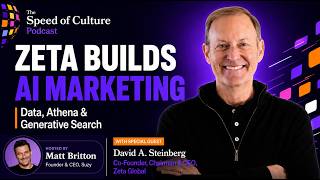
In this Speed of Culture podcast episode, host Matt Britton interviews David Steinberg, CEO and chairman of Zeta Global. Steinberg recounts his entrepreneurial journey from telecom startups to building Zeta’s AI‑driven marketing platform. He explains the "triangulation" research method that led him to recognize the need for a data‑cloud and AI foundation in 2017, and how Zeta’s architecture embeds AI natively to eliminate latency and drive massive ROAS (600‑700% per dollar spent). Steinberg outlines Zeta’s business model—serving large enterprises with a unified acquisition‑retention‑monetization flywheel, leveraging first‑party data, a consumer data platform with 5‑7k data elements per person, and a proprietary algorithm. He differentiates Zeta from competitors by owning first‑party data, being a revenue‑center, and maintaining a partnership‑first approach with OpenAI, AWS, Azure, etc. The conversation dives deep into Athena, Zeta’s voice‑enabled AI copilot, its evolution from the earlier Zoe prototype, its rapid 10‑month development, and its goal to deliver up to 1,000% ROI while reducing user friction. Steinberg describes internal change‑management tactics that forced AI adoption across the workforce, resulting in a 125% increase in engineering output. He discusses how AI democratizes marketing tool usage, shifts consumer reach from search to AI‑generated answers, and anticipates future ad‑tech dynamics with OpenAI and Google. The episode closes with Steinberg’s advice for young professionals: pursue non‑traditional paths, build soft‑skills, and treat crises as opportunities, encapsulated in his mantra “Never waste a crisis.”
Chapters
Up today on the Speed of Culture podcast, we're thrilled to welcome David Steinberg, the CEO and chairman of Zeta Global. David is a serial entrepreneur and marketing technology pioneer who has built, scaled multiple companies at the intersection of data, AI, and digital marketing. David, so great to see you today. I'm a huge fan and really looking forward to this.
Well, Matt, I'm a huge fan of yours too. Thanks for having me. It's great to see you again.
Absolutely. So my first question for you is, and it's so refreshing to speak to a fellow entrepreneur here on the podcast, especially one who's accomplished as much as you have. You've built multiple companies across telecom, e-commerce, and now AI-driven marketing. What's the pattern you see across each wave that most founders miss when trying to scale during times of rapid change?
Well, first of all, you know, you know how it goes, Matt. You're an entrepreneur too, right? How do you become an entrepreneur? You, you're unemployable, Right? I couldn't get a job outta school. But you know, it, it's sort of like I do this thing I call triangulation where I just, I read a lot, call it 5, 6 hours a day. I'm reading different publications, white papers, scientific journals, so on and so forth. And I try to triangulate sometimes incredibly disparate data points that lead me into believing that certain things will happen. So with Zeta, it was 2017. We had bought a bunch of, you know, customer acquisition and ESP assets, and we were sort of running these 8 disparate platforms. But we had started the beginning of building this sort of data ecosystem. Now it's pivoted a lot to the Data Cloud, but we had a lot of data. And what I was looking at at the time, Matt, was there was no way to process the amount of data we were ingesting in time to make an even somewhat intelligent decision, meaning it could take hours to make a decision that would be best served made in a millisecond. And that's when I started to explore and learn about artificial intelligence. And sort of, it came from reading about different things about AI. It really started with natural language processing. How do you ingest information, synthesize it, and so on and so forth? But, you know, you, you just have to be willing to be open to incredibly new ideas. And, and you are too, right? I've seen it with you in your career. You have to be incredibly open to to new ideas. And, you know, a lot of people ask me, how did I get from telecom to, you know, uh, AI data-driven marketing? I had founded 4 telecom companies, sold 3, taken 1 public. When the 4th one got purchased, I found out from the private equity firm that had bought it, I had signed this incredibly comprehensive non-compete in the wireless space, uh, that, that quite frankly, was probably one of 100 documents I signed without reading the day we went public. I didn't make that mistake of not reading everything this time, but, uh, you know, I sort of was like there and I remembered how incredibly complex it was for my last company to run its marketing. It needed 15 to 17 different vendors. And the vision was not, I mean, listen, in 2000, A, the vision was not data and AI. You know, we, we would've been way too ahead. It was just how do we put everything a marketer needs in one place and eliminate all the different point solutions? And on our journey to that sort of North Star vision, we figured out that without a data cloud and without AI as foundational to the platform, native to the application layer, we couldn't deliver on that North Star vision. So we sort of happened in to data and AI in 2017 as a part of continuing with that very early founding vision.
So fast forward to today in 2026, how would you describe the Zeta business? Who do you guys serve and what are some of the benefits they're gaining from your product that are moving their businesses forward?
Yeah, so we help very large enterprises to meaningfully better manage their customer acquisition, customer retention, and customer monetization. So you have acquisitions full, I mean, literally from the moment you meet to keeping them from churning, like literally. And what we have found, Matt, is that flywheel starts with acquisition or it starts with retention, but the data that informs acquisition then informs retention, which informs monetization, which better informs acquisition. And if you look at it recently, there was a, a, uh, Forrester study that just published that For every dollar spent through the Zeta marketing platform, we return between 600 and 700% on ad spend. So yeah, I mean, it's, it's really what I think one of the reasons that even going into 2026, where we are now, right? Uh, we've projected our 4th consecutive 30-plus percent growth rate year.
Which is not easy to do as, you know, as a software company, you see all these headlines about the SaaSpocalypse and, you know, companies losing their moat and you guys, that clearly hasn't impacted you guys. Why? Like, what is it about your business that's different than so many others that seem to be really hurt by all the recent innovations in AI that make it easier for new entrants to enter the space?
Yeah, I mean, I would start by saying that the biggest difference between us and our competitors, we are the disruptor. Not the disrupted. Like, we're the guy— like, last year, if you look at the marketing ecosystem, it grew about 10%. We grew 30%, right? So we're, we're by definition, you're taking meaningful market share from your competitors. And if you look at it, when we started programming with AI in 2017, we launched the Zeta marketing platform in 2021 with an entirely new architecture that put AI and data as native to the application layer, which by the way, removes latency and by definition drives massively higher return on ad spend, right? So, you know, I think, you know, I think that, I mean, let me also say that I think there's gonna be major winners, major losers in the large language model ecosystem, right? I'm old enough, I was around when, The internet was going to kill Walmart, was going to kill JPMorgan Chase, was going to kill FedEx. And you know what we found were companies that adopted the internet massively accelerated, ones that didn't are dead. Same thing with cloud computing, right? When cloud computing first came out, remember Matt, all enterprise software's going away. You're going to have little apps that sit on top of like Snowflake, Databricks, or AWS. The exact opposite happened, right? I, I think when you look at what's gonna happen, companies that embrace artificial intelligence like us, and I, I'm sure you saw at CES this year, I think I saw you there. We, we, we announced one of OpenAI's earliest enterprise-grade partnerships where we've built Athena, which as you know, we just launched the other day. We've built Athena in partnership with OpenAI. We can get to her in, in just a second. But I think the biggest differentiations between the winners and losers are, A, who has first-party proprietary data that doesn't feed into the large language model. So just to re-architect our model, we set up a consumer data platform for all of our clients. We had 603 enterprise clients, including 51% of the Fortune 100 at the end of last quarter. Okay? If you look at that, we ingest all of their first-party data into the CDP. We merge it with the 500 150 million opted-in individuals in our data cloud where we have an average of 5,000 to 7,000 data elements per person. And our first-party tracking pixel is sitting on trillions of pages of content. And all of that is feeding into a proprietary algorithm inside of the consumer data platform. Do you see a scenario where Fortune 500 companies start giving their first-party data to large language models to build enterprise applications for them?
No. I mean, that, that's the thing actually they're most concerned with. Correct.
Right. In fact, it's what we hear from every one of them. In addition to that, our data cloud has never been fed into a large language model and never will be. Second, are you creating return on investment for your clients or are you a major cost center? At Zeta, we're a revenue center. We're returning $6 to $7 for every dollar a client spends. And then three, Matt, I mean, you know how hard it is to sell into a Fortune 500 company. Right? You've got procurement, you've got data security, data privacy, the CIO, CTO, legal, accounting. Then you have to do SOC 2 audits and everything has to be delivered. I just don't think the large language model companies are gonna build expertise in that. I think what they're gonna do is partner with companies like Zeta that embrace them. And, and by the way, they'll become a, meaningful component of our cost structure. If you look at our first adoption, Matt, of AWS, which I think we did 4 or 5 years ago, I mean, we had 26 hosting centers at one point and we work with everybody. We work with Azure, we work with Oracle, we work with Google, we work with AWS. We, we do the most with AWS, but in— everybody said, you're crazy. You can't do that. The compute will be too expensive. We tried it in Europe. And we loved it. We've now adopted it globally. In the last 4 years, actually the last 3 years, not only has AWS continued to drop as a percentage of revenue, but we've added 500 basis points to operating margin, and we've grown the business on a compounded growth rate of greater than 30% top line, greater than 50% EBITDA, and greater than 75% free cash flow, while simultaneously making AWS one one of our larger global expenses. I think you're gonna see a similar thing with the large language models. We'll adopt them. We will pay them a fair rate for their software, which is very, you know, very valuable. But I think we'll continue to grow at a faster rate than that cost structure will grow. And I think we'll continue to expand operating margin.
And you mentioned Athena, which to me really signals a shift, which I believe is definitely occurring away from traditional dashboards more to answers. People want answers. They don't want to have to understand the knobs and dials of a product. Just want to hear, like, what was the journey for you to launch this new product, and what do you hope that your customers will get out of this new innovation?
Let me, let me start with the second part. I'm going to use invasion. I like that. I like, I like invasion. Athena's goal is to solve our clients' biggest problems. It's really that simple, right? And if you think about it, like almost all software companies, anybody who's watching this has a piece of software that they've paid for that they use 10% of. You're paying for 100% of it, but you use 10% of it, right? So what I say is we have built a 747 jet for a platform and a data cloud, and our clients know how to fly a Cessna. Athena is our voice-enabled, fully conversational copilot for the platform. So instead of using the, the keyboard, which I, I think if you think about And I don't want to get too existential here, but if you think about human— well, but think about humanity, right? We've been around for, you know, hundreds of thousands of years, right? We're the last second at midnight from a time of the Earth's existence. And for our entire existence, we communicated via voice. We didn't even create a keyboard until the 1950s. We didn't have a mouse until Xerox created it. You know, like you have all these different things that came out, but humans like to communicate with the voice. And the idea really germinated from like, as you want to remove the friction between the individual and the AI.
Yeah. And humanize it really, like, 'cause that removes all the learning curve. Everyone knows how to talk. They don't know how to use every part of your tool, but they know how to talk and, and explain what they want. Correct. Right.
Exactly. They know how to explain their problem and ask how to fix it. I, I'm sure you saw the other day when we launched Athena, we did it as a birth announcement. We sent hundreds of boxes out with a like beautifully done, thank you. Uh, you know, like birth announcement. And then we did the birth of Athena instead of the birth of Venus, you know, the old Botticelli painting. We, we had her clothed by the way, but the, and, and, and then we did baby pictures of Athena and really sort of rolled it out. Because she's a person. Like, she's— Athena's meant to be your friend. She's meant to help you navigate the platform. So I thought a birth announcement versus we're making her just generally available was a cool idea. It seemed to have been very, very well received. But when you think about it, the journey started years ago, to answer your first question. Second, we created a program called Zoe. And Zoe was our first voice-enabled platform. She was very clunky. She was, uh, she had, you, you remember the old sort of walkie-talkies? You'd say, hi David, out. And you'd like have to like really stop and like the, the, whereas you can interrupt Athena mid-thought, like she's fully conversational. But we integrated and launched Zoe a few years ago. We actually found something super interesting, Matt. Companies that adopted Zoe spent between 250% and 275% more on the Zeta marketing platform than clients that didn't. So when I came to the team with the idea for this voice-enabled copilot that could run your entire life, but starting with marketing, everybody was like, this is a good thing to invest in because we had already seen the ROI from, from clients that were using Zoe. Zoe, and we went into full build mode.
I would tell you from the germination of the idea for Zoe until her going generally available was approximately 10 months, which is incredible if you think about how much time that something of that nature would've taken 3 to 4 years ago.
Oh, and by the way, you know, everybody talks about the SaaSpocalypse. We're using Git, Claude, Anthropic to build her.
But you know what, David, you, you say that matter-of-factly, but I think a lot of people, especially ones that run a company of your size and scale, have a hard time with that sort of change management internally. I know I did at my company where just getting people to say, no, this is not the way it's done anymore. And you have to make some hard decisions and you have to look at your leadership. Like, talk to me about that internal transformation because you're obviously, you're a visionary, you know where things are going, but there's a lot of visionaries that don't know how to execute. One thing I've always admired about you is that you execute and the numbers follow. But executing isn't easy when you have people who are stuck in their ways and you have this massive change that have, have washed us over.
It, it— so I, I'll be very honest. I came back, this all sort of happened. I came back, I had taken my older— I have 3 older kids, 2 younger kids. I took my 3 older kids, my wife, we went to Kenya for a long weekend to go on safari. It just, the kids were working or in school and, and their calendars were really tough. And, you know, we literally red-eyed to Kenya on a Thursday. We were on safari Friday, Saturday, Sunday. Monday was a holiday. We did safari Monday morning. We flew back and we red-eyed back to New York. And I went into this like incredibly manic state. I hadn't slept in 4 or 5 days. It had been a really, I mean, amazing trip, but, but like, rough, and I was so unbelievably agitated that a human who worked with me had just messed up something super basic. And, and I wasn't mean to them or berating them, but I was agitated sort of in my head. And I was like, why can't we re-architect everything for, to put AI at the heart of this? And I built with Steve Gerber, our president, chief operating officer, 3 different work groups. One work group became Athena's work group. Another work group was, I want every one of our employees to have AI in their hands tomorrow. And we started with Copilot 'cause we're an Outlook shop, right? So that was like, we just added it for everybody. And then we started tracking who was using it, who wasn't using it. Instead of calling the people who weren't using it and saying, we're gonna fire you, we called the people out publicly who were using it as exceptional and asked them to tell their coworkers, how it was making their life better at EASE. The other thing we did was our CTO, Chris Monberg, who is just such a rockstar, and our Chief Data Officer, Nij Gor. I pulled them into these work groups, and because we still feel like we're a startup, we still feel like we're intrapreneurs inside the organization, I said to them, I want every one of our engineers using these tools within 30 days, and we then need to go hire the best people in the world using these tools. I don't care what it costs and put them in charge of pods. So instead of trying to get all, you know, I don't know how many engineers we have. We have, you know, hundreds, might even have 1,000 engineers at this point. But instead of trying to get every one of them to pivot overnight, We started moving the pods over. To put in perspective, at the end of last quarter, our existing engineering output is now up to 125% of where it was just 12 months ago on a net basis. The reason I say a net basis, Matt, is because it creates 150% productivity, but you gotta QA it down to get rid of the noise. Yeah. And you net 1.5.
It's one of the downsides of it becoming so easy to engineer is that there can be a lot of noise.
Well, as AWS found out, right? You've had a lot of guys have outages because they've pushed code that— and, and of course they fixed it. I wasn't trying to pick on AWS, but it was just in the news last week. But the, the reality is, I believe we're going to get to a world where we can get to 200% or 300%. Part of that, Matt, was employees who didn't embrace it We moved on from, and I don't mean to sound heartless. I'm sure they got great jobs the next day and so on and so forth. And the people who have embraced it, we are doubling down. And you know, I think that if you look at our business, you know, we're not like looking to massively cut headcount. You know, we just did a big acquisition, so we might, there, there might have, there was a little rightsizing in that, but But, but really, I think on a net basis, we will end up at the same headcount, you know, by the end of next November that we started last November with. And I think we'll grow the business another 30-plus percent this year. Fantastic.
So going back to Athena, 'cause, you know, I, and I completely agree with you in terms of voice is so natural. And one thing AI unlocks is the ability to interact with technology like you do other people. Which reduces the learning curve. I think there's two implications there that I want to ask you about, the first of which is on the customer side. So for years and for decades, really, in order to, you know, leverage tools like what Zeta's— I want to say pre-Athena product was— you needed knowledge of the knobs and dials. You needed specialists. You needed specialists to run paid media. But now if you're just talking about your problems, does the need for specialism go away? And does that democratize the ability to use tools like yours, which then widens the customer aperture? Like, could a CMO much more likely log into your platform now because they don't need to know how to use the knobs and dials? They can just talk.
Yeah, I'm not sure the CMOs want to do it, but they could. I mean, I think, I mean, you're, you're as usual, very intuitive, right? It, as you, remove the barriers between the individual and the AI, you open up the aperture to who can use it. And by the way, how much they can spend, like it, because, because a big component of this has been as we've meaningfully increased return on ad spend, our clients had meaningfully moved wallet share to us. So it's been sort of a really good flywheel for us. What I would say is, strategy, creative are still gonna be very, very important. What, like, but by way of example, the beta clients who are using this, and, and as you saw, there were a bunch of quotes from major organizations, uh, you know, the owners of UFC, WWE, Red Roof Inn. We had, we had great companies using this. Not only is it driving greater than our normal return on ad spend, so my goal for Athena, Matt, is to get to 1,000% return on investment. And I think we can do that. But it also allowed them to massively lower their headcount and the workflow management components of managing their marketing. Right.
So to your exact point, and more time on the credible inch that moves their business forward versus everything else that comes in between.
Right. I, I mean, listen, I, in an, a, a next generation AI world, right, we've spent spent a lot of money societally, whether it's coming through big tech, whether it's coming through government, whether it's coming through private equity, whether it's coming from very, very large enterprises building out the foundational layer of large language models, which require massive, massive training. But the next generation of AI, which, which we're calling the inference generation, that's the apps that are in the agents that are actually going to do stuff. They require far less, far less energy, they require far less data, and they require far less time to make a decision. And that's where Zeta's been playing since 2017. We've been buil— so, so if you look at Athena, interestingly enough, like, people were asking me that day, well, what new large language models, or what new models were being put— we didn't need to add any new models. We already have that. Athena's the driver of that. So So yes, one of the cool things about Athena, because of the relationship with OpenAI, is she gets smarter about what you personally need, and that's a separated model. But the, the, the data that she focuses on, when you say to Athena, I'd like to drive an incremental 2 million customers this quarter, and I'd like to do it at an average of a 7% cost savings. How would you recommend I do that? Athena will then say, well, we have these 6 million people who are actively in market through our data cloud, and these 4 million can afford your products. Here are the best ways to market to them. You could say, okay, great. I don't wanna start with 10 million, Athena, but let's start with 500,000. And by the way, I have to be outta the office today. Could you email me the return on investment report every hour on the hour? So that we can continue to do that. And because she's fully integrated into ChatGPT, they can jump into ChatGPT and change the campaign. Really sort of the next generation. And I think it's gonna keep us, and, and, and I've said this publicly, I'll say it again, I think it's gonna keep us a 20+ percent organic grower for many, many years to come.
And when you talk about, you know, running ads to, to reach consumers that, The other major change that is undoubtedly happening is I spoke at a conference last week and I asked people by show of hands, how many people have used a tool like ChatGPT in the place of some of like Google or traditional search engine, uh, in the last month? And 80% of people raised their hands, right? So the way that people are finding about products full funnel is going to change to chat on their side the same way that you're imparting this new change for your customers. How does that change the way that you look at kind of reach, consumer reach on behalf of your brands?
Yeah, I mean, look, there's no question that you're gonna start to see more and more traffic answered on platform. I mean, if you look at Google a year ago, 97% of all searches resulted in a link off of their platform. Today, 60% of all answers are answered on their platform. So there are a lot of implications of that. And, and first of all, we partner with Google. We partner with OpenAI. We've built a very comprehensive GEO platform to help our clients get into, and we're fully doing that now. I think that's going to be a meaningful business line for us in the years to come as we help clients get ingested into the synthification of answers from OpenAI Cloud and Gemini. But the other thing that's happening is for a very long time, Google and Meta have made up 50% of digital marketing, right? As more and more questions get answered on Google, there's still the same demand. So you're starting to see fewer clicks, which is massively driving the price per click up. For the first time, we're starting to see our clients saying, how could we conceivably supplement budget and move budget. I, I'm not suggesting Google is not gonna dominate the landscape, and I, I'm a massive Google fan and we, we partner with them. But at some point, enterprises do get to the point of diminished marginal return on what they can spend to create a customer. And it's something that we're very, very good at. Now, once again, some of that includes involving search and some of it includes being out outside of search. But, you know, I, I think that there's a lot going on in the ecosystem. OpenAI is, is moving to running ads. And, you know, we've already got one major announced partnership with them, working on others. And, you know, I think that, I think that we should be in good shape.
Yeah, a lot of people are curious to see how the OpenAI ads, OpenAI ads product performs. And, you know, I think that whole experience, it will be fascinating to look at from a consumer side as well. But we're entering uncharted territory. So to shift gears, we wrap up here. We'd love to hear your thoughts. You know, there's been so much in the news about the elimination of entry-level jobs and how AI is— and obviously you have people that believe or disbelieve that at polar opposites, and then most people fall somewhere in between. But regardless, what's some advice that you have for some of our younger listeners who are starting off in their career? Who wanna end up in a CEO role one day. Um, in terms of the area—
be careful, be careful what you wish for, right, Matt? I mean, the, the being the CEO is, uh, not always the fun—
is a heavy crown, right, David?
I, I had to say that to my wife just this morning when she was complaining about something. But it's funny, yesterday I spent the day with one of my dear friends, Dan Ives, and we went to Penn State where he's a big, you know, benefactor and very involved. And he does the Dan and Robin Ives AI Day. And they asked me to come. Some senior Palantir people were there. It was really like an interesting, interesting day. I, you know, I don't get to go to universities all the time. I enjoy it. It's really cool, but I'm busy. I don't remember in the past seeing students as concerned as they are now. Like they were talking about sky-high unemployment rates for new grads. They were talking about this. And what I said to them was, listen, If you looked at the stage, you had this extraordinary woman from Palantir who started her career, you know, not shocking, in Intel, the intelligence bureau, and then went into public account, uh, I'm sorry, public consulting or consulting, and then ended up at Palantir and now helps to run all of their product. Dan started his career at HBO. It's just working as a finance guy. I started my career on the Hill. And what's happening is you've got this Hunger Games going on for the internships at the elite banks or the internships for the elite consulting firms. And my advice to these kids, which would be the same advice to the people watching this, this, this podcast, maybe in a slightly different way, is think out of the box. So if everybody's trying to be at Google, Meta, or, you know, OpenAI, go somewhere else. Go somewhere where you can really get hands-on quickly. Go somewhere where you can really build your career. This belief in our industry that if you don't start at these 10 firms, you're never gonna make it, it's just so nonsensical. I think if you look at the CEOs of most of the agencies, the CEOs of most of the holdcos, the CEOs of most of the technology marketing companies, almost none of us started in those traditional routes. And it's just, I, it's sort of in today's world, I think it's gonna be more important than ever to build your soft skills, to understand creativity, no matter what you do. Even if you're a finance person or an attorney, you're gonna have to be creative. You're gonna have to understand how to build relationships with people, things that made us what we are today. Right, Matt? It's, it's, it's, it's The, the, the days of being somebody who, you know, starts at a, one of the Big Seven or a bank and, and works their way up, it's 1 in 300,000 employees per location. Whereas if you're willing to go out and break new ground with the new tools that are available from Anthropic, Claude, OpenAI, Google, I, I mean, you can start a business pretty quickly. My advice is, you know, get a job somewhere innovative where you can learn how business works and find a problem you think you can solve if you wanna one day be running a company.
That's fantastic advice. And to wrap things up here, we always ask our guests if there's a saying or mantra that's helped encapsulate their professional journey. And I have a feeling that you have no shortage of 'em, but what comes to mind for you?
I have many, but there is, there is one that if I didn't say, everybody who worked with me would call me on it. Never, never waste a crisis. It is your single biggest opportunity to effectuate change in your life or in your business.
What, what do you mean by that? And can you give me an example?
During COVID we re-architected a tremendous amount of our business. We happened to see it a little earlier, coming a little earlier than others. I had taken a trip around the world. I, you know, we have offices in India and Japan, so I was, I was there and I happened to be in Japan during the Chinese New Year. And everybody was coming from China because they travel. That's their thing during the New Year. And in outside Tokyo, I had gone, it was one of those, you know, you spend 10 hours a day in a conference room. I try to wake up, you know, the first day at 5:00 AM I went to the fish market, you know, the second day at 5:00 AM I went to some village to see, you know, Mount Fuji before I, 10:00 AM to, you know, 10:00 PM, I was working. Everybody was sick, everybody was wearing masks. And I got back home and said, this is real and it's coming to the US for the first time. And we swung into action. We re-architected all of our global employees to be able to be remote. That included getting 28 separate flats in Hyderabad, India for our employees who lived in more communal housing. We kept 2 flats for in case people got sick, we can move them there. We had to buy 400 of our 800 employees, uh, we bought them, uh, not MacBooks, uh, Chromebooks with wifi that they could take with them to their homes. And by the time everything shut down, we were ready. We grew that year. Everybody else shrank. But what was our downside? There was no downside. If, if the downside was, okay, we paid for some apartments or you bought some, some, some Chromebooks and you changed processes. 2017, we had all these different platforms that didn't talk to each other. They couldn't ingest information fast enough to make a decision that could drive meaningful return on ad spend. So what was our downside? We went from making, pick a number, $50 million a year to nothing for 2 or 3 years, which, you know, hurt. And you know, there, there's a lot being, you know, people talk about the board meeting that I went into that I had to convince my private equity-backed board to, to do this. Uh, you know, I think honestly, if I didn't control the company, there's no way it would have gotten done. Uh, but at the end of the day, when you're in the middle of the crisis, your opportunity cost to change is the lowest that it most likely has ever been. So why not do it? And I literally say it all the time. Now, a lot of people give Winston Churchill credit for this. The truth is I've done a lot of research on this and we have to actually give it to Machiavelli who said, never let a little crisis go to waste. So this goes back a long time for some really great thinkers. I've stolen it. I didn't make it up, but it is my mantra.
Well, it's clear that, you know, you're a dynamic leader and one who isn't afraid to take risks and leap forward. And obviously your recent announcements in the AI space around Athena, prove that and just wish you nothing but success and continued innovation in the year ahead. So thanks so much for taking the time today, Dave. It's been a great chat.
Always great to see you and catch up with you, Matt.
Really appreciate it. Likewise. On behalf of Suzy and I, we team, thank you again to the great David Steinberg, the CEO and chairman of Zeta Global, for joining us today. Be sure to subscribe, rate, and review the Speed of Culture podcast on your favorite podcast platform. Till next time, see you soon, everyone.
Bye-bye.
Hey!
More from Matt




MikMak’s Rachel Tipograph on Consumer Spending, Retail Media & Holiday Shopping Trends



Jaguar Land Rover’s Charlotte Blank on Luxury, Purpose & Experiential Storytelling



