Are Great Leaders Made Or Born? Jeremy King on how we can all keep learning leadership
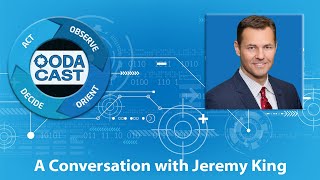
Bob Gourley talks with Jeremy King, president of Benchmark Executive Search, about whether leaders are born or made. King argues that leadership is learned, shaped by mentors and experience, and that cybersecurity leaders need both technical knowledge and people skills.
Chapters
Informing your decisions with intelligence analysis and insight brought to you by the team@ooda.
Loop.Com hello, I'm Bob Gourley, the Chief Technology officer of Ooda llc. And today on the oodacast, Jeremy King. Jeremy King is a trusted advisor to corporate boards and some of the nation's most elite business leaders. He's also a serial connector helping move business information on opportunities at the intersection of talent, capital, entrepreneurs and business development. Jeremy is an entrepreneur himself creating several successful companies in the executive search space and also a game changing nonprofit we'll talk a bit about later called Mission Link. Today Jeremy is president of Benchmark Executive Search, a firm he founded for more than 20 years. Jeremy has played a strategic role in building the leadership of organizations for more than 400 growth companies including some very noteworthy publicly traded success stories. Jeremy has helped transition and guide hundreds of top federal executives and flag officers into private sector into the private sector including helping me and I really appreciate that Jeremy. So Jeremy, welcome to the oodacast.
Thanks Bob, really appreciate it.
Jeremy, can you help us understand how you got to where you are today and give us a little bit of your foundational story and biography?
I guess I'd start that. Nobody grows up, I don't think and says I want to be a headhunter. Almost everybody falls into it at some point. So I went to Florida State University, studied political science, wanted to change the world, went to dc, interviewed on the Hill and realized this isn't going to be the way to do it. Kind of backed into a lower end telemarketing business. We raised funds for charities, Kiwanis, American Legion, vfw and I learned business. It got me on my feet. And my first landlord in Springfield Virginia, 1993 so I'm going back a ways was Errol's Internet and he had just sold all his stores to Blockbuster because it was Errol's video. And so I saw a real entrepreneur launch an ISP and I was immediately hooked. Did that for a year or so and then found my way through a weird set of circumstances doing a special project with the intel community, believe it or not, which my mentor was involved in and that ultimately led me to a top 10 search firm. That was 1997 and I haven't looked back since. Cool, cool.
And then right around well on 911 you kind of shifted your outlook and priorities. Can you describe what happened then?
I did, yeah. So I was living in Dallas, my wife and I just had our son and I was doing all executive searches for commercial venture backed startups. So VPC level and board, and nothing to do with federal. Even though I had some ties to it, I just hadn't focused on it. And we were getting billionaires richer, which is the job, because you back great investors and great entrepreneurs. But 911 hit, and I just felt there was something missing and. And I told my wife I need to do something for the mission. And so it took me a couple years to convince her, but we moved to Virginia. I started a federal practice, then started Benchmark a year or two later, and with a goal of being the best firm at the intersection of national security and mission and innovative technologies. And so we still sit right in that ecosystem.
Great. Hey, Jeremy, I've seen you work there, and one thing that has really rubbed off on me watching the way you work is your attention to what makes a good leader. I think that's core to what you do. And so I wanted to ask you a few questions about leadership, if that's all right. First, what's the difference in leadership and management?
Age old question. I see it as management or really a set of skills that you can start to learn in a classroom and then apply. And you could manage two people, you could manage a thousand. You could manage an entire company, organization or military unit. Management's important. You know, you teach our kids, hey, one day you'll rise up and you'll be management. Leadership, to me is different. Leadership at the end of the day is about getting results. And a good leader or a great leader shares the vision with the company. Hey, here's where we're going to go. Here's why we're going to get here. Here's how we're going to do it. We're going to have bumps along the way, but we're going to stick together. And whether you're a SEAL unit or a company, teams that stick together, they usually follow an inspirational leader. So leadership is the ability to have people believe in the vision and then get out of the way.
You know, Nate Fick, CEO of Endgame now with Elastic, told us on the oodacast that in his view, a CEO is the chief explaining officer. And I think what you just said resonates with that. I think.
I like that you have to be open. The smartest idea could come from an intern. And if you have such a hierarchical structure that only the top people have the best ideas, that's nonsense. Startups prove that it can be very flat. And you harness the power of great people. You know, I look a lot at what General McChrystal did with a Team of teams. And I think that's very valid. And we're seeing that being incorporated a lot into corporations.
So that gets to my next point, which is what does make a good leader besides this ability to set a vision and explain what is good leadership?
So our optic. And again, to be fair, we get brought in typically at the CEO or GM or VP level. So people running companies or divisions and a great leader is one that gets great results. I always saw it as kind of in school where you have 93 to 100 today, you know, the bell curve. Well, let's say in your industry or in your position, only 7% of people are going to be a players. If we use that as a definition. Well, everyone else is not why they had better results. If you took a company from 5 to 50 million, that's really impressive. We might have them as a candidate. But we're also going to talk to people that took it from 5 million to 100 million, twice better results. So who would you rather bet on? So leadership, it's just a different flavor of results. But a great leader gets great results. And to me that's really what it comes down to.
Right. Okay, that makes a lot of sense. And I've seen that too. I really, really have. An example would be like in federal sales. I believe one of the hardest thing in the world to do is sales of any type. But selling to the federal government is especially hard. And if you're selling high technology, it's just really tough. And it seems to me, just from observation, about 70 to 80% of the people in that sales space to the federal government are just kind of performing and just kind of doing it. And then there's the top 20% beyond that and. But at the truly top 1%, there's this exceptional leader who really knows how to convey the value of what they're selling and close deals.
That's exactly right. The best leaders or sales managers in federal are solving problems. And the government customer is probably betting on the ability that they've delivered before, not that they sold them a product. It's when it got hairy and things went wrong. They were always there to solve it. And it's not, you know, hey, let me sell you this or let me sell you that. It's what can I solve for you? How do we work this out? And maybe we don't have the best solution. Maybe a partner over here has the best solution. So I think honesty and transparency goes a lot to really great success, whether it's sales or any other leader. Right.
Makes a lot of sense. So let me ask this about leaders. So you get asked to find someone, CEO, C suite leader. How do you set about finding this right professional to fit in a spot like that?
Yeah. So 20 years of working out our own methodology, but at the end of the day, it's pretty simple. Instead of talking with the client, hey, what set of skills are you looking for? What set of experiences? We ask, what outcomes a year from now do you expect? We know who can do that. Culture and chemistry, of course, is everything. And so, you know, of the handful of candidates we present, one or two always rise to the top. And it has to be mutual, but really nailing down exactly where they want to go and find people that have already done that. And some people preferably have done it. Some people have failed. And I like to see failure in resumes sometimes just to see how resilient people can be. Right, okay.
So you talked about A players. Is it possible for a B player to improve themselves to the point where they're an A player?
Of course. Yeah. Everyone. You don't roll out of bed being an A player at anything in life, whether it's sports or business or government, military. You know, they say the cream rises. So it's, it's just that separation B player is not really a fair way to categorize that because it makes you seem lower than someone else. It just. They've accomplished different things. And we don't only present A players. If you use that definition, we present a handful of candidates. So we're, we're doing a CEO search right now. Had a call with a client this morning, and we said our guess is about half the candidates will be proven CEOs, been there, done that, and the other half will be up and comers. They're going to get a chance. Someone's going to give them a chance to go run a company and they'll probably hit it out of the park and we don't know who's going to win. And that's why you put the sides together. And, you know, magic happens. And that's what you call placement. You know, the right candidate usually wins.
That's good. That's good. And I think that's helpful for people to understand too, because no matter where you are in your career, you can always be seeking to improve and improve your ability to deliver results and get outcomes for your organization. And I think that applies across industries and across career levels.
That's right. Right.
So any other advice on how to become a better leader?
So we usually Advise people who either are looking for a job or starting to consider they may think about doing, you know, their next challenge. Don't join a company, join a boss. Find someone that wants to mentor you and doesn't see you as a threat and that wants to teach you everything they've learned, open doors for you, and they consider their success by you being successful. That's another characteristic of the best leaders. Hire smarter and better people and get out of the way. You know, give them what they need. But yeah, find someone that wants to be a mentor to you both in your full time job and privately. Mentors play a massive. I know in both of our careers we've had great mentors and, you know, where would we be without them?
Yeah, I think so much about the people that have helped me along the way and I just, I still have this enduring loyalty to them years later and it makes me want to pay it forward myself and figure out how I can help others out.
Exactly. Yeah. One of the questions we ask every candidate before we decide that they're a good candidate is, hey, tell us about a mentor or two along the way and what do they teach you? We learn more about people from that, the answer to that question than I think most people would in 100 interview questions. Because then it gets to the core of, well, who are you as a person? Not just what have you done? You know, that's a resume. We're more interested in, you know, who are you and how do you do things? And it's, it's a whole package, you know, it's not just a resume and what you've done. Yeah.
Well, let me ask another question. I want to talk about history because I found, you know, sometimes I interact with leaders and I have a very technical topic to talk about and maybe something they're not very familiar with. We need to build trust quickly. I bring up the subject of history and I find so many leaders have a favorite period in history and they read about it. They read the true human drama that's occurred in our history, they read about leaders and I'm able to connect with people and we'll have a conversation about our favorite leaders and then connect it to the topic I have to discuss. Are you an avid reader? Do you study history yourself?
I am an avid reader. I study history. Just curious on people in general. I always want to know what makes people tick. And then finding out, you know, asking every prospective candidate, you know, who are your titans? Who do you study? What leaders, you know, so, yes, absolutely. I love.
Great, Let Me ask you that. What about you? What are your favorite titans? Who are the great leaders in history that you think we should learn more from?
So, to be fair, I figured you'd ask this question. So I. I gave a talk years ago to a bunch of Eagle Scouts, incredible young men and women, and gave them kind of a reading assignment or some choices of leaders that I'd looked to in the past and have gotten a lot of insight as well as these names come up a lot when we ask candidates. So I broke them down. Military, sun Tzu, Napoleon, General McChrystal in Religion and civil rights, Mother Teresa, Martin Luther King in sports, of course, Vince Lombardi, you could say Bill Belichick. But, you know, everyone here gets results. They just do it differently. In philosophy, Aristotle, politics, Lincoln, Grant, Churchill, and in business, I could pick a whole bunch, but I picked Peter Drucker, you know, the father of management, Jack Welch, ge, of course, and then Simon Sinek. I'd like an awful lot about what he talks about. So they all have different approaches, different styles, but if you break down, each of them gives like a top five or ten bullets of leadership, you find a lot of commonality. Great.
You know, a question I get asked a lot is, is leadership in cybersecurity any different than leadership in general? And I think there are some key differences, but there's a lot of continuity also. And I think you can also take that historical perspective. I tell people, in my view, I mean, it's a good conversation starter that in my mind, the first great hacker was Hannibal Barakis, who had to cross the Alps to invade Rome and famously said when his generals told him, we cannot do that, I mean, they're bringing war elephants. He said, we will find a way or we will make a way. Great leader, very persistent, like today's great hacker leaders. And so I like that kind of story from history, and I like that it underscores that there's components even of cybersecurity leadership that are exactly the same as other leadership. But there's differences, too. And so I wanted to ask your views on that, because you must be getting asked a lot, too, to help create cybersecurity leadership teams.
We do a lot of that, and we kind of see it as. There's two types of CEOs in companies that want to hire senior cyber folks, whether it's a CSO or ciso, those who see cyber as a way to enable more profits, revenue, reputation growth, and the CEOs that see it as a cost center, always trying to find a Way to prove a negative. And the ones that are more short sighted like that they haven't created a culture of security and most likely are going to be behind the eight ball when they're competitors who weave security in from the beginning and see it as a way to not just grow, but not to fall. Great.
Makes sense. And then I'd also like your views of the overall structure for mitigating cyber threats and cyber risk. You've written before on this topic of special teams and you drew some sports analogies. Can you walk us through that?
Yeah. So for years we've thought it's broken how it's structured and again, we don't just think of this. We talk to a lot of smart people to help form our opinion. And if you compare sports and business, so sports has a team owner, business has either a shareholder or an investor. Sports has a general manager as an Xbox who runs the business of the team in sports and winning. And corporations have a board, general oversight, governance, strategy. And then the person in sports that executes that strategy is of course the head coach and a business, it's the CEO. So relatively similar where it diverges is in sports you have an equal offensive coordinator, defensive coordinator. One runs the offense, one runs the defense, one puts points on the board, one prevents points from being on the board. In a business you don't see that bifurcation, you see a very COO and then everyone else reports up. So we thought it would be more beneficial to companies if they had someone to run the defense, if you will. It could be called a chief resilience officer, a chief risk officer, but it would be someone that understands how cyber fits into the overall business as it relates to winning and losing. Right.
You also, you talk about offense team, defense team and special teams. What did you mean by special teams?
Special teams. If you use the same analogy that if you had someone running defense, whether it be a chief resilience officer, they would take it almost like a SEAL team would where there'd be a specialist in each area. So if you had someone from security, someone from engineering, someone from marketing or crisis management, perception management, when the cyber thing hits, you know when, when you're breached and it's that oh moment that gets pulled on the front page right now. It's, it's, there's not one team looking at it and making a single decision from a business lens. They have to go to all the different departments. And the special team could be almost like a SWAT team who is very small, but it enables the offense to do A better job. I was at RSA years ago and I remember a conversation I had with the CEO and I said, how do you guys play defense? You know, very open ended question. And he said, well, we have a, you know, Cracker Jack staff, we have a great ciso. And I said, well, what's your market cap? It's a billion dollars. Well, that's wonderful. I'm sure it, you know, took took a long time to get there. Well, what if you got hit, you know, massive breach and it went from a billion to 700 million overnight. That's defense. That's what I was talking about. And he's like, huh, never thought of it that way. So it's that the delta of losing what everyone's built in the company for all these years. How do you prevent that? Well, some sort of special team unit in a company that's proactively organized I think could help mitigate that. Right, if that makes sense. Yep.
And I wanted to ask because I think there's some analogies there to history again, because we just had a conversation with a guy named Ben Ford about a week ago. He runs an outfit in the UK called Commando Dev. He took his background as a, a Royal Marine Commando and translated it to how he trains technology teams. And it's fascinating. And we talked to him about the history of commandos, really commandos as we know them today. And all special forces draw their lineage to what Winston Churchill pulled together in World War II. He had learned a lot of lessons from adversaries that had been beating up on British military forces. And he created the commandos and he had a couple choices on how he could organize. He could have left all these special teams out where they are in the Army, Navy, Air Force, Marines, and let them kind of succeed there. Or he could pull them together into a special team and he picked that approach. Same thing in the US Military today. We could have left all special forces out distributed amongst the military services. But there was a lot of smart reasons to pull it together into a special operations command and have leadership there. And now the analogy that you make me think of is in cybersecurity in enterprises, you can just say, all of you guys need to have a little bit of cybersecurity in all lines of business, or you can pull it together in a special team and have some ability to surge and act and be more agile.
That's exactly right. Yes. Security is everybody's business. And special operations units, they will continue to evolve and improve. And when they find, if they find a better model, they'll implement it. So I think it's wonderful to look at those core groups because they get results. And ultimately, isn't that what leadership is about is getting better results than the next company, you know, than your competitor, than you did last year? And so I think there's an awful lot of parallels. That's why we see a lot of some of the best cyber minds come out of the government national security community. I mean, I've said for years, you guys have been protecting our country for decades. You know, secrets, networks, people, capitalism. And a lot of the best and the brightest go find their way to Fortune 500 and they're doing similar things, protecting networks, secrets, intellectual property. So it's not too dissimilar, but I think the special operations, special teams model, there's. There's something there to play with. Great.
Let me ask you another question related to this, and that is boards, board of directors. There's been a growing need, I think, for more cybersecurity expertise on the board itself. Are you seeing a shift like that? Are boards wanting to have more cyber expertise among their own board?
A lot of them are. A lot of them would want to bring on, you know, a ciso, Chief Information Security Officer. I'm not of that opinion. If that's what they want, you know, that's what they get. But I think a CISO is a. Is a practitioner of a craft. They're an expert in understanding how to play defense, if you will. That has to be translated to business. So if there was a chief resilience officer or a general manager or a COO who oversaw that before and knew how that interacted with all the other aspects of the business, that person can probably help create, implement strategy and policy better than the practitioner. Great, thanks.
Makes sense. Jeremy, can we shift and talk a little bit about Mission Link, this organization you co founded?
Happy to.
First, what is Mission Link?
So, good friend Andy Lustig and I, Andy's a partner at Coley, the top 10 tech law firm. We started Mission Link in 2010 in the back of a taxi. I think we had just left a great government contracting event. You know, a lot of impressive speakers from the government. And we were kind of scratching our heads on the ride back saying, you know, there was a receiving line of business development people trying to shove their card in this person's face. And the message that they gave in the speech was really, really fell on deaf ears. So we're like, wouldn't it be cool some of the times things start that way? Wouldn't it be Cool. If we had a very curated private room of decision makers, founders and CEOs of smaller companies under 100 million with some capability or service that had a mission application. And we got senior people in national security apparatus that in essence are buyers and sellers. And so we started it in 2010. There were 60 members the first year, and it just took root and magic happened. And we did it for about eight years and we started to wind it down. Covid hit. And so we're in talks right now of getting the band back together.
Great.
Cool.
And I saw firsthand the magic that occurred when you got the right brains in a room like that. And it really did make a difference for both these companies that engaged with you. But also in the national security space, there were problems that were solved because of getting these people in a room together.
Talking, an honest conversation is where it all starts. It's also about access. The mission piece, it's the mission of the country, of course, but the mission of the member. They may have met their customer, they may have met their teaming partner there, they may have met their advisor, they may have met their investor. And then really, it's at the end of the day what you learn, you know, where that, let's. Let's say the proverbial cyber hockey puck, where is it going? Well, we probably talked about it initially and, you know, that's the goal of the future, is it's going to continue to evolve and we want to be in the room and get out of the way. We put the right people in the room and as you have seen, we just get out of the way. And sometimes magic happens. Right?
For a CEO who wants to know more about Mission Link, of course they can ask me, but how else can they find out about Mission Link?
We'll be making some announcements here later in the year about relaunching, and there'll be some exciting new differences. So without letting the cat out of the bag, there'll be some news here in a couple months. Cool.
Great. Couple other questions for you, Jeremy. One is books on leadership. Do you have any that you would recommend that we pick up and read or any books that have really influenced you?
Oh, I hate to go back to the military example again, but extreme ownership. It's a Navy seal, Jocko Willink. He took a lot of the lessons that he learned in Iraq and Afghanistan and now teaches corporate America. One of his big opinions is there are no bad teams, there's only bad leaders. And there's some really fantastic examples in the book that he saw Firsthand when they were doing buds, the training to become a SEAL and they switched boat captains and the team that was worst every single time, of course became first and the team that was first became worse. And so that's one of the starkest examples I've seen of. I think he's right. A great leader makes all the difference.
Yeah, good, great. Thanks, Jeremy. And speaking of great leaders, I just wanted to ask your view, what's the greatest leader you have ever seen or the greatest leadership lesson that you have encountered?
Yeah, that's a good one. From an executive search standpoint, if, let's say candidate A won the job, they took the company from here to here. If you never know if another candidate took it, where they would take it. You know, there was an example a couple of years ago we did a CEO search. It was a government contractor, a couple hundred million dollar company. It was kind of broken, had some cultural challenges and the only candidate that had not been a CEO and we had to push this person because it had to be a proven CEO. It was our trust us on this one candidate and he came in in a couple years, just worked wonders, righted the ship, got everyone believing and sold the company for almost a billion dollars years later. And I have no doubt the other candidates that would were many times proven. I don't know if they would have gotten those results. So it's just neat to see those firsthand examples of when someone gets an opportunity, they get the job done.
Yeah, that's cool because it gets back to what you've been talking about throughout this conversation about mission and results. It's the outcomes.
It is, really is.
Well, Jeremy, thanks very much for the time today. I really appreciate this, Bob.
I think what you and Matt are doing, appreciate the opportunity and always great to be with you.
All right, I'll see you.
Take care.
Thanks for listening to this. OODA Loop production for the latest analysis on cybersecurity technology and global risks and please visit www.oodaloop.com.
More from Matt


Leading Cyber Change: Allan Friedman on the Revolution of SBOM & Future Cybersecurity Initiatives


Revolutionizing Medicine and Tech: Joe Tranquillo's Journey into Complex Systems






Bob Zukis and the Digital Directors Network: Helping corporate boards mitigate systemic risk

Adam Shostack on Cybersecurity and What Every Engineer Should Learn From Star Wars