Assessing the Business Impact of Quantum Technologies
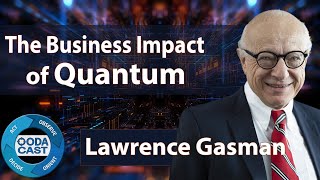
Bob Gourley and Lawrence Gassman discuss where quantum computing, security, and sensing actually matter for business. Gassman runs Inside Quantum Technology; Gourley is CTO of OODA LLC.
Chapters
Informing your decisions with intelligence analysis and insight Brought to you by the team@ooda.
Loop.Com hello, I'm Bob Gourley, the Chief Technology Officer of OODA llc. And today on the oodacast, Lawrence Gassman, the president of Inside Quantum Technology. Lawrence, thanks for joining us today.
Sure. Thanks for inviting me, Lawrence.
I've been a fan of your site for a long time. You guys provide a lot of information in a very, I think, unique way for business leaders. And I definitely want to talk about quantum and quantum technologies. But first wanted to ask a bit about your background. Can you tell us who Lawrence Gassman is and how you got into the role of president of Inside Quantum Technology?
Well, I'm old, so I've had plenty of time to get there. As far as education goes, I've always been a nerd, going way back. My first degree from University of Manchester in England was in mathematics and philosophy. And then I went on. It's not really clear from the fact that my next part was the London School of Economics. There's a lot of things at London School of Economics. And I went to scout to study mathematical logic and philosophy of science. And had I finished my PhD, which I didn't, I would have been writing a paper on quantum mechanics. I mean, a thesis on quantum mechanics and more from a philosophical point of view. So I've been involved with quantum mechanics a long time, more than half a century, I suppose. And then a lot of things happened to me which we don't need to go into. But I ended up getting my MBA at London Business School, which turned out to be a very valuable education for what I ended up doing. I guess I've indicated I originally grew up in the uk, moved to the States and got involved with the analyst community, initially in the telecom business, then advanced materials, then in 3D printing actually, and finally in quantum technology. And throughout the time I've been here, I've owned or partially owned analyst firms in that space.
Great. And so today you're at Inside Quantum Technology and I know that as both a site and a community, you hold events and you bring folks together and you produce research. Did I get that about right?
Yeah, pretty right. We have a podcast, we have a site that is a news site primarily. We put out market research reports on a fairly regular basis on topics of interest in the quantum community. And as you say, we have trade shows, conferences in both the US and Europe. I've missed something, I'm sure of it, but I can't think what right now.
Well, through that I know you're all good communicators. And that's some of the questions I wanted to ask. You may test some of your communication skills, Lawrence, because one thing I really think is still lacking is more business executives need to understand this world of quantum effects. But you don't expect business leaders to have a background in quantum mechanics. And I wanted to ask how you explain to people this world of quantum mechanics. How do you talk to a business leader about this?
So to be fair, there will be some business leaders who do know something about it. Certainly in electronics or electronics industry, or maybe even in the pharma industry. The kinds of people who are leading the Companies often have PhDs or at least master's degrees in the science. So they would have studied quantum mechanics and know a lot about it. You know, they may never teach it or anything. I think one way of explaining it on the, on the fingers of one hand, as it were, would be to say, look, with regular computing, as everybody knows from high school, you've got ones and zeros, and that's the high level theoretical side of it. But you have to model it onto something real to make a computer work. So you model it onto gates and they're either on or off. And it's very simple and don't knock it for that. That's one of the reasons it's been so successful. But obviously it takes time to compute things that way. It takes less time if instead of ones and zeros, you can have essentially an infinite number of states, all of which can carry information. Problem is, you've got to have something to model it onto. And what you do there. And again, this is an amazingly simplistic view of it, is to model it onto quantum phenomena, the kind of really weird quantum phenomena. One of them is entanglement. But what it all boils down to is in a quantum machine you've got a fantastic level of parallel processing. You're just not doing something linear, one plus one plus one, you're doing one plus one plus one and then somewhere else you're doing 103 plus. Again, not very good examples because you can do it in parallel. The times for computing speed up. And to take a very well known example, you can break a code, the kind of codes we use all the time for encryption with a regular computer. But it might take. And then here you've got to believe what people say. I've seen everything from 9,000 years to 9 billion years. But it doesn't matter because who's going, you know, I mean, you're not going to sit around and wait, but it could be down to nine hours if you're, if you're using your quantum computer. And then that becomes a real threat to, you know, pretty standard encryption. Right.
Okay, thanks. That is a very clear and helpful articulation of these quantum effects and quantum computing. Very helpful. And you also mentioned something else. You said entanglement. And this is another one that's is, this is the one that Einstein called spooky magic. Seems so hard to understand the reality of things at this super small level.
Yeah, it really is. And that's a perfect example. So he actually called it spooky action at a distance.
Spooky action at a distance.
Action at a distance. And the classical physics, you don't have action at a distance if I'm moving you, but there has to be something intervening. And in really classical computing, you have particles moving between things. And he wanted, he, Einstein wanted to reduce all physics to that. And he thought anything that appeared to go against that was there was something methodologically wrong with it. And it turns out in entanglement, you can entangle two particles to quantum particles, two elementary particles in a way that if I do something to particle A, it automatically, instantaneously happens to particle B. And then you get yourself into all sorts of paradoxes, which is faster than light information. And you're right, people don't understand it. And actually nobody understands that particular thing. But it turns out, ironically, that you can, you can work with it and do interesting things with it, even if we don't understand it just occurred to me. It's like hypnosis. Nobody knows how that works either. Right. But people are hypnotized routinely every day, so. But what it all means is what I was going to write my PhD thesis on about 50 years ago, but that won't happen now, so.
Right. Well, one thing we know for sure is that experiments tell us again and again and again that this is how it works. Even if we don't know why it works that way. All these things, I think there's quite a bit of experimental evidence saying this is how it works.
Yeah. So if you take that spooky action at a distance thingy, there was a guy called. Oh, what was he called? Bell, I can't think with. His first name was an Irish physicist. And essentially he came up with a way of showing that under any reasonable condition, we really did have spooky action at a distance. And then much more recently, French physicist called Alain Aspect, who actually was part of the quantum technology community. Now he works for a firm. He showed that experimentally it must be right. And there's still people who take the Einstein point of view and are trying to show that it's right, but that's a whole different story.
All this stuff is very interesting, and I think every high school today teaches the. These strange effects where at that scale something can be both a wave and a particle, which is counterintuitive if you're thinking at our scale, but at the quantum level is extremely important. Extremely important quantum effect to understand, I think.
Yeah, no, actually some of those experiments go back a long way to the 19th century. But one of the debates that used to be held is whether it only applies at a very small scale. And I think the consensus is now it applies to everything, including you and me. It's just that the quantum effects tends to cancel themselves out. So you're a quantum entity and we could do quantum computing with you, but it would be quite difficult to do. And me too, exclude myself, but. Well, the Schrodinger's cat experiment that everybody thinks they know about is essentially showing that a quantum event can kill a cat, which shows that it can impact macro level.
This is all very fascinating. And I can see how you were talking about your earlier degree of mathematics and philosophy. It kind of all fits some of this.
Yeah.
But it's also been. Oh, go ahead.
Oh, I was just going to say there's been a couple of periods in the. There's been a couple of periods in the history of quantum mechanics when it's become more about philosophy than about physics and can find some of that still around.
Yeah. And I tell you, as a, as a business guy, I'm very excited about how all of this theory and all of this experiment is now translating into the business world. And businesses have been stood up to bring these kind of things to market. And of course, there's the big research by Google and IBM and Microsoft on new ways of doing quantum computing and of course, D Wave and others. So it's a very exciting time in the business world where all these theoretical constructs are being turned into real capabilities.
There's probably. Oh, somebody's going to write in and tell you I'm an idiot. But I think there's about, probably about eight to 10 companies with quantum computers right now of different degrees of power for different applications. You mentioned some of them. The. There's Also probably another 20 or 30 companies who produce quantum processes which are the same thing as processors in any computer. They're the guts of the computer. They're the things that do the computing. But whereas IBM, take a very good example, is producing a full stack computer which is, you know, it's everything, you plug it in and it works. The processor is simply the thing that goes in the center of it. Like intel is one of the companies producing quantum processes or engineering work, engineering research on them. And you know, at the heart of a lot of quantum, a lot of non quantum machines as well. And then of course there's people working on quantum security, quantum sensors and quantum networks, all of which have something to do with each other. Right.
And Lawrence, let me ask your view about this. First, let me give you kind of a thesis. I believe that, well, guys like you, you've been studying quantum for a long time and you have a background, an academ background where you studied it intensely and I think you're studying that intensely for years and writing about it and running inside quantum technology gives you good insights. A lot of people don't have that background and it's hard to understand this technology. So how can we know if the claims of a quantum computing company are valid or not? And the reason I ask this is in any other domain in computing, if a company makes a claim, I can test that, I can bring it into my lab and see if this software works the way they said it would or if their hardware works the way they said it would. But with quantum computing, I don't know of any way to really know if claims are valid or not. Is this.
Well, yes and no. Yes in the sense that we're in the very early days. So a lot of the, I mean, are there quantum computers? That's one of those things you see on Wikipedia as a question. And the answer is sure there are. You know, pay enough money to IBM and they'll ship you one. They're doing it now, but so that's easily disposed of. Can it do anything useful? Yeah, it can. It can optimize stuff pretty well. So if you're designing drugs, for instance, you can feed it through some of these machines. D Wave, you mentioned specifically has designed their machine which isn't quite a compute, but going to start providing proper computers. But the original one was an optimization machine. So they do do useful things. And in that sense, if you wind up with a better drug or a better portfolio in an investment hedge fund or something, you can prove it because it's doing better than the one you didn't design with that. But obviously the power of a quantum computer is depending on the number of qubits you can Handle not bits, qubits, like I was talking about at the beginning. And we have, we're in a fuzzy period where it's difficult to show that a useful problem that can't be solved by a regular computer can be solved by a quantum computer. But we're getting very close to that time, I think, and maybe this is an oversimplification that we've got to a point where you can invent a mathematical problem that can only be solved by a quantum computer and not by a regular computer. The only thing is it's not a useful problem. You set up the problem to make the point. And that's, by the way, a standard way of doing things within mathematics to prove a theorem. But obviously if you're, you keep on mentioning business people, if you're a practical businessman, that probably sounds pretty stupid. And if you're trying to make money out of that, you can't. So, you know, we're again on the cusp of getting to a point. And it'll happen gradually in this. In one sense it'll happen gradually because people will tackle more and more difficult problems. In another sense, it might happen overnight because we're at such an early stage that break. You know, breakthroughs are unpredictable but inevitable.
Right. So maybe, I think that all makes a lot of sense. Maybe a close analogy might be the Wright brothers fly first manned flight 1903. And that airplane could do nothing. It was, you know, what's the use case of that first airplane? It couldn't carry the mail. It couldn't, you know, do anything. But it proved something. It proved that man flight was possible. And maybe would you consider that an analogy to where we are in quantum?
Yeah, yeah, absolutely, absolutely. So if you take, I mean, the two applications that come up all the time are, as I mentioned, in material science or in pharma or in the, in the financial services. And, and people are experimenting with this. Every major bank has access to quantum computers at this time. You know, not your small local banks live in rural Virginia and we've got a few banks around here. It's going to be many years before they have access. But you know, the Goldman Sachs of this world, they're paying a lot of money to put together quantum teams. They're paying a lot of money for the service. But at the end of the day, if you were putting together a portfolio for some huge industrial company, would you really hand it all over to a quantum computer and say, this is it? Because it is a computer, it has the same error potential. And you know, you you could really screw things up completely if, if, if it goes wrong. Even more so for making drugs. Oh, sorry, we killed a million people, but quantum computer did it. So we've got ways to go before some of these things can be trusted enough. But that's always true. You know, it's not so true anymore. But, you know, it was a long way from Wright brothers, which was a dangerous thing to do, to flying in a Pan Am intercontinental flight in the 60s.
Right.
These days, not that pleasant to fly, but analogy breaks down, but you know what I mean.
Yeah, absolutely. Absolutely. Yeah.
All right.
And Lawrence, I want to. You also mentioned quantum sensing, and I hear that term a lot. And to me, when I think of quantum sensing, I think of the medical devices in most hospitals today. Like the mri, for example, is using quantum effects to understand what's going on in your body. Is that kind of the state of quantum sensing today?
Well, yes and no. Again, there are sensors, quite a lot of them actually, but the majority of actually magnetometers. But true, across the whole range of sensing, light sensors, motion sensors, and things that use quantum phenomena specifically to measure things. And the point there kind of sorta is that quantum phenomena are very sensitive. So I suppose you could make the case that every kind of medical imaging is a quantum thing. But they're talking, when they talk about that, they're talking about new forms of imaging with explicitly quantum phenomena at their core. And there's a number of different types of. And they are very good at identifying tumors and all sorts of things. Some of them are in practical effect, most of them aren't. But I'm sure this is wrong, but I'm going to say it anyway, that every sensor has a quantum equivalent that's that much more effective, sensitive, whatever. And it's really got to do with the quantum events, always so sensitive to intervention of some kind that, you know, you could make some fairly fantastic things out of it. Quantum sensing is actually becoming a hot topic now. It had been pretty much an academic topic. I mean, when we started this series of conferences, it was an academic topic. But you're now seeing real military applications for it, medical imaging applications for it. And there were people who were finding ways of turning arrays of quantum sensors into quantum computers. Current quantum computers are based on, in some ways, fairly conventional technology. But there's a half a dozen ways of doing it, including atomic computing with quantum phenomena and using sensors as the. That's a basic physical fabric. I mean, that's all R and D stuff. It's not out there. All right.
Thanks, Lawrence. That's good context. And you also mentioned earlier quantum security, and I wanted to mention a friend of mine who I interviewed on the Oodacast last year, Vikram Sharma, who's the CEO of Quintessence Labs. And he, like you, I think, is a, he's a good explainer. And, and I think he has to be in his field because what Quintessence Labs does is leverage quantum effects to generate encryption keys and do that at, you know, they can do millions a second. And he has to be able to explain that to busy security professionals who are not quantum experts. But he's where I've learned a lot about quantum security from, but would love your context on the leveraging of quantum effects for the security side of the equation.
So I know Vikram and I have what Quintessa Slabs does, but. So part of this is not physics, it's coincidence. Most of the security that we use at the moment and have done for 40 years is public key encryption. And that means that part of the key, part of the code travels over a public network. And because you have the code book at the other end, literally. But the equivalent, it doesn't matter that anyone can get it, what's being looked. And the funny thing is that they could have chosen a lot of different encryption schemes which might be very difficult to break even with a quantum computer. It turns out they chose one that's very easy to break with a quantum computer. And that's just weirdness in history. And there's several levels of weirdness to it. So there's two ways of doing something about that. And one of them is called qkd, quantum key distribution, which means that the channel, that the, the channel that the key goes in is protected using quantum technology, essentially, it's a bit, it's a lot like, it's a lot like. It's not like quantum sensing, actually, when you try to break in and get the key to a bad person, it just disappears on you. And, you know, so that's quantum protecting, protecting quantum from quantum. I suppose the other way of doing it. And that's what Quintessence Labs and about 20 other companies are doing. And some of them are shipping stuff, some of them aren't. The other way of doing it is to say, look, we screwed up. We should have an entirely different kinds of just regular, not quantum way of encrypting things that just aren't that vulnerable to quantum computers. And that's what it's called post quantum encryption, that's what that is. And since today I'll mention that NIST government agency, part of, part of Department of Commerce, has held a competition for the best post quantum encryption schemes and they announced the, they announced the winners today, actually. I just hadn't had a chance to look at who they were and at least one friend of mine is competing in that. So there's nothing quantum about post quantum crypto. It's just that the consideration is that it's not hard to, it's, sorry, it's very hard to break with a quantum computer. So that's the two things that's happening in that space.
All right, thanks. Good context. And regarding the NIST announcement, I haven't read that myself yet either, but have been anticipating it. I'll definitely put the link in our show notes as soon as we publish this.
And to be fair to nist, I was going to say there's no real end to this because people will be coming out with new forms of software and encryption and things. So, you know, the NIST announcement is in many ways the first stage, but it'll keep us going for a few years.
Right, Lawrence? I have a feeling this may also coalesce a lot more R and D spending because now I think businesses will feel more comfortable that they're investing in something that has legs. Do you share that view?
Yeah, I mean, some of the big numbers you see are often from governments who have, you know, quantum programs. Even little countries like, well, particularly Holland have 650 million they threw into it a year or so ago. And I mean, that's everything. So it goes into education and, you know, if you, if you have to pay to ship something, it's in there too. So it's not. You really don't see $600 million worth of stuff. As far as businesses go, I'd say they're already investing, usually at the level of R and D and just trying things out. I mentioned two industries that are particularly using it, but it's right across the board. And automotive industry and transportation, they're using it too, but in very experimental ways. So it's part of their R and D budget. So I think the other part of the question that you asked was how long will it take to pay off? And the answer may be God knows, I don't know that any of them are entering this thinking, you know, that there's a promise that it's going to pay off anytime soon. What they hope, I suppose, is that it will pay off and also that it places them as leaders in the field. I mentioned the financial services industry And I think I said Goldman Sachs. And it is spending a lot of money on developing a quantum department. But think of a major bank and so are they. And in every country really. And again, my little bank that I bank with here, it's not so little actually. It's all the way down to Florida. Probably isn't thinking about that. But if you're based in New, if your headquarters are in New York, you kind of are. Because if you don't, your shareholders are going to want to know why. I'd say we're still at a point that some of this stuff just isn't going to work out. And this already some cases where it hasn't. But, but. And we'll not know for a few years. You know, I don't really mention my age. I don't expect to be around during the real area of quantum technology, but it's happening fast now.
Well, Lawrence, one thing I know will be around is inside quantum technology you got a great company and it's going to endure for a century. I just know it. So thanks for building that.
Pleasure. It wasn't just me, of course, but.
Yeah, I know it takes a team. But you're a great leader and I appreciate you building that site and using it to explain to all of us these quantum technologies. And Lawrence, thank you very much for joining us today on the oodacast. I really appreciate it.
Ah, my pleasure. I enjoyed every moment.
Thanks for listening to this OODA Loop production. For the latest analysis on cybersecurity technology and global risks, please visit www.oodaloop.com.
More from Matt


Leading Cyber Change: Allan Friedman on the Revolution of SBOM & Future Cybersecurity Initiatives


Revolutionizing Medicine and Tech: Joe Tranquillo's Journey into Complex Systems






Bob Zukis and the Digital Directors Network: Helping corporate boards mitigate systemic risk

Adam Shostack on Cybersecurity and What Every Engineer Should Learn From Star Wars