Bradley Rotter On The Future Of Work, Cryptocurrencies, Quantum Computing and Leadership
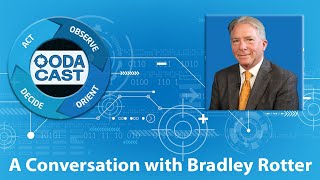
Matt Devost talks with investor Bradley Rotter about cryptocurrencies, quantum computing, and how leadership needs to adapt as technology reshapes work. They explore what's coming next in these fields and how to think about global risks.
Chapters
Informing your decisions with intelligence analysis and insight brought to you by the team@oodaloop.com hello, this is Matt DeVoe, the CEO of OODA and you are listening and watching the Oodacast. And today we have Bradley Rotter with us. Bradley's longtime investor, technologist and security expert. Also kind of one of the early adopters in the cryptocurrency space. So looking forward to having a lively conversation on past technology trends and emerging technology trends and also kind of getting his input on the state of the world. So Bradley, why don't you start by kind of giving us your background. How did your career progress over the years?
Thank you Matt. Well, I started out as a child. I didn't start trading commodities until I was 16. I grew up on a farm in Iowa. After West Point in the army raced back to Chicago and was one of the pioneers for a new asset class being developed at the time called financial futures. Kind of reminds me of cryptocurrency. Everybody was dismissive, thought it was unnecessary. I thought trading futures and derivatives on the largest commodity of all, money would be a big deal. It turned out to be. It exploded, was at the right place at the right time. I was on the the floor of the Chicago Mercantile Exchange and the floor of the Chicago Board of Trade. Grown men yelling, kicking, screaming, shoving and spitting. It was fabulous. As a result of some of those bets, I also pioneered another new asset class called hedge funds. I started investing in hedge funds starting in 1982 and seeding some with venture capital. And starting in 1985 came the conclusion that open outcry was archaic and inefficient. I thought the floors would go away. So I loaded up the truck and moved to the West Coast. I've been in San Francisco for the last 30 years, involved in trading hedge funds and Technology Investing Since 911 I've been a self described impact investor. In my case trying to impact the security of the homeland because we have issues. So that's where I spend my time as I suit up in the morning and try to make an impact.
Excellent. With regards to the early stage of hedge funds, what were some of the criteria that you were using to evaluate back then? Because obviously the industry was just emerging. What was kind of the thought process around where you were deciding to deploy capital?
So I would look for other risk takers that had different styles in different markets than what I was focused on. I was primarily focused on the bond market. So I would take money out of my account and give it to a guy that was Just trading grains or just trading metals or just trading oil. In fact, now that I think of it, I was Ray Dalio's first customer when he opened up Bridgewater. He had a fax service that was faxing out trade ideas and you'd call them up and have them execute them for you. So he's trying to build a diversified portfolio of non correlated strategies.
Excellent. And does that contribute to kind of the approach you're taking today with regards to homeland defense type investments as well?
Yeah, I think we've obviously entered a, a new paradigm. As you can see in the background. This is my day 174 of self quarantine. I saw the virus very early from underground video coming in from Wuhan, from my cryptocurrency knuckleheads. And I quickly came to the conclusion that this is not the flu.
So do you think that's driving the investments that you're looking at right now? What types of technologies or things are on your radar screen with regards to opportunities to address the risk that exists?
Well, I've been making my most favorite bet is in quantum. I staked a company called Entanglement Inc. Which is boldly building a post digital computation center in Newport, Rhode Island. Bringing together supercomputers, the quantum machines, neuromorphic computing, photonic computing and trying to put them all in one place. I describe it as kind of a modern day Manhattan Project, except more important, the Chinese I believe have pulled ahead of us in quantum and artificial intelligence and so we've got some catch up to do. My objective as an investor is to multiply. Quantum times AI. My investment thesis is simple. My quantum experts believe that the potential of quantum is unlimited. That's probably true. It's a billion times faster and capable of computation. That's hard for man to even grasp. Clearly the potential of AI is unlimited, especially when we have AI now developing AI. So I think multiplying those two together should have interesting results. We've entered into a new chapter of evolution. Evolution has been with us for 15 billion years, but it moved relatively slowly. When man appeared, they were able to impact evolution, which is why we have Saint Bernards and Chihuahuas. Those were created by man. I think now that the next evolution is going to be far swifter than anybody can handle. And humans are going to have a hard time coping with the evolution that's happening in the digital sphere.
Interesting. Yeah, I mean I've written about that a lot myself personally. Just being able to cope with exponential change and the fact that the pace of change is Rapidly increasing over time as well. You know, one key debate in the quantum field is kind of the timeline for when we get to, you know, where quantum actually has an impact beyond kind of the theoretical or kind of proof of concept. So what's your take, given that you're actively investing? I mean, where do you think we're going to reach the point where we get real contributions that are, you know, could be exploited as a national security risk or could also be exploited for positive benefit, kind of. Where do you pitch that timeline?
You know, I think it's happening right now. Entanglement is working on a fantastic project with the army that's, that's in and around the COVID process. They're able, using quantum computing, can optimize and predict the demand of where test kits will be needed and then how to get the right amount of kits to the right spot. So it's like a traveling salesman problem, you know, times a million. And the interesting thing about these machines is that they can literally evaluate all the possible paths at one time. And so the results have been rather extraordinary. And the results can, can come in five or six seconds. It's quite fascinating to watch.
Interesting. And you think that's outpacing kind of just the human intuition? Because my gut instincts as well. Send them to Florida, send them to Arizona, send them to California. Is there something that has come out of that program that has been a little counterintuitive that leads you to believe the machines saw something that humans would miss?
Well, humans can miss things. I've marveled my entire life that for thousands of years, man was absolutely convinced the Earth was flat, Even though every night when he was laying out at the campfire looking up into the heavens, everything else was round. And so when everybody's convinced of one thing, I like to kind of go the other way. I think we've got something coming that's going to be worse than Covid. And I really don't talk a lot about this because it's so out there, but I believe that we've entered a grand solar minimum. Doesn't happen very often, but it happens all the time. The last grand solar minimum was in 1645, a period that's fondly remembered as the Little Ice Age. The growing regions changed almost instantaneously, causing millions of, of deaths and famine. So pretty much everybody on the planet is, is, is convinced that we're, that the planet is warming. I think, I think it would be interesting. I think they're going to be surprised.
Interesting. And what is the, you know, not being familiar with the concept, kind of what is the, the background behind it.
It's fascinating. And, you know, the one, one interesting correlation of grand solar minimums is pandemic. So the, the effect is, is counterintuitive. If you, if you go outside now and look up at the sun, which I don't recommend, you will see zero sunspots on the face of the sun. It's been that way, the preponderance of the year. It was that way for almost 150 days last year. So the sun goes through cycles, as everything does, and there are cycles within cycles within cycles. But when a grand solar minimum happens, the sun quiets down, it doesn't change temperature, that doesn't affect the temperature of the Earth, but the sun basically relaxes. And as it relaxes, the magnetic force field that shields our solar system from the cosmic rays that are plowing in also relaxes. And so more cosmic rays enter the solar system, more cosmic rays hit the Earth's atmosphere. As those cosmic rays are plowing through the atmosphere, they ionize the molecules in the air around which clouds form. And it's the cloud cover that reflects the sun's rays and lowers the temperature of the Earth.
And what sort of temperature lowering do you expect? I mean, based on what happened in.
The 1600s there, the Thames river froze over. So, I mean, the absolute change in temperature might only be a few degrees, but the problem is, is that the summers start later and end sooner and the growing regions literally change overnight. So I'm using an indicator that nobody else on the planet is using. The sun.
Fascinating. So a comment that was attributed to you that caught my eye on social media was that we've entered peak civilization. Can you explain to me, you know, made it for a great sound bite. Can you explain to me kind of the nature behind the comment.
Yeah, I hope I'm wrong on this one. I've been giving speeches, you know, for the, for, for years, called Investing at the Peak of US Civilization. You know, it's, it seems like a bold call, but it isn't. They all peak and there's. And there. And it's not just the Greeks and the Romans and the Aztecs. There have been thousands of civilizations in various degrees, and they all, they all peak. It's just, it's part of nature, I suppose. The Apache was a grand civilization in the Southwest. They controlled it. I mean, it was a substantial civilization. Have you met an Apache lately?
No. No.
So I'm not being a Cassandra, it's actually pretty goddamn cool to live in the peak of civilization, we're immensely fortunate to have been able to to experience this. But I something has changed in our lifetime that never really changed very much before, and that was the unit of time. The unit of time has been compressed in our lifetime thanks to the Internet and telegram and telephone and social media. One of the one of my favorite speeches I gave in 2008 was called 1 if by Twitter, 2 if by Facebook. Basically forecasting what I thought might occur as we become interconnected and people have a one on one or one to many voice. So it's quite spectacular to watch that unfold.
Spectacular and also frightening. At least my Facebook feed, I've been.
Told I have the face for Twitter.
I just, you know, from my perspective, I'm interesting. Yes, the interaction has increased, but it also feels like the polarization has also increased and the ability to be influenced. Right. If you have a belief there are any number of entities out there, some state sponsored, that are willing to reinforce that belief from you with content that's not quite above board. So I see and live that every day in my Facebook feed in particular, just because I have a pretty wide community of friends.
Did you see Scott Adams tweet a week ago?
I did not, no.
He's the originator of Dilbert. He said, I was thinking about having a statue commissioned of me on a horse, but I'm thinking this is not the time.
I imagine that was a pretty polarizing comment. I do want to talk a little bit about cryptocurrency and bitcoin. I mean, you and I had dinner in San Francisco, like late 2011, early 2012, in which I described to you that I had been mining some bitcoin to learn about it, to teach my students at Georgetown. And you said, hey, you need to hang on to that. It's going to be worth more than an ounce of gold someday. And we're now at, I don't know what the current price is. Maybe 5.5x an ounce of gold per bitcoin. So what led you to see that that was emerging from a cryptocurrency digital currency perspective? And then where do you think that is going in the future?
I got to think that I've been involved in the metals markets and FX and all kinds of currencies. I've always had the belief that money would change, and that's coming to be the invention of bitcoin. Satoshi Nakamoto, whoever she is, really, really had an, I think a very important impact on how money is going to change the I began. I was on. Actually, my first podcast was in 2013 with a podcaster named Michael Covell. And I made the insanely bold forecast that bitcoin would be the highest returning asset of your lifetime. That was in 2013. And so far, so good. No one likes gold more than me, but bitcoin actually has some superior attributes. Try carrying your gold across a border and see what happens. And the fact that this is the only currency that I know of, and I study these kind of things, it's the only currency that can't be printed. And that's the most unique aspect of it. I was having this conversation this morning with an old gold trader and I told him there is, because of that limited supply, there's. There's enough bitcoin at this moment that every millionaire could buy one third of a bitcoin. So that limited supply is. Is rather interesting and, and will be interesting for the price. The. I mean, there are risks. You know, the. The biggest risk that I worry about and I was looking forward to talking about this is empty. An electromagnetic pulse radiation would not destroy any bitcoin, but it would destroy a lot of private keys. Right? So that's something I think about a lot. I have rotters rule number 66. There's never ever been a weapon ever made that was never, ever used. So we're likely, and Mark Weatherford agrees with this scenario, but we're likely to see an EMP attack in this country. The most dangerous weapon ever made doesn't kill anybody. I find that very interesting to think about.
Yeah, it is interesting. As you mentioned, it's not the currency itself. Bitcoin doesn't go away, but the access to the keys is what goes away. And I myself, I'm fascinated with the different ways in which you can store and transfer cryptocurrency as well. I mean, I have the open dimes, or you can put it on a USB key. In fact, I gave my kids each for Christmas a little miniature zero Halliburton briefcase with a 1 ounce silver coin and then $100 worth of Bitcoin on an open dime. And I said, I want you to track over the course of your lifetime which has more value over time. So that's an interesting experiment.
I started paying my son his allowance years ago in bitcoin. Son of a bitch is rich now. Left the country.
I'm sure he's happy about that. I even have the Finney phone, you know, with a little cold storage vault on the back. So.
Yeah, well, you might want to wrap Those in foil, Matt.
Yeah.
You know what I mean.
Definitely.
No one's thinking about an EMP attack. But the. We're living in a Tom Clancy novel at the moment. Anything could happen.
This is true. Definitely true. Excuse me. So are there other cryptocurrencies that are on your radar screen or just implementations of blockchain technology that you're interested in?
You know the first alternative currency I bought was in 2013. I was giving a talk on, on Bitcoin and a young 14 year old came up to the podium to chat me up. He was fascinating young man. So we went out for a drink, in this case Diet Coke. And he said, Mr. Rotter, you should take a look at the Made Safe network. I said, I'll do that, Jeremy. That night I went home and started looking into this project. And a week later I climbed on a plane to Troon, Scotland to meet the development team. Made Safe had developed a distributed, decentralized, peer to peer, self authenticating, self managed network that's run on math and logic. And all of them, all of the data is encrypted, sharded, sent around to the other nodes and then the map of where your shards went is encrypted again. It's a fascinating project. Turned out to be a great investment. I've been, I've been out of it for a long time. The project still not live. I was an early participant in, in a couple of unicorns. One was Wan Chain. I'm heavily involved in a project called Cosmos and so some of the returns in this marketplace is unlike any asset class that I've seen. Cosmos has been a 40x return in a couple of years, but it's moving really, really quickly because of the money involved. This space attracted the finest minds around the world that were working on this project and taking the gains of what they learned and working on other projects. So the analogy I use, it's kind of like having a thousand golf foursomes playing universal best ball. And so it has immense ramifications to Supply Chain. The blockchain really represents the first advancement in accounting theory in 200 years since double entry accounting. This is triple entry accounting. And so I've long said that if I'm right about cryptocurrency, banks will become as plentiful and as useful as Blockbuster Video stores. I'm pretty sure I'm right on that. One of the most interesting projects that I'm a seed investor in is a firm called ipwe which is putting the world's intellectual property system on the blockchain signing up countries at a time. If you can get a patent on a blockchain, you can do things more easily that were really hard to do before. You can license it, you can lease it, you can hypothecate it, you can buy or sell it, you can build portfolios. I think that probably permits the rise of a new asset class of intellectual property. We've always thought about it for years, but nobody's done it. This company has great potential I believe.
Interesting. It would be on the blockchain and you could use that to define the rules. You could almost have it be tree off where the inventor could seek some of the reward associated with the patent by distributing it via the blockchain and having the linkage to the originating ip. Is that kind of the model there?
Exactly. And they of course have artificial intelligence involved. They spent a ton of money building this model. But the AI can actually look at the entire framework of a, of a pool of patents and figure and evaluate them. Which means you could price them and allow borrowing against intellectual property that's now stranded on companies balance sheets as intangibles. So they'll be able to evaluate and lend against that. That's interesting. The AI can look at a portfolio and see where the holes are of what's missing.
I would love for AI to just go and find the applicable licensees for my patent because I mean that's the part that is so labor intensive. Right. Is to understand who might be using the technology in your patent that you could initiate a dialogue with or even automate the process.
That's what they're doing. I've always said I could use a little artificial intelligence.
So you mentioned we're kind of living in a Tom Clancy novel. I like that analogy. Read every book that Clancy wrote, including the continuation of the series after his death. Interesting times. If you were an entrepreneur trying to navigate a company through today's times, what leadership lessons from your career do you think you would apply to the advice you'd give to that person?
Well, it's easier said than done, but this is a good time to kind of peer over the horizon, if that's possible. I'm trying to peer over the horizon for the post digital world. We think that digital is the way the world's going to work, but with quantum and neuromorphic computation and so forth, I think there's a new chapter coming which is going to make everything move quickly. It's going to. If we're indeed at the peak of civilization, that's going to make Everything a little more tricky. My favorite quote in history is a quote from Lenin, not John Lenin. Said, there are decades in which nothing happens, and there are weeks in which decades happen. I think that was June.
Yeah. Stole that quote from you multiple times for my newsletter and other sources online. So, no, I first encountered it there. So what sources do you rely on to kind of inform your perspective on the world? You know, what do you consume to make you smart? Besides your email, is there anything out there that stands out or even any books that you're currently reading that you'd highlight for folks listening or watching?
You know, I spent a lot of time trying to figure out the development in the blockchain space. It's just. It's moving so quickly. It's hard to keep up. Obviously, a good website for that I enjoy is called Zero Hedge. Have you looked at that?
Yep.
So that's a daily. That's a daily stop. If I ever get through my inbox, it allows me to do a little bit of reading, but that's hard to do these days. I think fundamentally we've changed maybe the order in which human interaction occurs. So when you and I met, we had a beer, then we met for a steak, got to know each other. And once we got to know each other, we felt comfortable having a video call. Right. I think we're gonna flip that on their heads. I'm not gonna go meet anybody until I've had one or two zooms with them to figure out whether or not they're a knucklehead.
It's true. The. The cost, obviously, is a lot lower if you can just be in your office and dial into somebody than having to go commit to meeting them in person. And obviously the risks are lower right now.
The risks are lower. And the risks are not just viral that, you know, if you. If you happen to be in LA on the day when there's. When there's mass rioting, you're going to miss your flight to the airport. One of my partners in New York lived in down in the Greenwich Village the night that the Greenwich Village was attacked. And it was. It was surreal. They. The masses broke every window, looted every store on his street for trying to. Trying to light his building on fire. It was set. So we're in a Clancy novel. I was talking to a friend of mine in Seattle who went by the occupied zone. I said, what was it like? He goes, brad, it was surreal. It was like something out of a movie. It was dystopian, violent, but with really, really good coffee.
Something out of Blade Runner. Right. Like you don't want to live in that world. But I've always wanted to eat the noodles and drink the whiskey. Right. I mean, that was always the kicker. And Blade Runner, you know, one challenge I hear from people, especially given the fact that we can't be traveling or, you know, can't be attending events, how to expand the network and meet new people. So how are you expanding your network? How are you figuring out those people that are worthwhile to have the initial zoom calls with? Are those referrals coming in from other folks or kind of. How's that working out for you?
I'm not really trying to expand the network too much. I'm trying to keep up with the network already assembled. I've had 35 friends come down with COVID and if three deaths.
Wow.
So this is not the flu. I'm recommending people not get this. We don't. We don't know what it is yet. We originally thought it primarily impacted the lung system, but it's impacting the brain, the central nervous system.
Blood system, a lot of issues associated with the dynamics of blood work and having clots, et cetera.
Yeah. So I'm spending a lot of time trying to keep up on that. There's a really good resource called Peak Prosperity that I've been to that. It's been in my living room every night since 174 days. It's called Peak Prosperity and it's a great daily brief on what's going on with COVID I recommend it to everybody.
Interesting. Just search on that term, people will be able to locate it.
Yeah.
Fascinating. Any other topics that are top of mind for you by way of trends that you're looking at or things you want to cover before we end the call?
Well, I've been talking a lot about what I call the war in cyber. I fondly call it Web War One. And it's a fascinating war to be involved with. And I am. Web War One is. It's the first war in history that cannot end. There's no one to surrender. There's no flag or capital or general command staff. There's no one to surrender. Also, it's the first war in history that we're all on the battlefield for. The wars used to be over there somewhere. And most concerning, it's the first war in history that we're facing thousands of adversaries, thousands of armies, nation states, criminal gangs, terrorist organizations, pimply ass teenagers in the dorm room. So this is a war worth fighting. I'm the seed investor in a company called Bolden that I'd like to introduce to you. They're America's only offensive cyber weapons manufacturer. And as you know better than anybody, that war has heated up in the last few months.
Absolutely. It's an interesting one, too. I mean, before we pushed record on this call, you and I were talking a little bit about the OODA loop. And you know, an observation my friend Jeff Moss had, the founder, black hat, and DEFCON conferences was that if you are a defender, it becomes almost impossible to close your OODA loop because you don't know if the adversary achieved their goal or if the attack is over. Whereas the attacker has that advantage of understanding what they're going after and what success is. So even if you're a John Boyd and you were in a dog fight and you lost the dog fight, you closed your OODA loop. Right. You know, the losing of it was the closure. But in cyber defense, we face this dynamic of really not understanding adversary intent or if they've achieved their objective or if we've thwarted the attack. So, interesting dynamic there as well, on kind of the decision making process on offense versus defense in cyber war.
That's a fairly good point. Boy, the attacks in cyber make it easy to rob a bank without the pesky getaway problem.
Yeah.
I'm being hunted. My. My cell phone was ported twice last year by adversaries. That's it. Even even though I had anticipated that threat vector and locked it down, they're able. They have insiders inside of AT&T that will accommodate their needs. It's quite extraordinary.
Yeah, well, I'm sure that's associated with your involvement in the cryptocurrency community. Right, because they realize that that cell phone number might be the second factor for some of the places where you might have wallets stored online, et cetera. So see a lot of folks in the cryptocurrency space being targeted that way. I also think the ones that are known to have been very successful are subject to physical threats as well. To get somebody to compel or kidnap or able to get access to that private key and thus transfer the wealth associated with it.
I used to say the most valuable data in the world used to be in the Pentagon. It's no longer case. The most valuable data in the world is a Bitcoin private key, and they're coming for them.
I just want the first private key. I'd settle for that one. My theory on Bitcoin, I've been on the record on this a couple of times is that it was invented by Eric Hughes. I don't know if you ever met Eric, but he was one of the early cypherpunks, Very involved in the digital cash initiative and then kind of just disappeared off the grid. The guy that wrote the original cypherpunk manifesto just seems interesting to me that he's disappeared from the scene 100% over a decade ago.
That's really interesting. We'll have to talk about that. I was having dinner with our mutual friend Bill Kroll, who was the ex deputy director of the nsa. We were having dinner here in the Silicon Valley and at dinner I accused him and his team of being Satoshi Nakamoto. You know what his reaction was? He laughed nervously. So the government invented the Internet. They invented Tor. Would not you be disappointed had they not had a hand in this seemingly anonymous cryptocurrency that really wasn't.
Guess we will find out someday. Or maybe we won't. I'm going to continue to hold for the foreseeable future.
You know, it seems, it's, it's wild that the inventor of bitcoin has remained anonymous. I mean think, think of the, the internal pressure that there must be inside him, you know, to, to come out and take credit for such a thing. Other people have tried, but they've been frauds. But it'll be interesting if she ever, ever shows her face.
It will be interesting. I agree. I think it was somebody who was absolutely committed to the concept. Right. And didn't want to become a celebrity and wanted to remain anonymous. So. Yeah, which is why I've always liked Eric as the potential creator. Just somebody who's willing to write a manifesto about cryptography and be involved in these initiatives might be the person that has the requisite to walk away from multiple billions of dollars in value.
Yeah, you know, I'm sure you're following this, but the growth of these stablecoins, tether and USDC and so forth is growing. You know, $100 million a day probably. They're now. Tether is now used for cross border transactions. Not just, not for cryptocurrency transactions, but transactions in general. It's faster, it's cheaper than Swift or the wire system. So this phenomenon in defi reminds me of what I went through while trading on Wall Street. I did the first electronic trade on Wall street with, in the, in the government bond market. I remember that because I almost got fired.
Now the entirety of it is almost. Well, it's all online and electronic and at points there are times when I Think the machines are in charge. Right. And especially saw that kind of post shutdown in March, you know, and talking to the traders that I knew, they said, geez, you know, they're very few humans that I'm trading with. It just seems to be that the algorithms are running the market right now. I thought that was an interesting observation. Yep.
You know, the. I've kind of been to this rodeo before. One of, one of the ways that I talk about blockchain and trading in Wall street is it's absolutely, I'm absolutely convinced that everything will be tokenized and all securities digitized by Google. And so lots of people are working on that and making great gains. But I've been to this rodeo before. I equate it to the decimalization of Wall Street. When I was turning bonds for EF Hunt on Wall street bonds were quoted as a quarter bid and a half. The bid ask spread on the 30 year treasury was a half a point. Nobody really wanted that to change. But they could not stop the march of digitization. And when things became decimalized, lots of the profit, lots of the spread went away. We're seeing that now in the decentralized finance world. And I encourage your listeners to really spend some time looking at what's going on in decentralized finance. It's in the early days of replacing the banking system. It's a shadow banking system right now that has actually important ramifications. Good ramifications for the planet, for humans.
Excellent. Well, on that note, we'll close out. Thank you so much for joining us for Uticast. It was a great conversation.
Good to see you again, Matt. Say hello to Mr. Gourley for me.
Will do. Thanks for listening to this OODA Loop production. For the latest analysis on cybersecurity technology and global risks, please visit www.oodaloop.com.
More from Matt


Leading Cyber Change: Allan Friedman on the Revolution of SBOM & Future Cybersecurity Initiatives


Revolutionizing Medicine and Tech: Joe Tranquillo's Journey into Complex Systems






Bob Zukis and the Digital Directors Network: Helping corporate boards mitigate systemic risk

Adam Shostack on Cybersecurity and What Every Engineer Should Learn From Star Wars