Duyane Norman on Disrupting the CIA to Deal with Emerging Threats
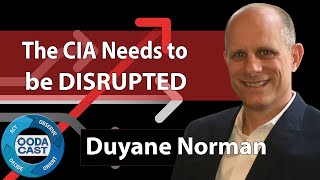
Retired CIA officer Duyane Norman spent 28 years in intelligence and argues the agency must completely reinvent itself. Digital footprints and surveillance have made traditional spy cover identities obsolete, so the CIA needs to merge human intelligence with signals and open-source intelligence, break free from bureaucratic inertia, and explore operations in virtual worlds.
Chapters
Informing your decisions with intelligence analysis and insight brought to you by the team@ooda.
Loop.Com hi, I'm Matt DeVoe and thanks for watching the Oodacast. And today I have a guest, Dwayne Norman, who is a retired member of the CIA's Senior Intelligence Service who worked both in the Directorate of Operations and the Directorate of Science and Technology. He was introduced to me by a mutual friend and we've had some great conversations about the of intelligence, so wanted to get him on the UDACAST to share those views and kind of his views of the world with us. So Dwayne, thanks for joining us on Uticast and I would love for you to give us an overview of kind of your career history and how you get to today.
Thanks Matt, and thanks for having me. It's my, my pleasure to be here. My career, I guess is a little bit unique in most people come to the Agency after some type of meaningful life experience. And I joined right out of undergrad. So I entered on duty in 1992 and did 28 years at CIA until I retired at age 53 years ago now this month. So I've been out for three years. In my 28 years I had most, I spent most of my adult life overseas. I did seven overseas tours but was lucky enough to have a couple of, well, have several really interesting jobs in our headquarters, including a couple at the relatively senior level, so enterprise level jobs, and was very fortunate, I think in my career to have a lot of really cool adventures and be able to go to a lot of really neat places and be in parts of the world at moments, real moments of history.
Yeah. Excellent. Can you speak to any of the places where you served?
Unfortunately, I can talk about regions, so I studied Latin American studies in school and so I speak Spanish and Portuguese and I did three tours in Latin America, two in the beginning and then one at the end of my career. And then in the middle of that I learned Russian and did several tours in what we call CE Central Europe and Central Eurasia, so former Soviet states. And, and I did a war zone tour in the Middle East.
Excellent. Thanks for sharing that. What attracted you to the CIA straight out of undergrad? What was the catalyst for wanting to join?
It was, it was an accident, actually. I didn't. I was raised in Baton Rouge, Louisiana. Not small town, I guess city, but you know, I had no real exposure to CIA. Nobody in my family knew anything about CIA. I did come from a military family, but my father died when I was really young so I Didn't grow up in, in a military community. I knew I wanted to serve because of the serve, because of the service that my family, the history of service within my family. But I didn't know how. The military struck me as very rigid at the time. I didn't like being told what to do or when to do it. And so. But I wanted to serve in some capacity. So I decided I wanted to be a law enforcement officer. And we had a job fair at Vanderbilt where I went to school, I remember, and I went to the FBI booth and told them I was interested and they said, that's great, yeah, you'd be a great candidate. But come back when you're 25 because we don't hire anybody right out of undergrad. So go get some meaningful life experience. And on either side of the FBI booth, on one side was a DEA booth, on the other side was a CIA booth. And I spoke to both of them and dropped off resumes at both. It's a little bit of a long story. The short version is I ended up applying with DEA and I got a letter of no thank you from the agency. And that, I guess it kind of pissed me off a little bit. I didn't understand why. So I called up the recruiter who was recruiting analysts and he explained to me I wasn't what he was looking for for analysts. But I ended up having a good long conversation with him and he said, you know what, there's this other group that might be interested in you and I don't know, I'll pass your resume to them along with a letter. They won't tell me if they are going to contact you or not. And they may or may not contact you, I don't know. And that led to a series of conversations and a very long year long process to end up with my offer of employment and then to start my career.
Excellent. Cool. Over the years, you've obviously lived during a very interesting period in history with regards to intelligence and you've made some observations with regards to the impact that technology and the pace of globalization are having on the practice and art of intelligence. Can you step us through some of your perspectives on what you think some of the risks are to traditional intelligence gathering?
Yeah, I think it's worth prefacing these comments by talking about just a little bit about the era that we live in today. It's this incredible era of disruption. I think the pace of change is almost dizzying at times. If you think about when you and I first met, we talked a little bit about our kids and our kids have grown up in this world. I have a, an 18 year old and a 20 year old and just the changes that have happened in their lifetime. They have more information at their fingertips through their, through their cell phone than I had in my entire city of Baton Rouge, Louisiana when I was their age. If I'd have gone to the state archives, the LSU museums, all the local libraries and everything, there's no way I could have accessed the amount of information that they can access almost instantaneously at their fingertips. I remember when making a long distance phone is a big deal even within our country, much less internationally, and now you can Skype or zoom across the planet then these changes have had a profound effect on a number of different industries. And some of these are well discussed and things like how did Kodak fail when they owned all the digital patents and they were leaders actually in the development of digital photography, but they failed to recognize when there's foundational shift, shift occurred within their industry and they failed to pivot and change. And I think the last couple of decades are littered with companies who were titans of industry or leaders in industry that failed to recognize when these shifts happen. We talk about Netflix becoming a leader in online content, whereas Blockbuster failed. There was a time when Blockbuster was a clear leader between those two companies. You look at Tesla becoming the most valuable US car company and Ford and GM really struggling despite being titans of industry. Of course, Ford just made a major announcement about a pretty significant pivot. They have finally, although a little bit late, recognized the need for foundational change. These industries and businesses that have remained largely unchanged for a very long time have been disrupted by new developments in technology and connectivity. The business of espionage is undergoing the exact same pressures. If you think about it, the practice of espionage has a couple of foundational elements to it that have existed since the practice was invented hundreds of years while predating CIA or the US Government. The idea of espionage is, is prefaced on a couple of foundational elements. One is that it's practiced by people pretending to be something or someone they are not. We call that cover operating in the shadows and away from prying eyes. And we call that tradecraft. And if you look at the practice of espionage as it has been developed over the centuries, those two concepts have been refined and improved upon, but they are still foundational elements to the point where I personally believe the US government, CIA in particular, but I believe the US Government, I believe we're the best practitioners of that craft that have ever existed on the planet. Despite what you read or some of the criticisms. I do believe we're genuinely the best at that and I do believe I received the best training and experience that the world has to offer in that. I also believe that those two practices, it doesn't matter how good you are, they're largely irrelevant in today's connected world. What I mean by that is the idea that you can effectively pretend to be something or someone you are not. In today's world of digital dust, ubiquitous surveillance, social media, 24, seven news cycles, I believe that concept is very severely challenged. I want to be careful, Matt, about how I say this. I don't mean to imply that it cannot be done. I still believe it can be done. I still believe it can be done effectively. The problem is the resources and the time and effort needs to go into building an effective cover and maintaining effective cover are prohibitive to the kind, to the practices, to the way, sorry, the way espionage has been practiced for centuries and decades, certainly. And that is this idea of a globally deployed cadre of undercover intelligence officers, I think is challenged by this, this world that we live in today. And happy to explore that a little bit more.
Absolutely. It seems like there's kind of multiple threads to that. One that you're talking about is just the technology, right? The fact that we are all carrying around geolocation devices that are tracking everything that we're doing and we're authenticating to the devices and services with biometrics, and the absence of that data becomes suspicious in of itself. So there's that kind of, that variable and then just the identity aspect of things with regards to facial recognition and the permanence now really of some of those identity factors in this data being captured in public streets, public venues, in airports, at border stations. So can you kind of step us through? I mean, is it a combination of those technologies and are there any sort of solutions or viable pathways forward, or do we need to completely disrupt the intelligence community at this point?
The short answer is I believe that we need to completely reinvent the business. But the longer answer and the explanation why is. So if you think about, and yes, you're absolutely right, it's all of the above, right? It's all of those factors, all of those technologies and capabilities play a role. But if you think about the idea of presenting yourself as something or someone you are not, that relies on a whole bunch of different things. It relies upon you being able to have a story that you can tell that's effective, that you know what you are purporting to Be you're able to talk that talk and walk that walk. You have an ability, if anybody does it, tries to verify or validate who you are, that you have an ability to defend that cover that you've built. But it's much more than that, right? In today's world, your activities are tracked by a myriad of sensors at any given time. Most of these we opt into on our own because it makes our life more convenient. We carry a cell phone around with us. We drive a car. If it's a relatively new car, and I don't mean like last five years, I mean the last 10 years, it has some form of telematics in it. Prob. We can increasingly pass through sensors, whether it's traffic cameras or just video surveillance cameras that are increasingly networked. But you are constantly being evaluated by your position, your location, and then your connections to other people who you interact with, what your behavior is. It's not just the signature that you are creating. I mean, it's easy enough. I think most people would say, okay, Dwayne, just don't have a signature, right? Don't drive an older car, drive a car without telematics in it. Don't carry your phone with you or leave your phone at home. But that's not good enough in today's world because the absence of a signature is a signature. If I purport to work downtown in downtown D.C. or if I say that I work in New York City, but, but I don't ever, you know, my cell phone doesn't show me there. My, my telematics in my vehicle don't ever go there. I don't ever use an atm, I don't ever use a credit card for lunch. I don't have, you know, my phone calls don't originate from there, then it doesn't matter if I. How good my story is or how well I can talk to talk. I have no signature that supports what I'm claiming to be. So it's. So even if I do everything right and don't have a signature that puts me at a known int. A facility that's known to be affiliated with the intelligence community, or even if I don't have a signature that puts me around other intelligence officers or at a training site during a known training window or something, even if I don't do anything that actually says yes, Dwayne is an intelligence officer, it's the absence of a signature that can be just as damning interesting.
Do you think that there's a role for the use of synthetic data I had a fireside chat at an event about a month ago with Mike Capps, who was the prior president at Epic Games, so creator of some of these immersive virtual world gaming environments, not Metaverse, but open world type communities. His focus today really is on explainable AI and synthetic data. So do you think there's ever a timeframe where we can fake it, where we can inject data into the system to help with some of these cover aspects?
Yes, but I want to be careful. So I think you have to, it has to be, you have to be very careful about how you make that calculation. One, I think it's a losing game to think that you can stay ahead of the data. I mean, 5G, assuming it. Assume. First of all, nobody really knows how 5G is going to transform our world. I think lots of people have some ideas about what it will do and what the power will be. But the idea of the Internet of things and sensors everywhere that will make our lives easier will also fundamentally transform the number of data points that are collected on us and our activities. And so I think that trying to stay ahead of this idea that you can create a digital signature that is consistent with what you're claiming to be, I think the idea is that pace of change is going to happen so fast. I think it's naive to believe that we can stay ahead of that. It's a little bit, Matt, like the climate change debate in my mind. If you, if we agree that this is a, if you agree that climate change is a legitimate problem, then there's a profound discussion to be had around what we can do or what we should do to address it. Do you try to reverse it? Do you just try to live with it? Do you try to manage it somehow? But if we start out with this, if the premise is that it's not real, if one of us believes that climate change is not real, then there's no meaningful debate there, meaningful debate about can you manipulate this, you know, these signatures in this digital dust. I think if we agree that it exists and it's, and it's an existential threat to our, to the practice of espionage, the way that we've carried it out for decades, then, then I think there's a, there's a good debate to be had there. My, my personal opinion is I think it's a fool's errand to think we can stay ahead of it. I think the answer is going to be a reinvention, not, not try to stay ahead of it.
Yeah. So what does that reinvention look like, what are the characteristics that you think it would encompass?
Let me tell you, before I do that, let me give you just one that, you know, Henry Ford used to say something along, I'm paraphrasing, but used to say, if I'd have given them what they wanted, I'd have given them a faster horse. Right. And I think a lot of. A lot of this idea of staying ahead of the digital dust or staying ahead of the ubiquitous surveillance challenge is really about this question of do we continue to try to build a faster horse? History has shown that faster horse is not what was needed to advance society in the transportation industry. I think the same can be said for this. The answer. I would love to say that I have the answer, right? I would love to tell you, Matt, I have the answer. Here's the solution, and let's go implement it. I think it is an incredibly complex problem that has a number of different factors. What I am convinced is true is that the answer is going to be found in some form of public private partnership. What I mean by that is, so if we go back to the two elements that I talked about, these foundational elements of espionage that have been fundamentally disrupted, the idea of COVID pretending to be something or someone you are not, and the idea of tradecraft operating in the shadows away from prying eyes, if those have been shattered, then the answer is don't pretend to be something you're not and don't operate in the shadows. So if those are broken and we're not going to fix them, or we're not going to make the faster horse version of those two things, then the answer, I think, is pretty clear. You know, do something different. Now, what does that mean? Well, what does it mean? If you say, okay, don't pretend to be something you're not and don't, you know, don't operate in the shadows, I think that means trying to find a way to leverage the natural accesses that we have to the decision makers, to the plans and intentions of our adversaries that we're interested in and trying to find a way to get to those. What do I mean by that? First, I think it's worth talking a little bit about what the business of espionage is really about and why it's important. A lot of people will say, in today's world, I think at least I hear this argument a lot, do we even need human intelligence? Is the day coming when it's not going to be relevant? I think it's going to be relevant at least for the foreseeable future. And I'll tell you why. First of all, I think there are lots of other types of intelligence that have grown significantly in importance over the past couple of decades because we've gotten better at signals intelligence, but we're much better than that than we ever were. There's much more data out there to acquire and collect and to analyze. With emerging technologies allowing us to, to triage and analyze massive data sets more quickly and provide tippers to humans to look at the most relevant points. I think we're much better at that than we ever have been. I also think open source intelligence, the ability to simply look at information that's available openly to the public and be able to analyze it, has become incredibly powerful, as evidenced by groups like Bell and Cat and others who have done incredible work on using open sources to go out and simply conduct some pretty impressive analysis. So I do believe that Geoint and Mint and Sigint and OSINT are all, to use the terms within the intelligence community. I do believe that those are all incredibly important and I do believe we need to spend effort and time and energy in this. The human intelligence side though, is still relevant and incredibly relevant. And I'll tell you what, none of those other forms of intelligence can really give you the plans and intentions of your adversaries. Sometimes they can give you a little bit, but really what you're asking, when you put a human in that loop, what you're asking is what's the thought process? What are the relevant influencers that cause that person to make the decisions he or she makes? Also, you have to talk about the COVID action side of this, the influence operation side of how do you influence those. So it's not just that you want to be able to understand why a leader makes a decision and who around them is influencing their incision, and be able to predict what their decision might be if situations change. But also how do you influence those? And I don't know of any effective ways to do that if you are simply doing that through the other forms of intelligence. So I believe human intelligence is, is incredibly important. I just believe that the way that we've gone about conducting that uniquely human side of intelligence is not sustainable.
Interesting. You mentioned the open source and my business partner Bob Gourley just wrote a post last week saying that the conflict in Ukraine is really the first open source war that we've seen. Given the viability of all the data coming, coming out, the imagery, and the fact that Google Maps can show you where Russian military convoys are because they show up as traffic jams, the collection of the data around military assets and putting them on maps, or just the ability of leadership and others to interact with the world. Any observations there? Have you seen anything that's been unique? I know that it's not a future of intelligence type question, but would love your perspective on that.
Yeah, I mean, I think the Ukraine conflict from an intelligence perspective is fascinating in just a whole host of ways. I think that we're seeing open source intelligence play a huge role. You're seeing all kinds of new technologies deployed on the battlefield. You're seeing incredible disinformation, massive disinformation campaigns, particularly on the side of the Russians on the Russian side, and not succeeding as well as they have in the past in the case of Ukraine. But yeah, I think that there are going to be a number of different intelligence case studies that will come out of this conflict. I think that the business of intelligence, like all these other industries, is constantly evolving. Again, we're in a world right now that's changing so fast that if you're not constantly evolving and adapting, you're. You're falling behind. And I think, you know, part of what we're seeing, part of the reason that the Russians have been so unsuccessful is a pretty significant intelligence. Well, so unsuccessful. I want to be careful how I say that. They've obviously done incredible damage, but I think, you know, they haven't. They clearly have not met what they set out as, set out as their primary objectives when they launched this conflict. I don't think they anticipated the resistance that they were going to face. And, and that is a pretty significant intelligence failure on their part. To read the willingness of the Ukrainians to fight and the willingness of their partners to help supply them and bolster them. And so I think that, yeah, there are going to be lots of intelligence lessons learned and open source, just the power of information. You can look at just imagery. For example, it used to be that classified imagery was, you know, was the gold standard by far, far and away. And if you wanted, you know, if you wanted legitimately useful imagery, real time imagery, you had to be a government agency of one of the superpowers in order to be able to access and utilize that imagery. Today there are a number of different private companies that produce really, just incredible, incredibly high quality imagery that is available for purchase. You see a lot of it on the news programs. They're buying imagery and using imagery every day that is, I mean, it's actionable, it's real imagery that can be used to conduct real Time or near real time analysis that can really affect a battlefield.
Interesting. And just the flow of information to me has been fascinating. I think I mentioned when we had coffee, my teenage boys come home with new Putin jokes every day. I don't know how so many are circulating. And I have private message group with fellow 50 year old men laughing at videos of Ukrainian tractors hauling tanks away. I mean, just the flow of information and the ability to connect with the region and the conflict and the people for me is definitely one of those kind of future shock type moments. I'm amazed with the amount of data that is coming out despite some of the concerted efforts to stop those information flows by the Russians.
Well, you're seeing, even in a closed society like Russia, you're seeing them really struggling, struggle to contain the information really, you know, to, to shape it and contain it, to affect their own populace. They're, they're, they're having significant, you know, problems. And that's just. We live in a different world. We live in a connected world. And you can't, you know, you can't conceal all of the data even in a closed society. So if, you know, bringing this back to our original topic, you know, the business of espionage, you know, relying on conducting activities in secrecy, I think is really, really seriously challenged, particularly in an open world, in a Western world where we really are a world of transparency and where information is omnipresent.
It's interesting too when you think about your call for additional public private sector cooperation. There are some that might make the argument that private corporations are not in the business of national. Yet we've seen now with this conflict and with some of the private sector companies, activities against Russia that they do have the requisite to get involved, make tough calls, reduce not major sources of revenue, but not insignificant sources of revenue, and absorb the pain associated with that. Do you think that that helps set the model that you think is required with regards to the private sector being a little bit more intertwined with some of our national security and intelligence missions?
I am more optimistic now than I've ever been about the real opportunity that we have right now to capitalize on what's going on. And I don't mean, I mean the war is a tragedy and I'm very concerned that it could escalate and become even worse. But there is a positive side to this. And the positive side is that, yeah, I think it is much clearer that there is a shared interest in protecting the value that have enabled us to have this great era of innovation and technological development. And that responsibility is a shared responsibility between government and private sector. I think it's a uniquely Western construct. Matt, this idea, I don't know if most, I think, of your viewers and listeners will be familiar with the movie A Few Good Men, although it's a little dated now, but there's the famous scene where Jack Nicholson's up on the stand and, you know, he's trying. The whole premise is that there is this collection of noble warriors who man the walls and protect the blissfully ignorant from these foreign, these external threats to their way of life. Right. And that these noble warriors operate under a certain code that's relevant to them and they operate under rules that are relevant to them. And as long as the blissfully ignorant populace doesn't tell them how to do their job, they'll be able to do their job and defend the kind of the normal and regular people. And the famous line from that movie is, when Jack Nicholson, they're talking about the truth. And Tom Cruise says, I want the truth. And Jack Nicholson says, you can't handle the truth. And what he's really saying is, hey, look, we're the defenders. We're the ones who, we know the truth, so you don't have to. Right. And that separation between the defenders of, in our case, democracy and human rights and free market economy. Right. These noble defenders and then the blissfully ignorant, I think, is. It really is, in my mind. It's uniquely Western and uniquely Western construct. Right. And you see it play out in our society. You have companies that come out and they talk about. They're not concerned about. They pursue ideas. Some of them will say they pursue noble ideas. I don't know. Facebook might say it pursues this idea of connecting people and isn't pursuing a profit model purely. But they don't say we're pursuing the idea of national security or Western security and defense of Western ideals in general. They don't. But I think it's naive to believe that any of these companies, any of these great Western companies would have been created in a different environment, that they would have been created under a Chinese or a Russian regime. They were created, they benefit from these Western ideals of, again, defense of human rights and free market economy and democracy, self determination, these values that we hold to be universal and self evident are really not. There is, if you look at China and you look at Russia in particular, just as two of our most obvious adversaries, their systems are very different than ours. And there is no clear separation between companies and state interests or national interests. They already acknowledge that their interests are intertwined. I think for us in the west, we have to realize that the days of these kind of this separation of responsibilities that you have, these groups, the Department of Defense, the intelligence community, the law enforcement community that's charged with protecting our values, and then the rest of the population in these private companies can just pursue other objectives without having to worry about that defense of these values. I think. I think it's pretty clear to me those days are done. And it's because so many of those interests are intertwined. Information, having real information that's valid, that can be verified and validated is a shared responsibility. And putting disinformation out there that undermine is ultimately corrosive to the very environment that enables some of these companies, you know, to succeed. So, sorry, go ahead.
Yeah, and as you say, definitely it seems to reinforce that piece. I mean, another observation I had around that, and not that we're living in a science fiction novel, but, you know, science fiction books have been telling us for 30 years that the corporations will start to act more like states. Was around pandemic response. Some of the most agile response to Covid in March 2020 was coming out of corporations with their decisive calls to shut down campuses with the stipends that they were paying to employees before the government was offering stimulus checks and even some of the grants associated with small businesses. Facebook famously offered up a grant program because they knew that the businesses that were surrounding their headquarters base would be suffering through the pandemic. I think we're seeing something similar. So it is definitely showing that intertwining and it is showing the corporations willing to act in almost a nation state like capacity. So it seems like, like further cooperation with nation states is not too big of an ask as kind of a follow on to that. We do a great job of injecting folks from the intelligence community into the private sector. I've worked with a lot of great retired CIA folks who come out and go into the private sector and they bring a ton of experience in domain expertise that can be applied to some of the private sector objectives. But we seem to do a very bad job of kind of reversing that process of injecting leadership and new perspectives into the intelligence community. Do you have any hope that we can serve to disrupt, even just internally, from a leadership perspective, so that maybe some of these new approaches or new realities can be better addressed from folks that come from the outside in, as opposed to expecting the disruption to occur on the inside?
Yeah, I think. I mean, I'm an Optimist at heart. And so, yeah, I believe there's absolutely hope. I do believe we're getting better at it. I do believe, although the pace of changes is impossibly slow sometimes, but I do believe we're better at it. And I've been, you know, I took part in numerous discussions when I was inside the agency of how do we do a better job of having talent, allowing talent to come and go, which is a. You know, when I joined the agency, there was a sense, there was a real criticism of people who didn't even, even as a trainee, I can remember people talking like, if you told a relatively senior officer that you were, you didn't know if you were going to be there for a career, you wanted to give it a few years and see if you liked it and figure out if you'd stay, they would, they would hold, many of them would hold it against you. I mean, they would look down on you and think, hey, no, this is a, this is a calling. This is a career here. We're going to invest in you. You need to be here for the duration. And so there was a, you just didn't talk like that. When I was a, when I was a young officer, you didn't talk about, oh, I'm thinking about leaving, or I'm thinking about going back to school, or I'm thinking about going off and try and set my hand at something else. I think it's a little bit different today, I think, because the private sector, there's so much flow between jobs and companies. I think that that extends into private, I mean, into the government sector. Sector a little bit. But there is still a sense of when you come in to the government, we're going to, you know, we want you to do a career, we want you to spend a career there and then, and then retire. And I'm not sure, I'm not sure that's the right model. I think, and I do disagree with you a little bit. While I think that, yes, we do a pretty good job of officers retiring from the intelligence community and then going off to the private sector, that's great, but in many ways that's too late. What we want to take is we want to take officers who've spent five or 10 years in the intelligence community, allow them to go outside and develop some private sector experience, and then come back and leverage that and utilize that in a more senior rank on the inside. One of the challenges within our organization is if you leave and come back, it's not as hard to come back. As it used to be. I'm not going to say it's easy, that's bureaucratic and cumbersome, but you can do it. The challenge is that oftentimes, let's say you leave as a GS13 and you go off and you get four or five years in the private sector, you do really well, you're really successful, you gain some real valuable knowledge and now you come back into the intelligence community, you're going to come back in, in the vast majority of cases as a GS13 because they're going to say all that. You still have to earn, you have to earn your stripes within the organization. And so it's really a disincentive, I think for a lot of people who can be successful in both environments to kind of go back and forth. But I do think we're getting better at it. I think we need to be better at it. And I think it does go both ways. I think that the challenge within the intelligence community oftentimes of integrating people who have real world experience and bringing them in and utilizing that real world experience on the inside is how do they gain credibility within that community. And that's, it's an internal challenge. It's not, I don't know that it's, I don't know that it's a real challenge, at least from an intellectual perspective. Right. I think many of those people have clearly have something to offer and some expertise that can be directly translated. The problem is you've got to convince the people on the inside who are going to be resistors to that. And so somebody could come in with great ideas. But the system oftentimes is going to say, yeah, come earn your stripes in here and then we'll listen to your ideas. We don't, they're not relevant to us until you've proven that you can operate the way that we operate. And it's a little bit akin to, you know, if we talk about, we talked earlier about Kodak, like imagine bringing somebody in who was an expert on digital photography and then telling them, yeah, that's, that's great that you're good at that, but you need to go master wet filling first and then we'll let you transform our, you know, our, you know, our digital photography operations. That's, you know, it's just silly.
So they wouldn't tolerate an Elon Musk as the director of CIA. Very well.
You know, I don't know. We've never done it.
Yeah, it's true.
You know, I don't, I don't know I don't know. What I do know is a lot of people ask me. So if you just accept, like if, you know, suspend disbelief for a minute and say, okay, Dwayne, you're right. We need a public private partnership. The foundations of espionage are broken. What do we do about it? The challenge is actually not. It's not one of what the answer is. I believe that we have the people on the inside and outside. We have partners on the outside and people on the inside who are brilliant enough to solve that problem. The real reason that we haven't done it already is a challenge of leadership. It's not a challenge of ideas. Right. People ask me all the time, what's your idea? And it's not. That's not it. I think within a couple of years we could revolutionize the entire business if we had the top cover in leadership and kind of room to be able to do it. And that's been the challenge. And part of it is if you look at leadership within government, and I'm not talking about just CIA here, I'm talking about across government, there is a real tendency to favor the steady Eddies in government. There's a very kind of clear way to advance in government. And this is true in the military. It's true in the civilian service. It's true in most cases, most in pretty much all of the agencies. Right. If you can take your. If you go to a job and you can do 10% better than your predecessor did at whatever it is they were doing, then generally speaking, you're going to be recognized as successful in your business. Right. And you will, and you will move through the ranks. And so what happens oftentimes is the people who reach the senior ranks and who get the senior level positions are the people who have steadily made improvements throughout a career failure. It's pretty rare. It's not, I'm not going to say it doesn't exist, but it's pretty rare that you see people who've had significant failures, you know, kind of reinvent themselves and rise to the senior ranks and get those senior level positions. And it's pretty rare that you have, you know, disruptors, people who are disruptive in their path, rise to those senior ranks. And it's simply because the system is designed to favor people who are steady in their progression. And so what you end up with oftentimes are very competent, very patriotic leaders, but who are not disruptive in their mindset. And so if you talk about, for example, reinventing the business of espionage and scrapping the entire way that we've done it, the foundations of the way we've done it for 70 or 80 years, that's a bold vision. Like that requires a bold leadership vision and commitment to doing that and the willingness to stick it through. It's not usually the people who rise to those senior ranks.
It's interesting because we could go on YouTube right now and search for entrepreneurship and failure and we would find 700,000 videos. Right. Whereas in the entrepreneurship side, failure is viewed as really a pathway to success because of the lessons learned that you encounter and just the audacity of trying. So that is a kind of interesting dynamic there.
One other point on that, you're absolutely right. So just one other point I point out. One thing is if you look at all of the major companies that have been disruptive in the past couple of decades, there is a common factor and it is visionary. Every one of them. You can point to one or two visionary leaders of those companies. And by visionary, there are lots of different types of visionary leaders. There's not. I don't mean you mentioned Elon Musk. Elon Musk is the kind of visionary leader who has a vision and is able to marshal people and resources around in support of that vision. That's one type of visionary leader. There are other types of visionary leaders. You could say like a Steve Jobs or Jeff Bezos, who maybe they had a vision at one point, they had some vision, they marshaled people around. But ultimately what made them great leaders later on was being able to put other people with great ideas in positions of power and influence to bring about these kind of dynamic changes or growth opportunities within their industry. I mean, Amazon, if you just said that Jeff Bezos had some master plan when he had the online bookseller to be Amazon Web Services and all these other things that Amazon's in today, I think you'd be kidding yourself. Right? He didn't have some master vision to get where. But what he did is he recognized great people and he had an opportunity to put them in positions to try new things and empower them to do new disruptive things and create a culture that really favors and values disruption. And so I think when you look at these private sector companies that are transforming the world, you can, at least, unless somebody can point to me otherwise, you can always point to a visionary leader or two. And I think that's a real challenge in government. It's a real challenge because we don't tend to grow those visionary leaders internally. When we do, we tend to hold them, keep them leashed. Give them limited responsibility or limited control, and then in the rare occasions when they do get to a position of reality, influence and authority, they're there for two to four years and then they're gone. Right. You don't have the time. And that's not. If you want to reinvent or transform a culture, you've got to be able to have more time to really implement that transformation. So that's the biggest challenge I think we face with bringing real innovation and disruption into government is that visionary leadership.
And if you bring the visionaries in and they build teams, those teams can have that exponential disruption on a go forward basis. Reading a fascinating book right now about the PayPal years and it's just amazing to look and see the team that they built for that really to come together and solve a hard problem. And really there were two competitors that ended up merging out of necessity. So this is some unique problem solving right there. It's incredible. I mean, they've brought us a ton of interesting technologies and companies over the years and they're not done yet. So if you can build those teams and succeed in that disruption, I think it pays forward. There's definitely a compounding interest component to it once you get going. The first few initiatives.
The funny and tragic piece about that, maybe not tragic, it depends on how you view it. But the interesting piece about that is when CIA was created and its predecessor organization, oss. OSS was created because there was a recognition of a need for a different approach to intelligence than there had been previously. Right. And so OSS was created and it was given these amazingly unique authorities to go out and find ways to collect intelligence that we had not had access to previously, particularly the human intelligence. And so when CIA was formed, if you look back at our history, a lot of that, like, let's just find the best people and let's figure out the answer, whatever it is. And if we don't have the authorities, let's go ask for the authorities, let's go rewrite the rules and regulations. That is a real part of the DNA of the Central Intelligence Agency. It's a real genuine part of the DNA in the history. The problem is, like a lot of other bureaucracies, what has happened over time is what happens is you'll have a failure at some point. And so within government, what happens is when you have a failure, you write a policy or a practice to prevent that failure from happening again. You'll put into practice that new policy. And then over time, what happens is policies build up on top of policies on top of policies. And you very rarely go back and readdress that original. So you end up with all these rules and regulations and practices that are like scar tissue that builds up and prevents any type of flexibility. And so despite our roots and our DNA being one of, hey, let's go and convince. Private industry or academia to partner with us on one of these huge national challenges. And there are storied operations in our past about some of these events. You look at that today and you say there are too many rules and regulations about the way we can interact with private sector, the way we can interact with academia, or whether or not they have their security clearances or how we can bring them in or what we can read them onto. And all of that prevents you from being able to have those kinds of conversations that if this was 1956, we just have. You just have those conversations. And I think that what's happened is now the agency of today is oftentimes it's a product of all of these policies and rules that have come up and not a product of our authorities and the intent that was really put into the creation of the organization.
So you have, similar to my compounding interest example with innovation and disruption, you have that as it relates to policy in the scar tissue as well. Did want to ask a question about potential use of technology in the future around human? I read an essay 15 years ago and it obviously stuck with me because I'm remembering it by Joey Ito, who was a venture capitalist at the time, was investing in firms, and later went on to run the MIT Media Lab, where he argued that World of Warcraft was the new gulf, that if you wanted to develop a relationship with him as an entrepreneur, that you would have more success doing that in the virtual world where you could interact than you would in trying to interact with him in real life. We have Facebook in 2021 changing its name to Meta, focused on Metaverse. We have what is being described as the inevitability of a metaverse where we're interacting in avatars and in the virtual environment. Do you feel like that that will ever serve as a pathway for doing true human? Will there ever be case officers operating in the metaverse successfully?
Yes, I believe. Yeah, absolutely. I believe the virtual worlds are a part of society today, and I believe that will be an increasing part of society. I do believe that we will eventually reach some form of metaverse. I think it's interesting, the whole debate about whether or not we're living in some kind of simulation as it is. I think There's a fascinating debate to be had there. But I think, yes, I believe that there will be growing opportunities for operations in those spaces. I don't believe that anytime in the near future it's going to replace the truly human operations. I still believe, I mean, I'm of a certain age, I guess, where most of our friends and colleagues probably don't play video games. I actually play a decent number of video games. It was one of the ways I bonded with my 18 year old son and we play online together. I have a whole collection of, of online friends that I only know through, you know, stuff like, you know, Warzone. Right. And as silly as that is, they're, they're my friends and I know, but it's different, it's a fundamentally different kind of relationship. And if you're trying to get them making the transition from, from playing and sharing having common experiences within this video game world to how do I get them to talk about their lives and what they do, much less commit espionage and give me secrets on their real life, is a huge leap within that environment, within that realm. I think the only time that that's really going to change. We can use those environments today to spot and assess people, maybe to do some development, but to actually recruit them and to actually handle them I think is very problematic because of the difference between that, because of the separation between those two environments. I think that will change. When you are going to work in the metaverse and when your work is within, your information is within the metaverse, then being able to spot, assess, develop, recruit and handle people within that environment will be more consistent. I think it'll be, I do believe that that will be a factor, but I don't believe it's going to be the only one. I mean, I don't, you know, until or unless we're running governments online, I think, you know, there's the idea that we still need to know the plans and intentions of our adversaries and to get at those, you're going to have to be able to get access to the inner circles of the decision, you know, the decision making inner circles within these governments and entities, non state actors as well. I still think there's a very human side to that. So I think there's fertile ground for virtual operations. I do believe it's a growing business and I do believe it's something we should invest significant time and energy in, and we do invest significant time and energy in, but I don't believe it's going to replace traditional hu mint anytime soon.
I remember thinking at the time that actually was doing some work, doing a research paper on tradecraft in virtual worlds. But we weren't focused on World of Warcraft. We were focused on Second Life. And for us, the distinction there is exactly what you said. People went to World of Warcraft looking for teammates and with a particular mission in mind. So the mission or the object of the game was the key catalyst for interaction. In Second Life, it was completely different. People went there with no purpose other than to interact with other people and develop human connectivity through avatars. I think the argument that you're making is when we have technologies that are more like Second Life, where we're living and working and interacting socially in those environments, that that'll be more fertile ground for some of those human relationships that can lead to valid human.
Right.
Shifting gears yet again, can you describe for us what the Station of the Future project was when you were still at the CIA?
Sure. The Station of the Future camp. So I. I came back from a war zone tour in 2010, summer of 2010, and I was fortunate enough for the first time in my career to be. I was put into an enterprise level position. I was made Chief of Operations for Latin America. It was the first time in my career where I was in an enterprise level position and was sitting in boards and panels that were looking across the agency and across the enterprise to try and address broader challenges. Up until that point, I'd been a leader. I'd been a Chief of Station a couple times. I'd been a Chief of base, I'd done a bunch of jobs, I'd been an instructor and taught the next generation of case officers. But I'd never really looked across the entire enterprise. And it was a real interesting time in our history. Most of it's public knowledge now, but it seemed like almost every month we were encountering a different problem. And many of them are very public today. Compromise of some assets. But the OPM data breach and Snowden, there were a number of different, different kind of challenges that we were facing. And we were doing what most organizations do, right? You'd get briefed on one and you'd address it and you'd put some policies in place to protect against it. But what it struck me in a small collection of my colleagues was that these were all symptoms of a much broader disease, right? We were treating the symptoms, we weren't treating the disease. And it was a realization. I call it an epiphany, but it wasn't. It didn't hit me in a day, right? It was more like a role epiphany. The more you thought about it, the more you talked about it, the more you had groups come together to talk about it, the more you kind of realized, hey, these are all interconnected. And it was all part of this changing world. And, you know, emerging technology, social media, connectivity, ubiquitous. All of these things were starting to come together and starting to create these challenges. And so I was fortunate enough to have a couple of senior mentors and friends in the organization who, who I talked to about this. And they said, okay, Dwayne, what do you want to do about it? And I said, well, I don't know, I want to get some people together and talk about it. And so we had an off site, a small conference that we invited people from all four at the time directorates and we had everybody. From now there are five directors, but at the time there were four. And we had people from every directorate and we had people everywhere, from new trainees who had been literally with the organization a couple of months, to SIS officers, senior intelligence service officers, and everything in between. So we had a real cross section of the agency. In fact, there was so much interest in this event that we had to. The facility that we had could only hold. We could, we could only effectively kind of have a discussion up to about 85 people. And we had to, we had to close, close the doors. Like I had to stop accepting people because there was so much interest in coming to this. So we had about 85 people who got together and we spent a day. And it was just, it started with just a day, but we asked it. And the fundamental question I asked everybody at the beginning was imagine that we in this room were tasked with creating CIA today. What would we do? What would we do different? How would we do things differently? What came out of that series of discussions was a number of different questions about why do we do things the way we do it? Why do we turn off cell phones and not have them in our office spaces? Why do we write cables? Is there a better way of storing data and information? Why do we have the career thrusts we have? Why do we deploy the way we deploy? There were certain some of these fundamental questions that we asked. And we kind of looked around the room, we said, you know, if we were creating this day, we'd never do it this way. We just do it because that's what we learned, that's what we were taught and now become the path. But is there a better way to do it? And that generated nine different working groups that went out to go make recommendations. So people volunteered from that and they said, okay, I want to take on this challenge. I want to figure out, you know, one of the questions was, why do we have a presidential daily brief in the morning? Everybody else's 24 hour news cycles, why do we give the President's daily brief in the morning? And is there a different, like, should it be a 24, 7, like News Feed? Is there a different way to do it? Right. And so they were the examples and the questions were a little bit all over the map, frankly. Right. I mean, there were a whole bunch of them, but these nine working groups went off and they started, you know, analyzing, okay, okay, what if we weren't going to do it this way, how would we do it? And it became pretty evident very quickly that what we needed to do was find a way to pilot some of these. Right? That you needed a way to go test some of these, because maybe they were great ideas, maybe they weren't, but you needed to go put them into practice. And so I went to my boss at the time, who became shortly thereafter the deputy Director of operations, and I went to him and I said, hey, I've got this idea. They've got these people around it, like, we have some really unique ideas. I need a place, I need a platform where we can go and try this. And it took several meetings for me to convince him, but eventually I convinced him and he endorsed it and gave money and resources and to say, okay, we'll try this in a, we'll create a pilot. And we called it Station of the Future. And the idea was, how do you to have an environment where you're working real problems, real problem sets, but you go off and you try some of these new tactics and techniques. And so I was fortunate enough to lead that effort to help architect it, create it, fund it, and then go lead it for three years and then come back and do lessons learned from it. And it went on after my time as well. But there was a pretty lengthy lessons learned piece that I worked on for a little while. And the biggest lesson learned in my mind is jumping forward. I mean, there were lots of lessons learned, lots of great things. Well, depending on who you talk to. Obviously I'm invested personally. If you talk to people from that time in the agency, it was either, you know, it was either a resounding success or an abject failure. And a lot of that just depends on who you talk to. My honest opinion is I think it was somewhere in between. I think we had some real successes that were valuable and had a real lasting impact still to this day on the organization. But I think in some of the critical areas, we failed. We failed to bring about the kind of change that was needed. And I think the reason, in hindsight, is that we tried to take an existing structure and pilot a station construct and reinvent that. And in a way, that's a little bit like a faster horse. It's not free thinking enough. Right. It wasn't wide enough and expansive enough in its thoughts. You're still trying to take an existing construct and make it better instead of reinventing the construct entirely. Then there were other challenges as well. I mean, the advocates that I had at the senior level who endorsed and supported it, like as happens in organizations, they moved on. Right. And new people came in who were good, intelligent, smart people, but who kind of went, what is this? And I don't know this really. We've got other initiatives gathering stuff. So, you know, a lot of the support was lost over time. And I spent an increasing amount of my time trying to explain what it was we were trying to do it and why we were trying to do it instead of actually doing it. And so I think. I think the legacy from that experiment is, again, I'm biased. I think it's largely positive, but I think it's a mixed legacy.
Interesting. The fact that it was polarizing probably means that it was more successful than you're giving it credit for, because in my experience, is kind of the mark of successful projects. Some people love them, some people hate them. So it means that you are doing something different, even if you felt like you're just in some aspects, coloring in the lines with a different color pencil. You've been very gracious with your time. I do have two more questions for you, though. The first being, what kind of risks are you concerned about today now that you're out of the agency and are operating as a citizen? What types of things are on your radar screen that you think pose risks to us that we need to be thinking about?
I think one of the greatest risks we face as a country and as a society, Western and society in general, I believe, is getting the power of disinformation. And the very. I think today we live in a world where you increasingly consume information that supports your worldview or a worldview that you have developed over time. And what happens is, is it is very easy today to kind of be stuck in a bubble and consume information, whether it's through the TV shows that you watch or the online content that you consume. Or the friend networks that you tend to develop. You start to consume the information that supports a certain type of worldview. And I've watched as particularly within our country, you know, the division between Democrats and Republicans, this, this gap between them has just widened to the point where there's very, very little, little compromise, I think, from both sides. And I think the extreme fringes of both parties are not operating in good faith at all on either side and I believe have very dangerous intent for our country. The very idea of democracy, the very idea of our representative government and democracy depends upon the idea of compromise and the idea of finding a way to agree, degree, right and respect for each other's positions. And I have never. I spent my adult life living and working in third world countries and I saw partisanship and disinformation play out in real time. And I saw how corrosive and destructive it can be to these societies and how much it held them back. And I never in my life thought it would happen in our country. I thought that we were more sophisticated as a society than we have proven to be. Be. And so I fear, you know, I fear that we live in a society today where that's increasingly divided, increasingly divisive, and increasingly confrontational and frankly, just nasty. And I think it's on both sides, and I think that part of it is driven by technology and private sector greed and corporate greed, but government indifference as well. I mean, it's not one side that of owns the responsibility for this, but I think that we end up in a world where it's incredibly dangerous for our way of life if we don't recognize it and change it. We have to be smart. You've got kids about the same age as mine. I'm trying to teach my kids to be smart consumers of information. If you tend to watch cnn, then watch Fox too. If you tend to watch Fox, then watch CNN too. But that's not enough. You have to be purposeful in the way you consume information online to click on those articles that maybe don't make sense to you or you don't want to read or they don't sound super just so that you get that kind of different opinion and that you're open to it. So I worry about that a lot. I worry about the idea of alternative facts my entire adult life. That facts, they're facts. There is reality. There are facts. Alternative. The whole concept of alternative facts scares me to death that I will choose to believe something that you, Matt, do not believe because it suits my world vision. I just think it's very dangerous this time.
Excellent, thanks. Yeah, I know. I'd share that. We talk at ooda. We do a lot of writing about the vulnerability of our cognitive infrastructure and our inability to discern facts or kind of the polarization associated with a lot of these issues. And I know in my own household I think it took us 10 minutes of fact checking just on something as simple as whether Tom Brady was unretiring or not. It's just crazy the amount of misinformation that you get faced with on simple issues, let alone things that have more complexity to them. Last question I always like to ask is whether you have a book recommendation, something you've read recently or in the past that you would recommend to folks that are watching this oodacast.
So one book that I read not too recently, I don't know about a year ago but I recommended to my father in law and a couple of other friends that they have liked and I think is relevant. Relevant, kind of relevant today is Ghost Fleet pw.
Yes. Singer. Yeah.
You know, I mean it's obviously, it's obviously it's fiction and there's not every part of it's accurate. But I do we talk about this, how technology is transforming the world we live in and we talk about disinformation, we talk about that and I think it's. I think that's a relevant book today. I think it's a. I think it's a good book. It's certainly an entertaining read and I thought it was a good book and relevant. The other one that I started reading again that I hadn't read since I was a trainee and it's a series by George MacDonald Fraser called the Flashman series. It's historical fiction and it's a little fantastical but it's fun. I served in parts of the world that it covers, but it's about this British military officer who's kind of a bumbling incompetent but finds himself in. In moments of history and influencing them in ways that he didn't necessarily anticipate. And I'm enjoying rereading those. So series kind of obscure little series.
Excellent, thanks. Yeah. As per our tradition, we'll put links to those in the show notes for the pseudocast. Well, thank you so much for joining me on this. This is a great conversation. I know folks will find it really insightful so I appreciate you taking the time and shar not only your experience but your perspectives.
Thank you for having me. Matt. Thanks for listening to this OODA Loop production for the latest analysis on cybersecurity technology and global risks, please visit www.oodaloop.com.
More from Matt


Leading Cyber Change: Allan Friedman on the Revolution of SBOM & Future Cybersecurity Initiatives


Revolutionizing Medicine and Tech: Joe Tranquillo's Journey into Complex Systems






Bob Zukis and the Digital Directors Network: Helping corporate boards mitigate systemic risk

Adam Shostack on Cybersecurity and What Every Engineer Should Learn From Star Wars