Jim Miller on Managing Policy in an Age of Constant Disruption and Dynamic Threats
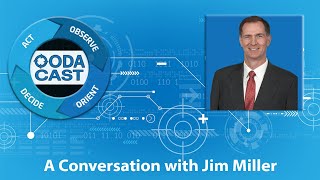
Matt Devost talks with Dr. Jim Miller about intelligence analysis and national security in an era of constant cyber threats. They discuss strategic planning, historical lessons, and why diverse perspectives matter in policy-making.
Chapters
Informing your decisions with intelligence analysis and insight. Brought to you by the team@ooda loop.com welcome.
I'm Matt DeVoe, CEO of OODA LLC, and you are watching and listening to the Oodacast. And today we're joined by Dr. Jim Miller. Jim is somebody who I've known for a long time in multiple capacities, not only in the private sector, but in his work within the US Government. Fascinating history and backstory. So, Jim, why don't you give us a little bit of background with regards to how your career started and some of the things that you've done along the way.
Sure, Matt, a great pleasure to be with you today, as always. So I got started in national security almost by accident. I was at the Kennedy School doing a master's. I thought I was going to focus on biostatistics and had done work in that field and thought as a concerned citizen, I should take a few courses on national security. This is during the early to mid-80s. Ronald Reagan is president. A lot of interesting issues. Those who remember the Star wars program that preceded this or that was different from, in any case, the Star wars movie, it was that time. And there are a lot of interesting issues. And so as it turned out, when I finished my doctorate, which was on deep cuts in superpower arsenals, superpower disappeared about a year after I finished it, but the superpower being the Soviet Union. But I had an offer from then chairman of the House Armed Services Committee, Les Aspen, to come work for him for a year as a fellow. And I decided to do that before going into academia. And next thing you know, a year passes, the person who brought me on board to work for less retired. And so I took his position as the lead policy person for the House Armed Services Committee. It's been a great four years there. Bounced into academia for a while and then came back into the Pentagon as a deputy assistant secretary in the late 90s in the Clinton administration. I'll fast forward a little bit. You and I met about this time frame, as you were legally, I am told, cracking into computers in the Department of Defense as part of a number of exercises, and then worked in the private sector for the bulk of the Bush administration and came back into the Obama administration, initially as principal deputy undersecretary for policy and then undersecretary for policy, working for Bob Gates, Leon Panetta and Chuck Hagel since departing in early 2014. For a substantial period of time, I've been a member of the Defense Science Board, which was interesting and fun. I resigned from that a few months ago, and then have also been doing a mix of consulting and writing during that period on national security issues, with a heavy emphasis on, on the future of strategic competition between great powers and the future of any strategic conflict, which would of course not just include but feature cyberspace preeminently.
So you kind of jumped into the public sector right as the fall of the Soviet Union. Are there any lessons from that kind of power void that you think are applicable to the circumstances we face today?
Man, I'd say two things leap out. One is that by 1988, 89, there were hints that there could be a big change coming in the Soviet Union. But the intelligence community had no confident predictions at that time. And many in the policy community thought it was highly unlikely that then Soviet Premier Mikhail Gorbachev would really follow through with some of the ideas that he had with, with the openness of glasnost and the restructuring of perestroika. What you learn from that period is that these transitions can happen very abruptly, that the indicators and warning that you thought would precede them might look very different in reality than they do when the event occurs. And that when change happens, it can be very rapid and cascading. So from Gorbachev to Yeltsin, Yeltsin's hold on power was relatively tenuous. There's the whole developed set of developments from say, late 1989 through the early 90s had a succession of surprising events. And I think you've got to understand that the intelligence assessments are useful, but that the real world still will offer a lot of surprises. And secondly, as you look at the collapse of the Soviet Union and the implications, one of the great lessons to me was that working with former adversaries, in this case us working with the former Soviet Union, can really be vital in reducing risks. And I'm thinking in particular about the nuclear risk reduction efforts undertaken as part of the Nunn Luger program. If you go back to World War II, you can think of the US role in post war Germany and Japan and helping to rebuild their economies and so forth. A small group of people really recognize that so called loose nukes could be a real problem. That small cadre, led by Kurt Campbell, whom I think you know pretty well, Matt, at the Kennedy School, Ash Carter, who was later Secretary of Defense, and Graham Allison, who's written on these topics, really helped shape the perceptions of people including, including Les Aspin, including then Senator and Chairman of the Senate Armed Services, Sam Nunn, and rest his soul, Brent Scowcroft, who was National Security Advisor at the time and who recently passed away. And before you knew it, there was $400 million per year program that later called the Nunn Luger program, really focused on reducing those nuclear risks. And a small cadre had really developed the initial ideas. So a lesson that ideas matter and that people from the outside can make a contribution as well.
Excellent. So talk about anticipating surprise. I mean, is there any kind of framework or tool that you've found most useful over the years to try and think through those issues? I know that you mentioned that the intelligence indicators weren't exactly correct and that things happened a lot quicker, but are other tools in the arsenal that are preparing the leaders of today and tomorrow to better understand even just what some of the outliers or surprises they might face would be?
Yeah, Matt, that's a great question. You and I both got involved in red teaming, particularly during the early 2000s when I ran the Defense Adaptive Red Team and brought you into a number of our efforts. Under that broad umbrella, I would try to be quick, but highlight three aspects of it. One is adversary emulation. And something that we found was that having people deeply knowledgeable about your potential adversaries was very valuable. But having two separate groups work and develop the adversary concepts of operation and approach and strategy and so forth, was incredibly illuminating because often two groups of experts, even if randomly assigned because of the dynamics of the room and so forth, would come to quite different assessments. And it was. It was a good way to get a quick understanding of the range of possibilities. So red teaming with always with a couple of red teams. The pre mortem assessment I think we've used dozens of times. I used it recently with an east coast university that decided to partially reopen during the COVID crisis and walk through. Pre Mortem was developed by a business school professor named Gary Klein. And the premise of the exercise is that your plan or strategy has failed catastrophically, and you've got to figure out why that's happened. And so it's a remarkable tool that takes about an hour to apply. If it's done well, it always provides new insights. That would be a second on my list. And third and broadly, and something that we used a lot in the Pentagon, it sometimes occurs naturally in bureaucracies and has to be tamed. And that is competitive analysis. And so getting that alternative perspective, whether it's on another country, whether it's about the nature of a problem, but competitive analysis and the art is to structure it in a way that you're driven toward useful insights and conclusions. So those three Tools are among those, I would say every policymaker, every analyst should have in his or her toolkit.
Excellent. I like the idea of having the dual red teams. I just participated in an event over defcon weekend, the hacker conference, which was held remotely, that was done by the Columbia School of Arts, kind of the film group there. And we were thrown into this online collaborative environment where we were told kind of figure out what happened to this one character in the narrative. And there was all sorts of evidence. There were text messages and ebay purchases and just all sorts of random stuff. And the teams came up with what they thought was, you know, what had happened to this character. We established these very robust narratives. And my team happened to have, for example, like Rob Joyce from NSA and others on it, Chris Painter, formerly the State Department. And we came up with a very government centric approach. A group that had mostly hackers came up with an approach that came out of kind of a Philip K. Dick novel, Right. So it was very kind of Blade Runner esque. And at the end of the exercise, what we found out was that there was actually no narrative to discover that AI or machine had assembled those artifacts near randomly. And it was our own biases that had kind of guided us through the process of developing a narrative from the data. So I think the idea of having multiple red teams and obviously having very distinct backgrounds of those participating in the Red team becomes an important dynamic. There is an aspect of that. I mean, the DART red teams are some of the favorite of mine that I engaged with over the years just because they were non cyber centric and trying to hack into things. We're looking at a lot of complex issues, including the risk of biological warfare or even pandemics. And it struck me as I watched what unfolded with COVID that we had looked at a lot of those same exact issues with dart. We understood kind of how things would spread, what actions would be available, what planning was going to be required. But over the years, the 15 to 20 years after that, it seemed like the planning and preparedness aspect out of that got lost. So is there anything that you would recommend in your role as a government leader or as somebody who participated in Red teams, how do we sustain the preparedness associated with the Red Team outcomes over the long term?
Well, Matt, in this case, and I want to not be partisan about it, but in the case of the pandemic, the Obama administration created a playbook, it's been largely published online for responding to pandemics and the team on the National Security Council in the Trump administration decided not to take that out and to apply it. But if you look at it, you'll see that it couldn't be applied like a cookbook. That would have to be adapted. That's the fundamental point. It's not just having a red team do some work or a war game conducted, a tabletop exercise conducted, and then put that on the shelf. Two things you need to have useful artifacts. And artifacts can be things like so called break glass books, what to do in the first day, in the first hours of an emergency. And you certainly worked on those with both companies and government entities in the event of a major cyber intrusion. But it can be applied more broadly. So the break glass books, a generalized version of that is so called playbooks, which is not exactly a script, but what are the things that you may need to do and sort of the plays that you would run. And both of those fit broadly into the category of planning. Oftentimes I'm not sure how it will work when I put my hands up here with this fake background, but oftentimes you get a plan that is 800 pages long and brilliantly detailed. And if the world turned out exactly the way the planners thought it would be great. But that's not the way anything ever goes. So having a high level plan with some discrete elements that people can pick out is fundamentally important. So you have artifacts. And the second thing is the most important artifacts that you have from tabletop exercises, red teaming, war games, et cetera, is in people's wetware. And so maintaining those networks, it can be challenging in any administration, maintaining them, including from people in the prior administration who are sometimes resident think tanks, resident in academia and significantly in the private sector, but having a cadre that stays in touch, that continues to be engaged. And it means that the people who stay in government, within the military, those in uniform who will still transition from one administration to the next, and then the career civilians, having a number of them participate even in the very high level game, so that knowledge is carried forward in their framing of problems and in their recognition of new events and ability to basically do pattern recognition to see things coming.
A couple components of that. One is kind of the institutional knowledge, right? Recognizing that there's a partisanship to politics and there's a natural churn. But we need to try and avoid some of that as it relates to these planning elements. And then the kind of other interesting lesson learned I heard there was that the plans are great, but what is even more important are the composite parts that can be kind of reassembled or mashed up based on the circumstances that the Red Teamers are never going to absolutely plan the exact circumstance correctly and therefore be able to provide you with a step by step cookbook, but that you're going to have to mix and match from the composite parts that have been provided. So kind of reminds me of that scene from the Apollo 13 movie where they dump the laundry basket full of parts and say we have to solve this problem, but if you don't have the parts or you don't have the people, then you're not going to be able to come together with the appropriate plan moving forward.
That's right. President Eisenhower said it nicely. He said it's not the plan, it's the planning.
Yeah, in the process, in of itself, one of the focuses we like to look at with regards to the Oodacast is kind of leadership lessons learned over the years. You touched on a few talking about your career, but are there things that you've learned either through your own experiences or through things that have been shared with you by some of your mentors and colleagues over the years that you'd share with the audience?
A lot of lessons. Many weren't learned the hard way, thankfully, usually in low consequence events early on in my career. But maybe I just list three that come to mind immediately. One is something that certainly saw every day when I was Undersecretary of Defense for Policy. I've got a team of hundreds of highly skilled civilians and military personnel. And that is, if I'm ever in a meeting with my team and I'm the smartest person in the room on an issue, I've done something wrong. And there's extraordinary talent both within government and externally, and the ability to assemble teams and to take advantage of their knowledge and insights through some of the processes we talked about. And also just by giving them oftentimes a long leash is fundamentally important. So it's the importance of the team and of the deep expertise that you need to assemble to deal with tough issues. And that expertise has to cut across a range of different areas. Whether it's a problem with China, whether it's a problem and counterterrorism, whether it's a cyber problem, you're going to want to have diverse experts in the room. And again, if you're the gang leader or the senior person and do the smartest person in the room on the issue, you've got to bring in some more talent somewhat related to that. Second, it's always important to get disparate views into the process. The challenge is to do that in a way that doesn't drag things down, but for important issues, important policy decisions, questions of whether to go to war or not to go to war, whether to undertake a major military operation. Always good to bring in disparate views. And my observation of the best leaders is that they did that very effectively. Go back to Eisenhower with his famous solarium exercise where he had views about where he wanted to go, but he knew he had to tap the insights of his senior team and frankly, he knew he needed to nudge some of them away from less than optimal options like preventive war with the Soviet Union at the time, it wasn't all just open season and any ideas ruled, but using that process of both internal external advisors to have that competition and to drive it towards both new insights and rational policies. And a third one I've learned multiple times is it's not the job, it's the boss. And I had the great opportunity to work for a number of people who were just fantastic bosses, most recently in government. Michelle Flournoy, who I worked for when I was principal deputy and she was undersecretary, who I worked for at the center for New American Security when she was president and I was the director of studies and indeed who I worked for in the 90s when I was a deputy assistant secretary and she was a principal deputy assistant secretary, someone from whom I've learned a tremendous amount, who role modeled some of the things that we've talked about, who could both give very strong support to her team, but to give those nudges when necessary. And so you know, as you think about where you want to go in your career, you of course want to go where your heart is and the issues you care most about. But given that look for someone who's a great boss and a great. And a great mentor. Excellent.
Yeah. But similar theory that is people should, you should work with people, not for companies, right? It's all, it's all about the company that you keep, not the brand or the logo because they come and go as we've seen over the years. But the, the people, connections and the ability to work with folks are definitely one of the most important. Putting on your kind of national security strategist and red teamer hat. What are some of the threats that you are concerned with over the next five to 10 years?
It's a long list and interestingly the list gets longer as new technologies come into play. More generally, the old threats and challenges don't go away, but they change. As an example, we're just A couple weeks past, the only use of atomic weapons or nuclear weapons in war in the August 1945 bombings of Hiroshima and Nagasaki. For all Those decades, for 75 years, nuclear weapons haven't been used in anger. And yet nuclear weapons remain a fundamental concern. Not because it's likely we're going to have a nuclear war today, knock wood, or this week or this year, but because the consequences are so severe. But now the developments in cyberspace that both affect the nuclear command and control and affect the escalation pathways that could get us towards nuclear developments in outer space, including the expanding counterspace capabilities of China and Russia, further developments in prompt global strike capabilities, including hypersonic weapons that the Chinese have deployed and the Russians have deployed, and advances in missile defense. I could go on and you could go back to the movie War Games and think about the implications of AI as well. It's less of an immediate issue, but it's a longer term issue. So what's in addition to the truly new sets of issues that were not predominant in the 70s or 80s, for example, cyberspace, a truly competitive and contested outer space that we have today and is emerging even more so advances in biotechnology, nanotechnology, allowing small groups potentially to do catastrophic damage to societies, all those are new. And in addition to what they add that's new, they complicate old challenges as well. So on the technology side, there's a wide range. We've touched on a few. And what I think the new thing and something that this administration got right is that we are in great power competition, particularly with China and also with Russia. They've recognized it for a long time. They've been acting on that for a long time and we need to act on it. And the national security strategy that the Trump administration put forward, I think got that part. Got that part right. The question of how to do so we can and should debate, but the question of really being in a competition, including with the so called gray zone activities in cyberspace and elsewhere, I think is fundamentally important and something we'll be living with for a long time. Excellent.
Thank you. My subliminal War Games poster gets people to mention the movie every time.
Oh, interesting. I didn't even notice it. I consciously didn't notice it.
Yeah, you did. You just didn't. Excellent. So if you're a large part of our audience for these, the oodacast is the business community. Are there issues? I mean, the stuff that you described are pretty national strategic type issues. Is there something you could articulate a little bit more granular for Somebody that's running a business, you know, cyber obviously is included in that. But are there other things that they should be wary about or even how some of the national strategic stuff is going to impact them as the operator of a global business?
Yeah, so near the top of that list is cyber, without a doubt. And the type of cyber intrusions and typically temporary interruptions that we've seen to date, I think are a tip of a much larger iceberg. And hopefully these leaders of business and entrepreneurs don't have to ever live through the full iceberg. But the capabilities and capacities of China and Russia in particular have grown truly exponentially over the last decade or more. And we need to be prepared for a lot of friction and a lot of pushing and shoving, if you will, in cyberspace from those and other actors below the threshold of armed conflict. I hope that among the people who would watch would be those who are interested in encouraging the government to share information more effectively, to receive information more effectively and to act on it, and to really begin to work to some new forms of private public partnership. Because in the event of a crisis or conflict, particularly with China or Russia, we will be seeing cyber attacks occurring not just on US critical infrastructure, but from US critical infrastructure, from substantial toeholds that they've achieved, whether by temporarily controlling or by literally purchasing that. And it's going to require a private sector response, working with the government to be effective. And the more we can build that in the meantime, the more, the more and better chance that we have that they see that this is not going to be a winning game for them and that deterrence works from that kind of high end cyber attack. But I think preparation for those, for intrusions is got to be part of it. Preparations for interruption of business through, whether through criminal acts or acts of nature as well, all hazards for many of the other companies is going to be important. And from a strategic perspective, I know, as you've done thinking through the competitive environment, not just today, but where it may be evolving toward and trying to lead it a little bit, and to anticipate where it may go and to make some bets both on technologies and on people that offer the possibility for breakout strategies for both small and large companies, I think is important as part of the environment that we're living in.
We tend to always associate an attack on critical infrastructure by a nation state adversary as something that is accompanied with traditional conflict, that there's some sort of conflict or arms exchange is taking place somewhere else, and that's a component of it. Do you think that one of the areas where we might get surprised over the coming decade is an attack on critical infrastructure that that takes place that doesn't exist within the realm of a traditional conflict.
Yes. So let me hit your first point first, Matt, and that is in the event that we're headed toward any high probability of so called kinetic conflict with certainly with China or Russia, each side is going to have overwhelming incentives to go heavy and fast in cyberspace. And I think the same is true in outer space on the calculation that you can interrupt the other side's command and control, precision weapons, navigation, logistics, transportation and so forth, all without directly killing anybody. And that notwithstanding any declaratory policy to the contrary, either side is going to go nuclear or even possibly conventional over some fried computers and dead robots in outer space. So it's. So that part you've got to take is given and the Department of Defense has work to do, as you know, on getting better. But I'd say in the other category is one we think about less. The prospects of escalation within cyberspace are real. And I don't think we've come close to anything that tumbles into high degree of escalation. But in a period of really intense political competition and in a period of where there's, if you can imagine the competition between the United States and China and Russia to some extent as well, about what form of government is operating most effectively, I can see at least two categories. One is the slow bleed. Now, China's been bleeding us for intellectual property for decades. It's been estimated to be as much as a 1% per year hit on GDP growth. Each side could turn the dial up on that type of activity to create friction, to steal more intellectual property, to create friction in how the other side's economy works. And we need to think about how to deter that and what the norms are associated with that type of behavior. And the second would be not the slow burn, but a fast burn. And that is that one side decides it's going to send a strong signal through cyberspace and take down, say a part of the grid. United States in the Northeast happens in winter and some people die. United States goes back. And one can imagine that type of tit for tat quickly escalating in part because of the cascading effects and unanticipated effects that may occur. So yeah, I think there's a. It's not just that this new, relatively new, I shouldn't call cyber new domain, but just, you know, relative to land, air, sea and space, what feels Like a new domain is going to affect other domains. There's a real prospect of crisis and conflict within cyberspace itself that we need to think about how to manage, how to deter and how to manage in crisis as well.
If we rewind a decade. You were kind of one of the key catalysts for the development of the first cyber strategy within the Department of Defense. What was the reasoning behind getting that strategy out, even though DoD had been dealing with the issue for kind of 20 years? And then what was kind of the legacy of addressing some of those issues back a decade ago?
It's interesting because General Paul Nakasone, the head of Cyber Command and NSA and Michael Sulmeyer just had a nice piece out in Foreign affairs on cyber and they referenced that strategy and a nice Foreign affairs article that then Deputy Secretary Bill Lynn put out that summarized the strategy. We had five pillars. I won't, you know, rehearse them or test my memory on all five. But pillar number one was that we need to treat cyber as a domain of conflict. And that has profound implications for military planning. There were some in other departments in the interagency process that said, oh my God, the Department of Defense is going to try to militarize cyberspace. But what we're saying is, look, that the land domain, the air domain, sea undersea, those are all recognized as areas of conflict and where we need to conduct military planning, the cyber space. Cyberspace has attributes including being privately owned predominantly that are different, but the preparedness to, and really the expectation that attacks will occur in and through cyberspace that will have profound effects on military operations, on economies and society, was something that we hadn't really fully taken account of. Although the people in the business, such as yourself, knew this reality, I would estimate 20 years in advance of it becoming a formal part of, of DoD strategy. And over time, and over time and again, a place where this administration, this Trump administration has taken good steps over time, has recognized that you've got to take that to heart and you've got to take action. And so the Defend Forward and persistent engagement efforts of cybercom, some of which, but not all of which were summarized in this nice Foreign affairs piece this month by Paul Nakasone and Michael Sulmeyer, really are fundamental. And it means in some cases taking action to prevent attacks, as it's now been acknowledged that the so called Russia small group did in 2018 to block any interference in the election, including by Russian trolls.
I was going to ask for your thoughts on the kind of Defend Forward as a concept as articulated in that Foreign affairs article. And how do you anticipate that working with private sector partners, which tend to be a lot of the early warning system around a lot of these attacks in the cyber domain?
Yeah, I think the policy is on the mark and the approach is on the mark and it fundamentally requires good judgment regarding when to take an accurate, you know, first where and when you need accesses. Because as you know, well, you can't snap your fingers and create a cyber effect. It takes time to build the accesses and infrastructure necessary, then good judgment about once you have those capabilities, when to employ them versus to withhold them and how to communicate about them. And I think Paul Nakasone has done a terrific job in that regard. I frankly would like to see more civilian leadership communicating about this and more evidence that they're involved in this. But I think Nakasone has been terrific, excellent, cool.
So one thing we always like to ask as well, you know, you're incredibly knowledgeable, well read guy. How do you stay on top of what's happening in the world? What are some of your favorite sources of information?
I just want to say that because the Presidential Daily Brief has been in the, in the news lately, shifting from having the PDB every morning at 6:00am and you know, with a briefer and a nice thick book in the briefer and then getting the same take from DIA and from nsa, just a ream of intelligence every morning and being doused in it in addition to the newspapers was, it was, it was quite a shift coming back out of government and having to try to understand the world without those aids. But I do what I think a lot of folks do, which is a combination of targeted reading in different areas. So I'll read the, a lot of the defense publication, foreign policy publications and also serendipitous reading which includes explicitly ensuring that I read from Washington Post and New York Times. Okay with a slightly, some would say more than slight, but at least slightly left of center. And then also others including the Wall Street Journal, which I read daily and not just the news. Pardon me, my pup has decided she wants to chip in here. Not just the news, but also the opinions and to really going back to their conversation earlier about red teaming. And I don't mean this in an adversarial way, really trying to understand the perspective of the people who are articulating arguments from both sides. I tend to be, I tend to be considered a moderate. In some areas you'd say I was conservative and some areas lean to even toward libertarian. But I think reading that diversity of views and ensuring that you immerse yourself, even if it's in this day of COVID if it's not face to face meetings, but in virtual meetings, and, and be an active reader of a diverse set of views and similar for magazines and journals as well. All that's the basic part. And then it's conversations, including with people who disagree, that are most important. You'll find that I have virtually no social media presence and I respect those people who communicate through those mechanisms. But the thing I think we all should, as leaders, as policy analysts or national security leaders, or in whatever domain, we really want to avoid what Irving Janus described in his famous book as groupthink. We need to listen to diverse perspectives. We need to recognize that we're not always right and that our brains were developed over eons, over thousands of years for survival and to have certain biases that they will apply and that we need to think about how to correct them. And one of the ways to correct those biases is really to be open to alternative perspectives. So I work hard, I work hard to do that and I work hard to put forward hypotheses about what I believe and really try to test them and get alternative views.
So, you know, in social media, you just need to post something that's somewhat political and it's like a magnet for opposing opinions. But given that you don't participate in social media as heavily, what is the forum by which you attract some of those diverging opinions or folks that you can interact with that have, you know, insider perspective that's different from your own?
Yeah. So I'd say two things. One goes back to the network that you mentioned earlier and maintaining a network of people whom I respect and that I can reach out to either on a particular issue or to bring into an event and to make sure that over a period of time that that network doesn't get oriented all around one subject area, whether it's nuclear weapons or space or Russia or China or cyber or et cetera, nor around one set of expertise, whether it's more technological versus regional versus psychological expertise, and certainly not around one political perspective and, and maintaining that network. And it means back in the day when we used to have coffees, I would have, literally when I wasn't in government, I'd have one or two coffees plus a lunch and then an afternoon with someone. And I would try to make sure that every day had diversity of experiences and perspectives in doing that. And when you can't get it done by virtue of your own Network. It's setting up conversations, sometimes one on one, sometimes group, sometimes in workshops or war games and so forth, and making sure that even if you don't know the right people, someone you know knows the right, a diverse set of people and tapping a range of those folks to help expand the circle, if you will, to get more and more diverse views. And I'm not, I just want to say that I'm not intending to be completely Luddite with respect to social media. It's an important force in our society. In some cases it's a force for good. We're in an incredible transition period. So I study it, I'm interested in it, but I don't find it's the best place to get insight. It's a place where I've sometimes gotten good humor and sometimes very, very poor humor, humor and bad taste from others. But I still believe there's something to this idea that especially in a democracy, you need to bring together people with differing backgrounds, differing views, and find a way to make progress even when you don't agree on every single element in.
That, you know, having the different viewpoints, I would imagine from your perspective, it's important to get folks that are kind of early in their career as well as folks that have had more experience. You know, what sort of value have you gotten from interacting with somebody who's maybe early 20s and getting their perspective on some of these issues?
Yeah. Let me just say that during my time in government, the last time in government as undersecretary, some of the best talent, most productive, most impactful people who work for me had just come in directly out of graduate school and it's like they didn't know any better. You're just going to speak their goddamn mind. One of them, I was in a one on one meeting with the Secretary of Defense and they just came blasting through the door. They ran right past the senior military assistant and, and the scene, and the Chief of staff was sitting there and they said, and they ran. Then they were right past me. This person's like a, you know, GS13, which is entry level for DoD on presidential management fellows, and said, Mr. Secretary, I'm not going to give you the name you need to call. So and so right now it was Secretary Panetta, I'll say that. And interesting thing, I mean this, this young action officer, if he hadn't done that, Americans would have died because Panetta made a call to one of our allies, told him about a situation about which they didn't know, and they sent people over to take, to take some and to take an ongoing operation down. And I can't say any more about it, but this young person, just because they had, you know, both, they built a network, including, this is how they got the call from one of their foreign counterparts. But they built a network, they'd done the work, they'd only been there a couple years, and they just, they had the courage to say, the hell with protocol, I'm just going for it. And there are more senior people who would have done that as well, perhaps without the, you know, without the same speed running up the hallway. But this was having that energy, having that courage, and also, as you were implying to conclude on this, having just a different perspective on how things can get done and whether it's on the. Within the US Government or in working with another government or engaging the private sector. And it's sort of the same thing as an expansion of what I said before. If you think you're the smartest one in the room on an issue, you've messed up. If you look around the room and everybody looks like you, you've also messed up big time.
I'm probably guilty of being that fresh out of graduate school person, you know, going in and speaking truth to power back in the early and mid-90s, you know, because that was me. And one thing that I was always fascinated by, and this sounds like this, you know, reinforces that is people view service in the government, especially in the early stage of their career, as not being that impactful. But there are opportunities to be very impactful right there. There's a big problem set that require diverse perspectives and the energy that you talked about, if we're going to solve them, it's not going to be solved entirely with the old guard. So that fresh perspective needs to be a vital component of a successful system.
No doubt about it. No doubt at all.
I'll be curious to get your feedback after our OODA network meeting because we've got a great diversity of folks there, from DNI Clapper to Art money to CISO at a bank to an analyst working on these threat issues. And it's fun to see the interactive dialogue that occurs amongst that kind of diversity of participants.
So I'm looking forward to it. I'm very much looking forward to it. Matt.
Reading list. You talked about some of the journals, etc. What are you reading right now? What's your current book that's on the bookshelf or by the bedside.
So I should. I told you before, I've got one kid in My study who's who's Knockwood doesn't have Covid but is a nursing student so as exposure so she's isolated so I'm not there. And I've got another kid who's taken over my what would otherwise be my basement office. He has a job in San Francisco from which he's telecommuting during this period. And so when I look around me in the it's his wife's in my bedroom. I've got about 100 books stacked for projects that I'm working on. I'm writing right now on two topics on this. I mean literally today an organization of the US government for cyber and making an argument that we need an interagency task force to conduct planning and coordinate operations goes beyond the Solarium Commission recommendations. So I've got a stack of cyber related and government organization related books some going back decades. Alexander George did some great work former Stanford professor on this. I've got several of his books sitting right here as well. And the second is a look at more broadly at how government can work more effectively toward a so called whole of government and can work with the private sector on whole of nation. Cyber is a special case of that to a lot of other areas as well. And so I've got a range of books including some have been going back and looking at the early American history and so Ron Chernow's biographies of Washington and Hamilton, believe it or not to me have been interesting and relevant to thinking about the structure of the government because and you get a little bit of this from the beautiful Broadway play of Hamilton but a lot from Ron Chernow's book. Hamilton really consciously as prior to becoming treasury secretary and during his time and after had very insightful ideas about how to organize the US Government and the relationship between economic growth, international diplomacy and engagement and international relationships and preparing for war if necessary. And so just a wide range and is Matt, as you know I just finished this part here since I got out of government I will read probably an average of one science fiction per month as well. And you've recommended probably 20 or 30 of the books that I've read and so I won't rehearse the names but find that you gain some insight not just about different ways of thinking but about potential future problems and solutions by doing that as well.
As you know I keep science fiction as a regular staple including rereading some of the older science fiction which can be fascinating in of itself and also find it interesting that some of the science fiction authors that I grew up with the William Gibsons and the Bruce Sterlings are having an increasingly harder time writing about the future just because they're so perplexed by kind of the current environment or what has evolved in the present. So that to me is brought up this whole new generation of folks that are writing from a science fiction perspective because they seem to be the ones that can actually GRASP what does 20, 30, 40, 50 years out look like.
Yeah, I think that's right, and I think you've got, you have generational issues. But it's also the fact that the pace of technology change is accelerating and people who grew up, as I did, in a world where it was changing rapidly, but that the rate of change wasn't perceptibly changing. And so we could wrap our arms around Moore's Law, but not so well around the implications of Moore's Law applied to other areas, like in biotech, where it's been moving much faster and the rate of change has increased. There's some good studies on that over recent years. So yeah, another add another argument to bring diversity of age as well as experience into any serious discussion or policymaking.
Process or even a AI where we know that there's going to be an exponential aspect of the Moore's Law for AI development once they start assisting us in the writing of their own software. So going to be interesting times for.
Certain ahead on the very front edge of that, and it's an exciting time.
Elon Musk is apparently going to demo the Neuralink system on Friday, so I'd be curious to see.
I want one of those, Davey, for sure.
I definitely do. I want the second brain and I want the ability to upload at some point in the future. So be watching that. Excellent. Well, thank you for joining us on oodacast. This was incredibly insightful. I know you're a busy guy and appreciate you taking the time to chat with me and to let us put this on the YouTube and podcast channel.
Glad to do, Matt, and it's always a great pleasure to talk with you and I will always be listening to your recommendations for who to talk to, what books to read, and always enjoying our conversations.
Excellent. Thanks, Jim.
Thanks Matt. Thanks for listening to this OODA Loop production. For the latest analysis on cybersecurity technology and global risks, please visit www.oodaloop.com.
More from Matt


Leading Cyber Change: Allan Friedman on the Revolution of SBOM & Future Cybersecurity Initiatives


Revolutionizing Medicine and Tech: Joe Tranquillo's Journey into Complex Systems






Bob Zukis and the Digital Directors Network: Helping corporate boards mitigate systemic risk

Adam Shostack on Cybersecurity and What Every Engineer Should Learn From Star Wars