Juan Enriquez On Technology, Ethics and the Future
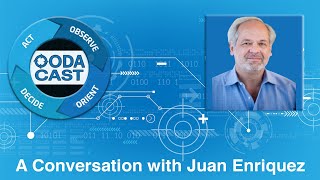
Bob Gourley talks with author and academic Juan Enriquez about how technology reshapes ethics, society, and global politics. They discuss his books and his views on human rights as technology accelerates change across economies and cultures.
Chapters
Informing your decisions with intelligence analysis and insight. Brought to you by the team@ooda loop.com.
Hello, I'm Bob Gourley, the Chief Technology Officer of OODA llc. Welcome back to the oodacast. Today on the oodacast, Juan Enriquez. Juan, how are you doing today?
I'm doing just peachy.
Great. It's such an honor to have you here, Juan, and for a lot of reasons. One read so many of your books and I've seen so many of your videos. When I read your books, I hear them in your voice. So it seems to me like I know you somehow through your books. And it's such an honor to finally get to talk to you and ask you a few questions about what you're up to.
Thank you. Great pleasure.
Let me start with a high level introduction from what I've gathered from your books and reading your bio. You are a author, you're a lecturer, you're an academic, a thinker, and you are also a practitioner. So you have invested in businesses and run companies that do real world things, including the company that created the first synthetic life. So I think this is. I wanted to make the point that you are not just a great author, not just a great lecturer, not just a great academic, but a practitioner that does stuff. So you have this ultimate skin in the game. I think so. More details from your bio. Your bio lists you as a member of the Discovery Council at Harvard Medical School and as the founding director of Harvard Business School's Life Sciences project. Would love to get into those as we have a the conversation here. And currently you are the managing director of Excel Venture Management, a life sciences VC firm. So again, I would underscore to me that means you don't just write about tech, you help create it and bring it to life.
It's a very fun place to sit actually.
And is there anything that I should. We should. That I left out of your bio that we should focus on here?
No, that's perfect.
Great.
Great.
I'm really curious, Juan, about some of your background and a couple things I assume about your youth I would like to mention and have you correct the record. You know, I had to assume since you did so well academically at school, getting accepted into Harvard is a huge accomplishment. And if I read right, you graduated one or two in your class. This is amazing. And then you go on to get a business degree from Harvard. I have to assume you were really driven. Something was motivating you in your youth. Did I get that right?
What was this you did? Harvard doesn't rank where people graduate. So I, I graduated and I did okay. And I was very fortunate. You know, I grew up in Mexico. I always thought I'd work in Mexico. I never thought I'd work in science. And what was really driving me is I saw enormous poverty and injustice and pain in the country I grew up in. I, I saw people starving. I saw people dying of diseases they shouldn't have died of. I saw people living in shacks. And I was hell bent on fixing Mexico. So I wanted to go to the best school I possibly could. I think I was the only person in my business school class who graduated and went straight into government. I had an extraordinary experience in Mexico and was allowed to build a city and do a whole bunch of stuff that was incredibly. I had one of the best jobs in the world. And then Mexico started to fall apart and it became a very violent country. I had to leave because they had decided to kill me. And I thought I'd leave for a year and ended up at Harvard. And that led to a very strange windy road. I wrote a book on Mexico. Then I wrote a book on why countries appear and disappear, why they're successful. That led me to technology and that led me to leading edge technologies, which at that point were genomics, which nobody had ever heard of. And now I'm switching again. And I've been working towards synthetic neurobiology for the last few years and how we alter the brain and how we change the brain.
Fascinating. And Juan, your books, in my opinion, really have stood the test of time. I can, I just picked up and reread one that was written about 20 years ago and it's just so relevant today. And I want to talk about some of the old books and the new book, Right Wrong, which I also think is going to be held in high regard for decades. The one I reread, the oldest for me was the Future Catches you. It was such a prescient look at the world of biological sciences. And I really do still recommend it to any business leader today to frame these issues of digital and genetic convergence. And that's the first time I ever read anybody talking about something called Life Code. So you're not just talking about a bunch of molecules, you're talking about something deeper. And the convergence of digital and biological was also something very impactful for me in that book. I wanted to say it was a motivational book also, because you have a couple warnings in there. I want to read you a couple lines from your book and get your response because I think they're still totally relevant today. Near the end of the book, you conclude that this is a quote. As these changes accelerate, much of the world remains isolated and ignorant about technologies that will fundamentally alter everyone's relative economic status and life expectancy. This will have consequences because only a few people and regions understand what is coming. To me, it reads, still totally relevant today. Would you change any of that?
No, I think it's accelerated. And I don't think people understand the order magnitude of how powerful technology is as a lever. So if you take a company like WhatsApp, less than 50 people created WhatsApp, but it was sold for $22 billion. And so the implication of that is that every person woke up in any one of 15 Latin American or Caribbean countries and went to work as a taxi driver, as a teacher, as an accountant, as a researcher, as a scientist, as a newspaper man, whatever, but every person in the country worked for a year and did not generate as much value during an entire year as those 50 people did. So when you're talking about creating a WhatsApp with 50 people, you're talking about creating the equivalent of the GDP of any one of 15 Latin American or Caribbean countries. So what you're looking at here is that three Chinese IPOs of new tech companies are the equivalent of Mexico's economy. And this, this gives us a tremendous challenge and a tremendous opportunity because what I'm writing about in this new book in Right, Wrong, and How Technology Changes Ethics, is you have instruments you've never had before, you have choices you've never had before. You can do things you could never do before. And let me just push this forward, not only is a sentence you read relevant, it's going up exponentially in its relevance because it takes the whole nature of economics and capitalism, which was, how do you allocate scarcity? And it flips it on its head. And the reason it does so is because for almost all of history, there weren't enough calories to go around. There weren't enough bits of coal, there weren't enough books, there weren't enough. So all of capitalism, all of economics, is based on we don't have enough, who do we give it to? The current situation in most things is, is we have more than enough calories to feed everybody in the world. We have more than enough antibiotics, we have more than enough vaccines. And it becomes an issue of distribution as opposed to availability. And the fundamental question for all of us then becomes, if you could do it, why didn't you? And that fig leaf of there Wasn't enough. And that's why I acted that way. Begins to go away when eight people contain or hold as much wealth as 40% plus of humanity.
Yeah, Very well put. Very well put. And one, I want to mention another book, the Untied States of America. This was published in 2005. I read it. Very prescient. I watched you lecture at a conference in California. Very prescient. And then I watched many of the events that you talk about unfold in front of us. You wrote this book. Well, I should ask you why you wrote the book, but I took it as a sign that we should all understand that just because something is the way it is, that doesn't mean it's going to stay that way forever. Including. I mean, how many stars will there be on the American flag in coming years? How many stars will be on the EU flag in North America? How many countries will there be? You write about polarization and fracturing and blaming the other. And you also write about ways that we can. Existing rifts and the need to. And the need to have frank discussions on how to do that. And I just wanted to say, for me, that's still foundational reading for anyone who wants to understand our collective situation. It's a book that I picked up and reread as this pandemic was kicking off, because I wanted to understand the kind of questions I should be asking myself and that I should be recommending to clients that they ask themselves about how this pandemic might affect North America and global politics. So I wanted to ask, before we get into right wrong, what lessons should we take away from your book on the Untied States that are relevant for today?
So. Part of what we've done to each other is we've separated ourselves into tribes that are increasingly politically correct or politically incorrect. And part of the problem in ending up in a trench is you have to agree with absolutely every person in the trench. And what you're doing is you're spending all of your day shooting at the enemy across no man's land. And if you try and cross into no man's land, the other side shoots you. And if you try and leave the trench in the other direction, then your own side shoots you because you become a deserter. And so we've ended up in this crazy situation where you have to believe everything the other side says your side says and disagree with everything the others say. And you can see that on lawn signs when. When you drive across the country today, there's a bunch of lawns that have signs that say Black Lives Matter. And there's a bunch of signs that say we support the police. But I have yet to see a single lawn that has both signs on it. And that to me is anathema, because I think the sign that should be on every lawn is Black Lives Matter and we support the police. And then a third sign that says e pluribus unum. Because the foundation of this country is not for everybody to have the same belief. It's not for everybody to only talk to or see or be with people they agree with. The foundation of this country is out of many, one. And we've really forgotten that lesson. And we're spending billions and billions of dollars every election cycle trying to convince 50.1% that those people over there are the others, those people over there are baby killers, those people over there are pedophiles, those people over there are ignorant rednecks, those people over there are racists, those people over there are ex. And if you spend enough money and you really do isolate the others, two things will happen. One is you will start to act in atrocious way towards other human beings because you won't see them as human beings, you'll see them as the others. And two, you will split the nation. So three quarters of the countries in Europe were not there in 1900. There has never been a president of the United States buried under the same flag he was born under. Countries borders, flags and anthems do change. You're seeing it with Catalonia, you're seeing it with the Basques, the Corsicans, the Northern Italians, the Walloons, the southern fins, and it goes on and on and on. I don't want the United States to split. I wrote that book as a warning of what was coming, not as a how to manual.
Great. And thanks Juan. And I think this also I want to mention one other before we get to right wrong and that is Evolving ourselves. This is another book that I mean just like Untied States made me a little uncomfortable because you're making me confront reality and facts. I maybe I didn't want to think about like in evolving ourselves. I had a biology under the undergraduate degree and I take it as a fact that the driving force in biology and how we got to today is natural selection. And sure there's a little bit of artificial selection here or there, we have all these dog breeds, for example. But after reading your book, I don't feel that way anymore. I feel like sure, natural selection is still occurring at these geologic timescales, but it's not the driver that it used to be. Am I taking away the right point from this book?
So that whole book started with a crazy idea, which is I love collecting Darwin. So I've collected pretty much everything Darwin wrote. And the core question is, okay, so this is a guy who's a lot smarter than I am. Could I possibly imagine what he would write if he was alive today? And it took me about six years. It takes me about six years to write any one of these books because I have to think about systems for a long time. It's not about being a futurist, it's about looking at compounding trends. And so if you see a trend compounding somewhere, then what is that going to change as it compounds? And then you can be much more accurate than if you're blue skying. Could this happen? Or could this happen? So when you think of in those terms, when you go out to a wheat field, a wheat field is the most unnatural place on earth because there is a single crop growing there. There are no other crops, and you've isolated most of the animals. And if you left a wheat field fallow for a few years, it would not be a wheat field. Well, that is true for about half the surface of the earth. So on about half the surface of the earth, what lives and dies is what humans choose. I want a city over here. I want roses, I want tulips. I don't want wolves. I do want dogs. And so that is a genuine superpower because we're choosing what lives and dies on this planet. And as you think of that structure and the responsibility that comes, you flip the logic of evolution from natural selection to human driven selection, which I call unnatural selection. And then you flip the random mutation part into a very directed bioengineering. I am going to engineer this cell so it becomes a vaccine against Covid. I'm going to engineer this cell so it makes this kind of cheese. I'm going to engineer this cell so it makes this kind of material. I'm going to engineer this cell so it makes this kind of plant that's got nothing to do with random mutation. And so what we've done is we've taken evolution, we've taken control of evolution, and we are directing and driving evolution. And that is compounding at geometric rates.
Right, Great. Because that compounding at that kind of rate is also. I took that as a key theme, at least a introductory theme to right Wrong.
Yes.
And that was another book that frankly made me confront some of my beliefs. So can we talk about that for.
A little bit, yep.
So another good book. And to me, early on, you talk about the exponential growth of technology, which I think all of us that are watching are seeing that across all dimensions. So not just genetics, but quantum computing, artificial intelligence, data analytics, every field, transportation, robotics, there's exponential growth in technology. And you give example after example of how technology impacts ethics. And then you make the very clear point that with the exponential growth in technology, since technology is going to impact ethics, we may be seeing exponential changes in ethics. Is that the central point that I'm taking away there?
Yeah, that's exactly right. So most people think they know right from wrong. But what I'd love you to consider is maybe you do know right from wrong right now. But right and wrong changes over time. And the primary driver of changes in right wrong is technology. And technology is increasing at exponential rates. So let me unpack that for a second. It used to be normal and natural to have human sacrifice because otherwise the rain wouldn't come, the sun wouldn't shine. And now we look back at that and say, boy were they wrong. It used to be normal and natural to have executions in the town squares or in the big plazas of Paris. And you take the kids to watch heads being chopped off and they'd be selling candy and we look at that and say, who were these barbarians? So across time, stuff that used to be legal and tolerated and celebrated has flipped 180 degrees. And often it's technology that's doing that. So I think we have to be a lot more humble and a lot more forgiving when we judge our ancestors, when we judge founding fathers, not because what they were doing was right, not because it's justifiable, but because 99% of us educated in that place at that time probably would have acted in that way because that's what was right to do at that point. Right.
Cool. And I'm trying to think, obviously this is going to have some big impacts that I would love to get your thoughts on. Like our system of government. You mentioned the founding fathers. It really hasn't changed that much in the United States anyway. We have three major branches of government. We have a federal system with states. Laws are essentially connected to geography. You know, you have a local town, a county that may have some laws, and then a city, you may have a state that has laws. And then there's federal districts and federal laws. And it's all kind of geographic based, is slow to change. We have legislatures where we send people to gather together and not do much and they Create slow to change laws. And those laws are supposed to be a reflection of our ethics and what justice is supposed to be. Oh, and I'd say the court system too, is very important, but that's a very slow moving thing. And now you have technology accelerating, ethics accelerating. Do you have any hope for us that the legal system can keep up with the changing technology and ethics?
So, you know, you can, you can pick any period in history and look at what a religion was doing or what a government was doing, and you can find just the most gruesome examples of evil. The Old Testament is not the New Testament. The New Testament as interpreted today is very different from how it was interpreted by the Spanish Inquisition or other such creatures. And it's the same thing with the government. You know, you read some of these separate but equal decisions, you read, you know, three fifths of vote decisions, and you go back and you think, how could they possibly have been so wrong? The issue is, we also have to understand that in shorter and shorter periods of time, people will say the same thing about us. So, you know, during a period of abundance where we have more than enough, why do we think it's okay to walk by somebody who's freezing to death on a park bench in the snowstorm? Why do we think that's somebody else's problem? Why do we think during a pandemic where many of us are doing well, it's okay for so many to go hungry, or it's okay for kids not to have access to broadband when we're mandating stay at home, and why didn't we treat broadband as a utility? And you're going to see example after example where technology gives you options you didn't have before. It enables you to be more generous, it enables you to have more and give more. And then the question becomes, why didn't you? And we too will be judged.
Right? Well, I think you're making a very important point to me, anyway. Something I should take away from this is that I believe laws are not going to keep up with technology and laws are not going to keep up with ethics. So we need to take it upon ourselves to do the right thing before the laws change.
And I think a lot of the drivers of, you know, people talk about these devices, cell phones, smartphones, being particularly evil because they carry Twitter or they carry Facebook or they carry this or they cover that. The question you have to ask yourself, you know, when you make blanket statements like that is, would we be better off without something like this in our hands? And the answer in my mind is an absolute, unequivocal no. Right. Our ability to communicate, our ability to have the world's largest libraries at our disposal, our ability to broadcast acts of police violence or corruption by politicians, our ability to show and spread knowledge have increased absolutely exponentially because each of us carries this enormous power. Now, is there misuse of that power? Yes. Is there huge downside sometimes to the misuse? Yes. But the upside of these things is so absolutely massive. Imagine going through the pandemic without smartphones and computers and the Internet. And of course, that's the situation I would have been in had this hit when I was in college. Right. It's not. I mean, it's a long time ago, but it's not that long time ago. Right. And so I don't think we understand just how damn lucky we are. And I think part of what scares me about media and smartphones and communication these days is on the one hand, we have access to all this stuff. On the other hand, people have found that fear and creating a tribe against another tribe is a very effective way of selling your product, whether you're a politician, whether you are a social platform. And nine, eleven did, I think, an extraordinary amount of damage to this country because it took a country that was self confident, that was forward thinking, that was brave, that was generous, and it turned it into a country where fear is pervasive, it sells, and it's escalated. And Americans are now afraid of one another. Americans are now afraid of the rest of the world. They're afraid of experts, they're afraid of their technology. We've gotten so good at terrifying people. And think about the experience of walking into an airport. You're there and you're taking the family and you're going on a vacation to the beach and everybody's in a good mood. And as soon as you get out of that taxi cab or that Uber, attention. If you see something, say something. Attention. Any unaccompanied bags, attention. You know, it's just this constant drumbeat of don't trust others. Fear the world. Fear for your life. And that's now become prevalent everywhere. There are a few things that get your heartbeat fasting, then all of a sudden that little music and then breaking news alert, breaking news alert. And it's just designed to grab your attention through fear and to terrify you and to blame. Other people over here are doing this against you and your group. That's a really good way of tearing a society apart. It's a really good way of killing optimism. It's A really good way of blinding people from all the stuff that we have that we didn't have 10 years ago or 20 years ago. We are so goddamn lucky as a generation. And I'm saying that when it looks like the politics are a disaster, when it looks like the pandemic is a disaster, when it looks like job transitions in a robot economy and an AI economy is a disaster, the answer is yes to all of those. But the instruments we have to deal with those disasters are completely different. There is no way we could have come up with a vaccine in 12 months. It would have taken us 12 years.
Right, and what do you attribute that to? I mean, there's. You mentioned the Internet, and so I know there's a lot of global collaboration and coordination there, but it's more than that, isn't it? What do you attribute this ability to rapidly come up with a vaccine today to?
So, you know, we're doubling knowledge. The number of photographs ever taken, number of films ever taken, the number of science papers ever printed, they're doubling less than every five years. And we're bringing billions of brains online, Right? So if you, if you say Einstein's brain is one in a million or one in a hundred million. Okay, if it's one in a hundred million, not that long ago there were 10 Einstein's walking around the planet at the same time. But when you move to 7 billion people, then all of a sudden you've got 70 Einstein's walking around the planet at the same time. And it's actually far more than that, because Most of those 7 billion didn't used to get educated. And in the measure that you attack child nutrition, in the measure that you attack infant mortality, in the measure that you bring education to women, children, what you're doing is you're booting up more and more brains to solve bigger and bigger problems. So it's not just the law of large numbers, it's the ability of those brains. Understanding that there's many education systems that are disaster, understanding that you could far improve it. I get all that. But would you really rather be educated at random, in the John Rawls sense, in a US school in the 1900s or in the 1800s or in the 1700s? And the answer is, most of us probably would not have gone to school. Women and minorities certainly wouldn't have gone to school. So there's an overall trend that makes me an optimistic curmudgeon.
Optimistic curmudgeon. I have to think about that for a second. I'm definitely an optimist. With you, I really am. But what do you mean by curmudgeon?
Well, I mean, when you get up every morning and you open the Twitter feed or you open the newspapers, there's a lot to be curmudgeonly about. Right? There's a lot of stuff that we are tolerating that is inhuman, is wrong, is incredibly dangerous, destructive to the nation and destructive to the world. So, boy, there's a lot to be curmudgeonally about. But I think the fundamental question you have to ask yourself is, let's assume that you and I were sitting in front of two pods and somebody said, you can safely and securely wake up 100 years from now if you go to sleep in one of these pods. Would you want to wake up 100 years from now? And the pessimist would say, hell no. Things are going to be, you know, a dystopian land disaster and Mad Max is going to be outside and I'll be shot within five minutes. And my viewpoint is completely contrary to that. I think waking up 100 years would be an absolutely extraordinary, wondrous, miraculous adventure.
Yeah, I'm with you on that, Juan. I really, really am. But I think you would have to put up with some questions from those people who wake you up early on. They probably want to buy you a cup of coffee and ask, what the hell were you thinking back then?
I think that's exactly right. Is it true that you guys used to eat meat, live animals, 6 billion of them a year? Is it true that you. Were you part of those people? Did you ever burn coal? Did you burn oil in your house? Were you crazy? What were you doing? Is it true that you allowed people to go hungry when you had so much? I mean, yeah, there'll be a lot of questions as to what all of us have done in the same way as there's a lot of questions about what folks did a long time ago. And it. I want to stress this in no way justifies what people did. Right? I'm not saying what they did was right. I am saying 99% of us educated in that place probably would have acted in a similar way because we didn't have the choices we have today. Right? Yeah.
These are very good points, and I think you give us a good framework to continue this discussion in this book. Right? Wrong. Because technology is rapidly accelerating and it is going to cause continued rapid changes to our ethics interpretation. Let me ask another angle on this. I talked before about law and geography. That's the way humans grew up now. I mean, in the United States, we don't have, I would say, a common understanding of ethics across every state or every part of the states, but still we're one state. In North America. You don't have a common understanding of ethics in the entire Western world. You don't. But think globally. Totally different approach in China, where ethics is really shaped by a dominant Communist party who's sole purpose is to stay in power. Or a totally different approach to ethics in North Korea where it's essentially the whole place is like a prison colony. So how can we think through ethics globally? And it's a hard question, I know, and I don't expect you to have a simple answer. Especially when we're dealing with countries that are nuclear powers, which raises other ethics issues. And I mean, how can, I mean we. It would be the height of all arrogance for us to think North American ethics apply everywhere else. But how can we improve the global situation? Thoughts on that?
So there's a whole series of folks who aren't where we would like them to be. There are still countries where you can be killed for being gay. There's still countries where you can be jailed for being gay. There are still parts of the United States, and I'm talking legally killed or legally judged. There's still many parts of the United States where you can be killed or hurt for being gay. Not legally, at least not yet, unless we have some serious reversals. But you know, I think what's fascinating about taking the mythology out of the other is when you get to know people. 99% of people are decent human beings. And it's very easy to call somebody a this or that until you sit down at dinner with them or until you get to know them. And I think coming back to this notion that technology changes what we think is right and wrong. In 1997, 2/3 of this country thought that gay marriage was wrong and should be against the law. And today it's flipped 180 degrees and it's 2/3 4. And in fact it's flipped so far that those who still hold the old belief are seen as bigots, are seen as people who should have their businesses boycotted and shut down. And they're sitting there saying, wait a minute. My grandpa and my daddy taught me right from wrong. My priest taught me right from wrong, my teacher taught me right from wrong. And these people are telling me that everything they taught me is completely wrong and that I should flip my opinion 180 degrees. And so it's just a shock and a completely discombobulated structure of what happened to the world. Why did it move on so that it is so radically different from the world I grew up in? And that's where demagogues can step in and say, oh, if only we can go back to the good old days. And the answer is, you really would not want your daughters to be born 50 years ago in the United States. You would not want them to be born 100 or 200 years ago or 500 years ago. And it's the same thing if you are a minority, and it's the same thing if you're gay. And it's the same thing, actually.
Almost.
For anyone in the United States. This is an extraordinary time, but it requires that we take some of the most fundamental beliefs we have and we flip them. And in my mind, one of the most extraordinary examples of this is the current Pope, because you can agree or disagree with him. You can say he's too liberal, you can say he's too conservative. But here's a guy who in 2010, as Cardinal, writes about gay marriage as something against God's plan and laws, and three years later says, who am I to judge? And this year said, I'm in favor of civil unions against much of his flock. Right? So most of his flock does not want him to go there, but he's being yanked 180 degrees on a very sensitive subject of right and wrong. And by the way, that's what a lot of us are going to live. And that's why I think you're absolutely correct in your assessment of boy. Would you be asked a lot of questions about what you and your generation were thinking if you woke up 100 years from now.
Right. And, you know, this raises another point, a quote I captured from your 2001 book, the Future catches you, because you're making this point again also near the end, near the conclusions you talk about. And let me just read this so I get exactly what our world looks like in 50 or 100 years depends to a significant extent on our ability to adopt and adapt to the ethical, political, and economic challenges of the digital genomics era. And I think you're just making that point very well. Now in these examples, I would just say you wrote that book 20 years ago, and perhaps the only thing that needs to change is we're talking about not 50 or 100 years, but just right today. This stuff is moving really, really fast. So, again, very prescient. So let me ask another question then, because I know we need to get our house in order in North America. We really do. Maybe we've slid back. Maybe there's all sorts of excuses. We could pick out and pick on social media or pick on politicians that want to divide us, or they pick on the tribalism that shouldn't be here. But whatever the excuse is, we need to get our house in better order. But shouldn't we also be raising issues like human rights globally when we trade with China? Shouldn't human rights be on the agenda? If it's not, Aren't we kind of tacitly endorsing the horrible things that they're doing there? What are your views on that?
I think we shouldn't be treating others in ways that we don't want to be treated ourselves. And I think that is the common strand across any major religion. And I think we have to think about that one very carefully. You know, there. There is stuff going on that is inexcusable in terms of how people are being treated in the Middle east, how people are being treated in China, how people are being treated in Russia, and how people are being treated in the United States. When you look at some of the darkest stains on US History, one of them was the internment camps for Japanese American citizens in World War II. And what we've been doing for the last few years is we've been taking kids, putting them in cages, separating their parents and losing the kids from their parents. So it's the equivalent of the Japanese internment, except that you used to keep the families together, and now you've escalated the cruelty where you deliberately separate the kids from the parents and lose the kids. And in terms of, you know, human rights, this is the kind of stuff that the Argentine junta did and Pinochet did in Chile and the generals did in Brazil. And those were crimes against humanity. Those are crimes that went to the Hague, to the International Court of Human Rights. And those are crimes that have been taking place under our watch in the United States over the last three and a half years. So I'm all in favor of watching for human rights. I'm all in favor of making sure that big chunks of the population aren't oppressed because of their ethnicity or because of their religion or because of X, Y or Z. And I think alongside being upset and outraged taking those positions, we, as you said, have to get our own house in order, and we have to seriously punish some people for some of the stuff that's going on.
Right. Well, you definitely make the point that it's hard for us to have a. An argument or pushback on any country about Human rights. If we are doing these horrible things ourself, just.
Well, it's just looking at the elections, right? I mean, if. If we were watching some of the electoral behaviors and claims in a South American strongman, there would be outrage. If you were watching, you know, the dictator of a Balkan country claim to have won an election that he clearly lost, that would be unacceptable. What's terrifying to me is that the party that represents a big chunk of the United States is not taking a position on that. I can understand individuals doing that because there are bad people in this world, and those people have to be ousted and punished. What really begins to worry me is when big chunks of society think it is justifiable to act against the others. When big chunks of society think, you know, it is okay to take kids from parents or to void millions of votes, you're getting into territory that looks a lot like the stuff that the United States has traditionally stood against. And this is really hurting the US Standing before the world, but it's also really hurting us because it's, next time you have a contested election that's decided by 12 votes, you may end up litigating it through violence because you've made the electoral system illegitimate. Really dangerous place to play.
You know, I have to agree. Very dangerous. Just today, I was reading a report about a death threat to Chris Krebs, the recently fired head of the DHS's Critical Infrastructure and security agency, the security professional who had been working so tirelessly to protect elections from cyber attack. And this death threat wasn't some from some random loony. It was from an attorney that works for the president. So I took it very personally because Chris is a hero of mine and someone I look up to, someone who's done a phenomenal job in cybersecurity, not just for the elections, but broadly cybersecurity across all of our infrastructures. And to have that kind of death threat issued from someone in a position of responsibility just. It's not right.
You know, things like that are going to happen. The question is, will the institutions stand behind him? So what's scary to me is not that this is happening. What's scary to me is that the parties as institutions, the heads of cabinet as institutions, the Senate as an institution, the House as an institution, the law enforcement agencies and justice agencies are not standing up as one saying, no, that's not who we are as America. We can agree or disagree politically, but that's not the way America operates. That's not what we stand for. That's not who we are. And that's why I wrote the Untied States of America Polarization Fracturing Our Future because I saw these trends compounding the way you cannot be a futurist, but you can be somebody who looks at compounding trends. And boy, this is a trend which is compounding faster and faster and it's going to rip this nation apart. And that helps nobody. This is a great nation.
Right? Juan, I have to keep looking at the clock because I've almost busted your schedule. And in the remaining minutes I wanted to ask. Well, first of all, I want to say thanks. Really, really appreciate this. In our show notes, I'll have links to all your books especially Right Wrong. Cause it does talk about how technology transforms our ethics. But a final question I would love to know what are you telling the CEOs of your portfolio companies that they should be doing today to prepare for the future?
Find places where people are really unhappy with the way things are and make it easy for them to have a better experience or a better outcome. So find the places where people say, this is awful. I really hate doing this, but there's nothing I can do and solve a part or all of that problem for them.
Great. Thank you. Good advice. And I know that's relevant, it seems to me, across every industry. And I think it's very well put.
Well, thank you so much. This has been a great pleasure.
Well, thanks, Juan. I really, really appreciate it.
Thanks for listening to this OODA Loop production for for the latest analysis on cybersecurity technology and global risks, please visit www.oodaloop.com.
More from Matt


Leading Cyber Change: Allan Friedman on the Revolution of SBOM & Future Cybersecurity Initiatives


Revolutionizing Medicine and Tech: Joe Tranquillo's Journey into Complex Systems






Bob Zukis and the Digital Directors Network: Helping corporate boards mitigate systemic risk

Adam Shostack on Cybersecurity and What Every Engineer Should Learn From Star Wars