Matt Devost on the Top 10 Security, Technology, and Business Books of 2020
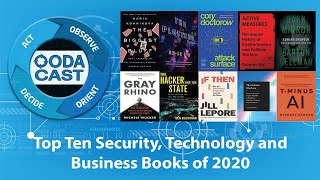
Matt Devost, CEO of OODA LLC, shares his ten favorite books of 2020 on security, technology, and business. The picks span intelligence analysis, decision-making, AI, and blockchain, discussed with Bob Gourley, OODA's CTO.
Chapters
Informing your decisions with intelligence analysis and insight brought to you by the team@oodaloop.com.
Hello, I'm Bob Gourley, the Chief Technology Officer of OODA LLC and co host of the Oodacast. I'm here with our CEO and co host of the Oodacast, Matt DeVoe. Hello Matt.
Hey Bob.
Hey Matt. Subject of today's Oodacast is books. Every year you publish a top ten list, the top ten business, security and technology books of the year. And you just published this year's and I would love an opportunity to run through the list with you.
Yeah, no, absolutely. Sounds like a lot of fun. This list is now in its fifth year and despite all the great content that I feel like I post on OODA Loop every year, this is definitely one of the most popular posts of the year. So it'd be a good one to do a quick oodacast on.
Yeah, and you know, you have done this for five years, but as long as I've known you, you've been really a voracious reader and you consume a lot of books and I think that's actually quite a service for us. You publish a book review a week, so I know you're reading at least 50, maybe up to 100 a year. Is that what you say about that?
Yeah, yeah, I read about 100 books a year and that's to get to 52 that I want to recommend. With the global frequency mailing list that I put out every Sunday I have a book recommendation and with rare exception, I want it to be a recommendation, not a review. So I'm not going to put a book in there that I wouldn't encourage people to read. So there's, you know, While I find 52 books that are worth recommending every year, there are probably 40 or so that I read where I'm kind of like, eh, not going to recommend it to the audience.
Cool. Well, it's a great service and let's just dive right in. I want to ask you book by book, the first if then how the Simulatics Corporation Invented the Future by Jill Lepore.
Yeah, this is a great story and I feel myself to be really well versed in kind of the history of data analytics and data science, especially as it's applied to political science, because that's my background as a master's degree. I have a political science degree, so I spent a lot of time in that space. And then you and I obviously are very involved in data science and sentiment analysis and that sort of stuff. This was A story of a corporation that got there first and was doing this work 40 years ago. This Simulatics Corporation, combining simulation and mathematics. They were the first to use large mainframe computers and the first to apply it to political and social and culture questions. So they were doing analysis to try and drive insight into politics and predicting election results. They were doing it to try and drive marketing and sales, and it really was a forerunner. So it's kind of an interesting and compelling story to see how they came together to formulate this idea and executed it within the company. But then some of the friction that they encountered and the fact that they obviously were not successful in the long run, and it would take us another several decades until their vision was fully realized.
Right. By companies like Cambridge Analytica. At least that's one of the most famous ones that we've all heard about in the news.
Absolutely. I think there's a direct heritage line from Simulatics Corporation to Cambridge Analytica. I mean, it's obviously the same thesis. Cambridge Analytica obviously got to operate in an age of Facebook and social networks, data science and cloud computing. And obviously they didn't have that when they had formed Simulatics. But still a compelling story and interesting to see that, you know, it's an interesting cast of characters that they brought together and diverse backgrounds. Great.
Would you say it could help us think through the ethics issues today by reading this story?
I think it helps us think through the ethics issues. I think it helps us understand friction associated with innovation, where you might have a great idea or application of technology in the market, but it takes decades to realize just because you're behind in compute power analytics, or the data doesn't exist, but with the granularity that you need. I also think it's a great thesis on the structure and building of teams. It was a very diverse team with very diverse backgrounds, very eclectic backgrounds that were able to operate successfully in this space and at least at their time, realize a little bit of the idea. So I think it's interesting from multiple perspectives.
Right, Matt, let's move on to the next book. It's one by. You're not supposed to judge a book by the COVID Looking at the COVID it looks like a poker book to me. The title is the biggest How I Learned to Pay Attention, Master Myself, and Win by Maria Konnikova.
Yes. So it is ultimately a book about poker, but it isn't. As you mentioned, Maria Konnikova basically decided that she wanted to become a professional poker player and went on this endeavor to get mentored. By one of the greats, and actually several of the greats and started participating, participating in these poker tournaments that kind of rose up through the ranks in the World Series of Poker to be a successful money winning poker player with absolutely zero expertise going into it, Completely self taught and mentored. What I found fascinating was if you like a good story about learning a trade or learning a craft, if you're interested in poker, definitely a compelling book. It's fun to read and it's exciting and it's very insightful because you get these insights from the pros. End of the day, it's really a book about decision making and understanding ourselves and understanding the factors that influence our decisions and the underlying psychological behaviors and expectations that influence those decisions. So for me, I found that part very fascinating. The assumptions that we make, the fact that even if we know something is completely random, like the flip of a card or the toss of a coin, if you have a positive streak, you tend to start looking at things from a positive perspective. I mean, just lots of little fascinating, interesting nuances about understanding our behavior, how it is influenced by others out there. And the poker table is really kind of the ultimate competitive environment. If you think about it from a corporate perspective, those are your competitors sitting at the table. They're going to bluff, they're going to exhibit the ticks, they're going to exhibit observable behaviors, they're going to make decisions, they're going to be influenced by the, you know, what you are portraying and the decisions that you are making. So it really is just a fascinating look at decision making that I think is highly applicable to business. It's also a great book on kind of self awareness and understanding those underlying factors that are influencing our decisions, even those that maybe we aren't quite conscious of.
And the way you describe it also makes it seem like this is a great book that underscores the point that we can remake ourselves and be proactive and continue to learn and grow and even learn a whole new field of discipline.
Absolutely, yeah. I mean, you know, starting from scratch, having never played a hand of poker, rising up through the ranks. I mean, it's a pretty compelling story. Obviously she dedicated a lot of time to it. There were a lot of frustrations along the way. She had great mentoring, but you know, it was possible to happen.
Next on your list, Matt, is the Gray Rhino. How to Recognize and Act on the Obvious Dangers We Ignore by Michelle Walker.
Yeah, this is a great book and I kind of went searching for this book when we hit the pandemic in March. And there was so much discussions about the pandemic event being a Black Swan event. I grew really frustrated because the black swans are supposed to be the things that we can't anticipate and are unexpected. And I had worked on pandemic response planning and war gaming different pandemic scenarios going back to 2001, 2002, 2003, as part of the Defense Adapt Red team, with great minds like Jim Miller and others. And there were playbooks, there were understanding about how a pandemic would spread and what measures you could put in place. So it really wasn't a Black Swan. And I said, we have to have some sort of framework for the surprises that aren't surprises. They're just. We get paralyzed by indecision going into them. But the data exists where we should be expecting them to happen. And that's when I discovered this great little book called the Gray Rhino. And it really focuses on, again, the things that impact our decisions are our inability to act on obvious dangers. And the Gray Rhino is meant to be much different than the Black Swan. It's the thing that is standing in your path that seems the data supports it as kind of almost inevitable that we're going to have to confront it. Yet for some reason, we overlook it. So it's a great study again in decision making and understanding how we can identify some of the more obvious risks in our business, maybe even obvious opportunities, and understanding the underlying behaviors are going to prevent us from seeing and acting on them and how to change that.
Matt, do you have an example of an obvious risk that she would call a Gray Rhino?
Well, the one that was stuck in my mind is the Pandemic. I read this back in March. I can't remember an example from the book, but there's definitely lots of them in there, both in politics and business.
Right. Next on your list, Matt. The Infinite Machine. How an army of Crypto Hackers Is Building the Next Internet with Ethereum by Camellia Russo.
Yeah, I was on a bit of an Ethereum kick this year, as you know, and we've interacted. I've been interested in cryptocurrencies and blockchain for quite some time. I mined my first bitcoin back in 2011 when it really wasn't that well known, and I did so in order to learn it to teach my Georgetown class. I wanted to teach the Georgetown students about cryptocurrency and blockchain, and I figured the best way to be able to teach it was to be able to do it. So I kind of experienced it myself. And I've spent over the past several years focusing my reading on Bitcoin itself. It's one of the frontrunners around a digital currency store of value. And realized that I was ignoring something that is probably more significant than Bitcoin, and that is Ethereum. Ethereum is compelling to me because it really is this idea of programmable money. And while Bitcoin might be a good store of value, the blockchain and contract system associated with Ethereum allows for it to be very transformational for business. There are a lot of businesses that can move into an Ethereum environment. So I read multiple books. This was my favorite of the books on Ethereum that I read, and I think it was. There's a lot of excitement and opportunity and potential associated with this technology. And I think that Camille captured that. It's almost like the old Apple commercial. The people who change the world or crazy enough to change the world are the ones that actually do. I felt like she captured that perspective. The youth, the energy, the idealism. And in this history of Ethereum and its potential to transform business.
Right. You did mention that there was a. There was one that came close. You called it a runner up called out of the Ether the Amazing Story of ethereum and the $55 million heist that almost destroyed it all. So it does seem like you had a lot of choices there and it was tough picking the one for your list.
Yeah. And I think it was, you know that the Runner up was a great book in that it spent some time focused on the early kind of fraud. I won't call it fraud. It was an exploitation of legitimate flaw in the contract system in the early Ethereum that almost killed it. So it was interesting from that perspective. But I felt like the Infinite Machine did a better job of capturing the opportunity and the energy and the passion of the Ethereum space. It's definitely something I've identified even in 2021 as an additional focus area for me. I just feel like we are on the cusp of some major business transformation associated with blockchain technology. And it'll be technologies like Ethereum that are at the forefront of that.
Great. Let's keep moving because you have some other exciting discipline areas you cover in your top 10 list. Next on your list was Dark Edwin Snowden and the American Surveillance State by Barton Gelman.
Yep, this was a good book. I've read probably all of the books on the Snowden, you know, the affair incident, if you will, including Snowden's own And I think this one is probably the top book. I feel like it takes a very objective perspective and it's written from the perspective of a journalist similar to others who had that early interaction with Snowden, as he was, you know, releasing this information, but was confirmed confronting him, was pushing back on him, was causing Snowden to confront his own ideals even before they knew his name was Edward Snowden. The journalist was kind of confronting how he wanted to cover this story. So I felt like it was a very, very balanced view. It doesn't paint Snowden as a villain, it doesn't paint him as a hero. It just gives an honest history as to what transpired leading up to the Snowden revelations and the Snowden leaks. I also found that it really fascinating from the perspective of looking at how a major institution like the Washington Post deals with the potential of a story like this, the OPSEC that they needed to engage in the negotiations around how they would protect the secrecy of the data that was being provided, the extent that they would go through to kind of vet to make sure that they didn't release anything that was truly harmful. So I found that to be a fascinating undercurrent because I'm sure it's something that journalistic organizations encounter all the time, but it was not a process I had been directly exposed to in prior reading. So I found that to be kind of a fascinating subtone to the book as well.
Great, thanks. Next on the list, Active Measures, the Secret History of Disinformation and Political Warfare by Thomas Riddle.
Yeah, this is a great book and obviously very timely. You know, it is one of those where if you're teaching a course on misinformation or Active Measures, I think you need to look no further. Thomas has written the definitive volume on it. From my perspective. It is a great summary on the history of misinformation and associated operations taking us up to present day. It's a. It's a little academic in tone, especially as it relates to the history. Of course, that's kind of the flavor that it's written from, but it is again, very informational in understanding that what we're facing with some of the misinformation campaigns that we see today are nothing new. What is new is the technology that they're being deployed on. But some of the fundamental and foundations of that have been established for multiple, multiple decades. So does a great job looking at the history, looking at past successful operations, and kind of transitioning it to it today. So for me, while the Dark Mirror is the definitive volume on The Snowden Affair, I think, as it relates to understanding historical, current implications of misinformation. Thomas Rid has written one of the definitive books.
That's great. I'm glad you called this out, because all of us really need to understand this impact on us. I mean, even more today with the impact of social media. But there are old Russian and Soviet disinformation campaigns that were launched decades ago that are still echoing around today. And one of the clearest examples is the Russian use of disinformation around the Kennedy assassination, which a lot of the themes that they put out are still bouncing around. And so it is important for all of us to study. You commented in your list that you would strategically pair this book with another Putin's People, how the KGB Took Back Russia and Then Took on the west by Katherine Belton. What did you mean, strategically pair?
Yeah, because I think if we look at the. The perpetrator of a lot of the misinformation that we're seeing out there links back to Russia. And obviously with Putin as the leader in Russia, understanding the heritage and kind of the pedigree of his rise is interesting. Right? It kind of shows his history in the intelligence services in Russia. It shows his rise as a politician, and it shows the misinformation and campaigns that he conducted in kind of his rise to power. So there's a great template there in understanding kind of the rise of Putin, the people he surrounded himself with, the people that he fooled, the people that he brought into his umbrella, and the people that he excluded from it. So to me, it's very kind of fascinatingly insightful into the heart and mind of the Russian government, which we can legitimately say evolves, revolves around Putin. So kind of great history, and it's a great pairing to think through. Here is the history of misinformation. Here is kind of the environment that Putin grew up with. Here he is as the leader of one of the largest perpetrators of misinformation campaigns in the world. And understanding how he got where he is and the people that made it happen, I think is insightful and useful to understand in today's age as well.
Matt, for the next book, I just wanted to say that you yourself have been writing about the hacker community and cyberspace and cyber attacks for decades now, since right around the time William Gibson brought the term into popularity. And your next book, I mean, I just say that because any book you recommend on that subject, I think is worth reading because you're a very credible expert. This one is called the Hacker and The Cyber Attacks and the New Normal of Geopolitics by Ben Buchanan. Why did you single this one out? Is one we should all read.
Yeah. There have been years where I've refused to actually list a cybersecurity book in the top 10 because I felt like we weren't covering any new material. This, I thought, was a great book because it's studying kind of the new dynamics around geopolitics and conflict, the convergence between threat actors, the impact that individual threat actors can have, just this blending of state and crime and individualism, and this kind of new dynamic that has emerged exclusively from the perspective of cyberspace. So for me, this was one that was worth reading. There's some interesting insights, there's some interesting frameworks, and for that perspective, it's why I put a cybersecurity book on my top 10 list for this year. It was good enough and I enjoyed it enough. And for me, any measure of a book is how often that I am highlighting it on my Kindle or in print. And this is one where, even as somebody who's been in this space for over 25 years, there were frameworks and thoughts and ideas that I found to be very worthwhile. Great.
And next is one on another topic that a lot of folks are writing about, artificial intelligence. The book is T Minus AI Humanity's Countdown to Artificial Intelligence and A New Pursuit of Global Power by Michael Kanin.
Yeah, I've been on an AI kick for the past couple of years, and a lot of my perspective has been around looking at AI developments outside the United States. I've looked at some of the corporate aspects, the companies that are building AI capabilities. But as it relates to the national strategic perspective on AI, I realized that my perspective was really kind of outside the US What I loved about this book is that his heritage is obviously coming from the military, running one of the top AI entities in the U.S. government. U.S. military. And I thought it was great to see the perspective on the strategic geopolitical and economic importance of AI from that perspective. That, for me was the true value is it was a framing of the importance of AI and the role that it's going to play from a US national security centric perspective.
Cool. And next on the list is a book by Cory Dr. Attack surface. Yeah, this is fiction, right?
This is fiction. I always try and include a couple of fiction books every year. I read quite a few. There's some regular thrillers that I read every year. I read every Brad Thor book every year, read all the Jack Carr series, and I'VE read the variants prior to Attack Surface, which is kind of the third book in a trilogy. Interesting. Cory. Dr. I met probably 20 years ago around Electronic Frontier foundation and privacy issues. And he wrote this great book, gosh, I'm not even sure how long ago, 12, 13 years ago, called Little Brother. And in Little Brother, there is a terrorist attack that takes place in San Francisco. And the US government comes in and implements these really draconian surveillance measures to try and prevent a terrorist attack from taking place. And at the time there's a teenager, so it's kind of a young adult book who starts a community around disrupting that surveillance. If you've got RFID cards in your car, they're cloning those, you know, they're cloning your Metro passes. They're making all these kind of false signals take place in the system. And it talks about their kind of their fight for freedom from these surveillance technologies. In number three with Attack Surface, we see the story from the perspective of a brilliant computer scientist, computer security person who gets recruited into the US Government side of the equation. And it's a great insight into not only kind of the. There's surveillance technologies and capabilities that exist in the government and some of the issues associated with that, but then she migrates into the private sector and starts working for the equivalent of Dark Cube or NSO group, engaging in surveillance and hacking on behalf of foreign regimes and the coming of age associated with that and understanding that maybe confronting the realities associated with the surveillance technologies that she's deploying and the impact that they're having on some of the people that are looking for civil liberties. And she kind of rebalances her life. I also think it's an interesting discussion on just technology itself in that when we think about surveillance technologies, we always think in terms of, well, we need technologies to counter it. And the book makes a pretty good argument that you can't have this arms race of technology to counter technology. Really the only confrontation against, you know, overdrawn surveillance or use of these measures against private citizens is through politics. So I found that fascinating as well. Kind of taking the spin, you know, what was a technology centric story back into the human domain. He's a great writer. The characters are great, the story is great, the dialogue is great. You learn a lot in the process about these technologies and how they work and the countermeasures and how they work. So, you know, highly recommended. Was one of my favorite books of the year.
Great. Cool. You also said, alternatively, fiction fans should check out Burn in a novel of the Real robotic revolution by P.W. singer and August Cole.
Yeah, that was a great, great read. You know, I'm a fan of theirs. Going back to Ghost Fleet, this takes a perspective of a, you know, robotic kind of AI augmentation, you know, capability that gets paired with a law enforcement officer and understanding the dynamics of how are we going to use tools such as a and such as robotics. And in this perspective, they kind of frame it both in one sort of. So it's a robot assistant that has some tactical capabilities, but also has the AI paired with it. Great. It's kind of a thrilling story, kind of counterterrorism story. You know, lots of action and adventure, but lots of underlying themes around how these technologies are going to integrate into society, are we going to trust them, and what the impact will be over the long term. So definitely a fun reading.
Great. The tenth one on your list, Matt, is the Plotters by Eun Soo Kim.
Yeah, this is another one that I specifically went and kind of found. I was really impressed with the Chinese English translation of the Three Body Problem. And it got me wondering what are some of the other great fiction, not necessarily science fiction, great fiction writers, where it can identify translated work that's compelling. And I read a few and this was my favorite. It really builds this world, and it's a Korean translation, so it builds this world around an underground economy where almost as a matter of daily life, people are assassinated or taken out in the system. And it's this kind of underworld of you have the assassins, you have the plotters, you have the sponsors. And it weaves the story from the narrative of somebody who is one of the assassins who starts doing a little bit of digging into kind of who's making the calls, who's making the decisions about who lives and who dies and kind of how does this underlying system work? Fascinating story, beautiful language, beautifully translated, interesting characters. Just compelling enough that I really enjoyed it as an international fiction reading.
Great. Thanks, Matt. Thanks for Reviewing your top 10 books here. Of course we'll have links in the show notes to the list on OODA loop and it's a great service you provide here and this filtering and recommending and endorsing and bringing these to our attention and I really appreciate it.
Thanks. I'll keep reading. I always love recommendations as well. If folks think there's a book that I should check out. There are several on this list that were actually recommended to me by OODA members, folks on the Global Frequency list. So happy to take those recommendations as well.
And I guess another note Matt, a couple of these authors we've had on the oodacast. You know, we had P.W. singer on the oodacast, Michael Cannon on the oodacast, and you have a couple others in the works as well, I hear.
I do, yeah. I've got invites out to Camille Russo and Michelle Walker, so they've both accepted. So we're hoping to get them Featured early in 2021, and we'll be extending invites out to the rest of the authors on the list. I think it's a great way to bridge the top 10 books with some of the content that we're covering on oodacast in a way that'll be really insightful for the folks that are watching the show.
Great. Thanks, Matt.
Thanks, Bob.
Thanks for listening to this OODA Loop production. For the latest analysis on cybersecurity, technology and global risks, please visit www.ooda loop.com.
More from Matt


Leading Cyber Change: Allan Friedman on the Revolution of SBOM & Future Cybersecurity Initiatives


Revolutionizing Medicine and Tech: Joe Tranquillo's Journey into Complex Systems






Bob Zukis and the Digital Directors Network: Helping corporate boards mitigate systemic risk

Adam Shostack on Cybersecurity and What Every Engineer Should Learn From Star Wars