Michael Gibson Wants to Light the Paper Belt on Fire
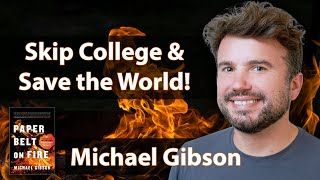
Matt Devost talks with Michael Gibson about dropping out for the Thiel Fellowship, why college degrees are overrated, and Gibson's vision for disrupting traditional institutions. Gibson argues the "paper belt" of credentials needs to burn.
Chapters
Informing your decisions with intelligence analysis and insight brought to you by the team@ooda.
Loop.Com hi, I'm Matt DeVoe, and thanks for watching the Oodacast today. I have with me Michael Gibson, who was the book recommendation that we got a few weeks ago from Jimmy Sunny, Paper Belt on Fire, who has a very interesting background and a very interesting perspective on a lot of issues that I know will be of interest. So, Michael, thanks for joining. And, you know, to start it off, I'd love to get your background that leads you to the position that you're at today running your fund.
Hi. Well, yeah, thanks for having me on. Big fan. So it's great to be here. And I'll have to thank Jimmy as well. You know, his book the Founders is certainly a lot of fun and dovetails into. Into my own story a little bit. So his book is on PayPal. You know, one of the leading characters of PayPal's formation is Peter Thiel, the investor. And, you know, through a series of unlikely events that I recount in the book, Peter hired me to work at his hedge fund. And he hired me for one purpose. So I have a background. I thought I was going to be a professor of philosophy. I studied Ancient Greek and Latin, background in literature and philosophy, and I was working towards a PhD in Philosophy. I dropped out and I had become a journalist, but Peter hired me. You know, I, I met Peter, I ended up in an interview with him, and, and we just gelled philosophically. We were talking about economics and this literary, French literary critic Peter, you know, admires and studied under at Stanford named Rene Girard. And after an hour, Peter just said, hey, do you want to help me teach this law school class at Stanford this winter on philosophy and technology? And I. And I thought, wow, you know, this is fascinating. So I said, yes. And he said, yeah, we'll get you set up as an analyst at the hedge fund and you'll work on this. So that's how the interview ended. And I was like, okay, I have no background in finance, but this is just such a unique opportunity. I got to do it. Well, fast forward, I think it was like a month and a half to my first day of work. I can tell you the exact day, September 27, 2010, because I showed up to work. It's exactly as you imagine on tv, how finance is portrayed. I met this hedge fund trading floor, stock ticker on the screen, all that. And a colleague comes to my desk and he says, hey, you know, on the plane ride back from New York to San Francisco last night we came up with this idea, this grant making program, the anti road scholarship we're calling it for now, but we got to go announce it to the world today at TechCrunch Disrupt Big Conference in San Francisco every September. So I was like, all right, let's go. And you know, Peter's in a T or I guess some kind of black limo with Peter and Jim o' Neill is the other guy. And we're just talking, what do we name this thing, how much money is involved. And then before I know it, we're at the conference and Peter's on stage announcing it to the world, like this program already exists. He's talking in the present tense where he says, oh, we're accepting applications. And I'm just like, wow. At the end of the day I remember, remember calling my parents and saying, wow, you know, this is my first day of work. What's tomorrow going to be like? So I got sweat. I, I was about that founding moment of the Teal Fellowship. It's a hundred thousand dollar grant, goes out to 20 people a year and it has two noteworthy conditions. The first is that at the time you had to be 19 and under to apply. They've raised that a little bit since then. But the second thing is the newsworthy thing, which was that you know, you had to not be enrolled in school to receive the grants. So you had to either be a dropout, stop out, something like that, you just couldn't be in university degree program. And I ended up co running that program for five years and it was, it was pretty amazing. We saw cool stuff come out of it. Probably the most noteworthy there is helped Vitalik Buterin, the creator of Ethereum, launch Ethereum in 2013, 2014. We had a young man, Dylan Field, 2012 he started a company called Figma. We helped him with that. And that made news recently because Adobe just bought it for 2020.
A lot of money. Yeah, yeah.
So I got swept up into this world. I told you my background. I'm you know this, I say defrocked philosopher, you know, outcast academic. My co founder Danielle Strachman is a former charter school principal. She is a. She found founded a school in San Diego called Innovations Academy. She's on the. And so you know, I thought it'd be fun my book to tell this story about who are these two unlikely people who you know, ran this program and then now we started a venture fund in 2015 and we primarily back people who don't have credentials because we're extending that mission, to show that it's possible to have a fulfilling and successful career without that credential. So I thought that was a cool business story to tell in the book. And, and the fact that we have these unusual backgrounds made it all the more interesting to me.
Yeah, no, it's, that's fascinating. What was the catalyst for kind of the 19 and under? You wanted to catch folks before they became too influenced by the higher education system or, and you said that they raised the number a little bit. What is the current age?
I, I believe the current one is 22. So they did just say, hey, as long as you are of college age. At the beginning, there were, there were two elements that I think were prominent. The first one was just the rising cost of college and the amount of debt people were taking on matched with the careers that they were pursuing. So it's extraordinary to me, but something on the order of like 40% depends on the school. But all of America's top universities, Ivy League down, something like 40 to 60% of the graduates go on to work in, in finance on Wall street or in management consulting firms, places like McKinsey or Boston Consulting Group, something like that. And so Peter's thought was that, you know, what's, what we're seeing is, you know, instead of pursuing a passion project, it could be novels, art, or it could be starting businesses because people accumulated debt over the four years that, that forces them to take these well paying, prestigious, but ultimately safe jobs. So the thought was if we, if we got to them before they accumulated debt or went too far down that track, maybe we could set them on the, on a different course. The next thing was just Peter's experience. So he, you know, he's famous for being the first outside investor in Facebook. When Zuckerberg pitched Peter, he, he was something like 20 years old. So, and Peter, even at PayPal had, had worked with a number of people who had left school behind. So in Silicon Valley, there already was this trend to see people, young people especially without any kind of credentials, starting something new. So I think that was the idea. In the event, over the years, what we saw was a lot of these people didn't necessarily have that much debt either because maybe their schools gave them generous packages or because they never went. So I think the idea then became by raising the age limit, they were thinking, okay, let's just sweep in anyone who wants to leave college. But for me, when we were doing it, it's like insane to me that we were able to find as many people as we did who are now quite successful and we had that constraint that they were 19 and under just that blows my mind.
Yeah, no, that's excellent. You know, I have a 18 year old who is very creative, hardcore coder and I've always joked with him, even before reading the book, that that that would be an interesting option for him. But it almost feels like gambling with their future, you know, unless they plan to go to college because those degree requirements are so stuck, it seems like in the employment process. So do you think that we'll move towards an environment where we start to devalue the degrees? Because as you mentioned, they are becoming increasingly expensive and it's primarily through a scarcity. You know, we just don't have the capacity in the academic institutions. So the TU gone up and the amount of debt that people are able to obtain and the circumstances around those debt, you know, seems like it's created this beast within the higher education system. So do you think that we'll see change over the longer term where more people will look to hire folks that don't have the college degree or will we make it a little bit more accessible so they don't have to incur this crazy debt through the process?
Yeah, I think it depends on the segment. The place where we see it most is actually in engineering where I think, and I think it's because it's a domain where you can directly measure someone's skill level. So a lot of engineers I know now who are up and coming, they don't even have LinkedIns, they're on GitHub and they might not even have a picture there. You know, it'll be like an avatar with Darth Vader. But their code has been vetted and voted on by their peers and they're able to get hired just based on that proof of work and the quality of the work. We see interns all the time at the top tech companies, people who take a summer internship and they're making like 40,000 bucks for, for three months and then Apple will offer them a full time job at the end. So in the world of computer programming it seems to be changing the fastest. And I think it's because either you can build or you can't. It's pretty quick to see if someone has the skills. Whereas in any kind of job where it's more intangible, it's tougher. So you know, I think what's happened in our society is we've had the labor market outsource the job interview and you know, job, you know, diligence process with any candidate. They've outsourced that to the university system and now we've asked the government to pay for it or families to take on debt. There are two competing the like. It is true. Plain fact is that people who have college degrees make more on average than those who don't. Who only those people who only have high school degrees. But the debate among economists and people who study these things is like, okay, what explains that wage gap? The standard story that everyone wants to believe is that not that every college degree is a vocational degree, but indeed that for some reason you know you're obtaining skills in college and then once you graduate, the labor market rewards you for having those skills. It's called the human capital model. A lot of people believe in it. But when you scrutinize the evidence, the competing theory seems more plausible to me. And that's called the signaling theory. And what that says is people aren't actually learning skills in college, at least not that they use on the job. In fact, we know whether in your personal life or people, you know, so many of us have careers that have nothing to do with anything we studied and, and that's just anecdotal or we've forgotten what we learned. So it's pretty weird that you would be rewarded for things you've forgotten for, for your life. That's bizarre. So what the signaling model says is actually what the colleges do is help sort the labor market IQ or cognitive skills. Okay, that's part of it. But you can test for that. What you can't test for is, is someone conscientious enough and hard working enough to undertake a four year project in which they take on assignments and complete them and meet deadlines and show up. And so the labor market is pretty much just using that as a way to say, okay, here's, here's a way to find, separate the lemons from the good quality labor in, in the market. So if you believe that, then maybe it's not even about the cost of college. It's like we just need to find a cheaper way to send that signal. Yeah, yeah.
And that argument really resonated with me. You know, when you look at it from the perspective of the, the college signaling is exactly that. You show. You can get up, you can go to class, you can do work, you can, you know, do something for four years straight kind of conditions you. Even the schedule itself, right. The hours that you keep and the, yeah. The work that you take home. I mean it kind of is like a little bit of A mini workforce, you know, environment. So I hadn't really thought about that aspect of it. And I'm one who, you know, in my hiring and all my, have never had a degree requirement. Some of the smartest people I've worked with had high school degrees only. So I've always had that kind of counter narrative with regards to that signaling. So that's why I think I found your story so compelling was, you know, putting a program in place for people to go and pursue an alternative and also be successful, come up with interesting ideas and, and I'm sure some weren't successful but probably benefited from kind of the intellectual freedom that afforded them to go and work on something that they were passionate about.
Yeah, absolutely. You know, we did it. We, yeah, we had major successes. I've mentioned a few, but we've also had people who flamed out, you know, the company. Maybe the idea didn't work. I don't know the total number over the years, but I'd say it's only a handful that actually went back to college and finished. I mean some people just went on and started their next thing or maybe they got, you know, acquired not for big money but just to work at a bigger company and they're on their way. So to me, I was really impressed by the paths that people carved for themselves even if they didn't become some big tech startup success. And then on the society wide level. Yeah, I think it is sad that it's like we have this cross current right now. I've seen some governors start trying to lighten up the degree requirements for people who work for, you know, state government roles. I wish, you know, it's so odd to see jobs in the past that didn't require a degree. Now do. I mean, you see this in the police force, for instance. It's like, and I'm not sure necessarily that policing has improved by, you know, by requiring that degree. I'm more of the let's see if the apprenticeship model works first. Get real learning by doing hands on experience from the pros. I think, you know, that's often the best way to learn is actually by doing. By doing something. So I wish we did embrace that idea more as a society.
Yeah. And it seems like the degrees are becoming a little bit overly commoditized as well, especially with the online degree aspect. And I was traveling a couple years ago, happened to be at a fairly small university and was talking with one of the IT directors and he was talking about just how large and expansive their IT environment was and it took me by surprise given the size of the campus. But then he explained that, no, in addition to the campus, they had 120,000 online students, right? So these are students that are not going on campus, they're just taking courses online, just getting the degree online, you know, in order to get that check mark. So it seems like there's a lot of, you know, components of the system that are broken and maybe being exploited temporarily in the. But I like the overall thematic, you know, you had with the book is that we can break away from the system and that there are alternatives.
So I have a right, the title of the book is a little bit of an odd one I found because I call it the Paper Belt. Paper Belt on Fire. And the paper belt was a term that a buddy of mine, you know, just jamming Balaji Srinivasan, interesting guy, pretty famous on Twitter because he was one of the first people to, you know, raise the alarm about COVID in January 2020. And he's an investor, tech founder. But back in like 20, 20, 13 or so, we came up with this term, the paper belt. What we noticed was the Rust belt defines the Midwest. These hollowed out industries in, in Indiana, Ohio, Michigan, hollowed out due to technological change or globalization. And so we were forecasting that a lot of the institutions and businesses on the east coast, from Washington D.C. to Boston, symbolically were going to face pressures either from their own failure or from competitors that might emerge in technology. And so in Washington D.C. they print money on paper, laws on paper. In Delaware, they companies incorporate on paper. In New York, New York Times, Wall Street Journal on paper, Madison Avenue advertising on paper. And in Boston, as the chief symbol of US higher education, boss Harvard and MIT print diplomas on paper. Now the one thing these sorts of paper based systems all have in common, and I probably go too far at length in this, in the book, is that when someone issues you a piece of paper like a diploma, that institution is acting as an authenticator of something to validate that this thing is real or that it signals something important. And I think what we've seen is just the institutional. Either because of corruption or because of insider collusion or just degradation, these institutions have abused this power. So they have become, they are no longer trusted third parties when it comes to authenticating the value of a piece of paper. And that could be a diploma. Like you're saying is like someone has something. What is this signal? I mean, did you learn like, I don't know, weird, like basket weaving? Did you, like, what is this Thing, you know, what skills does it convey? Not sure. I think the same is true of the dollar. The Fed prints dollars on paper. They authentic, they authenticate them as real. But it's quite clear that the value of a dollar is being lost over time. And can we trust these people to act as custodians of its value? I'm not so sure anymore. So I'm so steeped in the language of the crypto cypherpunk stuff. I talk about Bitcoin, I mean, I mentioned Ethereum, so certainly part. I wanted to use that analysis to talk about these, these institutions that rely on paper, that they are in fact trusted third parties that, you know, may no longer be trustworthy or at least reliable in the, in the sense that they used to be. And it's true of colleges. It's also true of the Fed. It's true of the media. They print news, but is it news? Hard to tell these days.
Yeah. And definitely what attracted you to the cypherpunk movement and when did you, you know, first get clued into it or get involved?
Yeah, the gateway drug for me as a maybe it is for a lot of people my age was Neal Stephenson and the Cryptonomicon. I think that was my, the first time I came across any sort of layman's explanation of cryptography. And, and it's a wonderful novel. It blends sci fi with, with historical fiction. If anyone hasn't read it, hasn't read it. I recommend it. So I read that when I was in grad. You know, I, I do have libertarian tendencies when it comes to distrusting authority and, and being, you know, also a romantic view of the power of technology and the imagination to, to, you know, make things better. So, so around that time when I was in grad school, I started learning more about it. And then by the time I was, I've been involved in side movements like the seasteading stuff. There were one of the original seastead ideas was a group of people who wanted to set up a data haven off the coast of, of England. And that's sort of how I did get come into Peter Thiel's world. So I, I, yeah, I've been immersed in it for a long time and it's just I've never been like a, I've never built a project on my own or anything like that, but I've certainly been a fan of people in, in that world.
Yeah. And I noticed in the book you always, you also made at least one trip to defcon. What was the appeal? How did you get involved with attending the conference?
Yeah, just learning about that. I mean, well, I learned through God of all people, Dan Kaminsky. The.
Dan has a friend.
Yeah, you know, he, he was telling me, it was just there are so many young people there. This is back in like 2011, and, and, you know, really working on stuff and hacking away. So I was like, okay, I gotta go. And it was awesome. You know, the first time I went, someone warned me, like, don't turn on your phone in the main area. You're. You're gonna get in trouble. But because I was supposed to meet Dan, we were supposed to sync up, I had to turn on my phone, and before I knew it, all the settings were changed somehow. I don't know how to this day, but my settings were changed and. But I, I was able to meet up with Dan. And yeah, I was just out there recruiting, always looking for talented people. I, I think, you know, the hacker community certainly has its, its a large number of younger people who are sort of eccentrics and off the beaten path and, and so I did love attending that and, and I haven't been in a few years, but I should go back because it's such a cool thing.
Yeah, you definitely should come back. I've been going for over 25 years, so it's okay.
Wow.
Near and dear to my heart. So when you mentioned it in the book, you know, of course I was trying to figure out who's this cipher person, but based on, based on the description.
Yeah. So I met him at defcon. He is still to this day one of the best engineers I've ever met. I've ever met. You know, he, he just. But I, I did want to tell a story about when we look for people to found companies. I think when we, when we first got started, we, we were too biased towards the sort of mad, lone genius view of, of creation that, you know, someone. We met a lot of gifted people in the technical realm, in the world of numbers and logic and so on, but they, they weren't so good at working with other people or working with investors or talking to customers. And, and that was an education for us. And, and it sort of narrowed the Venn diagram for the type of people that we were looking for. You know, it. They. Not only did they have to be good at. At coding, let's say, but they also had to be, you know, good with people and have some level of emotional intelligence. So, yeah, I tell a little bit of story about working with a young man. You know, sadly, he, he kind Of I think he had mental health issues and sort of fell off the, off the, the map a little bit. But I, he's a great guy and I wish him well.
Excellent. Yeah, I think, you know, one thing with regards to the hacker community is it's one, you know, it's a community that doesn't seek to ask for permission before those things. And I think that's what I'd always, you know, never had encountered the term paper belt until I read your book. But I had call I'd referred to things like permission slips. Right. So like your diploma to get employed or you know, incorporation tax, your permission to have a company, you get quoted in the newspaper, it's your permission to be an expert. Right?
Yes.
I think one thing about the hacker community is that kind of goes all out the window. It is, you know, how, how can you take this technology, take it apart, make it work better, figure out what its vulnerabilities are? You know, just has been always, always pushing the envelope as it relates to thinking about the use of technology and also some of the, you know, negative side effects as well.
Yeah, that's exactly right. I love that. And a big theme in the book is this idea that outside of computers and smartphones and Internet technology that the rate of progress has actually slowed down in science and tech. So if you look to things like, you know, energy creation, healthcare, even areas like education itself, the we haven't been making a whole lot of progress. And so it's a big question as to why, you know, you can, we could debate that issue but like, let's assume it's true. One of the things that we want to do is just and, and sort of spread this hacker mentality of permissionless exploration. And from this perspective it, it's like as if we live in a low trust society because when I look at what it takes to become a scientist, you know, not only do you have to do the four years undergrad, you have PhD postdoc, by the time you're in your mid-30s, maybe late-30s, only then it appears are you trustworthy enough to receive a grant to run some kind of experiment. And by that time you've just been beaten down by the system and homogenized that are you really going to try a radical idea out. So I wish we could find ways of advancing people to the frontier more. The hacker mentality is great at that and just, you know, not asking, but probing.
Yeah, yeah, it's been called to arms of mine in the hacker community over the past maybe I guess six Six or seven years. I gave a keynote at BSIDES here locally and said that the saddest thing for me that could ever happen within the hacker community is for the hacker mindset, I call it hack think, to only be applied to the problems of technology. I feel like that approach can be applied to all sorts of issues within society and that that should be the next kind of evolution of the hacker community because there's a lot of us out there now. You know, there's 30,000 people that show up at DEFCON, and that's just a small representation. But I definitely.
People I love who embodied this real quick is. It's a classic, so if you haven't read it, definitely pick it up. Is the Richard Feynman. Surely you're joking. Mr. Feynman memoir, because he talks about how he just decided he wanted to learn how to crack safes. He. And he was doing this in Los Alamos with classified information. So he. He had the hacker spirit at heart. And I think it did infuse his science with the spirit of, you know, cracking nature secrets. I. I always admired that in Feynman.
Excellent. Yeah, no, I had read the book, but I didn't remember that story. So that's. That's a good one. I'll have to. Have to go back and reread.
Oh, yeah. He became a pro at hacking into safes. Pretty interesting.
Yeah. You have a lot of hackers that, of course, if you've been to defcon, you know that. That also dabble in lock picking. Yes, My kids have learned lock picking. And I went to my daughter's school, you know, when we did a program on the intelligence community called it Spy School. We brought the locks and lock picks.
Oh, my God, the kids.
How to get out of handcuffs. It was a lot of fun.
That's so.
It seemed like a magic power. By the end of the week, we had one girl who could get out of handcuffs behind her back in about six seconds. And we put her on stage in front of the whole student body with another kid who was handcuffed, who had no idea how to get out.
And it was just, oh, my God, this is great. When she.
When she moved her hands around and was like, hey, I'm out. You know, and it was like, whoa. You know, it's a superpower, right? I wonder.
I don't know if you. I mean, maybe you've done this, but I wish there was some kind of summer camp for these things for teens where. There was something in San Francisco that lasted, I think, a summer it was called Danger Camp and it was like learning how to blow things up safely. I wish, you know, the teens could get exposed to this earlier.
Yeah, for sure. I mean, I drag my kids along to conference, they've been to defcon, into kids version, to Roots, bring them to B sides and stuff like that. But yeah, I, I did. You know, from my perspective, some of the, the, the most fun that I've had over the past year was I volunteered for the weekend at a local hackathon. It was for high schoolers and middle school kids and it was amazing to me what they were able to build. Right? Like just the creativity that the kids exhibited, what they were able to accomplish over a short period of time, the culture that existed there. You know, I'd hear on the PA system, hey, anyone who's ready to do the speed test Tetris contest, come outside the auditorium, that big TV's set up. I didn't even know what speed Tetris was. I was amazed at that kind of battling. And then the other thing that I loved is that the help desk at this hackathon for students that encountered problems with their coding was run entirely by students. So, you know, they obviously had adult supervisors and mentors, etc. But this whole weekend of, you know, 300 kids was run by people again under the age of 18 and built some fascinating stuff.
That's a great point. We, we. So I do a lot of recruiting off college campuses. You know, I'll visit a campus. And we learned quickly that anything run by the administrators was pretty much worthless. It was soulless, wasn't responsive to true needs. And this would be like, even if they had an entrepreneurship program, innovation center. I mean, it's all just like, it's got the feel of a, of like a train station or something.
I don't know.
It's not. But it doesn't feel like a place where people are actually building things. So we learned pretty quickly that the only, you know, the real people doing stuff are student led organizations. Whether it's like some kind of hacker house or, you know, the students who run the hackathons and stuff like that. It was, those were always the most exciting things.
Yeah, for sure. I used to, when I ran my company, Fusion X, we used to recruit out of the Nova Hackers here, the Northern Virginia hacker group.
Oh, group.
And we would just show up and, and buy pizza and say, we just want to. Yeah. Tell you what we'd do for one minute.
Exactly.
If that sounds like it's of interest to you, you know, Talk to us afterwards. But you buy a couple hundred dollars worth of pizza for everybody. We'd get great candidates out of there. Yeah, that's my favorite was one where the person that we hired was not actually in the audience, but his wife was. And she went out and got the details for her, for her husband. And during the interview process, we said, yeah, you know, your. Your wife flagged this for you. And she said, yeah, she had no idea who your company was or what you were doing. She said, I just want my husband to be as happy as that guy that's talking about his job on. So I was like, okay, obviously it was working because we did. We did have a lot of fun and do a lot of cool things. I do want to talk about that. You know, some of the discussion that you have around our inability to innovate or this kind of innovation stall that I think it says 1971, because right around the time that I was born. So give us a little bit of a backdrop there. Why do you think that innovation in these key areas has stalled over the past 50 years?
Yeah, so economists have some statistics that they point to, and you can see a divergence around that time. You know, their wonky number they look to is something called total factor productivity, which is just a measure of like, hey, given this set of inputs, what are the outputs? And so in a technologically advancing society, you should be getting more for less. Meaning, you know, the more you put. The less you put into the system, you know, the more you get out. And economists, you know, there is a divergence in the early 70s, you know, call it 1971, where the rate of productivity just started to decline. So that's in the standard economic data. But I think even in the qualitative side of things, you can see this. My mom was raised by her grandmother, so my great grandmother, and that woman was born in 1885. That meant she lived to see the invention of the radio, the television, the elevator, the skyscraper, the airplane, nuclear power. And then she saw. She died in 1980, so she lived to see someone on the moon. In terms of the number of innovations and the scale, that's quite impressive. Whereas in our time, you know, I'm born in the late 70s. I mean, we can sure point there. It's not that there hasn't been any advance, and certainly with computers and the Internet, we've seen some, but when you look at energy creation, we've certainly stalled there. We can talk about the why of it. I mean, that's a debate, but it's certainly true that energy creation. We've seen a slowdown. Education, no one is being educated better than they used to be. Not really, especially when you factor in the amount of money, I mean four times in real terms that we're spending. So we could go sector by sector and it's, and, and you could see that things are slowing down. I like to look at, if you look at health just like the bare raw statistic of life expectancy. 1900 in the US life expectancy at birth, somewhere around 45. By 1980 we had made it all the way up to you know, 72, 73. And since then, so from early 80s to now we've added like three or four years. In the last five years we've gone down, we've regressed due to deaths of despair and drug addiction and then, and then with COVID So we've regressed. But the fact that we only advanced three years compared to 30, 35 is quite astonishing to me. So that's, you know, there is a broad case to be made that, that the rate of progress has slowed down. There are lots of other explanations that people might have. One I've seen is just that it's harder to find great ideas that we picked all the low hanging fruit. So any new advance is going to require just more money, more people. But, but I don't think that's right. I mean I look at, at the education system, I just see so much waste. I think we can get people out to the frontier of knowledge faster than, than you know, 18, 22 years of education. So I, I, you know, my book is a, it pushes for a specific answer but I think it is broadly true. We could discuss the why, but I think it is true that, that stagnation is real.
Great. Yeah, we had a conference back in October or Uticon which was a lot of fun. But one of the comments I made in opening it, what I think was, is agreeing with your primary point and that was that the disruption that we're going to see over the next 10 years, the innovation is going to be greater than the past 50 years combined. So knowing how you feel about the past, how are you feeling about the next 10 years?
I think, I think it is quite possible that we could see large advances in different areas. I mean to speak to energy creation, I think the importance of nuclear power and its safety and cleanliness is the case is overwhelming and it does look like the political resistance to that is weakening. So that's positive. We've seen news of small incremental advances but maybe they offer lots of promise even for the creation of fusion Chat GPT offers. You know, okay, where does this, where does AI go? And then even in, in healthcare, you know, we are starting to, to make inroads to, to cure major diseases and, and then maybe even prolong life in ways that we can't imagine. So it could be the case in the next 20 years that, that some major breakthroughs answer to that is, well, we can't be just passive techno optimists. You know, it's only going to happen if, if we have agency. It's not that I believe in the, the lone heroic Ayn Randian hero in a garage. I think we do have to come together as, as p. You know, as teams, as friends to work on these problems, but also at, you know, at the society policy level. I think things matter too. But I, I agree, I think we're, it could be the case that these things are in reach, but we just have to, we have to make sure we try.
Did you get an opportunity to play with Chat GPT yet?
Yeah, I've messed around with it a little bit. I think it's funny. I think it's a tool you have to learn how to use right now because if you just randomly ask a question, it's like there are a lot of bad examples, so it's not quite there. And then also the mimics, like not Chat GPT but like some of the mimics where it's like you feed it Hemingway or Shakespeare. Like if you don't know Hemingway, it sounds like Hemingway but if you have read his novels, you're like, ah, you know, this is like pretty derivative stuff. So I think it has some way to go. But I think as a tool I think it holds out promise for. I mean maybe it becomes a competitor for Google search where you know, people are. Instead of looking for links to other things, Chat GPT could just like set up a, a first answer. You know, how do I make, how do I make a sweet potato? How do I roast a sweet potato? Well, it just answers, you know.
Yeah, I do find myself with a browser tab open with Chat GPT and using it for research. I actually think I used it when I was writing up the Udacast post for my interview with Jimmy where I just said what companies have been founded by early companies of PayPal? And it gave me a list. And then I said please give me more and it gave me more. And I've had interesting experiences with it where I've asked it fairly kind of nuanced. Questions and it's provided incredible responses which, you know, it fascinated me a little bit. And we have noticed a huge disparity just between using their interface and using the API. There are things it doesn't want to do via its interface that it will do if you ask it via the API. So okay, our CTO Bob did this great proof of concept. He was flying to Hawaii on vacation and just in the flight out there he built a website that he. It basically uses the chat GPT API, but it front ends the prompt to try and provide a response that is indicative of what an intelligence asset would provide. So somebody in the intelligence community or a report that is going into the pdb. So levels of confidence, alternative options, other things you should consider and the results coming out of that have been pretty fascinating. Obviously there's some, some massive failures that occur, but there's also some very interesting successes that come out of felt for me. Certainly like a bit of a great leap in that space.
That's impressive.
Yeah. So, you know, after the, the old fellowship you decided to raise a venture fund. So can you tell us about the investment thesis and kind of the process and some of the investments that you've made?
Yeah. So by 2015 we, we saw this was an investment opportunity that no one was systematically focusing on this demographic have degrees. So we, Danielle and I set out to launch a fund. We named it 1517 because we saw historical, we had geeky historical analogy between the Protestant Reformation and the corruption of the church in the 16th century. So 1517 year to a church door. What his theses were about was the church selling a piece of paper. So the diploma, we, the church was selling an indulgence. It was telling people, hey, if you buy this, you could save your soul. And so we thought, you know, the same thing's going on with universities. They're selling a piece of paper, it's this diplomatic. They say it'll save your soul. So we thought 1517 would be fun as a name. And people always asked about the number when we wore it on T shirts and stuff. The other thing about the Luther example that we were inspired by was that the printing press had been around for I guess 50 years or more, but it had really diffused throughout Europe by that time. And Luther's 95 theses were sort of like the first trolling listicle to go viral. And it was only made possible by the printing press. And also the printing press made possible the vernacular Bibles and all sorts of things. So it stands to reason that maybe that's what inspired people to start to begin to want to interpret these things for themselves. So likewise, we hope that technological trends are moving in a similar decentralized fashion especially when it comes to something like education and learning that people can take these things into their, into their own hands. So that, that's 1517. We've been in business now eight years. We make investments at the earliest stage. We are the first money in into companies and they're all different kinds of things across the board. We've done, we've invested in a group of guys who make a nuclear battery that'll be used by NASA and the US military for now and then maybe other things later. We've invested in software companies and enterprise consumer. But the one these companies have in common, they are founded by people who don't have college degrees. So we, we play, we stay pretty disciplined about that thesis, investment thesis. The times that we break it are when we meet a, a mad scientist, some kind of unorthodox figure who has a different take on, on a frontier technology. We tend to call that sci fi tech. So in that vein we have done like an investment in quantum computing, atom computing. They're great. So that's our investment thesis and, and yeah we've been at it eight years and it's been wild. I, I wrote the book because I thought it was just a good business story. I haven't. There's a book from the early 2000s called eBoys. It's about this VC fund that invested in ebay. There's Tom Perkins has his memoir but that's really gossipy. He married the mystery novelist Daniel Steele romance novelist and then, and then in the last year or so Sebastian Malibu's book the Power Law is very good profiles about investors but I, I realized there were no behind the scenes first person accounts of what is it? What does it, what does it mean to raise a venture fund? What goes on behind the scenes? So I really wanted to tell that story and the fact that Danielle and I have no business being in this business, I thought that made it more compelling and, and we're doing really well as a fund. I, I like to joke, to say that you know, we've returned more money to our investors than the Ocean's Eleven team steals from the Bellagio and MGM grand because one of our companies went public in 2020 and something I, I recount in the book and, and so the fact that we're successful at what we're doing, we're one of the best pre C funds out there and we have no business doing this job. I thought that was a great story to tell.
Yeah, no, definitely. Definitely is a great story and I enjoyed it. And you're right, you don't get a lot of an inside look, you know, at the formation, the funds. And, and I've got Sebastian coming actually on the recast at the end of the month, so I'm looking forward to that conversation.
Yeah, he's an amazing writer. I also love his book on hedge funds called More Money than God. Really, really good book.
Yeah.
Yeah.
I actually queued up the audio version of that to get reacquainted with it, given that the interview's coming up. Then the, the Power Law I read last year, but it's been a while since. Excellent there. You know, I want to dive into the kind of the frontier technology list that you have a little bit. But then before we do that, I wanted to ask about this, this quote that attracted my attention, and it's part of your investment thesis where you say you think any knowledge we learn about the future will come from people first, not books, not journals, not news services. Can you, can you step through kind of that perspective? You know, how it fits into your investment thesis? You talk about the mad scientists, the people who haven't been through the degree program, but how else do you kind of qualify that when you're looking at the opportunities?
Right, yeah. So, you know, I, I, and I, I have a long personal story where I, I have an interest in, in, you know, intelligence world and memoirs and spy novels and so on. And, you know, a classic conflict in any of these stories is often, you know, between signals intelligence and human intelligence. And what I, what I came to see is that what Danielle and I do resembles human intelligence quite a bit because we're always out in the road developing assets, trying to gain some kind of perspective on what the cutting edge is in some field and whether some group of people are capable of pulling something off. And it's taken me to strange places where I found that I'm actually further out on the cutting edge than someone who has a PhD in the subject. But just because they didn't know this team was working on something meant that their knowledge was a little outdated. So, yeah, that quote you read is something where I think if we're going to be the first investors in something that is out on that frontier, if I've read about it in a newspaper, it's too late. I mean, that means so many people know about it, there are competitors and so on. So how do you find out what's happening in. On any given sector? Well, you really have to talk to people. You have to talk to the pros. And sometimes they look like professors and sometimes they don't. But I realized I had to get out there in the world and interact with people to really get this knowledge. And Danielle and I have developed a system and a way of working together where we really believe in. And we're always trying to assess the character of people, to really understand their motivations, why they do what they do. Because if we're putting money behind them, there's so much risk, there's so many ups and downs. We really have to have a good sense of why they're motivated to do what they do, how committed they are and what their character is. And if we can get a picture of them over time, the better. You know, man, I mentioned the spy stuff, but maybe another analogy I've realized is, is also the sports recruiting, where it's not unnatural to see people in West Texas going to see some linebacker on Friday night in the middle of nowhere because they heard that, you know, they're fast and powerful, you know, in the same way. I'm out there in Tulsa or some other place, but it's a hackathon and I've heard and someone that introduced me to some whoop smart engineer who's 19. And so we're out there. So I think it'll always involve that human element. I have heard of funds, one's called Signal Fire. And I'm not quite sure if they still do this, but I've heard they set up all sorts of Internet tripwires on LinkedIn and GitHub. If a certain group of engineers move and it's clear they're forming a company, this sets off the alarm and then they know to contact those people. Maybe this works, but it's not my style. My style is about talking to people and learning and then. Yeah. And developing those assets who give us recommendations and tell us who we should talk to. Sometimes we call those people weirdo brokers. They're these people who just have like an orbit of weirdos in their life and they tend to send them to us. So that, that's our, our method of operating. You know, maybe I over romanticize it, but. But it works.
Yeah. Yeah. Well, the, the human aspect will definitely resonate with a lot of the folks that tune in because we of lot have a, A lot of viewers from the intel community have done a couple human focused podcasts over the past couple of years.
Oh, interesting. Okay, cool.
Yeah. I'll send you, I'll send you links to some of the better ones.
Okay. Yeah, please do. I'm so curious. Yeah, awesome.
So you have a whole list of areas and maybe I won't force you to go through all of them, but areas where you believe, you know, it's kind of ripe for innovation. Love to get your perspective. You know, if you had to pick a top three, a top five, you know, where are the things that you think were. And these are really areas that have huge requirements for new solutions. Can you step through a couple of the most compelling from your perspective?
Yeah, maybe by way of background, I was thinking that I wanted the book to be inspiring in a sense, maybe the call to action, if there is one, is that. So the first three quarter book, very interesting account of eccentric people. And then the last quarter of the book is a survey of maybe the top three or four problems that are left unsolved in various scientific fields or technological fields. And I wanted to do it that way because I realized our education system isn't, isn't set up that way. If you think about, you know, it's in this scaffolding model that I touched on earlier where maybe you study physics at Harvard, you decide you want to be a professor. Well, okay, how do you make sure you get tenure? Well, go to a top school. Okay. Caltech. And, and it's only, it's, it's, it's. At what point do you start to think that you might be able to make a major contribution to the field? It's not quite clear to me. The story that stands out to me is Andrew Wiles, the man who proved for Matt's last theorem. He, he worked on that problem for something like eight years or a decade in secrecy. He, he was ashamed to tell anyone he was working on that. So that, that's weird to me as a society. I think we should reverse things. I mean, I think if I could require anything of academic departments, it would be. When you walk in here are the top five unsolved problems in our field by consensus of, you know, who, everyone involved. And that could be contested, of course, but, but at least it would set our eyes on something and, and that would mean making progress because a lot could happen if we solve these problems. I already mentioned fusion, so I won't do that again. But you know, one that stands out to me because I live in the American west is just how dry things are, are. We don't even have to blame, whether climate change or just, you know, normal climate change or whatever. Things are much drier than they used to be. You look at the. Someplace like Lake Mead outside Las Vegas, which is the giant reservoir created by the Colorado River. It is at, you know, 30 year lows. The land is parched for water. And so fresh water creation, I think is something that we need get better at. There are some ways of doing this right now that aren't particularly great, but there's lots of room for improvement. I look to Israel. A great book is called Let There Be Water by a one of the, I believe he was a minister in charge of their water. And they've done many things across the board, some at the state level, but also down at the level of agriculture. One, to be more efficient at using water and two, at creating new water. So like they have cutting edge desalination plants. I think five were recently built on the coast of the Mediterranean, something on the order like 200, $300 million each. Whereas in the US took 10 years to build one desalination plant off the coast near, near San Diego. And it was something on the order of like a billion plus to build. So we, we need to get better at this. And it bothers me that, that we just, you know, people shake their fist at the sky and they pray for more rain, but I don't think we have a water shortage. We have a shortage of innovation, shortage of dynamism. And I think Israel is a great case in point to show that, you know, we could do these things. Another one is, I, I think, you know, that's fundamentally clear. In the last year is, is, or two years is infectious disease. I think we really do have to work harder to, because I don't think social control to me might, you know, maybe it slows things down. But there are so many, I mean, already existing diseases that could be made worse through bio error or bioterror. This thing, it is coming. It's like if there's one guarantee I can predict about the future is that there will be more pandemics to come. And so I really think we need to work on the tools to handle these things. All the way down from vaccines to testing. I think there's lots of room for improvement there. One of the big dreams has always been a universal flu vaccine. Because the flu mutates so frequently, it's tough to control. But scientists have been working on the idea that maybe there's some way we can stop them all. So I, I think that that's another area. And then the last one for me, and maybe this is controversial, is just, I Mean, well, okay, education I'll do quick is, I think it's funny that we don't. We could argue till the, the sun goes down about what people should learn, what the curriculum should be. Is it, is it, you know, ideological, is it religious, whatever. But what's remarkable to me is how little we know about how best to teach people, people things. And there have been some tantalizing studies showing certain techniques are better than others. And then certainly that styles of teaching like the one on one tutoring apparently is just like exceptional compared to anything else. But we haven't found a way and schools don't experiment to really make those improvements. But to me, the last issue is more of a cultural one where I feel like there's just been this inward turn over the last 50 years where maybe, maybe these problems in reality were just too tough. And, and so our mental health has degraded to the point where a lot of people are, are taking pretty hard drugs to soothe themselves and, and then maybe even overdose suicide rates are up. We've only increased spending and increased the number of awareness campaigns and so on. And you might say we'd be worse off without it. But I have to say it seems like we're not making any improvements at all. And I think we need to find a way to live the good life. I think we need to. And part of me this is the controversial part is I think it does mean that we do have to be outward facing to the world and instead of trying to adapt our feelings to how that world is, maybe we should change the world itself.
So these are kind of your declared innovation priorities. And it's interesting to me, I was trying to think, and I didn't go and do some research, but it seems like it would be useful to do that at a national level, at an academic level, to, to establish these priorities that are kind of the high watermark problems that people can work on.
Right. What? When I, in the process of writing the book, I was interested in finding examples out there and I found none. Meaning examples. Meaning, like here you can find a wiki page where it'll say here's some unsolved problems in physics. There's a prize for if anyone solves maybe the top eight pro problems in math, you know, there's a million dollar prize. Okay, so there are isolated examples of this, but I found nothing that provided a survey across fields that could express these things to the lame person or to someone who's a teenager. Right. How do you inspire someone to do something? I wish, you know, I, I I think if we, you know, if someone put their mind to it when they were 18 and they saw that this thing was unsolved, maybe, maybe that would push them down that. So, yeah, I wish at a national level, you know, at the level of schools and stuff, I wish there were available, just a greater awareness of all the knowledge that we know we don't have yet. We don't know how to fuse two atoms together to produce energy. Not well. Right. And I mainly stayed in the subject matter of things that could be commercialized or close to fruition. But I mean, there are. If we just did physics alone or math fields where even philosophy, for that matter, it's like they're. The problem of consciousness isn't going away. So I wish that, yeah, more people devoted themselves to actually solving these problems. When I talk to people who think that technology is overrated or troublesome, it's shocking to me how little they know about these unsolved problems. Problems. And so I kind of get the sense that people don't really care about progress because they wouldn't know what it means to make progress because they don't understand that, oh, here's where the boundary of our knowledge ends. So that. That was the aim in writing that.
I'm going to ask Chat GPT when we're done with the call, what it thinks the unsolved problem.
Oh my God.
Maybe the answer is right there. If not, I'd definitely get a good blog post out of it. You also had computation on the list. Can you take us through that one? This is one last example.
Yeah, and, and maybe, you know, some people might debate me on this, but I think it's fair to say, like the, you know, the classic measure of progress was always Moore's law, you know, twice as fast and half the acreage kind of thing every. Every 18 months or so. And, and that seemed to hold true, I'd say, up until maybe mid, mid late 2000s. And at that point, I think, you know, intel and others could have kept pushing, but it just became too expensive and they, they realized consumers didn't necessarily want that or they developed other architectures that could handle. Handle problems differently. So I think we are reaching the end point right now. The current paradigm when it comes to computational power, speed. You know, we're starting to push the limits of physics with the way that, you know, with these gates that are, you know, less than 5 nanometers or 3 nanometers, you know, suddenly the particles at that level just start to act more like the, the clouds of Possibility that they are rather than objects and they tunnel through walls and things and so you lose some precision. So yeah, I think it's interesting to think about. Okay, well what's next? It could be greater specialization in the way that, that GPUs have, you know, been specialized either for mining or for some of the machine learning stuff. But then, you know, I think we're also the quantum area. I think in some ways that's overrated, but it's still important to make advances in that way. And I generally think, yeah, so like when I see at the hardware level that specialization is becoming more important, I wonder if that's also true at the, the artificial intelligence level where you know, everyone in Silicon Valley for the last 15 years has been talking about the dream of general artificial intelligence, meaning, you know, some AI that can perform different tasks in different domains and then super at superhuman levels. But I wonder if the future is actually more specialized. It's like when I think about the, the most promising ideas in deep learning and, and machine learning, it tends to be the case that it's not the algorithms, it's. It's the proprietary data set that someone is training those algorithms on, which means this is going to be specialized towards one specific function. And so yeah, I might, I, I speculate a bit but you know, that that would be where my money is on this idea that we'll see greater specialization and not necessarily general artificial intelligence.
Yeah. At the, with the OODA network we have been referring to that as domain intelligence. Right. We have AI that is, that is, you know, has a great training data set on a very specific domain and is very good in that domain but not elsewhere. So I think that'll be interesting when we start to point chat GPT type capabilities, you know, but towards domain specific only training sets. And the other one, you know, I've heard come up on a couple other podcasts, kind of the non obvious data element of it too. Right. Does, at what point does somebody submit a whole bunch of stuff that is just not normal training data and see how some of the technologies handle that.
Yeah, that's interesting too. Right. GPT too, where okay, you prompt it with some kind of essay question, but it's been training on so many different weird data sets that it provides a kind of creative answer.
No. And it, I was, you know, through the web facility you can't get it to respond with a specific number, but through the API I was asking it to give me predictions for the price of the S and P and of course, you know, it's Training set ends in 2021, so it doesn't have kind of current knowledge. So I asked it, you know, what would the S and P be closing at on this particular date? That was the date that we were at. And it gave me an answer within, you know, three points, which kind of blew me away. So I was like, oh geez, you know, the. I'm wondering how it's coming to this conclusion. Then I realized it was providing the same answer no matter what date you gave it. For some reason it had in its mind that the S and P should be pegged to 4,000 and that was it. If it was, you know, yesterday, it should be 4,000. With 2025, it should be 4,000. I did get it to say 3,700 at one point, but I kind of thought that was funny. I initially thought, oh man, there's some crazy heuristic here where it picked up on the ability to, you know, predict, then arrange what the SB will be, but now is just faking it.
That's good. I. One of the cool things, having the book out in the world was actually a guy on Jimmy. He's, he's high up at the Phoenix Suns organization involved with, you know, player development, talent scouting and so on. And so I got to chat with him and I was surprised, like one day he hopes that, you know, coaching is consult the AI, you know, the human decision making going on. But I was impressed with the data that they were collecting. I mean, they have cameras all around the court and apparently the cameras are looking at even the degree of the follow through with someone's hand once they've shot, shot the basketball and, and predicting whether or not the, the shot is good or, or bad. And, and that's fascinating to me. I mean, wow, okay, what, what are these data sets going to tell us about, you know, you know, how teams compete in traditional sports? That could be interesting.
Yeah, could be interesting. Or it could be, you know, could overly structure the sports as well.
Yeah, the way. Well like the, and there are people who think it's ruined the sport. Like in basketball, the big change in my time. I'm not a huge sports fan, but you know, I remember the days of Michael Jordan with you had fast breaks and multiple people scoring. But now it's all like, all the shots are three pointers. You tend to get a lot of isolation. Apparently that's just what the stats guys say, right? Is like, hey, it's worth taking these open uncontested threes. But it makes it for a, maybe a little More boring game in my mind. And then the same is true of baseball where you get these people who are swinging for the fence now all the time and so you get that shift in the infield and it just makes the game more boring in my mind.
Yeah. That's why I'm a hockey fan, coach hockey. You know, serendipity in the sport of hockey.
Yep. A little more randomness thrown in for sure.
Yeah. Excellent. Well, hey, I appreciate the time that you've taken. I do have one final question that ask of everybody and that is what have you read recently that you would recommend to the folks that. That watch this Udacast.
Well, I just read a book, a. A short fiction story by an Irish writer, Claire Keegan, called Foster. It'll just melt your heart. It is just so touching. Yeah, I don't read a lot of fiction unless it's like spy, not genre fiction. That, that melted my heart and I loved it. On the non fiction side, I just read a kind of weird choice, but it's called A biography of a poem. So T.S. eliot wrote a book, a poem called the Wasteland 100 years ago. And this book looked into the composition of the poem. And it's weird how I was fascinated by the story because I love these creatures clusters. And there's one character, Ezra Pound, who is, I mean he went insane. He was thrown into a mental hospital. He had. By the 1940s he was on radio broadcast supporting Mussolini. But long before that this guy was like a talent magnet. I mean if you think like Hemingway, Joyce, just anyone who was a great writer in the 1920s was basically discovered and supported by Ezra Pound. So I, I read that book and it was surprisingly, really interesting.
Cool. We'll link both of those to the, to the Udacast as well. Given you mentioned spy novels, do you have any favorite authors in that space?
So not, not quite recently, but I did. And the movie is terrible. No one should ever watch the movie. But this guy, Jason Matthews, is a former case officer, retired, and he wrote a series of novels that I just love. I think the first one might be called. I can't remember the first one. Jason Matthews is the author though. I know one of them is called palace of Treason. Can't remember the first name. I, I really love the awful movie with Jennifer Lawrence. It was just comical, but. But as a former Red Sparrow, that's. Yeah. So the trilogy is just a lot of fun. And I think because he's a veteran, you know, to the extent that he can, he, he. You feel like you're in the world.
Yeah. Yeah, that was a good one. That did some beach reading with that series originally.
Yeah, yeah, that's a great beach read for sure.
Cool. Well, excellent. Well, thank you so much for joining us. Really appreciate it and look forward to interacting with you in the future. I'll try and find some renegades to send your way. Please get you out for a visit to to the Hack factory. The little I know.
I would love to like any of those events you mentioned. You know, I'd love to know more about, so.
Absolutely. Yeah, I'll get. I'll get you the details over email.
Okay. Matt, it's been awesome. Thanks for listening to this. OODA Loop production for the latest analysis on cyber security technology and global risks, please visit www.oodaloop.com.
More from Matt


Leading Cyber Change: Allan Friedman on the Revolution of SBOM & Future Cybersecurity Initiatives


Revolutionizing Medicine and Tech: Joe Tranquillo's Journey into Complex Systems






Bob Zukis and the Digital Directors Network: Helping corporate boards mitigate systemic risk

Adam Shostack on Cybersecurity and What Every Engineer Should Learn From Star Wars