Paul Pagnato, CEO and Founder at PagnatoKarp and Author of The Transparency Wave
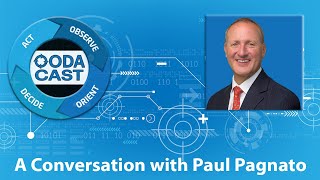
Paul Pagnato went from scientist to financial advisor and now argues that transparency is reshaping the financial industry. He discusses how exponential technologies are disrupting sectors and shares leadership lessons for entrepreneurs.
Chapters
Informing your decisions with intelligence analysis and insight brought to you by the team@ooda loop.com all right.
Welcome to Oodacast. This is Matt DeVoe, CEO of Ooda LLC. And I'm joined today by Paul Pagnato, who is the co chairman of Crescent, a top family office and wealth management advisory firm with around $10 billion of assets under management. Paul's very well known nationally and especially here in the Virginia area. He ranks 1 or 2, depending on whether you look at the Forbes or Barron's list for top wealth advisors in Virginia. Also an author of the book the Transparency Wave, which I've got a copy of here that we'd like to talk to. And an advisor to CEOs that are founders of companies that are going through liquidity events, which is how we first met. Obviously relied on Pagneto Karp, your prior company prior to the merger and guiding you through that process. You have an interesting background though by way of how you got in the financial services industry. So why don't you tell us about kind of, you know, how you started and how you got into the industry to begin with?
You bet. So when I went to school, I just followed my passions and that was the water. I love scuba diving. I love fishing. So I thought I'd be a marine biologist. So I went to Florida Atlantic for that. Thought I'd be the next Jacques Cousteau and end up obtaining a degree in microbiology. And so then I thought I'd put that degree to use. Accepted position with McDonnell Douglas and they had a contract with NASA and the contract was super cool. It was to detect life in outer space. So we were building these black boxes to put on the spaceships that were going to outer space with some really, really, really cool technology. So I did that for five years. Never, never found it. Never found life in outer space. I understand they're still looking for it and there's a high probability that it's out there somewhere. But then completely changed careers during that period of time. I realized that I like to talk to people during the course of a day as opposed to doing pure research 18 hours a day. Also realize I'm much more entrepreneurial and completely change careers to the financial industry. And I joined Merrill Lynch. I had some amazing mentors there at Merrill and I was fortunate to they were asked me to open up their private bank for them in Washington D.C. did that. It's a wonderful venture. And then the Great recession hit in 08 09. And when that happened, I, as many others were exposed to A big lack of transparency throughout the entire financial industry. And I went on a mission to find out, how could this happen? How could the regulators allow this? How could the industry leaders allow this? And I spent time with the chairman of the sec, Lewis Ackler, all the commissioners of the sec, Phyllis Borsey, overseeing all the Department of Labor, all the retirement plans. John Mack, at the time, he was CEO of Morgan Stanley. Todd Thompson, he was the CFO of Citibank. I met with everybody. I came to the conclusion that the problem was so onerous, so big, nobody was really going to address it. So that inspired me, as these obstacles inspire most entrepreneurs to solve a problem. So I departed to solve that problem and departed Merrill and founded Pagnato Carp. And we founded it on 10 principles of transparency. So to provide uber transparency in all aspects of wealth management and family office. So that was the journey. That's how I went from being a scientist to where I'm at today. But I'll always be a scientist at heart.
Yeah. I was going to ask, is there any aspect to kind of your experience as a scientist that you think informed your ability as a financial services advisor?
Oh, you bet. So from in the beginning, this was 30 years ago, you weren't just giving a bunch of clients to work with and manage your portfolios. You had to go out there and get it experimented in everything that I did. And so I would do everything. So I would do workshops, networking groups, seminars, cold call mailers, you name it, I tried it. And I figured some things figured out. Some things worked better for me than others. But then I also experimented constantly on value creation for our clients. At the end of the day, that's what it's all about. Serving, serving the people. And that has led to our company now being incredibly innovative. So we have eight areas of the company and each area is doing three to five experiments every single quarter. So what I hope is that just one or two pop out each quarter and we have more value creation for the client. So it integrates in the DNA of our company and our business. For sure.
It's interesting. I like the idea of having the experiments and seeing what comes of it, which is probably not typical, right? For a wealth advisor company, it's just the opposite.
And it's super hard because in the financial services industry, not a lot of failure is expected or is accepted. So you have to have a culture that accepts failure. And if you're gonna have a lot of their experimentation, that's what happens. So right when you're working in a lab you could have a hundred experiments that go on and you hope that one of them hits. So same thing now with our company, all backstage. These are not experiments that clients are receiving until we have success. But the culture needs to be one where people know it's okay to experiment, it's okay to try. It needs to be autonomous, needs to be bottom up versus top down. And that's very than the average wealth management firm.
Is there an example you can give of an experiment that kind of. That went through that process successfully for you?
You bet. So there's a ton. So here's one, here's a successful one. In serving ultra high net worth individuals, our clients average client has probably 20, 25% in private investments. So when you make a private investment, there's a lot of subscription documents that can be very, very onerous. And it takes on the advisor side, an individual literally hours to put all that together, make sure all the signatures are proper to correlate all that. So we were able to work with a third party to digitize the entire experience. So now it's literally minutes for one of our private bankers to work with a client to fully automate the paperwork. So that was about six month project and now it's live and we're one of the first firms in the industry to do that. So as an example where we had failure with took a lot to get there, but after six months we finally got there and now all clients have access to to DocuSign and digital tools to be able to subscribe to an investment. That's historically very onerous, which is also.
Prescient given the times that we're in where the in person meetings are not as viable. Right. And probably more firms looking to try and digitize. And you guys were able to get there first?
Yes. Yeah. The pandemic era that we're in, in March, you know, we made a decision to go remote, as most of our organizations did. And literally we had days to go remote and we needed to do that in a manner where it would be flawless for a client. So if a client needed to put in a trade or we need to rebalance a portfolio that needed to be seamless. And it happened. And then it was a period of time where people are looking to us for leadership. So what are you doing? The market was down 40% from the high. So everyone wants to know what's going on, what do we do? How bad is this pandemic going to be? So then we went to literally within weeks doing a series of events similar to yourself. Matt of virtual events to a week, which we had never even done a virtual event prior to that. So in a very short period of time, we had to become experts in zoom, like all of us.
Excellent. I want to talk about transparency first. Kind of get your definition of what it means in your industry, but then applied kind of more broadly and then use that as a transition to talk about the book, the Transparency Wave.
Yeah, so love, love, love that question. So in our industry, transparency to me means full disclosure, but full disclosure in very simple terms that anybody can understand. So, you know, you may, an investor may purchase a mutual fund and there may be tons of different fees associated with that mutual fund, you know, 10 B1 fees, trailers, upfront commissions, deferred sales charges, whatnot. And they may be provided full disclosure through a 30 page legal document called a prospectus, which the average person is not going to read, 90% of people are not going to read it. And if they did, they wouldn't understand what that legal document jargon is. So it's not just about providing full disclosure, it's doing it in very simple layman terms that anybody can understand. So in the financial world, to me that's, that's ultimate transparency in all we do. Yeah.
And how are you seeing transparency being adopted elsewhere in business and society in general?
So spending three years doing a deep, deep thinking and research on this led me to writing the book. And so I've studied company after company, industry after industry, and I've studied the DNA of the companies that are flourishing, the DNA of the companies that are now leading industries, the companies that are growing exponential and they have something in common. They've taken transparency to a whole new level in their respective market or a particular niche in their market. Look at Uber as an example. Right. So before Uber and ride sharing, we called a cab. We called a cab. We didn't know who the driver was, we didn't have transparency on who the driver was that's going to pick us up. We have transparency on their vehicle, their license plate. We didn't have transparency on their location and, and a lot of times didn't even know exactly what the cost was going to be. Uber changed that. Now with a couple clicks, we have complete transparency on all of that. So you can look at industry vertical after industry vertical and the leaders have done that in some way, shape or form.
Would you put Tesla in that category as well with kind of releasing patents into the public domain and kind of being transparent around even some of the IP that they're using?
Totally. Not just Their ip, but price. Right. I don't know about you, but one of the most energy draining things for me is to have to go to a car dealership and based on the price you pay, it's your negotiating skills and having to walk and price shop one versus another. They did away with all of that. They have complete transparency on pricing. Everyone pays the same amount. You go to their website, you order it online and in fact a friend of mine purchased a Tesla, hadn't received it yet and Tesla came back to him and said, well we know the contract was and you were going to pay X because we did a price reduction across the board, it's now Y and actually reduced the price of his car. I don't have another automobile company that's doing that. So yeah, I would put, I call those transparency beasts. Tesla's definitely a transparency beast.
Just went through the car acquisition process, not for me, but for my daughter. Right. So trying to guide a 19 year old through that was pretty interesting, right? Explaining the lack of transparency and the deliberate nature of negotiation. Educational for her in the very least. Are there examples of kind of non business entities? Are there any governments that you looked at or other institutions that you think are doing well by way of the transparency that they're bringing?
So I think there's organizations like Singularity University that does a tremendous job of bringing about transparency in all they do. So yes, organizations like SU, there's some NGOs that are doing a great job and part of the outcome that a lot of these organizations are seeking is transparency. Vince Cerf and Dr. David Bray founded PCI People Centered Internet. And that's the outcome they were seeking, is for everyone to have transparency on the downsides, on the risk of the Internet and usage of the Internet. So for sure there's some wonderful organizations that are. Their outcome, their mission is about bringing transparency to a whole new level and the niche that they serve and their constituents.
So the transparency is obviously a culture component. Do you think there's a technology component to it as well? The more that things are digitized, the easier it is. I think about governments like Estonia who have moved to primarily electronic interface with their citizens because everything is electronic, there's transparency with regards to the services that are being provided and the wait times and things of that sort. What factor do you think technology plays in that, Matt?
Huge. That is why I believe that's the fundamental reason why we've entered this transparency revolution like it is upon us. We're going through it right now. It's ripping through industry after industry, politics, organizations, you name it, it's all about transparency. So we had the first massive wave of innovation was the communication period. Advance of the airplane, the telephone, the printing press, the automobile. That led us into the digital era that we all continue to live through. While the highly intelligent digital aspect is machine learning, is artificial intelligence. And these aspects, there's nowhere to hide. You have complete transparency. And so this is now filtering in to industry after industry. So as the industries are becoming digitized and automated and advanced with machine learning, it's bringing about transparency in ways that we've never seen before. And it's very unsettling to a lot of people because it's changed. In fact, I believe transparency is one of the hardest things for a human being to do because it's deeply embedded in our DNA not to be transparent. You know, we survived 300 years ago, 500 years ago in the bush from a tiger by not being transparent. Right. From other predators. So now, in a very short period of time, you know, within a decade, it's being demanded upon us to be fully transparent. So when we get these emotional responses that are very real, literally, our hypothalamus ticks off, you know, cortisone hormone, our heart beats faster, we breathe more, our eyes dilate, is very real. When we feel vulnerable. Right. So being totally transparent, people feel vulnerable and they can be afraid of what other people, somebody else is going to think about them, or somebody else may use that data on them in a disadvantaged way. So very, very difficult to be fully transparent. But we're living in an era now where we don't have a choice.
Yeah. Do you think? I also feel like technology might be an enabler at the private citizen level. Right. I mean, one of the key issues is around agency. There's a, there's a ton of data that exists about me. I have agency over very little of it. But it seems like over time that there will be technologies like blockchain technologies, etc. That will give individuals more agency over their data so that I can be transparent where it benefits me, but then be a little bit more protective, like keep the predators at bay. I don't want the people studying me so that they can serve me up political ads, but I want Amazon to be able to recommend books to me because I want new reading material. So what role do you think technology will play on kind of the security or agency side as citizens try to be more transparent?
Tremendous. Like blockchain. Look at Apple as an example. They were one of the leaders in the space they were one of the first technology companies to come up with transparency of their privacy standards. So they created these privacy standards. And so, because we just want to know the deal, like, what are you going to do? What are you not going to do? Just tell me so I can be informed. Give me transparency and then I can make decisions. So you're completely spot on. So technology will enable us to be more confident in what's public or what's private and we'll be able to be more beholden to that.
So step me through the concept again, an exponential change. I know that's tied to the book and associated with transparency. Step through what you mean by exponential change and maybe an example of that.
You bet. So exponential is not an easy concept for any of us to wrap our brains around because we're linear creatures. So when we talk about Exponential, I'll give two quick examples. One is if you take 30 steps, you're going to walk 30 meters. So 30 steps is 30 meters linearly. If you take 30 exponential steps, guess how far you're going to walk. 26 and a half times around the planet. Mind boggling. That is exponential. That's what we're talking about. That's the era we're in right now. Another example is if I give you a penny a day linearly for 31 days, you're going to have 31 cents, 1 cent today, another penny tomorrow, the next day, next day, I give you a penny a day exponentially for 31 days. That's $10 million. Mind boggling, right? It's hard for our brains to wrap our brain around this, but this is what is now occurring, industry after industry after industry. So the change and the pace of change, mind boggling. You know, we hear a lot about these incredible predictions by people like Ray Kurzweil and Peter Diamandis and these individuals. Well, the reality is, you know, Ray Kurzweil and a lot of people like him, they're like 90% accurate with their predictions because they're all database. And more times than not, they come sooner, faster, earlier than what was expected. And that's because they hit the exponential phase of the curve. So it's an amazing, exciting period of time that we're in.
Are there any exponential technologies that you're kind of more excited about that are on that projection over the next 30 years, especially given your involvement with the Singularity University?
Yeah, some of the ones that are just going to change our lives are. Genomics is one. So it's gone exponential and the pandemic has fueled that even faster because of all the funding. Right. You see, just yesterday it was announced Novavax Biotech in Rockville, Maryland. The government gave them $1.6 billion. So you know, you have many, many companies, most of the vaccines that are underway are genomic based. We've never had a vaccine that is genomic based and now we're going to have a plethora of them. So we are truly in the genomic era. And I believe within 10 years all human diseases will be treated genomically. Already today you have approximately a million children born, babies born every year that have genetic defects that are life threatening, that can be fixed and addressed before they even leave the hospital. And it's just a matter of time that'll be fixed and changed. So genomics is one of them. Autonomous driving is another. Over a million people a year globally die from automobile accidents. There's no smog right now in LA because of the lack of traffic on the roads. Well, just imagine when we have are driving all EVs electric vehicles that are fully autonomous, right? It's going to be just amazing. 94% of all car accidents are human era. So the technology is there and next three to five years that will exponentially proliferate throughout the world. You think about our ability to multitask, right? So if we have a drive commute, the average person commutes. Now we all know this is changing, but the average person's commute to work is 30 minutes. So you go 30 minutes on both sides an hour. So you just gave somebody, you're going to be able to give somebody back an hour of their day when they're in a fully autonomous car to be able to do whatever functions they want. So that's an area that I absolutely love. Another area growing exponentially is 3D printing. You know, there's companies now making 3D printed mass to, you know, majority of car parts, to the rockets that are being launched to the machinery and hospitals. In space they have 3D printers. You know, the astronaut in space needs a new tool or a screw or a 3D printer cranks it out. So that's another area that we absolutely love. Another area is in fintech. So it is. There's so much friction with the traditional banking industry. There's so much friction to be able to transfer money from one institution to another institution. Most people aren't aware of this, but there's only five banks in the country that have direct access to the Fed. That's it, only five, but there's 6,000 banks. So all the other banks are going through. It's like a domino effect. Going through a bank, going through a bank, going through a bank for a transaction to occur. Well, blockchain is going to completely decentralize that and completely fix that issue. Square now, their technology is the fastest way to transfer money from here to Europe is using the Square app. It's, well, well on its way. 1 out of 6 adults uses the Square Cash app. It's pretty exciting. So those are some examples, Matt, of industries that I'm super excited about and that are beginning to grow exponentially.
And that drives opportunity. Right. Because if you look at the example of Square, it gives people access to a market, access to consumers in a way that's very low friction while reducing the fees. But it can also drive the entrepreneurial engine as well. It's very interested to look at the Travis from Uber, his new venture, this cloud kitchen concept, where they're basically, this is pre Covid standing up these kitchens where you can go and rent the kitchen to provide a takeout or delivery type service. But not only that, is they can provide you the data that says, hey, there were 15 people that were looking for buffalo wings in this geography. That didn't satisfy the search. So what would be really receptive is you could go build a buffalo wing kitchen, one of our cloud kitchens. So it's kind of amazing to see kind of how the technology also removes friction from a lot of these processes as well as.
Yeah. Which is increasing the client experience.
I know. And, you know, in giving my money to my daughter, it's easier to use Square and PayPal and some of these other technologies than to actually use the banking system. Talk about the lowering of the friction.
And they're growing up with that. You know, that's innate to them. They're growing up with that. In fact, the majority of college grads, they use Venmo. That's their number one tool is Venmo and Universities, which is owned by PayPal. But Square now has more monthly active users, 40 million than Venmo. Venmo has 35 active monthly users. So that just gives you a sense for how fast this is occurring and truly at an exponential pace making its way across.
And you think we've reached that kind of exponential pacing now? Because I can go back 20 years to being with my geek friends, obviously only, but being excited about the fact that we could use our Palm Pilots to send each other money over PayPal. Right. So the technology has been there for a while, but you think we've now entered into that exponential phase for it.
This is prime time. So yeah, we live through the dot com bubble, the tech bubble. We've lived through a lot of these and a lot of these technologies were, you know, conceived and templates were created. But now it's, now it's prime time. Now it's happening and they're being executed.
And you have the device ubiquity, you know, as well. So I mean, I remember with the version over my Palm Pilot, you could send money, but only if they had a Palm Pilot and it wouldn't actually send the money until you get back to your home and synced it with your computer. I mean, there were lots of kind of nuances is associated with it. Now I'm happy to be able to walk into the grocery store and just tap my phone and that's it, I'm done. That's the end of the transaction. Awesome. We always like to focus a little bit as well. Given that we like to look at leadership issues and decision making. As part of the OODA Loop piece, what are some leadership lessons that you learned along the way? We talked about transparency being a big one. But what are some of the other ones that have kind of guided you as an entrepreneur?
I think as a leader of an organization, it's super important to have alignment and alignment on your vision. I term it your mtp, your massive transformational purpose. So what is that mtp? What is that vision? What's the impact you're going to make? Because at the end of the day, that's what moves people, that's what motivates people, that's what draws a community together so that a leader needs to be constantly prophesizing that. But then you need to have complete alignment from top to bottom on not just the vision, but then how the game plan, how you're going to get there from point A to point B. And so we utilize something called a focus three. It's impossible to focus, I believe, on 10 things. So three is the magic number there. So as an organization, every year we have a Focus three and then we break that down into quarterly and we break it down into weekly. So every single team member has a weekly Focus three that they create and they provide complete transparency on what that is for everyone around them. And it starts with me. So every week I send a note out, just as you might send a note out with your readings. I love that. So, you know, my goal is to provide leadership. I provide my Focus 3 for the week. Everybody in the company knows what that is. I Also point out all the positives. You know, it takes five positives to overcome one negative. So us as leaders, we can't overdo it with the positivity. Right? People need that soul so bad. That's just the way our human brains work. So I'm always looking for ways to point out the successes and the triumphs that team members are having that the organization is having. We also have the company run bottom up versus top down. You know, that was a transition we made some time ago and it wasn't easy because the individuals that normally are looking to somebody else, looking to that leader for maybe some large business decisions that need to get made spontaneously or that day, they're now empowered to make those decisions. And we've given them the confidence to do that. And that's where it gets back to having failed. We employ fail fast. Right? So success is failure turned inside out. The companies that are growing the fastest, they're having the most failures. They're just getting to point A, to point B a lot faster. So having a culture that accepts failure and one where we all have the confidence to acknowledge our failure, make the tweaks and then get it right. So those are some items that we follow culturally that are so important to leadership.
Excellent. What advice would you give to an entrepreneur? You know, given today's climate, we live in this time of exponential change also exponentially, exponential disruption as well. Right. Just with the things that have been happening in politics and with COVID et cetera. So what advice would you give to kind of an existing founder?
So three things. Be a data based organization. So make decisions based on the data and empower your team members, your employees to make decisions based on the data. Utilize dashboards. Utilize dashboards for that data to flow up and funnel up so that you and others, you can hold yourself accountable and everybody else can hold themselves accountable to what the metrics are, what the KPIs are, the key performance indicators. And thirdly is have a culture of transparency. If your company doesn't have a set of transparency standards, create it. Work with your team members, work with your C suite, work with your clients, and take the level of transparency in your market, in your industry to a whole new level, and it'll blow your mind. The changes in your people and the growth.
Excellent. That's awesome. It's great advice. I know you're very well read, consume a lot of information. Obviously a lot of it is financial based, right. Given the field that you're in. But what are some sources of information that you rely on that maybe are a little unconventional given your field.
You bet. So I read all the research and content that comes out of Singularity University. Abundance360 Peter Diamantis Co. I read everything that Bill Gates pushes out. Every one of his YouTubes and the gates Foundation. Love all that content. Same thing with Warren Buffett. I love reading his annual shareholders meetings. I think that's just a must read for an entrepreneur. It's about business and about partnership. A recent book that I read that I love is Sapiens. Just a tremendous perspective of the evolution of us as human beings. How we process the way that we process. Yeah.
Excellent. Cool. I was going to ask you about the book next, so you jumped ahead of me. Jumped on for me there. That's awesome. This has been very insightful. Really appreciate you taking the time to chat with us. I'd encourage people to take a look at the book. We'll put a link to it in the comments below the video or in the comments of the podcast field. So, Paul, thank you so much for joining us.
My pleasure, Matt. Thanks for having me. Very grateful. Thanks. Cheers.
Thanks for listening to this OODA Loop production. For the latest analysis on cybersecurity, technology and global risks, please visit www.ooda loop.com.
More from Matt


Leading Cyber Change: Allan Friedman on the Revolution of SBOM & Future Cybersecurity Initiatives


Revolutionizing Medicine and Tech: Joe Tranquillo's Journey into Complex Systems






Bob Zukis and the Digital Directors Network: Helping corporate boards mitigate systemic risk

Adam Shostack on Cybersecurity and What Every Engineer Should Learn From Star Wars