Rear Admiral Paul Becker, USN (Retired) on Intelligence and Leadership in the Modern Age
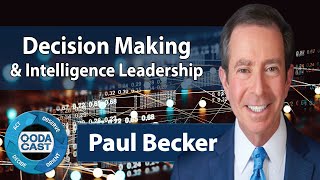
This content was created by Matt Devost. This content was uploaded by Matt Devost. This is a YouTube video titled "Rear Admiral Paul Becker, USN (Retired) on Intelligence and Leadership in the Modern Age" featuring a conversation between Bob Gourley, CTO of OODA LLC, and Paul Becker, a retired Rear Admiral. The discussion covers Becker's career in Navy intelligence, leadership principles, and the concept of T3 (teamwork, tone, tenacity). They also discuss the current state of the intelligence community, the threat from China, and Becker's personal experiences and insights on leadership and ethics.
Chapters
Informing your decisions with intelligence analysis and insight brought to you by the team@ooda loop.com.
Hello.
I'm Bob Gourley, the Chief Technology Officer of OODA llc. Welcome to the oodacast. Paul Becker, good seeing you.
Hello, Bob. Great to be with you.
Well, Paul, it's a real pleasure for us to be talking to you today because I've known you for so long and I also had a career in the Navy intelligence community, so I know a bit of your spirit. And it's just a real pleasure being able to introduce you to our community. So thanks again.
And it's so close to the Navy's birthday, which is coming up on Monday. We're 245.
Yeah, that's right.
Very proud to be part of it. Yeah.
So, Paul, let me give a brief overview of your background from my perspective, just for context, for people today. You are a consultant, author, speaker. You're widely known for your translation of military leadership principles into corporate action. And you're great at that. And you're great at capturing lessons not just from your own career, but from everything you've observed in the military and from history itself. So that's your current what you're currently doing at the Becker T3 group. And your background, though one way I have thought of you is you've always been a leader, which means you've always been a teacher, but you're also a professor now. You teach at the Naval Academy. You teach a course on ethics and moral reasoning for Naval leaders. You also teach courses at the University of Virginia. And I want to get back to that in just a minute, but back to your history in the Navy. You joined the Navy in 1979 when you started at the Naval Academy and you were commissioned to Ensign in 1983. Your career saw global deployments ashore and afloat in positions that I would mostly describe as operational intelligence or opintel positions. And I want to talk about that a little bit more in the future, too. But for now, I wanted to tell people that you rose to the pinnacle of that profession of operational intelligence as the J2 or Director of intelligence for the Joint Staff, which is a place I have observed closely. And this is just a critical position for helping the nation make operational decisions on how military forces are engaged and how they should be engaged immediately afterwards. It's just critical to our nation's ability to know, Paul. That's kind of my view of where you've been and what you've been up to and what you're doing now. Did I get that about right?
All true, and with very kind adjectives and compliments. Thank you.
All right, thanks. So there's so much I want to talk about, but one thing I think would be really interesting is hearing your foundational story. You know, what made you want to join the Naval Academy, and what was the deciding factor there that brought you into the service?
Bob, I grew up in New York City and in Long Island. My dad was a cop, and my mom was a mom to four boys. After my older brother went to college, he's a couple years older than me, my dad sat me down in his office one day, which was the kitchen table, after mom cleared away the supper dishes, and he explained to me his financial facts of life. And he asked me which service academy would I be applying to. And that was the First Herd, as we say. I thought about it, and the World War II and Korean War heroes that I saw on TV and in the movie theaters growing up. Of them all, the Navy leaders struck me as the most motivational and charismatic, whether it was Henry Fonda as Mr. Roberts, Naval Service, John Wayne as Sergeant Stryker, Sands of Iwo Jima, Gregory Peck as Captain Horatio Hornblower, and even Ernest Borgnine as Lieutenant Commander Quentin McHale in McHale's Navy, who was still engaged in combat but seemed to be having fun while he was doing it. So I didn't even apply to the other service academies. I applied to Navy, and thank goodness I was accepted, and this began my Navy adventure.
This is fascinating, Paul. Thanks for sharing that, because it's amazing. One point that makes to me is true. Leaders, their impact can go on for generations. So leaders of the past inspiring you to join the Navy and become a leader yourself, it was just fascinating. Then you, you graduated from Naval Academy, and what, what was the shift into the intelligence career? What caused that?
Well, well, like the founder of the OODA Freys, Colonel John Boyd, I wanted to be a pilot, but I had some surgery as a midshipman, which put me in the not physically qualified category to go to Pensacola and Navy flight school. So I thought the next closest thing would be to be a squadron intelligence officer. So I'll be part of the aviation culture. I'll deploy on an aircraft carrier. But it wasn't what I aspired to do, but I figured I could do it for five years and then I'll leave the Navy and become Mr. Becker. But after five years, I really liked the challenge, the opportunities, and I decided to stay for another tour and another and another. And it got to the point where, okay, at 20 years, that's a good run. Now it's time to become Mr. Becker, with a pension and a nice career behind me and a lot of real life experience. And as we were approaching 20 years, that was nine, 11. And America went to war. And at that point, I didn't think it was the best timing to leave the service. I had just participated actively in Operations Enduring Freedom from the Northern Arabian Sea and Operations Iraqi Freedom from the Air Force's Combined Air Operations center at Prince Sultan Air Base in Saudi Arabia. So I thought, well, let's see how the war is going. And it took 13 more years before I finally decided to hang up my khakis and become Mr. Becker and join the private sector.
Great. Thanks. And Paul, a couple other questions or topics that I want to pull from your career. And one is, in my time in Navy Intelligence, I had heroes and people.
I looked up to.
I'm sure you did, too, like Max Showers. What a great thinker. Bill Studeman, Mike McConnell, these are great masters of operational intelligence. But throughout my career, I had never heard of this guy, Colonel John Boyd, until I went to school with the Marines at the Marine Corps Command and staff in 1996. Those guys were all over John Boyd. And once I learned about his process for Observe, Orient, Decide and act, I recognized it as the kind of stuff we were doing in Naval Intelligence. We just didn't have that model on it. And you told me earlier about, you see his plaque at the Naval Academy. And that just really gave me hope that his impact is enduring in the military.
Yeah, I'm glad the midshipmen know who he is and why it's important to follow the tenets of ooda, but to even shorten that acronym a bit, rather than four words. Two that come to mind are Decision Advantage, which is ultimately the goal of intelligence. It's not to sit back, collect and admire information and data, but it's to act on it. And that's Decision Advantage. And that's what Colonel Boyd was all about. Right.
Great. And that is so relevant to corporate America today, too. It really is about if you want to win, you have to have a competitive advantage. And that Decision Advantage is a key way to do it in this information centric world. So another lesson I want to ask you about, Paul, is I would love your thoughts based on your career and your studies to date on leadership in management. Any thoughts there? I especially like asking people like you, what's the difference in leadership and management.
They're cousins and they're mutually supportive. And I'm A fan of both. Each have their own place, but it's important to recognize what those places are. Management is of things. Leadership is of people. My good friend from high school, Anthony, is an accountant, but he got tired of just being an accountant, and he just didn't want to manage accounts. He wanted to start a business. So he created an accounting firm. He led it. He had a vision for what the accounting firm would do. He provided motivation to the team that was working. He recruited to keep talent coming in. And he had a manager, a junior accountant that kept track of the things that needed to be done. And I put a bow on it by using a few adjectives. I think management is more measurement, regulation, control, whereas leadership is more a process of influence, expansion and creating value. Anthony is a very successful accounting firm CEO now in Long island, and we still keep in close touch.
That's cool. That's a good, succinct way of capturing that, Paul. I appreciate it. Let me ask another topic.
Success.
In your mind, what is success?
There are so many metrics of success, but to me, it comes down to the feeling that, you know, you've done your best to achieve an objective. Success is not the accumulation of accolades or materials, although that's a component of it for sure. My apologies for the phone disruption there. But to me, the feeling of success comes from an expectation that I've attempted to fulfill an individual goal and it may be a personal record. I'm a swimmer. I have a certain amount of time where I like to swim a mile a day. It's now hovering well under an hour. But when I started, it was above that. That's success in its own right, hitting a performance mark. There are other metrics as well, but whenever you can close the gap between your potential and your peak performance, to me, that's the definition of success.
Awesome. That's great. Very helpful. Now, another. I know you're teaching University of Virginia and the Naval Academy. The Naval Academy. You're teaching these young leaders ethics and moral decision making. Is there anything you can succinctly put up. Put to me now. To us now. That encapsulates your entire class in a couple sentences. What should a leader know about ethics in their morality, in their decision making?
Well, we want the midshipmen to have the framework to think about doing the right thing and whether that's as a follower or a leader. So while we cover philosophers from Aristotle and Marcus Aurelius and the Stoics up through Kant and Mill and the utility theory, we at a ratio of 2 to 1, apply case studies from the fleet as to what did this ship's captain do when they were confronted with this situation, or what did this Marine platoon leader do during the Battle of Fallujah when they were confronted with this collateral damage conundrum? And we let the mids think for themselves and we guide a discussion there. But the goal is to build people of integrity right where their values and their actions match. When there's a separation, that's a cognitive dissonance, something we want to avoid. And we coach them to bring their performance up to the level of their values, not bring their values down to the level of socialized or rationalized performance.
Awesome, Paul. So now we've talked a bit about operational intelligence and decision advantage. We talked a bit about management and leadership and success and ethics and decision making. And I wanted to say you're a great teacher of all that. And you're also personally an example of a leader that I want to keep learning from. And one of the things you've done to help explain leadership to people like me and everybody else is you talk about this concept of T3 and you do it consistently and in a very enjoyable way. You talk about teamwork, tone, tenacity, and you hit this lesson again and again and it's starting to sink in with me. It's really having an effect and I'm starting to get it. But I wanted to ask, in your words, what do you mean by T3, what is this?
Well, T3, teamwork, tone, tenacity. It's my credo, it's my maxim, it's my brand. And in today's Twitter tuned, Facebook, friending, LinkedIn looking world, it's okay to have a brand and an identifier. These three characteristics, T3 for short, these were the characteristics of the greatest leaders and the highest performing teams that I ever saw in peace, crisis and combat over 30 years in uniform. They're mutually reinforcing. It's a short, actionable, memorable, as we called it in uniform, commander's intent. I had the opportunity to share it with the units that I was associated with. It's a triangle. It's not always an equilateral triangle. Sometimes there's need to put more emphasis on one of those three T's compared to the others. But now that I'm in the private sector, I see that all three translate to the corporate pillars of performance, productivity and profit. So T3, the name of my consultancy, it's a platform for my speaking, whether it's organizational development, individual coaching, motivational or inspirational. Speaking or national security, cybersecurity consulting. That's how will work on things. The why and the what we fill in along the way. It's also served as a framework for me. When I was undergoing stage four bone marrow cancer treatment all through 2015 and I was enduring extreme adversity on the ropes a couple of times, this gave me something to fall back on, something I knew professionally, but I could apply it to my personal circumstances as well. Bob I needed to create a new team with medical professionals to understand what was happening. I needed to generate my own morale because my wife and I were up against the wall and the outcomes were uncertain and we needed to fight like we hadn't fought before. So tenacity, much more than just endurance. It's perseverance with purpose. It's grit, it's resolve. It's putting it all together to achieve a desired outcome and realizing that you may have to go over, around, underneath or through an obstacle on the way. So it's a framework for life in addition to a framework for business.
Very helpful and I appreciate your context. And I want to say after thinking about your approach of T3, I can't think of a business leader who succeeded anywhere without those kind of characteristics. Oh, you may have brief spurts of success if you're a butt head, but eventually it's going to catch up with you. Or you may have brief spurts of success if you're an individual who doesn' like to work with other people, but you won't get that far. And you've got to have that grit, that tenacity, that persistence. And I just, I really like the way you have brought all that together into one picture. So one of the things we're going to do in the show notes here is I want to point to your website so people can reach out to get more on this. And I also think, man, it'd be great if I could read more about this via a long form book. One of these days you've got so many stories you're already telling that's in the works.
And as you know, you're very kind to comment on my social media footprint where whenever there's a historic date or a historic birthday, I try to link that person or an activity to either one of or all of the tenets of teamwork, tone, tenacity. Cool.
Well, I also want to ask a couple other questions, Paul, about your information sources. What do you do to stay current? And I'd especially like to know what books you're reading now or what Recommendations for books you have for us to read?
Sure. In terms of current intelligence, I read news sites, multiple news sites, and. And I have a LinkedIn dashboard that provides me diverse sources of information and functional areas as well. I probably spend 45 minutes a morning reading overnight news, and sometime after dinner I'm catching up on another 30 minutes of what I may have missed during the day. Books have always been my friends. I'm glad you asked me about that. My goal is to read a book a month. I'm generally on track with that. Over the last three months, I've read three books and my friends at Naval Institute asked me to review them. And they'll be the last two months of proceedings and one coming up. One's called without the Saga of Gettysburg. Happen to have it here? I'm very tactile, Bob, you know, I still enjoy, you know, flipping through pages. So Without Warning is story of the Battle of Gettysburg told through the deep narrative of General George Meade. And the Civil War has been front and center in American political and social discourse this spring. Right. So that's what prompted me to get with this one. It's written by a former Navy surface warfare captain named Terry Pierce. And like Michael Schirra's Killer Angels, you know, of some decades ago, he goes through a historically accurate dialogue based study of General Meade taking command of the army of the Potomac just three days before Gettysburg, not knowing where Lee was at the time in the Pennsylvania countryside. Talk about decision advantage. Once he found out, what would he and his subordinates do? So there were great lessons there on dedication to duty, devotion to planning, flexibility in execution, action in the absence of clear indicators. And there was humble, apolitical military leadership. So love that. It's a hefty read and most importantly, it's just been nominated for the Pulitzer Prize for 2020 for historical fiction.
Great. I'm going to look for that for sure.
It's not just for us. I mean, that's some, some pretty significant acclaim. Another one, exercise of power. Right from Robert Gates, former Secretary of Defense, longtime national security stalwart. Many write about national security affairs. Few write about it that actually held power, which Gates is one. So a timely read. National security issues always near and dear to us. And the other one from my former boss on the Joint Chiefs of Staff. No time for spectators. Right from General Dempsey, who encourages whether you're a leader or follower, get off of those sidelines and live a felt life. A phrase he heard as a cadet at West Point, to go about and do it. And the one I'm tackling right now front burner by Commander Kirk Lippold. He was the captain of the USS Cole. And we're coming up on Sunday or Monday is the 20th anniversary of the attack on coalition. This was Al Qaeda's step of directly targeting a US military entity, which brought us into a whole new couple of decades of counter terrorism activity in Southwest Asia.
Right, right. Fascinating. And that it brings back so many memories when you say that there was so many indicators from that attack that I guess you could also write a book titled without warning about the 911 attacks. Maybe there should have been warning, but let me that kind of is a good transition. I would love to ask you some questions about today's intelligence community. We both track that closely, of course. And I was in a conversation with some other people a few days ago and we're talking about the future of the intelligence community. And in the past, you know, the intelligence community has been around since the time really of General George Washington who needed eyes on and an ability to collect information on the movements of the British during the Revolutionary War and of course needed mechanisms to protect his own information and to make decisions. But it's evolved over the years and the last major evolution was the national security Act of 1947 after World War II, which established the CIA and put in place a basic structure of what's there today. That's been changed a little bit over time. There's been some renaming of organizations, there's been some merging. The National Geospatial Intelligence center didn't exist back then, but it exists now. There's been the creation of the odni, the Office of the Director of National Intelligence, which in some ways is a change, but just a minor change. There used to be a Director of Central Intelligence. What I'm getting at is I want to ask you a question this way. This organization seems to be working the same way it is today that it did in 1947. What commercial enterprise would operate the same way it did in 1947 that it does today? The world is changing. Shouldn't the intel community change? And if you agree with that thesis, how should it change?
You mentioned the national security Act of 1947. I'd add to it the Intel Reform and Terrorist Prevention act of 2004 which created the Office of the Director of national intelligence in 2005 is pretty significant. Step up. Right. You recall post 911 it was exposed we had single threaded intelligence reported and analysis generally flowing to the national command authority. And we didn't adequately integrate all the resources of the 16 elements as they are now of the intel community. So let's create a staff to make that a little more integrated. But in my opinion, Bob, seeing it in action now for 15 years. Right, it's a bloated bureaucracy. Right. The Office of the Directorate of National Intelligence. I'm for there being one. The law says there should be one. It's added tangible value in creating some synergies. But on the whole there are hundreds if not thousands of intelligence professionals working to manage, not necessarily lead. And this comes at the expense of some of these people working on innovative and modernized intelligence collection, analysis, processing, OODA equivalent practices that should be exercised and empowered at the edge of the individual communities. Whether it's the Office of Naval Intelligence, whether it's the Drug Enforcement Agency, whether it's at the FBI national Security element. Along the way, I think the Office of the Director of National Intelligence can be scaled down to a smaller council that can help manage the budget and lead current efforts at synchronization and integration. But that synchronization and integration is the management aspect of the intel community. And I think there's too much resource devoted to it at the expense of analysis, innovation and application with the war fighters or decision makers to prevent war fighting.
Right, Thanks, I appreciate that. Paul, in our remaining time would love to ask you a few other questions about the operational situation globally today. And of course not relying on any sensitive information at all, we can both observe actions that China is taking on the international stage and actions that the US is taking in regards to China and the impact that may have. And I just wanted to ask your general perception about the Chinese threat. They're a topic of presidential debates and the vice presidential debate for example. And I would just really like your context on what is the threat from China?
Yeah, it's an existential threat, Bob. China poses a threat to the existence of the way Americans live their lives today. I'm not talking about old fashioned Soviet nuclear throw weight that they could eliminate what portion of the country with high blast weapons, not that type of existential threat. But diplomatically, informationally, militarily, economically, if China brings its full force to bear, it could impact daily American lives. From a Chinese perspective, they are in an information war with the United States right now. Their authoritative writings and speeches declare it to be so. And this is all part of their Chinese grand strategy for rejuvenation. Their word, not mine. By 2049, the hundredth anniversary of the founding of the Chinese Communist Party, they will return to a position of preeminence in Asia. This is according to their plan. And they have interim objectives along the way. Information warfare, cyber warfare, media warfare, intimidation, psychological warfare. Any kind of warfare, when it comes down to it, is just trying to bend an adversary to your will. And that's what they're trying to do. And something I know is a strong sweep for OODA is emphasis on cyber. Right? And it's important to recognize our adversary. China's perspective on cyber. Whereas the US sees cyber as a seamless landscape of global networks that are open, interoperable, secure, reliable, based on norms of behavior, respect for property value, multiple stakeholder governance, this is the Internet, the World Wide Web as we know it. China has a very different perspective. They view cyber as a sovereignty issue. That's why they have a great cyber wall. It's state controlled authority with the United nations, where one nation would get one vote. This ensures stability for the Chinese Communist Party, which allows them internal stability with a lot of people and economic growth. They also use cyber, as they call it, as an assassin's mace, an underarmed protagonist's weapon against a larger hegemonic foe, which they see us to steal. Our intellectual property estimate between $256 $200 billion per year in intellectual property theft from the United States, according to the FBI. And China has an incredible social welfare database. That's what they call it. I've seen a lot of Australian investigative reporting on this. They call it their overseas key Information Database. 2.4 million names of global influencers globally. And the Chinese keep files on those names. No doubt names taken in part from the OPM data breach of some years ago here in the United States, but via social media and other sources as well. So they're building up their databases.
For.
Whatever they think is necessary. And this leads to put a closure on the discussion of intelligence, Right? I've long said with you in uniform and beyond, good intelligence is good storytelling. It has to be truthful storytelling, right? But it needs to be compelling. And this is a story that needs to be made more aware, right? To the American public. It's why I've always gravitated towards operational intelligence or actionable intelligence. It would be the corporate equivalent of me always working in the chief operating officer bin. I like the action, I like the give and take. I like the multiple sources of input. I love the variable outcomes that come with it. And good intelligence, good operational intelligence needs to be timely, it needs to be relevant and it needs to be actionable. Otherwise it's just data and information where one admires a situation. Yeah.
If it's not actionable, it's not driving that decision advantage. Yeah.
I loved as an intel officer to sit down with a decision maker and say here are the facts, here's what I think. Separate, here's what I don't know. So there's some risk management involved and.
Here'S what I recommend.
And to be part of that decision cycle in uniform, whether it was the profession of arms and the execution of U.S. national security strategy or in a C suite. Right. As we're going to embark upon a new adventure with some significant resource outlays perhaps, but understanding the risk, but understanding the reward and the desired outcome. And then when you put the plan in place, well, that's when you apply the teamwork tone tenacity t3 to tie it all up.
Awesome Paul. I really appreciate all this today and one of the things I'm going to do is capture in the show notes how people can reach out to you and get more information. I'm going to put in our write up a link to the Becker T3 group website, to your Twitter and LinkedIn profiles as well. Is there anything else I need to capture for our audience? Any final thoughts?
I look forward to continuing the dialogue Bob, on a wide scale OODA basis or 1v1 with the members of the network. I'm a strong believer in networks and value added and expansion and those are tenets of leadership. So I look forward to continue the discussion and add value wherever I can. Awesome.
Well thanks again Paul.
Thank you Bob.
Thanks for listening to this OODA Loop production. For the latest analysis on cybersecurity technology and global risks, please visit www.oodaloop.com.
More from Matt


Leading Cyber Change: Allan Friedman on the Revolution of SBOM & Future Cybersecurity Initiatives


Revolutionizing Medicine and Tech: Joe Tranquillo's Journey into Complex Systems






Bob Zukis and the Digital Directors Network: Helping corporate boards mitigate systemic risk

Adam Shostack on Cybersecurity and What Every Engineer Should Learn From Star Wars