The Indiana Jones of Data Jer Thorp On Living in Data and Creating Better Futures
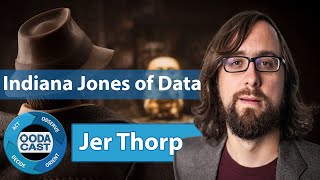
Jer Thorp talks about his book Living in Data and how data shapes decisions and society. He explains why data should be understood as a verb, not just a noun, and shares work from the 9/11 memorial and indigenous data sovereignty projects.
Chapters
Informing your decisions with intelligence analysis and insight brought to you by the team@oodaloop.com.
All right, welcome Matt DeVoe, the CEO of OODA. And this is a oodacast with Jer Thorpe. Jer is an artist, writer, teacher, living in New York City, best known for designing the algorithm to place the nearly 3,000 names on the 911 memorial in Manhattan, was the New York Times first data artist in residence, a National Geographic explorer, and in 2017 and 18 served as the innovator in residence at the Library of Congress. We'll link to the full bio before I've only read the first paragraph. It's very extensive. But what caught my attention was this book that he wrote called Living in Data, which really, for me, people that watch the podcast know I'm an avid reader, read over 100 books a year, and it's rare for something to stick with me like this book has stuck with me. I keep bringing it up in conversations. I keep recommending it. I've already announced that it'll be one of my top 10 picks of the year. And I think what really attracted me to it is I've read a lot of books about data science, but this is really kind of the human view of data science. But even more so given my hacker heritage. You know, my interpretation of Jer's work was that he's kind of a data hacker, that he's looking at the totality of the data and the systems that they exist with and asking the hard questions or looking at ways to construct the way that we use data in a way that is better for society. So with that jar, welcome to the Oodacast. Very happy to have you here.
Yeah, thanks for having me. It's really nice to be having this conversation. And I don't know, maybe you should just expand your list to 11 so that you're. You have a little more space. I don't mind being on the list.
But yeah, it's actually the most popular blog post I produce every year, which I guess is saying something. I get an avid group of folks that like to see what made the top 10 list. But hey, I'd love to hear your origin story. Can you just kind of step us through the progression of your career and some of the interesting things that you've done?
Sure. So I'm Canadian. I grew up outside of Vancouver in a suburb called Tsawwassen. And if you went to my basement in 1985 when I was 10, you would have found two floor looms, a pretty brand new Mac computer. And a box of punch cards that my dad brought home from his job at IBM that we would have used as kind of scrap paper. And I think those three things kind of tell the whole story. My mom is a textile artist, and my father, he started off as a programmer. He's more on the kind of thinking side of things now. But it's not a surprise, I guess, that I ended up somewhere in between those two things. As an artist who uses tech, I tried to avoid the computer business for a really long time. I promised myself as a teenager that I wouldn't get into computers because I was already nerdy enough. And the last thing I needed was to be the nerdy computer guy. So I kind of kept that hidden in some ways. And I went to school and I studied cell biology and genetics and really purposely kept away from programming and from computers until I dropped out of school. And at some point, one of my friends was kind of on the on ramp in the first kind of.com boom at the end of the 1990s. And I thought, okay, well, let's get a job. And at that point they would kind of hire anybody who, who could type on a keyboard. So they were looking for Flash programmers. And I didn't know what Flash was. So first I went and found out what Flash was. And then I spent a weekend just kind of hacking at it and put together a resume that over exaggerated my ability to do anything. And I got hired as their lead Flash, the lead Flash developer at this company. And so I would go to work, you know, all day, every day, just kind of nodding my head and saying, yes, of course we'll do that. And then I would go home and furiously try to learn, learn how I, how to do the thing that I had said that I knew how to do in the morning. So, you know, that was, that was my entry into, into this as a kind of job. And, but, but this is, I think, where, where we can circle back to those early days of being connected to the arts is that the way that I would learn how to do these things was never about thinking about how to do the practical thing, like how do I build a dropdown menu or whatever that might be. I would like, oh, let's see if I could build a tree or build some strange organisms that follow each other around the screen. And that was kind of the flavor of those days if people of a certain age will remember the Flash experiments pages. And so I had a Flash experiments page. And, and eventually he eventually found, got really, really tired for a lot of reasons about the business side of technology, and. And just kind of made the decision that I would start working on the weird stuff instead. And that was a good decision because there's like, a lot of people who do normal things, but not that many people who do weird things. So somebody has a weird idea, like their pool of people to choose from is smaller than if they were like, I have a normal idea. So kind of against what I expected. What happened? I kind of started to get more work and weirder work, which was great. And then when I moved to New York in 2010, I had met Nick Bilton at the New York Times, and there was an opening for somebody to come in and work on a project. And he's like, oh, I know this guy who does weird stuff because it was a weird project. And that's how I ended up with the Times. And then the rest of that history is really in the 300 pages of the book. And what I try to bring people through in that book is how my thoughts changed about, first of all, what data is and then what are the things that we should be doing with it, and maybe most importantly, like, who's welcome to do things with it and whose voices are sort of able to get in the room when we're talking about data.
Excellent. It seemed to kind of also have focused on kind of data in the field. I don't know if it's a thought that crossed my head or I read it somewhere else and it stuck. Kind of describing as the Indiana Jones of data. Can you. Can you discuss kind of the allure of kind of the field research and the kind of the obscure field data projects that you've been involved with?
Yeah, I mean, first of all, I do have a nice pair of leather boots, but I promise I'm not stealing anything from jungle tombs to bring it back to my colonial museums. But yeah, you know, there was a feeling in. In when I was working at the time. So I worked at the R and D group in the Times, and I worked primarily with a statistician and also an artist named Mark Hanson. And he really got me to start asking questions about. I guess we can think of it as the provenance of data, like where the data is coming from. I think it's pretty easy as a data scientist or like, data, put job after data, like data, whatever you want to call yourself, Istanbul is that it's easy to kind of have that data served to you on a plate. You know, what your job is to do with that data. But it's actually kind of not in your job to interrogate the data too much. You might want to know what the error ranges are in the numbers, or you might want to know if there was some big piece of the data that was supposed to be there that's missing. But you're probably not asking much about who collected that data, what were the decisions made about, about why that data was collected and how. And so I started to get really interested in the moment of data genesis, like the moment in which data is created. And really as a way, I thought, to make my own practice better. In 2013, by actually kind of sheer coincidence, I got an email that told me that I was awarded as a National Geographic Explorer. And I thought it was a spam message. National Geographic is pretty generous with their marketing. And so I just thought it was like, you're an explorer too, like that kind of message. And it took a couple of emails to be like, oh, no, okay, this is actually a thing. And so I ended up going to the National Geographic headquarters for their annual Explorers Symposium, and I met a scientist named Dr. Steve Boies, who had been really the beginning of a long chunk of field work in the Okavango Delta, which is in Botswana. And we just got to talking about what he was doing. And their job was really around collecting data. But they had pencils and paper that was like, they had waterproof paper and pencils, and that's kind of what they were doing. And so we got around the very, maybe nuts and bolts discussions about data management, like how we could build a database that would support their work, but then also data as a story, and. And the necessity to sort of make it something that isn't only there to be used by scientists, capital S, but by teachers and students, by conservationists, by the generally curious, by artists. And so we ended up building this big system that tried to do all of those things. And so that really started off what I would think of as like what you described as data in the field. Because there was a moment which I describe right in the beginning of the book where I was in the boat with my colleague Shah Selby, and there was this three and a half ton hippo coming towards us in the water and it was pulling this big bow wave and everyone was shouting. It was like, we're right approaching this catastrophe. I was trying to figure out we're in this very section of the river which is named for. Was colloquially. Colloquially, I can't even say that word. Anyways, it was named for maybe obvious reasons, Crocodile Alley. And we were about to be Thrown out of the boat into Crocodile Alley. There's this hippo. And I remember just thinking, maybe I took this data thing a little too far. This is close enough. But those experiences really informed my thinking in all kinds of ways. And there's a few of them in the book that really are trying on purpose to bring you to a place that you maybe don't necessarily bind with the word data. And that's a lot of what the book is trying to do. It's just kind of like pull your brain apart in ways that you might not have expected so that you can think about what data is a little differently.
Excellent. There's a concept you introduced early in the book and then kind of dismiss a little bit as maybe something we're not ready for. And that's the use of data as a verb. That also got me thinking, even in my own field, which is focused primarily on cybersecurity, that just the word security in and of itself dictates some sort of end state, when really it's kind of constant motion. So can you explain what you meant by that? We should be treating data as a verb?
Sure. Data is a word. There's a whole chapter on the idea of data as a word and where it came from and the kinds of things that carries, in some cases from hundreds of years ago still in our minds. But if I think for a lot of people, data is inert, It's not a surprise, maybe, that we think about data mining like it's something that you dig out of the earth and you put it in a wheelbarrow and kind of deliver it into your database. And the idea of trying to verbify data, to make it into something that carries action, is to remind people that. That the act of collecting data, and of course, all the things that we use data for, they have an effect on people's lives, or at least they carry the capacity to have effect on somebody's lives. So the verb that we commonly use, collect, is a pretty innocent verb, right? It's like, I don't know. When I close my eyes and think about collect, I think about, like, picking berries gently off of a bush. So when Facebook, who uses that word, I can't remember how many times, dozens of times. In their user agreement, they kind of depend on the idea that we see it as something relatively harmless and that we see the data as something that is inert. And so the experiment with the verb was, okay, well, what if data was a verb? So what if Facebook were dataing me? And what if the NSA were Dataing us. And to me, it became a useful thing to hold in my head because it asked me to really think about subjects and objects. So who's the subject of datification and who the object is of datification? And it sounds a little absurd, but actually the words that are close to data already have that. So we call data a record. And. And of course, record is a verb. And you can also think of data as a measurement. And of course, like, measure is a verb. So we have these things already. And actually, I don't think it's a huge stretch linguistically to ask people to use it as a verb, but it's itchy or agitates our brain for a specific reason, and that is that.
We.
Don'T like it being active. We like it being passive. And it fits better into the narratives we've constructed if it's a passive thing. And then maybe finally to wrap it up, I hope that it allows some sort of imagination for people to understand how they might be dataing things.
Right.
So how you might turn that data around, that's a real core piece of the book, is, first of all, how do we close the loop between the people who data was collected from and the ways that we use that data? People. People. I think I say this in the beginning of the book as well, that, like, living in data sucks.
Right.
You're being extracted from all the time, and the people who are extracting data from most are often the people who aren't getting the benefit of that data. So there's the question of how do we close that loop? But then there's the other question, which is like, how do we swap roles and put individuals and communities on a side where they can be dataing to empower themselves and their friends and their families?
Excellent. Yeah, there's a couple of those threads. I want to pull on some more for certain, with a couple of other questions. You also mentioned in the book, you know, just to stick on this topic a little bit, that the decision to collect data is a power, as is the decision not to collect it. Expand on that concept a little bit, particularly around the data that doesn't get collected.
Yeah, yeah. And I think a real shift for me, when I was starting to work with data, and I should say that I don't come from any kind of formal training in this, as I explained a little bit in the opening, it was a real shift for me to start looking at a data set that was given to me as much about what is there as what isn't there. And for A while that was a technical question more than anything, like, hey, what might I be missing here that would make my job easier. So after the times I founded a studio called the Office for Creative Research and we were more or less an R and D group for hire, although that doesn't completely describe what we were doing. And so often we would get delivered a very large data set by one of our clients with the intent that we would kind of build something to help them understand it better. And so we would always start with that question, like what, what is in here that, that we would need? But then, then that question becomes something different, right? And, and in the book I write about reasons for neglect and like reasons why the data aren't there rather. And sometimes that reason is just neglect. It's like, oh, well, I forgot the data. But sometimes it's something more ominous, right, that, that we didn't want to collect that data because didn't reflect what we would like the data to the story. We would like the data to tell us. We didn't collect that data because the people who the data was being collected from were of a certain demographic that we want to amplify and we want to marginalize another demographic. And we use the word marginalized a lot too. I think in a case that it becomes meaningless. But actually data is one of those places where marginalization is actually just a real functional thing. If somebody isn't in the data set, they are in the data sets. Margins. We don't compute on the margins, as you well know. We compute on what is in the data set. What is in the data set. Even the schema that you've built around your data set does not allow for a certain thing, then that thing is, is marginalized. And so how do we, how do we consider those things? You know, I sat down with the first interview I did for the book. As soon as I found out I was writing it, I knew who I wanted to interview first. And that was my friend Mimi Onuoha, who has done this amazing project for a number of years called the Library of Missing Data Sets in which she's cataloging data that doesn't exist. And so if you go to the GitHub repository, it's just literally a list of things we don't have data for. And then in physical space it manifests as these long but empty file cabinets or long folders of files that are empty. And I think that project is really evocative to me because it's a good reminder that while it is true that there are Some data that we don't have because it's too hard to collect. So Mimi's example for that is like international transfers of funds like this is like, happens too fast through too many avenues to be able to really get a good look at. But then there are things that we don't have data for which there's a good reason we don't have that data. And the data side of the Black Lives Matter movement, for example, was kind of born out of that exact thing. There was no data about police violence, not because it's impossible to collect data about police violence, but because the powers that be didn't want that data to exist. And so that was this really incredible act, I think, in liberatory active data collection, which really was manual and it was low tech. It was like people with spreadsheets who would sift through local news reports and collate it such that there was a central database. And so that, you know, in that chapter, what I'm talking about, missing data, which is called data stark matter, a term that was borrowed by the author Simone Brown. The idea is to open people's eyes, to be critical in that way, to say, hey, what is missing? But then also to maybe find a little bit of hope in the idea that that is a useful act is to fill some of those missing spaces. It's not as clear cut as that. And I think there are a lot of cases in which data shouldn't be collected for good reasons. And to build those kind of thinking skills, to be able to see what those spaces are and to understand when they should be filled and when they shouldn't be filled, I think is something I'm still learning, but hopefully people get from the book.
That definitely resonated with me. For certain, we obviously named our company and the podcast after the OODA Decision Loop. So we kind of try and bring everything back to action. And what resonated with me was that the decision not to collect could be based on a decision not to want to take certain actions, in which case you're not really going through some sort of decision loop. You're almost operating unilaterally. So when we have these programs or we collect this data that we say is for the betterment of the people or society or whatever it may be. And there are deliberate decisions not to collect the data. It seems like the decision not to collect is kind of a policy decision to support a particular action. That was kind of the one thing that certainly stuck with me. It seemed like a lot of your kind of own development and Maybe I misread this in the book, but it seems like the change around data and adjacencies and missing adjacencies was driven by your work on the 911 memorial in New York City. Is that a true statement? I mean, I was really interested in the story A. There's this great kind of David versus Goliath moment where the New York City quants, financial quants, think they have the best algorithm and you come and best them. You know, it's kind of a small studio guy, but then it almost turns sad for me with regards to your recognition around. You've been hired to build this model to map people onto the memorial based on these adjacencies. But then we're struck by the fact that there were people for which no adjacencies existed and kind of what that said. So can you talk a little bit about that project and, you know, am I right or wrong in viewing that as kind of a turning point for your own perspective on data?
Yeah, well, I think you're right. And one of the difficult parts for me in writing this book in general was that there is not a clear line between point A and point B in my understanding of these things. And as such, it felt somewhere between, like, insufficient and immoral to tell a story that was a straight line. And so for that project, some things came very quickly out of that, and some realizations came very quickly out of it, but some of them came much, much later. And so it was a turning point, but maybe in the kind of slow way that a cruise ship turns and not in the quick way that a dragonfly turns. It was something that took a lot of time to settle into. But so, yeah, so I don't know how familiar people are with the memorial. So I'll take a moment to describe what the problem was. So when the memorial was originally proposed, central to the design was the. Was the idea that the names would not appear in a visible order. So most memorials you would go to are either indexed by alphabetically or by time. And it was key to the proposal that it did neither of those things. And there was a thematic reason for it. And that was to kind of underlie the fact that it made no sense, Right, like that these people were not chosen for any particular reason. They just happened to be in this place on this day. And I mean, I think. Which I think is a powerful concept. It was a concept that didn't sit well with the first responders. And so the first responders refused that original concept for reasons that I can't understand, those are people who were there for a specific reason. They went there voluntarily. So the memorial is broken into those pieces. But for the rest of them, the rest of the people they arranged from what on the outset looks pretty random, but it isn't random. And they're. First of all, they're grouped by their companies and within large companies that are grouped by, like their, the people that they would have normally worked with. But the, the memorial foundation went through a very long process of asking the next of kin of people if they were any. There was anybody they worked with who, who they had a meaningful relationship with. And if so, they, they tried their best to put them beside each other on the memorial. So there are a lot of siblings who worked together and died together in the building, obviously people who had friendships at work. And it's, it's, it's a very emotional thing. And I think that the idea behind it, I'm not trying to criticize the idea behind it, but what I've realized over the years is that that data set that I was delivered, that I worked on, which is the connections between these people, is affected by the same kind of social and political constraints that a lot of data sets are. Some of those people were undocumented immigrants, and as such, pretty hard to find a connection to their parents or to their family or friends. And so in many cases, they weren't asked the same question as other people were. Social structures are different inside of a workplace for the person, for the people, the person that's the CEO than it is for the person who's doing the janitorial work. And all of that is mirrored in that data. And you know, I talk in the, in the, in the book about one particular story about a young man who was a police cadet who, who went to the scene and died on the scene, but is not included with the first responders. And the reason for that is because he was a Muslim man who for the weeks following the disaster was a person of suspect. And so there's a huge amount of politics in that, underneath that particular name and where it should sit in the memorial. And for me, I also just can't help but think of all the other people who suffered as an outcome of that event and how their names are not there and in some cases, how those people's names are just not known at all. And yeah, it did, to answer your first question, it did really, really change the way that I think about how data is used and collected, because I don't think there was any ill will in the way that that memorial came to form, but it just is what it is. And that is. It's. Data is objectivity, is. We can chase objectivity for the rest of our lives and never get to it. And that memorial is as much a structure of data as it is a structure of politics. And I think if we can recognize that no matter what your data set is that your data set is that as well, then I think we do a better job. We do a better job of the thing we were hired to do, but we also do a better job as humans to. To try to be more inclusive and more fair.
And.
And we maybe have gotten a pass, I think, as data professionals because. Because of our ability to cling so tightly to objectivity, we can be like, whoa, whoa. I'm just, like, I'm just following the numbers, right? Well, I don't. I don't think that that's. That's possible. And I think something that drove me in some ways away from data visualization was that kind of almost religious necessity to. Yeah, I call it like the clean white bone of truth in the book. Like, that should be the only goal in the way that we're telling data, the stories of data. But if you take anything out of this book, I hope it is that data is a messy thing and that that mess can be beautiful, but it also can cause all kinds of trouble for all kinds of people. And sometimes that trouble is an inconvenience. And for people who look like you and I, it's often an inconvenience. But for people who don't look like you and I and who live in places and in situations that are not like ours, it's more often harm, and it's kind of. We owe it, I think, as people who have benefited greatly from the industries that have grown up around data to do the work to make those structures better.
It was a compelling story that had to pause. Reading the book, like I mentioned, it brings this kind of sense of sorrow around the lack of adjacencies for this law enforcement cadet. And then also the realization that, I mean, kind of that's etched in stone. It's going to be around for hundreds of years. But then also maybe that serves as a marker, right? It's kind of a marker, a point in time and, you know, transition in our thinking about how to do better. So at least gives us something to compare to as we move forward. I want to switch gears a little bit and talk about the sense of data around our personal lives. Years ago, I wrote this quick Little blog post that was entitled you are big Data and so am I. And I was almost excited for the fact that this data was being collected about us, but not from the perspective of it being used by these third parties to deliver me better book recommendations. I was envisioning a time in which we might achieve some level of digital self sovereignty over our data and be able to use it to improve our lives. There seems to definitely be a thematic around that in the book. So can you speak to this concept of how do we obtain better control over the data about us and decisions that we're able to derive from it?
Yeah, I mean it's such a hard question and in fact when I got to the middle point of the book, I realized that there was an imbalance there that I was going to have a hard time filling, which was that I was sort of setting this. The book is built in two parts and the first part is, is meant to be a primer for people about what data is, how are we using it and kind of what ways are is it affecting our lives. And then the second part of it is meant to be a little more hopeful. It's supposed to be this kind of thinking and examples about how we might write a new story for data. And I realized kind of in the midst it took me about three years to write the book and I took in the middle of it, that I didn't have enough on that second side. There just wasn't there. I couldn't find a lot of really good, really good answers. And I think putting data to work for individuals has proven to be harder than I think I would place myself in that same sort of optimistic camp. When I was at the New York Times In 2011, we were trying to think about what tools would be looked like. We built this tool called Open Paths that allowed people to collect their own location data. And the idea was that you could then broker a trusted exchange with researchers so that they could use your data. And we were, we were pretty hopeful about that stuff but. And the idea was that we would prototype it and then like lots of other tools would come out that would let you do the same thing. But they just never did. You know, the people we still, I still get emails from people who are like, oh man, I miss openpaths because there still kind of isn't anything like it anymore. And part of that reason I think is that yeah, there's this no economy to support it. And, and so that makes any idea of how do you make your personal data work for you to be pretty challenging. And I think there's been lots of suggestions and lots of plans. And so we've heard that term data locker for years. There was this idea that you would have a personal data locker and that similar to our OpenPath project, you would be able to decide how to sell it to who. But why would anyone participate in that when they can just take it anyways? That's like the challenge there, right? Is that it relied on a certain amount of goodwill which never existed, that there would be that kind of desire to do something in a way that was more fair to individuals. And so, you know, where I found some hope was so I actually traveled to New Zealand because I read a little bit about the indigenous data sovereignty movement and in particular about that movement as it manifested in New Zealand with an organization called Tamana Roronga. And there the sovereignty issue. And to me, a little, a little like hidden little switch clicked in that I think too much of our focus was about individual data rights and not enough of it was focused on like rights as a, as a community or as a risk group or as a nation or whatever that is. And so what the Tamano Aranga people did have done an amazingly good job at is to sort of build out what a framework looks like for sort of realistic data sovereignty. And I should be very clear that this is all deeply anchored in the Maori worldview. And it's a project that's run by, by, by the Maori and, and is, is. So for example, when they started out on that project, the elders were very clear that they wanted the whole project to be all the documentation, all the planning and everything to be written in Maori. And that sort of, sort of forced the condition for people to find new definitions for words. But anyways, at the, at the root of it I think are some interesting ideas about what sovereignty of data could look like and how data projects might manifest that aren't top down and instead are bottom up. But what they have found a challenge with and which is still a really huge continuing challenge in my mind is whether the technologies look like that facilitate that type of, of an effort. And then, yeah, how do we face this kind of problem, which is like burns with the blazing heat of a thousand suns, which is that the computational power that is required to do these types of things is in the hands of like four people. And so it's like, you know, we have a hard, there's a hard job in front of us. I had a talk with my friend Kate Crawford, whose book Atlas of AI does a really amazing job at outlining the scale of these computational systems and how they came to be and how they rely on all kinds of things from changes in labor laws to cobalt mining and lithium salt plains and all that stuff, which really does a great job of picturing the task in front of us. And so the one line takeaway of the book is that we can't imagine a better future. We can't get to a better future for data unless we can imagine it. And so part of what I'm trying to get people to do is think about what something looks like without getting too overwhelmed by the fact that it's going to be really hard to get there.
I wrote that quote down so you know, revisit that in a second with a question. But you know, I was just getting ready to ask a follow up on that and you kind of mentioned it and that's around the kind of the computational aspect of this. We could obviously collect data about ourselves, right? I could trail off my browser history, I could download my, you know, the knowledge that Google has about me. There are various sorts of things that I can do. I can't broker that data with these providers. I can't transact with Amazon and say, okay, I'll let you give me book recommendations only, but not food recommendations or whatever it may be, because as you mentioned, we just kind of give that away. There's no consumer demand for value from that data besides the services that they offer the recommendation engine. And the ultimate irony is that the book you just mentioned was actually recommended to me by Amazon. The system works. But what I can't do with that data is compute on it for my own benefit. There's no engine that extracts that says in the past three years, on the way home from a lunch, Matt stopped at 7:11 and bought Pepto Bismol. Maybe there's an underlying low grade food allergy or it's just a kind of over obvious example. So do you think that that's kind of the big barrier moving forward is that we just don't have the computational power for us to be able to extract value from that data?
Yeah, well, part of me wonders if that if we again were playing into a narrative that's convenient, which is that value can only come through large scale computation and large scales of data because of course value comes from very small pieces of data as well. When the pandemic started I was kind of inundated with invitations to take part in these I think pretty well meaning projects that would use machine learning and big data to kind of Help solve the pandemic. Mostly contact tracing projects, but things like it, none of them worked. And the data efforts that did work. Thinking about the COVID tracking project, we're about spreadsheets, right? Like let's get some data and put it in a spreadsheet. And in my neighborhood, the data project that worked was a mutual aid organization called Waterfront Mutual Aid, which was again a spreadsheet. It was like a spreadsheet of like who needed help and where were they. And then if I were like a meaning, a well meaning volunteer, I could look at that spreadsheet and say, oh, I'm close to that person. Like I'm going to go and, and help them. So that's like action at a scale of computation that we could totally 100% do. And then I guess again I struggle to find good examples, but so just I'm a big bird watcher. And just yesterday the Cornell laboratories released an upgrade of an app they have called Merlin, which helps people to identify birds. And now it has audio recognition. You can record sounds from birds in real time and it'll tell you what birds are there. That's a huge computational system that is not owned by, you know, it's owned by a university, which I don't know if you've heard this, but universities are like civic structures that are meant to do exactly that. They are meant to be places where knowledge is concentrated, expertise is concentrated with the intent to benefit us. Reagan in this country and Mulroney in Canada kind of rewrote that by saying that oh, the universities should be engines of income for the country, but that's not actually what they're for. They're there to serve that role. So I got a hope from that project. Inaturalist is another university run project. They're trained. Data set is one of the most astounding, soundly complex systems. I'm going to make up the times, but in the dollar amount. But it costs somewhere in the neighborhood of half a million dollars and two weeks to train every time they train it. And that's subsidized by the university and by the city. And so we do see places where, where, where this, this types of very high scale computation is being done in the service of people and in this case wildlife and science. So it is imaginable, it is imaginable for us to fight to get to those places, but that's not necessarily what for the everyday. That's a great takeaway that I want for people like you and I to come out with. This is like, hey, this is actually possible, but for the average person it's more like how do I put data to this in service of my own well being or my community in the sense for belonging? And some of these things are much, much, much, much, much more simple. I talk in the book about this project that came out of Birmingham called Of all the People in all the World, which is also referred to as the Rice project. And it's this astounding project by an experimental theater group where they take a huge quantity of rice and then count it out to represent different numbers. And it occurs in a public space. And it's actually just like a massive data literacy effort bound with this amazing sort of shared storytelling and scene setting. And I think it's very important those types of endeavors and they're very low tech. I think I want to underline this, that it's a convenient narrative for the people who hold the power in data, that the only way to get use out of it is to use their infrastructures. That is not the case. You don't need, you don't need a huge server farm to get value out of your data, nor do you need a JavaScript library to be able to tell a good data story. You can do both of those things without those tools.
So maybe the answer is to, to introduce less complexity to some of these data self sovereignty problems that we're trying to solve.
Yeah, I would say like stretch, stretch your, your, your horizon of complexity. Right. And like, because I think some things do need, do need complexity, but many of them, most of them do not. And you know, we're, we're kind of at, we're at a repeated stage. And my father, who's been in this business of it for decades and decades and decades always talks about this, that we just go through cycles of hope where we think whatever, the newest technology is going to solve these intractable problems we've always had. And it is true that these new technologies do solve some things. But we're in that right now where it's like, okay, let's throw machine learning and everything and hope that it's going to get us somewhere.
But.
As individuals, as families and neighborhoods, there are many other ways that we can put data to work for us that don't require those types of scales.
That makes sense. We've talked a lot about the impact that data can have on decision making. You talk in the book about our perception that data is passive and that's maybe one of the most dangerous properties that it has. So we take that in the context of Someone might be watching this. That isn't a decision making capacity. How do they address, I'll call it some of the risks of the data that they're using. Do they need the equivalent of data red teams to help guide these problems or introducing contrarian views, or asking these tough questions? What action should they be taking if they're inspired to try and resolve some of these issues in their organization?
Well, I think, you know, the first, the first thing that you said is, well, I don't know if you said it directly, but even to be able to ask that question like what, what risks to people, what kind of possible harms are. Can I envision of this thing that I'm about to do? And it is impossible to envision these futures that, that other people will reside in. You know, it's easy to envision my own future, but not so easy to kind of envision the futures of other people. So yes, I do think you need other people telling you what these risks should be. And I think it's important that those other people don't look like you. That a huge part of the mess we've gotten in is because these systems have been built by people whose imaginary futures are very narrow. When you're thinking about, okay, we're going to start collecting this data, we're going to put it to this type of use, what kind of risks could happen? First of all, yeah, we need to broaden our. Again, let's use that same analogy. We need to stretch your horizon of like who, who, who that those risk groups are. And not just that, like your own personal risk. I read in the book about, about a humanitarian data project that was run by my friend Nathaniel Raymond where they were using satellite data to try to predict genocide, genocidal acts. And it was a hugely successful project until they realized that they could not comfortably and accurately assess the risk to the people on the ground of the things that they were doing. Because they couldn't assess that risk, they decided to stop doing it. And that's a very hard thing for people in our business to do. Right? What they did is they backed up and spent three years developing this thing called the signal code, which is for humanitarian institutions that are using data. And it's a set of codes and rules that should be answerable and fallible before anything, any plans start getting made. And we need something like that. And so we've seen the starting of this. There's algorithmic risk assessments, algorithmic audits that feel in some ways like, oh God, why do I have to fill out this checklist before I go do my thing. But sometimes those checklists are important to be able to say, oh yeah, wait, I didn't think about this and maybe we need to back up and think about it before we, before we get moving. You know, I had the chance to go to the bottom of the Gulf of Mexico in the submersible that discovered the Titanic. And I've never been witness to something like this because I've never been to space before. But I think it's the closest thing, like the rigor of the checklists that get involved before you get in that sub and they drop it in the water. It's like hours of checklists. You know, let's test, test engine one. Test engine one complete. Like, you know, everything, like everything, everything is double checked. And, and so, and the reason for that is because it's a very dangerous place that you're going and if something goes wrong, everyone's going to die. And you know, that's not necessarily the case when you're deploying a machine learning project. But it, but there are real risks and so the more clear we can be with those types of checklists, the better. And then I'll, you know, double underline that if there are not people on your team who can see the risk to the people who have, who are going to be at potential harm, that you're just not going to be able to do your job correctly. So if you're doing a, you know, if you're working on a hiring system and there's a potential that your hiring system is going to be introducing, you know, some type of bias towards women or towards LGBTQ plus people, and those people are not on your team. You can't do your job. You can't do it. It's impossible. And so you need to either bring those people into the room or even better put them on the team or in leadership. And these are things we've been saying all over and over again. And I think what, what is, what has been a shift for me that kind of happened a long time ago was that these things aren't about. Well, they are, they are about kind of fairness, but they're also about just doing a better job at building futures. Like you have we talked about before this interview, I think about our kids, right? We have kids, they're going to live in whatever day to the future it is that we create. And I don't like the one we've created so far. And a lot of the decisions we've made have been made without A sort of feeling that this was going to be a long term thing that people are going to need to reside in for generations. And the more we can get into that sense of the book is called Living in Data for a reason and the more we can think of ourselves in some ways more like architects that are building like homes that are about well being and are about safety, the better.
Excellent. As I have just two more questions and it kind of feeds directly into that you talk about. One of the call to actions in the book is that those of us that live in data need to be better at imagining futures. So what, what future would you imagine? Like if you kind of put that, that hat on?
I mean, I try it I guess in the last chapter of the book is kind of a look into, into what the future might look like. I had a couple of posts it notes up when I was writing this and one of them said if it's not fun, they won't read it because it's like conscious of the idea that a data book can be really dry. And I think our conversation has been quite serious. And I want to first say to people who might be thinking about buying the book that there's a lot of fun parts in it.
I think absolutely.
A lot of weird kind of funny pieces. And so when I think about a data future, it's anchored in hope. And I think I can't think of a future without centering the climate crisis because I think it's the thing we need to say center more than anything else. And we need to keep part of our mind on this question of like how do we stop it? Although I think that question becomes less relevant and we have to put the bigger part of our minds on how do we, how do we help each other survive it. And, and from a data perspective, you know, I want to encourage people to be able to better observe the world around them so that they can make decisions that are going to be good decisions for themselves and their families and their communities. Right now, you and I in this room don't fit into this description. But the vast majority of people do their data blind. They can't see data. It's not available to them. If there's a concern about air quality or that your neighborhood's getting too hot and that the elderly people in your neighborhood are really suffering, there's no good way for you to collect data to support that hypothesis. And so we need to be building tools for people to be able to do that. And I think the open data movement tried that in some way. But the open data movement ended up serving a different group of people than the ones I'm describing. They served like entrepreneurs who wanted to build a startup around, I don't know, whatever that startup might be. And so we need to do a better job of like, of, oh yeah, of getting people to be able to do data better. And so my future really looks like that where maybe through the public library, you could come in and say, hey, I'm really concerned about the heat in my neighborhood because my elderly neighbors aren't able to go out of the house anymore and get the groceries. And they could say, okay, well why don't you take one of these heat sensors and put out, you know, put a couple outside your building and come back in, you know, a couple months and we'll help you upload that data to this project that's looking at heat islands. And then once you've done that, we'll give you a printout of it that you can go to your council members with to talk about this problem like that that, you know, and I understand this feels utopian. I mean, I'm Canadian, so I have a slight license to be utopian. But another way, it really doesn't, right? We're talking about like old people who can't go outside because it's too hot, which is just going to be like a reality of our world. And so the ways that we're. And I don't know what the solution there looks like, you know, I know what some of the solutions look like. Plant more trees, you know, build, you know, build. Build more buildings that have better shade opportunities. But we can't start doing those things unless we dissolve the power around data such that it sort of flows into the streets and is a little bit more evenly distributed.
Yeah, no, I love that. I love the call to action. I'm grateful you wrote the book because I think even if you're a data scientist, as you mentioned, it kind of gives you this additional perspective. I had give a keynote at a hacker conference a few years ago and I closed by saying, for me, the greatest tragedy would be if the hacker ethos is ever only applied to cybers security instead of looking at other problems in society. And I feel like this is kind of the data science perspective on that as well. So I won't ask you your favorite tragically hip song, but I do want to ask you, because I close every interview with a book recommendation. Is there something that you're reading that you would recommend or a favorite book that you think that the audience should take a look at.
Well, you know, I already gave you the recommendation for Kate's book, which, you know, so Kate and I. Kate and I wrote, wrote our books literally in the same room for a lot of the time. So I think they speak well together in a way that's I think fairly unusual for two books to kind of sit so well together. But I read mostly fiction to be honest and know book that I've been thinking about a lot these days is Ann Leckie's Provenance. So Anne Leckie is a really spectacularly good sci fi writer. Although her books are political thrillers wrapped in sci fi in provenance is it. I can't think of a more relevant cultural book to be reading right now. It's about this society whose kind of whole political system and whole power system is built around artifacts that can be given like authenticity. So it's like I'm simplifying in a way that's ridiculous. But it's like imagine if like the whole society was built around NFTs like these things that are like authentically, like real. And so it's a wonderful book and I think will sit in a lot of people's brains in just the right way.
Excellent. Well, thanks so much for taking the time a to participate in this session. I love the, love the conversation and thanks for taking the time to write the book. I know that you are a very busy guy and a lot of times it's actually a gift to have a book like this come out. So I definitely appreciate it and it's going to stay on the top 10 list. I can guarantee you that. Won't expand it to 11. We're in June so I'm comfortable giving it a slot.
Yeah, that's right. It's not December. That's all right.
It's not December. December. So it's earned that spot. So thank you so much. Really appreciate you taking the time.
Thanks Matt. Likewise. Good kept talk. Thanks for listening to this OODA Loop production. For the latest analysis on cybersecurity, technology and global risks, please visit www.ooda loop.com.
More from Matt


Leading Cyber Change: Allan Friedman on the Revolution of SBOM & Future Cybersecurity Initiatives


Revolutionizing Medicine and Tech: Joe Tranquillo's Journey into Complex Systems






Bob Zukis and the Digital Directors Network: Helping corporate boards mitigate systemic risk

Adam Shostack on Cybersecurity and What Every Engineer Should Learn From Star Wars