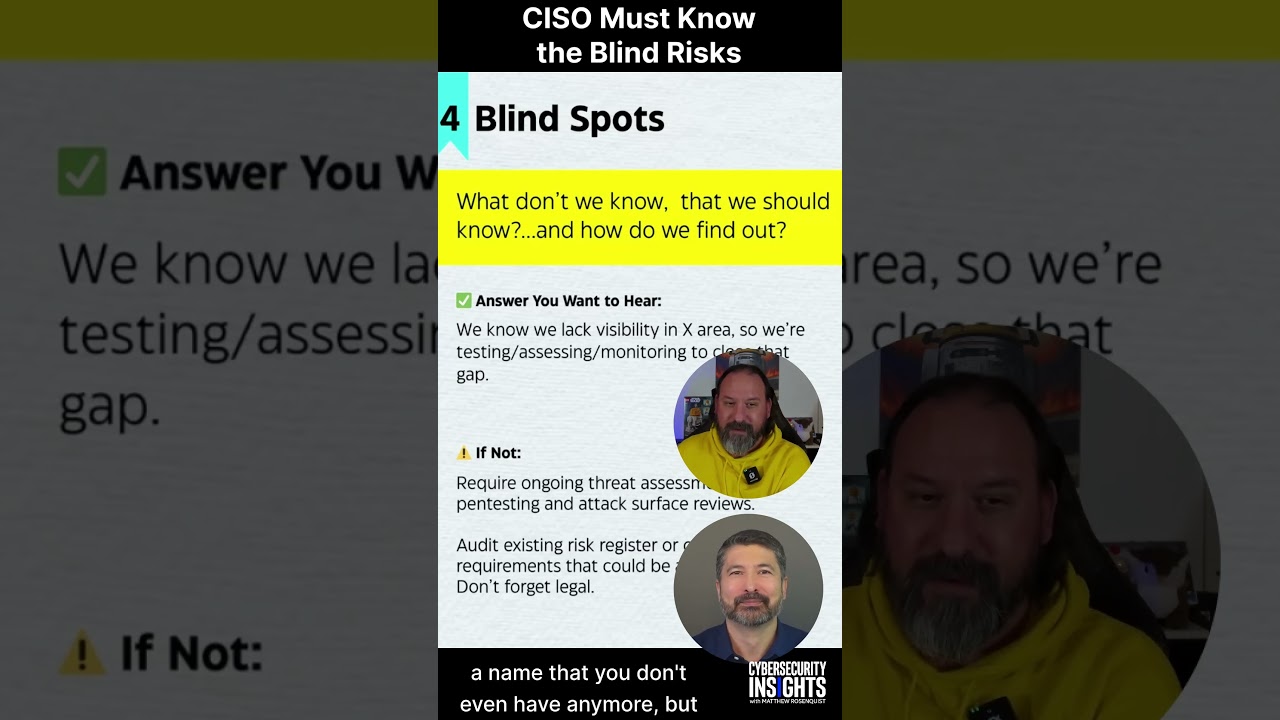
Matthew Rosenquist argues CISOs need to stop thinking like defenders and start thinking like attackers. Hidden servers left over from mergers often contain sensitive data but go unpatched. New attack-surface tools can find them, and CEOs should hold security leaders accountable for closing these gaps.
Chapters
This is again, CEO holding CISO accountable. Like, have you thought about all the stuff you haven't thought about yet? That's really what it comes down to. You know, I look at the last couple, and this probably came out in the last couple of, last 5 years or so when attack surface tooling became much more useful, advanced, and relevant. And, you know, we are now seeing a shift that the mature way as an organization to look at cybersecurity is from the attacker viewpoint. Not internally, right? We built our castle walls and we patrol our walls, but now we need to be looking at it from the bad guy, bad person's point of view. Adversarial, yes. Yeah. So that's kind of what this came down to because so many people are like, well, we have all of this in place. Our walls are great. You know, we patrol the walls. I look and there's no holes. But if you go outside the gate, there's a, you know, a server that's misconfigured that's left there from some M&A acquisition from a name that you don't even have anymore, but it's still got data you're responsible for. It's out there, right? That never happens. No, never, never. Real world thing. Hey, we found this PII box. Do you want to do something about it? So that's the reality. And again, taking this, this is going to feed into your vulnerability management program, your third-party risk, like everything, just kind of taking a look at like, okay, just because you're sort of checking the internal boxes, but are you looking at everything? Have you really thought about all that other stuff that maybe you haven't?