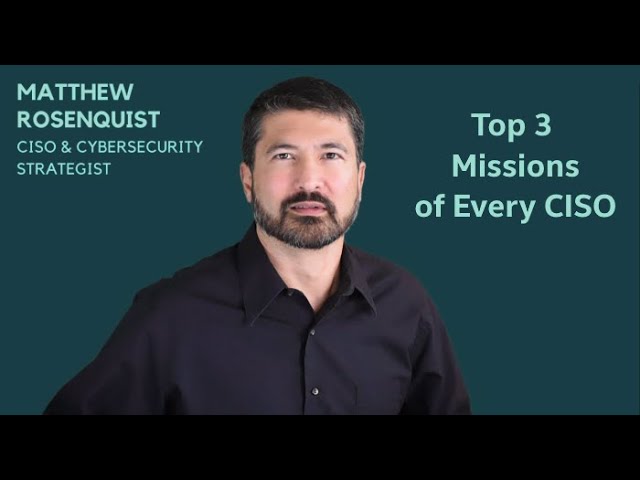
CISOs need three core missions: align security goals with business objectives and get board buy-in for resources, find the right risk balance by weighing cost against user friction and regulatory needs, and constantly scan for emerging threats to stay ahead of attacks.
Chapters
Every chief information security officer should have a strategic plan. They should be operating under a number of missions so they know what direction and what they have to achieve. And this is true when they come into the job as well as when they come into the office every single day. So here are my top 3 missions that CISOs should be driving towards. First, you have to set goals for your cybersecurity program, and these have to be aligned with the organizational goals. So if the organization is selling widgets, then the security goals have to align to help enable and protect that function. If the organization is a government agency providing services to the citizenry, Well, then the security program's goals should be aligned and attuned to those same objectives of making sure that those services are available and accurate and so forth. When you have a disparity there between the goals of security and the goals of the organization, too much conflict will arise and you won't get what's necessary, which is the support of the executives. And that's really what you need to be focusing on about this first goal, about this first mission. You have to get and secure the understanding and support from senior executives, potentially even up to the board level. Once you have that, then you'll have the appropriate resources— never as much as you want, but you'll be given the resources to be able to go forth and try and make it. And if you can't, then you can come back and justify why you need more or maybe even less based upon achieving those goals. But it's all about defining the goal. So that's mission number 1. Mission number 2 is about managing the risk. So when we look at the technology, the behaviors, the processes, and everything around that, it's important to identify— What is that sweet spot of risk? You never eliminated it altogether. It's really finding that acceptable level based upon the cost, based upon the friction of users and employees and what the executives are willing to accept from a risk perspective. And that could be losses, it could be regulatory non-compliance. There's lots of different potential impacts, but the CISO has to find that optimal balance and then put the controls in place to achieve that target. And again, the target is aligned with the corporate goals. Now, the third thing that a CISO has to do, and this may actually be the toughest, is to look ahead in the future because the world of risks, the world of attackers and threats is constantly changing. And no matter what you do today, it starts to become antiquated. So it's important for CISOs to get out of just the day-to-day grind and firefight and start looking forward? What are the emerging threats and risks and methods of attack? You wanna stay ahead of that curve because as soon as you fall behind, it is incredibly tough to try and catch up. It really is. So the CISO needs to have that mindset on what's coming around the corner next. And that type of strategic thinking, that type of planning gives a CISO an advantage. Because they can start putting measures in place, additional controls, fine-tuning before the risks are relevant, before they're just crashing down upon them. So that predictive capability is super important if you wanna maintain that optimal level of risk. So those are my three missions that I think every CISO, no matter what your experience level, no matter whether it's your first day or even your last, Those are the 3 missions that you should be focused upon.