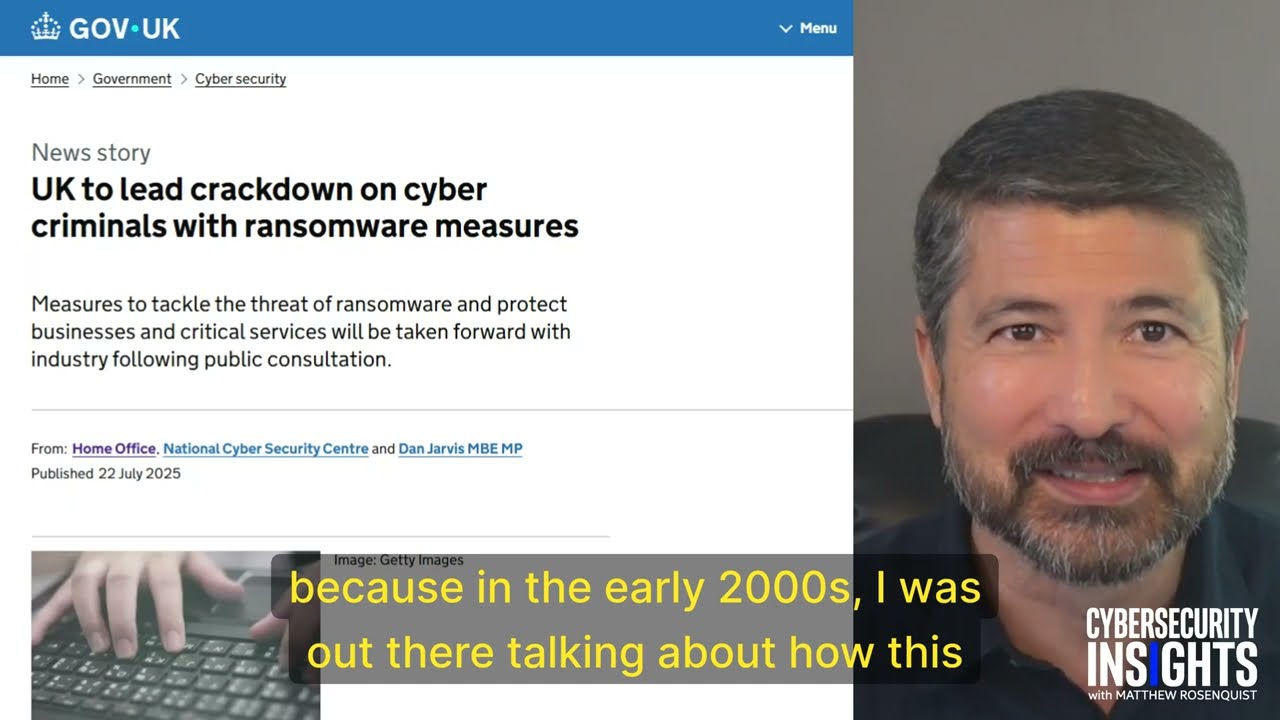
Matthew Rosenquist argues the UK's ransomware payment ban won't work because technical defenses keep failing. Instead of blocking payments, he says make ransomware unprofitable by targeting attackers' money through policy and economics, not tools.
Chapters
The United Kingdom is proposing a ban on ransomware payments from government entities, and this would include critical infrastructure. So, um, the healthcare system of the United Kingdom, schools, libraries, you name it, all of those in this proposal will not be allowed to pay extortion from ransomware. I love this idea. However, there's been a lot of discussion and a lot of controversy because people are thinking about it, including the cybersecurity community, and they're thinking, well, hey, there's a good reason that, that, that's not gonna work. That should not be good. Well, here's what you need to know. There's not one good reason. There's actually about a dozen reasons that are worthy of being discussed. And I know this because in the early 2000s, I was out there talking about how this little unknown kind of attack, ransomware, was gonna become a big deal. This was my prediction. And it was going to eventually target critical infrastructure. At the time, I started working on a plan. And figuring out, well, how do we really fix this? And not just for the big companies that can afford a lot of security, but for everyone, for the small and medium businesses, for the individuals, all those kinds of things. And starting to work on that, the solution was not technical. In fact, there are no technical solutions regardless of the last decade and a half of tool providers and service providers coming out and saying, "Oh, we have the solution to ransomware." It's all marketing BS. They didn't. I told them at the time. I told everybody at the time because it's not just a technical issue. If we actually look at the root problems, it's a much bigger issue. For example, let's consider this as part of a company, and we've got these cybercriminals here, and they're trying to do ransomware. Well, the simple fact is the cybercriminals can target many different areas. Maybe it's malware, maybe it's social engineering, maybe it's exploitation of a vulnerability in a product or third-party vendor. They've got lots of targets. And so they can get in, and once they do, they can then start moving around, getting to where they want to get to. They can either bring down operations, they can hijack critical data, they can remove critical data or simply encrypt it in place. They can copy that data and again, create extortion to say, "If you don't pay us, we're going to release the data." But they've got all these avenues. So from a technical perspective, even if you stop some of these issues, some of these vulnerabilities, they're still behavioral, they're still process. Process vulnerabilities that are in play. So the way you actually solve this problem for everybody is go after the cybercriminal themselves. Make attacking companies and critical infrastructure worthless to them. Make them unattractive. And this is really just a start because the next level is to put those rules in place for all businesses. If an attacker, if a cyber criminal, they're motivated by personal financial gain, and if they know they won't get paid, they're not going to waste their time attacking. So instead of trying to technically block all the possible avenues of attack, which is not possible, instead we use the very motivation of those attackers against them. To dissuade them, deter them from even launching attacks to begin with. That becomes affordable and scalable. And the process of doing this actually isn't that difficult. I create a whole series of videos that outlined an entire plan, um, how a country could do this over the course of a couple of years and actually get to the point where you undermine ransomware attacks against your economy, against your businesses, against your critical infrastructure. And everyone benefits. Well, everyone benefits except for the cybercriminals and except for the cybersecurity tools and solution providers because they want to keep selling you products that don't exactly work so they can upgrade you and sell you new ones and so forth. This is one of those rare situations in cybersecurity where the final solution is not really technical. It's not a new upgrade of a tool. It's actually going after the threat agents, the attackers themselves, and using their motivation to push them off to other areas. If you're interested in knowing what kind of plan could work, uh, I'll put a link in the description. I've got tons of videos where I outline all this. I'm not selling products or services. This is how a country or globally, how we can really undermine ransomware at its core without spending infinite amounts of money, time, and effort on tools and services that don't work over time. So if you're interested, take a look. And I did a whole hour-long video talking about all of those really good concerns, breaking them down, and discussing how we can get past them. So, take a look at that video. If you still think you have a concern why this wouldn't work, take a look at the video. If I don't answer your question, drop me a line, and we'll jump on a bridge. We will record it live if you want. We'll make a podcast, and we'll talk about the issue that you bring up and whether it really would impede this kind of solution that would benefit everybody.